How Your "Second Brain" Drives Cravings: And How to Reclaim Control.
The neuroscience behind alcohol — and the remarkable science of recovery
You're here because you're curious — and that curiosity is one of the most powerful things about you. This guide will walk you through what's actually happening inside your brain when you drink, when you cut back, and why the changes you're making matter more than you might think. Understanding the science doesn't just satisfy curiosity — it transforms the journey itself.



The Reward System
How dopamine drives motivation — and how to recalibrate it

The Anxiety Loop
Why GABA and glutamate explain so much — including 3am wake-ups

Sleep: The Hidden Superpower
How real rest heals your brain — and why it gets so much better

Stress & Cortisol
Breaking the cycle between stress, drinking, and more stress

Neuroplasticity
Your brain's superpower — and why it gets easier with time

The Timeline
What's happening inside you right now — and what's coming next

Your Daily Brain Boost
7 science-backed micro-actions to support your brain every day

Your Brain's Motivation Engine
You've probably noticed that a craving can feel almost impossible to ignore — like an urgent alarm going off that demands your attention. There's a reason it feels that way, and understanding it changes everything.
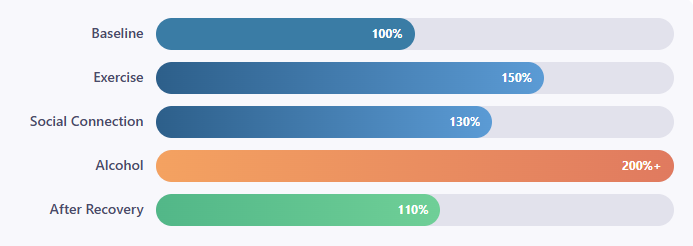

The Megaphone Effect
Imagine you're in a quiet room having a conversation. Alcohol is like someone turning a megaphone up to full volume. At first, it's exhilarating — everything feels louder, more exciting. But eventually, everyone in the room starts wearing earplugs to cope with the noise (that's your receptors downregulating). When you finally put the megaphone down, the room feels eerily silent. But it's not actually silent — your ears just need time to readjust. And they will.
What This Means for You
→ Cravings aren't a sign of weakness — they're your brain's dopamine system doing exactly what it was designed to do. The craving will pass, usually within 15–20 minutes.
→ If things feel "flat" or "boring" early on, that's the earplugs coming off. Your brain is recalibrating to enjoy normal, healthy levels of stimulation again. This is temporary.
→ Every healthy activity you enjoy is training your receptors to come back online. Each walk, each conversation, each small pleasure is doing real neurological work.
15-Minute Brisk Walk
A brisk walk can increase dopamine by roughly 20%, and the effect lasts for 2+ hours. It's one of the most reliable natural dopamine sources.
Why it works: Exercise triggers natural dopamine release through the same reward pathways, gradually teaching your brain that movement equals reward.

Learn Something New
Spend 10 minutes on something novel — a new recipe, a language app, a short video about a topic you've never explored.
Why it works: Novelty is one of dopamine's primary triggers. Your brain releases dopamine when it encounters new information, fueling curiosity and engagement.

Complete & Celebrate
Finish one small task (clear your desk, reply to an email, do the dishes) and genuinely pause to acknowledge you did it.
Why it works: Task completion triggers dopamine release. Consciously celebrating it amplifies the signal, reinforcing your brain's reward pathway for accomplishment.
GABA, Glutamate, and the 3am Wake-Up
If you've ever woken up at 3am with your heart pounding, your mind racing, and a sense of dread that something is terribly wrong — even though nothing actually happened — you're not imagining things. There's a precise neurochemical reason this happens.
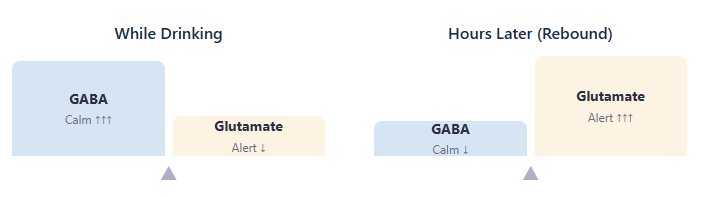
The Seesaw
Picture a seesaw on a playground. Alcohol sits down hard on the "calm" side, pushing it all the way down. But your brain, trying to keep balance, starts loading weight onto the "alert" side. When alcohol gets up and walks away, the alert side comes crashing down with all that extra weight — launching your anxiety sky-high. The good news? Without alcohol constantly messing with the balance, your brain gradually removes that extra weight, and the seesaw settles back to center.
What This Means for You
→ That 3am anxiety has a name and a mechanism — It's glutamate rebound, and it's temporary. Knowing this can take it from terrifying to manageable.
→ Anxiety after drinking is neurochemical, not emotional. It's not because something is actually wrong in your life. It's your brain's gas pedal stuck temporarily in high gear.
→ Each day without alcohol helps your GABA/glutamate balance reset. The seesaw doesn't fix itself overnight, but it does fix itself — consistently and predictably.
4-7-8 Breathing
Inhale for 4 counts, hold for 7 counts, exhale for 8 counts. Repeat 3–4 times. Takes about 2 minutes.Exercise triggers natural dopamine release
Why it works: Extended exhales activate your vagus nerve, which directly stimulates GABA production — literally pressing your brain's natural brake pedal.
Magnesium-Rich Foods
Add dark leafy greens, pumpkin seeds, dark chocolate (70%+), or almonds to your daily meals.
Why it works: Magnesium is a natural GABA agonist — it supports GABA receptor function, helping your brain maintain its calming systems. Many people are mildly deficient.

Progressive Muscle Relaxation
Starting from your toes, tense each muscle group for 5 seconds, then release. Work up through your whole body. Takes 5–10 minutes.
Why it works: The tense-and-release pattern sends a "safe" signal to your nervous system, counteracting the glutamate-driven fight-or-flight response.
"When you understand that your anxiety has a mechanism — not a meaning — it transforms from something you fear into something you can weather."
Breaking the Cycle
If you feel like your stress tolerance has gotten worse over time — like things that used to be manageable now feel overwhelming — you're not losing your ability to cope. There's something very specific going on in your brain, and understanding it is genuinely liberating.
The Fire Alarm
Alcohol is like pulling the battery out of your smoke detector. The beeping stops and you feel immediate relief. But the fire — the actual stressor — is still burning. And without the alarm, you can't respond to it effectively. Cutting back means reinstalling the battery. The alarm might feel louder at first (because you're hearing it clearly again after a long silence), but now you can actually find the fire and deal with it. Your stress response coming back online isn't a setback — it's your brain's safety system being restored.
What This Means for You
→ Feeling more stressed initially when cutting back is actually progress. It means your stress response system is coming back online — which means you can actually start processing and resolving stress instead of just numbing it.
→ The stress-drinking cycle is neurochemical, not a character flaw. Elevated cortisol creates a real physiological craving for relief. Knowing this can help you respond to the urge with understanding instead of frustration.
→ Within weeks, your baseline will shift. As cortisol normalizes, you'll find that daily challenges feel genuinely more manageable — not because the challenges change, but because your brain's calibration does.

20-Minute Walk
A moderate 20-minute walk has been shown to reduce cortisol levels by approximately 25% within 30 minutes of completion.
Why it works: Moderate movement signals to your HPA axis that the "threat" is being addressed, allowing cortisol to come down. Walking outside amplifies the effect through nature exposure.

5-Minute Social Connection
Call a friend, text someone you care about, or have a brief, genuine conversation with a coworker. Even 5 minutes counts.
Why it works: Social connection triggers oxytocin release, which directly counteracts cortisol. This is why stress feels more manageable when you're not facing it alone.

Nature Exposure
Step outside for 5 minutes. Even looking at trees, sky, or green space through a window has measurable effects.
Why it works: Research shows that even brief nature exposure reduces cortisol, lowers heart rate, and shifts your nervous system toward rest-and-digest mode.
"Your stress tolerance didn't break — it got temporarily recalibrated. Every day you choose differently, your brain recalibrates back."
Your Brain's Superpower
Here's something remarkable that a lot of people don't know: every single day you choose to do things differently, you are literally changing the physical structure of your brain. Not metaphorically. Actually, physically rewiring neural pathways. This is neuroplasticity, and it's perhaps the most empowering piece of science in this entire guide.
The Trail System
Imagine a forest with a well-worn trail — that's your old habit. The dirt is packed, the branches are cleared, you can walk it with your eyes closed. Now imagine you want to take a different route. At first, the new trail is overgrown. You have to push through bushes and step over roots. It takes real effort. But every time you walk the new trail, it gets a little clearer. The grass gets trampled, the path gets wider. And every day you don't walk the old trail, nature starts to reclaim it. Weeds grow in. Branches fall across it. One day, you realize the new trail is the easy one — and the old trail has practically disappeared.
What This Means for You
→ "It gets easier" isn't just encouragement — it's neuroscience. Every repetition of your new behavior physically strengthens the neural pathway, literally making it easier to follow next time.
→ The difficulty you feel right now is the clearest sign the work is happening. That effort isn't wasted energy — it's the feeling of new neural pathways being built.
→ You don't have to be perfect. Each time you choose the new path — even if you sometimes take the old one — you're strengthening the new pathway. Progress, not perfection, is what rewires a brain.

Habit Stacking
Attach your new habit to something you already do automatically. Example: "After I pour my evening tea, I'll do 5 minutes of journaling in the Reframe app."
Why it works: An existing habit provides a strong neural "anchor." Attaching a new behavior to it borrows the existing pathway's momentum, making the new habit easier to initiate.

Environment Redesign
Rearrange your physical space to remove drinking cues and add cues for your new habits. Move the sparkling water to eye level. Put your walking shoes by the door.
Why it works: Environmental cues trigger automatic behaviors. By changing the cues, you reduce the number of times the old neural pathway gets activated and increase activation of the new one.

Reward Substitution
Identify what reward drinking provides (relaxation, social ease, celebration) and find an alternative that delivers the same feeling. Wind-down bath, social game night, fancy dessert.
Why it works: Habits are driven by reward. When you substitute the reward rather than just removing it, the new pathway gets the dopamine reinforcement it needs to solidify.
"Every day you choose differently, you're not just making a decision — you're building new brain infrastructure. And that infrastructure compounds."

What's Happening Inside You Right Now
One of the most frustrating things about changing any habit is that the results often happen invisibly, beneath the surface, before you can feel them. Here's what the science tells us is happening inside your brain and body as you make this change — even on the days when it doesn't feel like much is happening at all.
Important: This timeline represents general patterns based on research. Your individual experience may vary — and that's completely normal. Think of this as a map of the typical terrain, not a schedule you need to follow. What matters is the direction, not the exact pace.
What This Means for You
→ Even when you can't feel the changes, they're happening. Your brain is working around the clock to rebalance, rebuild, and recalibrate. Trust the process on the hard days.
→ The toughest part is often the beginning. The first 1–2 weeks tend to be the most challenging, when your brain is actively rebalancing GABA/glutamate and cortisol. It genuinely gets better from there.
→ Every timeline is unique. If you're at day 10 and not feeling great yet, that doesn't mean something is wrong. Your brain is working on its own schedule. Keep going.
Your Brain's Motivation Engine
You now understand the science. Here's how to put it to work. These seven micro-actions are designed to support your brain's recovery throughout the day — each one targeting specific neurotransmitter systems. You don't need to do all seven every day. Start with the ones that feel most doable, and build from there.
What This Means for You
→ You don't need to overhaul your life. Each of these actions takes 30 seconds to 10 minutes. Small, consistent actions compound into remarkable neurological change.
→ These aren't random wellness tips. Each one targets specific neurotransmitter systems discussed in this guide. You now understand why they work, not just that they do.
→ Save this card. Screenshot it, bookmark this page, or jot down the ones that resonate most. Having a quick reference for hard moments can make the difference between a craving that passes and one that doesn't.
If there's one thing we hope you take away from this guide, it's this: your brain is already changing. Not tomorrow. Not when you hit some milestone. Right now. Every moment you spend learning about this, every day you make a different choice, every small action you take — it's all doing real, measurable, neurological work.
The science is clear: your brain is remarkably resilient. It built the neural pathways for your old patterns, and it can — and will — build new ones. The cravings that feel overwhelming today will feel manageable. The anxiety that wakes you at 3am will settle. The things that feel flat will regain their color. Not because you "powered through" on willpower, but because your brain physically rewired itself. That's not motivation — that's neuroscience.
Your journey doesn't have to be perfect. It doesn't have to be linear. It just has to keep going. And you don't have to do it alone.


Cryan, J. F., & Dinan, T. G. (2012). Mind-altering microorganisms: the impact of the gut microbiota on brain and behaviour. Nature Reviews Neuroscience, 13(10), 701-712.
Bravo, J. A., et al. (2011). Ingestion of Lactobacillus strain regulates emotional behavior and central GABA receptor expression in a mouse via the vagus nerve. Proceedings of the National Academy of Sciences, 108(38), 16050-16055.
Leclercq, S., et al. (2014). Intestinal permeability, gut-bacterial dysbiosis, and behavioral markers of alcohol-dependence severity. Proceedings of the National Academy of Sciences, 111(42), E4485-E4493.
Engen, P. A., et al. (2015). The Gastrointestinal Microbiome: Alcohol Effects on the Composition of Intestinal Microbiota. Alcohol Research: Current Reviews, 37(2), 223-236.
Yano, J. M., et al. (2015). Indigenous bacteria from the gut microbiota regulate host serotonin biosynthesis. Cell, 161(2), 264-276.
Bonaz, B., et al. (2018). The Vagus Nerve at the Interface of the Microbiota-Gut-Brain Axis. Frontiers in Neuroscience, 12, 49.
Gollwitzer, P. M., & Sheeran, P. (2006). Implementation intentions and goal achievement: A meta-analysis of effects and processes. Advances in Experimental Social Psychology, 38, 69-119.
The community is your support. The next 30 days will change your relationship with alcohol—and your understanding of your own brain.
You've got this.