How to Stop Enabling an Alcoholic & Set Boundaries
Published:
2024-03-21
·
Read time:
22
Last Updated:
2025-12-16
Written by
Reframe Content Team
A team of researchers and psychologists who specialize in behavioral health and neuroscience. This group collaborates to produce insightful and evidence-based content.
Certified recovery coach specialized in helping everyone redefine their relationship with alcohol. His approach in coaching focuses on habit formation and addressing the stress in our lives.
Recognized by Fortune and Fast Company as a top innovator shaping the future of health and known for his pivotal role in helping individuals change their relationship with alcohol.
March 21, 2024
·
22
Reframe Content Team
March 21, 2024
·
22
Enabling or Helping? Changing Your Relationship With an Alcoholic
Enabling an alcoholic is defined as doing something for them that they could do for themselves if they were sober, such as repeatedly spending money to bail them out of jail.
When we stop enabling, our loved one is empowered to make changes for themselves.
Help someone with alcohol problems by referring them to Reframe. Reframe’s neuroscience-based program helps people quit or cut back on alcohol.
You love them, so you do everything you can to help. You make excuses, pay their bills, and clean up the messes left behind by their drinking. You're their rock, their safety net. But what if that support is actually preventing them from hitting the bottom they need to find? It's a frustrating and painful cycle. This is the classic trap of enabling an alcoholic. Recognizing this pattern is the first, most crucial step. Let's explore what enabling looks like and, more importantly, how to stop enabling an alcoholic so you can offer help that truly makes a difference.
Empathy is an important part of human connection; it hurts to see someone struggle. But in our efforts to care for someone with addiction, we may actually be enabling them. Enabling supports and sustains an individual’s addiction (even though this isn’t our intent!), but there are ways to channel our care into more helpful behaviors. In this blog, we’ll learn more about enabling behaviors, how to recognize them in ourselves, and how to help our loved one constructively.
What Does Enabling Actually Mean?
Enabling is any behavior or action that allows our loved one to avoid the consequences of their actions. We enable others by justifying their bad actions or indirectly supporting their harmful behaviors (for example, paying off someone’s alcohol related debts).
Enabling is different from helping, even though they look alike. Helping provides support, assistance, and guidance in overcoming a specific challenge. Enabling directly or indirectly helps someone continue an unhealthy habit or behavior.
Helping empowers someone to escape their circumstance, whereas enabling them gives them permission to stay the same. While it may seem like we are helping the person or nurturing them with compassion, enabling actually makes things worse — and it typically prolongs recovery because it perpetuates the cycle of substance misuse.
Understanding the Dynamics of Enabling
Enabling isn't a one-size-fits-all behavior. It often shows up in subtle ways that can be hard to spot, especially when our actions come from a place of love and concern. These behaviors tend to fall into specific patterns and can evolve over time as the situation with our loved one intensifies. Recognizing these dynamics is the first step toward shifting from enabling to truly helping. By understanding the different types of enabling and the stages it progresses through, we can gain clarity on our own actions and learn how to build healthier, more supportive boundaries.
The Four Types of Enabling Behavior
Enabling often fits into one of four roles. Caretaking is when you try to meet all of your loved one’s needs, believing you’re protecting them, but you’re actually shielding them from the consequences of their drinking. The Protective role involves covering up their mistakes, like calling them in sick to work after a night of heavy drinking. Rescuing happens when you swoop in to solve their problems, like paying off a credit card they maxed out at a bar. Finally, Overcompensating means taking on their responsibilities to make up for their inaction, which can create a deep imbalance in the relationship and prevent them from feeling the need to change.
The Stages of Enabling
Enabling behavior typically unfolds in stages. It often starts with Denial, where we might ignore or downplay the drinking, hoping it’s just a phase. As the problem continues, we may move into Compliance, where we start to go along with the behavior to avoid conflict. This can look like having a drink with them when we don't want to, just to keep the peace. Next comes Control, a stage where we try to manage the chaos by making excuses for them or covering up their actions. Eventually, this leads to a Crisis, where the stress becomes overwhelming and we can no longer deny the damaging effects of both their addiction and our enabling.
The Surprising Reasons We Enable People We Love
The solution may seem simple: stop enabling bad behavior! The reality is more complicated than that, as many of us know. Enabling is unintentional and stems from our want/need to help others, especially when it comes to those we are closest to and most comfortable with.
Justifying our actions as “caring” or “showing love” is natural — and these actions are definitely an expression of our love. We may not be aware that our behaviors are enabling our loved one. Let’s go through some reasons why we find ourselves enabling instead of helping.
Protection instinct. Some of us enable because we feel we are protecting people from further harm. Our protection may come from a place of genuine compassion, but this approach is ultimately misguided.
Denial. We might enable our loved one because we refuse to acknowledge the full extent of their problem.
Codependency. We might have a codependent relationship with our loved one and feel compelled to care for them. Those of us in this type of relationship derive purpose or self-worth from being a caretaker and fear losing the relationship if we don’t enable the individual.
Guilt and shame. We may feel partially responsible for the behavior of the person we’re enabling, so we take action to alleviate our own feelings of guilt. We might also feel ashamed of the other person’s actions, so we “keep up appearances” and cover for them.
We enable those who misuse alcohol for many reasons. Understanding the subconscious thought process behind our actions is a crucial first step towards recognizing and dismantling the cycle of enabling.
Common Examples of Enabling an Alcoholic
We learned what it means to enable someone and why we may do it. Now let’s examine what it looks like when we enable an alcoholic.
Though often unintentional, enabling an alcoholic supports their destructive drinking habits by shielding them from the consequences of their actions. This can take many forms, but there are some common patterns:
Covering up or providing excuses. Lying on behalf of the person, making excuses, absorbing blame, or explaining away behaviors are all ways we enable an alcoholic. For example, calling in sick for the person and saying they have the flu instead of admitting that they are too hungover to go to work.
Financial support. Enabling via financial support includes providing money, paying off debts, paying their rent, allowing them to live rent-free, or bailing them out of financial trouble. If we pay someone’s rent because they can’t hold a job, they have no incentive to improve their circumstances.
Rescuing from consequences. Rescuing looks like shielding the person from the consequences of their actions. For example, we may intervene to remedy legal issues, job loss, or a relationship breakdown.
Minimizing the problem. We may offer endless excuses to explain away the actions of our loved one instead of acknowledging the root cause of the problem. We could be downplaying the severity of the person’s problems (to ourselves and others) by attributing them to stress or a temporary issue (this is also a form of denial). For instance, we could say, “They only drink because they are stressed about not having a job, and once they get a job everything will change.”
Taking on their responsibilities. This could involve doing chores, covering their work, or tasking ourselves with meeting their basic daily needs. These all shield them from facing the impact of their actions. For example, we may clean their apartment weekly or cook them special meals.
We shield our loved one from the consequences of their actions through a wide variety of behaviors, conscious and unconscious. Now that we know what enabling looks like, we can assess if it’s something we’re doing — and learn how to stop.
Keeping Their Substance Use a Secret
It’s tempting to avoid difficult conversations to “keep the peace.” You might ignore the smell of alcohol on their breath or quickly change the subject when a drinking-related incident comes up. While this feels like you’re preventing a fight, you’re actually creating a space where their drinking problem can exist without being challenged. By not talking about their substance use, you inadvertently send the message that their behavior is acceptable, or at least not worth discussing. This avoidance shields them from accountability and the natural consequences of their actions, making it easier for them to continue their patterns without facing the reality of the situation.
Using Alcohol or Drugs With Them
This one can feel counterintuitive. You might think, “If I have a drink with them, I can monitor how much they consume and keep them safe.” While your intention is to protect them, this action normalizes their behavior and validates their choice to drink. It sends a powerful, albeit unintentional, message: “What you’re doing is okay, because I’m doing it with you.” This form of enabling blurs boundaries and makes it harder for your loved one to see their drinking as a problem. Instead of helping them reduce their intake, you become a participant, which can diminish their motivation to seek help or make a change.
Am I Enabling? A Self-Check
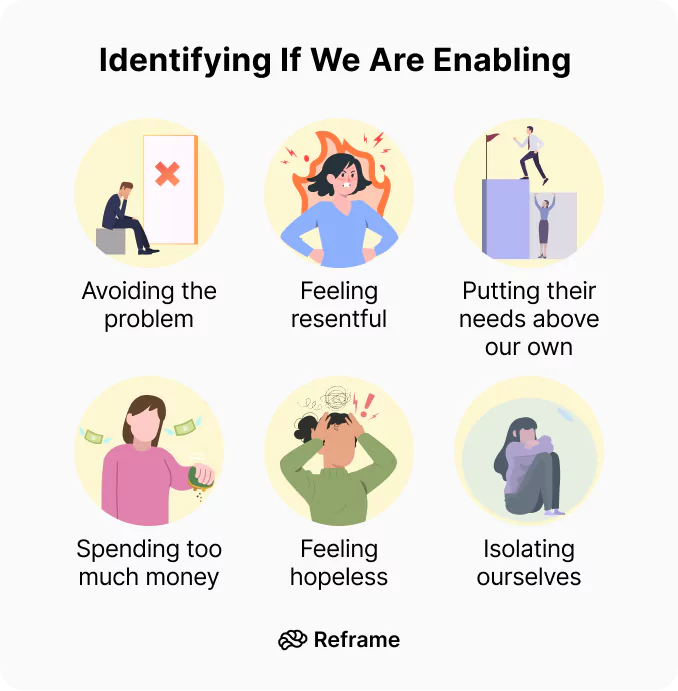
Sometimes it’s hard to recognize whether we are helping someone or enabling them. We should stop and ask ourselves, “Could they do this for themselves if they were sober?” Let’s go through some examples to help identify if we are enabling.
Avoiding the problem. Do we find that the only way to cope with the person’s behavior is to avoid dealing with it? This could be because we’re afraid of confronting them about their behavior, so we look the other way or keep quiet.
Feeling resentful. Are we starting to resent the person for everything we’ve done for them without getting much in return? If we are constantly helping this person avoid the consequences of their alcohol use, we will find ourselves feeling angry or irritable around them. This can harm our relationship with them and others.
Putting their needs above our own. Do we find ourselves setting aside our mental or physical health needs to help the person? Are we putting our goals on hold to help the person in need? These are examples of how enabling hurts us — not just them.
Spending too much money. Have we maxed out our credit cards to help this person? Is helping them holding us back from our financial goals? Are we spending more money on them than ourselves? This is another example of the personal fallout of enabling.
Feeling hopeless. We keep giving and helping but nothing changes, and they don’t even seem to be grateful. We may feel like things will never get better or change — these thoughts often lead to resentment, depression, or burnout.
Isolating ourselves. Have we stopped spending time with friends or family members because we’re too busy or exhausted from helping them? Our social well-being should not suffer because of our caretaking.
Reflecting on these questions helps us identify unhealthy enabling behaviors. Letting go of these behaviors can feel scary, especially when we don’t know what to expect.
What to Expect When You Stop Enabling
We often imagine the worst possible scenario when we think about stopping our enabling behaviors. We may worry that they’ll end up in jail or without a home — but in reality, chronic alcohol misuse can be fatal. Ending enabling behaviors is the best way to help our loved one, even if the opposite feels true.
Let’s look at some ways we empower others when we stop enabling.
Breaking the cycle. When we stop enabling, we interrupt the cycle of dependence and create opportunities for positive change. Breaking addiction’s pattern of destructive behavior empowers our loved one to improve themselves.
Ceding responsibility. When we stop enabling, people have to take accountability for their own actions. This allows them to make their own choices — and learn from them.
Facilitating treatment. When a person is no longer protected from consequences, they begin to realize how bad their problem is. This self-awareness can lead them to seek help with their recovery.
Preserving our well-being. When we stop enabling and protecting someone else’s well-being, we can refocus on caring for ourselves.
Improving relationships. Setting boundaries may strain our relationship at first, but over time it allows for a stronger bond based on mutuality. And if one person is no longer taking up all our time, it leaves more space for other friends and family members.
Helping someone recover from alcohol misuse can be stressful and taxing on everyone involved. Remember that it’s about progress, not perfection. There is an abundance of resources to support both you and your loved one through the recovery process.
There are healthy ways to actively support someone who is misusing alcohol. Let’s take a look.
How to Stop Enabling and Start Truly Helping
Letting go of enabling behaviors is not easy. It takes setting boundaries and unlearning destructive patterns of behavior. Here are some things you can do to help an alcoholic:
Encourage them to seek professional help. Whether it’s a rehabilitation program, therapy, counseling, or a support group, helping them find good resources is a great way to empower them to make changes themselves.
Be a good listener. Provide support and a nonjudgmental space for them to express their feelings.
Allow consequences. Let them face the consequences of their actions. If they get in trouble with the law, don’t bail them out.
Set boundaries. Set clear boundaries and hold them accountable. Healthy boundaries include letting go of your enabling behaviors or taking steps to ensure your personal well-being. For example, you can refuse to provide further financial support, or tell them you won’t talk to them on the phone if they’ve been drinking.
Celebrate positive steps. If they are taking steps to better themselves, acknowledge and celebrate their efforts. Positive reinforcement helps them along the way to recovery.
Encourage healthy activities. Bring them along for activities that do not involve alcohol. Invite them to a yoga class or plan a hike. Alcohol-free activities can give them a new outlet for dealing with stress.
Mind your own well-being. Therapy or a support group like Al-Anon can help you develop strategies to dismantle enabling behaviors. Focus on self-care and refill your cup so you can be fully present when providing mindful help.
The shift from enabling to helping is not easy! It’s important to remember the challenge will be worth it for you and the person struggling with alcohol addiction.
Internalize These Key Truths
Before you can change your approach, it’s helpful to ground yourself in a few core ideas. The most important one is understanding what enabling truly is. It’s when you, with the best intentions, accidentally help someone continue their self-destructive behavior instead of helping them get better. Think of it this way: helping gives someone the tools to climb out of a hole, while enabling just makes the hole more comfortable to sit in. This distinction is crucial because it reframes your actions. You’re not being unkind by setting boundaries; you’re being truly helpful by creating an environment where change is possible.
Let Go of the “Rock Bottom” Myth
Many of us have heard the idea that someone has to hit “rock bottom” before they’ll be ready to change. But this is a dangerous and outdated myth. Waiting for a major crisis—like a DUI, job loss, or serious health scare—can have devastating and sometimes irreversible consequences. You don’t have to wait for things to get as bad as they can possibly be. In fact, offering support and encouraging change before a person loses everything can be far more effective. True help involves stepping in with compassion and clear boundaries long before a crisis forces the issue.
Set Clear, Actionable Boundaries
So, how do you stop enabling? The answer is boundaries. Boundaries are simply the rules you set to protect your own well-being. They are not punishments or attempts to control the other person. Instead, they are clear lines that stop you from shielding your loved one from the natural results of their actions. When you set a boundary, you’re taking a step back and allowing reality to be the teacher. This can feel incredibly difficult, but it’s one of the most powerful ways to shift the dynamic from enabling to genuine support, creating the space they need to recognize the impact of their choices.
Examples of Effective Boundaries
Boundaries are most effective when they are specific and consistent. You have to decide what you are and are not willing to do. For example, you can state that they cannot drink or use other substances in your home or around you. You might decide you will no longer lend them money or pay bills they can’t cover due to their drinking. This also means not calling their boss with an excuse when they’re too hungover for work or making excuses for them to friends and family. These aren’t threats; they are calm statements about what you will do to protect your own peace and stability.
Choose the Right Time for a Conversation
Bringing up your concerns requires care and good timing. The best time to talk to your loved one about their drinking is when they are sober and you are both in a calm, private space. Approaching the conversation with kindness and concern, rather than blame or judgment, is key. Use "I" statements to express how their behavior affects you, like "I feel worried when I see you drinking so much," instead of accusatory "you" statements like "You always drink too much." The goal isn't to win an argument but to open a door for them to see the impact of their actions and consider getting help.
Explore Support Options for Yourself
Supporting someone with an alcohol problem can be emotionally and mentally draining. It’s absolutely essential that you get support for yourself, too. This isn't selfish; it's necessary. Support groups can teach you how to "detach with love," a concept that means you can still love the person without being entangled in their destructive behaviors. It’s about letting them face the consequences of their choices while you focus on your own healing and well-being. You cannot pour from an empty cup, and getting your own support ensures you have the strength to help in a healthy way.
Support Groups for Friends and Family
You are not alone in this experience. Groups like Al-Anon are specifically designed for the friends and family members of people struggling with alcohol misuse. In these groups, you can share your experiences and learn from others who truly understand what you’re going through. Finding a community that gets it can be incredibly validating and can provide you with the practical coping strategies and emotional support you need to navigate this difficult situation without losing yourself in the process.
Family Training Programs Like CRAFT
If you’re looking for a more structured, skills-based approach, consider a program like CRAFT (Community Reinforcement and Family Training). This evidence-based method teaches family and friends how to have more positive and effective conversations with their loved one. CRAFT focuses on using positive reinforcement to encourage them to reduce their drinking and to engage in treatment. It’s a proactive program that equips you with tools to improve communication and support your loved one’s journey toward change in a constructive way.
Consider a Formal Intervention
If conversations and boundary-setting haven’t led to change, you might consider a formal intervention. This is a planned, structured meeting where family and friends, often with the guidance of a professional interventionist, come together to talk to the person about their drinking. The goal is to present them with a clear picture of how their behavior is impacting everyone and to encourage them to accept a pre-arranged treatment plan. An intervention should be approached with love and concern, not anger, and is focused on one clear outcome: getting them to accept help.
Encourage Professional Help
Ultimately, one of the most helpful things you can do is consistently encourage your loved one to seek professional help. This could mean inpatient or outpatient treatment, therapy, or counseling. You can research options and have them ready to share. For some, a structured program is the right fit, while for others, a more flexible approach might be better. An app like Reframe can be an accessible first step, offering neuroscience-based tools and a supportive community to help them build healthier habits right from their phone. The key is to guide them toward resources, not to manage their recovery for them.
A Note on Coerced Treatment
A common fear is that forcing someone into treatment won't work if they don't want to go. However, research shows this isn't necessarily true. Treatment can be just as effective for people who are encouraged—or even pressured—by family or the legal system as it is for those who enter willingly. Sometimes, the structure and support of a treatment program are exactly what a person needs to gain clarity and motivation, even if they resisted it at first. Don't let their initial reluctance stop you from setting firm boundaries that lead to them getting the help they need.
Know When to Prioritize Your Safety
This is incredibly important: your safety comes first. If your loved one’s behavior ever becomes emotionally, verbally, or physically abusive, or if they are endangering you or others in your home, you must prioritize your safety. This may mean creating physical distance or, in some difficult cases, making the decision to walk away from the relationship entirely. Removing yourself from a dangerous situation is not giving up on them; it is an act of self-preservation and the ultimate boundary. You can still love someone from a distance while protecting your own well-being.
Frequently Asked Questions
I'm just trying to help. How do I know if I'm actually enabling? This is the question that keeps so many of us up at night. The simplest way to tell the difference is to look at the outcome of your actions. True help empowers your loved one to face their situation and build their own solutions, even if it's difficult. Enabling, on the other hand, removes the natural consequences of their drinking, which makes it easier for them to continue without changing. Ask yourself: Is my action solving a problem for them that they could, and should, be solving for themselves? If the answer is yes, it's likely leaning toward enabling.
What if they get angry when I set boundaries? I'm afraid of the conflict. It's completely normal to fear their reaction. Anger is a common response when you change the rules of a relationship they've grown comfortable with. Remember that their anger doesn't mean your boundary is wrong; it often means the boundary is working. The key is to communicate your boundary calmly and firmly, without blame or judgment, and then stick to it. Your goal isn't to control their reaction, but to control what you are and are not willing to do. The initial conflict is often temporary, while the benefits of a healthier dynamic can last a lifetime.
I'm terrified that if I stop paying their bills or bailing them out, they'll end up homeless or in jail. Isn't that worse? This fear is powerful, and it comes from a place of deep love. But consider this: shielding them from these major consequences is what allows the destructive pattern to continue, which could lead to a far worse, irreversible outcome. Allowing them to experience the direct results of their choices isn't cruel; it's often the only thing that can break through the denial and help them see the true severity of their problem. It can be the very catalyst that motivates them to finally accept real help.
Can I still support my loved one without enabling them? Absolutely. In fact, stopping your enabling behaviors is the most supportive thing you can do. True support looks different. It's offering to drive them to a therapy appointment, listening without judgment when they express a desire to change, or helping them research treatment options. It's about encouraging their recovery, not managing their addiction. You can be their biggest cheerleader for positive change while refusing to be a participant in their self-destruction.
This is all so overwhelming. Where do I even start? Start small, and start with yourself. You don't have to fix everything overnight. The most powerful first step is often finding your own support. Exploring a group like Al-Anon or speaking with a therapist can provide you with the clarity and strength needed to move forward. From there, you can focus on setting just one clear, manageable boundary. It could be as simple as deciding you will no longer make excuses for them to friends or family. Taking care of your own well-being is the foundation for helping anyone else effectively.
Key Takeaways
Distinguish between helping and enabling. Helping empowers your loved one to face their challenges, while enabling shields them from the consequences of their drinking. Recognizing this difference is the first step toward creating an environment where change is possible.
Set clear boundaries to protect your well-being. Boundaries are not punishments; they are rules you establish to safeguard your own mental and financial health. Deciding what you will no longer do, like making excuses or offering bailouts, allows your loved one to take responsibility for their actions.
You cannot pour from an empty cup. Supporting someone with an alcohol problem is emotionally taxing. It's essential to find your own support through therapy or groups like Al-Anon to gain the strength and clarity needed to help your loved one in a healthy, sustainable way.
1. What is the difference between enabling and helping?
Enabling is completing a task for someone else who would be capable of doing if they were sober. Helping is doing something for someone else that they aren’t capable of doing or that empowers them to develop self-efficacy.
2. Why might I be enabling someone with alcohol use problems?
You could be in a codependent relationship, in denial of the full extent of the problem, feel guilty, feel partially responsible for the situation, or want to protect your loved one.
3. What qualifies as enabling?
Financially assisting someone, not having any boundaries with the person, helping the person avoid consequences, and constantly making excuses for the person’s bad actions.
4. What is an easy way to determine if I am enabling or helping someone?
Ask yourself, “Could the person do this if they were sober?”
5. What is something positive that happens when I stop enabling?
You can take your own life back, and the person with alcohol use disorder will take accountability for their own actions.
6. What is something I can do instead of enabling?
Encourage them to seek help, provide them with information about resources (support groups, therapy), and plan activities that don’t involve alcohol.
Want To Examine Your Own Relationship With Alcohol? Start With Reframe!
Although it isn’t a treatment for alcohol use disorder (AUD), the Reframe app can help you cut back on drinking gradually, with the science-backed knowledge to empower you 100% of the way. Our proven program has helped millions of people around the world drink less and live more. And we want to help you get there, too!
The Reframe app equips you with the knowledge and skills you need to not only survive drinking less, but to thrive while you navigate the journey. Our daily research-backed readings teach you the neuroscience of alcohol, and our in-app Toolkit provides the resources and activities you need to navigate each challenge.
You’ll meet millions of fellow Reframers in our 24/7 Forum chat and daily Zoom check-in meetings. Receive encouragement from people worldwide who know exactly what you’re going through! You’ll also have the opportunity to connect with our licensed Reframe coaches for more personalized guidance.
Plus, we’re always introducing new features to optimize your in-app experience. We recently launched our in-app chatbot, Melody, powered by the world’s most powerful AI technology. Melody is here to help as you adjust to a life with less (or no) alcohol.
And that’s not all! Every month, we launch fun challenges, like Dry/Damp January, Mental Health May, and Outdoorsy June. You won’t want to miss out on the chance to participate alongside fellow Reframers (or solo if that’s more your thing!).
The Reframe app is free for 7 days, so you don’t have anything to lose by trying it. Are you ready to feel empowered and discover life beyond alcohol? Then download our app through the App Store or Google Play today!
Reframe has helped over 2 millions people to build healthier drinking habits globally
At Reframe, we do science, not stigma. We base our articles on the latest peer-reviewed research in psychology, neuroscience, and behavioral science. We follow the Reframe Content Creation Guidelines, to ensure that we share accurate and actionable information with our readers. This aids them in making informed decisions on their wellness journey. Learn more
Updated Regularly
Our articles undergo frequent updates to present the newest scientific research and changes in expert consensus in an easily understandable and implementable manner.






.png)


