A team of researchers and psychologists who specialize in behavioral health and neuroscience. This group collaborates to produce insightful and evidence-based content.
Certified recovery coach specialized in helping everyone redefine their relationship with alcohol. His approach in coaching focuses on habit formation and addressing the stress in our lives.
Recognized by Fortune and Fast Company as a top innovator shaping the future of health and known for his pivotal role in helping individuals change their relationship with alcohol.
September 17, 2023
·
25
Reframe Content Team
September 17, 2023
·
25
You’ve pulled through a grueling workday, making countless choices along the way. Now you're home, staring into the fridge, and that bottle of wine is calling your name. Why does saying 'no' feel like the hardest decision of the day? It's not a lack of willpower. It's decision fatigue—the mental exhaustion from all those earlier choices. This choice fatigue is a classic trigger, explaining the strong link between alcohol and fatigue. We'll show you how to protect your mental energy so that making a healthier choice doesn't feel like another battle.
Sound familiar? In the neverending decision-making that characterizes modern life, the phenomenon known as "decision fatigue" often pulls the strings, especially when it comes to habits like drinking. But don’t worry: today we’re discussing science-backed ways to navigate this conundrum and make decisions towards a healthier you.
What Is Decision Fatigue?
Decision fatigue isn't simply confined to choosing between a glass of wine or sparkling water at the end of a long day. In fact, it infiltrates multiple facets of daily life, impacting not just personal habits, but also relationships, professional output, and overall well-being.
The Sheer Volume of Choice: 35,000 Decisions a Day
It might sound unbelievable, but research suggests the average person makes around 35,000 decisions every single day. This count starts the moment your alarm goes off: Should you hit snooze? What will you wear? What’s for breakfast? These small choices pile up, and that’s before you even get to the bigger, more complex decisions at work or in your personal life. Each choice, no matter how minor, chips away at your mental energy. By the time evening rolls around, your brain has run a marathon. It’s no wonder that when faced with the choice of whether to have a drink, the path of least resistance—the familiar habit—often feels like the only one you have the energy for.
Common Signs of Decision Fatigue
So, how do you know if you’re dealing with decision fatigue? It’s more than just feeling a little tired or indecisive. This mental exhaustion shows up in distinct ways, affecting your thoughts, emotions, and even your physical body. Recognizing these signs is the first step toward managing them. When you can pinpoint what’s happening, you can start to understand why you might be reaching for a drink instead of sticking to your goals. Let’s look at some of the common symptoms you might experience when your decision-making power is running on empty.
Cognitive Symptoms
When your brain is overloaded, its processing power slows way down. Cognitively, decision fatigue can make it much harder to think clearly, especially when you need to solve problems or use your reasoning skills. You might find yourself procrastinating on simple tasks, making impulsive choices you later regret, or avoiding decisions altogether. This is often described as “analysis paralysis,” where you get stuck overthinking without ever moving forward. It’s your mind’s way of waving a white flag, signaling that it just can’t handle another complex thought process right now.
Emotional Symptoms
Emotionally, decision fatigue can leave you feeling completely drained. You might experience what’s often called “brain fog,” where your thoughts feel hazy and unfocused. Irritability is another classic sign; small annoyances that you’d normally brush off can suddenly feel like major issues. This emotional depletion can make you feel apathetic or less empathetic toward others because you simply don’t have the mental bandwidth to engage. When you’re in this state, the immediate comfort of a drink can seem like a welcome escape from the overwhelming feeling of being mentally and emotionally exhausted.
Physical Symptoms
The mental stress of constant decision-making doesn’t just stay in your head—it can manifest physically, too. According to the Cleveland Clinic, this strain can lead to tension headaches, persistent eye twitching, or even stomach issues like nausea. Your body keeps the score, and when your mind is overworked, it can trigger a physical stress response. If you’ve ever felt physically unwell after a particularly demanding day, even if you haven’t done much physical activity, decision fatigue could be the culprit. It’s a powerful reminder of the deep connection between our mental and physical health.
A Classic Example: The Judge Study on Parole Rulings
If you need a powerful, real-world example of decision fatigue in action, look no further than a famous study on parole board judges. Researchers found that a prisoner’s chance of being granted parole depended heavily on the time of day their case was heard. At the beginning of a session, judges granted parole about 65% of the time. However, as the day wore on, that number steadily dropped to nearly zero. After the judges took a food break, the approval rate shot right back up to 65% before declining again. This study perfectly illustrates that as mental energy wanes, people tend to default to the safest, simplest option—in this case, denying parole and maintaining the status quo.
The Science of Ego Depletion (and Its Critics)
The leading theory behind decision fatigue is a concept called “ego depletion.” Think of your willpower and self-control as a finite resource, like gas in a car. Every decision you make, from choosing your outfit to resisting a donut in the breakroom, uses up a little bit of that fuel. By the end of the day, your tank is low, making it much harder to exert self-control for the choices that really matter, like sticking to your drinking goals. While this is a popular and useful model, it’s worth noting that the concept of ego depletion is debated among some researchers. Regardless of the exact mechanism, the experience of feeling mentally drained after a long day of choices is something many of us can relate to.
How Decision Fatigue Drains Your Willpower
Let's dive into the scientific underpinnings a bit. Baumeister et al. (1998) coined the term "ego depletion" to describe the idea that self-control or willpower operates like a finite resource. In their seminal study, they found that subjects who resisted the temptation of cookies and chocolate were later less able to persist in a problem-solving task. This led to the hypothesis that exerting willpower in one task depletes a general resource, leaving less of it for subsequent tasks.
For example, imagine you're on a strict diet, and you've committed to not eating any sweets or unhealthy snacks. One day, you find a plate of freshly baked chocolate chip cookies in your office lunchroom. You love chocolate chip cookies, and they smell amazing. But you remember your diet commitment, and with a tremendous amount of willpower, you resist the temptation and walk away without taking a cookie.
Later in the evening, you find yourself needing to study for an upcoming exam. Normally, you'd aim to study for a couple of hours. However, you find it unusually difficult to concentrate. After just 30 minutes, you feel drained and decide to stop studying and watch TV instead.
In this example, the act of resisting the cookies earlier in the day depleted your reserve of self-control or willpower, making it harder for you to persist in your studying later on. Your willpower was stretched thin by the initial act of resistance, which left less of this "finite resource" for the subsequent task of studying.
Your Brain on Choices: What's Happening?
The brain plays a pivotal role in decision-making, with specific neurotransmitters like dopamine and serotonin influencing how choices are made. Exerting self-control tends to lower levels of glucose in the brain, which is the primary energy source for neural activity. A study by Gailliot et al. (2007) found that replenishing glucose levels could actually restore self-control, giving a physiological explanation for why making many decisions can be so exhausting.
Why Even Small Daily Choices Matter
From the moment the alarm buzzes in the morning to the final glance at a smartphone before sleep, modern life is replete with micro-decisions. What to wear, what to eat, how to prioritize work tasks — the list is never-ending. Each of these decisions, no matter how trivial, taps into the brain's decision-making reservoir. By the time evening rolls around, the well might be running dry, which often results in opting for the path of least resistance: pouring that extra glass of wine, binging on unhealthy snacks, or zoning out in front of the TV.
The Domino Effect of One Bad Choice
When decision fatigue sets in, the quality of our choices deteriorates — and our capacity for future planning also takes a hit. A study by Hagger et al. (2010) found that ego depletion negatively affects future planning, attention, and task performance. It's a snowball effect: poor decisions deplete resources, which leads to further poor decisions, creating a cycle that's hard to break.
When Are You Most Likely to Make Bad Decisions?
Research has identified certain times of day when people are most susceptible to decision fatigue. It turns out that self-control and the ability to make good choices actually follow a diurnal pattern, generally peaking in the morning and declining as the day progresses. This explains why, by the time wine o'clock comes around, the willpower muscle is not just tired — it's utterly fatigued.
How Social Pressure Affects Your Choices
Interestingly, the social environment can either alleviate or exacerbate decision fatigue. Supportive relationships, work settings that foster autonomy, and a social milieu that bolsters self-esteem all act as buffers. However, environments rife with stress, criticism, and high demands can accelerate the rate at which decision-making resources are drained.
The Surprising Power of Making Fewer Decisions
Decision avoidance or decision simplification is a strategy to reduce decision fatigue by minimizing or automating trivial choices to conserve mental energy for more important tasks. Methods include adopting a minimalist wardrobe, meal planning, automating recurring decisions like bill payments, and time-blocking activities. By delegating, limiting options, or using heuristics for minor choices, we can streamline our decision-making process, preserving our cognitive resources and enabling better focus and performance in areas that truly matter. Overall, decision avoidance aims to improve well-being by prioritizing meaningful decisions over trivial ones.
Understanding the multifaceted nature of decision fatigue helps us implement changes that facilitate better choices, especially when it comes to ingrained habits like alcohol consumption. The objective isn't just to make fewer decisions, but to make better ones by mitigating the factors that lead to decision fatigue.
How Decision Fatigue Affects Other Areas of Your Life
The impact of decision fatigue doesn't stop when you close the refrigerator door. This mental drain quietly spills over into nearly every corner of our lives, influencing everything from what we buy at the grocery store to how we interact with the people we love most. When our willpower is running on empty, we tend to take the path of least resistance, which can have significant consequences for our finances, relationships, and overall happiness. Recognizing how this fatigue shows up in different areas is the first step toward managing it effectively and making choices that align with our long-term goals, rather than just our immediate exhaustion.
Your Shopping Cart and Impulse Buys
Have you ever gone to the store for just a few essentials and walked out with a cart full of things you didn't need? That’s often decision fatigue at play. After a long day of making choices, your brain is tired of weighing pros and cons. As a result, you're more likely to give in to impulse buys and opt for convenience over careful consideration. That brightly packaged snack or on-sale item you don't really need suddenly seems like a great idea because it requires zero mental effort. These small, unplanned purchases can add up, potentially derailing your budget and causing financial stress, which can be a major trigger for other habits you're trying to change. You might be surprised to see how much you can save by being more mindful of these moments.
Your Personal Relationships
Decision fatigue can also take a toll on your personal relationships. When you’re mentally exhausted, your patience wears thin, making you more prone to irritability and short-tempered responses with partners, family, or friends. You might find yourself picking a fight over something trivial or withdrawing because you simply don't have the energy for a meaningful conversation. The social environment is a two-way street; supportive relationships can act as a buffer against stress, helping you recharge your mental batteries. However, demanding or critical environments can drain your decision-making resources even faster, making it harder to show up as the patient and engaged person you want to be for your loved ones.
Your Financial Well-being
Beyond impulse shopping, decision fatigue can have a broader impact on your financial health. Important financial tasks—like creating a budget, reviewing your investment portfolio, or planning for retirement—require significant mental energy. When you're already drained from daily choices, it's easy to put these big decisions on the back burner, a phenomenon known as decision avoidance. This procrastination can lead to missed opportunities or costly mistakes. One powerful strategy is to simplify and automate. By setting up automatic bill payments or recurring savings transfers, you reduce the number of financial decisions you have to make each month, freeing up mental space for the choices that truly matter for your long-term well-being.
How Alcohol Makes Decision Fatigue Worse
On the surface, the relationship between decision fatigue and alcohol consumption might seem indirect or even non-existent. However, upon closer inspection, it becomes evident that the two are intricately connected, impacting each other in ways that could either hinder or aid in the quest for healthier drinking habits.
Are You Caught in the Willpower Trap?
Alcohol consumption, especially habitual drinking, often comes under the purview of "automatic behavior," with little conscious thought involved. Automatic behaviors are regulated by the brain's reward system, which releases dopamine to reinforce actions it finds pleasurable. When trying to reduce or quit alcohol, conscious effort and self-control must override this ingrained neurological pattern. This, in turn, depletes your limited willpower reservoir. What's particularly challenging is that you’re also expending willpower in various other tasks throughout the day. When faced with the choice to drink or not to drink, the odds are stacked against you, thanks to decision fatigue.
When Are You Most Vulnerable to Cravings?
Time of day plays a crucial role. Many people find that their craving for a drink peaks in the late afternoon or evening — coincidentally, around the same time that decision fatigue usually sets in. This is no coincidence! It’s a synchronization of factors that work against the goal of cutting back on alcohol or quitting.
How Your Emotions Drive Drinking Choices
It's worth mentioning the role of emotions. Emotional decisions, such as those triggered by stress or negative feelings, often require higher amounts of self-control to regulate. Work-related stress, relationship issues, and regular daily hassles can compound decision fatigue, making it more difficult to resist a drink.
How "Just One Drink" Leads to More Decisions
Another complicating factor is the domino effect begun by the first drink. Alcohol impairs judgment and diminishes self-control, traits already compromised by decision fatigue. After the first drink, each subsequent decision about having another becomes progressively harder to make responsibly.
Breaking the Cycle of "I'll Start Again Tomorrow"
Succumbing to temptation can result in negative emotions like guilt or self-blame, which (ironically) many people try to "drown" by consuming more alcohol, thus perpetuating a cycle. This entire sequence often begins with decision fatigue, which undermines the initial resolve to not drink.
What Research Says About Alcohol and Fatigue
A 2012 study published in the journal Alcoholism: Clinical and ExperimentalResearch found a direct relationship between depleted self-control resources and increased alcohol consumption. Participants who engaged in tasks that depleted their self-control were more likely to drink alcohol afterward, supporting the concept that decision fatigue can lead to lapses in attempts to control drinking.
7 Simple Ways to Overcome Decision Fatigue
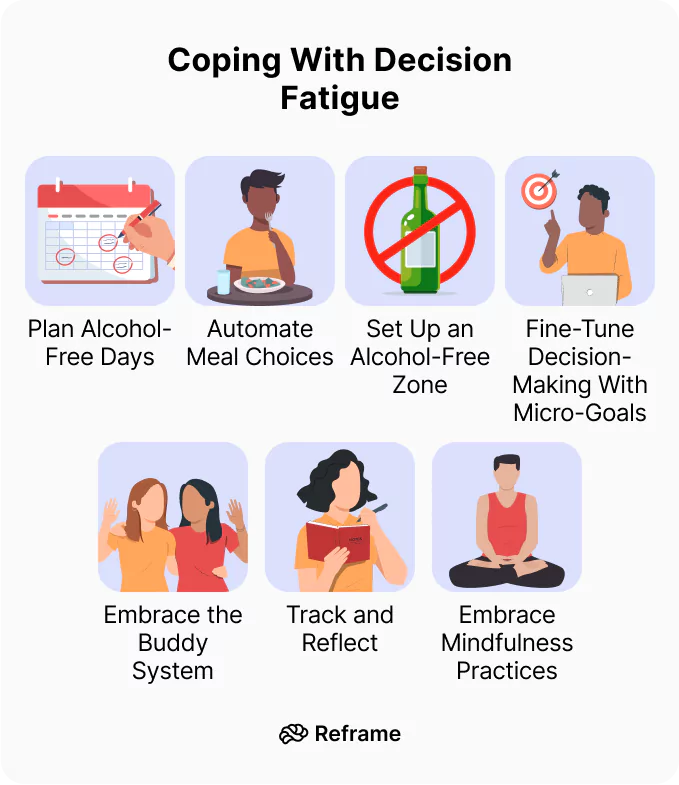
Understanding this link between decision fatigue and alcohol consumption provides valuable insights. It emphasizes the need for strategies designed to conserve mental energy, especially at vulnerable moments, as a part of any effort to reduce or quit drinking. Here are seven ways we can do just that.
Make Your Most Important Decisions in the Morning
Have you ever noticed that it’s easier to stick to your goals at 9 a.m. than at 9 p.m.? That’s because your willpower is at its peak early in the day. Research shows that our ability to make good choices follows a diurnal pattern, meaning it’s strongest in the morning and gradually fades as the day wears on. Use this to your advantage. Instead of waiting until you’re tired and stressed in the evening to decide whether or not to drink, make that choice in the morning. Plan your evening ahead of time. Decide what you’ll eat for dinner, what you’ll watch on TV, and what delicious alcohol-free drink you’ll enjoy. By making the decision when your resolve is high, you set yourself up for success later.
Simplify Your Choices (Like Obama and Jobs Did)
Some of the most successful people on the planet intentionally limit their daily choices. Former President Barack Obama, Steve Jobs, and Mark Zuckerberg famously wore similar outfits every day. Why? To save their mental energy for more important decisions. You can apply this same logic to your own life. Automate and simplify wherever possible. Plan your meals for the week, lay out your clothes the night before, and create routines that run on autopilot. Each small decision you eliminate is a little more willpower you save. This frees up cognitive resources, leaving you with more mental strength at the end of the day to focus on what truly matters, like your commitment to mindful drinking.
Delegate When You Can
You don’t have to carry the weight of every decision. Learning to delegate is a powerful way to reduce your mental load. At work, this might mean trusting a colleague to lead a project. At home, it could be as simple as letting your partner or kids decide what’s for dinner. Delegating isn’t about losing control; it’s about strategically preserving your energy for the choices only you can make. It also helps to break down overwhelming projects into smaller, more manageable tasks. Instead of facing one massive decision, you can tackle a series of smaller ones. This approach makes big goals feel less daunting and reduces the stress that can often lead to reaching for a drink.
Take Strategic Breaks to Recharge
When you feel your focus slipping and your patience wearing thin, that’s your brain telling you it needs a break. Pushing through will only deplete your decision-making ability further. Instead of powering on, take a strategic pause. This doesn’t have to be a long vacation; even five to ten minutes can make a difference. Step away from your screen, go for a short walk, listen to your favorite song, or simply sit and do nothing. These small moments of rest act like a reset button for your brain, helping to restore your capacity for thoughtful choices. By recharging throughout the day, you’ll have more energy in the evening to stick with your health goals.
Stop Second-Guessing Yourself
Once you’ve made a decision, let it be. Constantly questioning your choices—whether it’s what you said in a meeting or the brand of almond milk you bought—is a huge drain on your mental energy. Trust that you made the best choice you could with the information you had at the time. This is especially important when it comes to changing your drinking habits. If you decide to skip alcohol for the night, commit to it. Don’t waste the evening wondering if you’re missing out. And if you do have a drink, avoid falling into a spiral of guilt. Acknowledge the choice and focus on the next one. You can always find support and answers to common questions on our FAQ page.
1. Schedule Your Alcohol-Free Days
Reserve certain days of the week as alcohol-free days. Mark these on a physical calendar, stick a note on your refrigerator, or use reminders on your phone (which you can do through the Reframe app!). The brilliance of this strategy lies in its preemptive nature: the decision to abstain is made well in advance, eliminating the need for willpower on the designated day. This ensures that no mental energy is expended in making the “drink or not to drink” decision when the day arrives. It’s already set in stone, leaving your cognitive resources available for other tasks.
2. Simplify Your Meal Choices
Meal planning can seem like a minor chore, but every decision, no matter how small, contributes to decision fatigue. Automate this aspect of your life by planning meals for the week or opting for a meal kit delivery service. Not only does this eliminate decision making, but a well-fed brain is much better at making good decisions. Research has shown that low glucose levels impair self-control, increasing the likelihood of making poor choices like overindulging in alcohol. By automating meal choices, you remove one more variable from the equation, preserving your willpower for the more significant decisions like abstaining from alcohol or drinking less.
3. Create an Alcohol-Free Space
An environment that supports your goals can be a game-changer. Designate an entirely alcohol-free space in your home: a particular room, a comfy reading chair, or even a mocktail station stocked with all your favorite non-alcoholic beverages. The psychology behind this is rooted in environmental cues that influence behavior. When the choice to not drink is seamlessly integrated into your surroundings, the decision becomes much easier. The decision is almost outsourced to the environment, reducing the cognitive load on you.
4. Set Small, Achievable Goals
Broad goals like "I'll drink less" sound ambitious, but they often lack the actionable specificity needed for successful implementation. The brain struggles with ambiguity and, in the absence of a clear plan, it’s more likely to revert to familiar habits when fatigued. Instead of making sweeping declarations, break the goal into smaller, manageable decisions such as "I'll only have one drink at dinner" or "I'll choose a mocktail at the office party." Small, concrete decisions reduce the cognitive load, making each decision less taxing on the brain's finite pool of resources. Numerous studies, including one by psychologist Roy F. Baumeister, underscore the effectiveness of breaking down large goals into specific actions for better self-regulation. This strategy makes it easier to monitor progress and make course corrections, preserving willpower for other decisions throughout the day.
5. Find an Accountability Partner
Embarking on a journey to change your drinking habits doesn't have to be lonely. Partnering with a friend who shares the same goal offers multiple benefits. First, it cuts down on the number of solo decisions we have to make, reducing overall decision fatigue. Also, it introduces an accountability factor that can act as an additional layer of reinforcement. Studies have found that accountability to someone else can significantly improve the chances of reaching a set goal. The mere act of having to report your choices to someone else can act as a powerful deterrent against poor decisions. This dual-pronged approach provides a built-in safety net that makes each step of the journey easier to navigate.
6. Track Your Choices to Find Patterns
In the world of behavioral psychology, what gets measured gets managed. Maintaining a simple journal or even a digital log that tracks each drinking episode (which you can do through Reframe!) — and equally important, each successfully avoided opportunity to drink — can provide a goldmine of insights. A visual representation of choices, plotted over time, serves as a continuous feedback loop. This tactile involvement with your goal provides both a record and, importantly, a sense of accomplishment, reinforcing positive behavior. It's akin to the dopamine release associated with achieving micro-goals, further strengthening resolve and diminishing decision fatigue.
7. Use Mindfulness to Stay Centered
While eliminating decision fatigue may not be feasible, certain practices mitigate its impact. Activities like 10-minute meditation sessions or even a brisk jog around the block act as cognitive refreshers. Research has found that engaging in mindfulness activities restores self-control and decision-making abilities. These brief moments of respite recharge the decision-making battery, providing new energy to make healthier choices about alcohol consumption.
Decision Fatigue vs. Burnout: Knowing the Difference
If that feeling of being mentally drained sticks around for more than just an evening, you might be dealing with something more than simple decision fatigue. It’s easy to confuse it with burnout, as they can feel similar, but they are distinct conditions. Decision fatigue is a temporary state of mental exhaustion caused by a day packed with choices. According to the Cleveland Clinic, its effects are short-term; you should feel mentally refreshed after a good night's sleep or a restful day. Think of it as a cognitive muscle that’s sore after a heavy workout — it just needs a little time to recover.
Burnout, on the other hand, is a much deeper and more persistent state of emotional, physical, and mental exhaustion. It’s often the result of prolonged stress and feeling overwhelmed for an extended period. The American Medical Association highlights key signs of burnout, such as extreme tiredness, feeling cynical or negative about your work, and a sense of professional inadequacy. While chronic decision fatigue can certainly contribute to burnout, the key difference is duration. If the exhaustion, irritability, and lack of motivation are your constant companions rather than just end-of-day visitors, you may be experiencing burnout.
When to Seek Professional Help
Recognizing when you need extra support is a sign of strength. While the strategies we’ve discussed are effective for managing decision fatigue, they may not be enough if you’re dealing with burnout or another underlying issue. If your feelings of exhaustion and overwhelm don't improve with rest and you’re experiencing symptoms daily, it’s a good idea to speak with a healthcare professional. Persistent low mood, a loss of interest in things you once enjoyed, or consistently using alcohol to cope are all signals that it’s time to seek guidance. A doctor or therapist can help you understand what’s going on and create a plan to get you back on track. While supportive communities, like the one in the Reframe app, are valuable, they are not a substitute for professional medical advice.
Your Path to Fewer, Better Decisions
Adopting these strategic approaches makes the battle against decision fatigue less daunting. Each action item complements the other, creating an interwoven defense specifically designed to outsmart decision fatigue. The trick lies not just in making fewer decisions, but in making more efficient ones — and making sure they align with our overarching goal of reducing alcohol consumption.
Frequently Asked Questions
Is decision fatigue just a fancy term for feeling tired? Not quite. While both can leave you feeling drained, regular tiredness is more about physical exhaustion. Decision fatigue is specifically mental exhaustion that comes from making a constant stream of choices. Think of it as your brain's processing power running low. You might feel physically fine, but the quality of your judgment declines, making you more likely to make impulsive choices or simply take the easiest path available.
Why does planning small things like my outfit or meals actually help with bigger goals like drinking less? It might seem unrelated, but it's all about conserving your mental energy. Your willpower is a finite resource, and every single choice you make, no matter how small, takes a little bit out of that tank. By automating minor daily decisions, you're essentially plugging those tiny energy leaks. This leaves you with a fuller tank at the end of the day, giving you more mental strength to make the choices that truly align with your long-term goals.
I feel great in the morning, but by evening, my resolve is gone. Is there a way to make my willpower last all day? This is a completely normal experience, and it's the classic sign of decision fatigue. Instead of trying to stretch your willpower, the key is to work with its natural rhythm. Use your morning clarity to your advantage by making important decisions then, like planning a relaxing, alcohol-free evening. Throughout the day, take short, strategic breaks to recharge your mental batteries so you aren't running on empty by the time you get home.
What's the difference between having a bad day with decision fatigue and actual burnout? The main difference comes down to duration and recovery. Decision fatigue is a short-term state; you should feel mentally refreshed after a good night's sleep or a restful day off. Burnout is a much deeper, more chronic state of emotional and physical exhaustion that doesn't go away with a little rest. If that feeling of being overwhelmed, cynical, and depleted is your constant reality, it might be more than just decision fatigue.
What if I try these strategies but still end up having a drink when I didn't plan to? Changing habits is a process, and it's rarely a straight line. A single choice doesn't define your entire journey. Instead of viewing it as a failure, try to see it as a piece of information. It might highlight that you were particularly drained that day, which is a powerful insight. The goal is progress, not perfection. Acknowledge the moment, be kind to yourself, and focus on the very next choice you get to make.
Key Takeaways
Recognize that decision fatigue is a real drain on your willpower. The thousands of small choices you make all day deplete your mental energy, which is why resisting a familiar habit like drinking feels so much harder in the evening when your resolve is low.
Plan your evenings in the morning. Your willpower is strongest at the start of the day, so use that time to decide what your alcohol-free night will look like. When the choice is already made, you don't have to rely on a depleted battery later.
Automate small, daily choices to conserve mental energy. Simplify your life by creating routines for things like meals and outfits. Every decision you remove from your plate frees up cognitive resources, leaving you with more strength to make choices that align with your health goals.
Decision fatigue refers to the decrease in the quality of decisions made after a prolonged period of decision-making. It's like a muscle that gets tired with use, making it harder to exercise self-control and choose not to drink.
2. How does decision fatigue affect my ability to change my drinking habits?
When you make many decisions throughout the day, your mental resources for willpower become depleted. By the time you face the decision to drink or not, you might be more susceptible to giving in to temptation.
3. What is the benefit of planning alcohol-free days?
By choosing specific days to abstain from alcohol and marking them in advance, you remove the need for willpower on those days. This pre-commitment preserves your mental energy for other tasks.
4. How can automating meal choices help me?
Meal planning eliminates a minor yet impactful decision from your daily routine. A well-fed brain is also better at decision-making, boosting your willpower for more significant choices like avoiding alcohol.
5. Why should I create an alcohol-free zone at home?
Designating an alcohol-free area makes the choice to abstain easier. The decision to not drink becomes integrated into your environment, reducing the cognitive load on you.
6. What is the role of accountability in changing my drinking habits?
Partnering with a friend who has the same goal can cut down the number of solo decisions you make and introduce a level of accountability that reinforces positive choices.
7. Can mindfulness practices help me make better choices?
Yes, activities like meditation or a quick jog can act as cognitive refreshers, recharging your mental battery and making it easier to choose healthier behaviors, such as reducing or ending your alcohol consumption.
Drink Less, Thrive More — Download Reframe!
Although it isn’t a treatment for alcohol use disorder (AUD), the Reframe app can help you cut back on drinking gradually, with the science-backed knowledge to empower you 100% of the way. Our proven program has helped millions of people around the world drink less and live more. And we want to help you get there, too!
The Reframe app equips you with the knowledge and skills you need to not only survive drinking less, but to thrive while you navigate the journey. Our daily research-backed readings teach you the neuroscience of alcohol, and our in-app Toolkit provides the resources and activities you need to navigate each challenge.
You’ll meet millions of fellow Reframers in our 24/7 Forum chat and daily Zoom check-in meetings. Receive encouragement from people worldwide who know exactly what you’re going through! You’ll also have the opportunity to connect with our licensed Reframe coaches for more personalized guidance.
Plus, we’re always introducing new features to optimize your in-app experience. We recently launched our in-app chatbot, Melody, powered by the world’s most powerful AI technology. Melody is here to help as you adjust to a life with less (or no) alcohol.
And that’s not all! Every month, we launch fun challenges, like Dry/Damp January, Mental Health May, and Outdoorsy June. You won’t want to miss out on the chance to participate alongside fellow Reframers (or solo if that’s more your thing!).
The Reframe app is free for 7 days, so you don’t have anything to lose by trying it. Are you ready to feel empowered and discover life beyond alcohol? Then download our app through the App Store or Google Play today!
Reframe has helped over 2 millions people to build healthier drinking habits globally
At Reframe, we do science, not stigma. We base our articles on the latest peer-reviewed research in psychology, neuroscience, and behavioral science. We follow the Reframe Content Creation Guidelines, to ensure that we share accurate and actionable information with our readers. This aids them in making informed decisions on their wellness journey. Learn more
Updated Regularly
Our articles undergo frequent updates to present the newest scientific research and changes in expert consensus in an easily understandable and implementable manner.