How to Tailgate With Little or No Alcohol and Still Have a Blast
Published:
2026-08-28
·
Read time:
10 min read
Last Updated:
2026-08-29
Written by
Reframe Content Team
A team of researchers and psychologists who specialize in behavioral health and neuroscience. This group collaborates to produce insightful and evidence-based content.
Certified recovery coach specialized in helping everyone redefine their relationship with alcohol. His approach in coaching focuses on habit formation and addressing the stress in our lives.
Recognized by Fortune and Fast Company as a top innovator shaping the future of health and known for his pivotal role in helping individuals change their relationship with alcohol.
August 28, 2026
·
10 min read
Reframe Content Team
August 28, 2026
·
10 min read
You can absolutely tailgate with little or no alcohol by planning ahead: stock the cooler with non-alcoholic beers and travel-ready mocktail ingredients, lean into the parts of tailgating that were never really about drinking (the food, the games, the fantasy talk), and have a simple, drama-free answer ready for anyone who asks why you aren't drinking. The reason this works is that the tailgate ritual is mostly social scaffolding, and once you keep a drink in your hand and stay in the middle of the action, the alcohol turns out to be the least important ingredient. If game days have become the hardest drinking stretch of your week, Reframe can help you build the habits and scripts that make a low-alcohol tailgate feel easy instead of like white-knuckling.
Can You Tailgate Without Alcohol and Still Have a Blast?
Yes, you can absolutely tailgate with little or no alcohol by planning ahead. Stock the cooler with non-alcoholic beers and travel-ready mocktail ingredients, lean into the parts of tailgating that were never really about drinking (the food, the games, the fantasy talk), and keep a simple, drama-free answer ready for anyone who asks why you aren't drinking. The tailgate ritual is mostly social scaffolding, so once you keep a drink in your hand and stay in the middle of the action, the alcohol turns out to be the least important ingredient.
Here's the thing nobody tells you until you try it: the tailgate barely notices whether your can has beer in it. The chants, the ridiculous predictions, the guy who insists this is finally the year, the smell of something on the grill that's either genius or a fire hazard, all of that runs on people, not on booze. If game days have quietly become the hardest drinking stretch of your week, you don't have to give up the parking lot to change that. You just have to change your cup. Let's walk through exactly how, from what to pack to what to say, so figuring out how to tailgate without alcohol feels easy instead of like white-knuckling.
Why is tailgating so hard to do without alcohol?
Tailgating is uniquely built to keep a drink in your hand. It's not your imagination, and it's not a willpower problem. A few specific pressure points stack up, and naming each one makes it solvable instead of one vague wall of temptation you have to muscle through.
The all-day drinking window
The math is brutal on this one. A tailgate opens hours before kickoff, then the game itself runs another three or four, so you can easily be in the lot and stands for five hours or more. That's a long time to fill, and drinking is the default filler when there's no other structure between arrival and the first snap. For context on why that window matters so much, the National Institute on Alcohol Abuse and Alcoholism defines binge drinking as a pattern that brings blood alcohol concentration to 0.08%, typically five or more drinks for men or four or more for women in about two hours. A tailgate-plus-game session runs roughly twice that long, which means a "normal" day-drinking pace can quietly clear the binge threshold without anyone feeling like they went hard.
There's a demographic wrinkle too. The people most likely to be in that parking lot lot on a Saturday skew toward the age group that already drinks the heaviest. According to CDC survey data from 2018, past-30-day binge drinking prevalence was highest among adults aged 25 to 34, at 26.0%, per the agency's Morbidity and Mortality Weekly Report. None of that means you're doomed, but it does explain why the crowd around you is primed to keep the cans coming, and why swimming against that current takes a plan rather than good intentions.
Parking-lot beer culture and group buy-in
Beyond the clock, there's the social uniform. A can in your hand is basically the dress code of the parking lot, the thing that signals you're here, you're in, you're one of the crew. Opt out of the can and you can suddenly feel like you opted out of the group, even when nobody meant to make you feel that way. Group buy-in makes it stickier: everyone chipped in for the case or the keg, so passing on it can read like passing on the whole ritual. The good news is that this pressure is social, not chemical, which means the fixes are social too. If you're curious where your own patterns fall on the spectrum, the What Type of Drinker Are You? quiz is a low-stakes way to see what's actually driving your game-day habit.
What non-alcoholic drinks actually work for a tailgate cooler?
The short answer: anything that looks like everyone else's drink, survives a hot parking lot, and pours all day. The best swap is a non-alcoholic craft beer, because it does all three and needs zero prep. This is not a consolation-prize situation anymore, and there's real evidence behind the swap working.
A 2023 randomized controlled trial published in BMC Medicine found that simply giving heavy drinkers free non-alcoholic beverages significantly reduced their alcohol consumption, an effect that held for eight weeks after the study ended. The likely mechanism is boring and beautiful: people swapped the alcoholic drink for the non-alcoholic one and just kept the ritual. That's exactly the move at a tailgate. (Worth a light note that some of that study's funding came from a brewery, so take it as one supportive data point rather than gospel.)
Athletic-style non-alcoholic beers
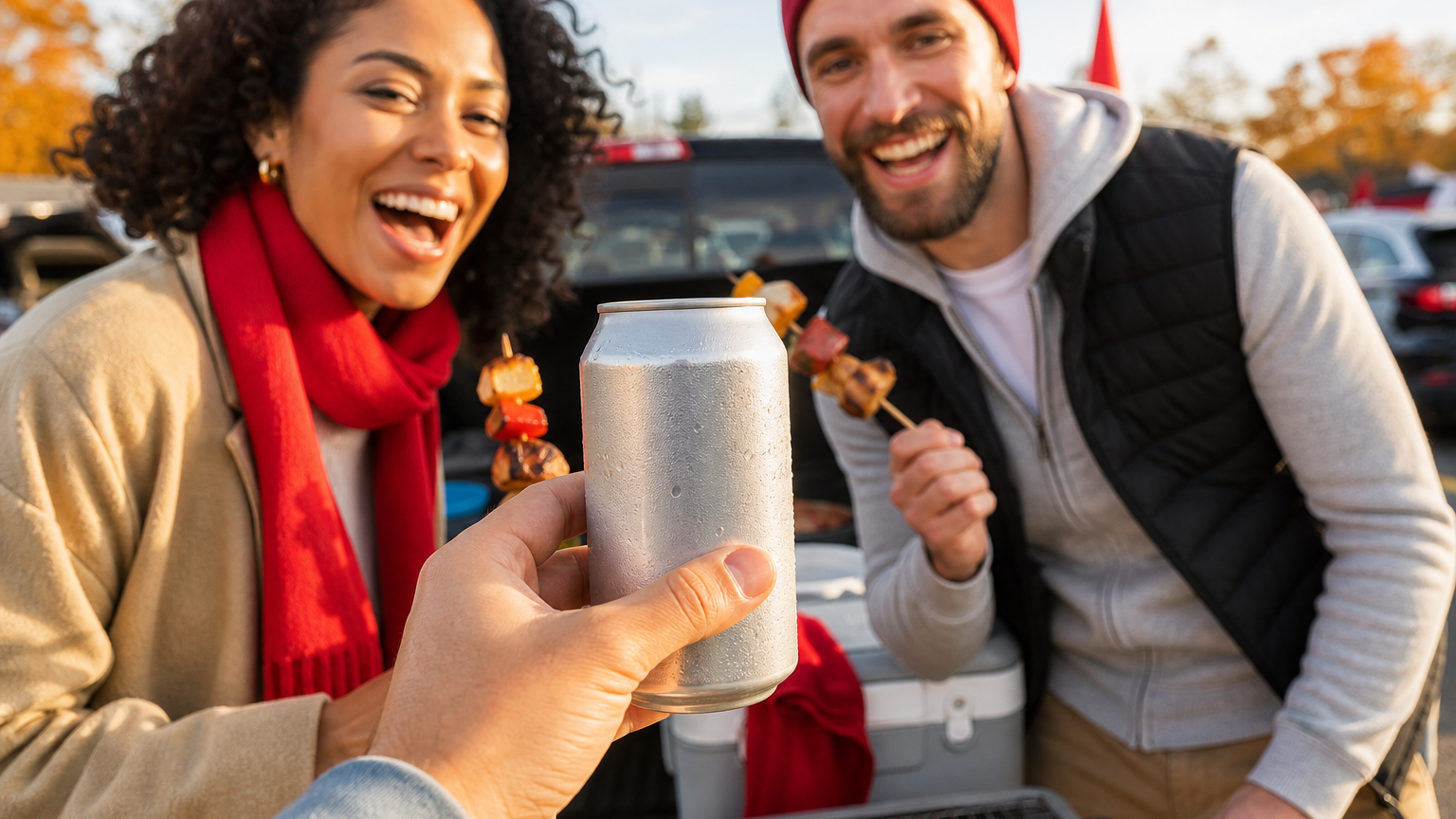
Athletic-style non-alcoholic craft brews are the easiest swap on this whole list because they demand nothing from you. They come cold, they look identical in a koozie, and they hold their own in flavor next to a full-strength beer, so nobody clocks the difference and neither do you. Pack them in a dedicated NA cooler with plenty of ice so they're as grab-and-go as anyone else's beer, buried in the same slush. And bring extras. Offering someone a cold NA brew instantly flips your role from the person not drinking to the person with the good stash, which is a much better seat at the table. For a deeper rundown of which styles taste closest to the real thing, our NA beer guide breaks it down.
Batch-friendly mocktails that survive the parking lot
If beer isn't your thing, batch a ranch water mocktail: sparkling water, fresh lime, a splash of agave, and a salt rim. It travels in a jug or a big drink dispenser and pours cleanly all afternoon, which is the whole point. The rule for a parking lot is that anything requiring a muddler, a shaker, or precise measuring is going to lose, so pre-mix everything at home the night before and pour it into a growler or dispenser. You want to walk up, fill your cup, and get back to the cornhole line, not run a cocktail station off your tailgate. Keep a cup or can in hand at all times and you blend into the crowd, which is half the battle right there. For more portable ideas, Reframe's mindful drinking program is built around swaps exactly like these.
What can you do at a tailgate besides drink?
Plenty, and honestly the best stuff was never about the beer to begin with. The trick is to grab a role that keeps your hands and attention busy, because idle hands are what reach for the cooler out of pure boredom. Pick something with a job attached and the drinking question basically answers itself.
Games are the obvious first move. Cornhole, ladder toss, or just a football to throw around give your hands something to do and pull you into the center of the group instead of leaving you hovering near the drinks. Better yet, take over the grill or the food prep. Being the person cooking is a built-in, respected role that keeps you occupied for hours and makes you genuinely useful, and a well-fed crowd tends to pace itself anyway.
Then there's the talk. Lead the fantasy football breakdown, run the betting-pool logistics, or appoint yourself keeper of the group's increasingly unhinged game predictions. If organizing is more your speed, be the logistics person: set up the tent, wrangle the speakers, arrange the chairs, and become the one the crew relies on to make the day happen. You can also just walk the lot, visit other tailgates, and take photos, which keeps you moving instead of parked by the cooler. These rituals were always the real point of tailgating. The alcohol was just riding along for free. For a bigger menu of things to do with your hands and attention, 12 fun things to do instead of drinking has more.
How do you host a tailgate that works for people drinking less?
If you're the one throwing the tailgate, you have more power than anyone to make the alcohol-free path effortless, and you can do it without ever making it a Thing. The goal is to set the table so the non-alcoholic choice looks like a real choice, not a sad afterthought buried behind the beer.
Start by stocking the NA options first and in visible quantity. Give them their own labeled cooler with the best ice, front and center, so they read as an equal option rather than a consolation prize somebody grudgingly remembered. Then build the day around an activity, a cornhole bracket, a chili cook-off, a live fantasy-draft recap, so drinking is never the main event. When there's a thing happening, the beer becomes background instead of the whole point.
Serve food early and often, because a full stomach slows everyone's pace naturally, and a slower pace is quietly the most effective host move there is. The NIAAA notes that heavy drinking starts at 4 or more drinks in a day for women and 5 or more for men, and a long unstructured day of grazing and pouring is exactly how people drift into that range without noticing. Feeding people well and keeping them busy heads that off. Above all, never announce or police anyone's drinking. Just make the low-alcohol path easy and let people take it, and model it yourself by holding an NA drink so guests see it as completely normal. If you're the host who also wants to gently open the door for anyone rethinking their habits, pointing a curious friend toward the Am I Drinking Too Much? quiz is far kinder than any lecture.
How do you answer "why aren't you drinking?" at a tailgate?
Decide your line before you arrive, and you'll never get caught flat-footed by a regular who notices. Most people ask exactly once, out of pure habit, and move on the second you give any confident answer. The question is almost never a challenge. It's a reflex, and a reflex only needs a reflex-sized response.
Short and light wins every time. "I'm the designated driver," "pacing myself for the fourth quarter," or "on a health kick this season" all end the conversation before it starts. You don't owe anyone a full explanation, and a smile plus a quick pivot back to the game usually closes it out. Even better, preempt the whole thing by holding a cold NA beer, because if you visibly already have a drink, the question mostly never comes up in the first place.
When someone does press, redirect. Ask about their fantasy lineup, hand them a plate, or drag them into the prediction argument. People love talking about themselves and their team far more than about your cup, so give them a better target. If saying no still feels awkward for you, that's normal and worth practicing, and our roundup of excuses to not drink and how to say no has a script for nearly every situation. A little rehearsal beforehand means the moment lands as a shrug, not a standoff.
How do you handle the four-plus hour game-day stretch?
This is the part that separates a good plan from a great one, because the long window is where most low-alcohol days quietly fall apart. Break the stretch into two problems, hydration and cravings, and tackle each on purpose rather than hoping willpower holds for five hours.
On the physical side, zebra-stripe the whole day: alternate a non-alcoholic drink with plain water so you stay hydrated across the entire window instead of running on salty snacks and sun. Eat on a schedule rather than grazing, since a steady stream of pretzels and chips ramps up thirst and makes everything feel drier and more urgent. Remember that a standard drink is about 14 grams of pure alcohol and that the binge threshold is calibrated to roughly two hours, so a genuinely long day gives alcohol a lot of runway. Structuring your intake with food and water takes that runway away. Our full breakdown of the zebra-striping approach and the NA-beer research goes deeper if you want the science.
The other half of the game is the mental one. Cravings are real, time-limited urges that play a central role in relapse and are recognized as a diagnostic criterion in the DSM-5, according to a systematic review of anti-craving treatments. The practical upshot is that a craving is a wave, not a permanent state: it tends to spike around a tipping point and then pass if you don't feed it. Watch for the classic triggers, halftime, a huge play, the group announcing they're heading to the bar afterward, and have a loose plan for each one. Keep your hands busy, keep water moving, and ride out the peak. It also helps to set a transition plan for after the game so the day doesn't automatically roll into an all-night session. Tools like Reframe are built to help you spot those tipping points before they hit and have a move ready.
How do you answer "why aren't you drinking?" at a tailgate?
Decide your line before you arrive, and you'll never get caught flat-footed by a regular who notices. Most people ask exactly once, out of pure habit, and move on the second you give any confident answer. The question is almost never a challenge. It's a reflex, and a reflex only needs a reflex-sized response.
Short and light wins every time. "I'm the designated driver," "pacing myself for the fourth quarter," or "on a health kick this season" all end the conversation before it starts. You don't owe anyone a full explanation, and a smile plus a quick pivot back to the game usually closes it out. Even better, preempt the whole thing by holding a cold NA beer, because if you visibly already have a drink, the question mostly never comes up in the first place.
When someone does press, redirect. Ask about their fantasy lineup, hand them a plate, or drag them into the prediction argument. People love talking about themselves and their team far more than about your cup, so give them a better target. If saying no still feels awkward for you, that's normal and worth practicing, and our roundup of excuses to not drink and how to say no has a script for nearly every situation. A little rehearsal beforehand means the moment lands as a shrug, not a standoff.
How do you handle the four-plus hour game-day stretch?
This is the part that separates a good plan from a great one, because the long window is where most low-alcohol days quietly fall apart. Break the stretch into two problems, hydration and cravings, and tackle each on purpose rather than hoping willpower holds for five hours.
On the physical side, zebra-stripe the whole day: alternate a non-alcoholic drink with plain water so you stay hydrated across the entire window instead of running on salty snacks and sun. Eat on a schedule rather than grazing, since a steady stream of pretzels and chips ramps up thirst and makes everything feel drier and more urgent. Remember that a standard drink is about 14 grams of pure alcohol and that the binge threshold is calibrated to roughly two hours, so a genuinely long day gives alcohol a lot of runway. Structuring your intake with food and water takes that runway away. Our full breakdown of the zebra-striping approach and the NA-beer research goes deeper if you want the science.
The other half of the game is the mental one. Cravings are real, time-limited urges that play a central role in relapse and are recognized as a diagnostic criterion in the DSM-5, according to a systematic review of anti-craving treatments. The practical upshot is that a craving is a wave, not a permanent state: it tends to spike around a tipping point and then pass if you don't feed it. Watch for the classic triggers, halftime, a huge play, the group announcing they're heading to the bar afterward, and have a loose plan for each one. Keep your hands busy, keep water moving, and ride out the peak. It also helps to set a transition plan for after the game so the day doesn't automatically roll into an all-night session. Tools like Reframe are built to help you spot those tipping points before they hit and have a move ready.
Summary FAQs
1. Can you tailgate without drinking and still fit in?
Yes. The key is to keep a drink in your hand (a non-alcoholic beer or a batched mocktail works perfectly) and stay in the middle of the action rather than hovering by the cooler. Tailgating is built around food, games, and hanging out with your crew, so once you plug into those, the alcohol stops being the point. Most people won't even notice what's in your cup.
2. What are the best non-alcoholic drinks to bring to a tailgate?
Athletic-style non-alcoholic craft beers are the easiest swap because they look and taste close to the real thing and travel well on ice. A batched ranch water mocktail (sparkling water, lime, a splash of agave, and a salt rim) also holds up in a jug or dispenser for hours. Pre-mix everything at home so you're not measuring ingredients in a parking lot.
3. How do I answer when tailgate regulars ask why I'm not drinking?
Keep it short and confident: 'I'm the designated driver,' 'pacing myself for the fourth quarter,' or 'on a health kick this season' all end the conversation fast. You don't owe anyone a full explanation, and most people ask once out of habit and move on. Holding a cold NA beer helps because it looks like you already have a drink, so the question often never comes up.
4. What can I do at a tailgate instead of drinking?
Lean into the rituals that were never really about alcohol: run the grill, set up cornhole or a football toss, lead the fantasy football and betting-pool talk, or be the logistics person who handles the tent and speakers. Walking the lot to visit other tailgates keeps you moving too. Having a clear role keeps your hands and attention busy so drinking never becomes the default.
5. How do I get through the long four-plus hour drinking window on game day?
Alternate a non-alcoholic drink with water so you stay hydrated across the whole stretch, and eat on a schedule instead of grazing on salty snacks that fuel thirst. Watch for tipping points like halftime, a big play, or the group heading to a bar afterward, and have a loose plan for each. Cravings tend to spike and then pass, so staying busy and fed carries you through the peaks.
6. How do I host a tailgate that works for people drinking less?
Stock plenty of non-alcoholic options up front and give them their own labeled cooler with good ice so they read as a real choice rather than an afterthought. Build the day around an activity like a cornhole bracket or a cook-off so drinking isn't the main event, and serve food early and often. Don't announce or police anyone's choices; just make the alcohol-free path effortless and let people take it.
Making Game Day Work Without the Beer Buzz? Reframe Can Help!
Although it isn't a treatment for alcohol use disorder (AUD), the Reframe app can help you cut back on drinking gradually with the science-backed knowledge to empower you 100% of the way. Our proven program has helped millions of people around the world drink less and live more. And we want to help you get there, too!
The Reframe app equips you with the knowledge and skills you need to not only survive drinking less, but to thrive while you navigate the journey. Our daily research-backed readings teach you the neuroscience of alcohol, and our in-app Toolkit provides the resources and activities you need to navigate each challenge.
You'll meet millions of fellow Reframers in our 24/7 Forum chat and daily Zoom check-in meetings. Receive encouragement from people worldwide who know exactly what you're going through! You'll also have the opportunity to connect with our licensed Reframe coaches for more personalized guidance.
Plus, we're always introducing new features to optimize your in-app experience. We recently launched our in-app chatbot, Melody, powered by the world's most powerful AI technology. Melody is here to help as you adjust to a life with less (or no) alcohol.
And that's not all! Every month, we launch fun challenges, like Dry/Damp January, Mental Health May, and Outdoorsy June. You won't want to miss out on the chance to participate alongside fellow Reframers (or solo if that's more your thing!).
The Reframe app is free for 7 days, so you don't have anything to lose by trying it. Are you ready to feel empowered and discover life beyond alcohol? Then download our app through the App Store or Google Play today!
Reframe has helped over 2 millions people to build healthier drinking habits globally
At Reframe, we do science, not stigma. We base our articles on the latest peer-reviewed research in psychology, neuroscience, and behavioral science. We follow the Reframe Content Creation Guidelines, to ensure that we share accurate and actionable information with our readers. This aids them in making informed decisions on their wellness journey. Learn more
Updated Regularly
Our articles undergo frequent updates to present the newest scientific research and changes in expert consensus in an easily understandable and implementable manner.
Pharmacotherapy for alcohol craving reduction: Efficacy of short-term treatments in alcohol use disorder. (2026). Medicines, 13(1), 7. https://doi.org/10.3390/medicines13010007
Centers for Disease Control and Prevention. (2021). Binge drinking among adults, by select characteristics and state — United States, 2018. Morbidity and Mortality Weekly Report, 70(41).
Yoshimoto, H., Kawaida, K., Dobashi, S., Saito, G., & Owaki, Y. (2023). Effect of provision of non-alcoholic beverages on alcohol consumption: A randomized controlled study. BMC Medicine, 21(1), 379. https://doi.org/10.1186/s12916-023-03085-1
National Institute on Alcohol Abuse and Alcoholism. (n.d.). Understanding alcohol drinking patterns.
National Institute on Alcohol Abuse and Alcoholism. (n.d.). The basics: Defining how much alcohol is too much. Core Resource on Alcohol.




.png)


