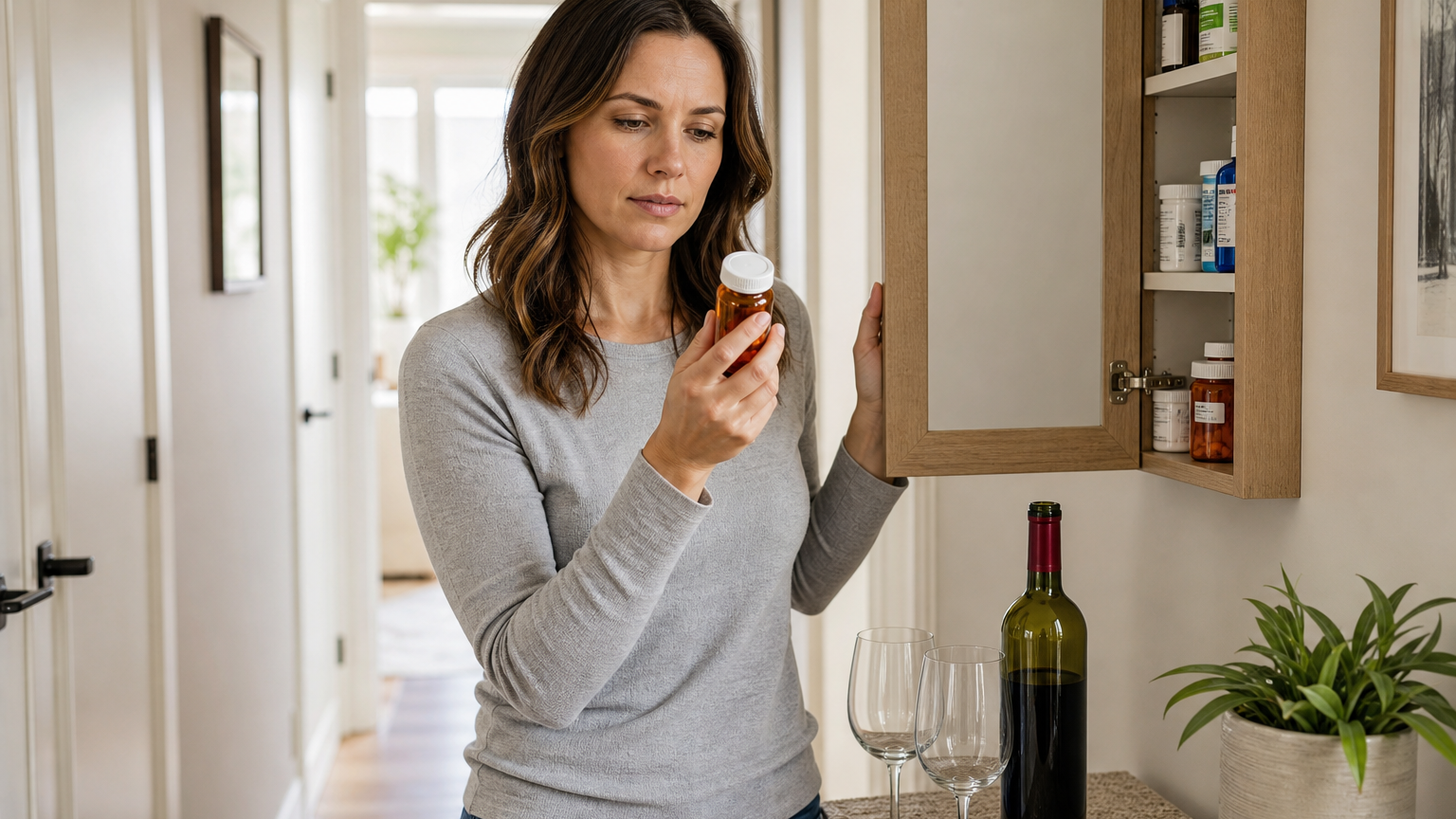
Can You Drink Alcohol on Mirtazapine? What to Know First
Published:
2026-09-28
·
Read time:
14 min read
Last Updated:
2026-09-28
Written by
Reframe Content Team
A team of researchers and psychologists who specialize in behavioral health and neuroscience. This group collaborates to produce insightful and evidence-based content.
Certified recovery coach specialized in helping everyone redefine their relationship with alcohol. His approach in coaching focuses on habit formation and addressing the stress in our lives.
Recognized by Fortune and Fast Company as a top innovator shaping the future of health and known for his pivotal role in helping individuals change their relationship with alcohol.
September 28, 2026
·
14 min read
Reframe Content Team
September 28, 2026
·
14 min read
Drinking on mirtazapine (Remeron) is not recommended, and the main reason is sedation: mirtazapine is a potent H1 antihistamine on top of being an antidepressant, so alcohol stacks onto an already heavy sedative load. Even one drink at bedtime can produce deeper grogginess, slowed reaction time, and impaired next-morning function that most people underestimate, and the risk climbs sharply if you also take a benzodiazepine, opioid, sleep aid, or muscle relaxant. If alcohol keeps showing up as part of your wind-down routine, that is worth looking at directly, and Reframe is built to help you untangle the drinking part of the equation.
The Short Answer on Mirtazapine and Alcohol
Drinking on mirtazapine (Remeron) is not recommended, and the main reason is sedation: mirtazapine is a potent H1 antihistamine on top of being an antidepressant, so alcohol stacks onto an already heavy sedative load. Even one drink at bedtime can produce deeper grogginess, slowed reaction time, and impaired next-morning function that most people underestimate, and the risk climbs sharply if you also take a benzodiazepine, opioid, sleep aid, or muscle relaxant. If alcohol keeps showing up as part of your wind-down routine, that is worth looking at directly, and Reframe is built to help you untangle the drinking part of the equation.
Here is the thing about mirtazapine that catches people off guard: it is not really the antidepressant part that causes trouble with a glass of wine. It is the antihistamine part. Mirtazapine is one of the most sedating medications in common psychiatric use, which is exactly why so many people take it at night and why so many people are prescribed a small dose purely to help them sleep. Add alcohol, another central nervous system depressant, and you are not adding two things. You are compounding them.
We are not here to tell you that one drink will hurt you. For most people taking mirtazapine and nothing else sedating, one drink is not an emergency. But the impairment is real, it lasts longer than you think, and it shows up most clearly in the places you care about most: driving the next morning, functioning at work, and getting sleep that actually restores you. Let's go through it honestly.
How does mirtazapine interact with alcohol?
The interaction is about effects stacking, not about drug levels changing. Mirtazapine prescribing references warn about somnolence and impairment of cognitive and motor skills, and clinicians generally treat that impairment as adding to what alcohol does on its own. Alcohol is not thought to meaningfully change how much mirtazapine ends up in your blood; what changes is how impaired you are.
That distinction matters more than it sounds. A lot of medication-and-alcohol posts lean on the idea that alcohol scrambles how your body processes the drug. With mirtazapine and alcohol, the simpler and more useful mental model is arithmetic: sedation from the medication plus sedation from the drink equals more sedation than either alone, in a way most people have not calibrated for.
What does NaSSA actually mean?
Mirtazapine belongs to a class called NaSSAs, short for noradrenergic and specific serotonergic antidepressants. It is a tetracyclic compound, not an SSRI, which is why advice about drinking on sertraline or escitalopram does not transfer neatly here. According to StatPearls from the National Library of Medicine, mirtazapine works largely by blocking central presynaptic alpha-2 adrenergic receptors, has a mean elimination half-life of roughly 20 to 40 hours, and is metabolized in the liver by CYP1A2, CYP2D6, and CYP3A4. That long half-life is worth filing away: the medication is in your system around the clock, not just for the few hours after you swallow it.
The practical upshot of the NaSSA label is that this is not primarily a serotonin-interaction story. It is a sedation story, and sedation is the lens that should guide every decision you make about drinking while taking it.
This is the part that surprises almost everyone: a small dose of mirtazapine tends to knock people out harder than a large one. A risk-benefit assessment published in Drug Safety reported that increased sedation with mirtazapine appears to be associated with subtherapeutic dosages, with sedation reported in substantially fewer patients when the drug was used at 15 mg or above as a single evening dose from the start of treatment.
The usual explanation is that at low doses the antihistamine effect runs the show, while at higher doses increased noradrenergic activity partially offsets the drowsiness. That explanation is widely repeated in clinical references, but it is worth being honest about how firmly it is established. A review from the British Columbia Provincial Academic Detailing Service describes mirtazapine as more sedating below 30 mg than at 30 mg or above, while noting that the higher-dose noradrenergic explanation is speculated rather than proven, and that a requested postmarketing dose-response trial on sedation could not be identified as completed. So: widely observed in practice, commonly reported in prescribing references, not settled by high-quality trial evidence.
Why does this matter for drinking? Because the people most likely to say "it's only 7.5 milligrams, it barely counts" are often the people getting the most sedation from it. Low-dose mirtazapine prescribed for sleep is not a lighter version of the interaction. If anything, it is the version where a single evening drink lands hardest. Sedation also varies with body size, age, and whether you are two weeks into treatment or two years in, so your friend's experience is not a reliable guide to yours.
What actually happens if you have one drink on mirtazapine?
Most people describe the same thing: drowsiness that arrives fast and feels heavier than the drink alone would explain. Within roughly half an hour to an hour, a single glass of wine can feel like two or three, not because your blood alcohol is higher but because the sedation you were already carrying got amplified. People often describe hitting a wall earlier in the evening than expected.
Alongside that, dizziness and unsteadiness are common. Dizziness is one of the adverse reactions listed in the mirtazapine prescribing information, and alcohol has its own well-known effect on balance and coordination, so standing up quickly after a drink can feel notably worse than usual. Clumsiness, bumping into furniture, and misjudging stairs are the kinds of ordinary-sounding problems that cause genuinely bad nights.
Two more things worth naming. Memory can get patchy at amounts of alcohol that would not normally do that to you; there is no study quantifying where that threshold sits on mirtazapine, so treat it as a plausible consequence of stacked sedation rather than an established finding. And appetite gets loud. Mirtazapine already increases appetite for many people, and alcohol adds its own disinhibition around food, which is why the 11 p.m. kitchen raid is such a familiar story. None of this makes one drink an emergency for most people. It does mean the evening is no longer one you should be driving through, and that the drinking triggers worth paying attention to may be showing up in a new way.
Why does bedtime dosing make a single evening drink riskier?
Timing is the quiet villain here. Mirtazapine is almost always taken at night precisely because it is sedating, which means an evening drink lands directly on top of the medication's peak effect. A drink with dinner is not a drink in a neutral window. It is a drink in the exact hours your nervous system is already being dialed down.
That is worth sitting with for a second, because it reframes the whole question. Plenty of people end up drinking in the evening to help them wind down while simultaneously taking a medication for the same purpose. If that describes you, the useful conversation is not "how much can I get away with" but "what is the wine actually doing for me here." Reframe's mindful drinking program exists for exactly that kind of untangling, and there are also practical ways to replace alcohol in your evening routine that do not fight your medication.
How does mixing mirtazapine and alcohol affect you the next day?
Next-day grogginess is the most common complaint people have about mirtazapine on its own, and alcohol deepens and stretches it. This is where the real-world cost of drinking on mirtazapine shows up: not in the moment, but at 7:30 the next morning when you are trying to get out the door.
There is no published study of mirtazapine specifically combined with alcohol on next-morning driving or work performance, so we have to reason across two separate bodies of evidence. First, the label's additive-impairment statement. Second, the hangover literature, which is unambiguous that impairment outlasts alcohol itself. A systematic review and meta-analysis in Addiction found measurable next-day deficits in short-term memory, long-term memory, sustained attention, and psychomotor speed even when blood alcohol had returned to near zero. Important caveat: those studies used heavy drinking, not one glass, so the finding establishes the principle rather than the dose.
The same logic applies to work. Attention, working memory, and the quality of your decisions can all be quietly worse on a morning like this, and the "quietly" is the problem. You do not feel drunk. You feel a bit slow, and you carry on as if slow is fine.
Weight and appetite effects
Over months rather than mornings, there is a second compounding effect worth naming without moralizing about it. The prescribing information lists increased appetite and weight gain among the most common adverse reactions with mirtazapine, alongside somnolence and dizziness. Alcohol brings its own calories plus a reliable loosening of food restraint. If body composition is something you are tracking alongside your mental health, an alcohol calorie calculator makes that arithmetic concrete rather than vague.
Mood is the last piece. A lot of people feel flatter the day after drinking, which muddies the water when you and your prescriber are trying to judge whether the medication is working. If your low days keep landing on the day after your drinking days, that is useful information, not a character flaw.
When is mixing mirtazapine and alcohol a medical emergency?
The genuinely dangerous scenario is a third sedative in the mix. Mirtazapine plus alcohol plus a benzodiazepine, opioid, z-drug sleep aid, gabapentinoid, or muscle relaxant is a different category of risk from mirtazapine plus a glass of wine. Prescribing guidance generally advises against combining mirtazapine with benzodiazepines or alcohol, and the CDC makes the broader point that combining drugs can produce effects that are stronger and more unpredictable than one drug alone, including with prescription medications.
Call emergency services if someone cannot be roused, is breathing slowly or irregularly, has blue-tinged lips, is vomiting while too drowsy to stay upright, or has a seizure. Heavy drinking is generally understood to lower the seizure threshold, and that matters in this context because seizures are a rare but recognized concern with mirtazapine as well. This is not a wait-and-see situation.
One more thing, and it is important: never stop, skip, or adjust mirtazapine on your own to make room for drinking. Cleveland Clinic describes antidepressant discontinuation syndrome as a cluster of symptoms including nausea, insomnia, fatigue, and achiness that can follow stopping an antidepressant, particularly abruptly, and notes that stopping should happen under a healthcare provider's guidance. Bring the question to your prescriber or pharmacist instead, and tell them honestly how much you actually drink. Their advice is only as good as the information you give them, and a striking share of people underreport drinking to their doctor, which helps nobody.
What should you do if you already drank on mirtazapine?
First, breathe. One drink with no other sedatives on board is usually not an emergency, and the task for the next several hours is straightforward: stay safe. Do not drive. Drink some water, eat something, and if you are alone, text someone so a person knows where you are.
Do not double up on your dose and do not skip it either. Take your medication as prescribed unless your prescriber has told you otherwise; the drug has a long enough half-life that skipping does not create a clean alcohol-free window anyway. Keep an eye out for the red-flag symptoms above, and seek care if any of them show up.
Then mention it at your next appointment. Not as a confession, just as data. Your prescriber is trying to figure out whether this medication is doing its job, and drinking patterns are part of that picture. And if you notice this is not a one-off (if the drink-on-mirtazapine question keeps coming up week after week), the pattern is the thing to look at, not the single evening. Understanding what alcohol cravings actually are tends to be more useful than relitigating one night.
How do you handle a wedding, holiday, or night out while taking mirtazapine?
Decide before you are in it. The single most effective move is making your choices while you are sober and unhurried at 4 p.m., not while you are standing at an open bar at 9. Pick what you are drinking, if anything, and pick how you are getting home. Arrange the ride regardless, because impairment on mirtazapine lasts longer than most people's intuition allows for.
Alcohol-free options do a lot of heavy lifting at events like these. Having a drink in your hand solves the social problem without adding to the sedation stack, and the non-alcoholic options available now are genuinely decent. If you and your prescriber have agreed that occasional drinking is reasonable for you, eat first, pace slowly, and plan for the sedation to land earlier than you expect. Have a low-drama exit line ready: "I've got an early start" has never once been questioned by anyone.
And here is the question worth asking if every social event has become a medication calculation. Is the hard part the mirtazapine, or is the hard part the drinking? Those are different problems with different solutions. If you are not sure which one you are dealing with, the Am I Drinking Too Much? quiz takes a few minutes and gives you something more concrete than a vague sense of unease. You can also download Reframe if you want a structured way to track what your drinking is actually costing you, medication or not.
Summary FAQs
1. Can you drink alcohol while taking mirtazapine?
The prescribing guidance is to avoid alcohol on mirtazapine, mainly because of additive sedation. Mirtazapine is a strong H1 antihistamine, so alcohol produces deeper drowsiness, slower reactions, and worse coordination than either would alone. If you are considering an occasional drink, that is a decision to make with your prescriber, especially if you take any other sedating medication.
2. How long after taking mirtazapine can I drink alcohol?
Mirtazapine has a half-life of roughly 20 to 40 hours, so it stays in your system around the clock regardless of when you take your nightly dose. Spacing a drink a few hours from your dose does not meaningfully remove the interaction. The sedation is most intense in the hours right after dosing, which is why an evening drink is the riskiest timing.
3. Why is low-dose mirtazapine more sedating than a high dose?
At 7.5 to 15 mg, mirtazapine's antihistamine effect dominates, producing strong sedation. At 30 to 45 mg, increased noradrenergic activity partially counteracts that drowsiness, so many people feel less sleepy on the higher dose. This means a low dose prescribed for sleep does not make adding alcohol safer, and often makes it feel worse.
4. Can you drive the morning after drinking on mirtazapine?
You may still be impaired even when your blood alcohol is zero. Residual mirtazapine sedation plus the poor-quality sleep alcohol causes can slow reaction time and attention into the next morning. If you feel groggy or foggy, do not drive, and treat next-day driving as a separate safety decision from being sober.
5. Does alcohol stop mirtazapine from working?
Regular drinking can undercut mirtazapine's benefits. Alcohol is a depressant that worsens mood and anxiety over time, and it fragments the sleep that mirtazapine is often prescribed to improve. Occasional drinking has less impact, but if your symptoms are creeping back, your drinking pattern is worth reviewing with your prescriber.
6. Is mixing mirtazapine and alcohol ever dangerous?
Yes, particularly when a third CNS depressant is involved, such as a benzodiazepine, opioid, z-drug sleep aid, gabapentinoid, or muscle relaxant. That combination can suppress breathing and cause dangerous over-sedation. Seek emergency care for unrousable drowsiness, slow or irregular breathing, blue-tinged lips, vomiting while drowsy, or a seizure.
7. Should I skip my mirtazapine dose so I can drink?
No. Skipping or stopping mirtazapine on your own can cause discontinuation symptoms like nausea, dizziness, irritability, and rebound insomnia, and the drug remains in your system for more than a day anyway. If alcohol and your medication feel incompatible, that is a conversation for your prescriber rather than a reason to interrupt treatment.
Rethinking the Nightly Drink While on Mirtazapine? Reframe Can Help!
Although it isn't a treatment for alcohol use disorder (AUD), the Reframe app can help you cut back on drinking gradually with the science-backed knowledge to empower you 100% of the way. Our proven program has helped millions of people around the world drink less and live more. And we want to help you get there, too!
The Reframe app equips you with the knowledge and skills you need to not only survive drinking less, but to thrive while you navigate the journey. Our daily research-backed readings teach you the neuroscience of alcohol, and our in-app Toolkit provides the resources and activities you need to navigate each challenge.
You'll meet millions of fellow Reframers in our 24/7 Forum chat and daily Zoom check-in meetings. Receive encouragement from people worldwide who know exactly what you're going through! You'll also have the opportunity to connect with our licensed Reframe coaches for more personalized guidance.
Plus, we're always introducing new features to optimize your in-app experience. We recently launched our in-app chatbot, Melody, powered by the world's most powerful AI technology. Melody is here to help as you adjust to a life with less (or no) alcohol.
And that's not all! Every month, we launch fun challenges, like Dry/Damp January, Mental Health May, and Outdoorsy June. You won't want to miss out on the chance to participate alongside fellow Reframers (or solo if that's more your thing!).
The Reframe app is free for 7 days, so you don't have anything to lose by trying it. Are you ready to feel empowered and discover life beyond alcohol? Then download our app through the App Store or Google Play today!
Reframe has helped over 2 millions people to build healthier drinking habits globally
At Reframe, we do science, not stigma. We base our articles on the latest peer-reviewed research in psychology, neuroscience, and behavioral science. We follow the Reframe Content Creation Guidelines, to ensure that we share accurate and actionable information with our readers. This aids them in making informed decisions on their wellness journey. Learn more
Updated Regularly
Our articles undergo frequent updates to present the newest scientific research and changes in expert consensus in an easily understandable and implementable manner.
U.S. Food and Drug Administration. (n.d.). Mirtazapine tablets, for oral use: Full prescribing information. DailyMed, U.S. National Library of Medicine.
Jilani, T. N., Gibbons, J. R., Faizy, R. M., & Saadabadi, A. (2024). Mirtazapine. In StatPearls. StatPearls Publishing.
Kasper, S., Praschak-Rieder, N., Tauscher, J., & Wolf, R. (1997). A risk-benefit assessment of mirtazapine in the treatment of depression. Drug Safety, 17(4), 251–264.
Provincial Academic Detailing Service. (2021). Is there a relationship between mirtazapine (Remeron) dose and sedation? British Columbia Ministry of Health.
Colrain, I. M., Nicholas, C. L., & Baker, F. C. (2014). Alcohol and the sleeping brain. Handbook of Clinical Neurology, 125, 415–431.
Gunn, C., Mackus, M., Griffin, C., Munafò, M. R., & Adams, S. (2018). A systematic review of the next-day effects of heavy alcohol consumption on cognitive performance. Addiction, 113(12), 2182–2193.
Alford, C., Broom, C., Carver, H., Johnson, S. J., Lands, S., Reece, R., & Verster, J. C. (2020). The impact of alcohol hangover on simulated driving performance during a 'commute to work'—Zero and residual alcohol effects compared. Journal of Clinical Medicine, 9(5), 1435.
National Institute on Alcohol Abuse and Alcoholism. (n.d.). Harmful interactions: Mixing alcohol with medicines. National Institutes of Health.
Centers for Disease Control and Prevention. (2024). Polysubstance use facts. Stop Overdose.