A team of researchers and psychologists who specialize in behavioral health and neuroscience. This group collaborates to produce insightful and evidence-based content.
Certified recovery coach specialized in helping everyone redefine their relationship with alcohol. His approach in coaching focuses on habit formation and addressing the stress in our lives.
Recognized by Fortune and Fast Company as a top innovator shaping the future of health and known for his pivotal role in helping individuals change their relationship with alcohol.
December 28, 2023
·
23
Reframe Content Team
December 28, 2023
·
23
Our brains have an instinct to protect us from uncomfortable feelings. We call these reactions defense mechanisms. Some are genuinely helpful. Take sublimation, for example—you redirect difficult emotions into something constructive, like art or exercise. But not all are so positive. Ever been in a tough conversation where the other person suddenly changes the subject? That's the deflection defense mechanism in action. This common deflective behavior creates distance and prevents real connection. Understanding it is the first step to better communication.
Every one of us uses defense mechanisms. However, when it comes to alcohol addiction, alcoholics might use unhealthy defense mechanisms at the expense of their loved ones. Learn the most common defense mechanisms associated with addiction and how to work through them.
Recognizing Unhelpful Defense Mechanisms
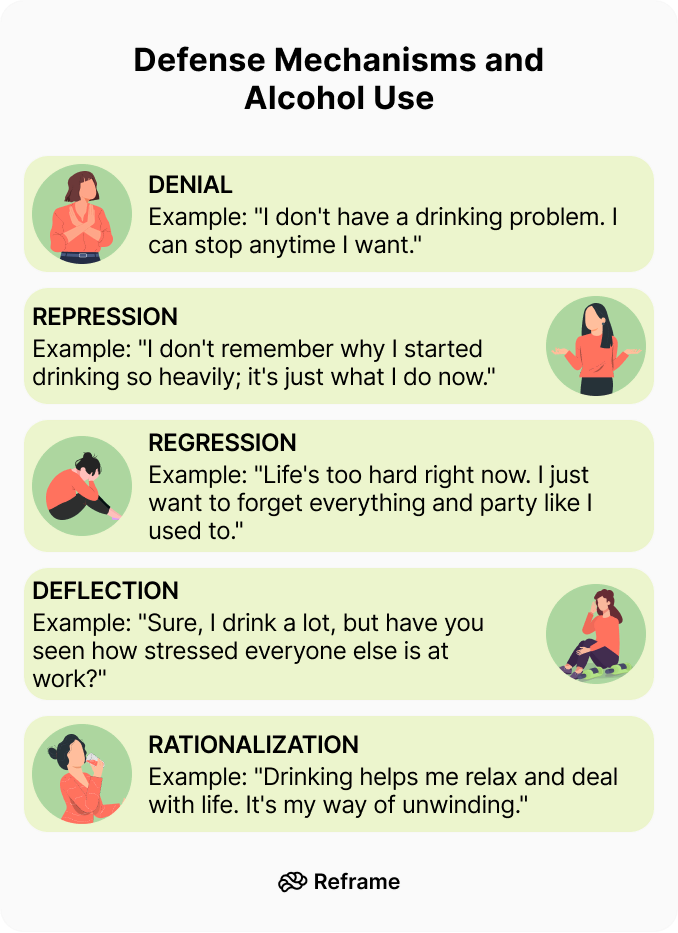
Alcoholics commonly use primitive defense mechanisms because these behaviors develop early in life and are unconsciously available to them most of the time. Children and teenagers typically use this defense mechanism, but for adults, it can become maladaptive. The most common primitive defenses show up in various ways.
Denial means a person refuses to accept reality or facts. More often than not, they do not understand that they are “in denial” or being dishonest because they refuse to acknowledge reality. An example of denial could be an alcoholic telling their friends that they do not have a drinking problem.
Regression is reverting to an earlier childhood behavior when faced with stress. For an alcoholic, it can manifest in refusing to get out of bed or neglecting responsibilities.
Deflection is redirecting a conversation or accusation to evade direct confrontation. This type of defense mechanism is used to shift focus away from yourself and toward another person, topic, or issue to avoid accountability.
Repression involves a person subconsciously “blocking” or “forgetting” distressing memories or facts. According to research, addiction itself is a form of repression because an alcoholic’s failure to deal with the reality of alcoholism eventually leads to more substance abuse.
Rationalization means a person makes excuses and justifies their actions to avoid shame and guilt. An alcoholic will try to offer an explanation for their behavior. For example, if a friend asks about their excessive drinking habits, an alcoholic might rationalize that drinking is okay because they had a stressful day at work.
What is deflection?
Have you ever tried to have a serious conversation with someone, only to find the topic suddenly switched, or the blame somehow turned back on you? You may have been experiencing deflection. Deflection is a defense mechanism used to redirect a conversation or accusation to evade direct confrontation. It’s a way to shift the focus away from yourself and onto another person, topic, or issue to sidestep accountability. While it can be a subconscious habit, it often leaves the person on the receiving end feeling confused, frustrated, and unheard. This is especially true when discussing sensitive subjects like alcohol consumption, where an open and honest dialogue is crucial for making progress and offering support.
Common examples of deflection
Deflection isn’t always obvious. It can show up in several different ways, from subtle shifts in conversation to outright blame-shifting. Because it’s often an automatic response, the person deflecting may not even be fully aware they’re doing it. However, the impact remains the same: the core issue is avoided, and the conversation stalls. Recognizing these tactics is the first step in understanding the dynamic at play and learning how to respond in a way that is both compassionate and constructive. Let's look at a few common forms deflection can take in everyday interactions.
Blame-shifting
This is a classic deflection tactic where the person turns the tables and makes you feel like you’re the one at fault. If you bring up their drinking habits, they might respond with, “Well, I wouldn’t have to drink if you didn’t stress me out so much.” This move not only dodges responsibility for their own actions but also puts you on the defensive, completely derailing the original concern you were trying to address. Suddenly, you find yourself defending your own behavior instead of discussing theirs, which is exactly what the deflection is designed to achieve.
Minimizing
Minimizing happens when someone tries to downplay the significance of their behavior or your feelings about it. They might say things like, “You’re making a big deal out of nothing,” or “It was just one night, relax.” This tactic is particularly damaging because it invalidates your concerns and can make you question whether you’re overreacting, even when your feelings are completely justified. It’s a way of dismissing the problem without ever having to engage with it, leaving you feeling small and unheard while the underlying issue goes unaddressed.
Counter-attacking
When you feel like you’re being attacked for simply bringing something up, that’s a counter-attack. Instead of addressing your point, the person lashes out with insults or brings up your past mistakes to discredit you. A common example is, “Who are you to talk? What about that time you…?” This aggressive strategy is designed to change the subject by putting your character or history on trial. It’s a powerful way to silence you, as it forces you to defend yourself against unrelated accusations, moving the spotlight far away from their own behavior.
Playing the victim
This tactic involves adopting a victim mentality to generate sympathy and shift the focus away from the problematic behavior. Someone might say, “I can never do anything right,” or “Why is everyone always against me?” This can make you feel guilty for raising the issue in the first place, effectively silencing your concerns. It cleverly reframes the situation, forcing you into the role of a comforter or an aggressor instead of a concerned loved one trying to have an important conversation. The original issue is lost as you tend to their perceived pain.
Changing the subject
Perhaps the most straightforward form of deflection, this is when someone abruptly steers the conversation to a completely unrelated topic. You might be in the middle of expressing your worries about their drinking, and they’ll suddenly say, “Hey, did you see the game last night?” or “I forgot to tell you what happened at work.” It’s a clear and often jarring attempt to escape an uncomfortable discussion. While it may seem less confrontational than other tactics, it’s just as effective at shutting down communication and preventing any resolution.
Why do people deflect?
Deflection is rarely a calculated, malicious act. More often, it’s an ingrained, automatic response to a perceived threat to one's emotional state or self-perception. Understanding the underlying reasons why someone deflects can foster empathy and help you approach the situation more effectively. It’s typically rooted in deep-seated fears, learned behaviors, and a desire for self-preservation rather than a conscious desire to cause harm. By looking past the frustrating behavior, we can see the vulnerability that often lies beneath it and find more productive ways to connect.
Fear of uncomfortable emotions
At its core, deflection is often a strategy to avoid difficult feelings. According to mental health experts, people deflect to sidestep vulnerability, judgment, or criticism. Confronting a drinking problem, for instance, means facing powerful emotions like shame, guilt, and fear of the unknown. By redirecting the conversation, a person can temporarily postpone having to deal with these overwhelming feelings. It’s a short-term solution to protect themselves from emotional pain, even if it creates bigger problems in the long run.
Low self-esteem
For many, admitting a mistake or a flaw feels like a direct attack on their self-worth. Deflection serves as a shield to protect a fragile self-image. If they can blame someone else, minimize the issue, or change the subject, they don’t have to face the possibility that they’ve done something wrong. This can be too painful for someone with low self-esteem to handle. Acknowledging a problem like excessive drinking might feel like admitting they are a "bad" person, so they instinctively push the focus elsewhere to preserve their sense of self.
Learned behavior
Many of our coping mechanisms are formed in childhood. If someone learned early on that blaming a sibling or creating a distraction was an effective way to avoid getting in trouble with a parent, that pattern can easily carry over into adulthood. Deflection becomes a go-to, subconscious habit for managing conflict and avoiding negative consequences. It’s not that they are intentionally trying to be difficult; rather, they are using a tool that has worked for them in the past, without realizing its destructive impact on their adult relationships.
Response to past trauma
For individuals who have experienced trauma, certain topics, feelings, or situations can be incredibly triggering. Deflection can be an unconscious attempt to avoid re-experiencing painful memories or the intense emotions associated with them. In this context, it’s a protective mechanism designed to maintain emotional safety and stability. A conversation about loss of control due to drinking, for example, might touch on past experiences where they felt powerless, causing them to instinctively shut down or redirect the conversation to feel safe again.
How deflection differs from other concepts
The world of psychology has a lot of overlapping terms, and it’s easy to confuse deflection with other behaviors like gaslighting, denial, or projection. While they can all be present in difficult conversations and serve as defense mechanisms, they aren’t the same thing. Pinpointing the exact mechanism at play can help you understand what’s happening on a deeper level and decide how to respond in the most helpful way. Let’s clear up the differences between these common but distinct psychological concepts.
Deflection vs. gaslighting
The key difference here is intent and impact. Deflection is primarily an avoidance tactic, often unconscious, meant to steer a conversation away from an uncomfortable topic. Gaslighting, however, is a deliberate and manipulative form of psychological abuse designed to make you doubt your own perceptions, memories, and sanity. Deflection essentially says, “Let’s not talk about this,” by changing the subject. Gaslighting is far more sinister, sending the message, “What you’re saying isn’t real, and you’re crazy for thinking it is.”
Deflection vs. denial
Deflection and denial are both ways of avoiding a difficult truth, but they operate differently. As explained by experts at 7 Cups, deflection acknowledges the topic on some level but immediately changes the subject or shifts blame. Denial is a complete refusal to accept that the problem even exists in the first place. For example, someone deflecting might pivot the conversation when you mention their drinking. In contrast, someone in denial will look you in the eye and insist, “I don’t have a drinking problem at all.”
Deflection vs. projection
Projection is when you take your own unacceptable qualities or feelings and attribute them to someone else. For example, a person who is secretly feeling insecure about their own behavior might accuse you of being judgmental or critical of them. It’s about offloading one's own internal state onto another person. Deflection, on the other hand, doesn’t necessarily involve assigning your feelings to others. It’s simply about avoiding the conversation about your own feelings or actions by any means necessary, most commonly by changing the subject entirely.
What Is the Most Common Defense Mechanism Used by Alcoholics?
Among the five primitive defense mechanisms listed above, denial and repression are the behaviors that could lead to alcoholism. An alcoholic may genuinely believe that they don’t have a problem or that their drinking is under control despite the evidence to the contrary. The habit of denying continued substance abuse, refusing to acknowledge the problem, and delaying treatment or support can easily spiral into addiction.
Shifting to Healthier Coping Strategies
Mature defense mechanisms include more evolved and adaptive behaviors than primitive defense mechanisms. These mechanisms develop later in life and are usually more effective in managing stress, trauma, and conflicts. They are often referred to as positive coping mechanisms in psychological theories.
Altruism is a transformative type of defense mechanism because it allows you to derive fulfillment from helping others. Unlike primitive defense mechanisms, which focus on yourself and often lead to negative outcomes, altruism can be constructive and beneficial to others. When you focus on the needs and well-being of others, you may find your own problems less overwhelming. You can also use altruism as a bridge to build strong social connections that can provide you with emotional support, which can greatly benefit your mental health.
Humor is when a person deflects tension by telling jokes. You might use this defense mechanism as a way to connect with others by breaking down barriers, and it can also be a way to lighten your emotional load.
Anticipation deals with managing anxiety by anticipating future issues and preparing for them. This type of adaptive defense mechanism lets you mentally prepare for potential situations, helps you actively think through obstacles, and encourages you to create contingency plans. If you are struggling to stay sober, you can create prevention plans to stay alcohol-free.
Are Defense Mechanisms Hurting Your Relationships?
Defense mechanisms have a ripple effect on relationships, so it’s important to understand how these behaviors can impact your interactions with your loved ones, friends, and even colleagues.
Strained relationships. The use of primitive defense mechanisms can strain personal and professional relationships if it turns into maladaptive behavior. For example, if you constantly deny issues or project your faults onto others, your loved ones or colleagues might feel misunderstood or turned away.
Barriers to accessing mental health support. Using defense mechanisms can prevent your family or friends from offering support or assistance, especially when they do not understand your situation.
Modeling and influence on others. In a family setting, alcohol misuse by parents can deeply affect their children. Using defense mechanisms to rationalize alcoholism or other destructive behaviors can influence how children cope with their own emotions and deal with stress since maladaptive defense mechanisms can become normalized within the family and create or perpetuate a cycle.
To preserve your relationships, you can find ways to overcome your defense mechanisms.
The negative impact of deflection
While deflection might seem like a harmless way to sidestep an awkward conversation, it can cause significant damage over time. It’s a conversational dead-end that not only shuts down communication but also chips away at the health of your relationships. When someone consistently redirects blame or changes the subject, they create an environment of instability and frustration. This makes it nearly impossible to connect authentically or resolve the underlying issues that are causing friction in the first place.
It breaks down trust
Trust is the foundation of any meaningful relationship, and deflection is a wrecking ball. When you try to have a serious conversation with someone who constantly deflects, you’re left feeling unheard, dismissed, and alone. According to Manhattan Mental Health Counseling, this dynamic can hurt relationships by causing misunderstandings and ultimately breaking down trust. Each time a concern is pushed aside, a little bit of that foundation crumbles. Over time, you might learn that being vulnerable with this person isn’t safe, and you may stop trying to communicate altogether, leading to distance and resentment.
It prevents problem-solving
You can’t fix a problem you refuse to acknowledge. Deflection is the ultimate roadblock to progress because it prevents the actual issue from ever being discussed. By shifting blame or changing the topic, the person deflecting ensures that the conversation stays on the surface, never getting to the root of the conflict. This tactic makes it harder to solve problems and stops people from having deeper, more meaningful conversations. Whether it’s a personal habit that needs addressing or a conflict within a relationship, deflection keeps everyone stuck in a frustrating cycle where nothing ever gets resolved.
It can become a form of emotional abuse
When used repeatedly and systematically, deflection can cross the line from a simple defense mechanism into a pattern of emotional abuse. It becomes a tool for manipulation and control, leaving the other person feeling confused and full of self-doubt. According to UK Therapy Guide, if deflection is constant, it can become emotional abuse, especially when paired with tactics like gaslighting—making you question your own memory and feelings. When someone consistently refuses to take responsibility for their actions and instead turns every issue back on you, it creates a toxic dynamic that can be incredibly damaging to your mental well-being.
How to Overcome Unhelpful Defense Mechanisms
The first step to overcoming destructive defense mechanisms is recognizing and addressing them as a problem. Heavily relying on primitive defense mechanisms can hold you back from emotional healing, self-awareness, and developing healthier coping strategies.
Psychoanalysis, mindfulness-based, and interpersonal therapies can be used to increase your insight and awareness, encourage acceptance to reduce defensive reactions, and explore your past experiences to identify the origin of your defense mechanisms.
You can also use self-reflection and gratitude journaling to inspire you to regularly reflect on your thoughts, feelings, and reactions, helping you identify how and why you use defense mechanisms. Starting a gratitude journal can help improve your emotional well-being, especially when dealing with negative thought patterns that come from self-reflection. Gratitude journaling can also help build your resilience over time, making it easier to work through defense mechanisms.
Mindfulness activities and meditation can help you reduce defensive mechanisms and become more aware of the present moment. Activities like walking, single-tasking, and DIY crafts are excellent ways to be fully present in the moment and reduce stress. Practicing mindfulness in your daily life can help you recognize defense mechanism patterns and choose a more constructive response.
How to stop deflecting
If you recognize deflection in your own behavior, that awareness is the first and most important step toward change. Breaking this habit involves slowing down your automatic reactions and choosing a more direct and honest way to communicate. It’s about building the emotional muscle to sit with discomfort instead of immediately pushing it away. By practicing new responses, you can learn to face difficult conversations with more confidence and create stronger, more authentic connections with the people around you.
Practice self-awareness
The first step is to simply notice when you're doing it. Self-awareness is the foundation of any meaningful behavior change, as you can’t fix a habit you don’t realize you have. Start paying attention to conversations where you feel criticized, ashamed, or uncomfortable. What is your immediate verbal reflex? Do you change the subject, point out someone else’s flaw, or make a joke? Just becoming aware of this pattern as it happens, without judgment, is a huge move in the right direction. It allows you to see the choice you have in how you respond.
Pause before you respond
When you feel the urge to deflect, give yourself a moment. A simple pause can be incredibly powerful. Take a deep breath before you say anything. This small action creates a buffer between the trigger (like a pointed question or criticism) and your habitual response. It breaks the knee-jerk reaction and gives your more thoughtful, intentional self a chance to step in. This space allows you to choose a response that aligns with the person you want to be, rather than letting an old defense mechanism run the show and dictate your actions.
Identify the underlying feeling
Deflection is almost always a shield for an uncomfortable emotion. Ask yourself: What feeling am I trying to avoid right now? Is it shame, guilt, fear of being wrong, or anxiety about the conflict? By naming the emotion, you take away some of its power. Instead of running from the feeling, you can acknowledge it. For example, you might think, “I’m feeling ashamed that I forgot to do that task.” Acknowledging the root cause allows you to address it directly, perhaps by saying, “You’re right, I forgot. I’m sorry,” instead of launching into a defensive tirade.
Practice openness and vulnerability
Ultimately, overcoming deflection requires a willingness to be vulnerable. It means accepting that you aren't perfect and that it's okay to make mistakes. When you can embrace vulnerability, you no longer need to build walls to protect yourself from judgment. Admitting when you’re wrong or acknowledging a valid point doesn’t make you weak; it makes you human and relatable. This openness fosters trust and allows for genuine problem-solving, strengthening your relationships far more than any defense mechanism ever could.
How to respond when someone deflects
It can be incredibly frustrating to have a conversation with someone who constantly deflects. You might feel like you’re talking in circles, unable to resolve anything. When you’re on the receiving end of this behavior, it’s important to respond in a way that is both firm and compassionate. Your goal is to guide the conversation back to a productive place without escalating the conflict. By using clear and calm communication strategies, you can address the deflection without attacking the person, creating an opportunity for a more honest dialogue.
Stay focused on the topic
When the other person tries to change the subject or point a finger elsewhere, your first job is to be a calm and steady anchor for the conversation. Don’t take the bait and follow them down a rabbit hole. Instead, gently but firmly guide the discussion back to the original point. You can say something like, “I understand that’s a concern, but I’d like to stay focused on the issue at hand,” or “We can talk about that later, but right now we need to resolve this.” This keeps the conversation on track and shows that you won’t be easily sidetracked.
Use “I” statements
To avoid making the other person more defensive, frame your feelings from your own perspective. Using “I” statements is a powerful tool for this. Instead of saying, “You’re not listening to me,” you could try, “I feel unheard when the conversation shifts away from my concern.” This approach communicates the impact of their behavior without sounding like an accusation. It focuses on your experience rather than their character, which can help them hear your point of view without immediately feeling the need to defend themselves.
Set clear boundaries
If deflection is a recurring pattern and is causing harm to the relationship, it’s crucial to set boundaries. You have a right to conversations that are respectful and productive. You might need to clearly state what you will and will not accept. For example, you could say, “It’s important to me that we can both take responsibility for our actions. If we can’t do that, I’m going to need to step away from this conversation for now.” Setting a boundary isn’t a threat; it’s a way of protecting your own emotional well-being and defining the terms for healthy communication.
Focus on solutions, not blame
Often, deflection is rooted in a fear of being blamed. You can de-escalate the situation by shifting the focus from fault-finding to problem-solving. Frame the issue as a shared challenge that you can tackle together. Ask questions like, “How can we work together to solve this?” or “What can we do to make sure this doesn’t happen again?” By inviting collaboration, you change the dynamic from a confrontation to a partnership. This makes it safer for the other person to let their guard down and engage in a more constructive way.
Finding Freedom from Reactive Behavior
Understanding and changing your defense mechanisms is tough, but it can be incredibly rewarding because it’s about taking control of your emotional journey. Remember, you are not doing this alone. Family, friends, support groups, and even therapists are there to back you up, offer support, and provide insight, especially when progress feels slow.
If you want to cut back on your alcohol consumption but don’t know where to start, consider trying Reframe. We’re a neuroscience-backed app that has helped millions of people reduce their alcohol consumption and develop healthier lifestyle habits.
Frequently Asked Questions
My partner always changes the subject when I mention their drinking. What can I do? It’s incredibly frustrating when you feel like you’re talking to a wall. The key is to not get pulled into the new topic. Try to gently but firmly steer the conversation back to your original point. Using “I” statements can help you express how their behavior affects you without sounding accusatory. For example, saying “I feel unheard when we switch topics” is less likely to provoke a defensive reaction than “You always change the subject.” If it’s a constant pattern, it may be time to set a clear boundary about your need for open and honest conversations.
I think I might be the one who deflects. How can I start to change this habit? First off, recognizing this in yourself is a huge and difficult step, so be proud of that awareness. The next step is to practice pausing. When you feel that urge to change the subject or shift blame, take a deep breath before you speak. In that small moment of silence, ask yourself what feeling you’re trying to avoid. Is it shame? Fear? Guilt? Simply naming the emotion can give you the power to choose a more direct response instead of letting an old habit take over.
Is deflection always a conscious, manipulative choice? Not at all. More often than not, deflection is an automatic and deeply ingrained habit. It’s a subconscious strategy our brains use to protect us from uncomfortable emotions like criticism, shame, or vulnerability. Many people learn this behavior in childhood as a way to avoid trouble, and it carries over into their adult relationships without them even realizing it. While it can feel manipulative to the person on the receiving end, it’s usually rooted in self-preservation rather than a deliberate intent to cause harm.
How can I tell the difference between deflection and gaslighting? This is a great question because the two can feel similar, but their core purpose is very different. Deflection is an avoidance tactic; its goal is to get out of an uncomfortable conversation. Think of it as someone saying, “Let’s not talk about this.” Gaslighting, on the other hand, is a form of psychological manipulation designed to make you question your own reality. It’s not about avoiding the topic—it’s about convincing you that the topic isn’t real and that you’re wrong or crazy for bringing it up.
Are all defense mechanisms bad? When are they helpful? No, not all defense mechanisms are unhealthy. Some are actually signs of emotional maturity and can be very helpful. For example, sublimation is when you channel difficult emotions into something productive, like writing, exercising, or starting a creative project. Using humor to lighten a tense situation or being able to anticipate a future problem and prepare for it are also positive coping strategies. The goal isn’t to eliminate all defenses, but to recognize when they are causing harm and replace those unhelpful reactions with more constructive ones.
Key Takeaways
Recognize Deflection as a Shield, Not a Sword: When someone shifts blame, minimizes your feelings, or changes the subject, it's often an automatic defense against feeling vulnerable. Seeing it as a protective reflex rather than a personal attack is the first step to a better conversation.
Deflection Creates Distance and Stalls Progress: This avoidance tactic might seem harmless in the moment, but it prevents real problem-solving and slowly erodes trust in your relationships. You can't fix an issue that you're not willing to discuss openly.
Break the Cycle with Mindful Communication: If you tend to deflect, practice pausing before you respond to identify the feeling you're avoiding. If you're on the receiving end, use "I" statements and gently guide the conversation back to the original topic to create a safe space for honesty.
1. What is the most common defense mechanism used by alcoholics?
Alcoholics often use primitive defense mechanisms like regression, denial, deflection, repression, and rationalization. These defense mechanisms can develop early in life and can be maladaptive in adulthood as they serve to avoid reality and justify negative behaviors.
2. How do defense mechanisms affect alcoholics differently from others?
For alcoholics, defense mechanisms can worsen their situation by enabling avoidance and rationalization of their addiction. This can lead to neglecting responsibilities, denying the severity of their addiction, and avoiding accountability, ultimately hindering recovery.
3. What are some examples of mature defense mechanisms and their benefits?
Mature defense mechanisms like altruism, humor, and anticipation are evolved behaviors that effectively manage stress and conflict. Altruism involves finding fulfillment in helping others and can lead to strong social connections, while humor lightens emotional loads and builds connections. Anticipation involves preparing for future challenges, aiding in proactive problem-solving and anxiety management.
4. How do defense mechanisms impact relationships?
Primitive defense mechanisms can strain relationships and create barriers to support. They may lead to misunderstandings, alienation, and a lack of effective communication. Additionally, using defense mechanisms to rationalize harmful behaviors, like alcoholism, can negatively influence children and perpetuate unhealthy coping strategies within families.
5. What are effective approaches to overcoming destructive defense mechanisms?
Recognizing defense mechanisms as a problem is the first step to overcoming them. Psychoanalysis, mindfulness-based therapies, and interpersonal therapies can improve insight, encourage acceptance, and explore past experiences to identify the origins of defense mechanisms. These approaches help in emotional healing and the development of healthier coping strategies.
6. How can journaling and mindfulness activities aid in managing defense mechanisms?
Self-reflection and gratitude journaling are powerful tools for understanding and managing defense mechanisms. They encourage regular reflection on thoughts and emotions, helping to identify and modify defensive behaviors. Mindfulness activities like walking, single-tasking, and DIY crafts can increase present-moment awareness and reduce stress, making recognizing and changing unhelpful defense patterns easier.
How Can Reframe Help You?
If you’ve been struggling with your drinking habits and maladaptive thought patterns, Reframe is here to help! We’re the #1 app for reducing alcohol or quitting altogether. With over two million downloads, our proven program has helped people across the world to achieve their drinking goals and start living their best lives.
How does it work? For starters, we give you daily readings about the neuroscience of alcohol in addition to activities like journal prompts and mindfulness exercises. You’ll also have access to a comprehensive suite of courses to broaden your knowledge and skill set, an in-app Toolkit which helps you through the tough moments like cravings, and a group of trackers to log your drinks, mood, appetite, and stress.
You also gain access to a 24/7 Forum chat where you can connect with people just like you who are also reevaluating their relationships with alcohol. Additionally, you can join daily check-in calls on Zoom where people from around the globe share their stories to ask for advice and offer encouragement to others.
Best of all, Reframe is free for 7 days, so you can try it without any pressure! We invite you to download the app today and discover life beyond drinking. Whether your ultimate goal is to cut back on your alcohol intake or quit for good, we’ve got you covered. Let’s drink less together!
Reframe is not a treatment for Alcohol Use Disorder (AUD). Because stopping drinking can be dangerous in some cases, any plan to greatly reduce or quit drinking should be developed with a medical professional who can ensure it is implemented using safe, effective methods.
Reframe has helped over 2 millions people to build healthier drinking habits globally
At Reframe, we do science, not stigma. We base our articles on the latest peer-reviewed research in psychology, neuroscience, and behavioral science. We follow the Reframe Content Creation Guidelines, to ensure that we share accurate and actionable information with our readers. This aids them in making informed decisions on their wellness journey. Learn more
Updated Regularly
Our articles undergo frequent updates to present the newest scientific research and changes in expert consensus in an easily understandable and implementable manner.