Can You Drink Alcohol Before a Sleep Study? What to Know
Published:
2026-09-15
·
Read time:
14 min read
Last Updated:
2026-09-16
Written by
Reframe Content Team
A team of researchers and psychologists who specialize in behavioral health and neuroscience. This group collaborates to produce insightful and evidence-based content.
Certified recovery coach specialized in helping everyone redefine their relationship with alcohol. His approach in coaching focuses on habit formation and addressing the stress in our lives.
Recognized by Fortune and Fast Company as a top innovator shaping the future of health and known for his pivotal role in helping individuals change their relationship with alcohol.
September 15, 2026
·
14 min read
Reframe Content Team
September 15, 2026
·
14 min read
No, you should not drink alcohol before a sleep study, and most sleep labs specifically ask you to avoid it for at least 24 to 48 hours beforehand. Alcohol suppresses REM sleep early in the night and triggers fragmentation and REM rebound later, while also relaxing your upper airway muscles and deepening oxygen dips, which can inflate or mask an apnea diagnosis and make the whole night's data unreliable. In practice, that means a study you waited weeks for may have to be repeated, or worse, may lead to a treatment plan built on distorted numbers. If cutting out alcohol for a couple of nights sounds harder than it should, that's worth noticing too, and it's exactly the kind of pattern Reframe helps people look at honestly.
Can You Drink Alcohol Before a Sleep Study?
No, you should not drink alcohol before a sleep study, and sleep labs routinely tell patients to skip it. The American Academy of Sleep Medicine lists avoiding alcohol and other sedatives among its standard pre-study instructions, and Cleveland Clinic advises avoiding caffeine and alcohol for at least eight hours beforehand, noting that both can disrupt normal sleep patterns and affect the results. More broadly, alcohol is generally understood to shift sleep stages, relax the muscles that keep your airway open, and deepen oxygen dips, which can inflate or mask an apnea diagnosis and make the night's data hard to interpret. Practically, that means a study you waited weeks for may need to be repeated, or may produce a treatment plan built on distorted numbers.
Here's the thing about a sleep study: you are being asked to sleep normally in a room full of wires while a stranger watches your breathing on a monitor. Nothing about that feels normal. So it's understandable that a glass of wine before the drive over starts to sound like a reasonable idea, a way of taking the edge off so you can actually fall asleep and give the lab something to record.
We get the logic. It just backfires. The whole point of polysomnography is to capture your baseline, and alcohol quietly rewrites almost every channel the machine is recording. Below we'll walk through what specifically goes wrong, how long labs want you to abstain, what to say if you already drank, and the one scenario where "just stop for two nights" is a question for your doctor rather than a matter of discipline.
Why do sleep clinics tell you to avoid alcohol before a sleep study?
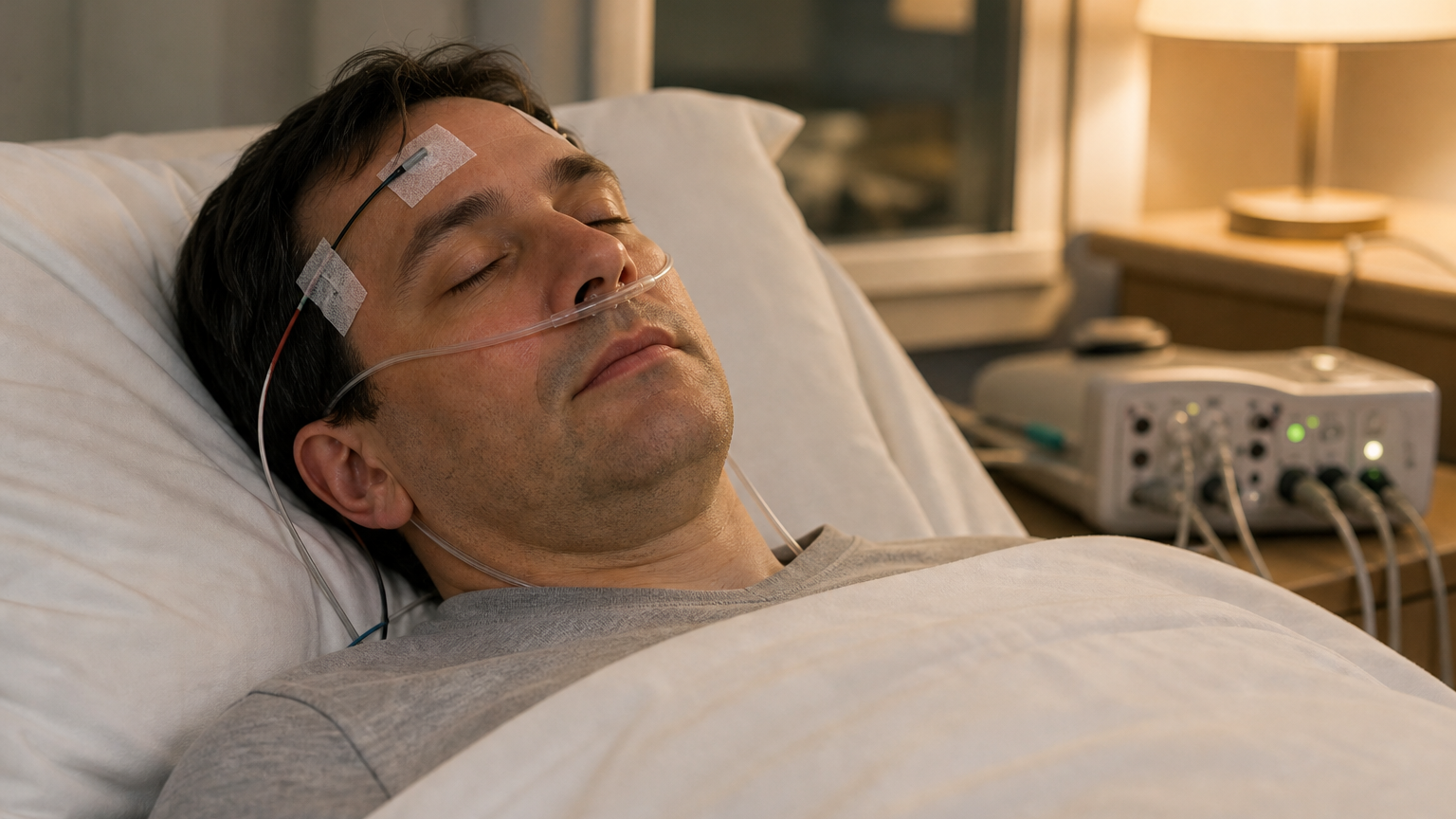
Clinics want one uncontaminated night that represents how you actually sleep. That's the entire premise of the test. When a technician hooks up electrodes to your scalp, face, chest, and legs, they are trying to record your ordinary physiology, not your physiology plus a central nervous system depressant. The AASM's patient guidance groups alcohol with other sedatives as things to avoid unless a doctor specifically prescribed them, and notes your provider may also ask you to pause certain medications before the test.
Look at what a polysomnogram actually measures and the problem becomes obvious. Brain waves and sleep stages. Eye movements. Chin and leg muscle tone. Airflow, breathing effort, snoring. Blood oxygen saturation. Heart rhythm. Alcohol touches nearly all of it. That's why pre-study instruction sheets tend to bundle alcohol with caffeine, naps, and heavy late meals: each one nudges the recording away from your baseline, and alcohol nudges the hardest.
A distorted study is not just a slightly noisy study. It can push results in either direction. A night of drinking can make breathing events look worse than they usually are, and it can also produce a report that doesn't match your daytime symptoms, leaving your physician with a confusing picture and you without an answer. Either way, you spent the night in a lab for data nobody can fully trust.
Home tests aren't exempt. The AASM notes that home sleep apnea test devices measure your breathing and blood oxygen level, with some also measuring heart rate or other information about your body. Those are channels alcohol is generally thought to affect. Because these limited setups typically don't capture the full picture a lab study does, drinking beforehand may be harder to spot. If you're weighing up a broader pattern here, our overview of alcohol and sleep covers the everyday version of this problem.
How does alcohol distort your sleep architecture on a polysomnogram?
Sleep architecture is just the shape of your night: how much time you spend in light sleep, deep sleep, and REM, and in what order. Alcohol bends that shape in a specific and well-documented way, which is why an interpreting physician can often tell something happened even without being told.
What alcohol does to REM in the first half of the night
The early hours after a drink can look, on paper, like unusually solid sleep. In a controlled polysomnography study, a bedtime dose producing a 0.1% blood alcohol level behaved like a short-acting sleep drug in the first half of the night, shortening the time to fall asleep, reducing awakenings, and increasing slow-wave sleep, with rebound effects such as more light sleep showing up in the second half. The authors were clear that the sample was small, so treat it as illustrative rather than definitive.
What's missing from that deceptively tidy first half is REM. A meta-analysis of 27 controlled studies found that alcohol delays the onset of REM sleep and reduces total REM duration, with disruption appearing at roughly two standard drinks and worsening as the dose climbs. So the report doesn't just show less dreaming sleep; it shows REM arriving late, which is one of the numbers your physician looks at directly. If you want the underlying neuroscience, our explainer on how alcohol impacts REM sleep goes deeper than we can here.
Why the REM rebound in the second half matters for your report
Then blood alcohol falls toward zero, and the brain does what brains do after suppression: it pushes back. The same polysomnography study found REM density reduced early in the night and REM amount increased after the alcohol was discontinued. In plain terms, the REM you didn't get shows up later, often alongside more fragmented, lighter sleep.
That produces a lopsided, two-halves night. Deep sleep front-loaded, REM back-loaded, awakenings clustered toward morning. Stage percentages, REM latency, and sleep-continuity measures all come out skewed relative to your normal night, and clinicians often note that more frequent arousals also push up the arousal index, a number used to judge how fragmented your sleep is. Worth saying plainly: the meta-analysis found large uncertainty in alcohol's effects on total sleep time and sleep efficiency, so we're not going to hand you a tidy percentage. The reliable part is the REM distortion and the shape of the night, and that alone is enough to make a report hard to read as your baseline. Readers who've noticed this pattern at home may recognize it from our piece on why alcohol worsens insomnia.
Can alcohol change your AHI and sleep apnea diagnosis?
Yes, and this is where a distorted study stops being an abstract data-quality issue and starts changing what happens to you clinically. The apnea-hypopnea index (AHI) counts how many times per hour your breathing stops or shallows enough to matter, and it's the number that determines whether you're diagnosed with obstructive sleep apnea and how severe it's called.
Alcohol works as a muscle relaxant, and the muscles holding your upper airway open at night are not exempt. A meta-analysis of 14 controlled studies including 422 participants found that AHI rose significantly after alcohol and mean oxygen saturation fell, with the largest increases among snorers and people already diagnosed with obstructive sleep apnea; in that already-diagnosed subgroup, AHI climbed by roughly seven events per hour. That review also reported longer respiratory events and a lower minimum oxygen saturation with alcohol. Seven events an hour is genuinely enough to move someone from mild to moderate, or moderate to severe, which is the kind of shift that changes treatment recommendations and device settings.
Clinicians often describe a second mechanism layered on top of the airway relaxation: alcohol blunts the arousal response that normally rouses you just enough to reopen a collapsed airway. We're flagging that as explanatory framing rather than a hard citation, but it fits the measured outcomes above, longer events and deeper oxygen dips, better than airway narrowing alone would.
Alcohol can also create events in people who wouldn't otherwise have them. In a small early polysomnography study, bedtime alcohol increased the duration and frequency of obstructive episodes in patients with sleep apnea, and in two patients with benign chronic snoring it induced frank obstructive sleep apnea in the first hour of sleep. Seven patients total, so hold it loosely, but the direction is consistent with everything else. And at the population level, a separate systematic review concluded that alcohol consumption is associated with a higher risk of sleep apnoea and that cutting back may have preventive value.
The flip side is real too. A night that starts with heavy front-loaded deep sleep, fewer position changes, and a groggy sleeper may generate a report that simply doesn't match what your partner describes hearing from the other side of the bed. Some people also find that pre-study drinking muddies a snoring question they came in to answer, which we unpack in why snoring worsens after drinking.
How long before a sleep study should you stop drinking?
Your clinic's written instructions are the authority, full stop. If the packet says something specific, that's your answer and nothing here overrides it. Different labs ask for different things, and the technician running your study is following that lab's protocol.
That said, here's the honest state of published guidance. Cleveland Clinic advises avoiding caffeine and alcohol for at least eight hours before your study. The AASM says to avoid alcohol and sedatives without specifying a window. Individual hospital sheets commonly say "the day of the test" or "the night of the study," and some clinics ask for a longer window of 24 hours or more. You'll see a 48-hour figure circulating widely online; we couldn't trace it to an authoritative body, so we're not going to present it as the standard. If your lab asks for 48 hours, follow that. If it asks for eight or twelve, follow that instead.
The reason a longer window is sometimes requested is straightforward, even if the evidence is thinner than the internet suggests. Alcohol clears the bloodstream in hours, but its effects on sleep don't necessarily exit on the same schedule. The polysomnography study above found that REM amount increased after alcohol was discontinued, though it did not find significant rebound effects on sleep continuity over the following two nights. So a Friday night of drinking may still nudge a Saturday night recording, particularly on REM measures, while the fragmentation effects appear to fade faster. What that means for you: "I'll be sober by bedtime" isn't quite the right standard, because being sober and having normal sleep architecture aren't the same thing.
While you're at it, honor the rest of the pre-study list. Skip caffeine after midday, avoid napping, keep your usual bedtime, and don't add any sleep aid your clinician hasn't approved. And do not stop a prescribed medication on your own to prepare for a study; the AASM's guidance is that your provider may direct you to pause specific medications, which means that decision belongs to the person who prescribed them. If your evening routine is built around a drink, replacing alcohol in your evening routine is a more useful place to start than white-knuckling one unfamiliar night.
What should you tell the technician if you already drank?
Tell them, specifically and without preamble: what you drank, how much, and what time you stopped. That's it. You will not be lectured, and the conversation takes about twenty seconds.
Technicians are not gatekeepers of your character; they are running a test. As a matter of practical clinical routine, they'll note the disclosure on the record so the interpreting physician can factor it in, and depending on how much and how recently you drank, they may raise the possibility of rescheduling. We're describing standard practice here rather than citing a formal protocol, because labs handle it differently. Either outcome is better than the alternative.
The alternative is genuinely the worst option. If nobody knows, the physician reads your distorted night as your ordinary night, and everything downstream, the diagnosis, the severity category, the pressure settings on a CPAP machine, gets built on it. Silence doesn't protect you; it just moves the cost from tonight to the next year of your treatment. Alcohol is one of the most commonly under-reported items in medical settings, which is its own quiet problem, and one we've written about in lying to your doctor about alcohol.
Mention last night, too, not just this evening. If you drank Friday and your study is Saturday, say so, since REM effects may linger past the point where you feel anything. The same honesty applies to a home test: note it on the intake form or call the clinic before you start the recording, since there's no technician in your bedroom to notice.
When is drinking before a sleep study a medical concern, not just a data problem?
For a small but real group of people, "no alcohol for 48 hours" is not a data-quality instruction. It's a medical one, and it needs a phone call.
If you drink daily or heavily, stopping abruptly can produce withdrawal symptoms, and the timing overlaps uncomfortably with a pre-study abstinence window. Harvard Health notes that withdrawal seizures can occur roughly six to 48 hours after the last drink, with risk peaking around 24 hours, and that severe withdrawal, seizures, or delirium tremens are safest treated in a hospital. Cleveland Clinic describes seizure risk as highest 24 to 48 hours after the last drink for severe or complicated withdrawal, with delirium tremens possibly appearing 48 to 72 hours out. Read those windows next to a "stop drinking two days before your appointment" instruction and you can see why this isn't a willpower conversation.
So call the clinician who ordered the study before the test. Sleep Foundation's preparation guidance makes the same point directly: when alcohol is a regular part of someone's routine, it shouldn't be stopped abruptly to prepare for a sleep study, and habitual drinkers should ask their doctor how to prepare. Your clinician can adjust the timing, arrange supervision, or simply note the situation so the study is interpreted with it in mind. That's not a failed test. That's the system working.
Some symptoms need care immediately rather than a scheduled call. MedlinePlus is explicit that delirium tremens is a medical emergency and that anyone with symptoms should go to the emergency room or call 911. Confusion, hallucinations, seizures, or a racing heart after stopping are not things to manage alone overnight in the hope of making your appointment.
One more safety note, because it comes up. Combining alcohol with sleeping pills, benzodiazepines, or opioids before a study is not just a testing problem. Each of those can suppress breathing, and stacking them with alcohol compounds the effect in a body whose airway is already under scrutiny. If you take any of them, ask your prescriber how to handle the night of your study rather than improvising. Our guide to mixing sleep aids and alcohol covers why that combination deserves caution generally.
What does it mean if you can't skip drinking for two nights?
Let's talk honestly about the part of this that has nothing to do with polysomnography. Sometimes the most informative result of a sleep study arrives before you ever get to the lab, in the moment you read "no alcohol" on the instruction sheet and feel something tighten.
A pre-test instruction is a low-stakes natural experiment. If two alcohol-free evenings produce dread, negotiation, or a quiet plan to have one anyway and not mention it, that's information. Not a diagnosis, not a verdict, just data about how automatic the evening drink has become. Plenty of people first notice the shape of their habit not when something goes wrong, but when something ordinary asks them to pause it for a couple of days.
There's also a useful reframe available here. The study is a rare chance to see your actual sleep, and many people find that the picture is far more persuasive than any health article. Alcohol-dependent sleep runs as a self-reinforcing loop: sedation at 11 p.m. purchased with fragmentation at 3 a.m., followed by fatigue that makes the next evening's drink feel more necessary. On a clean recording, that loop becomes visible, and on a contaminated one it stays hidden. Our timeline of what sleep looks like after two weeks of cutting back gives a sense of what the other side of the loop feels like.
If the instruction landed harder than expected, that's worth following up on at your own pace. The Am I Drinking Too Much? quiz takes a few minutes and is built for exactly this kind of noticing, and Reframe's mindful drinking program exists for people who want to change the pattern without being told they're broken. No alcohol before sleep study is a one-night ask. What you learn from making it is yours to keep.
Summary FAQs
1. Will one glass of wine ruin my sleep study?
A small amount may have less effect than several drinks, but labs ask you to skip alcohol entirely because there is no established safe amount for testing purposes. Research shows alcohol delays REM onset and reduces REM duration, with disruption appearing at around two standard drinks, and it also relaxes the upper airway. If you already had a drink, tell the technician the amount and timing so it can be noted on the record.
2. How long does alcohol affect sleep architecture?
Alcohol is usually cleared from the bloodstream within hours, but some effects on sleep stages can outlast the alcohol itself. Controlled polysomnography found REM amount increased after alcohol was discontinued, while sleep-continuity measures did not show significant rebound over the following two nights. That is part of why some clinics request a longer alcohol-free window rather than just a sober evening, though published guidance varies and your clinic's instructions are the authority.
3. Does alcohol make sleep apnea look worse on a test?
Often yes. A meta-analysis of controlled studies found that the apnea-hypopnea index rose and mean oxygen saturation fell after alcohol, with the largest increases in snorers and in people already diagnosed with obstructive sleep apnea. In that already-diagnosed group, AHI rose by roughly seven events per hour, which is enough to shift someone into a higher severity category and influence treatment settings.
4. Do the same rules apply to a home sleep apnea test?
Yes. Home tests measure breathing and blood oxygen, and some also record heart rate, which are precisely the channels alcohol distorts. Even though a home test does not record brain waves or sleep stages, drinking beforehand can still inflate or obscure your results, so follow the same no-alcohol instructions.
5. What if I drink every day and cannot stop for two nights before my sleep study?
Call the clinician who ordered the study before the test. Stopping daily or heavy drinking abruptly can cause withdrawal symptoms that range from tremor and insomnia to, in severe cases, seizures, so this is a medical decision rather than a willpower problem. Your clinician can advise on timing, a supervised plan, or how to interpret the study given your situation.
6. Should I tell the sleep technician that I drank?
Absolutely. As standard practice, technicians note the disclosure on the recording so the interpreting physician knows the data may be affected, and they can advise whether the study should be rescheduled. Concealing it is the riskier choice because the physician would otherwise read a distorted night as your normal baseline and build treatment recommendations on it.
7. Will I have to repeat the sleep study if I drank beforehand?
Sometimes. Depending on how much you drank, how close to bedtime, and how clearly the effects show up in the recording, the physician may judge the study uninterpretable and order a repeat. Being upfront about it early gives the lab the best chance to reschedule rather than waste the night.
Curious What Your Sleep Looks Like Without Alcohol? Reframe Can Help!
Although it isn't a treatment for alcohol use disorder (AUD), the Reframe app can help you cut back on drinking gradually with the science-backed knowledge to empower you 100% of the way. Our proven program has helped millions of people around the world drink less and live more. And we want to help you get there, too!
The Reframe app equips you with the knowledge and skills you need to not only survive drinking less, but to thrive while you navigate the journey. Our daily research-backed readings teach you the neuroscience of alcohol, and our in-app Toolkit provides the resources and activities you need to navigate each challenge.
You'll meet millions of fellow Reframers in our 24/7 Forum chat and daily Zoom check-in meetings. Receive encouragement from people worldwide who know exactly what you're going through! You'll also have the opportunity to connect with our licensed Reframe coaches for more personalized guidance.
Plus, we're always introducing new features to optimize your in-app experience. We recently launched our in-app chatbot, Melody, powered by the world's most powerful AI technology. Melody is here to help as you adjust to a life with less (or no) alcohol.
And that's not all! Every month, we launch fun challenges, like Dry/Damp January, Mental Health May, and Outdoorsy June. You won't want to miss out on the chance to participate alongside fellow Reframers (or solo if that's more your thing!).
The Reframe app is free for 7 days, so you don't have anything to lose by trying it. Are you ready to feel empowered and discover life beyond alcohol? Then download our app through the App Store or Google Play today!
Reframe has helped over 2 millions people to build healthier drinking habits globally
At Reframe, we do science, not stigma. We base our articles on the latest peer-reviewed research in psychology, neuroscience, and behavioral science. We follow the Reframe Content Creation Guidelines, to ensure that we share accurate and actionable information with our readers. This aids them in making informed decisions on their wellness journey. Learn more
Updated Regularly
Our articles undergo frequent updates to present the newest scientific research and changes in expert consensus in an easily understandable and implementable manner.
American Academy of Sleep Medicine. (n.d.). Sleep study. Sleep Education. https://sleepeducation.org/patients/sleep-study/
Cleveland Clinic. (n.d.). Sleep study (polysomnography). https://my.clevelandclinic.org/health/diagnostics/12131-sleep-study-polysomnography
Gardiner, C., Weakley, J., Burke, L. M., Roach, G. D., Sargent, C., Maniar, N., Townshend, A., & Halson, S. L. (2025). The effect of alcohol on subsequent sleep in healthy adults: A systematic review and meta-analysis. Sleep Medicine Reviews, 80, 102030. https://pubmed.ncbi.nlm.nih.gov/39631226/
Feige, B., Gann, H., Brueck, R., Hornyak, M., Litsch, S., Hohagen, F., & Riemann, D. (2006). Effects of alcohol on polysomnographically recorded sleep in healthy subjects. Alcoholism: Clinical and Experimental Research, 30(9), 1527–1537. https://pubmed.ncbi.nlm.nih.gov/16930215/
Kolla, B. P., Foroughi, M., Saeidifard, F., Chakravorty, S., Wang, Z., & Mansukhani, M. P. (2018). The impact of alcohol on breathing parameters during sleep: A systematic review and meta-analysis. Sleep Medicine Reviews, 42, 59–67. https://pubmed.ncbi.nlm.nih.gov/30017492/
Issa, F. G., & Sullivan, C. E. (1982). Alcohol, snoring and sleep apnea. Journal of Neurology, Neurosurgery & Psychiatry, 45(4), 353–359. https://pubmed.ncbi.nlm.nih.gov/7077345/
Simou, E., Britton, J., & Leonardi-Bee, J. (2018). Alcohol and the risk of sleep apnoea: A systematic review and meta-analysis. Sleep Medicine, 42, 38–46. https://pubmed.ncbi.nlm.nih.gov/29458744/
American Academy of Sleep Medicine. (n.d.). Home sleep apnea test. Sleep Education. https://sleepeducation.org/patients/home-sleep-apnea-test/
Sleep Foundation. (n.d.). How to prepare for a sleep study. https://www.sleepfoundation.org/sleep-studies/how-to-prepare-for-a-sleep-study
Harvard Health Publishing. (2024). Alcohol withdrawal. Harvard Medical School. https://www.health.harvard.edu/diseases-and-conditions/alcohol-withdrawal-a-to-z