A team of researchers and psychologists who specialize in behavioral health and neuroscience. This group collaborates to produce insightful and evidence-based content.
Certified recovery coach specialized in helping everyone redefine their relationship with alcohol. His approach in coaching focuses on habit formation and addressing the stress in our lives.
Recognized by Fortune and Fast Company as a top innovator shaping the future of health and known for his pivotal role in helping individuals change their relationship with alcohol.
September 24, 2026
·
14 min read
Reframe Content Team
September 24, 2026
·
14 min read
Yes, shorter days really can push you to drink more, and the trigger is usually light rather than mood. When sunset jumps from 7:30pm to 4:45pm after the clocks change, your brain starts its evening wind-down hours earlier: melatonin release shifts forward, serotonin availability dips with reduced daylight exposure, and your body reads darkness as the signal that the day is over. That makes 6pm feel like 10pm, which is exactly the stretch of empty, unstructured time where a drink tends to fill the gap. Reframe's approach is to make that window visible so you can answer it with something other than a pour.
Why Early Darkness Pulls Us Toward a Drink
Yes, shorter days really can push you to drink more, and the trigger is usually light rather than mood. When sunset jumps from 7:30pm to 4:45pm after the clocks change, your brain starts its evening wind-down hours earlier: melatonin release shifts forward, serotonin availability dips with reduced daylight exposure, and your body reads darkness as the signal that the day is over. That makes 6pm feel like 10pm, which is exactly the stretch of empty, unstructured time where a drink tends to fill the gap. Reframe's approach is to make that window visible so you can answer it with something other than a pour.
Here is the scene most of us recognize. It is the first or second week of November. You close the laptop, look up, and it has been pitch dark outside for an hour. The day feels finished even though dinner has not happened, the kids have not been picked up, and there are four hours left before bed. And somewhere in that stretch, a thought arrives that was not showing up in August: a glass of something would be nice right about now.
If you have noticed yourself drinking more when it gets dark early, you are not imagining a pattern and you have not suddenly lost discipline. What changed is the light. Your internal clock reads light and darkness the way a thermostat reads temperature, and in late fall that reading goes haywire relative to the clock on your wall. This post is about the mechanism behind that, the specific window where it lands, and what actually shifts it.
Why does drinking increase when the sun sets earlier?
The short version: the clocks moving back does not change how much sleep you get, but it does change how much evening you experience in the dark. Sunset lands three hours earlier in perceived terms, your body starts its shutdown sequence in the late afternoon, and alcohol is already coded in most of our heads as the thing that marks the end of a day. Move the end of the day earlier and the first drink follows it.
Think of it like this. For most of the year, there is a natural handoff between "working" and "resting" that happens somewhere around dusk. In June, dusk is at 9pm, so the handoff arrives when you are genuinely almost done. In November, dusk is at 4:45pm, so the handoff arrives while you are still on a call. Your body files the paperwork on the day anyway. What is left is several hours of feeling off-duty without actually being off-duty, which is a strange and slightly uncomfortable place to sit.
Population-level data on seasonal consumption is suggestive rather than settled. Researchers have looked at whether colder, darker regions drink more, and the association shows up, but the size of the effect and how much of it is causal are genuinely debated among the people who study it. What is much less debatable is the individual experience: a lot of people can name the week their evening pattern shifted, and it is usually the week the clocks changed.
The 6pm-feels-like-10pm effect
Your brain does not consult a clock to estimate the time of day. It consults light. When the visual input says "night" at 5pm, everything downstream of that estimate runs early: alertness drops, the pull toward the couch starts, and the mental category of "evening" opens up hours before your schedule agrees. A drink at 10pm feels like a nightcap. The same drink at 6pm feels like a nightcap too, if your body thinks it is 10pm.
That is the whole trick of it. This is a timing and cueing problem, not a character problem. Nobody gets weaker in November. The environment just started sending a different signal, and the signal happens to arrive at the exact moment nothing else is scheduled.
How does less daylight change your brain chemistry?
Three things move at once when daylight shrinks: melatonin timing shifts earlier, serotonin turnover drops, and alcohol looks briefly like the answer to both. None of these are dramatic on their own. Stacked, they make a 5pm evening feel heavier than it should, and they make sedation feel like something you want rather than something you chose.
Melatonin timing
A cluster of nerve cells called the suprachiasmatic nucleus functions as the body's master clock. According to the National Institute of General Medical Sciences, that master clock controls melatonin production based on the amount of light the eyes receive, and in the evening it tells the brain to make more melatonin, causing sleepiness. So early darkness is not a neutral event for that system.
The morning end of the day matters just as much and gets ignored more. Later sunrises mean less bright light early, which gives your clock less to anchor to. You end up with a day that is dim at both ends, and a body that is not sure when it is supposed to be awake.
Serotonin and light exposure
Here is where the mood piece comes in. A study measuring serotonin turnover in the brain found it was lowest in winter and directly related to how many hours of bright sunlight were around. It is worth being precise: the sample was healthy men, and the correlation was modest, not enormous. But the direction is consistent with what most of us report anecdotally. Less light, slightly flatter mood.
So now you have an early-evening slump plus a small downshift in baseline mood, arriving together in a stretch of unstructured time. Alcohol is unusually well suited to that moment, at least at first. The National Institute on Alcohol Abuse and Alcoholism describes how alcohol produces rewarding effects partly by prompting dopamine signaling in the brain's reward pathway, and notes that dopamine is central to learning to associate alcohol and its cues (people, places, things) with those effects. Translation: it feels good, and your brain takes notes on exactly when and where it felt good.
Then the bill arrives overnight. A 2025 systematic review and meta-analysis found that even a low dose of alcohol reduces REM sleep, and that higher doses may get you to sleep faster while likely making the later REM disruption worse. Worse sleep in a season where you already feel low on energy tends to deepen the dip you were trying to smooth out. If you want the longer version of that loop, we dug into it in our piece on how alcohol affects sleep quality.
Is this seasonal affective disorder or just the time change?
Most likely it is neither, in the clinical sense. What the majority of people experience in early winter is a sub-threshold seasonal dip: less energy, earlier fatigue, more appetite for carbs and for a drink, without persistent low mood or any loss of function. That is a real shift and it deserves a real response. It is not a diagnosis.
Seasonal affective disorder is a different thing. The National Institute of Mental Health notes that research links it to altered levels of serotonin, which helps regulate mood, and to altered levels of melatonin, with sunlight affecting the molecules that help maintain normal serotonin levels. Clinically, what tends to set it apart from an ordinary seasonal dip is persistence and impairment: symptoms that stick around over weeks and interfere with work or relationships.
It is also worth saying plainly that the post-clock-change craving shift happens in plenty of people with no mood disorder whatsoever. Your evening habit moving earlier is not evidence that something is wrong with you psychologically.
If you are trying to figure out which side of that line you are on, NIMH's guidance for seasonal symptoms turns on how much the symptoms interfere with daily life, and directs people with more severe symptoms lasting more than two weeks to seek professional help. Anyone in immediate distress or thinking about hurting themselves can call or text the 988 Suicide & Crisis Lifeline. A clinician can sort this out with you far faster than months of self-diagnosis can.
One boundary worth stating: Reframe is a behavior-change tool, not treatment for a mood disorder. The two coexist comfortably. If a seasonal depressive pattern is in play, that is a clinical conversation, and changing your drinking alongside it is a reasonable thing to do with support rather than instead of it.
When exactly does the craving window open after the clocks change?
There is no research that pins a precise craving latency to sunset, so treat this section as a self-tracking exercise rather than a finding. That said, the window most people describe when they pay attention lands in the first hour or two after full dark: in November that is somewhere between late afternoon and early evening, well before dinner and long before bed.
The useful move is to name the clock time rather than the feeling. For one week, write down the time you first think about a drink. Not the time you pour, the time the thought shows up. Most people are startled by how tightly clustered the answers are. Once you have a time, you have something you can plan around, which is a dramatically different situation than having a vague sense of struggling in the evenings.
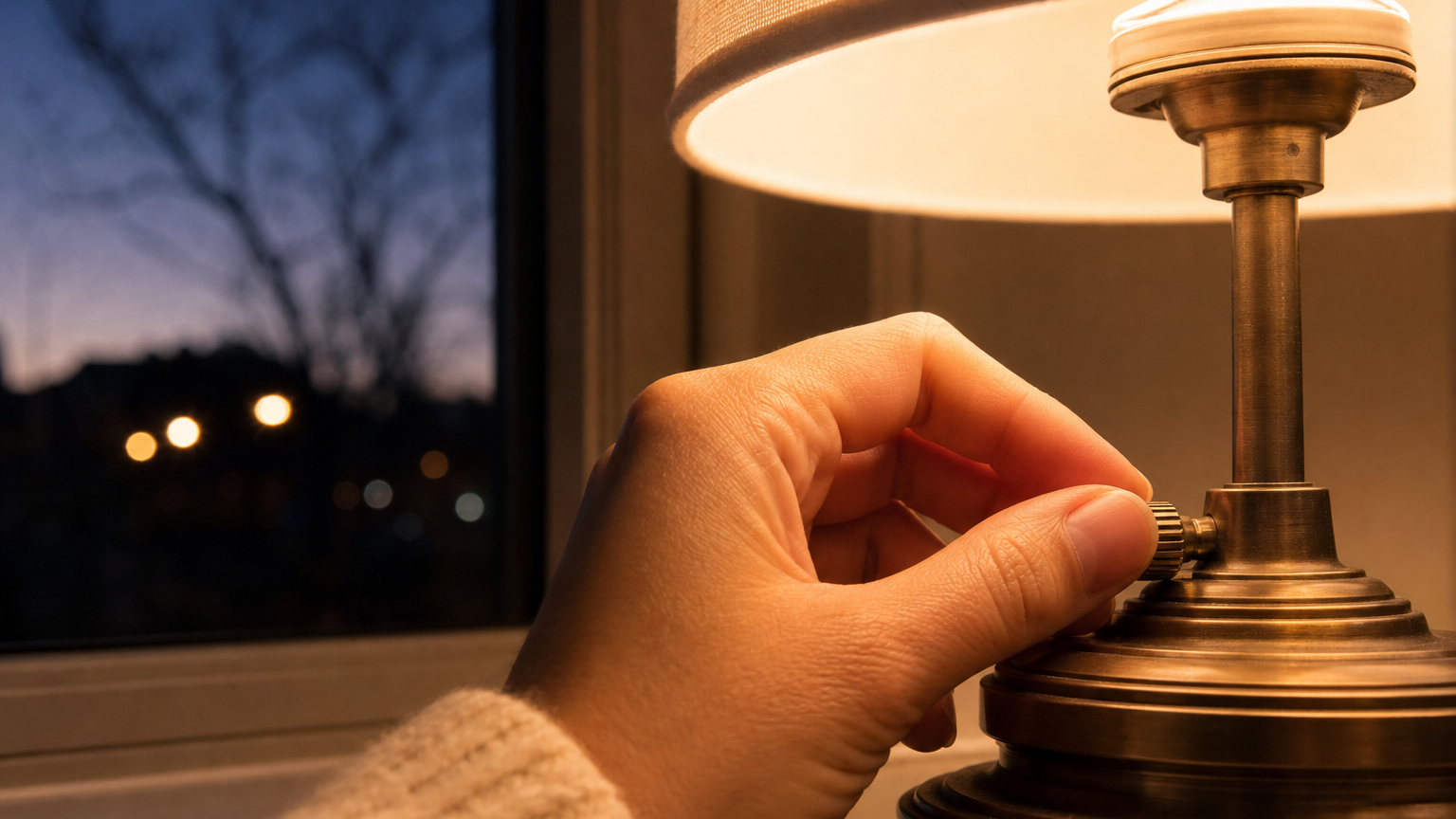
Watch for the environmental markers that usually sit right on top of the window: closing the laptop when it is already dark, drawing the blinds, switching on the lamps, walking in the door from a commute in full darkness. Those small actions are the actual cue, more than any emotion is.
Which brings up the part that makes this pattern so easy to miss. The urge rarely announces itself as a craving. It reads as boredom, or restlessness, or a vague sense that the evening needs an event in it. That is why it slips past unexamined for weeks. It does not feel like wanting a drink. It feels like not knowing what to do with yourself. If that description lands, our breakdown of why boredom triggers alcohol cravings covers the same machinery from a different angle.
For most people this runs from late October through February and then eases on its own. Knowing the expiration date helps. You are not managing a permanent new reality, you are managing a season.
How do you use light to shift the pattern?
If light created the problem, light is the most direct lever on it. Not the only one, and not a magic one, but the highest-leverage change available and the one that costs nothing. The goal is simple: more light early, more light in the late-afternoon window, less light close to actual bedtime.
Morning light
Getting outside for 10 to 30 minutes within an hour or two of waking is the single best move in the whole list. A review of morning light protocols reported that light delivered shortly after waking can produce modest phase advances of roughly 10 to 30 minutes within a single circadian cycle, particularly when the light is bright or delivered for longer stretches. Read that honestly: it nudges your clock, it does not reset your winter. Nudges compound, though.
Overcast counts. A gray morning outdoors is still far brighter than any indoor room, which is why stepping out the door beats sitting near a window with coffee. And a large observational study of more than 400,000 UK Biobank participants found that more time spent in outdoor light was associated with better mood, sleep and circadian-related outcomes, with the authors describing low daytime light exposure as an important environmental risk factor. It is association rather than proof, and going outside will not delete an evening craving, but it stacks the deck differently.
Protect a midday daylight break too, if the shape of your day allows it. When afternoons go dark fast, a lunchtime walk is the last real anchor your clock gets before the lights go out.
Evening light design
Most homes are lit like a cave from 4pm onward: one lamp in a corner, a laptop, a television. If your space reads as "night" at 5pm, your body will agree with it. Brighten the late-afternoon-to-early-evening stretch generously, with warm light spread across the room rather than a single dim pool. You are trying to tell your brain the day is not over yet, because it genuinely is not.
Then dim deliberately closer to real bedtime. The contrast is the point. If the whole evening is one uniform brightness, you lose the signal that separates evening from night, and you have traded one timing problem for another.
Light boxes are a documented tool for seasonal mood symptoms, and NIMH lists light therapy among the standard treatment approaches for seasonal affective disorder. We are not going to suggest specs, intensities, or timing here, because that is genuinely a conversation to have with a clinician who knows your history rather than something to self-prescribe from a blog post.
What can you put in the dark-evening window instead of a drink?
Structure beats resolve here, because the trigger is environmental rather than emotional. You are not trying to out-argue a feeling. You are trying to make sure that the moment the cue fires, something else is already happening.
Start by moving the first cue. Schedule something that begins at the exact clock time your craving usually lands, so darkness is no longer the only thing occupying that slot. It does not have to be impressive. A walk, a call, a standing errand, dinner prep that starts thirty minutes earlier than it used to. The specific activity matters less than the fact that it has a start time.
Movement at dusk is particularly effective against the melatonin-driven slump, and it works better than caffeine (which will follow you to bed) or a nap (which will make the evening longer, not shorter). Ten minutes outside in the cold does more for early-evening flatness than most people expect, and it doubles as the last scrap of natural light in the day.
Build an evening anchor with its own ritual weight. Part of what a drink provides is ceremony: a specific glass, a specific chair, a clear signal that the day has changed shape. A hot drink made properly, in a particular mug, in a particular spot, can carry a surprising amount of that load. Our guide to replacing alcohol in your evening routine goes deep on building those swaps, and Reframe's mindful drinking program is built around noticing exactly this kind of cue and answering it on purpose.
One more thing that matters more in winter than any other season: keep the social calendar alive. When it is dark before dinner, the default is to stay in, and isolation compounds the whole effect. A standing Tuesday plan with a friend does more work than it looks like it should.
Will the pattern go away on its own in spring?
For a lot of people, yes. As sunsets move later from late February onward, the early-evening pull loosens and the pattern quietly dissolves without anyone doing anything about it. That is a real and common outcome, and it is worth knowing so you do not catastrophize a seasonal shift into a permanent problem.
The catch is repetition. Three or four months is plenty of time for a cue-response loop to set. Research on habit formation shows that strongly habitual behaviors are triggered by the context cues associated with past performance (locations, times, surrounding routines) largely independently of current motivation. Which means that by March, the trigger may no longer be darkness at all. It may just be 6pm. Daylight alone will not undo that, because daylight was never the cue your brain actually encoded.
Signs the habit is hardening rather than riding the season: the first drink creeping earlier week over week, needing more to get the same easing effect, or drinking on nights you had specifically not planned to. None of those mean anything catastrophic, and none of them are a verdict on you. They are information about a loop that is tightening. If you want a structured way to look at it, the Am I Drinking Too Much? quiz is a reasonable ten-minute gut check, and our piece on common triggers for drinking maps the wider set of cues this one belongs to.
There is a better use for the season than waiting it out. Treating these months as a deliberate practice window, where you are actively building a non-alcohol answer to a very predictable cue, makes spring genuinely easier instead of just less dark. You come out the other side with a tested routine rather than a habit that happens to be dormant. If you want a nudge and some structure, you can download Reframe and use the winter as the training ground.
And if this pattern returns identically every single year, that is not a failure. That is a useful, specific piece of information about how your body handles light, and it is well worth bringing to a clinician who can look at the whole picture with you.
Summary FAQs
1. Why do I crave alcohol as soon as it gets dark outside?
Darkness is your brain's cue to begin its wind-down sequence, including melatonin release and a drop in alertness. After the clocks change, that cue arrives hours earlier than your actual bedtime, creating a long stretch of tired, unstructured evening. Alcohol slots neatly into that gap because it mimics the sedation your body is already signaling for.
2. Does daylight saving time really make people drink more?
Seasonal drinking data from northern latitudes shows higher alcohol consumption in low-daylight months, and many people notice their first drink moving earlier right after the clocks change. The mechanism is the shift in light exposure, which alters circadian timing and mood chemistry, not the hour on the clock itself. The change is real even if the size of the effect varies a lot from person to person.
3. Is a seasonal dip in mood the same as seasonal affective disorder?
No. Most people experience a sub-threshold seasonal dip: lower energy, earlier fatigue, more appetite for carbs and alcohol, without persistent low mood or loss of function. Seasonal affective disorder is a diagnosable depressive pattern with symptoms lasting most of the day, most days, for weeks. If your low mood is persistent, affects daily functioning, or includes thoughts of self-harm, that is a conversation for a clinician.
4. Can morning light exposure reduce evening alcohol cravings?
Indirectly, yes. Getting 10 to 30 minutes of outdoor daylight soon after waking helps anchor your circadian clock so melatonin onset does not creep too far forward, which softens the early-evening slump that drives the urge. It will not erase a craving on its own, but it changes the physiological conditions that make 5pm feel like the end of the day.
5. Why does 6pm feel like 10pm in the winter?
Your brain estimates the time of day largely from light, not from clocks. When it is fully dark at 5pm, your internal clock runs the evening program early: melatonin rises, alertness falls, and the day feels finished. That mismatch between body time and clock time creates several hours of low-energy, unstructured evening where drinking often fills the space.
6. Will my winter drinking pattern fade when the days get longer?
Often it eases as sunsets move later from late February onward. The catch is that three or four months of repetition can build a habit loop that outlives the season, so the cue shifts from darkness to simply being 6pm. If you notice the pattern hardening, drinking earlier or on unplanned nights, it is worth addressing during the season rather than waiting for spring.
Dark Evenings Pulling You Toward a Drink? Reframe Can Help!
Although it isn't a treatment for alcohol use disorder (AUD), the Reframe app can help you cut back on drinking gradually with the science-backed knowledge to empower you 100% of the way. Our proven program has helped millions of people around the world drink less and live more. And we want to help you get there, too!
The Reframe app equips you with the knowledge and skills you need to not only survive drinking less, but to thrive while you navigate the journey. Our daily research-backed readings teach you the neuroscience of alcohol, and our in-app Toolkit provides the resources and activities you need to navigate each challenge.
You'll meet millions of fellow Reframers in our 24/7 Forum chat and daily Zoom check-in meetings. Receive encouragement from people worldwide who know exactly what you're going through! You'll also have the opportunity to connect with our licensed Reframe coaches for more personalized guidance.
Plus, we're always introducing new features to optimize your in-app experience. We recently launched our in-app chatbot, Melody, powered by the world's most powerful AI technology. Melody is here to help as you adjust to a life with less (or no) alcohol.
And that's not all! Every month, we launch fun challenges, like Dry/Damp January, Mental Health May, and Outdoorsy June. You won't want to miss out on the chance to participate alongside fellow Reframers (or solo if that's more your thing!).
The Reframe app is free for 7 days, so you don't have anything to lose by trying it. Are you ready to feel empowered and discover life beyond alcohol? Then download our app through the App Store or Google Play today!
Reframe has helped over 2 millions people to build healthier drinking habits globally
At Reframe, we do science, not stigma. We base our articles on the latest peer-reviewed research in psychology, neuroscience, and behavioral science. We follow the Reframe Content Creation Guidelines, to ensure that we share accurate and actionable information with our readers. This aids them in making informed decisions on their wellness journey. Learn more
Updated Regularly
Our articles undergo frequent updates to present the newest scientific research and changes in expert consensus in an easily understandable and implementable manner.
Lambert, G. W., Reid, C., Kaye, D. M., Jennings, G. L., & Esler, M. D. (2002). Effect of sunlight and season on serotonin turnover in the brain. The Lancet, 360(9348), 1840–1842. https://doi.org/10.1016/S0140-6736(02)11737-5
National Institute of General Medical Sciences. Circadian rhythms [Fact sheet]. National Institutes of Health.
National Institute of Mental Health. Seasonal affective disorder. U.S. Department of Health and Human Services, National Institutes of Health.
National Institute of Mental Health. Seasonal affective disorder (SAD): More than the winter blues [Infographic]. National Institutes of Health.
Gardiner, C., Weakley, J., Burke, L. M., Roach, G. D., Sargent, C., Maniar, N., Huynh, M., Miller, D. J., Townshend, A., & Halson, S. L. (2025). The effect of alcohol on subsequent sleep in healthy adults: A systematic review and meta-analysis. Sleep Medicine Reviews, 80, 102030. https://doi.org/10.1016/j.smrv.2024.102030
National Institute on Alcohol Abuse and Alcoholism. Neuroscience: The brain in addiction and recovery. Core Resource on Alcohol. National Institutes of Health.
Burns, A. C., Saxena, R., Vetter, C., Phillips, A. J. K., Lane, J. M., & Cain, S. W. (2021). Time spent in outdoor light is associated with mood, sleep, and circadian rhythm-related outcomes: A cross-sectional and longitudinal study in over 400,000 UK Biobank participants. Journal of Affective Disorders, 295, 347–352.
Can morning light phase advance human melatonin rhythms in less than 24 h? [Narrative review]. PubMed, PMID 41832758.
Neal, D. T., Wood, W., Wu, M., & Kurlander, D. (2011). The pull of the past: When do habits persist despite conflict with motives? Personality and Social Psychology Bulletin, 37(11), 1428–1437.




.png)


