Can You Go to Bars Sober? How to Navigate Drinking Spaces Without Drinking
Published:
2026-06-24
·
Read time:
13 min read
Last Updated:
2026-06-24
Written by
Reframe Content Team
A team of researchers and psychologists who specialize in behavioral health and neuroscience. This group collaborates to produce insightful and evidence-based content.
Certified recovery coach specialized in helping everyone redefine their relationship with alcohol. His approach in coaching focuses on habit formation and addressing the stress in our lives.
Recognized by Fortune and Fast Company as a top innovator shaping the future of health and known for his pivotal role in helping individuals change their relationship with alcohol.
June 24, 2026
·
13 min read
Reframe Content Team
June 24, 2026
·
13 min read
Yes, you can go to bars sober, and for many people it is a worthwhile skill to build rather than a place to avoid forever. The catch is that a bar is one of the highest-trigger environments there is: the sights, smells, sounds, and social cues all nudge your brain toward the old habit, so going in with a plan matters more than willpower. The practical move is to treat the outing like a craving situation you are managing on purpose, with a drink order, a perception trick, and an exit plan ready before you arrive. Reframe's tools for spotting and defusing triggers can help you decide which bar nights are worth it and how to get through the ones that are.
Going to Bars Sober Is a Skill, Not a Forbidden Zone
Yes, you can go to bars sober, and for many people it is a worthwhile skill to build rather than a place to avoid forever. The catch is that a bar is one of the highest-trigger environments there is: the sights, smells, sounds, and social cues all nudge your brain toward the old habit, so going in with a plan matters more than willpower. The practical move is to treat the outing like a craving situation you are managing on purpose, with a drink order, a perception trick, and an exit plan ready before you arrive. Reframe's tools for spotting and defusing triggers can help you decide which bar nights are worth it and how to get through the ones that are.
Let's be honest about what a bar actually is for someone changing their relationship with alcohol. It is not neutral ground. It is a room engineered, intentionally or not, to encourage drinking, and for a while it can feel like the building itself is working against you. But that does not mean you have to give up bars for the rest of your life. With the right preparation, going to bars sober becomes one more thing you know how to do, like driving in the rain or speaking up in a meeting. This guide walks through why bars hit so hard, whether sitting there with a non-alcoholic drink is safe, the perception tricks that defuse a craving, what to order, how to build an exit plan, and how the people who work behind the bar can drink less too.
Why are bars such a strong drinking trigger?
A bar bundles almost every classic drinking cue into one room: the smell of beer, the clink of glasses, the music, the dim lighting, and a crowd of people drinking around you. That density is what makes it potent. Each of those signals has been paired with alcohol in your brain hundreds of times, so the setting does a lot of the work before you have consciously decided anything.
This is not a character flaw, it is conditioning. Research on people in alcohol detox found that exposure to alcohol cues, the sight of beverages and the act of drinking, triggered measurable physical arousal and craving as a conditioned response, even without a deliberate decision to drink. In plain terms, a once-neutral object like a pint glass picks up motivational pull through repeated pairing. Worth noting from that same study: the strength of someone's cue reactivity did not predict whether they relapsed, so a strong reaction in a bar is a craving event to ride out, not a verdict on how you are doing.
The sensory cues that fire a craving
Think about the specific bar you used to go to. Where did you stand? What did you order without thinking? Who was next to you? Those details are not nostalgia, they are retrieval cues. The physical setting re-triggers the old routine because the routine was built there. This is why a bar can feel different from, say, a friend's kitchen even when the same drink is available in both.
The social-expectation layer
On top of the sensory layer sits social expectation: the unspoken sense that being at a bar means drinking, and that not drinking needs explaining. The NIAAA describes how external triggers like particular places and social situations create predictable high-risk situations, and how they get harder when they stack with internal triggers like stress or excitement. A bar is the rare place where the external and internal layers pile up at once. Recognizing the bar as a trigger is not weakness; it is what lets you plan around it instead of getting ambushed. If you are still mapping your own patterns, Reframe's mindful drinking program and a quick read on how to identify your drinking triggers both help you see the cues before they see you.
Is it safe to sit at a bar drinking non-alcoholic beverages?
For most people, yes, sitting at a bar with a non-alcoholic drink is safe, and it has become an increasingly normal way to be out without drinking. You are not doing anything risky by holding a soda in a loud room full of cocktails. For many, it is a legitimate and even useful way to keep a social life intact while changing a habit.
There is also a case that managed exposure helps over time. Being in the environment while staying in control may, for some people, gradually loosen the bar's grip, because you are practicing the situation without the old payoff. We want to be careful here: the clinical evidence for deliberately exposing yourself to cues to weaken cravings is genuinely mixed, so treat this as a possible individual benefit rather than a guaranteed result. Some people find each sober bar night easier than the last; others do not, and both are normal.
When it helps as exposure practice
If your footing is solid, a low-stakes bar visit can be good rehearsal. You learn that the craving rises and falls, that nobody actually cares what is in your glass, and that you can stay an hour and leave intact. Repetition is part of why this gets easier, which lines up with the NIAAA's framing that urges are short-lived, predictable, and controllable and that a recognize-avoid-cope approach helps you manage them.
When to think twice
Two real caveats. First, it can be riskier in very early sobriety, if you are physically dependent on alcohol, or if a specific bar is wired to heavy patterns for you. If alcohol dependence is part of your picture, stopping is a medical matter and a clinician can help you do it safely; a bar visit is not the place to test that. Second, watch the closely mimicking products. Non-alcoholic beers and wines that nail the taste and ritual soothe a craving for some people and reignite it for others, which fits what we know about how much individual responses to alcohol cues can differ. Read your own state honestly that night, and keep an exit plan ready. Not sure where your own line is? The Am I Drinking Too Much? quiz is a low-pressure place to start.
Is it safe to use wine glasses or cocktail glasses with non-alcoholic drinks?
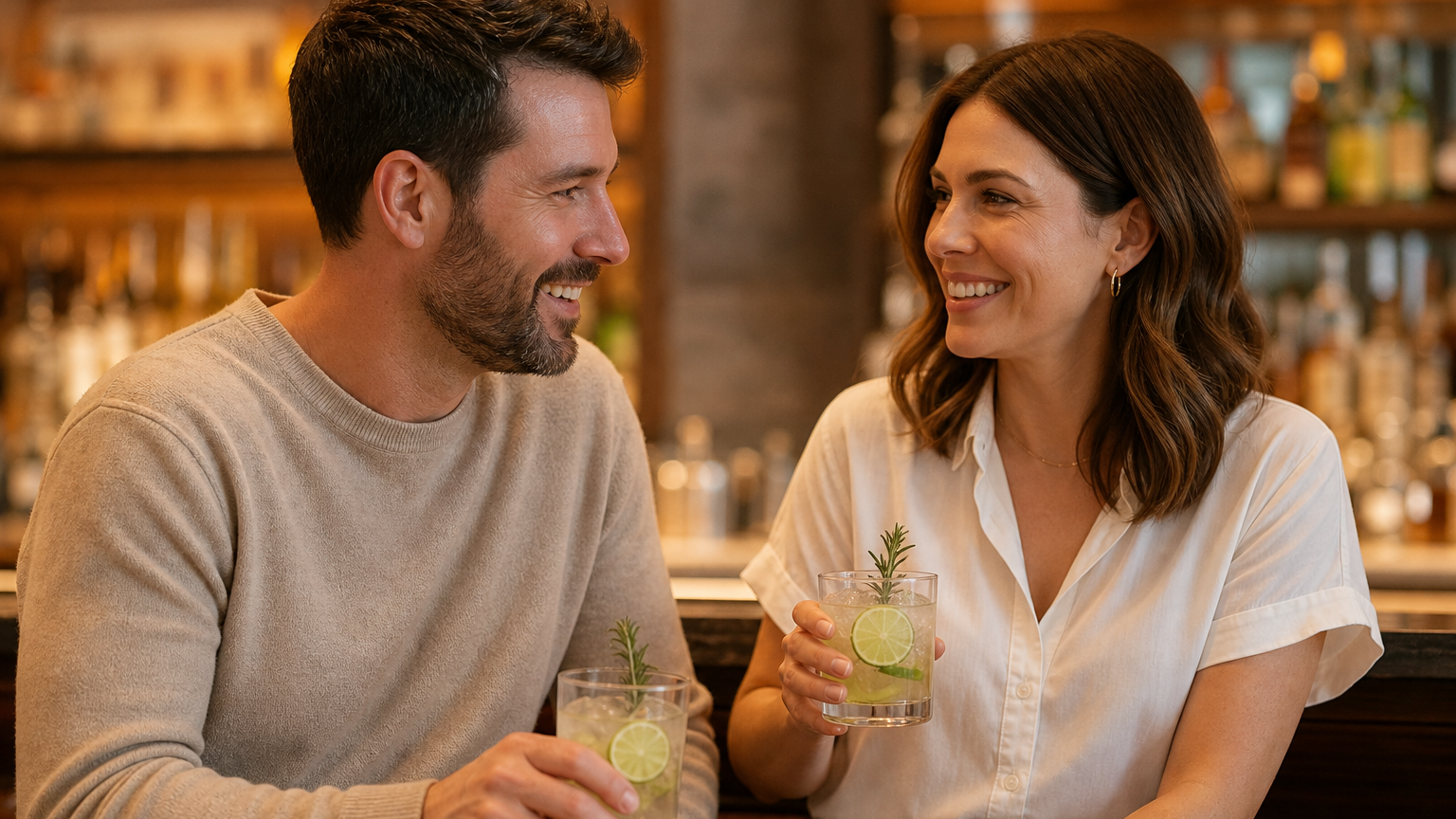
Drinking a non-alcoholic beverage out of a wine glass or a heavy tumbler is completely safe, and for a lot of people it makes staying sober easier, not harder. There is nothing physically risky about the glass itself, and the familiar vessel does real social work.
The "real glass" gives you three things at once: the ritual, the weight in your hand, and a drink that looks like everyone else's. That last part quietly heads off both self-consciousness and the round of questions that a giveaway plastic cup invites. You blend in, which means you spend less energy managing other people's curiosity and more energy enjoying the night.
Why the glass matters more than you think
This is really a version of the perception reframe: keep the comforting cues, drop the alcohol. The brain's craving system responds heavily to ritual and context, so giving it the familiar shape of the evening, the stem between your fingers, the swirl, the slow sip, can satisfy a surprising amount of what it is actually asking for. You are not faking it so much as redirecting it.
Reading your own reaction
The honest caveat: for a minority of people, closely copying the old ritual heightens a craving instead of easing it, which again reflects how much individual responses differ. If you notice the wine glass making things worse rather than better, switch to something that looks nothing like your old drink. A practical move is to ask the bartender to serve your soda, mocktail, or non-alcoholic option in real glassware so you are not holding a tell. If you want ideas, our list of 10 mocktails to order at any bar is built for exactly this.
What is the alcohol glasses or perception trick for cravings?
The "alcohol glasses" idea is a mindful-perception reframe: you deliberately notice what alcohol actually delivers versus the fantasy your craving is selling. The craving paints a tidy picture of the first sip and stops there. The trick is to refuse to stop there.
In the moment, name the craving out loud or in your head, then play the tape forward past that first sip to the hangxiety, the broken sleep, and the morning regret. The point is not to scold yourself, it is to give your brain the whole movie instead of the trailer. This pairs naturally with the NIAAA's recognize-avoid-cope method and its reminder that urges are short-lived and controllable. Knowing where your patterns come from helps; the What Type of Drinker Are You? quiz can sharpen that self-read.
Playing the tape forward
Make the forward tape specific to you. Not "I might feel bad," but the actual 3 a.m. wake-up, the actual canceled morning plan, the actual conversation you would rather not have had. Then anchor yourself in the present with your non-alcoholic drink: hold it, notice the temperature, taste it properly, and let it occupy the ritual slot the craving is reaching for. You are giving the urge something real to land on.
Urge surfing in a noisy room
Urge surfing is a mindfulness technique, developed by psychologist G. Alan Marlatt, in which you picture a craving as a wave that rises, peaks, and falls while you observe it without acting. You do not fight the wave and you do not obey it; you ride it as it crests and recedes. In a loud bar this is harder than on a meditation cushion, so keep it small: one breath, the drink in your hand, the reminder that this peak passes. These are skills that get easier with repetition, which is part of why managed bar exposure can help. Our full walkthrough on how urge surfing helps with cravings goes deeper if you want a script.
What should you order at a bar when you are not drinking?
Have a default order ready before you walk in, so you are never standing at the bar improvising under pressure. Decision-making is weakest exactly when the cues are loudest, so the order should already be decided. This one habit removes most of the friction of a sober bar night.
Reliable options travel well: soda with lime, tonic and bitters, a mocktail, sparkling water, a coffee, or a quality non-alcoholic beer if that works for you without nudging a craving. Any of them looks at home in your hand and gives you something to do besides field offers. The NIAAA's drink-refusal guidance advises keeping your response short and simple and not hesitating, since hesitating gives you the chance to think of reasons to go along, so order first or order confidently, because hesitation invites questions and a chorus of "have a real drink."
A default order that travels
Pick one go-to and one backup, the way you would pick a coffee order. Keep something in your hand at all times; a person already holding a full glass is far less likely to get one bought for them. The trick is having the answer ready, not clever, so you can say it without missing a beat in the conversation.
Linking to a mocktail list
If your usual is getting boring, variety keeps the night interesting and keeps you from drifting toward the old default. A rotating set of mocktails, paired with our 10 mocktails to order at any bar, covers most menus. And tip your bartender well, because a sober regular who tips is a welcome customer, not an oddity, and the staff will start steering good non-alcoholic options your way.
How do you build an exit plan and decide if a bar night is too risky?
Decide three things before you go: how long you will stay, how you will get home, and a clean line you can use to leave. The plan only works if it exists before the first craving, because in the moment your judgment is exactly what the environment is trying to bend.
Control your own transportation. Drive yourself or pre-book a ride so leaving is never hostage to someone else's night. Set a check-in point partway through, maybe the one-hour mark, where you honestly ask how you are doing rather than coasting on momentum. Building this kind of structure is the everyday work of changing your drinking habits, and it gets more automatic each time.
Your pre-set exit line
Your exit line should be short, true enough, and require no negotiation: an early morning, a ride waiting, a simple "I'm heading out, this was great." You are not asking permission, you are announcing a decision. Saying it the same way every time means you never have to invent it while a craving is talking.
Signs to skip it altogether
Some nights are not worth it, and reading that in advance is a skill. Red flags: you are already stressed, exhausted, or depleted; the entire event is built around heavy drinking with no other center of gravity; or you catch yourself bargaining, the quiet "just one wouldn't hurt" negotiation. That bargaining voice is the clearest tell. Choosing to skip or to leave early is a strong move that protects your goal, not a failure; you are not proving anything to anyone by staying. For more on spotting the moment before it slips, our piece on how to avoid your triggers pairs well with this.
How can bartenders and bar staff drink less while working in bars?
Bar work makes drinking less genuinely harder, because alcohol is constant, cheap or free, social, and woven straight into the job, but it is doable with structure rather than willpower alone. This is not in your head: workers in the accommodations and food services industry report the highest rate of past-month illicit drug use of any U.S. industry, around 19.1 percent in that SAMHSA report. The job pushes in this direction; you are pushing back against a strong current, and that deserves credit, not shame.
The core moves are about replacing rituals, not just resisting them. Swap the shift drink for a non-alcoholic default you actually like, and tell one trusted coworker your goal so the "one for the staff" offers quietly ease off. Track your intake against a clear weekly limit so easy access does not slide into a daily habit you never decided on; if you want a number to anchor to, the Am I Drinking Too Much? quiz is a fast gut check.
Rethinking the shift drink
The real need after a tough shift is decompression, not alcohol specifically. Alcohol just happens to be the closest tool on the rail. Meet the actual need another way: a walk home, real food, a no-alcohol drink, ten minutes of quiet before you switch your brain off. When you name what the shift drink is really for, it gets easier to give it a different job.
Handling free and offered drinks at work
Know your specific job triggers and pre-decide your response to each: the post-close drink, tasting cocktails on the line, and customers buying you rounds. A ready "I'm good, thank you" handles most of it, and a coworker who knows your goal can run interference. If drinking on the job starts to feel out of your control, that is worth taking seriously rather than normalizing as part of the trade; a clinician can help you sort out whether it is a habit or something more, and you do not have to figure that out alone. When you are ready for ongoing support, you can download Reframe and lean on a program built for exactly this kind of high-exposure environment.
Summary FAQs
1. Is it safe to sit at a bar drinking non-alcoholic beverages?
For most people, yes, sitting at a bar with a non-alcoholic drink is safe and is an increasingly normal way to socialize. It can even be useful exposure practice, letting you be in the environment while staying in control, which may weaken the bar's pull over time for some people. Be more cautious if you are in very early sobriety, physically dependent on alcohol, or if a particular bar is closely tied to heavy drinking for you, and always have an exit plan.
2. Is it safe to use wine glasses with non-alcoholic drinks?
Yes, drinking a non-alcoholic beverage from a wine glass or tumbler is completely safe and often makes staying sober easier. The familiar glass gives you the ritual and a drink that blends in, which cuts down on self-consciousness and unwanted questions. The one caveat is that, for a minority of people, closely mimicking the old ritual can heighten a craving rather than satisfy it, so pay attention to your own reaction and adjust.
3. How can bartenders reduce drinking while working in bars?
Bar staff face constant, cheap, social access to alcohol, so cutting back takes structure rather than willpower alone. Swap the shift drink for a non-alcoholic default, tell a trusted coworker your goal so the offered rounds ease off, and meet the real after-shift need (decompression) with a walk, food, or a no-alcohol drink instead. Tracking your intake against a clear weekly limit helps keep easy access from quietly becoming a daily habit.
4. What is the alcohol glasses trick for cravings at a bar?
The alcohol glasses reframe means deliberately seeing what alcohol actually delivers versus what your craving is promising. In the moment you name the craving and play the tape forward to the hangxiety, bad sleep, and regret rather than stopping at the imagined first sip. Pairing this with a sensory anchor, like really tasting your non-alcoholic drink, gives the ritual something to land on while the urge passes.
5. What should I order at a bar if I am not drinking?
Have a go-to order ready so you are never deciding under pressure: soda with lime, tonic and bitters, a mocktail, sparkling water, or a good non-alcoholic beer all work. Order confidently and keep a drink in your hand, which heads off both questions and offers to buy you "a real one." Tipping your bartender well makes you a welcome regular rather than an oddity.
6. How do I know if a particular bar night is too risky for my sobriety?
Watch for warning signs before and during the night: you are already stressed or depleted, the whole event is built around heavy drinking, or you catch yourself bargaining about "just one." Decide your stay length, your ride home, and an exit line in advance so leaving is always within your control. Choosing to skip or leave early is a strong move that protects your goal, not a failure.
Want to Walk Into Any Bar and Stay in Control? Reframe Can Help!
Although it isn't a treatment for alcohol use disorder (AUD), the Reframe app can help you cut back on drinking gradually with the science-backed knowledge to empower you 100% of the way. Our proven program has helped millions of people around the world drink less and live more. And we want to help you get there, too!
The Reframe app equips you with the knowledge and skills you need to not only survive drinking less, but to thrive while you navigate the journey. Our daily research-backed readings teach you the neuroscience of alcohol, and our in-app Toolkit provides the resources and activities you need to navigate each challenge.
You'll meet millions of fellow Reframers in our 24/7 Forum chat and daily Zoom check-in meetings. Receive encouragement from people worldwide who know exactly what you're going through! You'll also have the opportunity to connect with our licensed Reframe coaches for more personalized guidance.
Plus, we're always introducing new features to optimize your in-app experience. We recently launched our in-app chatbot, Melody, powered by the world's most powerful AI technology. Melody is here to help as you adjust to a life with less (or no) alcohol.
And that's not all! Every month, we launch fun challenges, like Dry/Damp January, Mental Health May, and Outdoorsy June. You won't want to miss out on the chance to participate alongside fellow Reframers (or solo if that's more your thing!).
The Reframe app is free for 7 days, so you don't have anything to lose by trying it. Are you ready to feel empowered and discover life beyond alcohol? Then download our app through the App Store or Google Play today!
Reframe has helped over 2 millions people to build healthier drinking habits globally
At Reframe, we do science, not stigma. We base our articles on the latest peer-reviewed research in psychology, neuroscience, and behavioral science. We follow the Reframe Content Creation Guidelines, to ensure that we share accurate and actionable information with our readers. This aids them in making informed decisions on their wellness journey. Learn more
Updated Regularly
Our articles undergo frequent updates to present the newest scientific research and changes in expert consensus in an easily understandable and implementable manner.
Cue reactivity and its relation to craving and relapse in alcohol dependence: A combined laboratory and field study. (2015). Psychopharmacology, 232(19), 3685-3696. https://pubmed.ncbi.nlm.nih.gov/26257163/
National Institute on Alcohol Abuse and Alcoholism. (2025). Support recovery: It's a marathon, not a sprint. Core Resource on Alcohol. https://www.niaaa.nih.gov/health-professionals-communities/core-resource-on-alcohol/support-recovery-its-marathon-not-sprint
National Institute on Alcohol Abuse and Alcoholism. (n.d.). How to stop alcohol cravings. Rethinking Drinking. https://rethinkingdrinking.niaaa.nih.gov/tools/worksheets-more/how-stop-alcohol-cravings
National Institute on Alcohol Abuse and Alcoholism. (n.d.). Building your drink refusal skills. Rethinking Drinking. https://rethinkingdrinking.niaaa.nih.gov/tools/worksheets-more/building-your-drink-refusal-skills
PositivePsychology.com. (n.d.). Urge surfing: How riding the wave breaks bad habits. https://positivepsychology.com/urge-surfing/
Substance Abuse and Mental Health Services Administration. (n.d.). Substance use and substance use disorder by industry (The NSDUH Report). https://www.samhsa.gov/data/sites/default/files/report_1959/ShortReport-1959.html