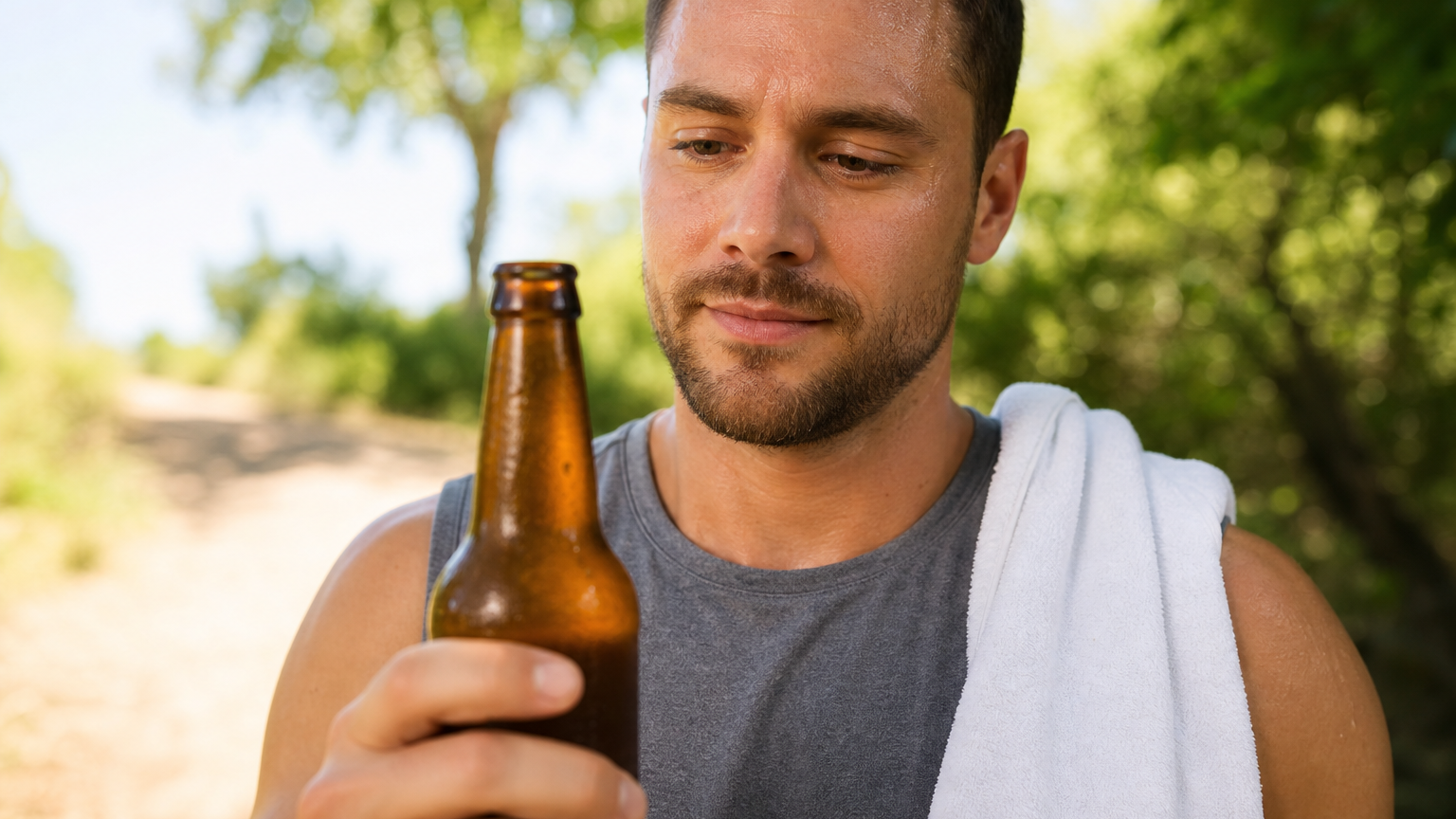
Why Do I Crave Alcohol After a Workout? The Post Gym Beer Urge
Published:
2026-07-15
·
Read time:
11 min read
Last Updated:
2026-07-15
Written by
Reframe Content Team
A team of researchers and psychologists who specialize in behavioral health and neuroscience. This group collaborates to produce insightful and evidence-based content.
Certified recovery coach specialized in helping everyone redefine their relationship with alcohol. His approach in coaching focuses on habit formation and addressing the stress in our lives.
Recognized by Fortune and Fast Company as a top innovator shaping the future of health and known for his pivotal role in helping individuals change their relationship with alcohol.
July 15, 2026
·
11 min read
Reframe Content Team
July 15, 2026
·
11 min read
The urge to drink after a workout usually comes from a stack of overlapping signals rather than one cause: dehydration and electrolyte loss that your brain misreads as a craving, a dopamine and reward dip after exertion that alcohol promises to fill, and years of social conditioning that pairs the finish line with a cold drink ("I earned it"). None of it means something is wrong with you. It means a predictable trigger is firing at a predictable moment, which also makes it one of the easier cravings to interrupt with hydration, protein, and a small change to your post-workout ritual. Reframe helps you spot patterns like this and build a wind-down routine that gives your body what it's actually asking for.
Where the Post Workout Drinking Urge Actually Comes From
The urge to drink after a workout usually comes from a stack of overlapping signals rather than one cause: dehydration and electrolyte loss that your brain may misread as a craving, a dopamine and reward dip after exertion that alcohol promises to fill, and years of social conditioning that pairs the finish line with a cold drink ("I earned it"). None of it means something is wrong with you. It means a predictable trigger is firing at a predictable moment, which also makes it one of the easier cravings to interrupt with hydration, protein, and a small change to your post-workout ritual. Reframe helps you spot patterns like this and build a wind-down routine that gives your body what it's actually asking for.
Let's talk honestly about that moment. You finish a run, you're sweaty and a little wrung out, and somewhere between the cooldown and the shower a very specific thought shows up: a beer would be perfect right now. It feels almost inevitable, like your body decided before your brain did. If you've been trying to drink less, that timing can be frustrating, because you did the healthy thing and the reward your mind wants is the exact thing you're cutting back on. The good news is that this particular craving is unusually easy to decode. Once you understand why it fires, you can meet the real need underneath it instead of just white-knuckling past the urge or giving in.
Why do you crave alcohol right after exercising?
The short version: craving alcohol after a workout is a time-locked trigger, not a random urge and definitely not a sign of weakness. It shows up at roughly the same point every time because several mechanisms are firing together: your body just lost fluid and electrolytes, your brain's reward chemistry spiked and then dipped, and, for a lot of us, exercise has been paired with a celebratory drink so many times that the association runs on autopilot.
Exertion raises your reward chemicals and then lets them settle back down, which leaves a small gap where the brain goes looking for something satisfying to close it. Alcohol is a fast, familiar way to close that gap, so it comes to mind quickly. That is the whole trick, really: the craving is not proof that you "need" a drink, it is your reward system doing exactly what it evolved to do at a moment when you happen to feel depleted.
Naming it matters more than it sounds. When you label the feeling as a trigger firing (rather than a command you have to obey), you create a little space between the urge and the action. That gap is where every practical strategy in this post lives. If you want to get better at spotting these moments across your whole week, learning to identify your drinking triggers is the foundational skill, and the post-workout urge is one of the cleanest examples to practice on.
Is your body confusing dehydration with a craving for alcohol?
Often, at least partly, yes. Exercise depletes fluid and electrolytes, and a thirst signal can feel a lot like a general "I want something" pull rather than a clear "I want water" message. On top of that, even mild dehydration of around 1.5% of body water has been shown to worsen mood and increase feelings of tension and fatigue, according to research published in the British Journal of Nutrition. When your mood dips and your energy sags, the brain tends to reach for a quick fix, and a drink is one it has learned well.
To be precise about the science: those studies show dehydration drags down mood and focus, not that the brain specifically relabels thirst as an alcohol craving. The mimicry idea is a reasonable read of how these pieces fit together, so treat it as a plausible mechanism rather than a proven fact. Either way, the practical takeaway holds up.
Here's the part worth sitting up for. Reaching for a beer to fix that feeling tends to work against you, because higher-strength drinks impair how well you rehydrate, and beer is a poor source of the electrolytes you just sweated out. A study in the Journal of Applied Physiology found that drinks with around 4% alcohol or more delayed the recovery of fluid balance after exercise-induced dehydration. So even when the craving is genuinely rooted in thirst, alcohol is close to the worst tool for the job.
That gives you a simple self-experiment. Drink 16 to 20 ounces of water or an electrolyte drink first, then wait about 15 minutes before you decide anything. This isn't a validated clinical test, just a practical way to separate signals. If the urge fades after you rehydrate, thirst and electrolyte loss were doing most of the talking. If it's still there, you've learned something useful too: this one is more about reward and ritual than water, and you can aim your next move accordingly. Either result is helpful, which is what makes the test worth doing every time for a while.
How does the exercise reward system feed the urge to drink?
A workout gives you a chemical high and then a comedown, and alcohol quietly volunteers to fill the dip. During and right after harder exercise, your brain releases feel-good chemicals (the "runner's high," which current research increasingly attributes to endocannabinoids rather than the endorphins most of us grew up hearing about). As those levels normalize afterward, you're left in a brief low spot where the brain is primed to seek a quick reward.
Here's the crossover that makes alcohol so tempting in that window. Alcohol acts directly on the same reward pathway, as the National Institute on Alcohol Abuse and Alcoholism explains: it prompts the ventral tegmental area to release dopamine into the nucleus accumbens, and that dopamine helps the brain tag cues (people, places, moments) as worth repeating. Because exercise and alcohol both operate on this dopamine machinery, your brain can treat them as interchangeable rewards. The post-workout dip is a vulnerable moment, and alcohol is standing right there offering a top-up. If the dopamine angle interests you, we go deeper into how alcohol affects dopamine levels in a dedicated piece.
None of this means exercise is somehow bad for you or "causing" a drinking problem. Reward-seeking after exertion is normal wiring; the only issue is which reward you've defaulted to. Understanding the crossover does two quiet, useful things at once: it removes the mystery, and it removes the self-judgment. You're not weak-willed, you're just running a well-worn neural shortcut, and shortcuts can be rerouted.
Why does the 'I earned it' feeling make the craving stronger?
That sense of having earned a drink is a real psychological effect, not just an excuse you tell yourself. Doing something virtuous or depleting (like a hard workout) makes the mind want to balance the ledger with a treat. Psychologists call this licensing: a good deed gives you permission, in your own accounting, to indulge somewhere else. "I worked out, so I deserve this" feels airtight in the moment precisely because part of it is true. You did work, and you are a little depleted.
Culture pours fuel on this. Gym and fitness culture actively pairs exertion with a drink at the finish: run clubs that end on a patio, the post-game round, the celebratory trail beer at the summit. Advertising leans into the same story, tying the reward you feel you're owed to a specific bottle. So the craving isn't only your brain chemistry, it's also decades of learned scripts about what "earning it" is supposed to look like. When you notice the thought, it can help to remember it's partly borrowed programming, not a fact about what your body needs.
Here's the reframe that actually breaks the link: the reward doesn't have to be alcohol. Your brain learned that pairing, which means it can learn a different one. Redefining "earned it" as recovery (a real meal, a hot shower, rest, a mocktail you genuinely like, a treat you choose on purpose) satisfies the same impulse without feeding the pattern you're trying to change. If you're curious how your own "earned it" reflex fits your broader relationship with drinking, the What Type of Drinker Are You? quiz is a low-stakes way to see the shape of it. And if you're weighing whether that post-workout drink is worth it at all on the recovery side, our piece on whether it's okay to drink alcohol after a workout covers the advisability question in detail.
Is post-workout drinking a conditioned habit or ritual?
Repetition turns a choice into a reflex, and the gym itself can become the cue. When you've paired a workout and a drink enough times, your brain wires up a loop: a cue (finishing exercise) leads to a routine (having a drink) leads to a reward (relief, relaxation, celebration). This cue-routine-reward pattern is well-established behavioral science, and it's why the craving can arrive before you've consciously decided anything. The location, the time of day, and the people around you can all fire the urge on their own.
Social settings crank the volume way up. The run club that always ends at the same bar, the post-game round with teammates, the group ride that finishes with a cooler of drinks: these aren't just occasions to drink, they're cues your brain has practiced responding to. Part of what feels like "wanting a beer" is really "this is the part where we all get a beer." Recognizing that the pull is partly environmental, not purely internal, takes some of its power away. If drinking tends to cluster around specific people and places for you, our guide to understanding your triggers for drinking maps out how those contexts quietly shape the urge.
The leverage point here is cue awareness, not raw willpower. You don't have to out-muscle a habit loop; you can interrupt the cue that starts it. Change the route home so you don't pass the usual spot. Change the first thing you do when you finish. Change who you decompress with, or how. Each small edit weakens the association a little, and weakened associations fire less insistently over time. This is also exactly the kind of pattern that Reframe's mindful drinking program is built to help you notice and rework, cue by cue.
How do you decouple exercise from the urge to drink?
Start by removing the physical drivers, then rewire the ritual. The urge is a stack of signals, so you dismantle it one layer at a time. None of these steps require heroic willpower; they mostly work by giving your body and brain what they're actually asking for before the craving can hijack the moment.
Rehydrate first, always. Water plus electrolytes before you decide anything, to rule out thirst mimicry. This is the single most reliable move, because so much of the post-workout urge is fluid and mood chemistry dressed up as a craving. Then refuel. Eat some protein and carbohydrates soon after finishing. A fed, stable body sends fewer frantic reward-seeking signals, and a snack you actually enjoy doubles as a small reward in its own right. If you like tracking the numbers, our alcohol calorie calculator can also make the swap from a drink to real recovery food feel more concrete.
Insert a new fast reward. The brain wants something satisfying in that dip, so give it one that isn't alcohol: a hot shower with good music, a mocktail you look forward to, a specific snack, a few minutes of doing nothing on purpose. Change the cue. Shift your route, your timing, or the first thing you do after the workout ends, so the old loop doesn't get its usual trigger. Delay and observe. Give the urge about 20 minutes; post-workout cravings often fade on their own as recovery kicks in and your fluids come back up.
It's also worth zooming out, because the acute post-workout spike and the big picture point in different directions. Over the long term, regular exercise tends to support drinking less, not more. A systematic review and meta-analysis in Frontiers in Psychology found that adding exercise to usual treatment significantly reduced overall drinking volume in people with alcohol use disorder. That was a clinical population, so it doesn't map perfectly onto every reader, but the direction is encouraging: exercise is on your side here, even when one post-workout craving suggests otherwise. There's even adjacent evidence that aerobic exercise itself can reduce cravings across dependency studies, which means movement can be part of managing an urge, not only a thing that sets one off.
Finally, use two skills that make the whole pattern lose its grip: urge surfing and self-tracking. Learning how urge surfing can help you overcome alcohol cravings gives you a way to ride the 20-minute wave without acting on it, and tracking the pattern lets you watch it weaken week over week. When you're ready to build this into a routine, you can download Reframe to log triggers and swap in new rewards, and if you have questions about how the app fits your goals, Reframe's FAQ covers the basics.
Summary FAQs
1. Why do I want a beer right after I exercise?
The urge is usually a combination of dehydration your brain misreads as a craving, a dip in dopamine and endorphins after the workout that alcohol promises to fill, and a learned habit of pairing exercise with a reward drink. It is a predictable trigger firing at a predictable moment, not a character flaw. Because it has clear causes, it is also one of the easier cravings to interrupt.
2. Is my post-workout alcohol craving actually thirst?
Often, at least in part. Exercise depletes fluid and electrolytes, and those signals can feel a lot like a craving, plus mild dehydration lowers mood and energy in ways the brain tries to fix quickly. Try drinking 16 to 20 ounces of water or an electrolyte drink and waiting 15 minutes; if the urge eases, thirst was a big driver. Alcohol makes dehydration worse, so it is the wrong fix even when the feeling is real.
3. Does exercise actually increase alcohol cravings?
For many people it can in the short window right after a workout, because exertion spikes then drops the brain's reward chemicals and alcohol acts on the same dopamine pathway. This is normal wiring, not a sign that exercise is bad for you. Over the long term, regular exercise tends to support drinking less; the craving is tied to that specific post-workout dip and to conditioning, both of which you can change.
4. Why do I feel like I 'earned' a drink after working out?
That is the licensing effect: doing something virtuous or depleting makes the mind want to balance it with a treat, and years of gym and social culture have taught many of us that the treat is a drink. The feeling is genuine, but the reward does not have to be alcohol. Choosing a different recovery reward, like food, rest, or a mocktail, satisfies the same impulse without the pairing.
5. How do I stop craving alcohol after the gym or a run?
Start by rehydrating with water and electrolytes and eating some protein and carbs, which removes the physical drivers. Then swap in a new fast reward and change the cue, such as your route home or the first thing you do after finishing. Give the urge about 20 minutes to fade, and track the pattern over time so it loses its grip.
6. Will the post-workout drinking urge go away over time?
Yes, for most people it weakens as you break the conditioned pairing and give your body what it is actually asking for. Cravings tied to a specific cue fade when the cue stops reliably leading to a drink, which usually takes a few weeks of consistently responding differently. Rehydrating, refueling, and swapping the reward speed this up considerably.
Ready To Break the Post Workout Drinking Trigger? Reframe Can Help!
Although it isn't a treatment for alcohol use disorder (AUD), the Reframe app can help you cut back on drinking gradually with the science-backed knowledge to empower you 100% of the way. Our proven program has helped millions of people around the world drink less and live more. And we want to help you get there, too!
The Reframe app equips you with the knowledge and skills you need to not only survive drinking less, but to thrive while you navigate the journey. Our daily research-backed readings teach you the neuroscience of alcohol, and our in-app Toolkit provides the resources and activities you need to navigate each challenge.
You'll meet millions of fellow Reframers in our 24/7 Forum chat and daily Zoom check-in meetings. Receive encouragement from people worldwide who know exactly what you're going through! You'll also have the opportunity to connect with our licensed Reframe coaches for more personalized guidance.
Plus, we're always introducing new features to optimize your in-app experience. We recently launched our in-app chatbot, Melody, powered by the world's most powerful AI technology. Melody is here to help as you adjust to a life with less (or no) alcohol.
And that's not all! Every month, we launch fun challenges, like Dry/Damp January, Mental Health May, and Outdoorsy June. You won't want to miss out on the chance to participate alongside fellow Reframers (or solo if that's more your thing!).
The Reframe app is free for 7 days, so you don't have anything to lose by trying it. Are you ready to feel empowered and discover life beyond alcohol? Then download our app through the App Store or Google Play today!
Reframe has helped over 2 millions people to build healthier drinking habits globally
At Reframe, we do science, not stigma. We base our articles on the latest peer-reviewed research in psychology, neuroscience, and behavioral science. We follow the Reframe Content Creation Guidelines, to ensure that we share accurate and actionable information with our readers. This aids them in making informed decisions on their wellness journey. Learn more
Updated Regularly
Our articles undergo frequent updates to present the newest scientific research and changes in expert consensus in an easily understandable and implementable manner.
National Institute on Alcohol Abuse and Alcoholism. (n.d.). Neuroscience: The brain in addiction and recovery. In Core resource on alcohol. U.S. Department of Health and Human Services.
Ganio, M. S., Armstrong, L. E., Casa, D. J., McDermott, B. P., Lee, E. C., Yamamoto, L. M., Marzano, S., Lopez, R. M., Jimenez, L., Le Bellego, L., Chevillotte, E., & Lieberman, H. R. (2011). Mild dehydration impairs cognitive performance and mood of men. British Journal of Nutrition, 106(10), 1535–1543.
Shirreffs, S. M., & Maughan, R. J. (1997). Restoration of fluid balance after exercise-induced dehydration: Effects of alcohol consumption. Journal of Applied Physiology, 83(4), 1152–1158.
Lardier, D. T., Coakley, K. E., Holladay, K. R., Amorim, F. T., & Zuhl, M. N. (2021). Exercise as a useful intervention to reduce alcohol consumption and improve physical fitness in individuals with alcohol use disorder: A systematic review and meta-analysis. Frontiers in Psychology, 12, 675285.
Effect of exercise on craving levels in individuals with drug dependency: A systematic review. (2024). [Systematic review]. Retrieved from the Drugs and Alcohol repository (drugsandalcohol.ie).