Why Do I Drink More on Vacation? The Trigger Behind It and How to Travel Without It
Published:
2026-07-16
·
Read time:
12 min read
Last Updated:
2026-07-16
Written by
Reframe Content Team
A team of researchers and psychologists who specialize in behavioral health and neuroscience. This group collaborates to produce insightful and evidence-based content.
Certified recovery coach specialized in helping everyone redefine their relationship with alcohol. His approach in coaching focuses on habit formation and addressing the stress in our lives.
Recognized by Fortune and Fast Company as a top innovator shaping the future of health and known for his pivotal role in helping individuals change their relationship with alcohol.
July 16, 2026
·
12 min read
Reframe Content Team
July 16, 2026
·
12 min read
You drink more on vacation because travel removes the everyday structure that normally keeps your drinking in check and swaps in a powerful "permission" mindset: the sense that vacation is earned, temporary, and exempt from your usual rules. Add in all-inclusive cues, novelty-seeking, and the blurry line between relaxing and being bored, and the environment nudges you toward a drink at almost every turn. The good news is that once you can name the specific trigger driving it, you can plan around it and still have a genuinely fun trip. Reframe's approach to spotting and reshaping situational triggers is built for exactly these predictable, high-cue moments.
The Real Reason Vacation Loosens Your Grip on Drinking
You drink more on vacation because travel removes the everyday structure that normally keeps your drinking in check and swaps in a powerful "permission" mindset: the sense that vacation is earned, temporary, and exempt from your usual rules. Add in all-inclusive cues, novelty-seeking, and the blurry line between relaxing and being bored, and the environment nudges you toward a drink at almost every turn. The good news is that once you can name the specific trigger driving it, you can plan around it and still have a genuinely fun trip. Reframe's approach to spotting and reshaping situational triggers is built for exactly these predictable, high-cue moments.
Here is the thing nobody tells you before you pack the sunscreen: you probably are not drinking more on vacation because you suddenly lost your willpower somewhere over the Atlantic. You are drinking more because the trip itself is engineered, almost perfectly, to make a drink the easiest choice in every direction you look. Understanding exactly how that works is far more useful than a list of scoldings, and it is the difference between white-knuckling your way through a week away and actually enjoying yourself while drinking on your own terms.
Most "how to travel without drinking" advice skips straight to the tips. We are going to start with the mechanism, because if you know why the pull is so strong, the tips finally make sense (and stick). Let's talk honestly about what a vacation does to your brain and your habits, and then get into what to do about it.
Why do I drink more on vacation than at home?
The short version: vacation quietly deletes the guardrails that normally cap your drinking, then floods the environment with cues that say "have one." At home, your workday, your morning alarm, and your structured evenings put a ceiling on how much you drink without you ever thinking about it. Travel strips all of that away in a single day, and the drink rushes in to fill the space.
The biggest driver is what we call the permission mindset, which we will unpack in its own section below. But it rides on top of a few very real, very human mechanisms.
Routine disruption
Your regular week is full of invisible brakes. You do not have a second glass of wine on a Tuesday because you have a 7 a.m. meeting, a gym class, a kid to get to school, or simply a routine that does not include drinking at that hour. Vacation removes every one of those anchors at once. There is no alarm, no commute, no reason not to order another. College students who travel with friends dramatically increase their alcohol use, while those who stay home or vacation with their parents tend to drink moderately or not at all, according to Psychology Today's addiction outlook. The pattern shifts with the setting and the company, not with your character.
Special occasions do something similar. Research summarized by that same outlet suggests adults drink roughly twice as much during holidays as during the rest of the year. That figure is about holidays specifically rather than vacations, but it is a useful illustration of the same principle: any context that reads as "a special exception" tends to license more drinking than an ordinary day would.
The all-inclusive cue trap
Environments teach your brain to want a drink. Cues previously paired with drinking, like bars, parties, and restaurants, can trigger cravings without any conscious decision on your part, and research in Frontiers in Psychology found that the highest-craving contexts include being at a party, in a restaurant, in a bar, or in a pub. That same study noted that nighttime and weekends emerged as triggers too.
Now picture a typical vacation. A poolside bar in your eyeline all afternoon. A welcome drink pressed into your hand at check-in. A wristband that has already technically paid for the next cocktail, so ordering one feels like getting your money's worth rather than a decision. Dinner out every single night. It is essentially a full day of drinking cues stacked back to back, in a place your brain reads as one long night-and-weekend. The environment is doing a lot of the pulling for you, and knowing that takes the mystery (and some of the self-blame) out of it.
Novelty, dopamine, and boredom
Vacation is novelty on purpose. New places, new food, new views, and novelty is a reward all by itself. Novel experiences appear to activate the same reward circuitry the brain uses for other reinforcing behaviors, and research reviewed via PubMed Central suggests that higher novelty- and sensation-seeking is associated with greater susceptibility to alcohol use. Much of the direct evidence there comes from animal models, so it is best read as consistent-with rather than proven, but the felt experience is familiar: in a heightened, everything-is-exciting state, a drink slots right in as "part of the experience."
Then there is the flip side of the same coin. On vacation the line between relaxing and being bored gets blurry. A lull by the pool, a slow hour before dinner, a rained-out afternoon, and because there is little structure and lots of easy access, a drink becomes the default way to fill the gap. If you want to go deeper on that specific pull, our piece on why you crave alcohol when you're bored covers it well. The first real step is simply naming which of these, permission, routine loss, cues, novelty, or boredom, is driving you on any given trip.
Is drinking more on vacation actually a problem?
An occasional, context-specific bump in drinking is common and not automatically a red flag. Most people drink somewhat more on a big trip than on a random weeknight, and that alone does not mean anything is wrong. The question worth asking is not "did I drink more?" but "did it cost me anything I care about?"
It is worth a closer look when vacation drinking regularly overshoots what you intended, leaves you with genuine regret, or bleeds into the days after (the mornings you write off, the parts of the trip you barely remember). The "what happens on vacation stays on vacation" framing is comforting, but it can quietly normalize a pattern you would question anywhere else. A useful gut check: would this amount of drinking bother you if it happened on a random Tuesday at home? If the answer is a clear yes, that is worth noticing, not to feel bad about, but as information.
None of this is a verdict on your character. It is about awareness and intention. If you want a low-pressure way to reflect, the Am I Drinking Too Much? quiz is a quick starting point, and for a slightly different angle, the What Type of Drinker Are You? quiz can help you spot which situations tend to push you. For a more structured self-check, NIAAA's Rethinking Drinking worksheets offer tools to evaluate your drinking and decide whether to make a change. The goal is clarity, not guilt.
How does the permission mindset drive vacation drinking?
The permission mindset is the internal story that vacation is a reward you deserve, is only temporary, and does not count toward your normal limits. It is the single most powerful thing turning "one nice drink" into "well, it's vacation." And crucially, it is a story you are telling yourself, not a fixed fact of travel, which means it can be rewritten. (Worth naming: "permission mindset" is our framing for a cluster of very real behavioral pulls, not a formal clinical diagnosis.)
It works through a few levers at once. First, the reward framing: you earned this trip, so you deserve every drink in it, and "I deserve this" is a hard argument to say no to when you are the one making it. Second, temporary framing: it's just this week, so each drink feels like it barely counts, which lowers the perceived cost of every single one. And third, social permission, which is sneakier than it looks.
We tend to assume everyone around us is drinking more than they actually are, and that assumption pushes us to match a pace that may not even be real. People consistently overestimate how much their peers drink, and one study reported that about 80% of women and 73% of men overestimated heavy drinking among their peers, with the size of that overestimation tied to their own drinking. That research came from a university sample, so treat the exact figures as illustrative rather than universal, but the mechanism travels well: "everyone's drinking" is often a story, and it nudges you to keep up with a crowd that is quieter than you think.
Here is the freeing part. Because the permission mindset is a narrative, you can swap in a better one. Reframing the trip as "a break I actually want to remember and enjoy" changes the default calculation. Suddenly the drink that would blur tomorrow morning is not a reward at all, it is a tax on the vacation you paid for. This kind of noticing-and-rewriting is the core of Reframe's mindful drinking program, and it is exactly the muscle that makes high-cue moments feel manageable.
How can I enjoy travel without drinking more (or at all)?
The most important move happens before you leave: set a loose intention while you are still at home and clear-headed, not in the moment at the bar when the permission mindset is running the show. It does not have to be rigid. "I want to be present for the mornings" or "I'll keep it to drinks I actually enjoy, not autopilot ones" is enough to give future-you something to hold onto.
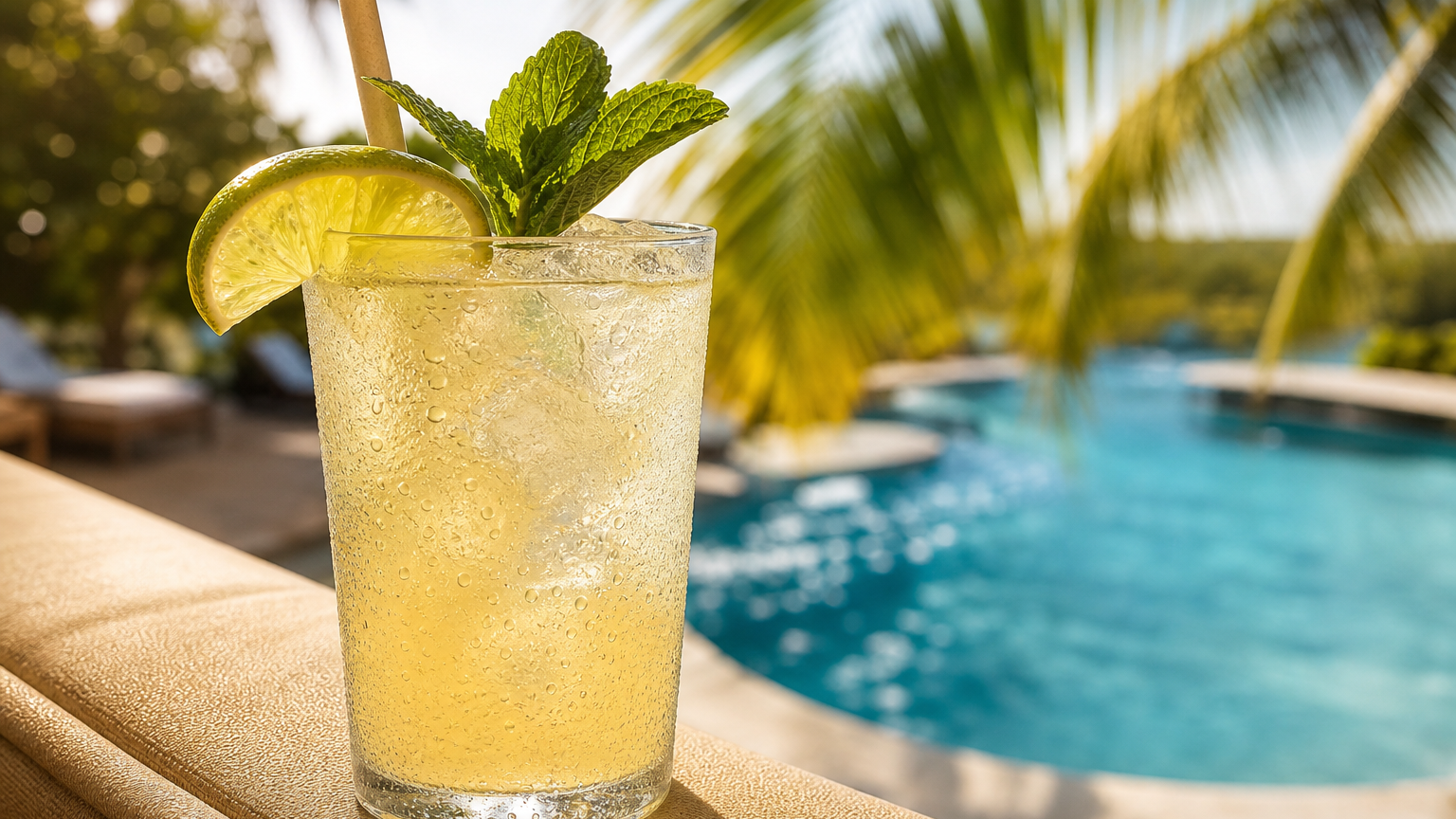
From there, the trick is to swap the ritual, not just the drink. A huge part of what you are after is the ritual itself: the cold glass in your hand, the pause, the social cue that you are relaxing with everyone else. You can keep all of that and lose the alcohol. Order a mocktail, a sparkling water with bitters, or a non-alcoholic beer so your hands and the social script are covered. Setting a limit before you start and alternating each alcoholic drink with water or a soft drink is classic NHS advice for a reason, and it is the backbone of what people call zebra-striping: you keep a drink in hand the whole time, you just cut the total in half without ever opting out.
Reframe the all-inclusive too. That wristband is not only "all the cocktails I can drink," it is also all the coffee, all the smoothies, all the fresh fruit and food you want. When you stop reading it as a bar tab you need to max out, the poolside bar loses a lot of its gravitational pull.
Planning the trip around experiences
The single best antidote to vacation drinking is making drinking not the main event. Front-load novelty into activities: the excursion, the hike, the market, the early boat trip, the great meal. When your days have a shape and a highlight that is not a glass, the reward-seeking part of your brain gets fed by the experience instead of the alcohol. Boredom is where the default drink sneaks in, so give the lulls somewhere else to go.
It also helps enormously to protect one anchor of routine. A morning walk, a workout, an early activity you have committed to, anything that keeps the whole trip from dissolving into unstructured time. That single anchor does what your normal week does at home: it puts a gentle ceiling on the night before, because now there is a reason to wake up decent. If you want more ideas in this vein, our guides on enjoying travel alcohol-free and the case for sober tourism go deep on making the trip itself the reward.
How do I handle social pressure to drink while traveling with others?
Half the battle when you are traveling with a group is not the alcohol, it is the offers, the rounds, and the low-grade sense that opting out makes you the odd one out. The fix is mostly logistical, and it starts with having a low-key line ready before anyone asks. Something like "I'm pacing myself today" or "I'm on the mocktails tonight" ends the conversation without inviting a debate.
Hold a non-alcoholic drink so you are not fielding offers with empty hands. This is where planning your refusals in advance pays off: NIAAA's guidance on building drink-refusal skills recommends knowing your "no" ahead of time and keeping it clear and firm yet friendly, while avoiding long explanations and vague excuses, and keeping an alcohol-free drink in hand. Redirecting the group ("let's actually go see the sunset spot") beats sitting there resisting drink after drink.
A quiet piece of insurance: let one travel companion in on your plan. Having a single person who knows you are keeping it light means you have backup without making an announcement to everyone. You can also take pace off the table by getting your own drinks instead of drinking in rounds, which, as Cancer Research UK notes, gives you more control over how much you actually consume. And if saying no still feels hard, our full guide on how to say no to alcohol has scripts for nearly every scenario.
The mindset underneath all of it: you do not owe anyone an explanation, and you definitely do not owe anyone a fully sober trip if that is not your goal. The aim is drinking on your terms. If you want tools that make those terms easier to hold when the cues stack up, you can download Reframe, and if you have questions about how it works, Reframe's FAQ is a good place to start.
Summary FAQs
1. Why do I drink so much more on vacation than in my normal life?
Vacation removes the everyday routine that quietly limits your drinking and replaces it with a permission mindset, the sense that a trip is earned and exempt from your usual rules. Environmental cues like poolside bars, all-inclusive wristbands, and everyone around you drinking make reaching for a drink the path of least resistance. It is a situational trigger, not a personal failing, which means it responds well to a little advance planning.
2. What is the vacation permission mindset?
The permission mindset is the internal story that vacation is a reward you deserve, is only temporary, and does not count toward your normal limits. That framing lowers the perceived cost of each drink and switches off the brakes you would normally apply at home. Because it is a story rather than a fact, you can rewrite it by framing the trip as a break you actually want to remember and enjoy.
3. Is it bad to drink more on vacation?
An occasional context-specific bump is common and not automatically a problem. It is worth a closer look when vacation drinking regularly overshoots what you intended, leaves you with regret, or spills into the days after. A helpful gut check is whether the same amount would bother you on an ordinary Tuesday at home.
4. How can I drink less on vacation without feeling like I'm missing out?
Swap the ritual rather than skipping it: order a mocktail, sparkling water with bitters, or a non-alcoholic beer so your hands and the social cue are covered. Alternate alcoholic and non-alcoholic drinks to slow your pace, and front-load the trip with excursions, food, and morning activities so drinking is not the headline. Setting a loose intention before you leave, rather than deciding at the bar, makes all of this far easier.
5. How do I handle friends pressuring me to drink on a trip?
Keep a simple line ready like 'I'm pacing myself today' and hold a non-alcoholic drink so you are not fielding offers empty-handed. Telling one travel companion your plan gives you quiet backup, and steering the group toward an activity beats waiting for the next round. You do not owe anyone an explanation or a fully sober trip; the aim is drinking on your own terms.
6. Why does boredom make me drink more on vacation?
On vacation the line between relaxing and being bored gets blurry, so an idle lull often gets filled with a drink by default. Because there is little structure and lots of easy access, drinking becomes the automatic way to occupy downtime. Planning a few anchor activities, even something small like a morning walk, gives those lulls somewhere else to go.
Want Vacations You Actually Remember? Reframe Can Help!
Although it isn't a treatment for alcohol use disorder (AUD), the Reframe app can help you cut back on drinking gradually with the science-backed knowledge to empower you 100% of the way. Our proven program has helped millions of people around the world drink less and live more. And we want to help you get there, too!
The Reframe app equips you with the knowledge and skills you need to not only survive drinking less, but to thrive while you navigate the journey. Our daily research-backed readings teach you the neuroscience of alcohol, and our in-app Toolkit provides the resources and activities you need to navigate each challenge.
You'll meet millions of fellow Reframers in our 24/7 Forum chat and daily Zoom check-in meetings. Receive encouragement from people worldwide who know exactly what you're going through! You'll also have the opportunity to connect with our licensed Reframe coaches for more personalized guidance.
Plus, we're always introducing new features to optimize your in-app experience. We recently launched our in-app chatbot, Melody, powered by the world's most powerful AI technology. Melody is here to help as you adjust to a life with less (or no) alcohol.
And that's not all! Every month, we launch fun challenges, like Dry/Damp January, Mental Health May, and Outdoorsy June. You won't want to miss out on the chance to participate alongside fellow Reframers (or solo if that's more your thing!).
The Reframe app is free for 7 days, so you don't have anything to lose by trying it. Are you ready to feel empowered and discover life beyond alcohol? Then download our app through the App Store or Google Play today!
Reframe has helped over 2 millions people to build healthier drinking habits globally
At Reframe, we do science, not stigma. We base our articles on the latest peer-reviewed research in psychology, neuroscience, and behavioral science. We follow the Reframe Content Creation Guidelines, to ensure that we share accurate and actionable information with our readers. This aids them in making informed decisions on their wellness journey. Learn more
Updated Regularly
Our articles undergo frequent updates to present the newest scientific research and changes in expert consensus in an easily understandable and implementable manner.
Gold, M. S. (2024, December 26). Extreme drinking on holidays and special occasions. Psychology Today. https://www.psychologytoday.com/us/blog/addiction-outlook/202412/extreme-drinking-on-holidays-and-special-occasions
Mellentin, A. I., Nielsen, B., Nielsen, A. S., Yu, F., & Stenager, E. (2019). Identifying triggers of alcohol craving to develop effective virtual environments for cue exposure therapy. Frontiers in Psychology, 10, 74. https://doi.org/10.3389/fpsyg.2019.00074
Wingo, T., Nesil, T., Choi, J.-S., & Li, M. D. (2016). Novelty seeking and drug addiction in humans and animals: From behavior to molecules. Journal of Neuroimmune Pharmacology, 11(3), 456–470. https://doi.org/10.1007/s11481-015-9636-7
National Institute on Alcohol Abuse and Alcoholism. (n.d.). Worksheets & more. Rethinking Drinking: Alcohol and your health. https://rethinkingdrinking.niaaa.nih.gov/tools/worksheets-more
Perkins, H. W., Haines, M. P., & Rice, R. (2005). Misperceiving the college drinking norm and related problems: A nationwide study of exposure to prevention information, perceived norms and student alcohol misuse. Journal of Studies on Alcohol, 66(4), 470–478. https://pubmed.ncbi.nlm.nih.gov/14743946/
National Health Service. (n.d.). Tips on cutting down on alcohol. NHS. https://www.nhs.uk/live-well/alcohol-advice/tips-on-cutting-down-alcohol/
Cancer Research UK. (n.d.). How can I cut down on alcohol? Cancer Research UK. https://www.cancerresearchuk.org/about-cancer/causes-of-cancer/alcohol-and-cancer/how-can-i-cut-down-on-alcohol
National Institute on Alcohol Abuse and Alcoholism. (n.d.). Building your drink refusal skills. Rethinking Drinking: Alcohol and your health. https://rethinkingdrinking.niaaa.nih.gov/tools/worksheets-more/building-your-drink-refusal-skills




.png)