Why Hotel Rooms Trigger Cravings and How to Break the Pattern
Published:
2026-09-29
·
Read time:
14 min read
Last Updated:
2026-10-04
Written by
Reframe Content Team
A team of researchers and psychologists who specialize in behavioral health and neuroscience. This group collaborates to produce insightful and evidence-based content.
Certified recovery coach specialized in helping everyone redefine their relationship with alcohol. His approach in coaching focuses on habit formation and addressing the stress in our lives.
Recognized by Fortune and Fast Company as a top innovator shaping the future of health and known for his pivotal role in helping individuals change their relationship with alcohol.
September 29, 2026
·
14 min read
Reframe Content Team
September 29, 2026
·
14 min read
Hotel rooms trigger the urge to drink because they combine three things your brain reads as permission: instant availability (a minibar and room service menu within arm's reach), total privacy with no social accountability, and a blank, novel space where none of your usual evening habits exist to compete. The check-in moment itself becomes a conditioned cue fast, because "drop bags, exhale, pour something" is a tidy reward at the end of a draining travel day, and your brain learns that sequence in only a few repetitions. Reframe's approach is to change what happens in that first hour, so the room cues a different ritual instead of a drink.
Why a Hotel Room Makes You Want to Drink
Hotel rooms trigger the urge to drink because they combine three things your brain reads as permission: instant availability (a minibar and room service menu within arm's reach), total privacy with no social accountability, and a blank, novel space where none of your usual evening habits exist to compete. The check-in moment itself becomes a conditioned cue fast, because "drop bags, exhale, pour something" is a tidy reward at the end of a draining travel day, and your brain learns that sequence in only a few repetitions. Reframe's approach is to change what happens in that first hour, so the room cues a different ritual instead of a drink.
Let's talk honestly about the thing almost nobody mentions in the group chat: you can go six weeks at home without much of a pull toward alcohol, then walk into a room with blackout curtains and a tiny fridge and feel it show up within minutes. That is not backsliding. That is a hotel room drinking trigger doing exactly what a well-built cue does, and the fact that it feels so specific and so reliable is actually good news, because specific and reliable patterns are the easiest kind to redesign.
This post is about the room itself. Not your destination, not your itinerary, not whether you should be traveling for work at all. Just the twelve or so hours between check-in and lights out, and how to make them go differently.
Why does a hotel room make you want to drink so quickly?
The speed is the strange part, and it comes down to the fact that a hotel room is a very small space holding a very large number of cues at once: alcohol physically present, nobody around to notice, and a stretch of unstructured evening with no plan attached. At home, your 7pm is crowded with other things. In a hotel room, the urge has nothing to compete with.
Habit research helps explain why the room matters more than your intentions do. In a pair of experiments published in the Journal of Experimental Social Psychology, performance contexts (the places and situations where a behavior was learned) automatically activated strongly habitual behaviors, largely independent of what participants currently wanted to do. Your goals live in one system; your locations talk to another.
The check-in decompression ritual
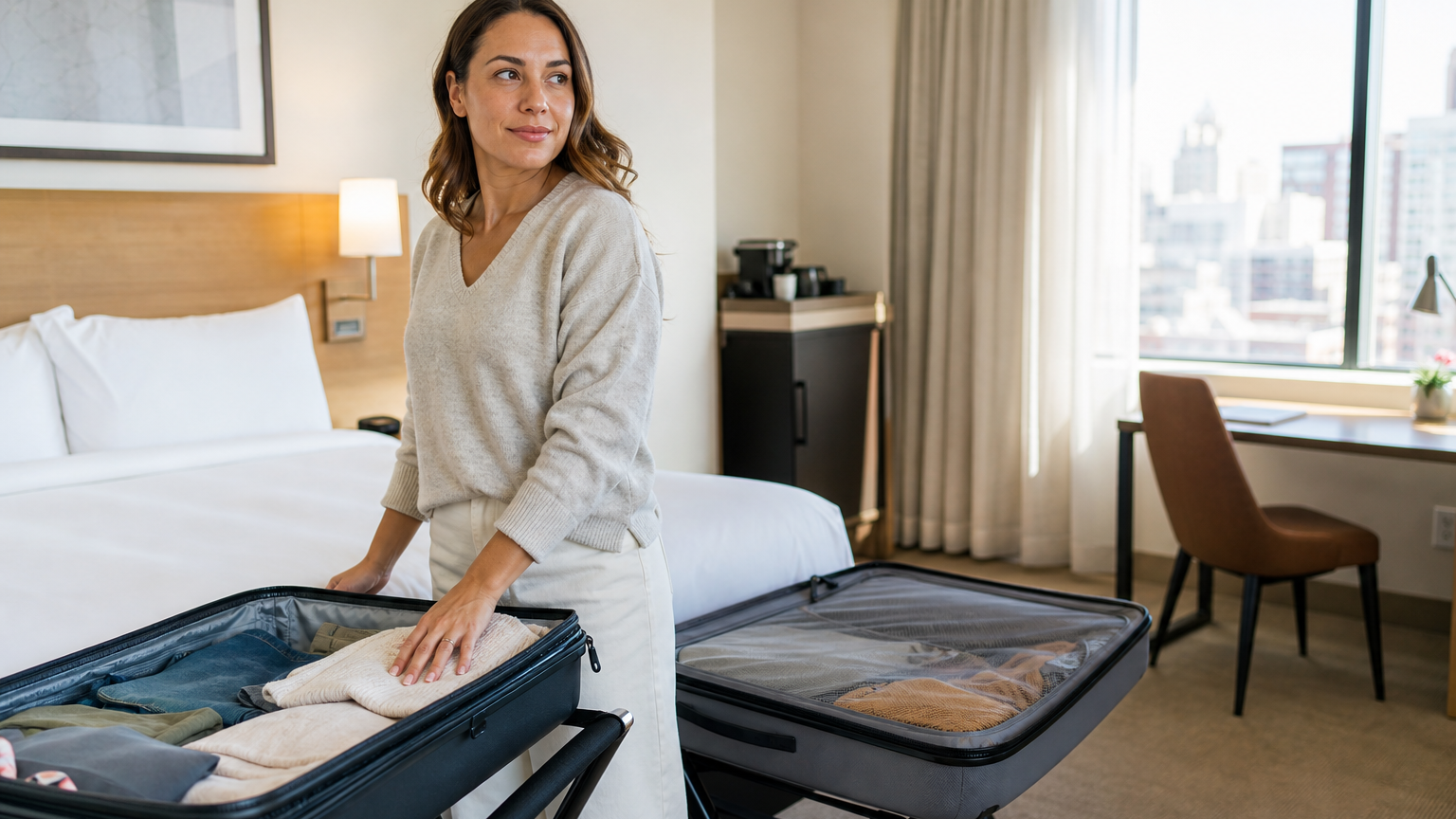
Picture the sequence: airport, rideshare, lobby line, elevator, keycard, bags down, long exhale. That exhale is a genuine reward moment after a genuinely tiring day. Whatever you do in the next ninety seconds gets stapled to it. If what you do is open the fridge, you have just built a small, tidy, high-quality habit loop, and habit loops built on relief are sticky ones.
It is worth remembering that the day was already hard on your body before you got to the room. Travel clinicians generally note that long, multi-leg itineraries leave people dehydrated, out of sync, and worn down, and many suggest going easy on in-flight alcohol when you have work waiting at the other end. By the time you reach the keycard, you are often tired, dehydrated, and running on airport food. Alcohol reads like the shortest available path to feeling better.
Why an unfamiliar room learns a habit faster than your own home
Here is the counterintuitive bit. You would think a strange room would be neutral. It is actually a blank slate, which is precisely the problem: there are no competing associations to push back.
Conditioning research suggests brand-new cues can pick up alcohol associations quickly. In a lab study of 36 social drinkers indexed on PubMed, previously neutral cues paired with alcohol began attracting participants' attention after only a few pairings, and the size of that shift tracked with how much they liked the alcohol's effects. That study measured where attention went, not self-reported craving, so the honest framing is this: after a couple of trips, your brain starts tracking the room. It notices the fridge. That is the earliest stage of the pattern.
None of this is a character problem. It is environmental learning, which is the most fixable category of drinking pattern there is. If you are wondering where your own patterns sit on the spectrum, the Am I Drinking Too Much? quiz is a low-stakes place to look, and our broader guide to understanding your triggers for drinking covers the non-travel versions.
What exactly is the minibar doing to your brain?
Mostly, it is deleting steps. Every step between wanting a drink and having one is friction, and friction is the quiet protective factor nobody credits. The minibar removes all of them at once: no going out, no ordering in front of a colleague, no waiting, no decision that anyone else witnesses.
Distance genuinely matters here, though let's not oversell it. A Finnish cohort study of 54,778 people published in Drug and Alcohol Dependence found that when the distance from home to the nearest beer outlet dropped below 500 meters, the likelihood of incident heavy drinking rose in women (odds ratio 1.23), with a smaller and non-significant effect for liquor outlets. The effect was modest and not uniform across groups. But the direction is consistent with what a minibar does at an extreme: it cuts the distance to roughly four feet.
Reducing availability where you sleep is also a mainstream, agency-endorsed move rather than an unusual one. The NIAAA's patient education tips list keeping little or no alcohol in your home among first-line strategies, alongside avoiding the people, places, and times of day that set off the urge. That guidance is written about home, but the principle transfers cleanly. Your hotel room is where you sleep this week.
A few other things the minibar is quietly doing. Price does not deter the way you would expect, because expensed spending and vacation-mode spending both disable the internal cost check that might otherwise slow you down (if you want to see what that math looks like over a year, the alcohol spend calculator is oddly motivating). And those small bottles create a false impression of portion control while making repeat pours effortless: four small ones do not feel like four. When the minibar empties, room service and the lobby bar extend the exact same frictionless arrangement, just with a phone call in between.
Why is solo business travel uniquely risky?
Solo work travel stacks the deck in a way that is worth naming plainly, and naming it is not the same as saying business travel is bad for you. What happens on the road is that external checks quietly disappear without you ever deciding to remove them. No partner in the next room. No neighbor. No morning in your own bed with your own routine waiting.
The pattern shows up in the data. An analysis of health records from 18,328 employees published in the Journal of Occupational and Environmental Medicine found that compared with those traveling one to six nights a month, employees traveling 21 or more nights a month were about twice as likely to score above the clinical threshold on an alcohol dependence screener, and also more likely to report trouble sleeping, anxiety symptoms, and depression symptoms. That study is cross-sectional and describes very heavy travelers, so it does not prove travel causes anything. What it does say is that if the road feels harder than home, you are not imagining it and you are not unusual.
Work travel also bundles performance stress with a culture where a nightcap reads as ordinary decompression. Client dinners and conference receptions front-load the drinking, and then the room extends it, often past the point where you would have stopped in company. This is closely related to why drinking alone tends to follow different rules than drinking with other people.
When the empty evening is really the trigger
Sometimes the fridge is not the problem. The problem is 8:40pm in a city where you know nobody, with a body clock two hours off and four hours to fill before you can reasonably sleep. Loneliness on the road is underrated as a driver, and it does not announce itself as loneliness. It announces itself as boredom, restlessness, or a vague sense that you have earned something.
Cravings attach to particular settings, not just particular moods. A momentary-assessment study indexed on PubMed had participants name, in advance, the specific contexts they expected to produce intense urges, and found that drinking contexts related meaningfully to real-time craving. Being able to name your context ahead of time is a recognized clinical move, not a party trick. If "hotel room, alone, after 8pm" is your context, you already have the most useful piece of information.
How do you plan for the hotel room before you leave home?
Pre-trip decisions beat in-room willpower every time, for one boring reason: you make them while rested, fed, and nowhere near the cue. The version of you standing in your kitchen on Sunday is a much better strategist than the version of you holding a keycard on Tuesday night.
Four things, none of which take long:
Call ahead about the minibar. Add a note to the reservation, mention it at check-in, or call housekeeping once you are in the room. Most hotels will empty it, lock it, or restock it with water and soft drinks, and nobody asks why. This is the single highest-leverage thing on the list because it removes the cue rather than requiring you to resist it.
Pre-order or pack your replacements. An empty fridge is better than a stocked one, but a fridge with something you actually want in it is better still. Sparkling water, a good non-alcoholic option, cold brew for the morning. Grocery delivery to the hotel works in most cities. Our roundup of non-alcoholic wines and beers is a decent starting point if you have not experimented much.
Decide the evening before you leave. Not vaguely. A gym slot, a walking route pinned on your phone, a restaurant with a counter, a scheduled call with someone at home. The goal is that 8pm already has an owner.
Set one accountability touchpoint per night. Two lines to a friend counts. A nightly check-in inside Reframe's mindful drinking program counts. The point is that someone or something exists outside the room, because privacy is doing half the work of this trigger.
What should you do in the first hour after check-in?
Treat the first hour as the whole game, because the rest of the night mostly follows from it. Here is the protocol, and the order matters.
Do not sit down first. That sit-down-and-exhale moment is the exact cue you are trying to interrupt, and sitting on the end of the bed with your coat still on is where the decision usually gets made. Stay vertical.
The unpack-and-leave rule
Unpack immediately, all of it, including the toiletries. Then leave the room for ten minutes. The lobby counts. A lap around the block counts. Buying a bottle of water from the shop next door counts. You are inserting a boundary between arrival and evening so the two stop being one continuous slide.
While you are still standing: empty the minibar into a drawer or the closet if housekeeping has not done it, put your own drinks in the fridge, and move the room service menu out of sight. These sound trivially small. They work because they change what your eye lands on, and the research above suggests it is the environment doing more of the driving than you would guess.
Building a replacement evening ritual
Then give the evening a container: shower, real food, one planned activity, a set lights-out time. Anything is better than an open-ended night with a fridge in it.
Worth knowing as you plan that container: a nightcap does not buy you the sleep it promises. An NIAAA review in Alcohol Research & Health describes alcohol shortening how long it takes to fall asleep while disturbing the second half of the night, with tolerance to the sedative effect developing quickly, and notes that alcohol interacts with sleep deprivation to worsen next-day sleepiness and performance. For someone already carrying travel sleep debt into a 9am meeting, that compounding is the practical argument. If your evening drink is really a sleep tool, our guide to replacing alcohol in your evening routine has better instruments for the job.
What if the craving hits anyway at 9pm in the room?
Expect it. A craving showing up is not evidence the plan failed; it is evidence you built a strong association and are now standing in the middle of it. The plan is working precisely when the urge arrives and nothing happens next.
Change the physical context first, before you try to reason with yourself. Leave the room. Ride the elevator down. Walk the corridor. Step outside for four minutes. Almost anything beats negotiating with yourself in silence while the fridge sits in your peripheral vision.
Then ride it rather than fight it. The NIAAA's Rethinking Drinking guidance describes urges as short-lived, predictable, and controllable, and notes that with time and practice, urges lose strength. The companion Rethinking Drinking booklet suggests accepting and riding out the feeling knowing it will crest like a wave and pass, talking it through with someone you trust, or getting involved in a distracting activity. In practice that means: order food, run a hot shower, start a call, put on headphones and walk. Many people find the peak fades within roughly twenty minutes, though the honest answer is that it varies and the strategy does not depend on the clock.
If you drink anyway, log it and move on. A single hotel night does not undo a trip, and writing off the remaining three nights because of Tuesday is the expensive mistake, not Tuesday. Adjust tomorrow's first hour instead. And one genuinely important caveat: if you drink heavily and daily, and stopping abruptly on the road brings on shaking, sweating, or confusion, that is a medical situation rather than a willpower one, and a clinician can help you taper safely.
How do you keep the hotel room from re-cueing you next trip?
The encouraging part is that conditioning runs both directions. The same mechanism that taught the room to mean "drink" can teach it to mean "shower, food, book, sleep," and it does not require heroics, just repetition in a stable sequence.
The Annual Review of Psychology review of habit psychology describes habit associations accruing through repeated pairing of a response with recurring context cues, which is exactly why holding the first-hour protocol identical across trips is the lever. Vary it and you are starting over each time. Keep it the same and the new sequence starts running itself. We do not have a clean number for how many trips this takes, and individual variation in habit formation is large, but plenty of Reframe members describe the pull dropping off noticeably by the second or third trip of doing it the same way.
A few things that make consistency easier:
Pack the same small kit every time. Tea bags, a couple of cans of sparkling water, a paperback, headphones, whatever your version is. Familiar objects are portable cues, and they give the room something of yours to attach to.
Track travel nights separately from home nights. Travel is its own pattern with its own triggers, and averaging it into your normal weeks hides both the problem and the progress. Seeing "four trips, first-hour protocol run four times" is more useful than a blurry monthly total, and it is the kind of thing worth logging in Reframe or a notebook, whichever you will actually keep up.
Notice the boring wins. This is the part people skip. A hotel night that ends flat, uneventful, and slightly early is a successful hotel night. There is no confetti for it. The reward is a 7am that feels like a normal 7am, and over a year of travel that adds up to more than any single evening ever did.
If you want structure around all of this rather than a list to remember, you can download Reframe and build the first-hour protocol into your trip prep, with check-ins that follow you onto the road. For more on travel specifically, our guide to alcohol-free travel picks up where this one stops.
Summary FAQs
1. Why do I only want to drink when I stay in a hotel?
A hotel room stacks several triggers at once: alcohol is within reach, nobody is watching, and the space has no existing routine attached to it. Your usual evening habits at home compete with drinking, but a blank room gives the urge nothing to push against. The check-in exhale then gets paired with a drink so reliably that the room itself becomes the cue.
2. Can I ask a hotel to empty the minibar?
Yes, and most hotels will do it without any explanation needed. Note the request on your reservation, mention it at check-in, or call housekeeping once you are in the room. Some properties will also lock the minibar or leave it stocked only with water and soft drinks if you ask.
3. Why is drinking alone in a hotel room different from drinking at home?
Solo hotel time removes the external checks that normally shape your drinking, like a partner in the next room, a work morning in your own bed, or the effort of going out to buy more. Novelty also matters: an unfamiliar space forms a new habit loop quickly because there is nothing competing with it. That combination is why one or two trips can install a pattern that feels automatic by the third.
4. What should I do in the first hour after checking into a hotel?
Do not sit down and decompress in the room, because that pause is the cue. Unpack right away, clear or restock the minibar with your own drinks, tuck the room service menu in a drawer, and then leave the room for ten minutes. Come back with the evening already planned: food, one activity, and a lights-out time.
5. How long does a craving in a hotel room usually last?
Urges tend to crest and pass rather than build indefinitely, and federal guidance describes them as short-lived and controllable rather than attaching a fixed number of minutes. Changing your physical context shortens the episode: leaving the room, ordering food, running a shower, or calling someone all help. The urge returning later in the night is normal and does not mean the strategy is not working.
6. How do I handle conference receptions and client dinners without drinking?
Get a non-alcoholic drink in your hand early so you are not offered one repeatedly, and decide your answer in advance so you are not improvising under pressure. The bigger risk is usually after the event, when you return to the room still keyed up. Plan what the post-event hour looks like before you walk into the reception.
7. Will hotel rooms always feel like a trigger?
No. Conditioned cues weaken when the old pairing stops being reinforced, and habit research indicates that associations shift through repeated pairing in a stable context. Consistency matters more than intensity, so keep the first-hour protocol identical rather than improvising a new plan each trip.
Traveling Soon and Dreading the Hotel Room? Reframe Can Help!
Although it isn't a treatment for alcohol use disorder (AUD), the Reframe app can help you cut back on drinking gradually with the science-backed knowledge to empower you 100% of the way. Our proven program has helped millions of people around the world drink less and live more. And we want to help you get there, too!
The Reframe app equips you with the knowledge and skills you need to not only survive drinking less, but to thrive while you navigate the journey. Our daily research-backed readings teach you the neuroscience of alcohol, and our in-app Toolkit provides the resources and activities you need to navigate each challenge.
You'll meet millions of fellow Reframers in our 24/7 Forum chat and daily Zoom check-in meetings. Receive encouragement from people worldwide who know exactly what you're going through! You'll also have the opportunity to connect with our licensed Reframe coaches for more personalized guidance.
Plus, we're always introducing new features to optimize your in-app experience. We recently launched our in-app chatbot, Melody, powered by the world's most powerful AI technology. Melody is here to help as you adjust to a life with less (or no) alcohol.
And that's not all! Every month, we launch fun challenges, like Dry/Damp January, Mental Health May, and Outdoorsy June. You won't want to miss out on the chance to participate alongside fellow Reframers (or solo if that's more your thing!).
The Reframe app is free for 7 days, so you don't have anything to lose by trying it. Are you ready to feel empowered and discover life beyond alcohol? Then download our app through the App Store or Google Play today!
Reframe has helped over 2 millions people to build healthier drinking habits globally
At Reframe, we do science, not stigma. We base our articles on the latest peer-reviewed research in psychology, neuroscience, and behavioral science. We follow the Reframe Content Creation Guidelines, to ensure that we share accurate and actionable information with our readers. This aids them in making informed decisions on their wellness journey. Learn more
Updated Regularly
Our articles undergo frequent updates to present the newest scientific research and changes in expert consensus in an easily understandable and implementable manner.
National Institute on Alcohol Abuse and Alcoholism. (n.d.). How to stop alcohol cravings. Rethinking Drinking. https://rethinkingdrinking.niaaa.nih.gov/tools/worksheets-more/how-stop-alcohol-cravings
National Institute on Alcohol Abuse and Alcoholism. (2022). Rethinking drinking: Alcohol and your health (NIH Publication). U.S. Department of Health and Human Services. https://www.niaaa.nih.gov/sites/default/files/publications/NIAAA_RethinkingDrinking.pdf
National Institute on Alcohol Abuse and Alcoholism. (n.d.). Tips and tools to help you quit drinking [Patient education handout]. https://www.niaaa.nih.gov/sites/default/files/patient-education-tips-for-quitting-drinking-and-recovering-from-a-drinking-episode.pdf
Neal, D. T., Wood, W., Labrecque, J. S., & Lally, P. (2012). How do habits guide behavior? Perceived and actual triggers of habits in daily life. Journal of Experimental Social Psychology, 48(2), 492–498. https://doi.org/10.1016/j.jesp.2011.10.011
Wood, W., & Rünger, D. (2016). Psychology of habit. Annual Review of Psychology, 67, 289–314. https://doi.org/10.1146/annurev-psych-122414-033417
Mayo, L. M., & de Wit, H. (2016). Acquisition of conditioned responses to a novel alcohol-paired cue in social drinkers. Journal of Studies on Alcohol and Drugs, 77(2), 317–326. https://pubmed.ncbi.nlm.nih.gov/26997190/
Context and craving among individuals with alcohol use disorder attempting to moderate their drinking. (2020). Psychology of Addictive Behaviors. https://pubmed.ncbi.nlm.nih.gov/31971419/
Halonen, J. I., Kivimäki, M., Virtanen, M., Pentti, J., Subramanian, S. V., Kawachi, I., & Vahtera, J. (2013). Proximity of off-premise alcohol outlets and heavy alcohol consumption: A cohort study. Drug and Alcohol Dependence, 132(3), 295–300. https://doi.org/10.1016/j.drugalcdep.2013.02.022
Rundle, A. G., Revenson, T. A., & Friedman, M. (2018). Business travel and behavioral and mental health. Journal of Occupational and Environmental Medicine, 60(7), 612–616. https://doi.org/10.1097/JOM.0000000000001262
Centers for Disease Control and Prevention. (2026). The international business traveler. CDC Yellow Book. https://www.cdc.gov/yellow-book/hcp/travel-for-work-other/international-business-traveler.html
Roehrs, T., & Roth, T. (2001). Sleep, sleepiness, and alcohol use. Alcohol Research & Health, 25(2), 101–109. https://www.ncbi.nlm.nih.gov/pmc/articles/PMC6707127/