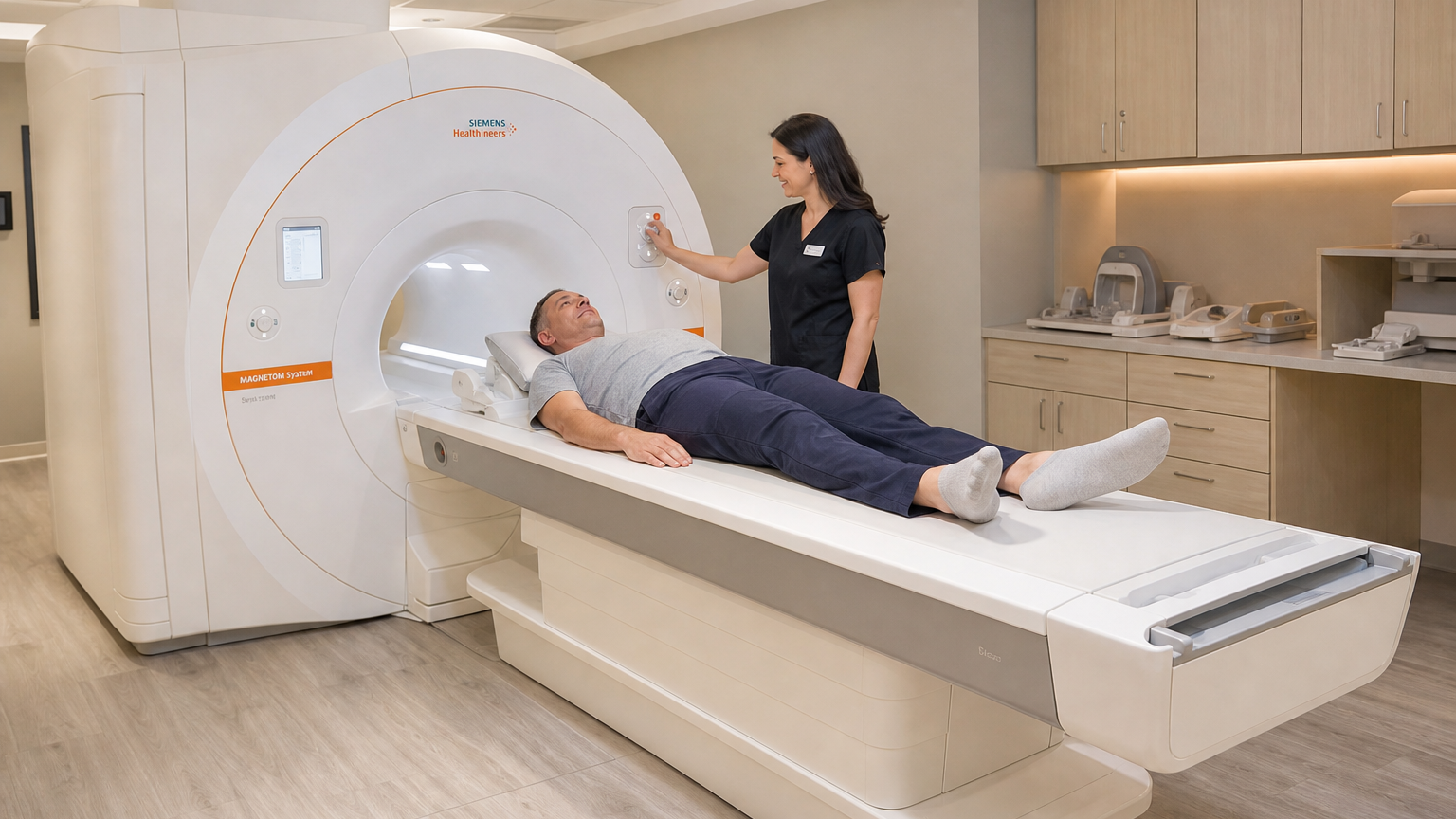
Can You Drink Alcohol Before an MRI With Contrast? What to Know
Published:
2026-08-18
·
Read time:
9 min read
Last Updated:
2026-08-18
Written by
Reframe Content Team
A team of researchers and psychologists who specialize in behavioral health and neuroscience. This group collaborates to produce insightful and evidence-based content.
Certified recovery coach specialized in helping everyone redefine their relationship with alcohol. His approach in coaching focuses on habit formation and addressing the stress in our lives.
Recognized by Fortune and Fast Company as a top innovator shaping the future of health and known for his pivotal role in helping individuals change their relationship with alcohol.
August 18, 2026
·
9 min read
Reframe Content Team
August 18, 2026
·
9 min read
Alcohol does not chemically interfere with the gadolinium contrast dye used in an MRI, and it will not distort the images themselves, but drinking before your scan is still not a great idea. The main reasons are hydration and your kidneys: gadolinium is cleared by the kidneys, and alcohol is a diuretic that dehydrates you and can make you feel worse if you also receive sedation. Always follow the specific prep instructions from your imaging center, since some scans require fasting. If a scan has you rethinking how much air time alcohol takes up in your life, Reframe can help you build habits that don't leave you second-guessing before a medical appointment.
The Short Answer on Alcohol Before an MRI With Contrast
Alcohol does not chemically interfere with the gadolinium contrast dye used in an MRI, and it will not distort the images themselves, but drinking before your scan is still not a great idea. The main reasons are hydration and your kidneys: gadolinium is cleared by the kidneys, and alcohol is a diuretic that dehydrates you and can make you feel worse if you also receive sedation. Always follow the specific prep instructions from your imaging center, since some scans require fasting. If a scan has you rethinking how much air time alcohol takes up in your life, Reframe can help you build habits that don't leave you second-guessing before a medical appointment.
Here's a question that pops up more often than you'd think: you've got an MRI with contrast scheduled, there's a social thing the night before, and you're wondering whether that glass of wine is going to mess anything up. It's a fair thing to ask, and the answers floating around online tend to be either "sure, no big deal" or a stern "never drink before any scan, ever." Neither is quite right. The truth sits in the middle, and it has less to do with the machine and more to do with your body, your kidneys, and whether anyone is planning to sedate you.
Let's walk through what actually matters when it comes to alcohol before MRI with contrast, so you can make a calm, informed call instead of guessing.
Does alcohol affect gadolinium contrast or MRI image quality?
Straight answer: alcohol will not ruin the scan itself. There is no known chemical reaction between the gadolinium-based contrast dye and alcohol, and alcohol does not blur, warp, or otherwise distort the images the way physical movement does. The MRI machine works by detecting magnetic signals from the water molecules in your tissues, and a drink the night before doesn't change how those signals behave.
So why does everyone act like drinking before an MRI with contrast is a problem? Because "the scan will still work" is not the same as "you'll be fine." The concern was never really about image chemistry. It's about how alcohol affects the rest of your body during and after the appointment, especially your kidneys and how you feel while you're lying inside a narrow tube trying not to move.
The one thing that genuinely degrades MRI images is motion. If you're nauseous, restless, or fighting a pounding head, staying perfectly still gets much harder, and that's where a rough morning can indirectly cost you a clear picture. We'll get to that. The bottom line for this section: alcohol won't chemically sabotage your contrast scan, but that's only the first chapter of the story, not the whole thing.
Why does hydration matter for an MRI with contrast?
Here's where the real reason to skip pre-scan drinks lives: your kidneys do the cleanup, and alcohol makes their job harder. Gadolinium-based contrast agents are cleared from the body primarily through the kidneys, which means good kidney function and good hydration help your body flush the dye out efficiently once the scan is done. Alcohol works against that because it has a diuretic, dehydrating tendency, pulling fluid out of you at exactly the moment you'd rather be topped up.
Why do the kidneys matter so much here? The reason imaging teams screen kidney function before giving contrast is that gadolinium carries a risk of nephrogenic systemic fibrosis in people with impaired kidney elimination, a rare but serious condition. For someone with normal kidney function, this is background context rather than a personal alarm, but it explains why "help your kidneys do their job" is the whole logic behind hydrating for a contrast scan. Showing up dehydrated is simply working against your own plumbing.
Hydration has a second, very practical payoff: it makes the IV line easier to place. Contrast is injected through an IV, and dehydrated veins are harder to find and stick, which can turn a two-second poke into an uncomfortable fishing expedition. Being well hydrated tends to make that part smoother.
Different centers give different instructions, and this is where you have to read your own paperwork. Some imaging centers ask you to drink water beforehand; Stanford Health Care's prep instructions for a renal MRI, for example, tell patients to drink three glasses of water finishing an hour before arrival. That's one facility's protocol for one type of scan, not a universal rule, and plenty of other exams require fasting instead. The takeaway isn't "always chug water," it's "follow your center's specific instructions, and don't undermine them by drinking alcohol." If you want a deeper dive on why booze pulls water out of you, we broke it down in our piece on how dehydrating alcohol really is, and on the kidney side, how alcohol affects kidney health covers the organ doing all this filtering.
Should you drink alcohol the night before an MRI?
A single drink the night before is very unlikely to affect the scan on a chemical level, so if that's your only concern, you can relax about that part. The problem isn't the alcohol lingering in your bloodstream by morning; it's what a rougher-than-expected night can do to how you feel when you show up.
Picture the less fun version: you have a few more than planned, and the next morning brings a hangover, dehydration, a headache, and a queasy stomach. Now you're being asked to lie flat and hold still for twenty to forty minutes inside a loud machine. Feeling unwell makes staying motionless genuinely difficult, and motion is the thing that actually degrades image quality. So the risk isn't chemical, it's behavioral: a hangover can indirectly sabotage your scan by making you fidget.
There's also the fasting wrinkle. If your MRI requires you to skip food beforehand, drinking on an empty stomach hits harder and dehydrates you more, which stacks the deck against a comfortable appointment. Our rundown on what happens when you drink on an empty stomach explains why that combination lands rougher. The cleanest choice, honestly, is to skip alcohol the night before, drink water, and give yourself the best shot at a smooth, still, clear scan. It's a small ask for one evening, and it removes a variable you'd otherwise be wondering about in the waiting room.
What if your MRI involves sedation or anesthesia?
This is the section where the stakes change, so it deserves your full attention. Some people receive sedation or light anesthesia for an MRI, usually because of claustrophobia or because holding still for the whole scan is difficult. If sedation is part of your plan, alcohol stops being a hydration footnote and becomes a genuine safety issue.
When does drinking before sedation become a safety issue?
The honest answer is that this is not a call to make on your own, and it's not one to settle with an internet search. Anesthesia and sedation teams need you to disclose recent alcohol use honestly, because that information changes how they plan and monitor your care. If sedation is scheduled, your provider will give you a specific no-alcohol and fasting window, and following it exactly is part of keeping the procedure safe. A clinician can help you do this the right way, so loop them in rather than guessing. If your MRI has you thinking more broadly about mixing alcohol with medications, our overview on drinking while taking medication is a good companion read. The short version: when sedation is involved, this is a medical decision to confirm with your care team, full stop.
What should you do if you already drank before your MRI?
First, don't panic and don't cancel on impulse. If you had one drink the night before a routine contrast MRI, that is rarely a reason to call the whole thing off. The single best move is to call your imaging center and tell them what happened so they can advise you based on your specific scan and situation. They deal with this question regularly, and they'd much rather hear from you than have you agonize alone.
The calculus shifts if you drank a lot, or if your scan involves sedation or anesthesia. In those cases, tell your care team before anything proceeds, and be straight with them about both the amount and the timing. That honesty isn't about judgment; it's the information they need to decide whether to continue as planned or reschedule for your safety. Under-reporting to avoid an awkward moment can put you at real risk, so give them the full picture.
If you're not on a fasting restriction, drinking water is a reasonable thing to do while you sort it out, since it helps counter the dehydrating effect. But the decision itself belongs to your imaging center or prescriber, not to a blog post, not to a forum thread, and not to your own best guess. When in doubt, they make the final call. That's not a cop-out, it's genuinely the safest and most accurate source of advice for your particular scan.
Why do medical appointments make people rethink their drinking?
Here's a quieter thing worth naming. Sometimes the most revealing part of a medical appointment isn't the scan at all, it's the moment you're asked to skip alcohol for a night and notice a flicker of resistance. Being told "no drinks before your MRI" can surface just how automatic drinking has become in your routine, and that noticing is worth paying attention to.
If the idea of a short, planned break makes you a little anxious, that's not a verdict on your character, it's useful information. A lot of people discover that alcohol has quietly claimed more real estate in their week than they realized, and a medical prep instruction is what finally shines a light on it. There's no shame in that, and there's certainly no need to spiral about it. A quick self-check can help you see clearly where your drinking sits; our Am I Drinking Too Much? quiz is a low-pressure place to start, and the What Type of Drinker Are You? quiz can add a little nuance about your patterns.
Cutting back or taking a break is almost always easier with structure and support than with willpower alone. That's the whole idea behind Reframe's mindful drinking program, which uses evidence-based tools to help you drink less or quit without judgment or lectures. If a scan nudged you toward rethinking your relationship with alcohol, you can download Reframe and take the next small step whenever you're ready. No rock-bottom story required, just a decision to spend a little less time second-guessing yourself before your next appointment.
Summary FAQs
1. Can I drink alcohol before an MRI with contrast dye?
Alcohol does not chemically interact with gadolinium contrast or distort the MRI images, so it will not ruin the scan itself. The bigger issues are dehydration and kidney clearance, since gadolinium is filtered by the kidneys and alcohol is a diuretic. It is best to skip alcohol beforehand and follow the specific instructions from your imaging center.
2. How long before an MRI should I stop drinking alcohol?
There is no universal rule, but avoiding alcohol for at least the night before is a sensible choice, mainly to prevent a hangover and dehydration on the day of your scan. If your MRI involves sedation or anesthesia, your provider will give you a specific no-alcohol and fasting window that you should follow exactly. When in doubt, call your imaging center and ask.
3. Does alcohol affect the accuracy of an MRI scan?
Alcohol does not directly distort MRI images or interfere with gadolinium contrast. However, feeling hungover, nauseous, or dehydrated can make it hard to stay still, and movement is what genuinely degrades image quality. Showing up rested and hydrated gives you the clearest scan.
4. Why does hydration matter so much for a contrast MRI?
Gadolinium contrast is cleared from your body through the kidneys, and staying hydrated helps them flush it out efficiently after the scan. Alcohol is a diuretic, so it dehydrates you and works against this. Good hydration also makes it easier to place the IV line for the contrast injection.
5. Is it dangerous to drink before an MRI with sedation?
Yes, this can be dangerous because alcohol and sedatives both depress the central nervous system, raising the risk of excessive drowsiness and breathing problems. If your MRI involves sedation or anesthesia, you must avoid alcohol within the window your provider specifies and disclose any recent drinking honestly. This is a medical decision to confirm with your care team, not something to manage on your own.
6. What should I do if I already drank before my scheduled MRI?
One drink the night before usually is not a reason to cancel, but the safest move is to call your imaging center and confirm. If you drank heavily or the scan involves sedation, tell your care team before proceeding so they can decide whether to reschedule. Being honest about the amount and timing protects your safety and the quality of your scan.
Rethinking Alcohol After a Health Scare? Reframe Can Help!
Although it isn't a treatment for alcohol use disorder (AUD), the Reframe app can help you cut back on drinking gradually with the science-backed knowledge to empower you 100% of the way. Our proven program has helped millions of people around the world drink less and live more. And we want to help you get there, too!
The Reframe app equips you with the knowledge and skills you need to not only survive drinking less, but to thrive while you navigate the journey. Our daily research-backed readings teach you the neuroscience of alcohol, and our in-app Toolkit provides the resources and activities you need to navigate each challenge.
You'll meet millions of fellow Reframers in our 24/7 Forum chat and daily Zoom check-in meetings. Receive encouragement from people worldwide who know exactly what you're going through! You'll also have the opportunity to connect with our licensed Reframe coaches for more personalized guidance.
Plus, we're always introducing new features to optimize your in-app experience. We recently launched our in-app chatbot, Melody, powered by the world's most powerful AI technology. Melody is here to help as you adjust to a life with less (or no) alcohol.
And that's not all! Every month, we launch fun challenges, like Dry/Damp January, Mental Health May, and Outdoorsy June. You won't want to miss out on the chance to participate alongside fellow Reframers (or solo if that's more your thing!).
The Reframe app is free for 7 days, so you don't have anything to lose by trying it. Are you ready to feel empowered and discover life beyond alcohol? Then download our app through the App Store or Google Play today!
Reframe has helped over 2 millions people to build healthier drinking habits globally
At Reframe, we do science, not stigma. We base our articles on the latest peer-reviewed research in psychology, neuroscience, and behavioral science. We follow the Reframe Content Creation Guidelines, to ensure that we share accurate and actionable information with our readers. This aids them in making informed decisions on their wellness journey. Learn more
Updated Regularly
Our articles undergo frequent updates to present the newest scientific research and changes in expert consensus in an easily understandable and implementable manner.
U.S. Food and Drug Administration. (2018). Dotarem (gadoterate meglumine) injection [Prescribing information]. https://www.accessdata.fda.gov/drugsatfda_docs/label/2018/204781s008lbl.pdf
U.S. Food and Drug Administration. (2018). Magnevist (gadopentetate dimeglumine) injection [Prescribing information]. https://www.accessdata.fda.gov/drugsatfda_docs/label/2018/019596s063lbl.pdf
National Institute on Alcohol Abuse and Alcoholism. (n.d.). Harmful interactions: Mixing alcohol with medicines. U.S. Department of Health and Human Services, National Institutes of Health. https://www.niaaa.nih.gov/publications/brochures-and-fact-sheets/harmful-interactions-mixing-alcohol-with-medicines
Stanford Health Care. (n.d.). Patient prep instructions [PDF]. https://stanfordhealthcare.org/content/dam/SHC/programs-services/imaging-clinic/docs/a100-1019-patient-prep-instructions.pdf