

Get the facts on gen x alcohol trends, including favorite drinks, cultural influences, and how this generation’s habits compare to younger groups.

Although it isn’t a treatment for alcohol use disorder (AUD), the Reframe app can help you cut back on drinking gradually, with the science-backed knowledge to empower you 100% of the way. Our proven program has helped millions of people around the world drink less and live more. And we want to help you get there, too!
The Reframe app equips you with the knowledge and skills you need to not only survive drinking less, but to thrive while you navigate the journey. Our daily research-backed readings teach you the neuroscience of alcohol, and our in-app Toolkit provides the resources and activities you need to navigate each challenge.
You’ll meet millions of fellow Reframers in our 24/7 Forum chat and daily Zoom check-in meetings. Receive encouragement from people worldwide who know exactly what you’re going through! You’ll also have the opportunity to connect with our licensed Reframe coaches for more personalized guidance.
Plus, we’re always introducing new features to optimize your in-app experience. We recently launched our in-app chatbot, Melody, powered by the world’s most powerful AI technology. Melody is here to help as you adjust to a life with less (or no) alcohol.
And that’s not all! Every month, we launch fun challenges, like Dry/Damp January, Mental Health May, and Outdoorsy June. You won’t want to miss out on the chance to participate alongside fellow Reframers (or solo if that’s more your thing!).
The Reframe app is free for 7 days, so you don’t have anything to lose by trying it. Are you ready to feel empowered and discover life beyond alcohol? Then download our app through the App Store or Google Play today!
We hear plenty about Boomers and Millennials, but what about the so-called “forgotten generation” in between? Generation X, born between 1965 and 1980, includes over 65 million people who are often overlooked. They're the original latchkey kids who grew up independent and resilient. This self-reliance shaped their entire lives, including their gen x drinking habits. To understand the full picture of gen x alcohol consumption, we need to look at the unique pressures and culture that defined their formative years. Their approach to drinking is a story worth telling.
Despite being overshadowed by the larger generations above and below them, Gen Xers have their own unique characteristics, including drinking habits. So are there signs of Gen Z drinking less than their grandparents? And what is the most sober generation? Let’s take a look at the alcohol use trends in Gen X drinkers.
One of the most notable trends among Gen Xers is their increased consumption of alcohol compared to other generations. A study by the Substance Abuse and Mental Health Services Administration found that the percentage of Gen Xers who reported drinking alcohol in the past month increased from 56% in 2002 to 60% in 2014.
When you look at the numbers, it becomes clear that Gen X’s relationship with alcohol is unique. Their drinking habits, shaped by the social and cultural norms of the 70s, 80s, and 90s, stand in contrast to those of younger people. In fact, reports show that Millennials and Generation Z drink much less alcohol than Gen X and older groups. This isn't just about frequency; it's also about spending. Gen X holds the title for drinking more alcohol than any other generation, and with a collective spending power of $2.4 trillion, they often invest in higher-quality products. This pattern highlights a distinct generational divide in how alcohol is perceived and consumed.
While a preference for premium drinks might seem harmless, experts are pointing to some concerning trends. Addiction specialists have noted a rise in both binge drinking and daily drinking among older Gen Xers, who often underestimate its impact on their health. The bigger issue may not be loud nights at the bar, but rather the habit of quietly drinking too much at home. This type of consistent, private consumption can fly under the radar, making it easier to overlook the potential health consequences. Recognizing these patterns is the first step toward making a change, whether that means cutting back or simply practicing more mindful drinking to build healthier habits for the long term.
Another trend among Gen Xers is their preference for wine over other types of alcohol, particularly beer. In fact, they purchase more wine than any other generation, including Baby Boomers (who traditionally were top wine drinkers). One study found that Gen Xers are the largest consumers of wine in the United States, with 48% of Gen Xers reporting that they drink wine at least once a month.
Furthermore, another report indicates that Gen X purchased 13% more wine than any other generation between 2017-2019. Interestingly, Gen Xers are more likely to make wine purchases based on their established tastes and preferences, compared to millennials, who tend to follow industry trends.
According to Drizly, an online alcohol retailer, Gen X buys a greater share of red and white still wine than other generations. Some of the top selling red wines include Josh Cellars Cabernet Sauvignon, Meiomi Pinot Noir, Caymus Napa Valley Cabernet Sauvignon, Decoy Cabernet Sauvignon, and La Crema Sonoma Coast Pinot Noir.
Popular white wines among Gen X consumers include Kim Crawford Sauvignon Blanc, Oyster Bay Sauvignon Blanc, Santa Margherita Pinot Grigio DOC, Cavit Pinot Grigio, and Whitehaven Sauvignon Blanc.

To understand why Gen X drinks the way it does, we have to look at the world they grew up in. This generation’s relationship with alcohol didn’t form in a vacuum; it was shaped by a unique blend of economic uncertainty, shifting social norms, and a media landscape that was rapidly changing. From being the first kids to come home to an empty house to navigating the anxieties of the Cold War, the AIDS crisis, and economic recessions, these cultural forces played a significant role in establishing their drinking habits, many of which persist today.
Many Gen Xers are part of the original “latchkey generation.” Growing up with less parental supervision than previous generations, they learned to be independent and self-reliant from a young age. This hands-off upbringing meant they often made their own rules when it came to socializing and had to figure things out for themselves. Without adults consistently present, experimenting with alcohol became a common part of teenage life. This early independence fostered social behaviors where drinking was simply a normal, unsupervised activity among friends, setting a foundation for their relationship with alcohol that carried into adulthood.
Gen X came of age during a period of major cultural and economic shifts. They witnessed the rise of personal computers, lived with the looming threat of nuclear war, and faced the frightening reality of the AIDS crisis. This environment fostered a certain "work hard, play hard" mentality, where alcohol was often seen as a necessary tool to decompress from the pressures of a rapidly changing and often uncertain world. The societal norms of the time normalized drinking as a way to cope with stress and anxiety, a habit that for many, has carried over into their adult lives.
For Gen X women, the 90s introduced the “ladette” culture, which celebrated women who embraced traditionally masculine behaviors, including heavy drinking. This movement was framed as a form of liberation and equality, allowing women to shed old expectations and drink as freely as their male counterparts. Alcohol brands quickly caught on, tailoring their advertising to appeal to this new, empowered female consumer. This cultural shift not only normalized but actively encouraged a more liberated approach to drinking for women, cementing it as a symbol of independence and fun.
Gen X is also said to hold greater immediate “purchasing potential” than its younger counterparts. This is largely because they have greater financial resources at their disposal compared to younger generations. In fact, Gen X maintains the highest average household income of all the generations, with a spending power of $2.4 trillion (yes, trillion-with-a-T!)
This makes them the leading demographic in wine and fine wine consumption. They tend to appreciate the “finer” things, and they’re known for being prime luxury consumers who value exclusivity. In general, they’re willing to spend more for quality wine.
One poll found that 27% of Gen X consumers reported that in the past two years they had been buying more expensive beer and wine than normal. Interestingly, Gen X also reportedly makes more winery visits than other generations, such as the Millennials.
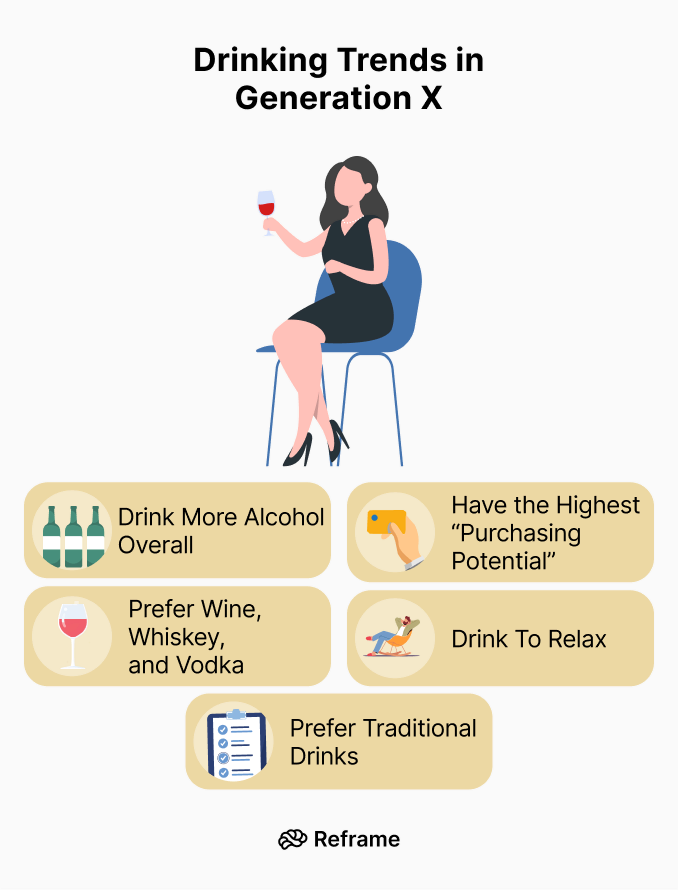


While Gen X has a strong preference for wine, they also take the lead when it comes to sales of whiskey and vodka compared to other generations. Some data suggests that Gen X over-indexes within the whiskey category on bourbon and Canadian whisky. On the other hand, Gen X under-indexes on tequila and ready-to-drink cocktails, both of which are popular with younger generations.
Interestingly, despite their increased consumption of alcohol, Gen Xers are largely still considered “responsible drinkers.” A study by the Centers for Disease Control and Prevention found that Gen-Xers are less likely to engage in excessive or binge drinking (defined as consuming five or more drinks in a single sitting for men, and four or more for women) than younger generations.
While Gen Xers may be less prone to binge drinking than younger generations, a fascinating counter-trend is also taking shape. A growing number are becoming “sober curious,” re-evaluating their relationship with alcohol and exploring what life could look like with less of it. This doesn't always mean quitting completely, but rather embracing mindful drinking by cutting back or experimenting with non-alcoholic options. For a generation that grew up with drinking as a social norm, changing these long-standing habits can be tough. Still, the interest is there, showing that many are looking for a healthier balance and questioning the role alcohol plays in their lives.
According to polling, Gen Xers cite relaxation as one of the main reasons for consuming alcohol, compared to millennials and Gen Z, who cite drinking for special occasions or to feel comfortable around other people. As such, Generation X is more likely to drink by themselves, second only to Baby Boomers.
So does Gen Z drink less? Gen Z alcohol consumption surveys seem to say so. In fact, they can even be called the most sober generation!

One of the most significant changes in drinking habits for Gen X is the move from the pub to the living room. It’s a complete reversal of how people used to socialize. In the early 1970s, about 70% of drinking happened in public places like bars. By the early 2000s, that number had flipped, with 70% of drinking taking place at home. This trend mirrors broader societal shifts, including the rise of home entertainment and a greater emphasis on convenience. For many Gen Xers, pouring a glass of wine at home simply became the new, easier way to unwind after a long day.
This change in setting also says a lot about the generation's lifestyle. Gen Xers have adapted their drinking habits to fit their lives, often choosing the comfort of their own space over a public one. As The Guardian notes, this preference for a relaxed, private environment aligns with the trend of drinking to de-stress rather than for purely social reasons. It points to a fundamental shift in not just where people drink, but also the core reasons why they choose to do so. The motivation moves away from social connection in a bustling pub and toward personal relaxation on the couch.
Overall, Generation X reflects an overall preference for familiar drinks and categories. For instance, they’re less inclined than younger generations to try newer alcoholic categories, such as hard seltzer. When it comes to drinking beer, Gen X leads toward the light lager and American-style lager categories, compared to craft beers. However, some data indicates that all generations — including Gen X — are increasingly shifting toward above-premium and craft beers.
Gen X isn't easily swayed by fleeting trends or flashy marketing. Having grown up in a world before social media influencers, they value authenticity and a good story. They connect with brands that feel genuine and mature, preferring substance over style. This often translates to a fondness for products with a rich history or a nostalgic feel, reminding them of simpler times. It’s why they often stick to classic wine varietals or beer styles they’ve enjoyed for years. They appreciate the craftsmanship and heritage behind a product, and they’re more likely to choose a brand that tells a compelling, honest story rather than one that just follows the latest craze.
While younger generations are often credited with driving the demand for ethical consumerism, Gen X quietly shares these values. They care about supporting businesses that are socially responsible and make a positive impact on their communities. Now in their peak earning years, many Gen Xers are in a position to vote with their wallets, and they often choose to support companies that align with their principles. This could mean buying from a local brewery that sources ingredients sustainably or a winery that gives back to charitable causes. For this generation, a purchase can be more than just a transaction; it’s a statement of support for the kind of world they want to live in.
Don’t mistake Gen X for being tech-averse. As the generation that ushered in the digital age, they are comfortable with technology, especially when it offers convenience. They appreciate the ease of managing things like loyalty rewards through an app, and data shows that these programs heavily influence their purchasing decisions. In fact, 71% of Gen Xers say loyalty programs help them choose which brand to buy. This blend of brand loyalty and tech-savviness means that once they find a product or service they trust, they tend to stick with it. This comfort with digital tools also extends to other areas of life, including health and wellness, where many are open to using apps to support their goals for mindful drinking and personal growth.
Generation X is relatively small in number, but is consuming more alcohol than other generations. Gen Xers have a strong preference for wine, and they’re concerned more about quality and exclusivity than trends. While they are largely considered “responsible drinkers” by not engaging in excessive drinking, they are still purchasing and consuming large volumes of alcohol.
Even without drinking excessively, alcohol can cause long-term effects on our physical and mental health. It puts us at a greater risk for developing heart disease, cancer, liver disease, and brain damage.
If you want to cut back on your alcohol consumption, consider downloading Reframe. We’ve helped millions of people reduce their alcohol intake and enhance their health and well-being.
Why does Gen X seem to drink more than younger generations? It really comes down to the environment they grew up in. Gen Xers were shaped by a "work hard, play hard" culture in the 80s and 90s, where drinking was often framed as a normal way to decompress from stress. This, combined with more independence at a young age and different social norms, helped establish a relationship with alcohol that has simply continued into adulthood, unlike younger generations who are drinking less overall.
The post says Gen Xers are "responsible drinkers" but also points out health risks. Can you clarify? This is a great question because it highlights a subtle but important distinction. While Gen Xers are statistically less likely to engage in what's defined as binge drinking compared to younger people, they tend to drink more consistently. The concern isn't necessarily about one wild night out, but rather the cumulative health impact of regular, moderate drinking over many years, especially when it becomes a daily habit at home.
I'm a Gen Xer who enjoys a glass of wine at home to unwind. Is this pattern of drinking a concern? Drinking to relax is one of the most common reasons Gen Xers give for their alcohol consumption. While there's nothing inherently wrong with unwinding, it becomes a potential issue when alcohol is the only tool you have for managing stress. If you find that you're relying on that glass of wine every single night to cope, it might be a good time to explore other relaxation techniques and build a healthier, more balanced relationship with drinking.
What's behind the strong preference for wine and classic spirits over trendier drinks? Gen X values authenticity and tends to stick with what they know and trust. They grew up before the age of social media influencers, so they're less likely to be swayed by the latest craze, like hard seltzers. Instead, they often prefer brands with a history and a story they connect with. This translates to a loyalty toward classic wine varietals, whiskeys, and other spirits that have stood the test of time.
Is it too late for a Gen Xer to change drinking habits that have been in place for decades? Absolutely not. It's never too late to re-evaluate your habits and make a change for the better. In fact, many Gen Xers are becoming "sober curious" and exploring mindful drinking. The key is understanding the role alcohol plays in your life and then taking small, intentional steps to build new routines. Changing long-standing habits takes effort, but it is completely achievable with the right mindset and support.
We hear plenty about Boomers and Millennials, but what about the so-called “forgotten generation” in between? Generation X, born between 1965 and 1980, includes over 65 million people who are often overlooked. They're the original latchkey kids who grew up independent and resilient. This self-reliance shaped their entire lives, including their gen x drinking habits. To understand the full picture of gen x alcohol consumption, we need to look at the unique pressures and culture that defined their formative years. Their approach to drinking is a story worth telling.
Despite being overshadowed by the larger generations above and below them, Gen Xers have their own unique characteristics, including drinking habits. So are there signs of Gen Z drinking less than their grandparents? And what is the most sober generation? Let’s take a look at the alcohol use trends in Gen X drinkers.
One of the most notable trends among Gen Xers is their increased consumption of alcohol compared to other generations. A study by the Substance Abuse and Mental Health Services Administration found that the percentage of Gen Xers who reported drinking alcohol in the past month increased from 56% in 2002 to 60% in 2014.
When you look at the numbers, it becomes clear that Gen X’s relationship with alcohol is unique. Their drinking habits, shaped by the social and cultural norms of the 70s, 80s, and 90s, stand in contrast to those of younger people. In fact, reports show that Millennials and Generation Z drink much less alcohol than Gen X and older groups. This isn't just about frequency; it's also about spending. Gen X holds the title for drinking more alcohol than any other generation, and with a collective spending power of $2.4 trillion, they often invest in higher-quality products. This pattern highlights a distinct generational divide in how alcohol is perceived and consumed.
While a preference for premium drinks might seem harmless, experts are pointing to some concerning trends. Addiction specialists have noted a rise in both binge drinking and daily drinking among older Gen Xers, who often underestimate its impact on their health. The bigger issue may not be loud nights at the bar, but rather the habit of quietly drinking too much at home. This type of consistent, private consumption can fly under the radar, making it easier to overlook the potential health consequences. Recognizing these patterns is the first step toward making a change, whether that means cutting back or simply practicing more mindful drinking to build healthier habits for the long term.
Another trend among Gen Xers is their preference for wine over other types of alcohol, particularly beer. In fact, they purchase more wine than any other generation, including Baby Boomers (who traditionally were top wine drinkers). One study found that Gen Xers are the largest consumers of wine in the United States, with 48% of Gen Xers reporting that they drink wine at least once a month.
Furthermore, another report indicates that Gen X purchased 13% more wine than any other generation between 2017-2019. Interestingly, Gen Xers are more likely to make wine purchases based on their established tastes and preferences, compared to millennials, who tend to follow industry trends.
According to Drizly, an online alcohol retailer, Gen X buys a greater share of red and white still wine than other generations. Some of the top selling red wines include Josh Cellars Cabernet Sauvignon, Meiomi Pinot Noir, Caymus Napa Valley Cabernet Sauvignon, Decoy Cabernet Sauvignon, and La Crema Sonoma Coast Pinot Noir.
Popular white wines among Gen X consumers include Kim Crawford Sauvignon Blanc, Oyster Bay Sauvignon Blanc, Santa Margherita Pinot Grigio DOC, Cavit Pinot Grigio, and Whitehaven Sauvignon Blanc.
To understand why Gen X drinks the way it does, we have to look at the world they grew up in. This generation’s relationship with alcohol didn’t form in a vacuum; it was shaped by a unique blend of economic uncertainty, shifting social norms, and a media landscape that was rapidly changing. From being the first kids to come home to an empty house to navigating the anxieties of the Cold War, the AIDS crisis, and economic recessions, these cultural forces played a significant role in establishing their drinking habits, many of which persist today.
Many Gen Xers are part of the original “latchkey generation.” Growing up with less parental supervision than previous generations, they learned to be independent and self-reliant from a young age. This hands-off upbringing meant they often made their own rules when it came to socializing and had to figure things out for themselves. Without adults consistently present, experimenting with alcohol became a common part of teenage life. This early independence fostered social behaviors where drinking was simply a normal, unsupervised activity among friends, setting a foundation for their relationship with alcohol that carried into adulthood.
Gen X came of age during a period of major cultural and economic shifts. They witnessed the rise of personal computers, lived with the looming threat of nuclear war, and faced the frightening reality of the AIDS crisis. This environment fostered a certain "work hard, play hard" mentality, where alcohol was often seen as a necessary tool to decompress from the pressures of a rapidly changing and often uncertain world. The societal norms of the time normalized drinking as a way to cope with stress and anxiety, a habit that for many, has carried over into their adult lives.
For Gen X women, the 90s introduced the “ladette” culture, which celebrated women who embraced traditionally masculine behaviors, including heavy drinking. This movement was framed as a form of liberation and equality, allowing women to shed old expectations and drink as freely as their male counterparts. Alcohol brands quickly caught on, tailoring their advertising to appeal to this new, empowered female consumer. This cultural shift not only normalized but actively encouraged a more liberated approach to drinking for women, cementing it as a symbol of independence and fun.
Gen X is also said to hold greater immediate “purchasing potential” than its younger counterparts. This is largely because they have greater financial resources at their disposal compared to younger generations. In fact, Gen X maintains the highest average household income of all the generations, with a spending power of $2.4 trillion (yes, trillion-with-a-T!)
This makes them the leading demographic in wine and fine wine consumption. They tend to appreciate the “finer” things, and they’re known for being prime luxury consumers who value exclusivity. In general, they’re willing to spend more for quality wine.
One poll found that 27% of Gen X consumers reported that in the past two years they had been buying more expensive beer and wine than normal. Interestingly, Gen X also reportedly makes more winery visits than other generations, such as the Millennials.
While Gen X has a strong preference for wine, they also take the lead when it comes to sales of whiskey and vodka compared to other generations. Some data suggests that Gen X over-indexes within the whiskey category on bourbon and Canadian whisky. On the other hand, Gen X under-indexes on tequila and ready-to-drink cocktails, both of which are popular with younger generations.
Interestingly, despite their increased consumption of alcohol, Gen Xers are largely still considered “responsible drinkers.” A study by the Centers for Disease Control and Prevention found that Gen-Xers are less likely to engage in excessive or binge drinking (defined as consuming five or more drinks in a single sitting for men, and four or more for women) than younger generations.
While Gen Xers may be less prone to binge drinking than younger generations, a fascinating counter-trend is also taking shape. A growing number are becoming “sober curious,” re-evaluating their relationship with alcohol and exploring what life could look like with less of it. This doesn't always mean quitting completely, but rather embracing mindful drinking by cutting back or experimenting with non-alcoholic options. For a generation that grew up with drinking as a social norm, changing these long-standing habits can be tough. Still, the interest is there, showing that many are looking for a healthier balance and questioning the role alcohol plays in their lives.
According to polling, Gen Xers cite relaxation as one of the main reasons for consuming alcohol, compared to millennials and Gen Z, who cite drinking for special occasions or to feel comfortable around other people. As such, Generation X is more likely to drink by themselves, second only to Baby Boomers.
So does Gen Z drink less? Gen Z alcohol consumption surveys seem to say so. In fact, they can even be called the most sober generation!
One of the most significant changes in drinking habits for Gen X is the move from the pub to the living room. It’s a complete reversal of how people used to socialize. In the early 1970s, about 70% of drinking happened in public places like bars. By the early 2000s, that number had flipped, with 70% of drinking taking place at home. This trend mirrors broader societal shifts, including the rise of home entertainment and a greater emphasis on convenience. For many Gen Xers, pouring a glass of wine at home simply became the new, easier way to unwind after a long day.
This change in setting also says a lot about the generation's lifestyle. Gen Xers have adapted their drinking habits to fit their lives, often choosing the comfort of their own space over a public one. As The Guardian notes, this preference for a relaxed, private environment aligns with the trend of drinking to de-stress rather than for purely social reasons. It points to a fundamental shift in not just where people drink, but also the core reasons why they choose to do so. The motivation moves away from social connection in a bustling pub and toward personal relaxation on the couch.
Overall, Generation X reflects an overall preference for familiar drinks and categories. For instance, they’re less inclined than younger generations to try newer alcoholic categories, such as hard seltzer. When it comes to drinking beer, Gen X leads toward the light lager and American-style lager categories, compared to craft beers. However, some data indicates that all generations — including Gen X — are increasingly shifting toward above-premium and craft beers.
Gen X isn't easily swayed by fleeting trends or flashy marketing. Having grown up in a world before social media influencers, they value authenticity and a good story. They connect with brands that feel genuine and mature, preferring substance over style. This often translates to a fondness for products with a rich history or a nostalgic feel, reminding them of simpler times. It’s why they often stick to classic wine varietals or beer styles they’ve enjoyed for years. They appreciate the craftsmanship and heritage behind a product, and they’re more likely to choose a brand that tells a compelling, honest story rather than one that just follows the latest craze.
While younger generations are often credited with driving the demand for ethical consumerism, Gen X quietly shares these values. They care about supporting businesses that are socially responsible and make a positive impact on their communities. Now in their peak earning years, many Gen Xers are in a position to vote with their wallets, and they often choose to support companies that align with their principles. This could mean buying from a local brewery that sources ingredients sustainably or a winery that gives back to charitable causes. For this generation, a purchase can be more than just a transaction; it’s a statement of support for the kind of world they want to live in.
Don’t mistake Gen X for being tech-averse. As the generation that ushered in the digital age, they are comfortable with technology, especially when it offers convenience. They appreciate the ease of managing things like loyalty rewards through an app, and data shows that these programs heavily influence their purchasing decisions. In fact, 71% of Gen Xers say loyalty programs help them choose which brand to buy. This blend of brand loyalty and tech-savviness means that once they find a product or service they trust, they tend to stick with it. This comfort with digital tools also extends to other areas of life, including health and wellness, where many are open to using apps to support their goals for mindful drinking and personal growth.
Generation X is relatively small in number, but is consuming more alcohol than other generations. Gen Xers have a strong preference for wine, and they’re concerned more about quality and exclusivity than trends. While they are largely considered “responsible drinkers” by not engaging in excessive drinking, they are still purchasing and consuming large volumes of alcohol.
Even without drinking excessively, alcohol can cause long-term effects on our physical and mental health. It puts us at a greater risk for developing heart disease, cancer, liver disease, and brain damage.
If you want to cut back on your alcohol consumption, consider downloading Reframe. We’ve helped millions of people reduce their alcohol intake and enhance their health and well-being.
Why does Gen X seem to drink more than younger generations? It really comes down to the environment they grew up in. Gen Xers were shaped by a "work hard, play hard" culture in the 80s and 90s, where drinking was often framed as a normal way to decompress from stress. This, combined with more independence at a young age and different social norms, helped establish a relationship with alcohol that has simply continued into adulthood, unlike younger generations who are drinking less overall.
The post says Gen Xers are "responsible drinkers" but also points out health risks. Can you clarify? This is a great question because it highlights a subtle but important distinction. While Gen Xers are statistically less likely to engage in what's defined as binge drinking compared to younger people, they tend to drink more consistently. The concern isn't necessarily about one wild night out, but rather the cumulative health impact of regular, moderate drinking over many years, especially when it becomes a daily habit at home.
I'm a Gen Xer who enjoys a glass of wine at home to unwind. Is this pattern of drinking a concern? Drinking to relax is one of the most common reasons Gen Xers give for their alcohol consumption. While there's nothing inherently wrong with unwinding, it becomes a potential issue when alcohol is the only tool you have for managing stress. If you find that you're relying on that glass of wine every single night to cope, it might be a good time to explore other relaxation techniques and build a healthier, more balanced relationship with drinking.
What's behind the strong preference for wine and classic spirits over trendier drinks? Gen X values authenticity and tends to stick with what they know and trust. They grew up before the age of social media influencers, so they're less likely to be swayed by the latest craze, like hard seltzers. Instead, they often prefer brands with a history and a story they connect with. This translates to a loyalty toward classic wine varietals, whiskeys, and other spirits that have stood the test of time.
Is it too late for a Gen Xer to change drinking habits that have been in place for decades? Absolutely not. It's never too late to re-evaluate your habits and make a change for the better. In fact, many Gen Xers are becoming "sober curious" and exploring mindful drinking. The key is understanding the role alcohol plays in your life and then taking small, intentional steps to build new routines. Changing long-standing habits takes effort, but it is completely achievable with the right mindset and support.

The data speaks for itself: the U.S. has a significant problem with alcohol use. Gain insight into some of the most alarming data about alcohol misuse in America.

Although it isn’t a treatment for alcohol use disorder (AUD), the Reframe app can help you cut back on drinking gradually, with the science-backed knowledge to empower you 100% of the way. Our proven program has helped millions of people around the world drink less and live more. And we want to help you get there, too!
The Reframe app equips you with the knowledge and skills you need to not only survive drinking less, but to thrive while you navigate the journey. Our daily research-backed readings teach you the neuroscience of alcohol, and our in-app Toolkit provides the resources and activities you need to navigate each challenge.
You’ll meet millions of fellow Reframers in our 24/7 Forum chat and daily Zoom check-in meetings. Receive encouragement from people worldwide who know exactly what you’re going through! You’ll also have the opportunity to connect with our licensed Reframe coaches for more personalized guidance.
Plus, we’re always introducing new features to optimize your in-app experience. We recently launched our in-app chatbot, Melody, powered by the world’s most powerful AI technology. Melody is here to help as you adjust to a life with less (or no) alcohol.
And that’s not all! Every month, we launch fun challenges, like Dry/Damp January, Mental Health May, and Outdoorsy June. You won’t want to miss out on the chance to participate alongside fellow Reframers (or solo if that’s more your thing!).
The Reframe app is free for 7 days, so you don’t have anything to lose by trying it. Are you ready to feel empowered and discover life beyond alcohol? Then download our app through the App Store or Google Play today!
It’s 5 p.m. on a Friday at the end of a long week and you’ve just gotten home. You got into an argument with your boss, a client yelled at you, and all you want to do is kick back and relax with a few drinks. It’s been a tough week and you’ve earned that drink, right?
If this sounds familiar, you’re not alone. It’s a pretty classic story in American culture. More than 85 percent of U.S. adults have had a drink at some point in their lives, 70 percent said they’ve had a drink in the last year, and more than half have had a drink this month. Let’s take a closer look at alcohol misuse statistics in the U.S.

Interestingly, the U.S. has one of the lowest alcohol use rates per capita of first-world countries, with Belgium, Germany, France, the UK, and Australia ahead of the U.S. However, Americans have higher rates of alcohol abuse than any of those countries. In fact, about 15 million people struggle with alcohol use disorder in the United States. Sadly, fewer than 10 percent of them seek treatment.
In 2021 alone, more than 10 percent of adults — 28.6 million adults — had alcohol use disorder. This includes 16.3 million men and 12.4 million women ages 18 and older. But it’s not just adults who are suffering. An additional 894,000 people between the ages of 12 and 17 have alcohol use disorders.
Furthermore, while young adults (18-25) and adults (26 and older) report the highest rate of current alcohol use, the elderly also struggle with alcohol misuse. In fact, 1 in 20 adults aged 65 or older had an alcohol use disorder in the past year.
Alcohol also continues to be one of the nation’s most preventable causes of death, surpassed only by tobacco and a poor diet and sedentary lifestyle. More than 140,000 people die from alcohol-related deaths each year in the U.S. Every day, 385 Americans die as a result of excessive alcohol use; 84 percent of these deaths involve adults aged 35 or older.
Many of these deaths are related to the long-term effects of alcohol use, such as liver disease, heart disease, and certain cancers. However, a good portion are from short-term effects, such as alcohol poisoning. In fact, over 2,200 people die from alcohol poisoning every year, and these deaths often occur in adults ages 35-64.
Furthermore, alcohol use disorder contributes to more than 200 separate health conditions and alcohol-related injuries. It also costs the U.S. approximately $250 billion annually.

So, what does the average alcohol consumption look like for U.S. drinkers? On average, U.S. drinkers reported consuming about four drinks per week in 2022. However, that number rises to six drinks per week for those who appear to be regular drinkers, defined as those who had at least one drink in the past week.
As for average drinks per week by age, data shows that among adults aged 18 and over, 5.1 percent engaged in heavy drinking (consuming more than 14 alcoholic drinks per week for men and more than 7 drinks for women). However, the number of young adults over- drinking has fallen from an average of 5.2 drinks per week in 2001-2003 to 3.6 drinks in 2021-2023.
Interestingly, when it comes to statistics on non drinkers, about 39 percent of women and 33 percent of men reported completely abstaining from alcohol. When breaking this down by age, 40 percent of those aged 18-29 reported being sober, compared to 30 percent of those aged 30-49, 35 percent for those aged 54-60, and 46 percent for those aged 65 and over.
While the U.S. has long had a problem with alcohol use, research indicates that the COVID-19 pandemic made things significantly worse. For instance, online liquor sales rose 262 percent year-over-year in the first 3 weeks of March 2020, which coincided with the greatest number of state-wide lockdowns. Similarly, in the first year of the pandemic, sales of alcohol increased by 2.9% — the largest annual increase in over 50 years.
As for alcohol consumption, one survey from Johns Hopkins University of Baltimore, Maryland noted that 60 percent of participants reported drinking more alcohol after March 1, 2020. Furthermore, data shows that deaths involving alcohol jumped 25.5 percent between 2019 and 2020, totalling nearly 100,00 deaths.
Interestingly, some researchers have noted that drinking returned to pre-pandemic levels by June 2021. This is largely attributed to an ease in lockdown restrictions and the ability to re-engage in social activities.

America also has a problem with binge drinking (drinking large amounts of alcohol within a short period of time), which can be incredibly dangerous. Binge drinking is generally defined as consuming 5 or more drinks in one sitting for men, or 4 or more drinks for women.
Data show that 24 percent of people aged 18 years and older — roughly 59 million U.S. adults — reported binge drinking in the last 30 days. This includes 32 million men and 27 million women. Approximately one in two women of child-bearing age drink, and 18 percent of women in this group binge drink.
Binge drinking is also a problem among teens. In 2021, 995,000 youth ages 12 to 17 — or 3.8 percent of this age group — reported binge drinking in the past month. This includes more girls (594,000) than boys (400,000).
Even the elderly engage in binge drinking. Data shows that approximately 20 percent of adults aged 60-64 and around 11% over age 65 report current binge drinking.
It’s also worth noting that the National Institute on Alcohol Abuse and Alcoholism (NIAAA) has identified an emerging trend in the U.S. that it has labeled “high-intensity drinking” (HID): the consumption of alcohol at levels that are two or more times the gender-specific binge drinking thresholds.
Due to its status as an emerging trend, there are a limited number of peer-reviewed studies. However, available data indicate that high-intensity drinking is common among binge drinkers and that it’s typically associated with special occasions, such as holidays, sporting events, and 21st birthdays. In fact, data suggests that high-intensity drinking peaks at age 21. Nearly 13 percent of young adults aged 25-26 reported at least once instance of high-intensity drinking within the past 14 days.
Furthermore, compared with people who didn’t binge drink, people who drank alcohol at twice the gender-specific binge drinking thresholds were 70 times more likely to have an alcohol-related emergency department visit, while those who consumed alcohol at three times the threshold were 93 times more likely.
The data speaks for itself: alcohol misuse is a significant problem in the U.S. Large numbers of men, women, and even the youth struggle with alcohol misuse or are consuming alcohol frequently or at excessive levels. This is particularly concerning, given the well-documented negative effects of alcohol on our physical, mental, and emotional health.
Thankfully, there are multiple treatment options available and numerous ways for people to get help. Reframe is one option. We’ve helped millions of people cut back on their alcohol consumption or quit drinking altogether. If you’re struggling with alcohol use, you’re not alone. And it’s never too late to get help!
It’s 5 p.m. on a Friday at the end of a long week and you’ve just gotten home. You got into an argument with your boss, a client yelled at you, and all you want to do is kick back and relax with a few drinks. It’s been a tough week and you’ve earned that drink, right?
If this sounds familiar, you’re not alone. It’s a pretty classic story in American culture. More than 85 percent of U.S. adults have had a drink at some point in their lives, 70 percent said they’ve had a drink in the last year, and more than half have had a drink this month. Let’s take a closer look at alcohol misuse statistics in the U.S.
Interestingly, the U.S. has one of the lowest alcohol use rates per capita of first-world countries, with Belgium, Germany, France, the UK, and Australia ahead of the U.S. However, Americans have higher rates of alcohol abuse than any of those countries. In fact, about 15 million people struggle with alcohol use disorder in the United States. Sadly, fewer than 10 percent of them seek treatment.
In 2021 alone, more than 10 percent of adults — 28.6 million adults — had alcohol use disorder. This includes 16.3 million men and 12.4 million women ages 18 and older. But it’s not just adults who are suffering. An additional 894,000 people between the ages of 12 and 17 have alcohol use disorders.
Furthermore, while young adults (18-25) and adults (26 and older) report the highest rate of current alcohol use, the elderly also struggle with alcohol misuse. In fact, 1 in 20 adults aged 65 or older had an alcohol use disorder in the past year.
Alcohol also continues to be one of the nation’s most preventable causes of death, surpassed only by tobacco and a poor diet and sedentary lifestyle. More than 140,000 people die from alcohol-related deaths each year in the U.S. Every day, 385 Americans die as a result of excessive alcohol use; 84 percent of these deaths involve adults aged 35 or older.
Many of these deaths are related to the long-term effects of alcohol use, such as liver disease, heart disease, and certain cancers. However, a good portion are from short-term effects, such as alcohol poisoning. In fact, over 2,200 people die from alcohol poisoning every year, and these deaths often occur in adults ages 35-64.
Furthermore, alcohol use disorder contributes to more than 200 separate health conditions and alcohol-related injuries. It also costs the U.S. approximately $250 billion annually.
So, what does the average alcohol consumption look like for U.S. drinkers? On average, U.S. drinkers reported consuming about four drinks per week in 2022. However, that number rises to six drinks per week for those who appear to be regular drinkers, defined as those who had at least one drink in the past week.
As for average drinks per week by age, data shows that among adults aged 18 and over, 5.1 percent engaged in heavy drinking (consuming more than 14 alcoholic drinks per week for men and more than 7 drinks for women). However, the number of young adults over- drinking has fallen from an average of 5.2 drinks per week in 2001-2003 to 3.6 drinks in 2021-2023.
Interestingly, when it comes to statistics on non drinkers, about 39 percent of women and 33 percent of men reported completely abstaining from alcohol. When breaking this down by age, 40 percent of those aged 18-29 reported being sober, compared to 30 percent of those aged 30-49, 35 percent for those aged 54-60, and 46 percent for those aged 65 and over.
While the U.S. has long had a problem with alcohol use, research indicates that the COVID-19 pandemic made things significantly worse. For instance, online liquor sales rose 262 percent year-over-year in the first 3 weeks of March 2020, which coincided with the greatest number of state-wide lockdowns. Similarly, in the first year of the pandemic, sales of alcohol increased by 2.9% — the largest annual increase in over 50 years.
As for alcohol consumption, one survey from Johns Hopkins University of Baltimore, Maryland noted that 60 percent of participants reported drinking more alcohol after March 1, 2020. Furthermore, data shows that deaths involving alcohol jumped 25.5 percent between 2019 and 2020, totalling nearly 100,00 deaths.
Interestingly, some researchers have noted that drinking returned to pre-pandemic levels by June 2021. This is largely attributed to an ease in lockdown restrictions and the ability to re-engage in social activities.
America also has a problem with binge drinking (drinking large amounts of alcohol within a short period of time), which can be incredibly dangerous. Binge drinking is generally defined as consuming 5 or more drinks in one sitting for men, or 4 or more drinks for women.
Data show that 24 percent of people aged 18 years and older — roughly 59 million U.S. adults — reported binge drinking in the last 30 days. This includes 32 million men and 27 million women. Approximately one in two women of child-bearing age drink, and 18 percent of women in this group binge drink.
Binge drinking is also a problem among teens. In 2021, 995,000 youth ages 12 to 17 — or 3.8 percent of this age group — reported binge drinking in the past month. This includes more girls (594,000) than boys (400,000).
Even the elderly engage in binge drinking. Data shows that approximately 20 percent of adults aged 60-64 and around 11% over age 65 report current binge drinking.
It’s also worth noting that the National Institute on Alcohol Abuse and Alcoholism (NIAAA) has identified an emerging trend in the U.S. that it has labeled “high-intensity drinking” (HID): the consumption of alcohol at levels that are two or more times the gender-specific binge drinking thresholds.
Due to its status as an emerging trend, there are a limited number of peer-reviewed studies. However, available data indicate that high-intensity drinking is common among binge drinkers and that it’s typically associated with special occasions, such as holidays, sporting events, and 21st birthdays. In fact, data suggests that high-intensity drinking peaks at age 21. Nearly 13 percent of young adults aged 25-26 reported at least once instance of high-intensity drinking within the past 14 days.
Furthermore, compared with people who didn’t binge drink, people who drank alcohol at twice the gender-specific binge drinking thresholds were 70 times more likely to have an alcohol-related emergency department visit, while those who consumed alcohol at three times the threshold were 93 times more likely.
The data speaks for itself: alcohol misuse is a significant problem in the U.S. Large numbers of men, women, and even the youth struggle with alcohol misuse or are consuming alcohol frequently or at excessive levels. This is particularly concerning, given the well-documented negative effects of alcohol on our physical, mental, and emotional health.
Thankfully, there are multiple treatment options available and numerous ways for people to get help. Reframe is one option. We’ve helped millions of people cut back on their alcohol consumption or quit drinking altogether. If you’re struggling with alcohol use, you’re not alone. And it’s never too late to get help!

If you’ve ever wondered whether you have a drinking problem, chances are that you probably do. Gain insight into 11 of the most common signs of alcohol misuse.
Although it isn’t a treatment for alcohol use disorder (AUD), the Reframe app can help you cut back on drinking gradually, with the science-backed knowledge to empower you 100% of the way. Our proven program has helped millions of people around the world drink less and live more. And we want to help you get there, too!
The Reframe app equips you with the knowledge and skills you need to not only survive drinking less, but to thrive while you navigate the journey. Our daily research-backed readings teach you the neuroscience of alcohol, and our in-app Toolkit provides the resources and activities you need to navigate each challenge.
You’ll meet millions of fellow Reframers in our 24/7 Forum chat and daily Zoom check-in meetings. Receive encouragement from people worldwide who know exactly what you’re going through! You’ll also have the opportunity to connect with our licensed Reframe coaches for more personalized guidance.
Plus, we’re always introducing new features to optimize your in-app experience. We recently launched our in-app chatbot, Melody, powered by the world’s most powerful AI technology. Melody is here to help as you adjust to a life with less (or no) alcohol.
And that’s not all! Every month, we launch fun challenges, like Dry/Damp January, Mental Health May, and Outdoorsy June. You won’t want to miss out on the chance to participate alongside fellow Reframers (or solo if that’s more your thing!).
The Reframe app is free for 7 days, so you don’t have anything to lose by trying it. Are you ready to feel empowered and discover life beyond alcohol? Then download our app through the App Store or Google Play today!
It can sometimes be difficult to know when we have a drinking problem. We might think that we’re fine because we’re a social drinker and we can stop anytime we want. We might tell ourselves we don’t need to worry because we’re still fulfilling our duties and responsibilities. But we might be too close to the problem to see things accurately. What are some early signs of alcoholism? And how can we be more aware of alcoholism signs? If you’re wondering how to know if you have a drinking problem, you’ve come to the right place. Let’s find out more.

What, exactly, do we mean by a drinking problem? Someone with a drinking problem may or may not have an alcohol use disorder. In some cases, people who might be described as “problem drinkers” can reduce or end their alcohol intake when they realize it negatively affects their lives.
However, if we’ve ever told ourselves that we would never get that drunk again — or declared we’d never drink again — but found ourselves doing exactly what we swore we’d never do, chances are that our drinking falls into the category of alcohol use disorder.
Alcohol misuse is described as any “harmful use” of alcohol. According to the National Institute on Alcohol Abuse and Alcoholism (NIAAA), our drinking may be considered risky if our alcohol consumption exceeds five or more drinks a day for men, and four or more drinks a day for women.
It’s worth noting, however, that even if we’re consuming less than these amounts, we still may have a drinking problem — particularly if we’re experiencing alcohol’s negative effects on our health and well-being.

When it comes to discovering how to know if you have a drinking problem, there are a few key points to keep in mind. While each person is different, here are 11 common signs of alcoholism that indicate we might have a drinking problem:
This might mean not being able to control how long a drinking session is, how much alcohol we consume when we do drink, how frequently we drink, or being unable to stop drinking once we start.
In other words, we need to drink much more than we used to in order to get the dopamine “reward.” This is because our brain adapts to alcohol over time and can become less sensitive to its effects.
This includes the whole drinking cycle: buying the alcohol, drinking it, feeling sick afterwards, and recovering from its effects (which can sometimes take the whole day).
This might mean skipping work from being hungover, missing deadlines, forgetting to pick up the kids at school, or letting chores and housework (such as bill-paying, laundry, cleaning, or dishes) fall by the wayside.

This might look like giving precedence to drinking over other daily activities and responsibilities, even if it’s taking a toll on our health. It might look like no longer engaging in the activities we used to enjoy. In other words, we might realize that the only way we spend our free time anymore — the only thing we do for “fun” — is drink alcohol.
This might look like continuing to drink even though it has led to trouble with our family, friends, or our partner. Even if they’ve confronted us about our drinking, we might continue to drink.
Maybe we continue to tell ourselves that we won’t drink tonight, but when 5pm rolls around, we simply cannot help ourselves.
This might look like being unable to focus on anything until we start drinking, or going out of our way to get alcohol, even if it means missing something important. We also might drink on inappropriate occasions or at inappropriate places because our cravings are so strong.
This might include getting into risky situations, such as driving, swimming, fighting, operating machinery, or walking in dangerous areas. Even if nothing bad has happened to us yet, putting ourselves in these situations is often a warning sign.
As the effects of alcohol wear off, we might experience a range of withdrawal symptoms, such as trouble sleeping, shakiness, irritability, anxiety, depression, restlessness, nausea, or sweating.
We probably have a drinking problem if we continue to drink even though we’re noticing problems with our physical health, such as numbness in our hands and feet, ulcers or an upset stomach, or erectile dysfunction or menstrual disruptions. It’s even more concerning if we have — or have had — a serious condition (such as cancer or a heart problem) and continue drinking.
Keep in mind that a medical professional might diagnose alcohol misuse if they see two or more of the above alcoholism signs based on an ongoing pattern of how we use alcohol. Usually, this is based on behavior over the last 12 months or more, but it can be diagnosed based on continuous daily use of alcohol over a period of at least 3 months.
Furthermore, it’s worth noting that other mental symptoms can also indicate we might have a problem with alcohol — although these are often more apparent to our loved ones than they are to us. For instance, it’s not uncommon for people misusing alcohol to exhibit mood swings or unpredictable behaviors of aggression, violence, depression, anxiety, agitation or irritability. We might become particularly irritable whenever we’re not drinking. This is largely because excessive drinking damages neurons and interferes with our natural dopamine production, causing a wide range of psychological reactions. In extreme cases, we might experience memory loss, blackouts, or visual, tactile, or auditory hallucinations (otherwise known as alcohol-induced psychosis).
If we’ve ever asked ourselves, “Am I an alcoholic?”, chances are we probably have a drinking problem. Sometimes it can be painful to realize we have a problem, but this doesn’t mean that something is wrong with us. Many people struggle with alcohol use, and there’s a world of help available. If we suspect we have a problem, the best thing we can do is to contact our healthcare provider and be completely honest about our alcohol use.
Reframe is also here to help. We’ve helped millions of people cut back on their alcohol consumption or quit drinking entirely.
It can sometimes be difficult to know when we have a drinking problem. We might think that we’re fine because we’re a social drinker and we can stop anytime we want. We might tell ourselves we don’t need to worry because we’re still fulfilling our duties and responsibilities. But we might be too close to the problem to see things accurately. What are some early signs of alcoholism? And how can we be more aware of alcoholism signs? If you’re wondering how to know if you have a drinking problem, you’ve come to the right place. Let’s find out more.
What, exactly, do we mean by a drinking problem? Someone with a drinking problem may or may not have an alcohol use disorder. In some cases, people who might be described as “problem drinkers” can reduce or end their alcohol intake when they realize it negatively affects their lives.
However, if we’ve ever told ourselves that we would never get that drunk again — or declared we’d never drink again — but found ourselves doing exactly what we swore we’d never do, chances are that our drinking falls into the category of alcohol use disorder.
Alcohol misuse is described as any “harmful use” of alcohol. According to the National Institute on Alcohol Abuse and Alcoholism (NIAAA), our drinking may be considered risky if our alcohol consumption exceeds five or more drinks a day for men, and four or more drinks a day for women.
It’s worth noting, however, that even if we’re consuming less than these amounts, we still may have a drinking problem — particularly if we’re experiencing alcohol’s negative effects on our health and well-being.
When it comes to discovering how to know if you have a drinking problem, there are a few key points to keep in mind. While each person is different, here are 11 common signs of alcoholism that indicate we might have a drinking problem:
This might mean not being able to control how long a drinking session is, how much alcohol we consume when we do drink, how frequently we drink, or being unable to stop drinking once we start.
In other words, we need to drink much more than we used to in order to get the dopamine “reward.” This is because our brain adapts to alcohol over time and can become less sensitive to its effects.
This includes the whole drinking cycle: buying the alcohol, drinking it, feeling sick afterwards, and recovering from its effects (which can sometimes take the whole day).
This might mean skipping work from being hungover, missing deadlines, forgetting to pick up the kids at school, or letting chores and housework (such as bill-paying, laundry, cleaning, or dishes) fall by the wayside.
This might look like giving precedence to drinking over other daily activities and responsibilities, even if it’s taking a toll on our health. It might look like no longer engaging in the activities we used to enjoy. In other words, we might realize that the only way we spend our free time anymore — the only thing we do for “fun” — is drink alcohol.
This might look like continuing to drink even though it has led to trouble with our family, friends, or our partner. Even if they’ve confronted us about our drinking, we might continue to drink.
Maybe we continue to tell ourselves that we won’t drink tonight, but when 5pm rolls around, we simply cannot help ourselves.
This might look like being unable to focus on anything until we start drinking, or going out of our way to get alcohol, even if it means missing something important. We also might drink on inappropriate occasions or at inappropriate places because our cravings are so strong.
This might include getting into risky situations, such as driving, swimming, fighting, operating machinery, or walking in dangerous areas. Even if nothing bad has happened to us yet, putting ourselves in these situations is often a warning sign.
As the effects of alcohol wear off, we might experience a range of withdrawal symptoms, such as trouble sleeping, shakiness, irritability, anxiety, depression, restlessness, nausea, or sweating.
We probably have a drinking problem if we continue to drink even though we’re noticing problems with our physical health, such as numbness in our hands and feet, ulcers or an upset stomach, or erectile dysfunction or menstrual disruptions. It’s even more concerning if we have — or have had — a serious condition (such as cancer or a heart problem) and continue drinking.
Keep in mind that a medical professional might diagnose alcohol misuse if they see two or more of the above alcoholism signs based on an ongoing pattern of how we use alcohol. Usually, this is based on behavior over the last 12 months or more, but it can be diagnosed based on continuous daily use of alcohol over a period of at least 3 months.
Furthermore, it’s worth noting that other mental symptoms can also indicate we might have a problem with alcohol — although these are often more apparent to our loved ones than they are to us. For instance, it’s not uncommon for people misusing alcohol to exhibit mood swings or unpredictable behaviors of aggression, violence, depression, anxiety, agitation or irritability. We might become particularly irritable whenever we’re not drinking. This is largely because excessive drinking damages neurons and interferes with our natural dopamine production, causing a wide range of psychological reactions. In extreme cases, we might experience memory loss, blackouts, or visual, tactile, or auditory hallucinations (otherwise known as alcohol-induced psychosis).
If we’ve ever asked ourselves, “Am I an alcoholic?”, chances are we probably have a drinking problem. Sometimes it can be painful to realize we have a problem, but this doesn’t mean that something is wrong with us. Many people struggle with alcohol use, and there’s a world of help available. If we suspect we have a problem, the best thing we can do is to contact our healthcare provider and be completely honest about our alcohol use.
Reframe is also here to help. We’ve helped millions of people cut back on their alcohol consumption or quit drinking entirely.

Get the facts on alcohol manufacturing, from raw ingredients to finished drinks, and learn how understanding the process can help you make informed choices.
Although it isn’t a treatment for alcohol use disorder (AUD), the Reframe app can help you cut back on drinking gradually, with the science-backed knowledge to empower you 100% of the way. Our proven program has helped millions of people around the world drink less and live more. And we want to help you get there, too!
The Reframe app equips you with the knowledge and skills you need to not only survive drinking less, but to thrive while you navigate the journey. Our daily research-backed readings teach you the neuroscience of alcohol, and our in-app Toolkit provides the resources and activities you need to navigate each challenge.
You’ll meet millions of fellow Reframers in our 24/7 Forum chat and daily Zoom check-in meetings. Receive encouragement from people worldwide who know exactly what you’re going through! You’ll also have the opportunity to connect with our licensed Reframe coaches for more personalized guidance.
Plus, we’re always introducing new features to optimize your in-app experience. We recently launched our in-app chatbot, Melody, powered by the world’s most powerful AI technology. Melody is here to help as you adjust to a life with less (or no) alcohol.
And that’s not all! Every month, we launch fun challenges, like Dry/Damp January, Mental Health May, and Outdoorsy June. You won’t want to miss out on the chance to participate alongside fellow Reframers (or solo if that’s more your thing!).
The Reframe app is free for 7 days, so you don’t have anything to lose by trying it. Are you ready to feel empowered and discover life beyond alcohol? Then download our app through the App Store or Google Play today!
You’re at a party, glass in hand, enjoying the moment. It's easy to sip a beer or wine without a second thought. But have you ever wondered what alcohol is made of? Beyond the clever marketing and rustic labels, there's a fascinating science at play. Understanding the alcohol manufacturing process, from raw ingredients to the final pour, is key. Knowing exactly how alcohol is made empowers you to make more informed choices about what you're drinking. We'll pull back the curtain on how your favorite drink gets from the field to your glass.
Let's explore the science behind its composition, the reasons for its widespread acceptance, and ways we can imbibe it more mindfully.
Yes, alcohol is a drug. It’s considered to be a depressant that slows down the central nervous system while altering mood, cognition, and behavior. Regular or excessive drinking can lead to dependence and other serious health issues.
The World Health Organization (WHO) offers a clear perspective on this, classifying alcohol as a "psychoactive substance." This isn't just medical jargon; it means that alcohol directly impacts our mental processes, altering our mood, thoughts, and even how we perceive the world around us. This classification puts it in the same category as other substances known for their mind-altering effects. It's a powerful reminder that while a glass of wine might feel like a simple way to unwind, we're consuming something that has a profound effect on our brain chemistry. Understanding this helps us approach drinking with more awareness and intention.
Beyond the immediate effects on our minds, the WHO also points to serious long-term health risks. They emphasize that consistent, heavy drinking is linked to a higher risk of developing several types of cancer and other chronic diseases. This isn't meant to be a scare tactic, but rather a crucial piece of the puzzle when we consider our relationship with alcohol. Being informed about the full picture of what alcohol is and how it affects our bodies empowers us to make choices that align with our health goals. It’s about having all the facts so we can engage with alcohol mindfully, if we choose to engage with it at all.

To understand alcohol, we must take a deep dive into ethanol. Ethanol is a potent compound of carbon, hydrogen, and oxygen atoms. This compound is what we commonly refer to as “alcohol.” The adaptability of ethanol is a double-edged sword; while it can seamlessly blend with a multitude of flavors to create the vast array of alcoholic beverages, it also serves as the primary agent of alcohol's adverse effects.
So, how does ethanol become the glass of wine or beer that we frequently hold in our hands? The answer lies in a natural, age-old process known as fermentation.
How is alcohol made? All alcoholic beverages start with fermentation. Fermentation involves microorganisms like yeasts or bacteria digesting sugars — primarily glucose, fructose, and maltose. These sugars are typically derived from fruits like grapes or grains such as barley or corn. Under the right conditions, the microorganisms begin to metabolize the sugars. This biochemical reaction transforms sugar into ethanol and carbon dioxide, leading to what we identify as alcohol. This process of alcohol fermentation has been utilized for thousands of years to make wine, beer, and spirits.
The sugars that yield from alcohol fermentation shape the flavor of the final product, often distracting from the potential harm caused by the ethanol itself. Sugars derived from fruits, such as grapes, form the backbone of wines, and grains contribute to a wide array of beer flavors.
Furthermore, many drinks come with a lot of added sugar, which masks the potentially hazardous effects of ethanol into a seemingly harmless, enjoyable beverage. Alcohol’s deceptive appeal to our taste buds can lead our brains to crave more alcohol, potentially leading to a cycle of dependence. The extra sugar intake can lead to a host of health issues, such as Type 2 diabetes, heart disease, and even dental problems.
So, how do those different sugar sources turn into the drinks we know? It all comes down to the base ingredient and the specific process it goes through. The primary ingredient must contain sugar or starch for fermentation to work its magic. Here are a few of the most common starting points:
Each type of alcohol undergoes a unique manufacturing process that creates its distinct character and flavor profile. For wine, the journey begins with crushing grapes, followed by fermentation where yeast converts the sugars into alcohol. The wine is then pressed, clarified, and aged before it’s finally bottled. Beer production starts with malting grains like barley, which are then mashed to create a sugary liquid. This liquid is boiled with hops, cooled, and fermented before it’s matured and carbonated. Spirits like tequila, rum, and vodka are made by distilling already fermented liquids to create a much more concentrated alcoholic beverage. Finally, cider is produced in a way that’s similar to wine, but it uses fermented apples instead of grapes, resulting in a crisp and often lower-alcohol drink.
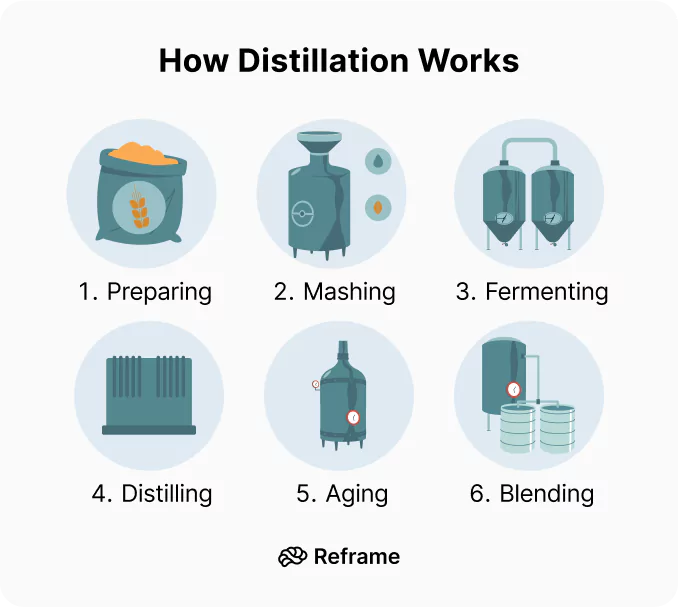
While fermentation is the starting point for all alcoholic drinks, some beverages go through extra steps to increase their strength and develop more complex flavors. For spirits like whiskey, vodka, and gin, these next stages are distillation and aging. These processes are what separate a lower-alcohol-content beer or wine from a much more potent spirit. Understanding these steps can give you a clearer picture of what’s actually in your glass and how it gets its powerful effects, which is a key part of practicing mindful drinking.
After fermentation, the resulting liquid has a relatively low alcohol content. To create spirits, this alcohol needs to be concentrated. This is done through a process called distillation, which essentially separates and removes water to make the final product much stronger. The fermented liquid is heated in a still, and because alcohol has a lower boiling point than water, it turns into vapor first. This vapor is collected and cooled, condensing back into a liquid with a much higher concentration of ethanol. This is how clear spirits like vodka and gin are made, and it’s the first step for aged spirits like whiskey and rum.
While distillation creates a potent spirit, the flavor is often neutral or harsh at first. The final character of many spirits comes from aging, also known as maturation. This is where the distilled liquid is stored in wooden barrels—often oak—for a period that can range from a few years to several decades. During this time, the spirit interacts with the wood, which imparts distinct flavors, aromas, and colors. This aging process is what gives whiskey its amber hue and notes of vanilla and caramel, and it allows the flavors in wine and some beers to mellow and deepen over time.
The journey from raw ingredients to a bottled beverage is a complex industrial process, especially when produced on a commercial scale. While we might picture small, artisanal operations, the reality for most of the alcohol we consume involves large-scale manufacturing facilities, precise chemical monitoring, and a team of specialists. Companies like BevSource specialize in helping beverage creators navigate this intricate world, from initial recipe formulation to navigating the complex legal requirements. This industrial approach ensures consistency and safety but also highlights that alcohol is a mass-produced consumer product, not just a simple fermented drink made in a rustic barrel.
On an industrial scale, fermentation doesn't happen in small vats. Instead, a yeast starter is added to massive, temperature-controlled tanks filled with the sugar source, whether it's grain mash for whiskey or grape juice for wine. Technicians carefully monitor this process to ensure the yeast converts sugar to ethanol efficiently. For distilled spirits, this fermented liquid then moves to enormous industrial stills. The entire operation is a highly controlled chemical process designed for maximum efficiency and output, a far cry from the romanticized image of a craft distiller tinkering with a small copper pot still.
The primary ingredient in alcoholic drinks, ethanol, is a versatile and powerful chemical with many industrial applications beyond beverages. In its purest form, known as absolute alcohol, it's a key component in medicines, where it acts as a solvent or antiseptic. It's also found in many beauty products, from perfumes to creams. Because of its combustible nature, ethanol is used as a biofuel to power vehicles, offering a renewable alternative to fossil fuels. Its effectiveness as a solvent also makes it essential for producing paints, varnishes, and cleaning agents, which underscores its potent chemical properties.
Because alcohol is a controlled substance with significant health implications, its production is heavily regulated. From the initial sourcing of raw materials to the final label on the bottle, every step is subject to strict government oversight and rigorous quality control measures. This ensures that the product is safe for consumption and that consumers are accurately informed about what they’re drinking. These regulations cover everything from the percentage of alcohol to the ingredients used, and failure to comply can result in hefty fines and legal trouble for producers.
Before an alcoholic beverage can be sold, it must gain approval from government bodies like the Alcohol and Tobacco Tax and Trade Bureau (TTB) in the United States. Producers have to navigate a mountain of paperwork to get the necessary licenses and formula approvals. This oversight ensures that products meet legal standards for safety and labeling. For example, the TTB verifies the alcohol by volume (ABV) listed on the bottle and ensures that no unapproved additives are used. This strict regulatory framework is in place to protect consumers and maintain standards across the industry.
Quality control is a critical part of the alcohol manufacturing process, happening at every single stage. It begins with testing the raw materials, like grains and fruits, to ensure they are free of contaminants. During fermentation, technicians perform chemical and microbiological analyses to monitor the yeast's health and prevent spoilage. After distillation and aging, the final product is tested for consistency in flavor, color, and alcohol content. This constant checking ensures that every bottle that leaves the factory is safe and meets the brand's quality standards, reinforcing the industrial nature of beverage production.
Producing alcohol on an industrial scale comes with significant safety risks, primarily because alcohol vapors are highly flammable. A single spark in an area with concentrated vapors could lead to a serious fire or explosion. Because of this, manufacturing facilities must be equipped with robust safety systems. This includes advanced ventilation to prevent vapor buildup, specialized leak detectors, and comprehensive fire suppression systems. Workers must also follow strict safety protocols to manage these hazards, highlighting the volatile nature of the substance being produced.
Interestingly, the omnipresence of alcohol isn't a recent phenomenon. Alcohol fermentation is a naturally occurring process that was not invented by humans at all, but archeological evidence in China shows that people have been making alcoholic beverages since at least 7,000 BCE. It has been an integral part of human cultures for millennia. Research has revealed that alcohol served multifaceted roles in ancient societies, from being a crucial component in religious rituals and medicinal practices to a staple in diets.
Over the centuries, alcohol’s use evolved and integrated into the fabric of different cultures, becoming a catalyst for social bonding, celebrations, and a conversation facilitator. Its deep-rooted societal acceptance helps explain its widespread prevalence today.
Despite alcohol's sociocultural roles, the contemporary trend of excessive consumption poses severe public health challenges. The World Health Organization's 2018 report suggests a grim picture, attributing over 3 million global deaths to harmful alcohol use annually. Factors like aggressive marketing strategies, societal pressures, and increasing stress levels have propelled the shift from regulated, social drinking to uncontrolled consumption patterns.
Overindulgence in alcohol can have wide-ranging effects on our health. It can interfere with the brain's communication pathways, leading to mood alterations, cognitive impairments, and coordination challenges. Prolonged excessive drinking can inflict damage on various organs.
From the very first sip, alcohol begins to act as a depressant, slowing down your central nervous system. This is why you might initially feel a wave of relaxation or a drop in your inhibitions. However, this effect comes from alcohol interfering with your brain's delicate communication pathways. This interference can quickly lead to less desirable outcomes, such as noticeable mood swings, difficulty thinking clearly, and impaired coordination. These are all direct signs that alcohol is altering your brain's normal function. Recognizing these immediate impacts is a crucial first step toward understanding your own patterns and making more mindful choices about your consumption.
So, what does a healthier relationship with alcohol actually look like in practice? Health organizations have established low-risk drinking guidelines to help minimize potential harm. A common recommendation is to consume no more than 14 units of alcohol per week, making sure to spread them out over three or more days. This approach helps you avoid binge drinking, which puts significant strain on your body. It’s also incredibly beneficial to incorporate several drink-free days each week to give your body and mind time to rest and recover. Following these guidelines isn’t about restriction; it’s about empowering you to enjoy social occasions without compromising your long-term health.
With these alarming implications, it becomes paramount to foster a more mindful approach towards alcohol consumption. Here’s how:
Understanding the science behind alcohol's creation and its impact on our health can empower us to make more informed choices about our drinking habits. While alcohol has seamlessly integrated into societal practices, its allure shouldn't overshadow the importance of balance and moderation. By choosing to drink mindfully, we can enjoy the pleasurable aspects of our favorite drinks without compromising our well-being.
So, as we raise our next glass, let it be a toast to wiser choices, healthier practices, and the joy that stems not merely from the drink in our hand but from the shared laughter, stories, and friendships that truly make our lives richer.
What's the main difference between how beer, wine, and spirits are made? Think of it in steps. Both beer and wine are created through fermentation. Wine typically uses the natural sugars from grapes, while beer uses sugars from grains like barley. Spirits, such as vodka or whiskey, take it a step further. They start with a fermented liquid and then go through distillation, a process that removes water to create a much more concentrated and potent form of alcohol.
Why does alcohol sometimes make me feel energetic if it's a depressant? This is a common experience, and it comes down to brain chemistry. When you first have a drink, your brain releases a rush of dopamine, which can make you feel happy, social, and energetic. However, this initial lift is temporary. As you continue to drink, alcohol's true nature as a depressant takes over, slowing down your central nervous system, which leads to impaired coordination, slower reaction times, and a tired feeling.
Are drinks with more "natural" ingredients, like wine from grapes, healthier than others? While the source of the sugar—whether it's grapes for wine or potatoes for vodka—defines the drink's flavor, the main component affecting your health is the ethanol itself. All alcoholic beverages contain ethanol, which is the psychoactive substance that impacts your body. A drink isn't necessarily "healthier" just because its ingredients sound more natural; the risks are associated with the alcohol content, not whether it came from a fruit or a grain.
Does aging spirits in barrels change anything besides the flavor? The aging process is all about developing a deeper flavor, aroma, and color. When a spirit like whiskey sits in an oak barrel, it interacts with the wood, which mellows out the harshness and adds notes of vanilla, caramel, or spice. This maturation process does not, however, make the alcohol any safer or less potent. It's purely a technique for enhancing the taste, not for altering the fundamental effects of the ethanol.
If fermentation is a natural process, why is alcohol classified as a drug? Many substances that occur naturally have powerful effects on our bodies, and alcohol is one of them. Fermentation naturally produces ethanol, which is a psychoactive substance. This means it directly alters your brain function, mood, and perception. It's this ability to change how your central nervous system works that places alcohol in the category of a drug, regardless of its natural origins.
You’re at a party, glass in hand, enjoying the moment. It's easy to sip a beer or wine without a second thought. But have you ever wondered what alcohol is made of? Beyond the clever marketing and rustic labels, there's a fascinating science at play. Understanding the alcohol manufacturing process, from raw ingredients to the final pour, is key. Knowing exactly how alcohol is made empowers you to make more informed choices about what you're drinking. We'll pull back the curtain on how your favorite drink gets from the field to your glass.
Let's explore the science behind its composition, the reasons for its widespread acceptance, and ways we can imbibe it more mindfully.
Yes, alcohol is a drug. It’s considered to be a depressant that slows down the central nervous system while altering mood, cognition, and behavior. Regular or excessive drinking can lead to dependence and other serious health issues.
The World Health Organization (WHO) offers a clear perspective on this, classifying alcohol as a "psychoactive substance." This isn't just medical jargon; it means that alcohol directly impacts our mental processes, altering our mood, thoughts, and even how we perceive the world around us. This classification puts it in the same category as other substances known for their mind-altering effects. It's a powerful reminder that while a glass of wine might feel like a simple way to unwind, we're consuming something that has a profound effect on our brain chemistry. Understanding this helps us approach drinking with more awareness and intention.
Beyond the immediate effects on our minds, the WHO also points to serious long-term health risks. They emphasize that consistent, heavy drinking is linked to a higher risk of developing several types of cancer and other chronic diseases. This isn't meant to be a scare tactic, but rather a crucial piece of the puzzle when we consider our relationship with alcohol. Being informed about the full picture of what alcohol is and how it affects our bodies empowers us to make choices that align with our health goals. It’s about having all the facts so we can engage with alcohol mindfully, if we choose to engage with it at all.
To understand alcohol, we must take a deep dive into ethanol. Ethanol is a potent compound of carbon, hydrogen, and oxygen atoms. This compound is what we commonly refer to as “alcohol.” The adaptability of ethanol is a double-edged sword; while it can seamlessly blend with a multitude of flavors to create the vast array of alcoholic beverages, it also serves as the primary agent of alcohol's adverse effects.
So, how does ethanol become the glass of wine or beer that we frequently hold in our hands? The answer lies in a natural, age-old process known as fermentation.
How is alcohol made? All alcoholic beverages start with fermentation. Fermentation involves microorganisms like yeasts or bacteria digesting sugars — primarily glucose, fructose, and maltose. These sugars are typically derived from fruits like grapes or grains such as barley or corn. Under the right conditions, the microorganisms begin to metabolize the sugars. This biochemical reaction transforms sugar into ethanol and carbon dioxide, leading to what we identify as alcohol. This process of alcohol fermentation has been utilized for thousands of years to make wine, beer, and spirits.
The sugars that yield from alcohol fermentation shape the flavor of the final product, often distracting from the potential harm caused by the ethanol itself. Sugars derived from fruits, such as grapes, form the backbone of wines, and grains contribute to a wide array of beer flavors.
Furthermore, many drinks come with a lot of added sugar, which masks the potentially hazardous effects of ethanol into a seemingly harmless, enjoyable beverage. Alcohol’s deceptive appeal to our taste buds can lead our brains to crave more alcohol, potentially leading to a cycle of dependence. The extra sugar intake can lead to a host of health issues, such as Type 2 diabetes, heart disease, and even dental problems.
So, how do those different sugar sources turn into the drinks we know? It all comes down to the base ingredient and the specific process it goes through. The primary ingredient must contain sugar or starch for fermentation to work its magic. Here are a few of the most common starting points:
Each type of alcohol undergoes a unique manufacturing process that creates its distinct character and flavor profile. For wine, the journey begins with crushing grapes, followed by fermentation where yeast converts the sugars into alcohol. The wine is then pressed, clarified, and aged before it’s finally bottled. Beer production starts with malting grains like barley, which are then mashed to create a sugary liquid. This liquid is boiled with hops, cooled, and fermented before it’s matured and carbonated. Spirits like tequila, rum, and vodka are made by distilling already fermented liquids to create a much more concentrated alcoholic beverage. Finally, cider is produced in a way that’s similar to wine, but it uses fermented apples instead of grapes, resulting in a crisp and often lower-alcohol drink.
While fermentation is the starting point for all alcoholic drinks, some beverages go through extra steps to increase their strength and develop more complex flavors. For spirits like whiskey, vodka, and gin, these next stages are distillation and aging. These processes are what separate a lower-alcohol-content beer or wine from a much more potent spirit. Understanding these steps can give you a clearer picture of what’s actually in your glass and how it gets its powerful effects, which is a key part of practicing mindful drinking.
After fermentation, the resulting liquid has a relatively low alcohol content. To create spirits, this alcohol needs to be concentrated. This is done through a process called distillation, which essentially separates and removes water to make the final product much stronger. The fermented liquid is heated in a still, and because alcohol has a lower boiling point than water, it turns into vapor first. This vapor is collected and cooled, condensing back into a liquid with a much higher concentration of ethanol. This is how clear spirits like vodka and gin are made, and it’s the first step for aged spirits like whiskey and rum.
While distillation creates a potent spirit, the flavor is often neutral or harsh at first. The final character of many spirits comes from aging, also known as maturation. This is where the distilled liquid is stored in wooden barrels—often oak—for a period that can range from a few years to several decades. During this time, the spirit interacts with the wood, which imparts distinct flavors, aromas, and colors. This aging process is what gives whiskey its amber hue and notes of vanilla and caramel, and it allows the flavors in wine and some beers to mellow and deepen over time.
The journey from raw ingredients to a bottled beverage is a complex industrial process, especially when produced on a commercial scale. While we might picture small, artisanal operations, the reality for most of the alcohol we consume involves large-scale manufacturing facilities, precise chemical monitoring, and a team of specialists. Companies like BevSource specialize in helping beverage creators navigate this intricate world, from initial recipe formulation to navigating the complex legal requirements. This industrial approach ensures consistency and safety but also highlights that alcohol is a mass-produced consumer product, not just a simple fermented drink made in a rustic barrel.
On an industrial scale, fermentation doesn't happen in small vats. Instead, a yeast starter is added to massive, temperature-controlled tanks filled with the sugar source, whether it's grain mash for whiskey or grape juice for wine. Technicians carefully monitor this process to ensure the yeast converts sugar to ethanol efficiently. For distilled spirits, this fermented liquid then moves to enormous industrial stills. The entire operation is a highly controlled chemical process designed for maximum efficiency and output, a far cry from the romanticized image of a craft distiller tinkering with a small copper pot still.
The primary ingredient in alcoholic drinks, ethanol, is a versatile and powerful chemical with many industrial applications beyond beverages. In its purest form, known as absolute alcohol, it's a key component in medicines, where it acts as a solvent or antiseptic. It's also found in many beauty products, from perfumes to creams. Because of its combustible nature, ethanol is used as a biofuel to power vehicles, offering a renewable alternative to fossil fuels. Its effectiveness as a solvent also makes it essential for producing paints, varnishes, and cleaning agents, which underscores its potent chemical properties.
Because alcohol is a controlled substance with significant health implications, its production is heavily regulated. From the initial sourcing of raw materials to the final label on the bottle, every step is subject to strict government oversight and rigorous quality control measures. This ensures that the product is safe for consumption and that consumers are accurately informed about what they’re drinking. These regulations cover everything from the percentage of alcohol to the ingredients used, and failure to comply can result in hefty fines and legal trouble for producers.
Before an alcoholic beverage can be sold, it must gain approval from government bodies like the Alcohol and Tobacco Tax and Trade Bureau (TTB) in the United States. Producers have to navigate a mountain of paperwork to get the necessary licenses and formula approvals. This oversight ensures that products meet legal standards for safety and labeling. For example, the TTB verifies the alcohol by volume (ABV) listed on the bottle and ensures that no unapproved additives are used. This strict regulatory framework is in place to protect consumers and maintain standards across the industry.
Quality control is a critical part of the alcohol manufacturing process, happening at every single stage. It begins with testing the raw materials, like grains and fruits, to ensure they are free of contaminants. During fermentation, technicians perform chemical and microbiological analyses to monitor the yeast's health and prevent spoilage. After distillation and aging, the final product is tested for consistency in flavor, color, and alcohol content. This constant checking ensures that every bottle that leaves the factory is safe and meets the brand's quality standards, reinforcing the industrial nature of beverage production.
Producing alcohol on an industrial scale comes with significant safety risks, primarily because alcohol vapors are highly flammable. A single spark in an area with concentrated vapors could lead to a serious fire or explosion. Because of this, manufacturing facilities must be equipped with robust safety systems. This includes advanced ventilation to prevent vapor buildup, specialized leak detectors, and comprehensive fire suppression systems. Workers must also follow strict safety protocols to manage these hazards, highlighting the volatile nature of the substance being produced.
Interestingly, the omnipresence of alcohol isn't a recent phenomenon. Alcohol fermentation is a naturally occurring process that was not invented by humans at all, but archeological evidence in China shows that people have been making alcoholic beverages since at least 7,000 BCE. It has been an integral part of human cultures for millennia. Research has revealed that alcohol served multifaceted roles in ancient societies, from being a crucial component in religious rituals and medicinal practices to a staple in diets.
Over the centuries, alcohol’s use evolved and integrated into the fabric of different cultures, becoming a catalyst for social bonding, celebrations, and a conversation facilitator. Its deep-rooted societal acceptance helps explain its widespread prevalence today.
Despite alcohol's sociocultural roles, the contemporary trend of excessive consumption poses severe public health challenges. The World Health Organization's 2018 report suggests a grim picture, attributing over 3 million global deaths to harmful alcohol use annually. Factors like aggressive marketing strategies, societal pressures, and increasing stress levels have propelled the shift from regulated, social drinking to uncontrolled consumption patterns.
Overindulgence in alcohol can have wide-ranging effects on our health. It can interfere with the brain's communication pathways, leading to mood alterations, cognitive impairments, and coordination challenges. Prolonged excessive drinking can inflict damage on various organs.
From the very first sip, alcohol begins to act as a depressant, slowing down your central nervous system. This is why you might initially feel a wave of relaxation or a drop in your inhibitions. However, this effect comes from alcohol interfering with your brain's delicate communication pathways. This interference can quickly lead to less desirable outcomes, such as noticeable mood swings, difficulty thinking clearly, and impaired coordination. These are all direct signs that alcohol is altering your brain's normal function. Recognizing these immediate impacts is a crucial first step toward understanding your own patterns and making more mindful choices about your consumption.
So, what does a healthier relationship with alcohol actually look like in practice? Health organizations have established low-risk drinking guidelines to help minimize potential harm. A common recommendation is to consume no more than 14 units of alcohol per week, making sure to spread them out over three or more days. This approach helps you avoid binge drinking, which puts significant strain on your body. It’s also incredibly beneficial to incorporate several drink-free days each week to give your body and mind time to rest and recover. Following these guidelines isn’t about restriction; it’s about empowering you to enjoy social occasions without compromising your long-term health.
With these alarming implications, it becomes paramount to foster a more mindful approach towards alcohol consumption. Here’s how:
Understanding the science behind alcohol's creation and its impact on our health can empower us to make more informed choices about our drinking habits. While alcohol has seamlessly integrated into societal practices, its allure shouldn't overshadow the importance of balance and moderation. By choosing to drink mindfully, we can enjoy the pleasurable aspects of our favorite drinks without compromising our well-being.
So, as we raise our next glass, let it be a toast to wiser choices, healthier practices, and the joy that stems not merely from the drink in our hand but from the shared laughter, stories, and friendships that truly make our lives richer.
What's the main difference between how beer, wine, and spirits are made? Think of it in steps. Both beer and wine are created through fermentation. Wine typically uses the natural sugars from grapes, while beer uses sugars from grains like barley. Spirits, such as vodka or whiskey, take it a step further. They start with a fermented liquid and then go through distillation, a process that removes water to create a much more concentrated and potent form of alcohol.
Why does alcohol sometimes make me feel energetic if it's a depressant? This is a common experience, and it comes down to brain chemistry. When you first have a drink, your brain releases a rush of dopamine, which can make you feel happy, social, and energetic. However, this initial lift is temporary. As you continue to drink, alcohol's true nature as a depressant takes over, slowing down your central nervous system, which leads to impaired coordination, slower reaction times, and a tired feeling.
Are drinks with more "natural" ingredients, like wine from grapes, healthier than others? While the source of the sugar—whether it's grapes for wine or potatoes for vodka—defines the drink's flavor, the main component affecting your health is the ethanol itself. All alcoholic beverages contain ethanol, which is the psychoactive substance that impacts your body. A drink isn't necessarily "healthier" just because its ingredients sound more natural; the risks are associated with the alcohol content, not whether it came from a fruit or a grain.
Does aging spirits in barrels change anything besides the flavor? The aging process is all about developing a deeper flavor, aroma, and color. When a spirit like whiskey sits in an oak barrel, it interacts with the wood, which mellows out the harshness and adds notes of vanilla, caramel, or spice. This maturation process does not, however, make the alcohol any safer or less potent. It's purely a technique for enhancing the taste, not for altering the fundamental effects of the ethanol.
If fermentation is a natural process, why is alcohol classified as a drug? Many substances that occur naturally have powerful effects on our bodies, and alcohol is one of them. Fermentation naturally produces ethanol, which is a psychoactive substance. This means it directly alters your brain function, mood, and perception. It's this ability to change how your central nervous system works that places alcohol in the category of a drug, regardless of its natural origins.

Unravel the impacts of alcohol on muscle recovery, hydration, nutrient absorption, and sleep. Discover the balance between fitness and fun.
Although it isn’t a treatment for alcohol use disorder (AUD), the Reframe app can help you cut back on drinking gradually, with the science-backed knowledge to empower you 100% of the way. Our proven program has helped millions of people around the world drink less and live more. And we want to help you get there, too!
The Reframe app equips you with the knowledge and skills you need to not only survive drinking less, but to thrive while you navigate the journey. Our daily research-backed readings teach you the neuroscience of alcohol, and our in-app Toolkit provides the resources and activities you need to navigate each challenge.
You’ll meet millions of fellow Reframers in our 24/7 Forum chat and daily Zoom check-in meetings. Receive encouragement from people worldwide who know exactly what you’re going through! You’ll also have the opportunity to connect with our licensed Reframe coaches for more personalized guidance.
Plus, we’re always introducing new features to optimize your in-app experience. We recently launched our in-app chatbot, Melody, powered by the world’s most powerful AI technology. Melody is here to help as you adjust to a life with less (or no) alcohol.
And that’s not all! Every month, we launch fun challenges, like Dry/Damp January, Mental Health May, and Outdoorsy June. You won’t want to miss out on the chance to participate alongside fellow Reframers (or solo if that’s more your thing!).
The Reframe app is free for 7 days, so you don’t have anything to lose by trying it. Are you ready to feel empowered and discover life beyond alcohol? Then download our app through the App Store or Google Play today!
You’ve just finished a strenuous workout at the gym, your muscles are burning with the sweet ache of exertion, and you feel an exhilarating sense of accomplishment. It’s time to celebrate! You grab your favorite beer from the fridge, reveling in the old tradition of a post-workout brew. But is this truly the best way to celebrate? To understand this better, we delve into the scientific research exploring the intersection of alcohol and physical exercise.
Let’s first discuss the basics of muscle recovery post-exercise. When we exercise, especially during strength training, microscopic tears occur in our muscle fibers. This might sound alarming, but it's an essential part of physical development. The body responds to these tears by repairing and strengthening the muscles, leading to muscle growth and enhanced strength over time. However, introducing alcohol into this process throws a wrench into the works.
Studies have shown that alcohol consumption can hinder protein synthesis — the process by which our bodies repair the damaged muscle fibers and facilitate muscle growth. This doesn't just slow the recovery process; it also potentially undermines the strength gains we are working so hard to achieve. If we look forward to seeing improvements in our fitness levels, it's important to recognize that grabbing a beer after our workout might be standing in the way.

After an intense workout, it's natural for us to feel thirsty. While we might think a chilled beer is the perfect thirst quencher, it’s not. Why? Because of the physiological effects of alcohol on our body’s hydration. Alcohol is a diuretic, a substance that increases urine production. The more we drink, the more we urinate, losing valuable fluids that our body needs. Along with the fluids, we also lose crucial electrolytes — minerals like sodium, potassium, and calcium. So, contrary to our assumptions, consuming alcohol after a workout can actually worsen dehydration and disrupt our body's electrolyte balance.

To replenish energy reserves and repair muscle damage post-workout, we need to consume a balanced meal — one rich in proteins, carbohydrates, and fats. These macronutrients provide the fuel our body needs to kick-start the recovery process.
However, alcohol can interfere with this process. Research has found that alcohol can hinder the body's ability to absorb nutrients. This is because alcohol can damage the cells lining the stomach and intestines, impeding their ability to absorb nutrients efficiently.
Even if we consume a hearty, nutrient-rich meal post-workout, alcohol consumption might mean we aren't reaping all the nutritional benefits of our carefully planned meal.
A good night's sleep is integral to overall health, and even more so when we're engaging in regular exercise. During sleep, our body carries out vital repair and recovery processes. This includes the repair of muscle tissues and consolidation of memory, which is crucial for skill acquisition and improvement in exercise techniques.
However, despite its reputation as a sleep aid, alcohol can significantly disrupt our sleep patterns. While it might help us fall asleep faster, alcohol reduces the amount of REM sleep we experience. REM — rapid eye movement — sleep is considered the most restorative phase of sleep, playing a significant role in memory consolidation and mood regulation.
By reducing REM sleep, alcohol impacts our overall sleep quality, impedes recovery, and affects our performance during subsequent workouts. It's another reason to think twice before reaching for that post-workout beer.
There are several ways in which alcohol can sabotage our workout efforts.
As we can see, booze won’t help our workout, and may actively stand in the way of our efforts.
Most experts say wait at least an hour. For the first hour after working out, the priority should be resting and replenishing lost fluids and electrolytes.

The risks of drinking after a workout are mostly centered on the recovery process, which can be sabotaged by alcohol. Alcohol hinders muscle growth and can even cause muscle deterioration, especially if we drink a lot. This is the exact opposite of what we want if we’re trying to build up our strength and endurance.
Moreover, the increased fatigue caused by alcohol can sap our motivation, leading us to opt out of future workouts. Over time, we can find ourselves getting out of the habit of working out altogether, which can have a negative impact on our health (especially with alcohol in the picture).
The goal here isn't to demonize alcohol or to insist that fitness buffs need to abstain entirely. It's about understanding the potential impacts and finding a balance that doesn't undermine our fitness goals.
Here are some tips for mindful drinking:
The relationship between alcohol and exercise is nuanced. While enjoying a post-workout drink isn't inherently detrimental, it's important to understand its potential impacts on our fitness journey. Alcohol prevents muscle growth, dehydrates the body, and disrupts the sleep we need for recovery. With understanding our physiology and practicing mindful drinking, we can strike a balance between having a drink and reaching our fitness goals.
You’ve just finished a strenuous workout at the gym, your muscles are burning with the sweet ache of exertion, and you feel an exhilarating sense of accomplishment. It’s time to celebrate! You grab your favorite beer from the fridge, reveling in the old tradition of a post-workout brew. But is this truly the best way to celebrate? To understand this better, we delve into the scientific research exploring the intersection of alcohol and physical exercise.
Let’s first discuss the basics of muscle recovery post-exercise. When we exercise, especially during strength training, microscopic tears occur in our muscle fibers. This might sound alarming, but it's an essential part of physical development. The body responds to these tears by repairing and strengthening the muscles, leading to muscle growth and enhanced strength over time. However, introducing alcohol into this process throws a wrench into the works.
Studies have shown that alcohol consumption can hinder protein synthesis — the process by which our bodies repair the damaged muscle fibers and facilitate muscle growth. This doesn't just slow the recovery process; it also potentially undermines the strength gains we are working so hard to achieve. If we look forward to seeing improvements in our fitness levels, it's important to recognize that grabbing a beer after our workout might be standing in the way.
After an intense workout, it's natural for us to feel thirsty. While we might think a chilled beer is the perfect thirst quencher, it’s not. Why? Because of the physiological effects of alcohol on our body’s hydration. Alcohol is a diuretic, a substance that increases urine production. The more we drink, the more we urinate, losing valuable fluids that our body needs. Along with the fluids, we also lose crucial electrolytes — minerals like sodium, potassium, and calcium. So, contrary to our assumptions, consuming alcohol after a workout can actually worsen dehydration and disrupt our body's electrolyte balance.
To replenish energy reserves and repair muscle damage post-workout, we need to consume a balanced meal — one rich in proteins, carbohydrates, and fats. These macronutrients provide the fuel our body needs to kick-start the recovery process.
However, alcohol can interfere with this process. Research has found that alcohol can hinder the body's ability to absorb nutrients. This is because alcohol can damage the cells lining the stomach and intestines, impeding their ability to absorb nutrients efficiently.
Even if we consume a hearty, nutrient-rich meal post-workout, alcohol consumption might mean we aren't reaping all the nutritional benefits of our carefully planned meal.
A good night's sleep is integral to overall health, and even more so when we're engaging in regular exercise. During sleep, our body carries out vital repair and recovery processes. This includes the repair of muscle tissues and consolidation of memory, which is crucial for skill acquisition and improvement in exercise techniques.
However, despite its reputation as a sleep aid, alcohol can significantly disrupt our sleep patterns. While it might help us fall asleep faster, alcohol reduces the amount of REM sleep we experience. REM — rapid eye movement — sleep is considered the most restorative phase of sleep, playing a significant role in memory consolidation and mood regulation.
By reducing REM sleep, alcohol impacts our overall sleep quality, impedes recovery, and affects our performance during subsequent workouts. It's another reason to think twice before reaching for that post-workout beer.
There are several ways in which alcohol can sabotage our workout efforts.
As we can see, booze won’t help our workout, and may actively stand in the way of our efforts.
Most experts say wait at least an hour. For the first hour after working out, the priority should be resting and replenishing lost fluids and electrolytes.
The risks of drinking after a workout are mostly centered on the recovery process, which can be sabotaged by alcohol. Alcohol hinders muscle growth and can even cause muscle deterioration, especially if we drink a lot. This is the exact opposite of what we want if we’re trying to build up our strength and endurance.
Moreover, the increased fatigue caused by alcohol can sap our motivation, leading us to opt out of future workouts. Over time, we can find ourselves getting out of the habit of working out altogether, which can have a negative impact on our health (especially with alcohol in the picture).
The goal here isn't to demonize alcohol or to insist that fitness buffs need to abstain entirely. It's about understanding the potential impacts and finding a balance that doesn't undermine our fitness goals.
Here are some tips for mindful drinking:
The relationship between alcohol and exercise is nuanced. While enjoying a post-workout drink isn't inherently detrimental, it's important to understand its potential impacts on our fitness journey. Alcohol prevents muscle growth, dehydrates the body, and disrupts the sleep we need for recovery. With understanding our physiology and practicing mindful drinking, we can strike a balance between having a drink and reaching our fitness goals.

Explore the COVID-19 pandemic's impact on alcohol use and ways we can navigate these changes to maintain a healthier relationship with alcohol.
Although it isn’t a treatment for alcohol use disorder (AUD), the Reframe app can help you cut back on drinking gradually, with the science-backed knowledge to empower you 100% of the way. Our proven program has helped millions of people around the world drink less and live more. And we want to help you get there, too!
The Reframe app equips you with the knowledge and skills you need to not only survive drinking less, but to thrive while you navigate the journey. Our daily research-backed readings teach you the neuroscience of alcohol, and our in-app Toolkit provides the resources and activities you need to navigate each challenge.
You’ll meet millions of fellow Reframers in our 24/7 Forum chat and daily Zoom check-in meetings. Receive encouragement from people worldwide who know exactly what you’re going through! You’ll also have the opportunity to connect with our licensed Reframe coaches for more personalized guidance.
Plus, we’re always introducing new features to optimize your in-app experience. We recently launched our in-app chatbot, Melody, powered by the world’s most powerful AI technology. Melody is here to help as you adjust to a life with less (or no) alcohol.
And that’s not all! Every month, we launch fun challenges, like Dry/Damp January, Mental Health May, and Outdoorsy June. You won’t want to miss out on the chance to participate alongside fellow Reframers (or solo if that’s more your thing!).
The Reframe app is free for 7 days, so you don’t have anything to lose by trying it. Are you ready to feel empowered and discover life beyond alcohol? Then download our app through the App Store or Google Play today!
As the final rays of daylight surrender to twilight, the image of a tantalizing wine bottle poised on the kitchen counter surfaces in our minds. It's been a taxing day — no, a taxing year — brimming with back-to-back Zoom meetings, virtual schooling, and continually unsettling news cycles. The glass of wine feels like a much-needed reprieve, a comfortable corner in our pandemic-stricken lives.
The seismic repercussions of the COVID-19 pandemic have left their mark not just on our day-to-day routines, work-life balance, and social dynamics but have also significantly altered our relationship with alcohol. Let's explore the impacts of the pandemic on alcohol use (and misuse) patterns.
A striking shift observed during the pandemic was the upsurge in alcohol consumption, with a pronounced spike among adults who had previously grappled with depression and anxiety. The ominous cloud of uncertainty and fear cast by the virus, coupled with the lockdown measures that spurred social isolation, led to heightened stress and anxiety levels. For millions of people, alcohol transformed into a comforting antidote as they tried to escape from the turbulent reality swirling around them.
The pandemic’s stay-at-home orders nudged the world's populace to grapple with an often overlooked adversary: boredom. For many of us, it became a challenge to fill our days productively. Parallel to this was the surge in the accessibility of alcohol, with the United States observing a colossal 243% increase in online alcohol sales during the pandemic's initial phase. This intersection of heightened boredom and easily-accessible alcohol made it simple to reach for a bottle.
Traditional in-person socialization took a back seat due to essential public health measures, paving the way for the rise of virtual gatherings. From family reunions to friendly hangouts, and even workplace happy hours, these events often normalized and sometimes even endorsed the presence of alcohol, subtly advocating drinking at home. Moreover, this trend has also ushered in blurred demarcations between professional and personal time, potentially leading to escalated alcohol use.
The pandemic has left a profound impact on our collective mental well-being, with an increased incidence of depression, anxiety, and stress. In the face of such adversity, alcohol has morphed into a form of self-medication for many, even though overconsumption can amplify these mental health challenges. This vicious cycle breeds a "hidden wave" of mental health concerns, underscoring an escalating pattern of alcohol misuse.

Knowing the reasons why our alcohol use may have increased during the pandemic is one thing — but what do we do about it? Here are some suggestions:
We recognize that the COVID-19 pandemic has significantly redefined our alcohol consumption patterns, even three years after its onset. Yet, we are far from powerless amid these changes. By comprehending these shifts and employing strategies to sustain a healthier relationship with alcohol, we can navigate these challenging times. Remember, reaching out is not a sign of weakness, but rather a testament to courage.
As the final rays of daylight surrender to twilight, the image of a tantalizing wine bottle poised on the kitchen counter surfaces in our minds. It's been a taxing day — no, a taxing year — brimming with back-to-back Zoom meetings, virtual schooling, and continually unsettling news cycles. The glass of wine feels like a much-needed reprieve, a comfortable corner in our pandemic-stricken lives.
The seismic repercussions of the COVID-19 pandemic have left their mark not just on our day-to-day routines, work-life balance, and social dynamics but have also significantly altered our relationship with alcohol. Let's explore the impacts of the pandemic on alcohol use (and misuse) patterns.
A striking shift observed during the pandemic was the upsurge in alcohol consumption, with a pronounced spike among adults who had previously grappled with depression and anxiety. The ominous cloud of uncertainty and fear cast by the virus, coupled with the lockdown measures that spurred social isolation, led to heightened stress and anxiety levels. For millions of people, alcohol transformed into a comforting antidote as they tried to escape from the turbulent reality swirling around them.
The pandemic’s stay-at-home orders nudged the world's populace to grapple with an often overlooked adversary: boredom. For many of us, it became a challenge to fill our days productively. Parallel to this was the surge in the accessibility of alcohol, with the United States observing a colossal 243% increase in online alcohol sales during the pandemic's initial phase. This intersection of heightened boredom and easily-accessible alcohol made it simple to reach for a bottle.
Traditional in-person socialization took a back seat due to essential public health measures, paving the way for the rise of virtual gatherings. From family reunions to friendly hangouts, and even workplace happy hours, these events often normalized and sometimes even endorsed the presence of alcohol, subtly advocating drinking at home. Moreover, this trend has also ushered in blurred demarcations between professional and personal time, potentially leading to escalated alcohol use.
The pandemic has left a profound impact on our collective mental well-being, with an increased incidence of depression, anxiety, and stress. In the face of such adversity, alcohol has morphed into a form of self-medication for many, even though overconsumption can amplify these mental health challenges. This vicious cycle breeds a "hidden wave" of mental health concerns, underscoring an escalating pattern of alcohol misuse.
Knowing the reasons why our alcohol use may have increased during the pandemic is one thing — but what do we do about it? Here are some suggestions:
We recognize that the COVID-19 pandemic has significantly redefined our alcohol consumption patterns, even three years after its onset. Yet, we are far from powerless amid these changes. By comprehending these shifts and employing strategies to sustain a healthier relationship with alcohol, we can navigate these challenging times. Remember, reaching out is not a sign of weakness, but rather a testament to courage.

Nearly all unflavored hard liquors are vegan, but when it comes to beer and wine, it’s a bit more complicated. Some beers and wines use animal products during processing or as ingredients in the drink itself.
Although it isn’t a treatment for alcohol use disorder (AUD), the Reframe app can help you cut back on drinking gradually, with the science-backed knowledge to empower you 100% of the way. Our proven program has helped millions of people around the world drink less and live more. And we want to help you get there, too!
The Reframe app equips you with the knowledge and skills you need to not only survive drinking less, but to thrive while you navigate the journey. Our daily research-backed readings teach you the neuroscience of alcohol, and our in-app Toolkit provides the resources and activities you need to navigate each challenge.
You’ll meet millions of fellow Reframers in our 24/7 Forum chat and daily Zoom check-in meetings. Receive encouragement from people worldwide who know exactly what you’re going through! You’ll also have the opportunity to connect with our licensed Reframe coaches for more personalized guidance.
Plus, we’re always introducing new features to optimize your in-app experience. We recently launched our in-app chatbot, Melody, powered by the world’s most powerful AI technology. Melody is here to help as you adjust to a life with less (or no) alcohol.
And that’s not all! Every month, we launch fun challenges, like Dry/Damp January, Mental Health May, and Outdoorsy June. You won’t want to miss out on the chance to participate alongside fellow Reframers (or solo if that’s more your thing!).
The Reframe app is free for 7 days, so you don’t have anything to lose by trying it. Are you ready to feel empowered and discover life beyond alcohol? Then download our app through the App Store or Google Play today!
Meat, poultry, seafood, eggs, cheese, butter, honey: these are just some of things vegans eliminate from their diet. Most vegans also eliminate any byproducts derived from animals or insects, including ones used during food processing. But what about alcohol? Are wine, beer, liquor, and spirits vegan-friendly?
While some people assume that all alcoholic beverages are vegan, this isn’t entirely true. In this post, we’ll explore what types of alcohol are vegan and provide recommendations for vegan drinks. Let’s dive in!
Well, yes and no. Some alcoholic beverages are vegan, and some aren’t. There are two reasons some alcohol isn’t vegan:
Some alcoholic beverages may contain ingredients with an animal product. For instance, milk may be used in a White Russian cocktail or eggs in Advocaat, and mead is made from honey.
Some alcoholic beverages use animal products during the process of fermentation. For instance, animal-derived foods are often used as “fining agents'' to help remove impurities and improve the clarity, flavor, and aroma of alcoholic beverages.
These are some of the more common non-vegan ingredients and fining agents used in alcohol:

Most beer is vegan. Many popular beer brands are made from four main ingredients, all of which are vegan: water, a grain like barley or wheat, yeast, and hops — a flower that provides beer’s distinct, bitter taste.
Here are some more specific types of vegan beer:
This list is by no means exhaustive! Many other beers on the market are vegan, including many craft beers. For instance, most West Coast IPAs, Belgian Abbey Ales, and other craft beers are vegan.
Certain types of beers aren’t vegan, as they use some of the non-vegan ingredients listed above, such as isinglass, gelatin, whey, lactose, and honey:
Sometimes, young beers can look cloudy. While the beer naturally becomes clearer over time, beer manufacturers add refining agents, such as gelatin and isinglass to aid the filtering. While these refining agents are removed afterwards, small amounts of gelatin and isinglass may have been absorbed in the beer.

So, what about wine — is wine vegan? Not always.This is because of a process called “fining.” Similar to young beer, shortly after wine is produced, it can appear cloudy. While this isn’t harmful to consumers, most of us like our wine to appear as clear as possible. Interestingly, wine can be filtered naturally, but it takes a long time to get to vintage wine level. So manufacturers tend to speed up the fining process using fining agents, many of which aren’t vegan.
The most common animal products used for the fining process include isinglass, gelatin, albumin, and casein. Winemakers use different clarifying agents for various resious. Some are better suited for white wine, while others are better for red.
While this list is by no means exhaustive, most wines from the following brands aren’t vegan:
Vegan wines do exist, and more and more manufacturers are starting to make them. Instead of using animal-derived products for the fining process, vegan wines use clay-based fining agents, such as bentonite, or proteins derived from wheat, corn, legumes, potatoes, or other plants.
These are some of the more popular vegan wines:
We can also enjoy a 100% organic and vegan prosecco from Bellissima Prosecco. Christie Brinkley’s eco approach means that even the packaging uses organic ink and environmentally-friendly material.
Again, this list is by no means exhaustive, but these are some of the widely known vegan wines.
So, what about liquors and spirits? Is vodka vegan? Unlike beer and wine, spirits rely on a process called distillation, in which alcohol is concentrated from fermented ingredients. They are usually free of animal-based ingredients. Nearly all unflavored hard liquors — including bourbon, whiskey, vodka, gin, tequila, and rum — are vegan.
Keep in mind, however, that non-vegan ingredients may be added to spirits when making cocktails. Watch out for these potentially non-vegan spirits and cocktails:
Determining whether wines or beers are vegan can be challenging. While some companies list ingredients voluntarily, it’s not mandatory in the United States or Europe for most alcoholic beverages. Substances that have been used during processing and later removed, such as isinglass and gelatin, seldom make it onto labels.
Here are some tips for determining whether certain types of alcohol are vegan:
Go online: You can easily find a list of vegan-friendly brands on popular websites. Barnivore in particular catalogs the vegan status of over 47,000 alcoholic beverages, including beers and wines. A simple Google search can also do the trick.
So, can vegans drink alcohol? Yes! There are plenty of vegan drinks out there, and more manufacturers are making their alcoholic beverages vegan-friendly. Some manufacturers are even eliminating the filtration process altogether, in favor of allowing the process of clarification to occur naturally. Many liquor stores now carry a great selection of vegan-friendly liquors, making different options easy to find.
As for ordering drinks at restaurants and bars, always make sure to ask if they have vegan alcoholic beverages available. You might be surprised: some places have their own vegan-friendly drinks menu!
Furthermore, if you order a cocktail, make sure to ask what’s in the cocktail. For instance, ask which milk is used in a pina colada. Traditional pina coladas are made with coconut milk, but some bars use cow milk since it’s cheaper.
Similarly, many trendy cocktails, such as whiskey sours, contain egg whites. You can always ask the bartender to omit the egg whites. They might even have aquafaba as a substitute.
The bottom line is that while many alcoholic beverages are naturally vegan, some include animal products as ingredients or during processing. For those of us following a strict vegan diet, it’s best to avoid products without a vegan label or to double check with the manufacturer. Thankfully, more manufacturers are making vegan-friendly alcoholic beverages.
If you’re looking to cut back on your drinking or eliminate alcohol from your life entirely, come see us at Reframe. We’ve helped millions of people change their relationship with alcohol and become healthier, happier versions of themselves.
Meat, poultry, seafood, eggs, cheese, butter, honey: these are just some of things vegans eliminate from their diet. Most vegans also eliminate any byproducts derived from animals or insects, including ones used during food processing. But what about alcohol? Are wine, beer, liquor, and spirits vegan-friendly?
While some people assume that all alcoholic beverages are vegan, this isn’t entirely true. In this post, we’ll explore what types of alcohol are vegan and provide recommendations for vegan drinks. Let’s dive in!
Well, yes and no. Some alcoholic beverages are vegan, and some aren’t. There are two reasons some alcohol isn’t vegan:
Some alcoholic beverages may contain ingredients with an animal product. For instance, milk may be used in a White Russian cocktail or eggs in Advocaat, and mead is made from honey.
Some alcoholic beverages use animal products during the process of fermentation. For instance, animal-derived foods are often used as “fining agents'' to help remove impurities and improve the clarity, flavor, and aroma of alcoholic beverages.
These are some of the more common non-vegan ingredients and fining agents used in alcohol:
Most beer is vegan. Many popular beer brands are made from four main ingredients, all of which are vegan: water, a grain like barley or wheat, yeast, and hops — a flower that provides beer’s distinct, bitter taste.
Here are some more specific types of vegan beer:
This list is by no means exhaustive! Many other beers on the market are vegan, including many craft beers. For instance, most West Coast IPAs, Belgian Abbey Ales, and other craft beers are vegan.
Certain types of beers aren’t vegan, as they use some of the non-vegan ingredients listed above, such as isinglass, gelatin, whey, lactose, and honey:
Sometimes, young beers can look cloudy. While the beer naturally becomes clearer over time, beer manufacturers add refining agents, such as gelatin and isinglass to aid the filtering. While these refining agents are removed afterwards, small amounts of gelatin and isinglass may have been absorbed in the beer.
So, what about wine — is wine vegan? Not always.This is because of a process called “fining.” Similar to young beer, shortly after wine is produced, it can appear cloudy. While this isn’t harmful to consumers, most of us like our wine to appear as clear as possible. Interestingly, wine can be filtered naturally, but it takes a long time to get to vintage wine level. So manufacturers tend to speed up the fining process using fining agents, many of which aren’t vegan.
The most common animal products used for the fining process include isinglass, gelatin, albumin, and casein. Winemakers use different clarifying agents for various resious. Some are better suited for white wine, while others are better for red.
While this list is by no means exhaustive, most wines from the following brands aren’t vegan:
Vegan wines do exist, and more and more manufacturers are starting to make them. Instead of using animal-derived products for the fining process, vegan wines use clay-based fining agents, such as bentonite, or proteins derived from wheat, corn, legumes, potatoes, or other plants.
These are some of the more popular vegan wines:
We can also enjoy a 100% organic and vegan prosecco from Bellissima Prosecco. Christie Brinkley’s eco approach means that even the packaging uses organic ink and environmentally-friendly material.
Again, this list is by no means exhaustive, but these are some of the widely known vegan wines.
So, what about liquors and spirits? Is vodka vegan? Unlike beer and wine, spirits rely on a process called distillation, in which alcohol is concentrated from fermented ingredients. They are usually free of animal-based ingredients. Nearly all unflavored hard liquors — including bourbon, whiskey, vodka, gin, tequila, and rum — are vegan.
Keep in mind, however, that non-vegan ingredients may be added to spirits when making cocktails. Watch out for these potentially non-vegan spirits and cocktails:
Determining whether wines or beers are vegan can be challenging. While some companies list ingredients voluntarily, it’s not mandatory in the United States or Europe for most alcoholic beverages. Substances that have been used during processing and later removed, such as isinglass and gelatin, seldom make it onto labels.
Here are some tips for determining whether certain types of alcohol are vegan:
Go online: You can easily find a list of vegan-friendly brands on popular websites. Barnivore in particular catalogs the vegan status of over 47,000 alcoholic beverages, including beers and wines. A simple Google search can also do the trick.
So, can vegans drink alcohol? Yes! There are plenty of vegan drinks out there, and more manufacturers are making their alcoholic beverages vegan-friendly. Some manufacturers are even eliminating the filtration process altogether, in favor of allowing the process of clarification to occur naturally. Many liquor stores now carry a great selection of vegan-friendly liquors, making different options easy to find.
As for ordering drinks at restaurants and bars, always make sure to ask if they have vegan alcoholic beverages available. You might be surprised: some places have their own vegan-friendly drinks menu!
Furthermore, if you order a cocktail, make sure to ask what’s in the cocktail. For instance, ask which milk is used in a pina colada. Traditional pina coladas are made with coconut milk, but some bars use cow milk since it’s cheaper.
Similarly, many trendy cocktails, such as whiskey sours, contain egg whites. You can always ask the bartender to omit the egg whites. They might even have aquafaba as a substitute.
The bottom line is that while many alcoholic beverages are naturally vegan, some include animal products as ingredients or during processing. For those of us following a strict vegan diet, it’s best to avoid products without a vegan label or to double check with the manufacturer. Thankfully, more manufacturers are making vegan-friendly alcoholic beverages.
If you’re looking to cut back on your drinking or eliminate alcohol from your life entirely, come see us at Reframe. We’ve helped millions of people change their relationship with alcohol and become healthier, happier versions of themselves.

Ever wondered what's really in your glass? Dive into our latest blog to unravel the mystery of alcohol units and make your toasts smarter!
Although it isn’t a treatment for alcohol use disorder (AUD), the Reframe app can help you cut back on drinking gradually, with the science-backed knowledge to empower you 100% of the way. Our proven program has helped millions of people around the world drink less and live more. And we want to help you get there, too!
The Reframe app equips you with the knowledge and skills you need to not only survive drinking less, but to thrive while you navigate the journey. Our daily research-backed readings teach you the neuroscience of alcohol, and our in-app Toolkit provides the resources and activities you need to navigate each challenge.
You’ll meet millions of fellow Reframers in our 24/7 Forum chat and daily Zoom check-in meetings. Receive encouragement from people worldwide who know exactly what you’re going through! You’ll also have the opportunity to connect with our licensed Reframe coaches for more personalized guidance.
Plus, we’re always introducing new features to optimize your in-app experience. We recently launched our in-app chatbot, Melody, powered by the world’s most powerful AI technology. Melody is here to help as you adjust to a life with less (or no) alcohol.
And that’s not all! Every month, we launch fun challenges, like Dry/Damp January, Mental Health May, and Outdoorsy June. You won’t want to miss out on the chance to participate alongside fellow Reframers (or solo if that’s more your thing!).
The Reframe app is free for 7 days, so you don’t have anything to lose by trying it. Are you ready to feel empowered and discover life beyond alcohol? Then download our app through the App Store or Google Play today!
There are countless systems of measurement out there. Like universal languages, they help us communicate quantities such as length, weight, time, and so much more. From the everyday inches, seconds, and grams, to scientific ones like parsecs and pascals, these units let us share precise information.
The same is true for alcohol, which is also measured in “units” — and it’s a good idea to keep an eye on them! What is a unit of alcohol, and how much is a unit of alcohol in terms of what’s actually in our glass? For example, how much alcohol is in a shot? And how many ml are in a shot? And what about specific types — for instance, how much alcohol is in vodka? There are lots of questions that come up — let’s dig deeper and find out!
You might be thinking, “Alcohol unit? Sounds awfully scientific!” But the concept of alcohol measurement is simpler than it appears. Basically, it's a way to measure how much pure alcohol — ethanol — is present in our drink. This standard measure allows us to compare different types of drinks, even though they might come in different volumes.
In the United States, one standard drink or alcohol unit contains about 14 grams — 0.6 ounces — of pure alcohol, which is roughly the amount of alcohol that the average human liver can metabolize in one hour. Now, that doesn't sound like much, but it adds up, especially when our “one drink” is actually a giant goblet of wine!
So how much is 14 grams in actual drinks?
Beer alcohol percentage is usually around 5 percent, so one standard drink equals about 12 ounces. How much is a pint? About 16 ounces. So, your standard pint of beer (16 ounces) is actually more than one alcohol unit.
For the wine drinkers out there, a standard drink is around 5 ounces of wine, clocking in at about 12 percent alcohol. If you pour yourself a large glass of wine — let's say 9 ounces — you've already consumed nearly two standard drinks.
How much alcohol is in a shot? When it comes to distilled spirits — vodka, rum, tequila, and whiskey, which are around 49% alcohol — a standard shot is about 1.5 ounces, containing one 14-gram alcohol unit. This means a typical cocktail with 3 ounces of hard liquor adds up to two standard drinks. And how many ml in a shot? Around 37 to 44.
Of course, these are approximations. Alcohol content can vary based on the brand, brewing, and preparation method.

Why do we need to count these units, anyway? It’s just like keeping an eye on the slices of pizza we’ve consumed — it’s a friendly tap on the shoulder, a little nudge saying, "hey, that's probably enough for now."
Keeping track of the alcohol units we consume is all about empowering us to make informed decisions about our drinking habits, particularly if we’re looking to cut back or quit. Remember, the body can only process a certain amount of alcohol per hour — generally one unit — and going beyond this can lead to health issues and heightened risk of accidents.
Regularly consuming more than the recommended limit (generally 2 standard drinks per day for men and 1 for women) increases the risk of liver disease, cardiovascular disease, and certain types of cancer. And, of course, being mindful of the units can help us track our drinking patterns, set concrete goals, make more informed decisions, and gauge our progress if we’re trying to cut back.
Some drinks have the number of units on the bottle or can, just like nutritional information on our favorite snacks. But since glasses often deviate from standard sizes — particularly when you're out at a bar or restaurant — tracking your units can get a bit tricky. That large glass of wine? Likely more than one standard drink. The pint of craft beer with a higher alcohol percentage? Probably more than one, too.
There are many tools and apps available today that can help you keep track of your alcohol units. By entering the type and quantity of drink, you can calculate the number of units you've consumed, making it easier to monitor and manage your alcohol intake.
Some popular apps include "Drinkaware: Track and Calculate Units," "Try Dry: The Dry January App," and "AlcoDroid Alcohol Tracker." These apps can help you understand alcohol guidelines and visualize your consumption patterns, set goals, and track your progress towards them.
When you’re mindful of your alcohol units, you can pace yourself to avoid overindulging. Don’t forget to alternate your drinks with water or other non-alcoholic beverages to slow down your drinking, stay hydrated, and reduce the chances of waking up with a hangover!
Alright! Now that we've armed you with knowledge, here are some concrete steps to put it into practice:
Remember, the goal is to understand how alcohol works, be mindful of our consumption, and make choices that align with our health goals. So, whether it's a Sunday barbecue, a night out with friends, or a cozy movie night with the fam, we stay on top of our game.
There are countless systems of measurement out there. Like universal languages, they help us communicate quantities such as length, weight, time, and so much more. From the everyday inches, seconds, and grams, to scientific ones like parsecs and pascals, these units let us share precise information.
The same is true for alcohol, which is also measured in “units” — and it’s a good idea to keep an eye on them! What is a unit of alcohol, and how much is a unit of alcohol in terms of what’s actually in our glass? For example, how much alcohol is in a shot? And how many ml are in a shot? And what about specific types — for instance, how much alcohol is in vodka? There are lots of questions that come up — let’s dig deeper and find out!
You might be thinking, “Alcohol unit? Sounds awfully scientific!” But the concept of alcohol measurement is simpler than it appears. Basically, it's a way to measure how much pure alcohol — ethanol — is present in our drink. This standard measure allows us to compare different types of drinks, even though they might come in different volumes.
In the United States, one standard drink or alcohol unit contains about 14 grams — 0.6 ounces — of pure alcohol, which is roughly the amount of alcohol that the average human liver can metabolize in one hour. Now, that doesn't sound like much, but it adds up, especially when our “one drink” is actually a giant goblet of wine!
So how much is 14 grams in actual drinks?
Beer alcohol percentage is usually around 5 percent, so one standard drink equals about 12 ounces. How much is a pint? About 16 ounces. So, your standard pint of beer (16 ounces) is actually more than one alcohol unit.
For the wine drinkers out there, a standard drink is around 5 ounces of wine, clocking in at about 12 percent alcohol. If you pour yourself a large glass of wine — let's say 9 ounces — you've already consumed nearly two standard drinks.
How much alcohol is in a shot? When it comes to distilled spirits — vodka, rum, tequila, and whiskey, which are around 49% alcohol — a standard shot is about 1.5 ounces, containing one 14-gram alcohol unit. This means a typical cocktail with 3 ounces of hard liquor adds up to two standard drinks. And how many ml in a shot? Around 37 to 44.
Of course, these are approximations. Alcohol content can vary based on the brand, brewing, and preparation method.
Why do we need to count these units, anyway? It’s just like keeping an eye on the slices of pizza we’ve consumed — it’s a friendly tap on the shoulder, a little nudge saying, "hey, that's probably enough for now."
Keeping track of the alcohol units we consume is all about empowering us to make informed decisions about our drinking habits, particularly if we’re looking to cut back or quit. Remember, the body can only process a certain amount of alcohol per hour — generally one unit — and going beyond this can lead to health issues and heightened risk of accidents.
Regularly consuming more than the recommended limit (generally 2 standard drinks per day for men and 1 for women) increases the risk of liver disease, cardiovascular disease, and certain types of cancer. And, of course, being mindful of the units can help us track our drinking patterns, set concrete goals, make more informed decisions, and gauge our progress if we’re trying to cut back.
Some drinks have the number of units on the bottle or can, just like nutritional information on our favorite snacks. But since glasses often deviate from standard sizes — particularly when you're out at a bar or restaurant — tracking your units can get a bit tricky. That large glass of wine? Likely more than one standard drink. The pint of craft beer with a higher alcohol percentage? Probably more than one, too.
There are many tools and apps available today that can help you keep track of your alcohol units. By entering the type and quantity of drink, you can calculate the number of units you've consumed, making it easier to monitor and manage your alcohol intake.
Some popular apps include "Drinkaware: Track and Calculate Units," "Try Dry: The Dry January App," and "AlcoDroid Alcohol Tracker." These apps can help you understand alcohol guidelines and visualize your consumption patterns, set goals, and track your progress towards them.
When you’re mindful of your alcohol units, you can pace yourself to avoid overindulging. Don’t forget to alternate your drinks with water or other non-alcoholic beverages to slow down your drinking, stay hydrated, and reduce the chances of waking up with a hangover!
Alright! Now that we've armed you with knowledge, here are some concrete steps to put it into practice:
Remember, the goal is to understand how alcohol works, be mindful of our consumption, and make choices that align with our health goals. So, whether it's a Sunday barbecue, a night out with friends, or a cozy movie night with the fam, we stay on top of our game.

Why are we so drawn to that glass of wine or frothy beer? Dive into our latest blog post to unravel alcohol’s allure.
Although it isn’t a treatment for alcohol use disorder (AUD), the Reframe app can help you cut back on drinking gradually, with the science-backed knowledge to empower you 100% of the way. Our proven program has helped millions of people around the world drink less and live more. And we want to help you get there, too!
The Reframe app equips you with the knowledge and skills you need to not only survive drinking less, but to thrive while you navigate the journey. Our daily research-backed readings teach you the neuroscience of alcohol, and our in-app Toolkit provides the resources and activities you need to navigate each challenge.
You’ll meet millions of fellow Reframers in our 24/7 Forum chat and daily Zoom check-in meetings. Receive encouragement from people worldwide who know exactly what you’re going through! You’ll also have the opportunity to connect with our licensed Reframe coaches for more personalized guidance.
Plus, we’re always introducing new features to optimize your in-app experience. We recently launched our in-app chatbot, Melody, powered by the world’s most powerful AI technology. Melody is here to help as you adjust to a life with less (or no) alcohol.
And that’s not all! Every month, we launch fun challenges, like Dry/Damp January, Mental Health May, and Outdoorsy June. You won’t want to miss out on the chance to participate alongside fellow Reframers (or solo if that’s more your thing!).
The Reframe app is free for 7 days, so you don’t have anything to lose by trying it. Are you ready to feel empowered and discover life beyond alcohol? Then download our app through the App Store or Google Play today!
As poet Charles Bukowski writes, “If something bad happens you drink in an attempt to forget; if something good happens you drink in order to celebrate; and if nothing happens you drink to make something happen.”
People drink for all sorts of reasons, but whether they actually get what they want out of it is a whole different story. Despite the fact that much of the perceived “benefits” are short-lived at best, alcohol seems to have a hold over us — and has, for centuries. So why do people drink? And why do people like getting drunk, even when it clearly doesn’t benefit them, especially in the long run? Part of the answer lies in science; another part lies in cultural influence.
Whether it's a wedding, a backyard barbecue, or a simple dinner at home, alcohol often takes center stage. This penchant for alcoholic beverages stretches back thousands of years. But what makes alcohol so enticing?

The story of alcohol is as old as civilization itself. Archaeologists believe that our ancestors stumbled upon the process of fermentation accidentally, probably when some fruit or grains were left to rot in a water-filled container. This windfall quickly caught on as people realized the effects of this "magical" brew. Imagine the sheer delight and surprise of those ancient folks when a sip of an odd-looking fruit stew made the worries of the prehistoric world momentarily slip away.
From the ancient Sumerians and Egyptians who brewed beer to the Greeks and Romans who considered wine an integral part of their diet, alcohol flows through thousands of years of human history. The reasons? Well, let's dig into that next.

When we sip an alcoholic drink, ethanol — the active ingredient in alcohol — enters the bloodstream and quickly finds its way to the brain. Once there, it taps into the brain's reward system, releasing feel-good neurotransmitters such as dopamine. The result? That fuzzy warm feeling, the hearty laughter, and the lowered inhibitions that make us feel relaxed and sociable. It's a carefree euphoria on demand — no wonder it can quickly become irresistible!
The “hook” that keeps us coming back to alcohol can vary from one person to another.
However, it tends to be one of two things: some people are drawn to alcohol’s stimulating qualities, while others mainly see it as a way to relax. Similarly, some of us might drink to feel inspired while others might literally “drink to oblivion.” Of course, it’s also common to experience both impulses, depending on the situation.

Whatever our motivation, there's usually a plot twist in the story of alcohol use if it continues. After a while, the brain’s love affair with alcohol can start to get rocky. We might find ourselves in a situation where we’re relying on alcohol to make us feel at ease, to release stress, or to socialize with others. And that's where problems can start to creep in.
The main problem is that over time, we start to build a tolerance to alcohol — we need more alcohol to experience the same euphoric effect. When we drink regularly, our brain dials down our natural baseline levels of neurotransmitters (such as dopamine) to stay in balance. As a result, we need more and more alcohol to achieve the same effect — and that effect continues to weaken, getting further out of reach. With heavy use, the feeling of pleasure becomes all but imperceptible, and we find ourselves drinking just to feel “normal.”
It's not just the biological factor that entices us towards alcohol — there's also a strong social aspect at play.
Humans are social creatures: we generally love gatherings and parties, and alcohol often plays a starring role. Why? Drinking can help us relax and lower our guard, making interactions with others feel smoother and easier.
However, leaning on alcohol as a social lubricant can be a slippery slope. It's like any other shortcut that seems to deliver results without the work necessary to make them sustainable in the long term — it may feel fantastic in the moment, but it can leave you feeling less than stellar later.

So, you've heard the ups and downs of the alcohol story. Now you might be thinking about changing the script. Whether it's cutting back on your alcohol intake or quitting altogether, here are some steps to help:
The journey towards change has its share of ups and downs. But with determination and the right strategies, you can definitely create a happy ending. Remember, the goal isn't just to survive but to thrive. So here's to a healthier, happier you!
As poet Charles Bukowski writes, “If something bad happens you drink in an attempt to forget; if something good happens you drink in order to celebrate; and if nothing happens you drink to make something happen.”
People drink for all sorts of reasons, but whether they actually get what they want out of it is a whole different story. Despite the fact that much of the perceived “benefits” are short-lived at best, alcohol seems to have a hold over us — and has, for centuries. So why do people drink? And why do people like getting drunk, even when it clearly doesn’t benefit them, especially in the long run? Part of the answer lies in science; another part lies in cultural influence.
Whether it's a wedding, a backyard barbecue, or a simple dinner at home, alcohol often takes center stage. This penchant for alcoholic beverages stretches back thousands of years. But what makes alcohol so enticing?
The story of alcohol is as old as civilization itself. Archaeologists believe that our ancestors stumbled upon the process of fermentation accidentally, probably when some fruit or grains were left to rot in a water-filled container. This windfall quickly caught on as people realized the effects of this "magical" brew. Imagine the sheer delight and surprise of those ancient folks when a sip of an odd-looking fruit stew made the worries of the prehistoric world momentarily slip away.
From the ancient Sumerians and Egyptians who brewed beer to the Greeks and Romans who considered wine an integral part of their diet, alcohol flows through thousands of years of human history. The reasons? Well, let's dig into that next.
When we sip an alcoholic drink, ethanol — the active ingredient in alcohol — enters the bloodstream and quickly finds its way to the brain. Once there, it taps into the brain's reward system, releasing feel-good neurotransmitters such as dopamine. The result? That fuzzy warm feeling, the hearty laughter, and the lowered inhibitions that make us feel relaxed and sociable. It's a carefree euphoria on demand — no wonder it can quickly become irresistible!
The “hook” that keeps us coming back to alcohol can vary from one person to another.
However, it tends to be one of two things: some people are drawn to alcohol’s stimulating qualities, while others mainly see it as a way to relax. Similarly, some of us might drink to feel inspired while others might literally “drink to oblivion.” Of course, it’s also common to experience both impulses, depending on the situation.
Whatever our motivation, there's usually a plot twist in the story of alcohol use if it continues. After a while, the brain’s love affair with alcohol can start to get rocky. We might find ourselves in a situation where we’re relying on alcohol to make us feel at ease, to release stress, or to socialize with others. And that's where problems can start to creep in.
The main problem is that over time, we start to build a tolerance to alcohol — we need more alcohol to experience the same euphoric effect. When we drink regularly, our brain dials down our natural baseline levels of neurotransmitters (such as dopamine) to stay in balance. As a result, we need more and more alcohol to achieve the same effect — and that effect continues to weaken, getting further out of reach. With heavy use, the feeling of pleasure becomes all but imperceptible, and we find ourselves drinking just to feel “normal.”
It's not just the biological factor that entices us towards alcohol — there's also a strong social aspect at play.
Humans are social creatures: we generally love gatherings and parties, and alcohol often plays a starring role. Why? Drinking can help us relax and lower our guard, making interactions with others feel smoother and easier.
However, leaning on alcohol as a social lubricant can be a slippery slope. It's like any other shortcut that seems to deliver results without the work necessary to make them sustainable in the long term — it may feel fantastic in the moment, but it can leave you feeling less than stellar later.
So, you've heard the ups and downs of the alcohol story. Now you might be thinking about changing the script. Whether it's cutting back on your alcohol intake or quitting altogether, here are some steps to help:
The journey towards change has its share of ups and downs. But with determination and the right strategies, you can definitely create a happy ending. Remember, the goal isn't just to survive but to thrive. So here's to a healthier, happier you!
