When Cozy Season Turns Your Nightcap Into a Nightly Habit
Published:
2026-09-22
·
Read time:
14 min read
Last Updated:
2026-09-27
Written by
Reframe Content Team
A team of researchers and psychologists who specialize in behavioral health and neuroscience. This group collaborates to produce insightful and evidence-based content.
Certified recovery coach specialized in helping everyone redefine their relationship with alcohol. His approach in coaching focuses on habit formation and addressing the stress in our lives.
Recognized by Fortune and Fast Company as a top innovator shaping the future of health and known for his pivotal role in helping individuals change their relationship with alcohol.
September 22, 2026
·
14 min read
Reframe Content Team
September 22, 2026
·
14 min read
A seasonal warm drink becomes a nightly habit when the cue stops being the occasion and starts being the weather, the darkness, or the clock. Cold-weather cues (early sunsets, chill, the pull toward comfort) repeat every single evening, so a ritual that once needed a snowstorm or a holiday now fires at 5pm on a Tuesday, and the alcohol gets credit for the warmth and wind-down the mug itself is providing. The good news is that the ritual and the alcohol are separable: the heat, the spice aroma, the mug in your hands, and the fixed time are doing most of the comforting work. Reframe is built around exactly this kind of cue-level change, helping you keep the parts of the evening you love while loosening the part you didn't choose on purpose.
When a Cozy Nightcap Becomes a Nightly Nightcap Habit
A seasonal warm drink becomes a nightly habit when the cue stops being the occasion and starts being the weather, the darkness, or the clock. Cold-weather cues (early sunsets, chill, the pull toward comfort) repeat every single evening, so a ritual that once needed a snowstorm or a holiday now fires at 5pm on a Tuesday, and the alcohol gets credit for the warmth and wind-down the mug itself is providing. The good news is that the ritual and the alcohol are separable: the heat, the spice aroma, the mug in your hands, and the fixed time are doing most of the comforting work. Reframe is built around exactly this kind of cue-level change, helping you keep the parts of the evening you love while loosening the part you didn't choose on purpose.
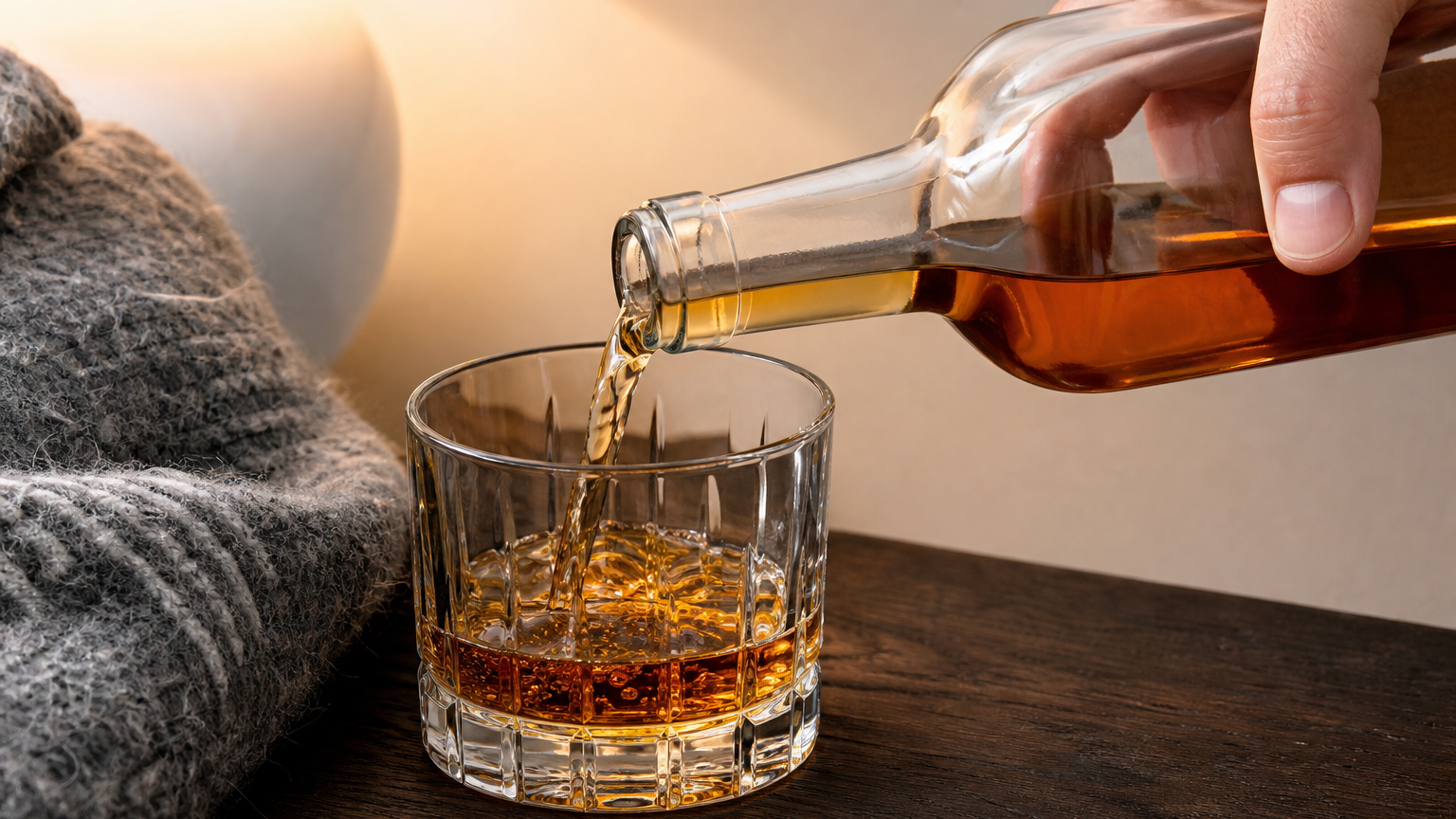
Let's talk honestly about the mug. Somewhere around late October, a warm drink with a little something in it stops being a treat and starts being a fixture. Nobody decides this. There's no evening where you sit down and announce that from now on, the hot toddy is happening nightly. It just accumulates, one dark 5pm at a time, until you notice you've had one seven nights running and the eighth night already feels non-negotiable.
We want to be clear about something up front: the ritual is not the problem. Hot spiced things in a heavy mug at the end of a cold day are genuinely good. This post is not an argument against coziness. It's an argument for noticing which part of the ritual you're actually attached to, because in our experience most people are attached to the warmth, the smell, and the full stop at the end of the workday, and the alcohol is just the part that came along for the ride and then started charging rent on your sleep.
Why do cold weather and early darkness make a nightly drink feel so automatic?
Seasonal cues repeat, and that repetition is the whole mechanism. A ski trip or a holiday party gives you one occasion to pair with a warm drink. A dark, cold Tuesday gives you that same pairing every single day for four months, and habits are built out of repetition in a stable context. Psychologists Wendy Wood and Dennis Rünger describe habits as responses triggered by context cues (the place, the time of day, the action that came right before), which become the default mode of responding largely independent of what you currently intend to do. Cold weather drinking triggers are sticky precisely because they're boring and daily.
Then there's the clock problem. When the sun sets at 4:40, your internal sense of "evening" arrives hours before it did in July. The first drink doesn't feel early, because darkness is doing the timekeeping. You are not pouring at 5pm; you are pouring "after dark," which happens to be 5pm now. That's the same subjective moment you used to reach at 8:30, just relocated.
Less daylight also strips out the things that used to compete for those hours. Fewer evening walks, fewer patio plans, fewer people texting about doing something. The hours don't disappear; they just go unstructured, and unstructured indoor hours are where a drink slots in most easily.
The "it's cozy season" permission slip
Culture hands you a ready-made justification, and it's a good one. It's freezing. Everyone's hibernating. This is what the season is for. That framing is harmless when it applies to a handful of nights and quietly powerful when it applies to ninety of them, because it converts an exception into a standing rule that never gets re-examined.
Worth naming: the evidence does not actually show that people drink more all winter. Seasonal analyses find a pronounced December peak that shifts the share of people reporting recent and heavy drinking, while non-December seasonality in that same research was highest in summer. So winter drinking habits aren't a biological inevitability of cold. What cold does is supply a nightly cue and a socially approved reason not to question it.
Why a seasonal cue is stickier than an occasional one
Think of it as rehearsal count. An occasion-based ritual gets practiced maybe eight times a year. A weather-based one gets practiced a hundred and twenty times between Halloween and March. The loop is simple: cue (dark, cold, 6pm), routine (pour, warm, sip), reward (heat, wind-down, the official end of work mode). Run that loop enough times and the pour stops requiring a decision. If you want to see how your own loop is wired, Reframe's guide to common triggers for drinking is a useful place to start mapping cue to routine.
How do you know when a cozy ritual has become a nightly drinking habit?
The most honest test is frequency, measured rather than remembered. Count how many of the last fourteen nights included a warm alcoholic drink, then count the same stretch in September. If September was three and this month is eleven, you have your answer, and no amount of "but it's been a rough winter" changes the arithmetic. Memory is a terrible auditor here because each individual night felt reasonable.
A few other signals are worth watching, and none of them are verdicts:
The pour grew. A splash of whiskey in cider became a generous one, or one mug became two while the count in your head stayed at one.
The start time drifted earlier in step with sunset, so the drink now bookends a longer evening than it used to.
The company changed. Drinking with people became drinking alone, and you can't pinpoint when.
It got load-bearing. You can't quite wind down, warm up, or fall asleep without it.
There's a small flare of resistance when you picture skipping tonight, and it arrives faster than your reasons do.
A two-week frequency check you can do tonight
Open a notes app, write the last fourteen dates, and mark each one Y or N. Don't estimate. If you can't remember Tuesday, mark it unknown and start tracking forward instead. Two weeks of actual data beats two months of vibes, and it's the single fastest way to see frequency creep that your memory has been smoothing over. If you'd rather answer structured questions than keep a tally, the Am I Drinking Too Much? quiz covers the same ground in a few minutes, and the What Type of Drinker Are You? quiz is useful if the pattern feels more situational than volume-based.
Signs the drink has become load-bearing
Here's the cleanest self-check we know: would you still want the ritual if the mug contained no alcohol? Sit with that for a second before answering. If the answer is an easy yes, you're attached to the ritual and the swap will be straightforward. If the answer is "then what's the point," that's not a character flaw, it's information: the drink is carrying a job (sleep onset, anxiety damping, transition out of work) that the ritual alone stopped doing somewhere along the way. Jobs like that can be reassigned, but only once you've noticed them.
What does a nightcap actually do to your sleep?
Alcohol is sedating on the front end, which is exactly why the nightcap feels like it works. You get drowsy, you drop off faster than usual, and the subjective evidence seems overwhelming. The catch is that sedation and sleep are not the same thing, and the second half of the night is where the bill arrives.
Is a nightcap bad for sleep? The honest answer is that it trades sleep onset for sleep quality. A 2025 systematic review and meta-analysis of 27 controlled studies in healthy adults found that even a low dose (roughly two standard drinks) delays and reduces REM sleep, with the disruption worsening as the dose rises. Notably, that same review could not pin down effects on total sleep time or overall sleep efficiency, so we're not going to tell you a single small toddy demolishes your night. What the evidence does support is that the architecture of your sleep changes at doses most people would consider modest.
Why you fall asleep fast and wake at 3am
The mechanism is a handoff. A narrative review of alcohol and adult sleep describes how, as ethanol is metabolized overnight, the early sedative effect fades and is replaced by sympathetic activation and easier arousal, with increased wake time concentrated in the second half of the night. The same review describes REM being suppressed early and then rebounding later, which is the likely reason for the vivid, oddly cinematic dreams people report in the small hours after drinking.
That's the 3am wake-up, in mechanical terms. You didn't sleep badly because of stress or the thermostat or getting older. You slept through the sedation and then woke into the rebound. The night sweats, the full bladder, the heart that seems to be running a slightly faster program than usual: clinicians often describe these as part of the same post-sedation picture, and they cluster in exactly the stretch of night when you most need to be unconscious.
Why the trade is worse in winter
Here's what makes this particular season awkward. You are already tired. Less daylight, less movement, more dark hours. And the thing you've reached for to help you sleep is preferentially degrading the back half of the night, so you wake unrefreshed after what looked like eight hours in bed, feel more depleted the next day, and arrive at 5pm with an even stronger case for the mug. A nightly nightcap habit is unusually good at generating its own justification.
Can you keep the ritual and drop the alcohol?
Yes, and this is the part we'd actually push you toward, because it works better than willpower does. Start by separating the ritual into components and asking which ones you'd miss: the heat, the aroma, the weight of the mug, the specific chair, the fixed time, and the signal that the workday is officially closed. For most people, the alcohol isn't in the top three.
The cue-swap protocol in five steps
The logic borrows straight from the habit research: keep the cue and the context identical, change only the response. Since habits fire off context cues rather than intentions, preserving the context lets the existing pattern carry the new behavior instead of fighting it.
Keep the time. Same hour, same trigger moment (laptop closes, dinner ends, kids down).
Keep the place. Same chair, same blanket, same view of the same dark window.
Keep the vessel. The heavy mug matters more than it has any right to.
Keep the sequence. Kettle, spices, steep, sit. Change only what goes in.
Add friction on one side and remove it on the other. Bottles move out of the kitchen; cider, spices, and tea bags move to the front of the shelf at eye level.
Expect the first several nights to feel a little flat. Many people describe a stretch of "this is fine but it's not the thing" before the reward re-attaches to the ritual itself, and we'd rather you know that's coming than interpret it as failure. If you want structure while that rewiring happens, Reframe's mindful drinking program is built around this exact kind of cue-level change rather than around white-knuckling.
What to actually put in the mug
Aroma is doing far more of the work than people expect. Cinnamon, clove, orange peel, ginger, and cardamom are what make a drink read as "mulled" to your senses, and none of them require alcohol. Solid options that preserve heat and mouthfeel: spiced apple cider, alcohol-free mulled wine, golden milk, rooibos chai, hot lemon and ginger, warm spiced cranberry. We're not going to improvise recipes here because we already have good ones: see winter mocktail recipes and these warm, comforting alcohol-free drinks for actual measurements.
One practical note on hot toddy every night as a specific case: the toddy is mostly lemon, honey, hot water, and spice, with whiskey as a minority ingredient by volume. It is one of the easiest drinks in the entire cold-weather canon to make alcohol-free without anyone, including you, noticing much difference.
What if the nightcap is the only thing helping you sleep?
This is the most common objection we hear, and it's also the clearest sign the drink has become load-bearing. It deserves a real answer rather than a pep talk. The short version: the wind-down cue can be rebuilt, the sleep benefit you're protecting is partly an illusion of onset speed, and there is a specific scenario where you should talk to a clinician before changing anything.
Start with the rebuildable part. The cue itself (warm drink, roughly an hour before bed, lights coming down) survives the swap intact. Federal sleep guidance emphasizes consistent bed and wake times including days off, daytime bright light with the first hours of the day particularly helpful, and a dimly lit wind-down beginning about 90 minutes before bed. Harvard Health adds that most people sleep better in a slightly cool room with a consistent schedule. Morning light, a fixed wake time, and a cold bedroom are unglamorous, and they outperform a nightcap over any timeframe longer than twenty minutes.
Be ready for a rough patch. When you remove a nightly sedative, the first few nights often feel worse, because you've lost the fast-onset effect and haven't yet recovered the back-half quality. Many people find that evens out within a week or two. If you want a longer view of what that adjustment looks like, we cover it in improving sleep without alcohol and in how to replace alcohol in your evening routine.
When skipping the drink is a medical question, not a self-help one
Here is the part that matters more than anything else in this post. If you've been drinking every night and you notice shakiness, sweating, a racing heart, nausea, restlessness, or strong anxiety on the nights you skip, that is a medical question and not a willpower question. NIAAA lists trouble sleeping, shakiness, restlessness, nausea, sweating, and a racing heart among withdrawal symptoms that may be cause for concern. Cleveland Clinic notes that withdrawal symptoms tend to peak 24 to 72 hours after the last drink and can develop after more than two weeks of heavy use.
Do not self-manage this. Stopping suddenly after prolonged heavy drinking can be dangerous, and NIAAA points to a primary care provider as an important first step, since they can help craft a treatment plan and provide referrals and medications. A clinician can help you taper on a schedule that actually works, which is both safer and, frankly, more likely to succeed than going it alone in January.
How do you get through the rest of winter without white-knuckling it?
Pick a specific seasonal target instead of a vague intention. "Drink less this winter" is unfalsifiable and therefore useless. "Warm alcoholic drinks on Friday and Saturday, alcohol-free the other five nights" is a rule you can check yourself against on a Wednesday, which is the entire point. Specific beats sincere.
Then plan for the nights that will test it. Event-specific drinking is real: research on general-population drinking found consumption in the winter holiday months peaks on Fridays, Saturdays, and especially Christmas and New Year's Eve. Name your own versions in advance (the first real snow, the office party, the long dark Sunday in February) and decide now what you'll be holding. Deciding in the moment, in a warm room, with the kettle already on, is not a fair fight.
Rebuild the inputs winter takes away, too, because the drink is partly filling a gap the season created. Daylight in the morning. Some movement, ideally outdoors, ideally before the sun quits. One standing social plan a week that doesn't depend on weather or motivation. If you're looking for non-drinking options that suit the season, fun things to do in each season while cutting back is a decent starting list.
Track it lightly so frequency creep can't hide. A two-week look-back is more honest than memory, and seeing a pattern on a calendar ends arguments with yourself that could otherwise run all winter. When you're ready for something more structured than a notes app, you can download Reframe and let the tracking happen in the background.
And keep the frame straight: you're not giving up hygge. You're keeping the mug, the chair, the spices, and the wind-down, and removing the ingredient that wakes you at 3am. That's not a sacrifice. That's an upgrade with better mornings attached.
Summary FAQs
1. Is having a hot toddy every night bad for you?
A nightly hot toddy means daily alcohol, and the seasonal framing tends to hide that. Even one drink close to bedtime fragments the second half of your sleep, and daily drinking raises risks that occasional drinking does not. If you want the drink most nights, the more useful question is whether you'd still want the ritual with an alcohol-free mug.
2. How do I know if my winter drinking has become a problem?
Look for frequency creep (more nights than two months ago), a bigger pour, an earlier start time, drinking alone more than with others, and needing the drink to fall asleep or unwind. Any resistance you feel at the idea of skipping tonight is useful information rather than a verdict. A two-week look-back at actual nights, not your memory of them, is the fastest honest check.
3. Does a nightcap help you sleep?
It helps you fall asleep and then works against you. Alcohol sedates the front half of the night and then rebounds as it clears, causing lighter sleep, more awakenings, suppressed and then rebounding REM, and early-morning waking. Most people trade a faster sleep onset for several hours of worse sleep.
4. Why do I crave alcohol more in the winter?
Early darkness moves your sense of 'evening' earlier, cold weather pushes you toward warmth and comfort, and there are fewer daytime activities competing for the hours. Those cues repeat every single day, so a ritual that used to need an occasion now has a standing invitation. Cultural permission ("it's cozy season") makes the daily version feel normal.
5. What can I drink instead of mulled wine or a hot toddy at night?
Keep the heat and the aroma and change the contents: spiced apple cider, alcohol-free mulled wine, golden milk with turmeric and ginger, rooibos chai, or hot lemon with ginger and honey. The cinnamon, clove, orange peel, and ginger are carrying most of the sensory experience you're actually after. Using the same mug, chair, and time keeps the ritual recognizable to your brain.
6. How long does sleep take to improve after I stop having a nightly nightcap?
Many people sleep worse for the first few nights because the sedating front-end effect is gone, then notice deeper, less-interrupted sleep within one to two weeks. Morning light, a consistent wake time, and a cool bedroom speed this up more than any drink does. If skipping brings shakiness, sweating, a racing heart, or intense anxiety, talk to a clinician before stopping on your own.
Ready To Keep the Cozy and Lose the Nightcap? Reframe Can Help!
Although it isn't a treatment for alcohol use disorder (AUD), the Reframe app can help you cut back on drinking gradually with the science-backed knowledge to empower you 100% of the way. Our proven program has helped millions of people around the world drink less and live more. And we want to help you get there, too!
The Reframe app equips you with the knowledge and skills you need to not only survive drinking less, but to thrive while you navigate the journey. Our daily research-backed readings teach you the neuroscience of alcohol, and our in-app Toolkit provides the resources and activities you need to navigate each challenge.
You'll meet millions of fellow Reframers in our 24/7 Forum chat and daily Zoom check-in meetings. Receive encouragement from people worldwide who know exactly what you're going through! You'll also have the opportunity to connect with our licensed Reframe coaches for more personalized guidance.
Plus, we're always introducing new features to optimize your in-app experience. We recently launched our in-app chatbot, Melody, powered by the world's most powerful AI technology. Melody is here to help as you adjust to a life with less (or no) alcohol.
And that's not all! Every month, we launch fun challenges, like Dry/Damp January, Mental Health May, and Outdoorsy June. You won't want to miss out on the chance to participate alongside fellow Reframers (or solo if that's more your thing!).
The Reframe app is free for 7 days, so you don't have anything to lose by trying it. Are you ready to feel empowered and discover life beyond alcohol? Then download our app through the App Store or Google Play today!
Reframe has helped over 2 millions people to build healthier drinking habits globally
At Reframe, we do science, not stigma. We base our articles on the latest peer-reviewed research in psychology, neuroscience, and behavioral science. We follow the Reframe Content Creation Guidelines, to ensure that we share accurate and actionable information with our readers. This aids them in making informed decisions on their wellness journey. Learn more
Updated Regularly
Our articles undergo frequent updates to present the newest scientific research and changes in expert consensus in an easily understandable and implementable manner.
Gardiner, C., Weakley, J., Burke, L. M., Roach, G. D., Sargent, C., Maniar, N., Townshend, A., & Halson, S. L. (2025). The effect of alcohol on subsequent sleep in healthy adults: A systematic review and meta-analysis. Sleep Medicine Reviews, 80, 102030.
Alcohol, wine, and sleep in adults: Insights from a narrative review. (2025). PubMed Central. https://pmc.ncbi.nlm.nih.gov/articles/PMC12942847/
Wood, W., & Rünger, D. (2016). Psychology of habit. Annual Review of Psychology, 67, 289–314.
Kushnir, V., & Cunningham, J. A. (2014). Event-specific drinking in the general population. Journal of Studies on Alcohol and Drugs, 75(6), 968–972.
Uitenbroek, D. G. (1996). Seasonal variation in alcohol use. Journal of Studies on Alcohol, 57(1), 47–52.
National Institute on Alcohol Abuse and Alcoholism. (2024). Treatment for alcohol problems: Finding and getting help. U.S. Department of Health and Human Services.
National Institute on Alcohol Abuse and Alcoholism. (2024). Understanding alcohol use disorder. U.S. Department of Health and Human Services.
National Institute for Occupational Safety and Health. (2020). Improve sleep: Tips to improve your sleep when times are tough. Centers for Disease Control and Prevention.
Harvard Health Publishing. (2025). Sleep hygiene: Simple practices for better rest. Harvard Medical School.