

Learn practical steps to reassess your relationship with alcohol, understand emotional triggers, and explore healthier coping strategies for a balanced life.
Let's talk honestly about alcohol. It's woven into the fabric of our social lives, often portrayed as a key to relaxation and connection. But beneath the surface, many of us grapple with the complexities of our drinking habits, wondering if there's a better way to feel good and live fully. This post explores the often-overlooked psychological aspects of alcohol's influence, debunking common myths and offering practical strategies for change. We'll delve into the science behind alcohol's effects on the brain, uncover the emotional triggers that drive drinking, and provide actionable steps to build a healthier relationship with alcohol. Whether you're aiming for moderation or abstinence, this guide offers support and resources to empower you to make lasting changes.
Alcohol's pull goes beyond the physical; it often has a strong psychological grip. For some, it becomes a coping mechanism for stress, anxiety, or low self-esteem. It can feel like a quick fix for emotional discomfort, a way to numb difficult feelings, or a social lubricant in awkward situations. This reliance can develop into a psychological dependence, where alcohol feels essential for managing emotions or navigating social situations. Reframe's mindful drinking program offers tools to help you understand these patterns and develop healthier coping strategies. For additional support and resources, check out Reframe's FAQ page.
This psychological grip is reinforced by alcohol's biphasic effects on the brain. Initially, it can create a sense of euphoria by increasing dopamine levels. This pleasant feeling can be especially alluring for those seeking relief from emotional distress. However, this initial "up" is often followed by a "down" as alcohol inhibits excitatory neurotransmitters. This can lead to feelings of relaxation that can easily tip into sluggishness or sadness. This two-phase effect can create a cycle where people drink to feel good, then drink more to counter the subsequent low, further strengthening the psychological connection.
Recognizing this psychological dependence in yourself requires honest self-reflection. It's often difficult to confront the underlying reasons why you might be drinking, especially since alcohol can mask these issues, making it harder to address them directly. Understanding this complex interplay of emotional, social, and biological factors is key to breaking free from alcohol's psychological grip. Explore Reframe's personalized programs to gain insights into your drinking habits and start building a healthier relationship with alcohol.
Many reach for a drink to unwind after a long day, believing alcohol is a shortcut to relaxation. Societal norms often reinforce this idea, making it tricky to separate genuine benefits from cleverly marketed myths. Let's unpack some common misconceptions about alcohol's positive effects.
It's easy to fall into the trap of thinking alcohol helps you relax. A glass of wine after work, a beer with friends—these scenarios often get linked with relaxation and stress relief. However, this connection is more about learned associations than actual physiological effects. Alcohol initially creates a sense of calm by depressing the central nervous system, but this is short-lived. As Annie Grace discusses in her exploration of alcohol's effects, this initial calm is deceptive. Alcohol doesn't truly relax you; it actually increases cortisol, the stress hormone, in your body. This can lead to a cycle where you rely on alcohol to manage stress, but end up feeling more anxious in the long run. Psychology Today explains that alcohol has a biphasic effect on the brain, initially increasing dopamine (creating a sense of euphoria) but ultimately slowing down brain function. This means the "relaxation" you feel is actually a slowdown of your brain's activity, not true stress relief.
Social gatherings often revolve around alcohol, creating the impression that drinking is essential for connection and fun. We see it everywhere: happy hour with colleagues, celebrations with friends, even casual get-togethers. This constant association between alcohol and socializing makes it hard to imagine social situations without it. The BPS Research Digest highlights how alcohol's rewarding psychological effects contribute to this perception, making social drinking feel enjoyable. However, this can mask the underlying reasons we drink in social settings. Often, it's less about the alcohol itself and more about seeking connection, belonging, and a sense of ease in social interactions. Mental Health Match points out that alcohol can be a way to avoid self-reflection and honesty, making it difficult to recognize when social drinking becomes a crutch. By understanding the real reasons behind our social drinking habits, we can start to explore healthier ways to connect with others and enjoy social situations without relying on alcohol.
We often hear that alcohol helps us relax and unwind. But what if I told you that's not the whole story? Let's take a closer look at how alcohol really affects your body and mind.
It's easy to fall into the trap of thinking a drink or two melts away stress. However, alcohol doesn't actually relax you. Instead, it triggers the release of cortisol, the stress hormone, in your body. This can actually amplify feelings of anxiety and tension over time, making it harder to manage stress in healthy ways. Alcohol also has a biphasic effect on the brain. Initially, it increases dopamine, creating a temporary sense of euphoria. But it also inhibits excitatory neurotransmitters, ultimately slowing down brain function. This means that while you might feel a brief "up," it's followed by a downturn that can leave you feeling sluggish and mentally foggy.
Beyond the physical effects, alcohol can also impact your emotional landscape. It can numb your ability to experience joy from everyday activities. This can create a dependence on alcohol to feel good, making it seem like it enhances happiness when, in reality, it's interfering with your natural ability to find joy. This complex relationship is worth exploring if you're looking to understand your drinking habits. It's important to recognize that true joy comes from within, not from a bottle. Building a fulfilling life involves finding healthy ways to connect with yourself and others, and exploring activities that genuinely bring you pleasure. Understanding the rewarding psychological effects of alcohol can help you find healthier ways to enjoy social interactions and experience genuine happiness. Reframe's mindful drinking program can provide support and guidance as you explore a more balanced relationship with alcohol.
We live in a culture that often glorifies alcohol. It’s the centerpiece of celebrations, the go-to stress reliever, and the social lubricant that eases awkward encounters. But how often do we question these deeply ingrained beliefs about alcohol's role in our lives? Challenging these norms is the first step toward building a healthier relationship with drinking. It's about recognizing that alcohol isn't the magic solution it's often portrayed to be.
Many of us have been led to believe that alcohol is essential for relaxation and social connection. We see it in movies, TV shows, and advertisements—the image of someone unwinding with a drink after a long day, or a group of friends toasting to good times. But the truth is, alcohol can increase stress and anxiety over time. It has a biphasic effect on the brain, initially increasing dopamine levels and creating a sense of euphoria, but then inhibiting excitatory neurotransmitters, which ultimately slows things down and can lead to feelings of depression or anxiety. It's also important to remember that alcohol is an addictive substance for anyone, regardless of background or circumstance. By questioning these cultural beliefs, we can start to separate the myths from the realities of alcohol's impact. You can explore more about alcohol abuse and recovery to better understand the complexities involved.
We live in a culture that often glorifies alcohol. It’s the centerpiece of celebrations, the go-to stress reliever, and the social lubricant that eases awkward encounters. But how often do we question these deeply ingrained beliefs about alcohol's role in our lives? Challenging these norms is the first step toward building a healthier relationship with drinking. It's about recognizing that alcohol isn't the magic solution it's often portrayed to be.
Many of us have been led to believe that alcohol is essential for relaxation and social connection. We see it in movies, TV shows, and advertisements—the image of someone unwinding with a drink after a long day, or a group of friends toasting to good times. But the truth is, alcohol can increase stress and anxiety over time. It has a biphasic effect on the brain, initially increasing dopamine levels and creating a sense of euphoria, but then inhibiting excitatory neurotransmitters, which ultimately slows things down and can lead to feelings of depression or anxiety. It's also important to remember that alcohol is an addictive substance for anyone, regardless of background or circumstance. By questioning these cultural beliefs, we can start to separate the myths from the realities of alcohol's impact. You can explore more about alcohol abuse and recovery to better understand the complexities involved.
Social pressure to drink can be immense, making it difficult to make independent choices about alcohol. We might worry about being judged or excluded if we don't participate in drinking culture. But it's crucial to recognize that our worth isn't tied to how much we drink. For some, psychological traits like impulsiveness or a need for approval can fuel problematic drinking habits. The American Psychological Association offers insights into this connection. Choosing to drink less, or not at all, is a personal decision, and it's okay to set boundaries that prioritize your well-being. Remember, you have the power to define your own relationship with alcohol, regardless of what others may think. Research highlights the different needs of individuals when it comes to alcohol reduction, reinforcing the importance of a personalized approach. Reframe provides tools and support to help you make lasting changes, regardless of your drinking habits. Check out our Mindful Drinking resources to learn more.
Once you're aware of your triggers, you can start to practice mindful drinking. This means paying attention to how alcohol makes you feel—both physically and emotionally—in the moment. Instead of drinking on autopilot, ask yourself: Why am I having this drink? What am I hoping to gain from it? Reframe is a neuroscience-based habit change program that can help you reshape your drinking habits, whether you're aiming to cut back or quit altogether. Cognitive Behavioral Therapy (CBT) techniques can also be incredibly helpful. Learn more about how CBT can help you drink less. CBT teaches you to identify and challenge negative thought patterns and behaviors related to alcohol. By combining self-awareness with practical strategies, you can take control of your drinking and create a healthier relationship with alcohol.
This section dives into the how and why of changing your drinking habits, offering practical steps and insights to guide you.
Changing your relationship with alcohol starts with understanding why you drink. This requires honest self-reflection, which can be tough, especially if alcohol has become a way to avoid difficult emotions. But developing self-awareness around your drinking habits is the first step toward making positive changes.
Think about the times you reach for a drink. Is it after a stressful day at work? When you're feeling lonely or bored? Identifying these emotional triggers is key to understanding your drinking patterns. Alcohol Abuse: Understanding, Overcoming, and Recovery Guide offers further insights into these patterns. Common signs that you might be using alcohol as a coping mechanism include constantly thinking about alcohol, feeling restless or irritable when you can't drink, and experiencing physical symptoms like a racing heart or sweating. Even engaging in risky behaviors to obtain alcohol is a red flag. Recognizing these emotional and physical cues can help you interrupt the cycle and make more conscious choices.
Once you're aware of your triggers, you can start to practice mindful drinking. This means paying attention to how alcohol makes you feel—both physically and emotionally—in the moment. Instead of drinking on autopilot, ask yourself: Why am I having this drink? What am I hoping to gain from it? Reframe is a neuroscience-based habit change program that can help you reshape your drinking habits, whether you're aiming to cut back or quit altogether. Cognitive Behavioral Therapy (CBT) techniques can also be incredibly helpful. Learn more about how CBT can help you drink less. CBT teaches you to identify and challenge negative thought patterns and behaviors related to alcohol. By combining self-awareness with practical strategies, you can take control of your drinking and create a healthier relationship with alcohol.
Changing any habit can be challenging, and changing your drinking habits is no exception. Building a strong support network can provide the encouragement and accountability you need to stay on track. Connecting with friends, family, or a support group can create a safe space to share your struggles and celebrate your successes. If you're finding it difficult to open up to loved ones, consider seeking guidance from a therapist or counselor. They can offer professional support and help you work through emotional challenges. You don't have to go through this alone. Connecting with others who understand your journey can make a world of difference. Even online communities and forums can be valuable resources for finding support and sharing experiences. Consider exploring apps like Reframe, which offer built-in community features and feedback mechanisms to help you stay connected and motivated. Building a support network is an investment in your long-term success.
Changing your relationship with alcohol is a journey, not a destination. It requires ongoing learning, self-reflection, and a strong support system. Equipping yourself with the right resources and connecting with others can make all the difference.
Knowledge is power, especially when it comes to understanding how alcohol affects your mind and body. The more you learn, the better equipped you'll be to make informed decisions about your drinking habits. Resources like the Reframe app offer evidence-based programs and personalized support to help you change your drinking habits. Developed with insights from medical and mental health professionals, Reframe provides a comprehensive toolkit and in-depth courses to empower you to make lasting changes. Explore articles, books, and podcasts that discuss the science behind alcohol's effects, and share personal stories of transformation. Learning from experts and others who have similar experiences can provide valuable insights and motivation. For example, Annie Grace, author of This Naked Mind, offers a wealth of information on sobriety and alcohol's impact on the body and brain. Continuous learning is key to staying informed and empowered on your journey. Reframe's guide on tracking drinking habits is a great starting point for understanding your current relationship with alcohol.
Changing any habit can be challenging, and changing your drinking habits is no exception. Building a strong support network can provide the encouragement and accountability you need to stay on track. Connecting with friends, family, or a support group can create a safe space to share your struggles and celebrate your successes. If you're finding it difficult to open up to loved ones, consider seeking guidance from a therapist or counselor. They can offer professional support and help you work through emotional challenges. You don't have to go through this alone. Connecting with others who understand your journey can make a world of difference. Even online communities and forums can be valuable resources for finding support and sharing experiences. Consider exploring apps like Reframe, which offer built-in community features and feedback mechanisms to help you stay connected and motivated. Building a support network is an investment in your long-term success.
Changing your drinking habits is a journey, not a race. It's about progress, not perfection. To stay motivated and on track, keep tabs on your habits and emotions, and don't forget to celebrate your wins.
Understanding your drinking patterns is the first step toward making lasting changes. Think of it like detective work—you're gathering clues to understand what influences your choices. A journal for tracking drinking habits or an app like Reframe can be invaluable. They help you monitor not just how much you drink, but also when, where, and why. Pay attention to the emotional triggers that lead you to reach for a drink. Are you stressed, bored, or celebrating? Recognizing these patterns helps you develop healthier coping mechanisms. As you gather data, you'll start to see connections between your emotions and your drinking, giving you valuable insights to guide your choices. This feedback process is crucial for understanding your behavior and making informed decisions.
Whether your goal is to cut back or quit completely, acknowledge and celebrate every milestone. Every sober day, every drink refused, every craving overcome—these are all victories worth celebrating. Did you make it through a social event without drinking? Fantastic! Did you choose a mocktail instead of a cocktail? That's amazing! These small wins build momentum and reinforce positive changes. Remember, roughly half of Reframe’s users initially aim to moderate their drinking, so even small changes are significant. Celebrating these milestones keeps you motivated and reminds you of how far you've come. Reframe is designed to support you every step of the way, offering encouragement and tools to help you mark your progress.
Living without alcohol opens a world of possibilities and allows you to truly experience life's richness. It's about rediscovering joy in simple pleasures and creating meaningful experiences that aren't clouded by the effects of alcohol. This shift in perspective can be transformative, leading to a greater sense of self and overall well-being.
Many associate alcohol with relaxation and enjoyment, but the reality is often quite different. Alcohol doesn't relax you; it triggers the release of cortisol, the stress hormone, hindering your ability to experience joy from everyday moments. As Annie Grace points out in her work, this can numb you to the simple pleasures in life. Removing alcohol creates space for genuine joy to emerge. You become more present and attuned to the world, appreciating the beauty and connection in everyday experiences. This rediscovery of joy can be a powerful motivator in maintaining a healthier relationship with alcohol. It's a reminder that true enjoyment comes from within. As Grace mentions in her interview, alcohol's addictive nature affects everyone. Understanding this can be a crucial step in breaking free from its grip.
Let's be honest: changing your drinking habits isn't just about willpower. It's about understanding the mental and emotional factors that influence your choices. This section offers practical strategies to address those underlying psychological hurdles.
Cognitive Behavioral Therapy (CBT) offers powerful tools to reshape your relationship with alcohol. It helps you become aware of—and change—negative thought patterns and behaviors. Think of those automatic thoughts that pop up when you're stressed or in a social situation where drinking is expected. CBT helps you identify those triggers, manage cravings, and develop healthier coping mechanisms. Reframe's CBT-based resources can guide you through this process. Learning to recognize the signs of alcohol cravings is also crucial. These can include intense thoughts about alcohol, feeling restless or irritable, or even experiencing physical symptoms like a racing heart or nausea. Understanding these signs empowers you to respond proactively.
Many people use alcohol to cope with stress or difficult emotions. It's a common but ultimately unhelpful approach. Psychological factors like impulsiveness or low self-esteem can also fuel unhealthy drinking patterns, as described by the American Psychological Association. It's important to remember that alcohol can intensify emotional ups and downs. While it might seem to offer temporary relief, it can actually worsen underlying issues and create a cycle of dependence. Explore healthier ways to manage stress and process emotions. This could include exercise, mindfulness practices, spending time in nature, or connecting with supportive friends and family. Reframe's mindful drinking program offers practical guidance and support as you develop these new coping strategies. Remember, acknowledging the role of emotions in your drinking habits is a significant step toward lasting change.
Living without alcohol opens a world of possibilities and allows you to truly experience life's richness. It's about rediscovering joy in simple pleasures and creating meaningful experiences that aren't clouded by the effects of alcohol. This shift in perspective can be transformative, leading to a greater sense of self and overall well-being.
Many associate alcohol with relaxation and enjoyment, but the reality is often quite different. Alcohol doesn't relax you; it triggers the release of cortisol, the stress hormone, hindering your ability to experience joy from everyday moments. As Annie Grace points out in her work, this can numb you to the simple pleasures in life. Removing alcohol creates space for genuine joy to emerge. You become more present and attuned to the world, appreciating the beauty and connection in everyday experiences. This rediscovery of joy can be a powerful motivator in maintaining a healthier relationship with alcohol. It's a reminder that true enjoyment comes from within. As Grace mentions in her interview, alcohol's addictive nature affects everyone. Understanding this can be a crucial step in breaking free from its grip.
Building a life you love without alcohol involves creating meaningful experiences. This might mean exploring new hobbies, deepening relationships, or savoring quiet moments. Reframe offers support and resources for those looking to change their relationship with alcohol, whether it's cutting back or abstaining completely. Taking control of your drinking habits empowers you to actively shape your life. Setting clear goals is a crucial first step. This process of self-discovery can be challenging, especially when acknowledging alcohol's role in avoiding difficult emotions, as discussed in this guide. However, facing these challenges head-on is essential for creating a fulfilling life free from alcohol's influence. It's about building a life rich with purpose and connection, where your experiences are truly your own.
Start by tracking your drinking patterns. Notice when, where, and why you drink. Identify your emotional triggers. Explore healthier coping mechanisms for stress and difficult emotions, such as exercise, mindfulness, or connecting with loved ones. Consider using a support system or app like Reframe for guidance and accountability.
How can I stay motivated on my journey to change my relationship with alcohol?
Focus on progress, not perfection. Celebrate every milestone, no matter how small. Remember why you started this journey and visualize the positive changes you want to create in your life. Connect with a supportive community and seek professional help if needed. Changing your relationship with alcohol is a marathon, not a sprint.
Let's talk honestly about alcohol. It's woven into the fabric of our social lives, often portrayed as a key to relaxation and connection. But beneath the surface, many of us grapple with the complexities of our drinking habits, wondering if there's a better way to feel good and live fully. This post explores the often-overlooked psychological aspects of alcohol's influence, debunking common myths and offering practical strategies for change. We'll delve into the science behind alcohol's effects on the brain, uncover the emotional triggers that drive drinking, and provide actionable steps to build a healthier relationship with alcohol. Whether you're aiming for moderation or abstinence, this guide offers support and resources to empower you to make lasting changes.
Alcohol's pull goes beyond the physical; it often has a strong psychological grip. For some, it becomes a coping mechanism for stress, anxiety, or low self-esteem. It can feel like a quick fix for emotional discomfort, a way to numb difficult feelings, or a social lubricant in awkward situations. This reliance can develop into a psychological dependence, where alcohol feels essential for managing emotions or navigating social situations. Reframe's mindful drinking program offers tools to help you understand these patterns and develop healthier coping strategies. For additional support and resources, check out Reframe's FAQ page.
This psychological grip is reinforced by alcohol's biphasic effects on the brain. Initially, it can create a sense of euphoria by increasing dopamine levels. This pleasant feeling can be especially alluring for those seeking relief from emotional distress. However, this initial "up" is often followed by a "down" as alcohol inhibits excitatory neurotransmitters. This can lead to feelings of relaxation that can easily tip into sluggishness or sadness. This two-phase effect can create a cycle where people drink to feel good, then drink more to counter the subsequent low, further strengthening the psychological connection.
Recognizing this psychological dependence in yourself requires honest self-reflection. It's often difficult to confront the underlying reasons why you might be drinking, especially since alcohol can mask these issues, making it harder to address them directly. Understanding this complex interplay of emotional, social, and biological factors is key to breaking free from alcohol's psychological grip. Explore Reframe's personalized programs to gain insights into your drinking habits and start building a healthier relationship with alcohol.
Many reach for a drink to unwind after a long day, believing alcohol is a shortcut to relaxation. Societal norms often reinforce this idea, making it tricky to separate genuine benefits from cleverly marketed myths. Let's unpack some common misconceptions about alcohol's positive effects.
It's easy to fall into the trap of thinking alcohol helps you relax. A glass of wine after work, a beer with friends—these scenarios often get linked with relaxation and stress relief. However, this connection is more about learned associations than actual physiological effects. Alcohol initially creates a sense of calm by depressing the central nervous system, but this is short-lived. As Annie Grace discusses in her exploration of alcohol's effects, this initial calm is deceptive. Alcohol doesn't truly relax you; it actually increases cortisol, the stress hormone, in your body. This can lead to a cycle where you rely on alcohol to manage stress, but end up feeling more anxious in the long run. Psychology Today explains that alcohol has a biphasic effect on the brain, initially increasing dopamine (creating a sense of euphoria) but ultimately slowing down brain function. This means the "relaxation" you feel is actually a slowdown of your brain's activity, not true stress relief.
Social gatherings often revolve around alcohol, creating the impression that drinking is essential for connection and fun. We see it everywhere: happy hour with colleagues, celebrations with friends, even casual get-togethers. This constant association between alcohol and socializing makes it hard to imagine social situations without it. The BPS Research Digest highlights how alcohol's rewarding psychological effects contribute to this perception, making social drinking feel enjoyable. However, this can mask the underlying reasons we drink in social settings. Often, it's less about the alcohol itself and more about seeking connection, belonging, and a sense of ease in social interactions. Mental Health Match points out that alcohol can be a way to avoid self-reflection and honesty, making it difficult to recognize when social drinking becomes a crutch. By understanding the real reasons behind our social drinking habits, we can start to explore healthier ways to connect with others and enjoy social situations without relying on alcohol.
We often hear that alcohol helps us relax and unwind. But what if I told you that's not the whole story? Let's take a closer look at how alcohol really affects your body and mind.
It's easy to fall into the trap of thinking a drink or two melts away stress. However, alcohol doesn't actually relax you. Instead, it triggers the release of cortisol, the stress hormone, in your body. This can actually amplify feelings of anxiety and tension over time, making it harder to manage stress in healthy ways. Alcohol also has a biphasic effect on the brain. Initially, it increases dopamine, creating a temporary sense of euphoria. But it also inhibits excitatory neurotransmitters, ultimately slowing down brain function. This means that while you might feel a brief "up," it's followed by a downturn that can leave you feeling sluggish and mentally foggy.
Beyond the physical effects, alcohol can also impact your emotional landscape. It can numb your ability to experience joy from everyday activities. This can create a dependence on alcohol to feel good, making it seem like it enhances happiness when, in reality, it's interfering with your natural ability to find joy. This complex relationship is worth exploring if you're looking to understand your drinking habits. It's important to recognize that true joy comes from within, not from a bottle. Building a fulfilling life involves finding healthy ways to connect with yourself and others, and exploring activities that genuinely bring you pleasure. Understanding the rewarding psychological effects of alcohol can help you find healthier ways to enjoy social interactions and experience genuine happiness. Reframe's mindful drinking program can provide support and guidance as you explore a more balanced relationship with alcohol.
We live in a culture that often glorifies alcohol. It’s the centerpiece of celebrations, the go-to stress reliever, and the social lubricant that eases awkward encounters. But how often do we question these deeply ingrained beliefs about alcohol's role in our lives? Challenging these norms is the first step toward building a healthier relationship with drinking. It's about recognizing that alcohol isn't the magic solution it's often portrayed to be.
Many of us have been led to believe that alcohol is essential for relaxation and social connection. We see it in movies, TV shows, and advertisements—the image of someone unwinding with a drink after a long day, or a group of friends toasting to good times. But the truth is, alcohol can increase stress and anxiety over time. It has a biphasic effect on the brain, initially increasing dopamine levels and creating a sense of euphoria, but then inhibiting excitatory neurotransmitters, which ultimately slows things down and can lead to feelings of depression or anxiety. It's also important to remember that alcohol is an addictive substance for anyone, regardless of background or circumstance. By questioning these cultural beliefs, we can start to separate the myths from the realities of alcohol's impact. You can explore more about alcohol abuse and recovery to better understand the complexities involved.
We live in a culture that often glorifies alcohol. It’s the centerpiece of celebrations, the go-to stress reliever, and the social lubricant that eases awkward encounters. But how often do we question these deeply ingrained beliefs about alcohol's role in our lives? Challenging these norms is the first step toward building a healthier relationship with drinking. It's about recognizing that alcohol isn't the magic solution it's often portrayed to be.
Many of us have been led to believe that alcohol is essential for relaxation and social connection. We see it in movies, TV shows, and advertisements—the image of someone unwinding with a drink after a long day, or a group of friends toasting to good times. But the truth is, alcohol can increase stress and anxiety over time. It has a biphasic effect on the brain, initially increasing dopamine levels and creating a sense of euphoria, but then inhibiting excitatory neurotransmitters, which ultimately slows things down and can lead to feelings of depression or anxiety. It's also important to remember that alcohol is an addictive substance for anyone, regardless of background or circumstance. By questioning these cultural beliefs, we can start to separate the myths from the realities of alcohol's impact. You can explore more about alcohol abuse and recovery to better understand the complexities involved.
Social pressure to drink can be immense, making it difficult to make independent choices about alcohol. We might worry about being judged or excluded if we don't participate in drinking culture. But it's crucial to recognize that our worth isn't tied to how much we drink. For some, psychological traits like impulsiveness or a need for approval can fuel problematic drinking habits. The American Psychological Association offers insights into this connection. Choosing to drink less, or not at all, is a personal decision, and it's okay to set boundaries that prioritize your well-being. Remember, you have the power to define your own relationship with alcohol, regardless of what others may think. Research highlights the different needs of individuals when it comes to alcohol reduction, reinforcing the importance of a personalized approach. Reframe provides tools and support to help you make lasting changes, regardless of your drinking habits. Check out our Mindful Drinking resources to learn more.
Once you're aware of your triggers, you can start to practice mindful drinking. This means paying attention to how alcohol makes you feel—both physically and emotionally—in the moment. Instead of drinking on autopilot, ask yourself: Why am I having this drink? What am I hoping to gain from it? Reframe is a neuroscience-based habit change program that can help you reshape your drinking habits, whether you're aiming to cut back or quit altogether. Cognitive Behavioral Therapy (CBT) techniques can also be incredibly helpful. Learn more about how CBT can help you drink less. CBT teaches you to identify and challenge negative thought patterns and behaviors related to alcohol. By combining self-awareness with practical strategies, you can take control of your drinking and create a healthier relationship with alcohol.
This section dives into the how and why of changing your drinking habits, offering practical steps and insights to guide you.
Changing your relationship with alcohol starts with understanding why you drink. This requires honest self-reflection, which can be tough, especially if alcohol has become a way to avoid difficult emotions. But developing self-awareness around your drinking habits is the first step toward making positive changes.
Think about the times you reach for a drink. Is it after a stressful day at work? When you're feeling lonely or bored? Identifying these emotional triggers is key to understanding your drinking patterns. Alcohol Abuse: Understanding, Overcoming, and Recovery Guide offers further insights into these patterns. Common signs that you might be using alcohol as a coping mechanism include constantly thinking about alcohol, feeling restless or irritable when you can't drink, and experiencing physical symptoms like a racing heart or sweating. Even engaging in risky behaviors to obtain alcohol is a red flag. Recognizing these emotional and physical cues can help you interrupt the cycle and make more conscious choices.
Once you're aware of your triggers, you can start to practice mindful drinking. This means paying attention to how alcohol makes you feel—both physically and emotionally—in the moment. Instead of drinking on autopilot, ask yourself: Why am I having this drink? What am I hoping to gain from it? Reframe is a neuroscience-based habit change program that can help you reshape your drinking habits, whether you're aiming to cut back or quit altogether. Cognitive Behavioral Therapy (CBT) techniques can also be incredibly helpful. Learn more about how CBT can help you drink less. CBT teaches you to identify and challenge negative thought patterns and behaviors related to alcohol. By combining self-awareness with practical strategies, you can take control of your drinking and create a healthier relationship with alcohol.
Changing any habit can be challenging, and changing your drinking habits is no exception. Building a strong support network can provide the encouragement and accountability you need to stay on track. Connecting with friends, family, or a support group can create a safe space to share your struggles and celebrate your successes. If you're finding it difficult to open up to loved ones, consider seeking guidance from a therapist or counselor. They can offer professional support and help you work through emotional challenges. You don't have to go through this alone. Connecting with others who understand your journey can make a world of difference. Even online communities and forums can be valuable resources for finding support and sharing experiences. Consider exploring apps like Reframe, which offer built-in community features and feedback mechanisms to help you stay connected and motivated. Building a support network is an investment in your long-term success.
Changing your relationship with alcohol is a journey, not a destination. It requires ongoing learning, self-reflection, and a strong support system. Equipping yourself with the right resources and connecting with others can make all the difference.
Knowledge is power, especially when it comes to understanding how alcohol affects your mind and body. The more you learn, the better equipped you'll be to make informed decisions about your drinking habits. Resources like the Reframe app offer evidence-based programs and personalized support to help you change your drinking habits. Developed with insights from medical and mental health professionals, Reframe provides a comprehensive toolkit and in-depth courses to empower you to make lasting changes. Explore articles, books, and podcasts that discuss the science behind alcohol's effects, and share personal stories of transformation. Learning from experts and others who have similar experiences can provide valuable insights and motivation. For example, Annie Grace, author of This Naked Mind, offers a wealth of information on sobriety and alcohol's impact on the body and brain. Continuous learning is key to staying informed and empowered on your journey. Reframe's guide on tracking drinking habits is a great starting point for understanding your current relationship with alcohol.
Changing any habit can be challenging, and changing your drinking habits is no exception. Building a strong support network can provide the encouragement and accountability you need to stay on track. Connecting with friends, family, or a support group can create a safe space to share your struggles and celebrate your successes. If you're finding it difficult to open up to loved ones, consider seeking guidance from a therapist or counselor. They can offer professional support and help you work through emotional challenges. You don't have to go through this alone. Connecting with others who understand your journey can make a world of difference. Even online communities and forums can be valuable resources for finding support and sharing experiences. Consider exploring apps like Reframe, which offer built-in community features and feedback mechanisms to help you stay connected and motivated. Building a support network is an investment in your long-term success.
Changing your drinking habits is a journey, not a race. It's about progress, not perfection. To stay motivated and on track, keep tabs on your habits and emotions, and don't forget to celebrate your wins.
Understanding your drinking patterns is the first step toward making lasting changes. Think of it like detective work—you're gathering clues to understand what influences your choices. A journal for tracking drinking habits or an app like Reframe can be invaluable. They help you monitor not just how much you drink, but also when, where, and why. Pay attention to the emotional triggers that lead you to reach for a drink. Are you stressed, bored, or celebrating? Recognizing these patterns helps you develop healthier coping mechanisms. As you gather data, you'll start to see connections between your emotions and your drinking, giving you valuable insights to guide your choices. This feedback process is crucial for understanding your behavior and making informed decisions.
Whether your goal is to cut back or quit completely, acknowledge and celebrate every milestone. Every sober day, every drink refused, every craving overcome—these are all victories worth celebrating. Did you make it through a social event without drinking? Fantastic! Did you choose a mocktail instead of a cocktail? That's amazing! These small wins build momentum and reinforce positive changes. Remember, roughly half of Reframe’s users initially aim to moderate their drinking, so even small changes are significant. Celebrating these milestones keeps you motivated and reminds you of how far you've come. Reframe is designed to support you every step of the way, offering encouragement and tools to help you mark your progress.
Living without alcohol opens a world of possibilities and allows you to truly experience life's richness. It's about rediscovering joy in simple pleasures and creating meaningful experiences that aren't clouded by the effects of alcohol. This shift in perspective can be transformative, leading to a greater sense of self and overall well-being.
Many associate alcohol with relaxation and enjoyment, but the reality is often quite different. Alcohol doesn't relax you; it triggers the release of cortisol, the stress hormone, hindering your ability to experience joy from everyday moments. As Annie Grace points out in her work, this can numb you to the simple pleasures in life. Removing alcohol creates space for genuine joy to emerge. You become more present and attuned to the world, appreciating the beauty and connection in everyday experiences. This rediscovery of joy can be a powerful motivator in maintaining a healthier relationship with alcohol. It's a reminder that true enjoyment comes from within. As Grace mentions in her interview, alcohol's addictive nature affects everyone. Understanding this can be a crucial step in breaking free from its grip.
Let's be honest: changing your drinking habits isn't just about willpower. It's about understanding the mental and emotional factors that influence your choices. This section offers practical strategies to address those underlying psychological hurdles.
Cognitive Behavioral Therapy (CBT) offers powerful tools to reshape your relationship with alcohol. It helps you become aware of—and change—negative thought patterns and behaviors. Think of those automatic thoughts that pop up when you're stressed or in a social situation where drinking is expected. CBT helps you identify those triggers, manage cravings, and develop healthier coping mechanisms. Reframe's CBT-based resources can guide you through this process. Learning to recognize the signs of alcohol cravings is also crucial. These can include intense thoughts about alcohol, feeling restless or irritable, or even experiencing physical symptoms like a racing heart or nausea. Understanding these signs empowers you to respond proactively.
Many people use alcohol to cope with stress or difficult emotions. It's a common but ultimately unhelpful approach. Psychological factors like impulsiveness or low self-esteem can also fuel unhealthy drinking patterns, as described by the American Psychological Association. It's important to remember that alcohol can intensify emotional ups and downs. While it might seem to offer temporary relief, it can actually worsen underlying issues and create a cycle of dependence. Explore healthier ways to manage stress and process emotions. This could include exercise, mindfulness practices, spending time in nature, or connecting with supportive friends and family. Reframe's mindful drinking program offers practical guidance and support as you develop these new coping strategies. Remember, acknowledging the role of emotions in your drinking habits is a significant step toward lasting change.
Living without alcohol opens a world of possibilities and allows you to truly experience life's richness. It's about rediscovering joy in simple pleasures and creating meaningful experiences that aren't clouded by the effects of alcohol. This shift in perspective can be transformative, leading to a greater sense of self and overall well-being.
Many associate alcohol with relaxation and enjoyment, but the reality is often quite different. Alcohol doesn't relax you; it triggers the release of cortisol, the stress hormone, hindering your ability to experience joy from everyday moments. As Annie Grace points out in her work, this can numb you to the simple pleasures in life. Removing alcohol creates space for genuine joy to emerge. You become more present and attuned to the world, appreciating the beauty and connection in everyday experiences. This rediscovery of joy can be a powerful motivator in maintaining a healthier relationship with alcohol. It's a reminder that true enjoyment comes from within. As Grace mentions in her interview, alcohol's addictive nature affects everyone. Understanding this can be a crucial step in breaking free from its grip.
Building a life you love without alcohol involves creating meaningful experiences. This might mean exploring new hobbies, deepening relationships, or savoring quiet moments. Reframe offers support and resources for those looking to change their relationship with alcohol, whether it's cutting back or abstaining completely. Taking control of your drinking habits empowers you to actively shape your life. Setting clear goals is a crucial first step. This process of self-discovery can be challenging, especially when acknowledging alcohol's role in avoiding difficult emotions, as discussed in this guide. However, facing these challenges head-on is essential for creating a fulfilling life free from alcohol's influence. It's about building a life rich with purpose and connection, where your experiences are truly your own.
Start by tracking your drinking patterns. Notice when, where, and why you drink. Identify your emotional triggers. Explore healthier coping mechanisms for stress and difficult emotions, such as exercise, mindfulness, or connecting with loved ones. Consider using a support system or app like Reframe for guidance and accountability.
How can I stay motivated on my journey to change my relationship with alcohol?
Focus on progress, not perfection. Celebrate every milestone, no matter how small. Remember why you started this journey and visualize the positive changes you want to create in your life. Connect with a supportive community and seek professional help if needed. Changing your relationship with alcohol is a marathon, not a sprint.

Learn practical strategies for managing stress without alcohol, including healthy coping mechanisms and lifestyle changes to improve your well-being.
We've all been there: a tough day at work, a frustrating commute, or a never-ending to-do list. It's tempting to pour a drink and try to forget about it all. But while alcohol might offer temporary relief, it's not a sustainable solution for managing stress. In fact, it can often make things worse. Relying on alcohol to cope with stress can lead to a dangerous cycle, disrupting your sleep, increasing anxiety, and ultimately making you more reliant on alcohol to deal with the very problems it's creating. This post will explore the hidden dangers of using alcohol as a stress reliever and offer practical, actionable steps for managing stress without alcohol. We'll cover everything from exercise and mindfulness to nutrition and sleep, providing you with a toolkit of healthy coping mechanisms to navigate life's challenges.
Many people reach for a drink to unwind after a long day. It's a common scenario, often portrayed as a perfectly acceptable way to de-stress. But the relationship between stress and alcohol is more complicated than it appears. While a glass of wine might offer temporary relief, it can actually worsen stress over time. It becomes a cycle: you feel stressed, so you drink, but the alcohol disrupts your sleep and affects your mood, ultimately increasing your stress levels. This can lead to a desire for more alcohol, perpetuating the cycle. This is supported by research showing that using alcohol to cope with stress can increase anxiety and depression, potentially leading to addiction and other health issues like liver damage and heart disease. It's not always easy to break free from this pattern, especially when it's so ingrained in our culture. Resources like This Naked Mind offer valuable insights into managing stress without alcohol. If you're looking to change your drinking habits, Reframe's Mindful Drinking resources offer support and guidance. Finding healthy coping mechanisms is key to breaking the cycle and managing stress effectively.
It's tempting to reach for a drink after a long day. We're constantly told—in movies, on TV, and in magazines—that it's the perfect way to unwind. But while a glass of wine might seem like a quick fix for stress, relying on alcohol as a coping mechanism can create more problems than it solves. It's a bit like putting a band-aid on a broken bone – it covers the problem temporarily, but doesn't address the underlying issue. In fact, it can make things much worse.
It's tempting to reach for a drink after a long day. We're constantly told—in movies, on TV, and in magazines—that it's the perfect way to unwind. But while a glass of wine might seem like a quick fix for stress, relying on alcohol as a coping mechanism can create more problems than it solves. It's a bit like putting a band-aid on a broken bone – it covers the problem temporarily, but doesn't address the underlying issue. In fact, it can make things much worse.
One of the biggest dangers is the vicious cycle it creates. Alcohol might offer temporary relief, a fleeting sense of calm, but it actually disrupts the delicate balance of neurochemicals in your brain. This can increase anxiety and depression over time, making you even more reliant on alcohol to cope. This cycle can quickly spiral, potentially leading to alcohol dependence and a host of health problems, including liver damage and heart disease. This Naked Mind explores how pervasive cultural messaging can make it even harder to break free from alcohol's grip.
Think of stress like a fire. Alcohol might seem to extinguish it at first, but it's actually just dousing it with gasoline. The flames might die down momentarily, but they'll come back even stronger. Nuvance Health highlights how this pattern became even more pronounced for many people during the pandemic, with increased stress leading to increased alcohol consumption. Building healthy coping mechanisms, not relying on a temporary fix, is the key to true stress management. Alcohol Change UK offers some excellent alternatives to alcohol for relaxation. True relaxation comes from addressing the root causes of stress, not masking them with a substance.
Exercise is a fantastic stress reliever. It releases endorphins, which have mood-boosting effects. Regular physical activity can significantly reduce stress, improve sleep, and boost your overall well-being. Find an activity you enjoy, whether it's brisk walking, dancing, swimming, or cycling, and make it a regular part of your routine. Even a short burst of activity can make a difference. Nuvance Health offers additional tips for managing stress without alcohol.
If you're looking for ways to manage stress without alcohol, you're in the right place. There are plenty of healthy and effective strategies that can help you relax and unwind. Let's explore some powerful alternatives.
Exercise is a fantastic stress reliever. It releases endorphins, which have mood-boosting effects. Regular physical activity can significantly reduce stress, improve sleep, and boost your overall well-being. Find an activity you enjoy, whether it's brisk walking, dancing, swimming, or cycling, and make it a regular part of your routine. Even a short burst of activity can make a difference. Nuvance Health offers additional tips for managing stress without alcohol.
Practicing mindfulness and meditation can help you stay grounded in the present moment and quiet the racing thoughts that often accompany stress. Techniques like focusing on your senses—five things you see, four things you touch, three things you hear, two things you smell, and one thing you taste—can bring you back to the here and now. Mindfulness resources can guide you through various exercises. Even a few minutes of daily practice can make a noticeable difference in your ability to manage stress. MCCS Find Balance offers nine alcohol-free coping strategies, including mindfulness techniques.
Engaging in hobbies and creative pursuits offers a positive outlet for stress. Whether it's painting, gardening, playing music, or writing, these activities provide a sense of accomplishment and can be incredibly therapeutic. Finding joy in creative expression can help you de-stress and focus on something positive. Explore different activities and discover what resonates with you. Bold Health provides seven tips for coping with stress without alcohol, including engaging in creative outlets.
When stress hits, it's tempting to reach for comfort foods or sugary snacks. But what if I told you that nourishing your body with the right foods could actually help you manage stress more effectively? It's true—the food we eat plays a crucial role in our physical and mental well-being, directly impacting our ability to handle stressful situations. By focusing on nutrient-rich choices, we can build a foundation for stress resilience.
Maintaining a balanced diet is key. Think whole foods, fruits, vegetables, and lean proteins. These foods provide the vitamins and minerals necessary for optimal brain function and mood regulation. A well-nourished brain is better equipped to handle stress, think clearly, and make sound decisions under pressure. Try incorporating foods rich in magnesium, like leafy greens and nuts, which can help regulate the body's stress response. Similarly, foods high in omega-3 fatty acids, such as salmon and flaxseed, can support brain health and reduce inflammation, contributing to better stress management. Avoiding processed foods, excessive sugar, and excessive caffeine can help prevent spikes in anxiety and stress, allowing you to maintain a more even keel throughout the day. For practical tips on incorporating these foods into your diet, check out resources like EatingWell.
Staying properly hydrated is just as important as choosing the right foods. Even mild dehydration can lead to increased feelings of anxiety and stress. Think of it this way: your brain is mostly water, so when you're dehydrated, it can't function at its best. This can make you feel more irritable, anxious, and less able to cope with stress. Drinking enough water throughout the day helps maintain optimal physical and mental performance, which is essential for coping with stress effectively. Carry a reusable water bottle and aim to sip on it consistently. If plain water isn't your thing, try adding slices of fruit or cucumber for a refreshing twist. You can also incorporate hydrating foods like watermelon and cucumbers into your diet. For more information on the importance of hydration for stress management, take a look at this article from Nuvance Health. Remember, a hydrated body is a less stressed body.
Stress and sleep have a complicated relationship. When stressed, sleep can feel impossible. But a lack of sleep makes you more susceptible to stress. Prioritizing quality sleep is a powerful tool in managing stress without turning to alcohol. It's a game-changer.
Your bedroom should be a sanctuary. Minimize noise disruptions—consider a white noise machine or earplugs if outside sounds are a problem. Light is another factor. Blackout curtains can make a huge difference in creating a truly dark, sleep-conducive space. And don’t underestimate comfort. A supportive mattress and cozy bedding can make you actually look forward to going to bed. A comfortable, quiet, and dark environment significantly improves your ability to fall asleep and stay asleep, essential for effective stress management.
Stress and sleep have a complicated relationship. When stressed, sleep can feel impossible. But a lack of sleep makes you more susceptible to stress. Prioritizing quality sleep is a powerful tool in managing stress without turning to alcohol. It's a game-changer.
Your bedroom should be a sanctuary. Minimize noise disruptions—consider a white noise machine or earplugs if outside sounds are a problem. Light is another factor. Blackout curtains can make a huge difference in creating a truly dark, sleep-conducive space. And don’t underestimate comfort. A supportive mattress and cozy bedding can make you actually look forward to going to bed. A comfortable, quiet, and dark environment significantly improves your ability to fall asleep and stay asleep, essential for effective stress management.
Our bodies thrive on routine. Going to bed and waking up around the same time daily, even on weekends, regulates your body’s natural sleep-wake cycle. This consistency makes falling asleep and waking up refreshed much easier. Aim for seven to eight hours of sleep nightly to manage stress hormones and set yourself up for a more balanced, less stressful day. A consistent sleep schedule is a simple yet effective way to improve sleep quality and manage stress. If establishing a routine feels challenging, try small, achievable goals, like going to bed 15 minutes earlier each night until you reach your target bedtime.
Stress is a normal part of life, but excessive stress can negatively impact your emotional and physical well-being. As the American Psychological Association points out, effective time management can significantly reduce stress by helping you prioritize tasks and gain control over your day. When you feel more in charge of your schedule, you're less likely to reach for a drink to cope.
Simple organizational techniques can make a world of difference. Try creating to-do lists, setting reminders, and breaking down large tasks into smaller, more manageable steps. These strategies, as described by MindTools, not only improve time management but also increase productivity and reduce feelings of overwhelm. When you feel organized and in control, you're less likely to feel the need to unwind with alcohol. Experiment with different planning methods—digital calendars, paper planners, or project management apps—to find what works best for you. Consider time-blocking techniques to allocate specific time slots for different activities, ensuring you dedicate enough time to both work and personal life.
Setting realistic goals and boundaries is essential for a healthy work-life balance. Avoid overcommitting yourself, which can lead to stress and burnout. Setting achievable goals helps you avoid the pressure of unrealistic expectations, reducing the temptation to use alcohol as a coping mechanism. Learn to say no to requests that stretch you too thin. Setting boundaries protects your time and energy. Remember, it's okay to prioritize your well-being. Start by identifying your priorities and aligning your commitments accordingly. This will help you create a more balanced and fulfilling life, free from the need to rely on alcohol for stress relief.
Building resilience also involves cultivating a supportive inner dialogue. We often tend to be our own harshest critics, especially when stressed. Instead of beating yourself up, practice self-compassion. Acknowledge your struggles without judgment and treat yourself with the same kindness you would offer a friend. Strong social connections also play a vital role in stress management. Connecting with others provides a sense of belonging and support, which can buffer the negative effects of stress. As the American Psychological Association notes, "emotional support is an important protective factor for dealing with life’s difficulties." Nurturing your relationships and building a strong support system can significantly impact your ability to cope with stress. Remember, seeking professional help is also a sign of strength. If you're feeling overwhelmed, don't hesitate to reach out to a therapist or counselor.
Quitting or reducing alcohol intake can feel overwhelming, especially when it's intertwined with stress management. Reframe provides the tools and support you need to break free from this cycle and build healthier habits. We understand that stress is a significant trigger for many, and we're here to help you develop alternative coping strategies.
Reframe offers practical, science-backed strategies to manage stress without alcohol. The app provides personalized drink tracking and evidence-based behavior change programs to help you understand your drinking patterns and make gradual changes. You'll learn alternative strategies for managing stress, giving you the confidence to handle challenging situations without relying on alcohol. Reframe helps you cut back on drinking gradually, providing the support you need every step of the way. For those exploring a more mindful approach, our Mindful Drinking program offers valuable resources and insights. You can also explore additional tools like our Alcohol Spend Calculator to gain further perspective on your habits.
Stress is a part of life, but how you handle it makes all the difference. Building long-term stress resilience is key to navigating life's ups and downs without turning to alcohol. It's about developing healthy coping mechanisms and fostering a kinder relationship with yourself. This approach helps you manage stress in the present and equips you with tools to handle future challenges.
Let's be honest: using alcohol to cope with stress is like putting a band-aid on a broken bone. It might offer temporary relief, but it doesn't address the underlying issue and often exacerbates the problem. As Bold Health points out, "using alcohol to manage stress is a vicious cycle." It provides temporary relief but worsens anxiety and depression long-term, potentially leading to addiction and other health issues.
Instead of reaching for a drink, explore healthier ways to manage stress. Think of activities that bring you joy and help you relax, like taking a walk in nature, pursuing a creative hobby, spending time with loved ones, or learning something new. Find what works for you and make it a regular part of your routine. Reframe's resources on mindful drinking can offer additional support and guidance as you develop these healthy habits.
Building resilience also involves cultivating a supportive inner dialogue. We often tend to be our own harshest critics, especially when stressed. Instead of beating yourself up, practice self-compassion. Acknowledge your struggles without judgment and treat yourself with the same kindness you would offer a friend. Strong social connections also play a vital role in stress management. Connecting with others provides a sense of belonging and support, which can buffer the negative effects of stress. As the American Psychological Association notes, "emotional support is an important protective factor for dealing with life’s difficulties." Nurturing your relationships and building a strong support system can significantly impact your ability to cope with stress. Remember, seeking professional help is also a sign of strength. If you're feeling overwhelmed, don't hesitate to reach out to a therapist or counselor.
I've tried other stress-relief methods, but they don't work as well as alcohol. What should I do?
It takes time to find what works best for you. Experiment with different strategies and be patient with yourself. Combining methods, like exercise and mindfulness, can be particularly effective. If you're struggling, consider seeking professional guidance from a therapist or counselor. They can help you develop personalized coping strategies.
How can I tell if my drinking habits are problematic?
Reflect on how often you drink and how much you drink each time. Do you find yourself drinking more than you intended? Do you experience negative consequences, like difficulty sleeping or increased anxiety, after drinking? If you're concerned, resources like Reframe's drink tracker and educational content can offer valuable insights.
I'm ready to change my relationship with alcohol. Where do I start?
Start by setting realistic goals. Don't try to change everything overnight. Begin with small, achievable steps, like reducing your drinking frequency or the amount you drink per occasion. Reframe's personalized programs and supportive community can guide you through the process.
How can I support a loved one who's struggling with stress and alcohol?
Educate yourself about the link between stress and alcohol. Approach your loved one with empathy and understanding, avoiding judgment or criticism. Encourage them to seek professional help and offer your support as they explore healthier coping mechanisms. Remember, you can't force someone to change, but you can offer encouragement and resources.
Is it wrong to ever drink alcohol to relax?
Not necessarily. One drink occasionally might not be harmful, but it's important to be mindful of your patterns. If you find yourself regularly relying on alcohol to cope with stress, it's worth exploring other coping mechanisms. The key is to avoid using alcohol as your primary stress-relief strategy.
I've tried other stress-relief methods, but they don't work as well as alcohol. What should I do?
It takes time to find what works best for you. Experiment with different strategies and be patient with yourself. Combining methods, like exercise and mindfulness, can be particularly effective. If you're struggling, consider seeking professional guidance from a therapist or counselor. They can help you develop personalized coping strategies.
How can I tell if my drinking habits are problematic?
Reflect on how often you drink and how much you drink each time. Do you find yourself drinking more than you intended? Do you experience negative consequences, like difficulty sleeping or increased anxiety, after drinking? If you're concerned, resources like Reframe's drink tracker and educational content can offer valuable insights.
I'm ready to change my relationship with alcohol. Where do I start?
Start by setting realistic goals. Don't try to change everything overnight. Begin with small, achievable steps, like reducing your drinking frequency or the amount you drink per occasion. Reframe's personalized programs and supportive community can guide you through the process.
How can I support a loved one who's struggling with stress and alcohol?
Educate yourself about the link between stress and alcohol. Approach your loved one with empathy and understanding, avoiding judgment or criticism. Encourage them to seek professional help and offer your support as they explore healthier coping mechanisms. Remember, you can't force someone to change, but you can offer encouragement and resources.
We've all been there: a tough day at work, a frustrating commute, or a never-ending to-do list. It's tempting to pour a drink and try to forget about it all. But while alcohol might offer temporary relief, it's not a sustainable solution for managing stress. In fact, it can often make things worse. Relying on alcohol to cope with stress can lead to a dangerous cycle, disrupting your sleep, increasing anxiety, and ultimately making you more reliant on alcohol to deal with the very problems it's creating. This post will explore the hidden dangers of using alcohol as a stress reliever and offer practical, actionable steps for managing stress without alcohol. We'll cover everything from exercise and mindfulness to nutrition and sleep, providing you with a toolkit of healthy coping mechanisms to navigate life's challenges.
Many people reach for a drink to unwind after a long day. It's a common scenario, often portrayed as a perfectly acceptable way to de-stress. But the relationship between stress and alcohol is more complicated than it appears. While a glass of wine might offer temporary relief, it can actually worsen stress over time. It becomes a cycle: you feel stressed, so you drink, but the alcohol disrupts your sleep and affects your mood, ultimately increasing your stress levels. This can lead to a desire for more alcohol, perpetuating the cycle. This is supported by research showing that using alcohol to cope with stress can increase anxiety and depression, potentially leading to addiction and other health issues like liver damage and heart disease. It's not always easy to break free from this pattern, especially when it's so ingrained in our culture. Resources like This Naked Mind offer valuable insights into managing stress without alcohol. If you're looking to change your drinking habits, Reframe's Mindful Drinking resources offer support and guidance. Finding healthy coping mechanisms is key to breaking the cycle and managing stress effectively.
It's tempting to reach for a drink after a long day. We're constantly told—in movies, on TV, and in magazines—that it's the perfect way to unwind. But while a glass of wine might seem like a quick fix for stress, relying on alcohol as a coping mechanism can create more problems than it solves. It's a bit like putting a band-aid on a broken bone – it covers the problem temporarily, but doesn't address the underlying issue. In fact, it can make things much worse.
It's tempting to reach for a drink after a long day. We're constantly told—in movies, on TV, and in magazines—that it's the perfect way to unwind. But while a glass of wine might seem like a quick fix for stress, relying on alcohol as a coping mechanism can create more problems than it solves. It's a bit like putting a band-aid on a broken bone – it covers the problem temporarily, but doesn't address the underlying issue. In fact, it can make things much worse.
One of the biggest dangers is the vicious cycle it creates. Alcohol might offer temporary relief, a fleeting sense of calm, but it actually disrupts the delicate balance of neurochemicals in your brain. This can increase anxiety and depression over time, making you even more reliant on alcohol to cope. This cycle can quickly spiral, potentially leading to alcohol dependence and a host of health problems, including liver damage and heart disease. This Naked Mind explores how pervasive cultural messaging can make it even harder to break free from alcohol's grip.
Think of stress like a fire. Alcohol might seem to extinguish it at first, but it's actually just dousing it with gasoline. The flames might die down momentarily, but they'll come back even stronger. Nuvance Health highlights how this pattern became even more pronounced for many people during the pandemic, with increased stress leading to increased alcohol consumption. Building healthy coping mechanisms, not relying on a temporary fix, is the key to true stress management. Alcohol Change UK offers some excellent alternatives to alcohol for relaxation. True relaxation comes from addressing the root causes of stress, not masking them with a substance.
Exercise is a fantastic stress reliever. It releases endorphins, which have mood-boosting effects. Regular physical activity can significantly reduce stress, improve sleep, and boost your overall well-being. Find an activity you enjoy, whether it's brisk walking, dancing, swimming, or cycling, and make it a regular part of your routine. Even a short burst of activity can make a difference. Nuvance Health offers additional tips for managing stress without alcohol.
If you're looking for ways to manage stress without alcohol, you're in the right place. There are plenty of healthy and effective strategies that can help you relax and unwind. Let's explore some powerful alternatives.
Exercise is a fantastic stress reliever. It releases endorphins, which have mood-boosting effects. Regular physical activity can significantly reduce stress, improve sleep, and boost your overall well-being. Find an activity you enjoy, whether it's brisk walking, dancing, swimming, or cycling, and make it a regular part of your routine. Even a short burst of activity can make a difference. Nuvance Health offers additional tips for managing stress without alcohol.
Practicing mindfulness and meditation can help you stay grounded in the present moment and quiet the racing thoughts that often accompany stress. Techniques like focusing on your senses—five things you see, four things you touch, three things you hear, two things you smell, and one thing you taste—can bring you back to the here and now. Mindfulness resources can guide you through various exercises. Even a few minutes of daily practice can make a noticeable difference in your ability to manage stress. MCCS Find Balance offers nine alcohol-free coping strategies, including mindfulness techniques.
Engaging in hobbies and creative pursuits offers a positive outlet for stress. Whether it's painting, gardening, playing music, or writing, these activities provide a sense of accomplishment and can be incredibly therapeutic. Finding joy in creative expression can help you de-stress and focus on something positive. Explore different activities and discover what resonates with you. Bold Health provides seven tips for coping with stress without alcohol, including engaging in creative outlets.
When stress hits, it's tempting to reach for comfort foods or sugary snacks. But what if I told you that nourishing your body with the right foods could actually help you manage stress more effectively? It's true—the food we eat plays a crucial role in our physical and mental well-being, directly impacting our ability to handle stressful situations. By focusing on nutrient-rich choices, we can build a foundation for stress resilience.
Maintaining a balanced diet is key. Think whole foods, fruits, vegetables, and lean proteins. These foods provide the vitamins and minerals necessary for optimal brain function and mood regulation. A well-nourished brain is better equipped to handle stress, think clearly, and make sound decisions under pressure. Try incorporating foods rich in magnesium, like leafy greens and nuts, which can help regulate the body's stress response. Similarly, foods high in omega-3 fatty acids, such as salmon and flaxseed, can support brain health and reduce inflammation, contributing to better stress management. Avoiding processed foods, excessive sugar, and excessive caffeine can help prevent spikes in anxiety and stress, allowing you to maintain a more even keel throughout the day. For practical tips on incorporating these foods into your diet, check out resources like EatingWell.
Staying properly hydrated is just as important as choosing the right foods. Even mild dehydration can lead to increased feelings of anxiety and stress. Think of it this way: your brain is mostly water, so when you're dehydrated, it can't function at its best. This can make you feel more irritable, anxious, and less able to cope with stress. Drinking enough water throughout the day helps maintain optimal physical and mental performance, which is essential for coping with stress effectively. Carry a reusable water bottle and aim to sip on it consistently. If plain water isn't your thing, try adding slices of fruit or cucumber for a refreshing twist. You can also incorporate hydrating foods like watermelon and cucumbers into your diet. For more information on the importance of hydration for stress management, take a look at this article from Nuvance Health. Remember, a hydrated body is a less stressed body.
Stress and sleep have a complicated relationship. When stressed, sleep can feel impossible. But a lack of sleep makes you more susceptible to stress. Prioritizing quality sleep is a powerful tool in managing stress without turning to alcohol. It's a game-changer.
Your bedroom should be a sanctuary. Minimize noise disruptions—consider a white noise machine or earplugs if outside sounds are a problem. Light is another factor. Blackout curtains can make a huge difference in creating a truly dark, sleep-conducive space. And don’t underestimate comfort. A supportive mattress and cozy bedding can make you actually look forward to going to bed. A comfortable, quiet, and dark environment significantly improves your ability to fall asleep and stay asleep, essential for effective stress management.
Stress and sleep have a complicated relationship. When stressed, sleep can feel impossible. But a lack of sleep makes you more susceptible to stress. Prioritizing quality sleep is a powerful tool in managing stress without turning to alcohol. It's a game-changer.
Your bedroom should be a sanctuary. Minimize noise disruptions—consider a white noise machine or earplugs if outside sounds are a problem. Light is another factor. Blackout curtains can make a huge difference in creating a truly dark, sleep-conducive space. And don’t underestimate comfort. A supportive mattress and cozy bedding can make you actually look forward to going to bed. A comfortable, quiet, and dark environment significantly improves your ability to fall asleep and stay asleep, essential for effective stress management.
Our bodies thrive on routine. Going to bed and waking up around the same time daily, even on weekends, regulates your body’s natural sleep-wake cycle. This consistency makes falling asleep and waking up refreshed much easier. Aim for seven to eight hours of sleep nightly to manage stress hormones and set yourself up for a more balanced, less stressful day. A consistent sleep schedule is a simple yet effective way to improve sleep quality and manage stress. If establishing a routine feels challenging, try small, achievable goals, like going to bed 15 minutes earlier each night until you reach your target bedtime.
Stress is a normal part of life, but excessive stress can negatively impact your emotional and physical well-being. As the American Psychological Association points out, effective time management can significantly reduce stress by helping you prioritize tasks and gain control over your day. When you feel more in charge of your schedule, you're less likely to reach for a drink to cope.
Simple organizational techniques can make a world of difference. Try creating to-do lists, setting reminders, and breaking down large tasks into smaller, more manageable steps. These strategies, as described by MindTools, not only improve time management but also increase productivity and reduce feelings of overwhelm. When you feel organized and in control, you're less likely to feel the need to unwind with alcohol. Experiment with different planning methods—digital calendars, paper planners, or project management apps—to find what works best for you. Consider time-blocking techniques to allocate specific time slots for different activities, ensuring you dedicate enough time to both work and personal life.
Setting realistic goals and boundaries is essential for a healthy work-life balance. Avoid overcommitting yourself, which can lead to stress and burnout. Setting achievable goals helps you avoid the pressure of unrealistic expectations, reducing the temptation to use alcohol as a coping mechanism. Learn to say no to requests that stretch you too thin. Setting boundaries protects your time and energy. Remember, it's okay to prioritize your well-being. Start by identifying your priorities and aligning your commitments accordingly. This will help you create a more balanced and fulfilling life, free from the need to rely on alcohol for stress relief.
Building resilience also involves cultivating a supportive inner dialogue. We often tend to be our own harshest critics, especially when stressed. Instead of beating yourself up, practice self-compassion. Acknowledge your struggles without judgment and treat yourself with the same kindness you would offer a friend. Strong social connections also play a vital role in stress management. Connecting with others provides a sense of belonging and support, which can buffer the negative effects of stress. As the American Psychological Association notes, "emotional support is an important protective factor for dealing with life’s difficulties." Nurturing your relationships and building a strong support system can significantly impact your ability to cope with stress. Remember, seeking professional help is also a sign of strength. If you're feeling overwhelmed, don't hesitate to reach out to a therapist or counselor.
Quitting or reducing alcohol intake can feel overwhelming, especially when it's intertwined with stress management. Reframe provides the tools and support you need to break free from this cycle and build healthier habits. We understand that stress is a significant trigger for many, and we're here to help you develop alternative coping strategies.
Reframe offers practical, science-backed strategies to manage stress without alcohol. The app provides personalized drink tracking and evidence-based behavior change programs to help you understand your drinking patterns and make gradual changes. You'll learn alternative strategies for managing stress, giving you the confidence to handle challenging situations without relying on alcohol. Reframe helps you cut back on drinking gradually, providing the support you need every step of the way. For those exploring a more mindful approach, our Mindful Drinking program offers valuable resources and insights. You can also explore additional tools like our Alcohol Spend Calculator to gain further perspective on your habits.
Stress is a part of life, but how you handle it makes all the difference. Building long-term stress resilience is key to navigating life's ups and downs without turning to alcohol. It's about developing healthy coping mechanisms and fostering a kinder relationship with yourself. This approach helps you manage stress in the present and equips you with tools to handle future challenges.
Let's be honest: using alcohol to cope with stress is like putting a band-aid on a broken bone. It might offer temporary relief, but it doesn't address the underlying issue and often exacerbates the problem. As Bold Health points out, "using alcohol to manage stress is a vicious cycle." It provides temporary relief but worsens anxiety and depression long-term, potentially leading to addiction and other health issues.
Instead of reaching for a drink, explore healthier ways to manage stress. Think of activities that bring you joy and help you relax, like taking a walk in nature, pursuing a creative hobby, spending time with loved ones, or learning something new. Find what works for you and make it a regular part of your routine. Reframe's resources on mindful drinking can offer additional support and guidance as you develop these healthy habits.
Building resilience also involves cultivating a supportive inner dialogue. We often tend to be our own harshest critics, especially when stressed. Instead of beating yourself up, practice self-compassion. Acknowledge your struggles without judgment and treat yourself with the same kindness you would offer a friend. Strong social connections also play a vital role in stress management. Connecting with others provides a sense of belonging and support, which can buffer the negative effects of stress. As the American Psychological Association notes, "emotional support is an important protective factor for dealing with life’s difficulties." Nurturing your relationships and building a strong support system can significantly impact your ability to cope with stress. Remember, seeking professional help is also a sign of strength. If you're feeling overwhelmed, don't hesitate to reach out to a therapist or counselor.
I've tried other stress-relief methods, but they don't work as well as alcohol. What should I do?
It takes time to find what works best for you. Experiment with different strategies and be patient with yourself. Combining methods, like exercise and mindfulness, can be particularly effective. If you're struggling, consider seeking professional guidance from a therapist or counselor. They can help you develop personalized coping strategies.
How can I tell if my drinking habits are problematic?
Reflect on how often you drink and how much you drink each time. Do you find yourself drinking more than you intended? Do you experience negative consequences, like difficulty sleeping or increased anxiety, after drinking? If you're concerned, resources like Reframe's drink tracker and educational content can offer valuable insights.
I'm ready to change my relationship with alcohol. Where do I start?
Start by setting realistic goals. Don't try to change everything overnight. Begin with small, achievable steps, like reducing your drinking frequency or the amount you drink per occasion. Reframe's personalized programs and supportive community can guide you through the process.
How can I support a loved one who's struggling with stress and alcohol?
Educate yourself about the link between stress and alcohol. Approach your loved one with empathy and understanding, avoiding judgment or criticism. Encourage them to seek professional help and offer your support as they explore healthier coping mechanisms. Remember, you can't force someone to change, but you can offer encouragement and resources.
Is it wrong to ever drink alcohol to relax?
Not necessarily. One drink occasionally might not be harmful, but it's important to be mindful of your patterns. If you find yourself regularly relying on alcohol to cope with stress, it's worth exploring other coping mechanisms. The key is to avoid using alcohol as your primary stress-relief strategy.
I've tried other stress-relief methods, but they don't work as well as alcohol. What should I do?
It takes time to find what works best for you. Experiment with different strategies and be patient with yourself. Combining methods, like exercise and mindfulness, can be particularly effective. If you're struggling, consider seeking professional guidance from a therapist or counselor. They can help you develop personalized coping strategies.
How can I tell if my drinking habits are problematic?
Reflect on how often you drink and how much you drink each time. Do you find yourself drinking more than you intended? Do you experience negative consequences, like difficulty sleeping or increased anxiety, after drinking? If you're concerned, resources like Reframe's drink tracker and educational content can offer valuable insights.
I'm ready to change my relationship with alcohol. Where do I start?
Start by setting realistic goals. Don't try to change everything overnight. Begin with small, achievable steps, like reducing your drinking frequency or the amount you drink per occasion. Reframe's personalized programs and supportive community can guide you through the process.
How can I support a loved one who's struggling with stress and alcohol?
Educate yourself about the link between stress and alcohol. Approach your loved one with empathy and understanding, avoiding judgment or criticism. Encourage them to seek professional help and offer your support as they explore healthier coping mechanisms. Remember, you can't force someone to change, but you can offer encouragement and resources.

Wondering how ditching alcohol can help your weight loss journey? From metabolic marvels to radiant rewards, discover how quickly quitting can reshape your health in our latest blog.

Although it isn’t a treatment for alcohol use disorder (AUD), the Reframe app can help you cut back on drinking gradually, with the science-backed knowledge to empower you 100% of the way. Our proven program has helped millions of people around the world drink less and live more. And we want to help you get there, too!
The Reframe app equips you with the knowledge and skills you need to not only survive drinking less, but to thrive while you navigate the journey. Our daily research-backed readings teach you the neuroscience of alcohol, and our in-app Toolkit provides the resources and activities you need to navigate each challenge.
You’ll meet millions of fellow Reframers in our 24/7 Forum chat and daily Zoom check-in meetings. Receive encouragement from people worldwide who know exactly what you’re going through! You’ll also have the opportunity to connect with our licensed Reframe coaches for more personalized guidance.
Plus, we’re always introducing new features to optimize your in-app experience. We recently launched our in-app chatbot, Melody, powered by the world’s most powerful AI technology. Melody is here to help as you adjust to a life with less (or no) alcohol.
And that’s not all! Every month, we launch fun challenges, like Dry January, Mental Health May, and Outdoorsy June. You won’t want to miss out on the chance to participate alongside fellow Reframers (or solo if that’s more your thing!).
The Reframe app is free for 7 days, so you don’t have anything to lose by trying it. Are you ready to feel empowered and discover life beyond alcohol? Then download our app through the App Store or Google Play today!
You've marked your calendar, taken a deep breath, and decided to quit or cut back on alcohol. It's a brave step forward, and your body is already cheering you on from the inside out. Among the many questions circling your mind, one stands out: will I lose weight if I stop drinking?
The short answer is that it’s very likely — losing weight after quitting alcohol is one of the perks. What happens to your body when you stop drinking alcohol is nothing short of amazing, and alcohol often goes unremembered when we think about weight management. But while kicking it to the curb can definitely help you on your weight loss journey, there’s more to it. You might be wondering, how soon will I lose weight after quitting alcohol? How long will it take for hormones to balance after quitting alcohol? What is the connection between alcohol and water retention? And how much weight can you lose by not drinking alcohol? Let's find out!

First, let’s explore the three main reasons alcohol contributes to weight gain:
Ever heard of the term "empty calories"? Alcohol is the textbook definition. It doesn’t offer nutritional benefits, but it sure does contribute to our daily calorie count. And while we're at it, let's not forget the mixers — those sneaky add-ins pile up quickly!
Ever had that sudden craving for midnight snacks post your vino or cocktail hours? It's not just you — there's science behind it!
Alcohol can also stimulate appetite, making you reach for that extra slice of pizza or those deliciously crispy fries you promised yourself you'd resist. Here’s how:
Ever wondered why it's not a salad you’re craving but something greasy or cheesy? Alcohol lowers our inhibitions and impairs our judgment, making us more likely to give in to less-healthy cravings. Plus, fatty foods might momentarily feel like they're absorbing or countering the alcohol (even though they're not truly helping in the ways we think they are).
What’s happening inside when you're sipping on that cocktail or glass of wine? Here’s the scoop:


The timeline can vary. Expecting rapid weight loss after quitting alcohol is probably unrealistic, but with patience you’re likely to see results soon enough! Here's a general idea:
Embarking on our alcohol-free journey can be both exhilarating and anxiety-provoking. As days unfold and we progress through that very first week, our body starts its behind-the-scenes magic. Let's delve into what we might expect during this initial phase when it comes to weight loss:
Remember, everyone's body is unique, and reactions can differ. While these are general observations many experience in the first week, listen to your own body and its signals. Whether you're taking small steps or big leaps, each day is a stride toward better well-being. Keep going, and cherish every victory, no matter how small!

Congratulations on reaching the one-month mark! That’s no small feat. As the days accumulate into weeks and you hit that 30-day milestone, your body continues its transformative journey. Curious about the changes brewing within? Let's dive into the wonders of a month sans alcohol.

Hitting longer milestones in your alcohol-free journey is truly a gift that keeps on giving. As days turn into weeks and weeks into months, the benefits compound. Here’s what you might find as you unwrap the ongoing benefits of your commitment:
As you stay alcohol-free, the long-term benefits compound. Reduced calorie intake, better sleep, more energy for physical activity, and a more efficiently working metabolism can all contribute to weight loss over time!
Everyone's body is different, so your individual results can vary based on these factors:
Finally, here are seven tips to help kickstart your weight loss journey post-booze!
Quitting or cutting back on alcohol is a commendable step toward improved health and well-being. Weight loss can be an added bonus, among other health benefits. Be patient with yourself, stay consistent, and remember that every body is different. You're already on a fantastic journey — keep going!
You've marked your calendar, taken a deep breath, and decided to quit or cut back on alcohol. It's a brave step forward, and your body is already cheering you on from the inside out. Among the many questions circling your mind, one stands out: will I lose weight if I stop drinking?
The short answer is that it’s very likely — losing weight after quitting alcohol is one of the perks. What happens to your body when you stop drinking alcohol is nothing short of amazing, and alcohol often goes unremembered when we think about weight management. But while kicking it to the curb can definitely help you on your weight loss journey, there’s more to it. You might be wondering, how soon will I lose weight after quitting alcohol? How long will it take for hormones to balance after quitting alcohol? What is the connection between alcohol and water retention? And how much weight can you lose by not drinking alcohol? Let's find out!
First, let’s explore the three main reasons alcohol contributes to weight gain:
Ever heard of the term "empty calories"? Alcohol is the textbook definition. It doesn’t offer nutritional benefits, but it sure does contribute to our daily calorie count. And while we're at it, let's not forget the mixers — those sneaky add-ins pile up quickly!
Ever had that sudden craving for midnight snacks post your vino or cocktail hours? It's not just you — there's science behind it!
Alcohol can also stimulate appetite, making you reach for that extra slice of pizza or those deliciously crispy fries you promised yourself you'd resist. Here’s how:
Ever wondered why it's not a salad you’re craving but something greasy or cheesy? Alcohol lowers our inhibitions and impairs our judgment, making us more likely to give in to less-healthy cravings. Plus, fatty foods might momentarily feel like they're absorbing or countering the alcohol (even though they're not truly helping in the ways we think they are).
What’s happening inside when you're sipping on that cocktail or glass of wine? Here’s the scoop:
The timeline can vary. Expecting rapid weight loss after quitting alcohol is probably unrealistic, but with patience you’re likely to see results soon enough! Here's a general idea:
Embarking on our alcohol-free journey can be both exhilarating and anxiety-provoking. As days unfold and we progress through that very first week, our body starts its behind-the-scenes magic. Let's delve into what we might expect during this initial phase when it comes to weight loss:
Remember, everyone's body is unique, and reactions can differ. While these are general observations many experience in the first week, listen to your own body and its signals. Whether you're taking small steps or big leaps, each day is a stride toward better well-being. Keep going, and cherish every victory, no matter how small!
Congratulations on reaching the one-month mark! That’s no small feat. As the days accumulate into weeks and you hit that 30-day milestone, your body continues its transformative journey. Curious about the changes brewing within? Let's dive into the wonders of a month sans alcohol.
Hitting longer milestones in your alcohol-free journey is truly a gift that keeps on giving. As days turn into weeks and weeks into months, the benefits compound. Here’s what you might find as you unwrap the ongoing benefits of your commitment:
As you stay alcohol-free, the long-term benefits compound. Reduced calorie intake, better sleep, more energy for physical activity, and a more efficiently working metabolism can all contribute to weight loss over time!
Everyone's body is different, so your individual results can vary based on these factors:
Finally, here are seven tips to help kickstart your weight loss journey post-booze!
Quitting or cutting back on alcohol is a commendable step toward improved health and well-being. Weight loss can be an added bonus, among other health benefits. Be patient with yourself, stay consistent, and remember that every body is different. You're already on a fantastic journey — keep going!

Brain fog after quitting drinking is normal and temporary. Here is a week-by-week and month-by-month cognitive recovery timeline plus what actually helps.
Although it isn't a treatment for alcohol use disorder (AUD), the Reframe app can help you cut back on drinking gradually with the science-backed knowledge to empower you 100% of the way. Our proven program has helped millions of people around the world drink less and live more. And we want to help you get there, too!
The Reframe app equips you with the knowledge and skills you need to not only survive drinking less, but to thrive while you navigate the journey. Our daily research-backed readings teach you the neuroscience of alcohol, and our in-app Toolkit provides the resources and activities you need to navigate each challenge.
You'll meet millions of fellow Reframers in our 24/7 Forum chat and daily Zoom check-in meetings. Receive encouragement from people worldwide who know exactly what you're going through! You'll also have the opportunity to connect with our licensed Reframe coaches for more personalized guidance.
Plus, we're always introducing new features to optimize your in-app experience. We recently launched our in-app chatbot, Melody, powered by the world's most powerful AI technology. Melody is here to help as you adjust to a life with less (or no) alcohol.
And that's not all! Every month, we launch fun challenges, like Dry/Damp January, Mental Health May, and Outdoorsy June. You won't want to miss out on the chance to participate alongside fellow Reframers (or solo if that's more your thing!).
The Reframe app is free for 7 days, so you don't have anything to lose by trying it. Are you ready to feel empowered and discover life beyond alcohol? Then download our app through the App Store or Google Play today!
Brain fog after quitting drinking is common, expected, and temporary. Most people notice their thinking, focus, and memory begin to sharpen within the first two to four weeks, with steady gains over three to twelve months as the brain rebalances neurotransmitters and rebuilds neural connections that alcohol had disrupted. The fog can briefly worsen in the first days as your nervous system recalibrates, then lifts on a fairly predictable curve. Reframe helps you track these cognitive milestones so the slow, invisible progress becomes something you can actually see and stay motivated by.
Here is the frustrating part about early sobriety: you did the hard thing, you stopped drinking, and instead of feeling like a crisp new version of yourself, you feel like your brain is wrapped in a wet towel. You lose your keys, you reread the same email four times, and you occasionally feel oddly far away from your own life, like you are watching it through fogged glass. If that is where you are right now, we want to say this clearly before anything else: that fog is not a sign you broke something. It is a sign your brain is busy repairing itself. This post walks through what the fog is, how long it usually lasts, why time itself can start to feel different once you are further along, what actually helps it clear faster, and when lingering symptoms are worth a call to a doctor.
Yes. Fuzzy thinking, trouble concentrating, forgetfulness, and even a sense of feeling detached or slightly unreal are among the most common experiences in the first weeks after you stop drinking. They are not evidence that anything has gone wrong. They are the brain doing the work of getting back to baseline, and for most people they follow a recognizable pattern of improvement rather than a downward slide.
The short version involves two chemical messengers. According to a peer-reviewed clinical overview on alcohol withdrawal syndrome, chronic drinking pushes the brain to over-produce the excitatory chemical glutamate and to dial down the calming chemical GABA. When you remove alcohol, you are left with a relative shortage of the calming signal and an excess of the excitatory one, which drives the jittery, overstimulated, hard-to-focus feeling of early withdrawal. In plain terms, the volume knobs your brain had cranked to compensate for alcohol are still cranked, and it takes time to turn them back to normal. That temporary imbalance is a big part of why concentration slips and mental fatigue sets in.
Some of what you are feeling may also fall under what some clinicians describe as post-acute withdrawal, or PAWS. A systematic review of post-acute alcohol withdrawal describes a phase of predominantly negative mood that develops in early abstinence and can persist for four to six months or longer, with symptoms that include anxiety, low mood, poor concentration, sleep disturbance, and cravings. The literature does not yet agree on formal diagnostic criteria for PAWS, so we hold it loosely, but the underlying point is reassuring: these waxing-and-waning symptoms reflect a brain re-regulating, not a brain being damaged.
A mild sense of being spaced out, on autopilot, or one step removed from the moment is a familiar companion in the first weeks, and it usually tracks with the same nervous-system recalibration and the disrupted sleep that comes with it. It tends to ease as your system settles. What is not part of the ordinary picture is severe confusion, memory gaps you cannot account for, physical unsteadiness, or symptoms that are escalating rather than easing. Those deserve prompt medical attention, and we cover the specific red flags near the end of this post. If you are unsure which camp your experience falls into, checking in with a healthcare provider is always the safer move.
One more thing worth saying plainly: feeling worse before you feel better does not mean quitting was a mistake. The early dip is part of the arc, not a verdict on your decision.
Most people notice the fog begin to lift within two to four weeks, with steadier gains in focus, memory, and processing speed over the following months. Rather than hand you a single number, it helps to see the whole curve, because different mental skills come back on different schedules. Research suggests the fastest functions rebound remarkably early, while the deeper, slower work of full recovery unfolds across most of the first year.
Honestly, this is the hard part. In roughly the first week, the fog can actually peak as your nervous system recalibrates and your sleep is fragmented. You may feel foggier, more irritable, and more tired than you expected, which can be demoralizing right when you are hoping for a reward. Hang on through this stretch. It is temporary, and it is often the worst of it. By the end of the first two weeks, many people start to catch the first flickers of clarity: a slightly sharper morning, an easier time following a conversation, a mood that lifts a notch.
This is where the gains start to feel real. A systematic review of neuropsychological recovery after abstinence found that basic processing speed and working-memory updating tend to recover earlier than most other functions, while the broader set of cognitive domains recovered over six to twelve months. Over the early months, executive function, working memory, and attention tend to show steady, measurable improvement. In practical terms, that looks like remembering why you walked into a room, holding a plan in your head without writing every step down, and getting through a workday without your brain tapping out by mid-afternoon.
The slower, structural repair keeps going well past the three-month mark. That same review found that most cognitive domains generally recover toward normal levels somewhere in the six-to-twelve-month window, though the arc is strong rather than guaranteed, and some deficits can linger. Brain imaging backs this up: a serial MRI study of abstinent individuals found that gray- and white-matter volumes in several brain regions increased over roughly the first seven to eight months of abstinence, and in non-smokers those volume gains tracked with improving processing speed. Importantly, that same study still found some gray-matter deficits present at seven and a half months, which is why the honest framing here is steady, ongoing improvement rather than a tidy "fully healed by twelve months." How long and how heavily you drank, your age, your sleep, and your overall health all shift the pace. If you want to see your own arc rather than guess at it, tools like Reframe's mindful drinking program can help you log how your focus and mood change week to week. For the bigger picture beyond cognition, our quitting alcohol benefits timeline maps out what else changes across the same months.
Many people find that time itself starts to feel different after sustained sobriety: days feel fuller, evenings feel longer, and weekends stop dissolving into a single indistinct blur. We want to be upfront that this is a widely reported experience rather than a precisely measured neuroscience finding, so treat it as something people notice, not a lab result. That said, there are good reasons it happens, and it is genuinely one of the more pleasant surprises of the recovery arc.
Part of it is memory coming back online. Heavy intoxication and blackouts interfere with how the brain encodes memories in the first place, so nights spent drinking often left thin, patchy records or none at all. As your memory function returns, more of your ordinary experiences actually get encoded and can be recalled later, which means a week now contains more remembered moments than a week did before. More stored experience makes stretches of time feel richer and more distinct in hindsight.
Restored attention plays a role too. When you are present for a dinner, a walk, or a conversation instead of half-checked-out, those moments register more vividly. That can make time feel fuller, and at first it can even feel oddly slow, because a Saturday that used to compress into a hazy loop of drinking and recovering now unfolds as a whole set of separate, noticed hours. The disappearance of that drink-recover-repeat weekly cycle removes a distortion that had quietly been compressing how you experienced time. If you are curious how your own patterns shaped your weeks, the What Type of Drinker Are You? quiz is a low-stakes place to reflect. Far from a side effect to worry about, this shift is a marker of cognitive recovery worth savoring.
The most useful mindset here is that you are not forcing the fog to clear so much as giving your brain the conditions to heal on its own schedule. A handful of levers genuinely help, and none of them require heroics. Think of it as removing obstacles from the repair crew's path rather than doing the repairs yourself.
Protect your sleep first, because it is the single biggest lever you have. That said, we want to be honest about the timeline: research on how alcohol disrupts sleep shows that heavy drinking can cause profound insomnia, excessive daytime sleepiness, and altered sleep architecture. So sleep quality tends to improve over weeks to months, though it can take longer, and it is worth guarding fiercely: consistent bedtimes, a dark cool room, and a wind-down routine that does not involve a screen inches from your face. If sleep is your main struggle, our guide on why you feel tired after quitting alcohol digs into that specific piece.
Feed the recovery. Steady blood sugar, enough protein, omega-3 fats, and B vitamins, especially thiamine, are widely considered supportive of brain function during this period, and dehydration only makes fog feel worse, so keep water within reach. Move your body, too. A meta-analysis on aerobic exercise and brain-derived neurotrophic factor found that regular aerobic exercise meaningfully raised BDNF, a growth factor associated with the plasticity-related processes involved in neural repair. That research was done in people with neurological disorders rather than specifically in alcohol recovery, so we frame exercise as supporting the growth factors involved in brain repair rather than as a proven fog cure, but a brisk daily walk is a low-risk, high-upside habit either way.
Finally, go easy on yourself operationally. In week one especially, avoid stacking your calendar with cognitively demanding commitments, and break big tasks into small, finishable pieces. Rebuild focus gradually with light mental exercise, reading, and single-tasking instead of trying to juggle six tabs of your life at once. Track your progress so the slow gains stay visible, because on a foggy Tuesday it is easy to forget how much clearer you were compared to day three. You can download Reframe to log those milestones, and if you have questions about how the app works, Reframe's FAQ covers the basics. Above all, be patient. This is a months-long arc, not a weekend fix.
Most fog lifts on the expected timeline, so the honest headline is that ordinary early-sobriety fogginess usually does not require medical intervention. But there are specific situations where getting evaluated is not optional, and knowing them is part of taking care of yourself. If your cognitive problems persist or worsen past several months instead of gradually improving, that is worth a medical evaluation rather than a wait-and-see.
Some symptoms warrant urgent care, not a scheduled appointment. New or worsening confusion, memory gaps, an unsteady or off-balance gait, or changes in eye movements or vision can be red flags for Wernicke encephalopathy, a thiamine-deficiency emergency. A clinical reference on Wernicke encephalopathy describes it as a life-threatening, time-sensitive disorder whose classic triad is altered mental status, ataxic gait, and eye-movement abnormalities, requiring prompt recognition and treatment to prevent irreversible damage. This is a case where a clinician can treat the underlying deficiency and where prompt care genuinely matters.
Separately, severe withdrawal symptoms such as seizures, hallucinations, or extreme agitation are a medical emergency and never something to ride out alone. For some people, especially anyone who has been drinking heavily for a long time, stopping should be done under medical supervision precisely because severe withdrawal can be dangerous. A clinician can help you do this safely, and if you are weighing whether a gradual approach fits your situation, that is exactly the kind of high-stakes decision to hand to a professional rather than self-manage.
It is also worth remembering that not every foggy feeling is about alcohol at all. Treatable conditions like depression, thyroid problems, and sleep disorders can masquerade as brain fog, and they respond to their own treatments. If clarity is not returning and you are not sure why, a checkup is a reasonable next step. Not sure whether your drinking itself is worth reassessing? Our Am I Drinking Too Much? quiz is a private place to start.
Brain fog after quitting drinking is common, expected, and temporary. Most people notice their thinking, focus, and memory begin to sharpen within the first two to four weeks, with steady gains over three to twelve months as the brain rebalances neurotransmitters and rebuilds neural connections that alcohol had disrupted. The fog can briefly worsen in the first days as your nervous system recalibrates, then lifts on a fairly predictable curve. Reframe helps you track these cognitive milestones so the slow, invisible progress becomes something you can actually see and stay motivated by.
Here is the frustrating part about early sobriety: you did the hard thing, you stopped drinking, and instead of feeling like a crisp new version of yourself, you feel like your brain is wrapped in a wet towel. You lose your keys, you reread the same email four times, and you occasionally feel oddly far away from your own life, like you are watching it through fogged glass. If that is where you are right now, we want to say this clearly before anything else: that fog is not a sign you broke something. It is a sign your brain is busy repairing itself. This post walks through what the fog is, how long it usually lasts, why time itself can start to feel different once you are further along, what actually helps it clear faster, and when lingering symptoms are worth a call to a doctor.
Yes. Fuzzy thinking, trouble concentrating, forgetfulness, and even a sense of feeling detached or slightly unreal are among the most common experiences in the first weeks after you stop drinking. They are not evidence that anything has gone wrong. They are the brain doing the work of getting back to baseline, and for most people they follow a recognizable pattern of improvement rather than a downward slide.
The short version involves two chemical messengers. According to a peer-reviewed clinical overview on alcohol withdrawal syndrome, chronic drinking pushes the brain to over-produce the excitatory chemical glutamate and to dial down the calming chemical GABA. When you remove alcohol, you are left with a relative shortage of the calming signal and an excess of the excitatory one, which drives the jittery, overstimulated, hard-to-focus feeling of early withdrawal. In plain terms, the volume knobs your brain had cranked to compensate for alcohol are still cranked, and it takes time to turn them back to normal. That temporary imbalance is a big part of why concentration slips and mental fatigue sets in.
Some of what you are feeling may also fall under what some clinicians describe as post-acute withdrawal, or PAWS. A systematic review of post-acute alcohol withdrawal describes a phase of predominantly negative mood that develops in early abstinence and can persist for four to six months or longer, with symptoms that include anxiety, low mood, poor concentration, sleep disturbance, and cravings. The literature does not yet agree on formal diagnostic criteria for PAWS, so we hold it loosely, but the underlying point is reassuring: these waxing-and-waning symptoms reflect a brain re-regulating, not a brain being damaged.
A mild sense of being spaced out, on autopilot, or one step removed from the moment is a familiar companion in the first weeks, and it usually tracks with the same nervous-system recalibration and the disrupted sleep that comes with it. It tends to ease as your system settles. What is not part of the ordinary picture is severe confusion, memory gaps you cannot account for, physical unsteadiness, or symptoms that are escalating rather than easing. Those deserve prompt medical attention, and we cover the specific red flags near the end of this post. If you are unsure which camp your experience falls into, checking in with a healthcare provider is always the safer move.
One more thing worth saying plainly: feeling worse before you feel better does not mean quitting was a mistake. The early dip is part of the arc, not a verdict on your decision.
Most people notice the fog begin to lift within two to four weeks, with steadier gains in focus, memory, and processing speed over the following months. Rather than hand you a single number, it helps to see the whole curve, because different mental skills come back on different schedules. Research suggests the fastest functions rebound remarkably early, while the deeper, slower work of full recovery unfolds across most of the first year.
Honestly, this is the hard part. In roughly the first week, the fog can actually peak as your nervous system recalibrates and your sleep is fragmented. You may feel foggier, more irritable, and more tired than you expected, which can be demoralizing right when you are hoping for a reward. Hang on through this stretch. It is temporary, and it is often the worst of it. By the end of the first two weeks, many people start to catch the first flickers of clarity: a slightly sharper morning, an easier time following a conversation, a mood that lifts a notch.
This is where the gains start to feel real. A systematic review of neuropsychological recovery after abstinence found that basic processing speed and working-memory updating tend to recover earlier than most other functions, while the broader set of cognitive domains recovered over six to twelve months. Over the early months, executive function, working memory, and attention tend to show steady, measurable improvement. In practical terms, that looks like remembering why you walked into a room, holding a plan in your head without writing every step down, and getting through a workday without your brain tapping out by mid-afternoon.
The slower, structural repair keeps going well past the three-month mark. That same review found that most cognitive domains generally recover toward normal levels somewhere in the six-to-twelve-month window, though the arc is strong rather than guaranteed, and some deficits can linger. Brain imaging backs this up: a serial MRI study of abstinent individuals found that gray- and white-matter volumes in several brain regions increased over roughly the first seven to eight months of abstinence, and in non-smokers those volume gains tracked with improving processing speed. Importantly, that same study still found some gray-matter deficits present at seven and a half months, which is why the honest framing here is steady, ongoing improvement rather than a tidy "fully healed by twelve months." How long and how heavily you drank, your age, your sleep, and your overall health all shift the pace. If you want to see your own arc rather than guess at it, tools like Reframe's mindful drinking program can help you log how your focus and mood change week to week. For the bigger picture beyond cognition, our quitting alcohol benefits timeline maps out what else changes across the same months.
Many people find that time itself starts to feel different after sustained sobriety: days feel fuller, evenings feel longer, and weekends stop dissolving into a single indistinct blur. We want to be upfront that this is a widely reported experience rather than a precisely measured neuroscience finding, so treat it as something people notice, not a lab result. That said, there are good reasons it happens, and it is genuinely one of the more pleasant surprises of the recovery arc.
Part of it is memory coming back online. Heavy intoxication and blackouts interfere with how the brain encodes memories in the first place, so nights spent drinking often left thin, patchy records or none at all. As your memory function returns, more of your ordinary experiences actually get encoded and can be recalled later, which means a week now contains more remembered moments than a week did before. More stored experience makes stretches of time feel richer and more distinct in hindsight.
Restored attention plays a role too. When you are present for a dinner, a walk, or a conversation instead of half-checked-out, those moments register more vividly. That can make time feel fuller, and at first it can even feel oddly slow, because a Saturday that used to compress into a hazy loop of drinking and recovering now unfolds as a whole set of separate, noticed hours. The disappearance of that drink-recover-repeat weekly cycle removes a distortion that had quietly been compressing how you experienced time. If you are curious how your own patterns shaped your weeks, the What Type of Drinker Are You? quiz is a low-stakes place to reflect. Far from a side effect to worry about, this shift is a marker of cognitive recovery worth savoring.
The most useful mindset here is that you are not forcing the fog to clear so much as giving your brain the conditions to heal on its own schedule. A handful of levers genuinely help, and none of them require heroics. Think of it as removing obstacles from the repair crew's path rather than doing the repairs yourself.
Protect your sleep first, because it is the single biggest lever you have. That said, we want to be honest about the timeline: research on how alcohol disrupts sleep shows that heavy drinking can cause profound insomnia, excessive daytime sleepiness, and altered sleep architecture. So sleep quality tends to improve over weeks to months, though it can take longer, and it is worth guarding fiercely: consistent bedtimes, a dark cool room, and a wind-down routine that does not involve a screen inches from your face. If sleep is your main struggle, our guide on why you feel tired after quitting alcohol digs into that specific piece.
Feed the recovery. Steady blood sugar, enough protein, omega-3 fats, and B vitamins, especially thiamine, are widely considered supportive of brain function during this period, and dehydration only makes fog feel worse, so keep water within reach. Move your body, too. A meta-analysis on aerobic exercise and brain-derived neurotrophic factor found that regular aerobic exercise meaningfully raised BDNF, a growth factor associated with the plasticity-related processes involved in neural repair. That research was done in people with neurological disorders rather than specifically in alcohol recovery, so we frame exercise as supporting the growth factors involved in brain repair rather than as a proven fog cure, but a brisk daily walk is a low-risk, high-upside habit either way.
Finally, go easy on yourself operationally. In week one especially, avoid stacking your calendar with cognitively demanding commitments, and break big tasks into small, finishable pieces. Rebuild focus gradually with light mental exercise, reading, and single-tasking instead of trying to juggle six tabs of your life at once. Track your progress so the slow gains stay visible, because on a foggy Tuesday it is easy to forget how much clearer you were compared to day three. You can download Reframe to log those milestones, and if you have questions about how the app works, Reframe's FAQ covers the basics. Above all, be patient. This is a months-long arc, not a weekend fix.
Most fog lifts on the expected timeline, so the honest headline is that ordinary early-sobriety fogginess usually does not require medical intervention. But there are specific situations where getting evaluated is not optional, and knowing them is part of taking care of yourself. If your cognitive problems persist or worsen past several months instead of gradually improving, that is worth a medical evaluation rather than a wait-and-see.
Some symptoms warrant urgent care, not a scheduled appointment. New or worsening confusion, memory gaps, an unsteady or off-balance gait, or changes in eye movements or vision can be red flags for Wernicke encephalopathy, a thiamine-deficiency emergency. A clinical reference on Wernicke encephalopathy describes it as a life-threatening, time-sensitive disorder whose classic triad is altered mental status, ataxic gait, and eye-movement abnormalities, requiring prompt recognition and treatment to prevent irreversible damage. This is a case where a clinician can treat the underlying deficiency and where prompt care genuinely matters.
Separately, severe withdrawal symptoms such as seizures, hallucinations, or extreme agitation are a medical emergency and never something to ride out alone. For some people, especially anyone who has been drinking heavily for a long time, stopping should be done under medical supervision precisely because severe withdrawal can be dangerous. A clinician can help you do this safely, and if you are weighing whether a gradual approach fits your situation, that is exactly the kind of high-stakes decision to hand to a professional rather than self-manage.
It is also worth remembering that not every foggy feeling is about alcohol at all. Treatable conditions like depression, thyroid problems, and sleep disorders can masquerade as brain fog, and they respond to their own treatments. If clarity is not returning and you are not sure why, a checkup is a reasonable next step. Not sure whether your drinking itself is worth reassessing? Our Am I Drinking Too Much? quiz is a private place to start.
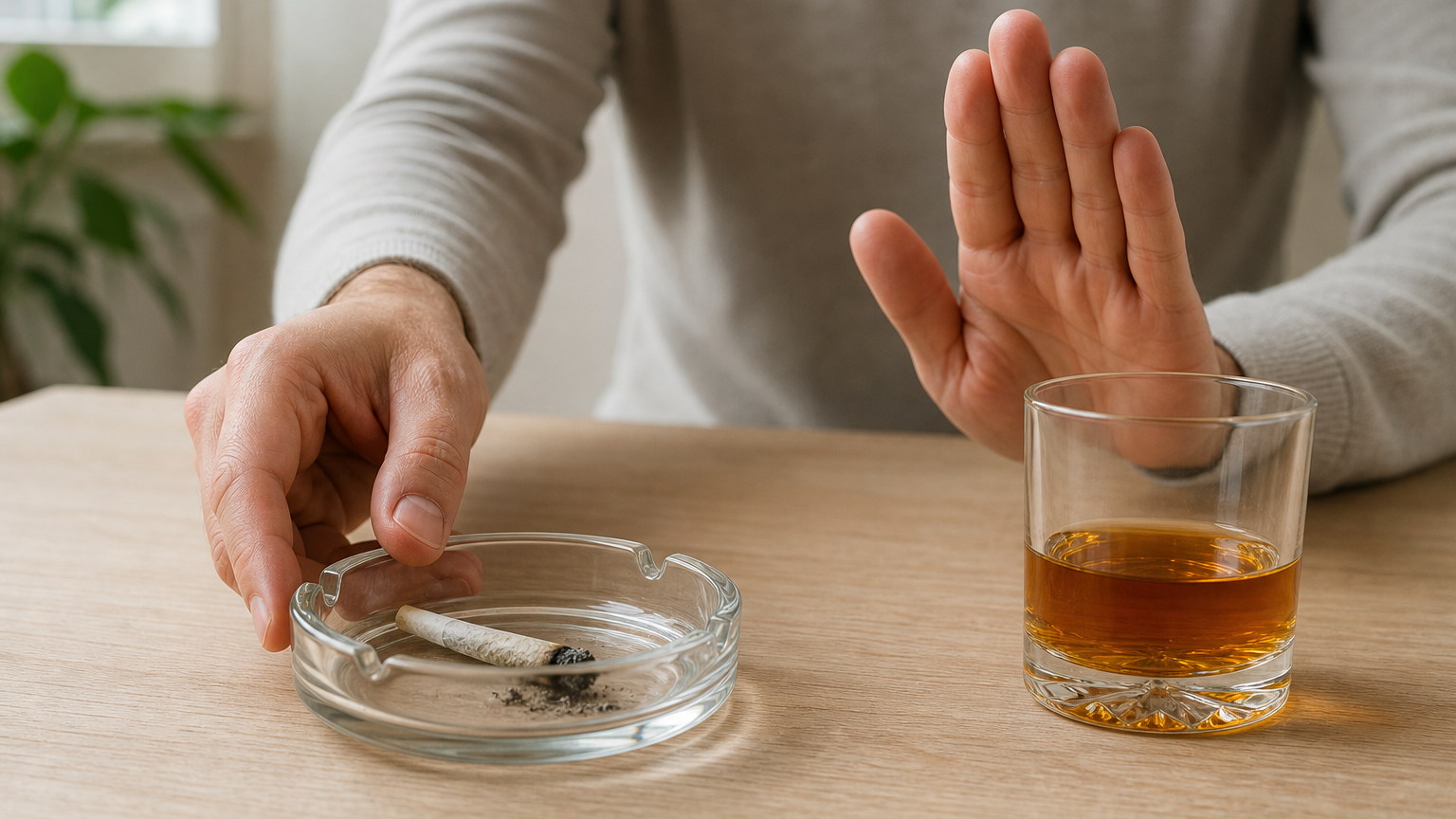
Getting sober from alcohol but leaning on weed? Here's how to reduce or quit cannabis too, manage sleep and withdrawal, and know when to get support.
Although it isn't a treatment for alcohol use disorder (AUD), the Reframe app can help you cut back on drinking gradually with the science-backed knowledge to empower you 100% of the way. Our proven program has helped millions of people around the world drink less and live more. And we want to help you get there, too!
The Reframe app equips you with the knowledge and skills you need to not only survive drinking less, but to thrive while you navigate the journey. Our daily research-backed readings teach you the neuroscience of alcohol, and our in-app Toolkit provides the resources and activities you need to navigate each challenge.
You'll meet millions of fellow Reframers in our 24/7 Forum chat and daily Zoom check-in meetings. Receive encouragement from people worldwide who know exactly what you're going through! You'll also have the opportunity to connect with our licensed Reframe coaches for more personalized guidance.
Plus, we're always introducing new features to optimize your in-app experience. We recently launched our in-app chatbot, Melody, powered by the world's most powerful AI technology. Melody is here to help as you adjust to a life with less (or no) alcohol.
And that's not all! Every month, we launch fun challenges, like Dry/Damp January, Mental Health May, and Outdoorsy June. You won't want to miss out on the chance to participate alongside fellow Reframers (or solo if that's more your thing!).
The Reframe app is free for 7 days, so you don't have anything to lose by trying it. Are you ready to feel empowered and discover life beyond alcohol? Then download our app through the App Store or Google Play today!
If you are getting sober from alcohol and now wondering about cannabis, the short answer is that reducing or quitting weed is often worth it, but it is its own process with its own timeline. Many people lean on cannabis to fill the space alcohol left behind, which is called cross-substitution, and it can quietly become a new dependence while masking the same patterns you set out to change. A gradual step-down, paired with a plan for sleep and cravings, usually works better than stopping both at once. Reframe can help you notice the role each substance plays and build habits that do not hinge on either one.
Here is the situation a lot of people find themselves in. You decided to stop drinking. Good. Maybe the first few weeks went better than expected. And then you noticed that the evening joint or the bedtime gummy had quietly taken over the slot that the second glass of wine used to fill. Now you are wondering whether that counts, whether it is a problem, and whether you need to do anything about it at all.
This is a how-to for someone already committed to alcohol sobriety, not a lecture about whether weed is good or bad. We are going to look at why cannabis tends to step in, whether it is safe, what it does to your sleep, how to taper if you decide to, and how to think about whether continued use counts as a relapse. We will keep it honest, including where the science is messier than the wellness internet wants it to be.
When you remove alcohol, your brain goes looking for the reward and relief it was getting from that drink, and cannabis is the most common thing that fills the gap. This is what people mean by cross-substitution: a new habit slides into the exact slot the old one vacated, often without you consciously deciding it should. It can feel like progress because you genuinely did stop drinking, while the underlying loop keeps spinning.
Alcohol was almost certainly doing several jobs for you at once. Winding down after work. Falling asleep. Smoothing out social awkwardness. Filling a boring Tuesday. When the drink disappears, those jobs do not. Cannabis is good at most of them, which is exactly why it steps in so easily and so quietly.
Cross-substitution, sometimes called transfer addiction, is the pattern of swapping one substance or behavior for another that scratches the same itch. It is worth saying clearly: this is a pattern worth watching for, not a guaranteed outcome of getting sober. Some people assume relapse simply migrates from one substance to the next, but the strongest population data is more reassuring than that. A longitudinal analysis using national survey data actually found that people who recovered from alcohol use disorder were less likely, not more, to start using opioids later, which is a useful reality check on the idea that your dependence has to go somewhere (NESARC longitudinal analysis). So treat cross-substitution as a real thing that happens to some people, worth noticing in yourself, rather than a fate you are doomed to.
A few honest tells: you reach for it at the same time you used to reach for a drink, the amount or frequency has crept up without much deliberation, and you would feel genuinely uneasy about going a few days without it. Tolerance and daily use can build faster than people expect, which is part of why the habit sneaks up.
The numbers are worth keeping in view, not to scare you but to calibrate. The CDC notes that roughly 3 in 10 people who use cannabis develop cannabis use disorder, with higher risk for those who start young or use more often (CDC). Looked at another way, cannabis use disorder develops in about 1 in 10 regular users and in as many as one-third of those who use daily (Nature Reviews Disease Primers). Those are two different slices of the population, so it is worth keeping them separate: one figure is for everyone who uses, the other is specifically for daily users, where the risk climbs.
Naming what alcohol was actually doing for you is the first real step. Once you can see the job, you can ask whether weed is doing the same job, and whether that is what you want. If you are not sure where your patterns stand, taking the What Type of Drinker Are You? quiz can be a useful nudge to look at the broader picture.
On the one risk that matters most in early alcohol recovery, cannabis is genuinely different from alcohol: it does not cause the dangerous physical withdrawal that heavy drinking can. Heavy alcohol withdrawal can progress to seizures and to delirium tremens, the most severe form, which is a medical emergency that can be life-threatening without treatment (StatPearls). Cannabis withdrawal, by contrast, is uncomfortable but not dangerous in that way. So no, weed is not a physical-safety risk on the seizure front.
That said, "not physically dangerous to stop" is not the same as "helpful to keep using." Relying on cannabis can stall the behavior change you are working on, and it can build its own dependence, as the disorder numbers above make clear. It also affects mood, motivation, and sleep in ways that can complicate the already-bumpy first months of sobriety.
Here is the line we want to draw clearly. Using cannabis to cope with alcohol withdrawal symptoms is a medical decision, not a self-help one. Delirium tremens is a severe, potentially life-threatening form of withdrawal that most often shows up within 48 to 96 hours of the last drink, though it can appear later, and warrants emergency care (MedlinePlus). Weed does not treat any of that, and leaning on it can mask symptoms you need a professional to see. If you have been drinking heavily or daily, talk to a clinician before changing your intake. A clinician can help you taper safely, and that is a kindness to yourself, not a sign that anything is wrong with you. This section is information, not a green light to manage withdrawal on your own.
If you want a non-emergency starting point for figuring out whether your drinking warrants professional support, the Am I Drinking Too Much? quiz is a low-stakes way to begin.
Quitting both at once is often harder, because you are removing two coping tools simultaneously, and the withdrawal from each can stack on top of the other. Cannabis withdrawal is a recognized syndrome whose most common features are anxiety, irritability, anger, disturbed sleep and dreaming, low mood, and reduced appetite (Addiction journal). Notice how much of that overlaps with what early alcohol recovery already throws at you. Hit both at once and the irritability and sleep disruption can compound.
There are two reasonable approaches, and neither is "the right one" in the abstract. Some people do better stabilizing their alcohol sobriety first and then tapering cannabis once the ground feels steadier. Others prefer a clean break from both precisely because it avoids the substitution trap, where weed simply inherits alcohol's old job and you never really change the pattern. Which one fits you depends on your dependence level, your support system, and your history. If your alcohol use was heavy, getting that handled safely with medical guidance comes first, and the cannabis question can wait a few weeks.
If you do take both on together, plan for a harder first one to two weeks. With cannabis, symptom onset typically comes within a day or two of stopping, and most symptoms peak within the first week before easing, though sleep and dream changes can linger longer in heavier users (Addiction journal). Knowing the shape of that curve helps. The discomfort is real, it is time-limited, and it is not a sign you are failing. Building in extra support during that window, whether that is people, structure, or a tool like Reframe's mindful drinking program, makes either path more doable.
Start with an honest baseline before you change anything: how often you use, how much, what time of day, and what triggers each session. Most people underestimate one of those four, and you cannot adjust a habit you have not actually looked at. Write it down for a week. The pattern usually tells you something you already half-knew.
From there, if you are a daily user, a gradual step-down generally works better than an abrupt stop. For each session you identify, name the specific need it meets, then line up a replacement before you cut it. Bedtime use that is really about sleep gets a wind-down routine. After-work use that is really about decompressing gets a walk, a few minutes of breathing, or a shower. The point is not willpower; it is having something ready in the slot so the absence does not just sit there.
Reduce the most automatic use first, which is often the bedtime or after-work session, because automatic habits are the easiest to swap and the ones running most on autopilot. Expect cravings to come in time-limited waves rather than as a constant state. A short toolkit for the peak moment, a glass of water, a five-minute task, a text to someone, a quick walk around the block, gets you past the spike, which usually passes faster than it feels like it will. Tracking and a little accountability keep the change visible, and visible progress is motivating in a way that vague intention is not. Some people find that putting the money saved toward something concrete, which you can map out with an alcohol spend calculator, gives the effort a satisfying receipt.
Yes, sleep usually improves, but typically after it gets worse first. When regular users cut back, the most reliable short-term effect is a wave of vivid, sometimes unsettling dreams and lighter, more broken sleep. Researchers describe this as a rebound: with chronic use, REM sleep appears suppressed, and when you stop, dreaming comes roaring back (Salon, interviewing cannabis researchers). It is worth being honest that the exact mechanism is less settled than rehab blogs imply; what is well documented is the dream rebound itself, with REM changes as the leading explanation rather than proven fact.
The timing is the catch. This rebound overlaps with the sleep disruption that is already common in early alcohol recovery, so the two can stack and make the first couple of weeks feel rough. The same researchers note that most withdrawal symptoms settle within a few weeks, while the effects on dreaming can linger a bit longer before fading (Salon). For most people, deeper and more restorative sleep returns as the brain readjusts.
Because this window is bumpy, practical sleep support matters more than ever. A consistent schedule, morning light, sensible caffeine timing, and an actual wind-down routine do real work here. Reframe's guides on improving sleep without alcohol cover the same ground in more depth. The single most useful thing to remember is that the rebound is temporary, which keeps you from reaching back for either substance just to force a night of rest.
Whether THC counts as a relapse depends entirely on the goal you set for yourself, so the honest first move is to define your own target clearly. If your commitment was specifically to stop drinking, then using cannabis is not an alcohol relapse, though it may be cross-substitution worth examining. If your framework was total abstinence or a fully sober lifestyle, continued THC use falls outside that goal. There is no universal scoreboard here; there is the line you drew, and whether you are still on the side of it you wanted.
And yes, quitting alcohol is absolutely still worth it even if you continue to use cannabis. Alcohol carries distinct and serious health risks; the World Health Organization has concluded that there is no safe level of alcohol consumption for health, with risk starting from the first drink (World Health Organization). Reducing or stopping it is meaningful progress on its own, and you do not have to have solved everything at once to have done something real. Many people make these changes in stages.
The more useful question than the relapse label is whether cannabis is genuinely helping you or quietly recreating the pattern you wanted to leave. A few signals suggest it is worth bringing in support: daily reliance, use that keeps escalating, using to cope with withdrawal, or cannabis sitting on top of a co-occurring mental health concern like anxiety or depression. None of those mean you have failed. They mean the situation has outgrown a willpower-and-checklist approach, and that a clinician or a structured program can help. If you decide you are ready to take that next step, you can download Reframe, and if you have practical questions about how the app works, Reframe's FAQ covers the basics.
If you are getting sober from alcohol and now wondering about cannabis, the short answer is that reducing or quitting weed is often worth it, but it is its own process with its own timeline. Many people lean on cannabis to fill the space alcohol left behind, which is called cross-substitution, and it can quietly become a new dependence while masking the same patterns you set out to change. A gradual step-down, paired with a plan for sleep and cravings, usually works better than stopping both at once. Reframe can help you notice the role each substance plays and build habits that do not hinge on either one.
Here is the situation a lot of people find themselves in. You decided to stop drinking. Good. Maybe the first few weeks went better than expected. And then you noticed that the evening joint or the bedtime gummy had quietly taken over the slot that the second glass of wine used to fill. Now you are wondering whether that counts, whether it is a problem, and whether you need to do anything about it at all.
This is a how-to for someone already committed to alcohol sobriety, not a lecture about whether weed is good or bad. We are going to look at why cannabis tends to step in, whether it is safe, what it does to your sleep, how to taper if you decide to, and how to think about whether continued use counts as a relapse. We will keep it honest, including where the science is messier than the wellness internet wants it to be.
When you remove alcohol, your brain goes looking for the reward and relief it was getting from that drink, and cannabis is the most common thing that fills the gap. This is what people mean by cross-substitution: a new habit slides into the exact slot the old one vacated, often without you consciously deciding it should. It can feel like progress because you genuinely did stop drinking, while the underlying loop keeps spinning.
Alcohol was almost certainly doing several jobs for you at once. Winding down after work. Falling asleep. Smoothing out social awkwardness. Filling a boring Tuesday. When the drink disappears, those jobs do not. Cannabis is good at most of them, which is exactly why it steps in so easily and so quietly.
Cross-substitution, sometimes called transfer addiction, is the pattern of swapping one substance or behavior for another that scratches the same itch. It is worth saying clearly: this is a pattern worth watching for, not a guaranteed outcome of getting sober. Some people assume relapse simply migrates from one substance to the next, but the strongest population data is more reassuring than that. A longitudinal analysis using national survey data actually found that people who recovered from alcohol use disorder were less likely, not more, to start using opioids later, which is a useful reality check on the idea that your dependence has to go somewhere (NESARC longitudinal analysis). So treat cross-substitution as a real thing that happens to some people, worth noticing in yourself, rather than a fate you are doomed to.
A few honest tells: you reach for it at the same time you used to reach for a drink, the amount or frequency has crept up without much deliberation, and you would feel genuinely uneasy about going a few days without it. Tolerance and daily use can build faster than people expect, which is part of why the habit sneaks up.
The numbers are worth keeping in view, not to scare you but to calibrate. The CDC notes that roughly 3 in 10 people who use cannabis develop cannabis use disorder, with higher risk for those who start young or use more often (CDC). Looked at another way, cannabis use disorder develops in about 1 in 10 regular users and in as many as one-third of those who use daily (Nature Reviews Disease Primers). Those are two different slices of the population, so it is worth keeping them separate: one figure is for everyone who uses, the other is specifically for daily users, where the risk climbs.
Naming what alcohol was actually doing for you is the first real step. Once you can see the job, you can ask whether weed is doing the same job, and whether that is what you want. If you are not sure where your patterns stand, taking the What Type of Drinker Are You? quiz can be a useful nudge to look at the broader picture.
On the one risk that matters most in early alcohol recovery, cannabis is genuinely different from alcohol: it does not cause the dangerous physical withdrawal that heavy drinking can. Heavy alcohol withdrawal can progress to seizures and to delirium tremens, the most severe form, which is a medical emergency that can be life-threatening without treatment (StatPearls). Cannabis withdrawal, by contrast, is uncomfortable but not dangerous in that way. So no, weed is not a physical-safety risk on the seizure front.
That said, "not physically dangerous to stop" is not the same as "helpful to keep using." Relying on cannabis can stall the behavior change you are working on, and it can build its own dependence, as the disorder numbers above make clear. It also affects mood, motivation, and sleep in ways that can complicate the already-bumpy first months of sobriety.
Here is the line we want to draw clearly. Using cannabis to cope with alcohol withdrawal symptoms is a medical decision, not a self-help one. Delirium tremens is a severe, potentially life-threatening form of withdrawal that most often shows up within 48 to 96 hours of the last drink, though it can appear later, and warrants emergency care (MedlinePlus). Weed does not treat any of that, and leaning on it can mask symptoms you need a professional to see. If you have been drinking heavily or daily, talk to a clinician before changing your intake. A clinician can help you taper safely, and that is a kindness to yourself, not a sign that anything is wrong with you. This section is information, not a green light to manage withdrawal on your own.
If you want a non-emergency starting point for figuring out whether your drinking warrants professional support, the Am I Drinking Too Much? quiz is a low-stakes way to begin.
Quitting both at once is often harder, because you are removing two coping tools simultaneously, and the withdrawal from each can stack on top of the other. Cannabis withdrawal is a recognized syndrome whose most common features are anxiety, irritability, anger, disturbed sleep and dreaming, low mood, and reduced appetite (Addiction journal). Notice how much of that overlaps with what early alcohol recovery already throws at you. Hit both at once and the irritability and sleep disruption can compound.
There are two reasonable approaches, and neither is "the right one" in the abstract. Some people do better stabilizing their alcohol sobriety first and then tapering cannabis once the ground feels steadier. Others prefer a clean break from both precisely because it avoids the substitution trap, where weed simply inherits alcohol's old job and you never really change the pattern. Which one fits you depends on your dependence level, your support system, and your history. If your alcohol use was heavy, getting that handled safely with medical guidance comes first, and the cannabis question can wait a few weeks.
If you do take both on together, plan for a harder first one to two weeks. With cannabis, symptom onset typically comes within a day or two of stopping, and most symptoms peak within the first week before easing, though sleep and dream changes can linger longer in heavier users (Addiction journal). Knowing the shape of that curve helps. The discomfort is real, it is time-limited, and it is not a sign you are failing. Building in extra support during that window, whether that is people, structure, or a tool like Reframe's mindful drinking program, makes either path more doable.
Start with an honest baseline before you change anything: how often you use, how much, what time of day, and what triggers each session. Most people underestimate one of those four, and you cannot adjust a habit you have not actually looked at. Write it down for a week. The pattern usually tells you something you already half-knew.
From there, if you are a daily user, a gradual step-down generally works better than an abrupt stop. For each session you identify, name the specific need it meets, then line up a replacement before you cut it. Bedtime use that is really about sleep gets a wind-down routine. After-work use that is really about decompressing gets a walk, a few minutes of breathing, or a shower. The point is not willpower; it is having something ready in the slot so the absence does not just sit there.
Reduce the most automatic use first, which is often the bedtime or after-work session, because automatic habits are the easiest to swap and the ones running most on autopilot. Expect cravings to come in time-limited waves rather than as a constant state. A short toolkit for the peak moment, a glass of water, a five-minute task, a text to someone, a quick walk around the block, gets you past the spike, which usually passes faster than it feels like it will. Tracking and a little accountability keep the change visible, and visible progress is motivating in a way that vague intention is not. Some people find that putting the money saved toward something concrete, which you can map out with an alcohol spend calculator, gives the effort a satisfying receipt.
Yes, sleep usually improves, but typically after it gets worse first. When regular users cut back, the most reliable short-term effect is a wave of vivid, sometimes unsettling dreams and lighter, more broken sleep. Researchers describe this as a rebound: with chronic use, REM sleep appears suppressed, and when you stop, dreaming comes roaring back (Salon, interviewing cannabis researchers). It is worth being honest that the exact mechanism is less settled than rehab blogs imply; what is well documented is the dream rebound itself, with REM changes as the leading explanation rather than proven fact.
The timing is the catch. This rebound overlaps with the sleep disruption that is already common in early alcohol recovery, so the two can stack and make the first couple of weeks feel rough. The same researchers note that most withdrawal symptoms settle within a few weeks, while the effects on dreaming can linger a bit longer before fading (Salon). For most people, deeper and more restorative sleep returns as the brain readjusts.
Because this window is bumpy, practical sleep support matters more than ever. A consistent schedule, morning light, sensible caffeine timing, and an actual wind-down routine do real work here. Reframe's guides on improving sleep without alcohol cover the same ground in more depth. The single most useful thing to remember is that the rebound is temporary, which keeps you from reaching back for either substance just to force a night of rest.
Whether THC counts as a relapse depends entirely on the goal you set for yourself, so the honest first move is to define your own target clearly. If your commitment was specifically to stop drinking, then using cannabis is not an alcohol relapse, though it may be cross-substitution worth examining. If your framework was total abstinence or a fully sober lifestyle, continued THC use falls outside that goal. There is no universal scoreboard here; there is the line you drew, and whether you are still on the side of it you wanted.
And yes, quitting alcohol is absolutely still worth it even if you continue to use cannabis. Alcohol carries distinct and serious health risks; the World Health Organization has concluded that there is no safe level of alcohol consumption for health, with risk starting from the first drink (World Health Organization). Reducing or stopping it is meaningful progress on its own, and you do not have to have solved everything at once to have done something real. Many people make these changes in stages.
The more useful question than the relapse label is whether cannabis is genuinely helping you or quietly recreating the pattern you wanted to leave. A few signals suggest it is worth bringing in support: daily reliance, use that keeps escalating, using to cope with withdrawal, or cannabis sitting on top of a co-occurring mental health concern like anxiety or depression. None of those mean you have failed. They mean the situation has outgrown a willpower-and-checklist approach, and that a clinician or a structured program can help. If you decide you are ready to take that next step, you can download Reframe, and if you have practical questions about how the app works, Reframe's FAQ covers the basics.

A guide to the best sobriety and recovery podcasts plus apps and audiobooks, what each covers, who they suit, and how much to listen to daily.
Although it isn't a treatment for alcohol use disorder (AUD), the Reframe app can help you cut back on drinking gradually with the science-backed knowledge to empower you 100% of the way. Our proven program has helped millions of people around the world drink less and live more. And we want to help you get there, too!
The Reframe app equips you with the knowledge and skills you need to not only survive drinking less, but to thrive while you navigate the journey. Our daily research-backed readings teach you the neuroscience of alcohol, and our in-app Toolkit provides the resources and activities you need to navigate each challenge.
You'll meet millions of fellow Reframers in our 24/7 Forum chat and daily Zoom check-in meetings. Receive encouragement from people worldwide who know exactly what you're going through! You'll also have the opportunity to connect with our licensed Reframe coaches for more personalized guidance.
Plus, we're always introducing new features to optimize your in-app experience. We recently launched our in-app chatbot, Melody, powered by the world's most powerful AI technology. Melody is here to help as you adjust to a life with less (or no) alcohol.
And that's not all! Every month, we launch fun challenges, like Dry/Damp January, Mental Health May, and Outdoorsy June. You won't want to miss out on the chance to participate alongside fellow Reframers (or solo if that's more your thing!).
The Reframe app is free for 7 days, so you don't have anything to lose by trying it. Are you ready to feel empowered and discover life beyond alcohol? Then download our app through the App Store or Google Play today!
Recovery podcasts are one of the most accessible, low-cost tools for changing your relationship with alcohol, and the best ones pair real recovery stories with practical, evidence-informed tools you can use the same day. Strong options fall into three buckets: personal-story shows, science-led shows, and coaching-style shows, so the right pick depends on whether you want connection, information, or actionable strategy. Listening helps most in small, consistent doses (often 15 to 30 minutes a day) layered alongside community, books, and an app that turns what you hear into daily habit change.
Let's talk honestly about how people actually change their drinking these days. It rarely happens in a single dramatic moment. It happens in the small, ordinary windows of a day, the commute, the dog walk, the 6 p.m. stretch when a craving shows up and you reach for headphones instead of a glass. That is where recovery podcasts earn their keep. They are free, private, and waiting on demand, and they meet you exactly when motivation runs thin.
This guide walks through what to listen to, who each type of show is for, and how to fold listening into a larger plan that actually moves the needle. We will keep podcasts at the center and treat apps and books as companions, not replacements. And because this topic brushes up against heavy drinking and withdrawal, we will be straight with you about the moments when audio is not enough and a real person needs to step in.
The most helpful recovery resources sort into three groups, and a strong plan borrows one from each: podcasts for daily motivation and connection, apps for structure like drink tracking and craving tools, and books or audiobooks for the deeper narrative a single episode can only sample. You do not need all three on day one. You need the one that fits the gap you feel most.
Recovery podcasts are the easiest entry point because the barrier is almost zero. They are free, portable, and judgment-free, which matters a lot when you are not ready to walk into a meeting or tell anyone you are rethinking your drinking. You press play and you are no longer alone with the thought. That accessibility is exactly why we treat podcasts as the hub of a recovery resource stack rather than a footnote.
Podcasts work in the cracks of a normal life. A meeting asks for a fixed hour and a place to be; a book asks you to sit still. A podcast asks for nothing but your ears, so it slots into the moments you already have. That on-demand quality is what makes a show useful during a craving, when timing matters more than depth. If you want a structured way to notice and shift those patterns over time, pairing a show with Reframe's neuroscience-based approach gives the insight somewhere to land.
The other quiet advantage is range. Some episodes lean toward moderation, some toward full abstinence, some toward the sober-curious middle, so you can find voices that match where you actually are instead of where a program assumes you should be. If you are not sure where you stand yet, a quick Am I Drinking Too Much? quiz is a low-pressure way to get oriented before you start queuing episodes.
Here is the honest limitation: a podcast can move you, but it cannot measure you. That is the job of an app. Drink tracking, daily lessons, craving tools, and community check-ins turn a flash of motivation into something you can see and repeat. The best apps to help you quit drinking do for your behavior what a fitness tracker does for your steps: they make the invisible visible, so a good idea from an episode becomes a tracked action instead of a nice thought you forgot by dinner.
Books and audiobooks fill a different gap. A 30-minute episode samples an arc; a book gives you the whole thing, the slow build, the relapse, the recovery, the reckoning. When you want depth rather than a quick hit, a list of the best sober books is a better next step than another podcast. Self-assessments and calculators round out the toolkit by making the stakes concrete. Seeing your numbers, what you spend or how many calories you pour, can be quietly motivating in a way no host can replicate.
When you mostly need to feel less alone, story-led shows win. These are the long-form interview podcasts built around lived experience, where guests walk through what their drinking looked like, what cracked it open, and what specifically helped them change. The value is not advice; it is recognition. Hearing someone describe your exact 9 p.m. ritual, out loud, on a recording, can do more than a stack of statistics.
This archetype usually features a rotating cast of guests across the full spectrum of paths, moderation, abstinence, and sober-curious experiments. The variety is the point. You are listening for the one guest whose triggers, job, family situation, or turning point mirrors yours closely enough that their proof of change becomes your permission to try. These sobriety podcasts are especially powerful early on, when the loudest voice in your head is the one insisting that people like you do not actually change.
To use story shows well, queue them with intention rather than at random. If weekend evenings are your hard window, line up an episode whose guest struggled in that same window and save it for Friday at 6. The point is to have the right voice ready before the craving arrives, not to scroll for one while it builds. Building a wider support network in sobriety works the same way: connection is most useful when it is already in place. One caution worth naming: stories inspire, but they are not prescriptions. What worked for a guest is a clue, not a protocol, so pair the connection these shows give you with a structured tool that turns feeling into action.
If understanding the mechanism is what makes change feel possible for you, reach for science-led shows. These podcasts unpack the neuroscience of cravings, the psychology of habit, and what the evidence actually says about cutting back versus quitting, often hosted by or featuring clinicians and researchers. For analytical listeners, the lightbulb moment is not a pep talk; it is finally understanding why the urge feels the way it does.
A lot of that understanding starts with dopamine. Alcohol prompts the brain's reward circuitry to release dopamine, and according to the National Institute on Alcohol Abuse and Alcoholism, dopamine helps the brain link alcohol and its cues, the people, places, and things around drinking, to alcohol's rewarding effects, which is a big part of why cravings fire on cue. Once you know a craving is a learned association rather than a personal failing, you can treat it like a circuit to retrain instead of a verdict on your character.
Sleep is another favorite topic of these shows, and for good reason. A review published in the journal Alcohol found that while alcohol can help you fall asleep faster, it disrupts sleep in the second half of the night, and people who drink heavily commonly deal with poor sleep quality and insomnia. That single mechanism explains a lot of 3 a.m. wakeups, and it tends to land harder than a generic "drink less" because it connects to something you actually feel the next day.
The practical move with science shows is to pick one mechanism per week and apply it to a real situation, rather than collecting facts you never use. Learn how cravings spike, then watch for your own spike on Friday and name it. Because Reframe's mindful drinking program is itself built on neuroscience, these shows pair naturally with the app, the episode explains the why and the app gives you a place to practice the what.
For listeners who want steps rather than stories or theory, coaching-style shows deliver. These tend to run shorter and more actionable, scripts for saying no at a party, urge-surfing techniques, plans for navigating a wedding or a stressful week. The whole episode often orbits a single takeaway you are meant to try before the next one drops. If you have moved past the earliest days and now want durable habits, this is your lane.
Who benefits most? People who are ready to build and handle social pressure, not just survive a craving. A coaching show treats you as someone with agency and homework, which can be exactly the nudge you need when the novelty of cutting back wears off and the real work of new routines begins. For the social side specifically, having a few rehearsed excuses to not drink ready in your pocket turns an awkward moment into a non-event.
The way to get value here is to treat each episode as a micro-assignment. Listen, pick the one tactic, try it in a real situation this week, and then judge whether it worked for you. That last part matters: insight you never test is just entertainment. Pairing these shows with drink tracking and goal setting lets you measure what is actually moving the needle, and noticing which common triggers keep tripping you makes each coaching tactic easier to aim. Over time you end up with a small, personal playbook of moves you know work, because you have the data to prove it.
The cleanest way to think about it: podcasts supply motivation and ideas, while apps and books supply structure and depth. Audio gets you fired up and gives you something to try; the other tools make sure that energy turns into measured, repeatable change instead of evaporating by Thursday. A resource you do not act on is just content, and the companions are what convert listening into doing.
Resist the urge to download everything at once. The fastest route to overwhelm is twelve apps, six podcasts, and a reading list you will never finish. A better starter stack is one podcast, one app, and one book at a time. The podcast handles daily motivation, the app handles tracking and craving tools and 24/7 community, and the book handles the deeper narrative arc when you want to sit with the subject. If you want to see how others have built that kind of layered support, the range of online support for alcohol challenges shows there is no single right combination, just the one you will actually use.
The app is the load-bearing piece because it is the only tool that remembers. It logs your drinks, serves a daily lesson, and gives you something to reach for the moment a craving hits, which is precisely when a podcast episode is too slow to cue up. When you are ready, you can download Reframe and let it carry the structure so your listening stays about inspiration.
Before you stack anything, it helps to know what you are actually working with. Quizzes and self-assessments give you a quick read on your patterns so you can pick the right depth of resource instead of guessing. A What Type of Drinker Are You? quiz can surface the personality and situational factors driving your drinking, which then makes it obvious whether you need connection, science, or coaching first.
Calculators make the cost concrete in a way that motivates without moralizing. Running your numbers through an alcohol spend calculator often produces a figure that genuinely surprises people, and seeing what drinking costs in dollars per year reframes the whole project. If physical health is your lever, an alcohol calorie calculator does the same trick for weight and energy. None of this is about guilt; it is about giving your motivation something real to hold onto between episodes. Personal-development reading pairs well here too, and the case for reading personal development books in recovery is essentially the same as the case for self-assessment: the more clearly you see yourself, the better your choices get.
Most people benefit most from a consistent 15 to 30 minutes a day rather than occasional long binges. Small, regular reinforcement supports habit change better than a marathon session you cannot sustain, the same way a short daily walk beats one exhausting hike a month. The goal is a rhythm you can keep, not a streak you will break.
Consistency wins because habits are built by repetition, not intensity. A focused 20-minute episode that you actually finish most days will outpace a three-hour binge you do once and never repeat. The trick is to anchor your listening to something you already do, the commute, the dog walk, the dishes, so it costs no extra time and does not become one more thing to schedule. When a habit rides on the back of an existing routine, it tends to stick on its own.
Early recovery may call for a little more, especially during high-craving windows like evenings and weekends. That is fine. If a longer stretch of audio gets you through a Saturday night that used to belong to drinking, the extra time is well spent. As things stabilize, most people naturally settle back toward that steady daily dose. The amount is less important than the consistency, and learning to stop alcohol cravings in the moment matters more than logging hours of listening.
There is a failure mode worth watching for: passively listening all day can quietly become avoidance rather than progress. If you have heard forty episodes this month but changed nothing about Friday, the podcast has become a way to feel productive about your drinking without actually addressing it. That is not a character flaw, it is just a sign the balance has tipped too far toward input.
The fix is simple and a little annoying: pair every session with one small thing you actually do. Hear a tactic, try the tactic. Hear a craving tool, use it the next time a craving shows up. The point of input is to drive output, and a single applied idea beats ten unapplied ones. If you find yourself reaching for episodes the way you used to reach for a drink, that is useful information too, and worth bringing to the structure an app or a mindful drinking practice provides.
Here is the part we will not soften: podcasts are a companion to recovery, not a substitute for medical care. For most people rethinking their drinking, audio plus an app plus community is a genuinely strong toolkit. But if you are drinking heavily every day, the situation changes, because the body's response to stopping can become a medical issue rather than a willpower one.
Quitting cold turkey after sustained heavy drinking can be dangerous. According to the National Institute on Alcohol Abuse and Alcoholism, heavy drinkers who suddenly stop or sharply cut back can experience alcohol withdrawal, whose most severe forms include seizures and delirium tremens and can be life-threatening. That is not a reason to keep drinking; it is a reason to involve a clinician in how you stop. Tapering or detox decisions are medical decisions, and a clinician can help you do it safely.
Timing matters here, which is why this is a medical call and not a self-help one. Cleveland Clinic notes that withdrawal can develop after more than two weeks of heavy drinking, with symptoms typically peaking 24 to 72 hours after the last drink and seizure risk highest around 24 to 48 hours. Those windows are exactly when professional supervision is most valuable, and exactly why a podcast, however good, cannot be your plan if you are physically dependent.
Know the red flags. If you notice shakes, sweats, severe anxiety, or seizures when you are not drinking, treat that as a medical emergency, not a willpower problem. MedlinePlus, from the U.S. National Library of Medicine, describes seizures and signs of delirium tremens as a life-threatening emergency that warrant calling 911 or going to the emergency room. There is no podcast for that moment, only a phone and a doctor.
Beyond emergencies, plenty of real support exists for the long haul: support groups, counseling, telehealth, and structured programs that can sit alongside everything you are listening to and reading. Reaching out for that help is a strength, not a failure. The most durable recoveries we see tend to be the ones that combine accessible daily tools, recovery podcasts very much included, with real human support when the stakes get high.
Recovery podcasts are one of the most accessible, low-cost tools for changing your relationship with alcohol, and the best ones pair real recovery stories with practical, evidence-informed tools you can use the same day. Strong options fall into three buckets: personal-story shows, science-led shows, and coaching-style shows, so the right pick depends on whether you want connection, information, or actionable strategy. Listening helps most in small, consistent doses (often 15 to 30 minutes a day) layered alongside community, books, and an app that turns what you hear into daily habit change.
Let's talk honestly about how people actually change their drinking these days. It rarely happens in a single dramatic moment. It happens in the small, ordinary windows of a day, the commute, the dog walk, the 6 p.m. stretch when a craving shows up and you reach for headphones instead of a glass. That is where recovery podcasts earn their keep. They are free, private, and waiting on demand, and they meet you exactly when motivation runs thin.
This guide walks through what to listen to, who each type of show is for, and how to fold listening into a larger plan that actually moves the needle. We will keep podcasts at the center and treat apps and books as companions, not replacements. And because this topic brushes up against heavy drinking and withdrawal, we will be straight with you about the moments when audio is not enough and a real person needs to step in.
The most helpful recovery resources sort into three groups, and a strong plan borrows one from each: podcasts for daily motivation and connection, apps for structure like drink tracking and craving tools, and books or audiobooks for the deeper narrative a single episode can only sample. You do not need all three on day one. You need the one that fits the gap you feel most.
Recovery podcasts are the easiest entry point because the barrier is almost zero. They are free, portable, and judgment-free, which matters a lot when you are not ready to walk into a meeting or tell anyone you are rethinking your drinking. You press play and you are no longer alone with the thought. That accessibility is exactly why we treat podcasts as the hub of a recovery resource stack rather than a footnote.
Podcasts work in the cracks of a normal life. A meeting asks for a fixed hour and a place to be; a book asks you to sit still. A podcast asks for nothing but your ears, so it slots into the moments you already have. That on-demand quality is what makes a show useful during a craving, when timing matters more than depth. If you want a structured way to notice and shift those patterns over time, pairing a show with Reframe's neuroscience-based approach gives the insight somewhere to land.
The other quiet advantage is range. Some episodes lean toward moderation, some toward full abstinence, some toward the sober-curious middle, so you can find voices that match where you actually are instead of where a program assumes you should be. If you are not sure where you stand yet, a quick Am I Drinking Too Much? quiz is a low-pressure way to get oriented before you start queuing episodes.
Here is the honest limitation: a podcast can move you, but it cannot measure you. That is the job of an app. Drink tracking, daily lessons, craving tools, and community check-ins turn a flash of motivation into something you can see and repeat. The best apps to help you quit drinking do for your behavior what a fitness tracker does for your steps: they make the invisible visible, so a good idea from an episode becomes a tracked action instead of a nice thought you forgot by dinner.
Books and audiobooks fill a different gap. A 30-minute episode samples an arc; a book gives you the whole thing, the slow build, the relapse, the recovery, the reckoning. When you want depth rather than a quick hit, a list of the best sober books is a better next step than another podcast. Self-assessments and calculators round out the toolkit by making the stakes concrete. Seeing your numbers, what you spend or how many calories you pour, can be quietly motivating in a way no host can replicate.
When you mostly need to feel less alone, story-led shows win. These are the long-form interview podcasts built around lived experience, where guests walk through what their drinking looked like, what cracked it open, and what specifically helped them change. The value is not advice; it is recognition. Hearing someone describe your exact 9 p.m. ritual, out loud, on a recording, can do more than a stack of statistics.
This archetype usually features a rotating cast of guests across the full spectrum of paths, moderation, abstinence, and sober-curious experiments. The variety is the point. You are listening for the one guest whose triggers, job, family situation, or turning point mirrors yours closely enough that their proof of change becomes your permission to try. These sobriety podcasts are especially powerful early on, when the loudest voice in your head is the one insisting that people like you do not actually change.
To use story shows well, queue them with intention rather than at random. If weekend evenings are your hard window, line up an episode whose guest struggled in that same window and save it for Friday at 6. The point is to have the right voice ready before the craving arrives, not to scroll for one while it builds. Building a wider support network in sobriety works the same way: connection is most useful when it is already in place. One caution worth naming: stories inspire, but they are not prescriptions. What worked for a guest is a clue, not a protocol, so pair the connection these shows give you with a structured tool that turns feeling into action.
If understanding the mechanism is what makes change feel possible for you, reach for science-led shows. These podcasts unpack the neuroscience of cravings, the psychology of habit, and what the evidence actually says about cutting back versus quitting, often hosted by or featuring clinicians and researchers. For analytical listeners, the lightbulb moment is not a pep talk; it is finally understanding why the urge feels the way it does.
A lot of that understanding starts with dopamine. Alcohol prompts the brain's reward circuitry to release dopamine, and according to the National Institute on Alcohol Abuse and Alcoholism, dopamine helps the brain link alcohol and its cues, the people, places, and things around drinking, to alcohol's rewarding effects, which is a big part of why cravings fire on cue. Once you know a craving is a learned association rather than a personal failing, you can treat it like a circuit to retrain instead of a verdict on your character.
Sleep is another favorite topic of these shows, and for good reason. A review published in the journal Alcohol found that while alcohol can help you fall asleep faster, it disrupts sleep in the second half of the night, and people who drink heavily commonly deal with poor sleep quality and insomnia. That single mechanism explains a lot of 3 a.m. wakeups, and it tends to land harder than a generic "drink less" because it connects to something you actually feel the next day.
The practical move with science shows is to pick one mechanism per week and apply it to a real situation, rather than collecting facts you never use. Learn how cravings spike, then watch for your own spike on Friday and name it. Because Reframe's mindful drinking program is itself built on neuroscience, these shows pair naturally with the app, the episode explains the why and the app gives you a place to practice the what.
For listeners who want steps rather than stories or theory, coaching-style shows deliver. These tend to run shorter and more actionable, scripts for saying no at a party, urge-surfing techniques, plans for navigating a wedding or a stressful week. The whole episode often orbits a single takeaway you are meant to try before the next one drops. If you have moved past the earliest days and now want durable habits, this is your lane.
Who benefits most? People who are ready to build and handle social pressure, not just survive a craving. A coaching show treats you as someone with agency and homework, which can be exactly the nudge you need when the novelty of cutting back wears off and the real work of new routines begins. For the social side specifically, having a few rehearsed excuses to not drink ready in your pocket turns an awkward moment into a non-event.
The way to get value here is to treat each episode as a micro-assignment. Listen, pick the one tactic, try it in a real situation this week, and then judge whether it worked for you. That last part matters: insight you never test is just entertainment. Pairing these shows with drink tracking and goal setting lets you measure what is actually moving the needle, and noticing which common triggers keep tripping you makes each coaching tactic easier to aim. Over time you end up with a small, personal playbook of moves you know work, because you have the data to prove it.
The cleanest way to think about it: podcasts supply motivation and ideas, while apps and books supply structure and depth. Audio gets you fired up and gives you something to try; the other tools make sure that energy turns into measured, repeatable change instead of evaporating by Thursday. A resource you do not act on is just content, and the companions are what convert listening into doing.
Resist the urge to download everything at once. The fastest route to overwhelm is twelve apps, six podcasts, and a reading list you will never finish. A better starter stack is one podcast, one app, and one book at a time. The podcast handles daily motivation, the app handles tracking and craving tools and 24/7 community, and the book handles the deeper narrative arc when you want to sit with the subject. If you want to see how others have built that kind of layered support, the range of online support for alcohol challenges shows there is no single right combination, just the one you will actually use.
The app is the load-bearing piece because it is the only tool that remembers. It logs your drinks, serves a daily lesson, and gives you something to reach for the moment a craving hits, which is precisely when a podcast episode is too slow to cue up. When you are ready, you can download Reframe and let it carry the structure so your listening stays about inspiration.
Before you stack anything, it helps to know what you are actually working with. Quizzes and self-assessments give you a quick read on your patterns so you can pick the right depth of resource instead of guessing. A What Type of Drinker Are You? quiz can surface the personality and situational factors driving your drinking, which then makes it obvious whether you need connection, science, or coaching first.
Calculators make the cost concrete in a way that motivates without moralizing. Running your numbers through an alcohol spend calculator often produces a figure that genuinely surprises people, and seeing what drinking costs in dollars per year reframes the whole project. If physical health is your lever, an alcohol calorie calculator does the same trick for weight and energy. None of this is about guilt; it is about giving your motivation something real to hold onto between episodes. Personal-development reading pairs well here too, and the case for reading personal development books in recovery is essentially the same as the case for self-assessment: the more clearly you see yourself, the better your choices get.
Most people benefit most from a consistent 15 to 30 minutes a day rather than occasional long binges. Small, regular reinforcement supports habit change better than a marathon session you cannot sustain, the same way a short daily walk beats one exhausting hike a month. The goal is a rhythm you can keep, not a streak you will break.
Consistency wins because habits are built by repetition, not intensity. A focused 20-minute episode that you actually finish most days will outpace a three-hour binge you do once and never repeat. The trick is to anchor your listening to something you already do, the commute, the dog walk, the dishes, so it costs no extra time and does not become one more thing to schedule. When a habit rides on the back of an existing routine, it tends to stick on its own.
Early recovery may call for a little more, especially during high-craving windows like evenings and weekends. That is fine. If a longer stretch of audio gets you through a Saturday night that used to belong to drinking, the extra time is well spent. As things stabilize, most people naturally settle back toward that steady daily dose. The amount is less important than the consistency, and learning to stop alcohol cravings in the moment matters more than logging hours of listening.
There is a failure mode worth watching for: passively listening all day can quietly become avoidance rather than progress. If you have heard forty episodes this month but changed nothing about Friday, the podcast has become a way to feel productive about your drinking without actually addressing it. That is not a character flaw, it is just a sign the balance has tipped too far toward input.
The fix is simple and a little annoying: pair every session with one small thing you actually do. Hear a tactic, try the tactic. Hear a craving tool, use it the next time a craving shows up. The point of input is to drive output, and a single applied idea beats ten unapplied ones. If you find yourself reaching for episodes the way you used to reach for a drink, that is useful information too, and worth bringing to the structure an app or a mindful drinking practice provides.
Here is the part we will not soften: podcasts are a companion to recovery, not a substitute for medical care. For most people rethinking their drinking, audio plus an app plus community is a genuinely strong toolkit. But if you are drinking heavily every day, the situation changes, because the body's response to stopping can become a medical issue rather than a willpower one.
Quitting cold turkey after sustained heavy drinking can be dangerous. According to the National Institute on Alcohol Abuse and Alcoholism, heavy drinkers who suddenly stop or sharply cut back can experience alcohol withdrawal, whose most severe forms include seizures and delirium tremens and can be life-threatening. That is not a reason to keep drinking; it is a reason to involve a clinician in how you stop. Tapering or detox decisions are medical decisions, and a clinician can help you do it safely.
Timing matters here, which is why this is a medical call and not a self-help one. Cleveland Clinic notes that withdrawal can develop after more than two weeks of heavy drinking, with symptoms typically peaking 24 to 72 hours after the last drink and seizure risk highest around 24 to 48 hours. Those windows are exactly when professional supervision is most valuable, and exactly why a podcast, however good, cannot be your plan if you are physically dependent.
Know the red flags. If you notice shakes, sweats, severe anxiety, or seizures when you are not drinking, treat that as a medical emergency, not a willpower problem. MedlinePlus, from the U.S. National Library of Medicine, describes seizures and signs of delirium tremens as a life-threatening emergency that warrant calling 911 or going to the emergency room. There is no podcast for that moment, only a phone and a doctor.
Beyond emergencies, plenty of real support exists for the long haul: support groups, counseling, telehealth, and structured programs that can sit alongside everything you are listening to and reading. Reaching out for that help is a strength, not a failure. The most durable recoveries we see tend to be the ones that combine accessible daily tools, recovery podcasts very much included, with real human support when the stakes get high.
.png)
How to know you've internalized the habit change enough to taper off your alcohol reduction app, the markers to watch, and when to re-engage support.
Although it isn't a treatment for alcohol use disorder (AUD), the Reframe app can help you cut back on drinking gradually with the science-backed knowledge to empower you 100% of the way. Our proven program has helped millions of people around the world drink less and live more. And we want to help you get there, too!
The Reframe app equips you with the knowledge and skills you need to not only survive drinking less, but to thrive while you navigate the journey. Our daily research-backed readings teach you the neuroscience of alcohol, and our in-app Toolkit provides the resources and activities you need to navigate each challenge.
You'll meet millions of fellow Reframers in our 24/7 Forum chat and daily Zoom check-in meetings. Receive encouragement from people worldwide who know exactly what you're going through! You'll also have the opportunity to connect with our licensed Reframe coaches for more personalized guidance.
Plus, we're always introducing new features to optimize your in-app experience. We recently launched our in-app chatbot, Melody, powered by the world's most powerful AI technology. Melody is here to help as you adjust to a life with less (or no) alcohol.
And that's not all! Every month, we launch fun challenges, like Dry/Damp January, Mental Health May, and Outdoorsy June. You won't want to miss out on the chance to participate alongside fellow Reframers (or solo if that's more your thing!).
The Reframe app is free for 7 days, so you don't have anything to lose by trying it. Are you ready to feel empowered and discover life beyond alcohol? Then download our app through the App Store or Google Play today!
There is no fixed day to stop using an alcohol reduction app, but the readiness markers are concrete: cravings have dropped to occasional and manageable, refusing a drink feels automatic rather than effortful, and your evenings and social routines no longer hinge on logging or in-app prompts. The smart move is to taper your reliance gradually, from daily check-ins to weekly to as-needed, rather than deleting the app overnight, so support stays one tap away if old patterns resurface. Reframe is built to grow quieter in your life as your new habits take over, not to keep you dependent on it forever.
Here is the thing nobody tells you when you download a quit-drinking app: the goal is to need it less. A good tool earns its place by becoming optional. So if you have hit a milestone and you are wondering whether you have outgrown the daily nudges, that question is itself a sign of progress. Let's talk honestly about how to know when you are ready, how to step down without losing your footing, and how to keep the structure that got you here even after the app fades into the background.
This is a maintenance question, not a beginner's question. We are going to stay scoped to the graduation decision: when to taper, what readiness actually looks like, and what to do if old patterns knock on the door again.
Yes, plenty of people keep using a reduction app well past their early milestones, but the way they use it usually shifts from active daily coaching to lighter, as-needed maintenance. Dropping daily logging while holding onto milestone tracking, community, or the occasional craving tool is common and healthy. Continuing to use an app is not a sign of dependence; it is closer to keeping a gym membership after you are already fit.
The pattern most people settle into is light-touch. Behavior change consolidates over months, not days, so it makes sense that ongoing gentle use through the first year is both common and reasonable. One reason apps help at all is that they bundle several active ingredients. Researchers who built and tested the Drink Less app included modules like self-monitoring and feedback, action planning, identity change, normative feedback, and cognitive bias re-training. As you graduate, you naturally drop the daily data entry and keep the features tied to identity and meaning: your streak, your community, the tool you reach for on a hard night.
Not at all. We get this worry a lot, and it usually comes from a sneaky assumption that real change should feel like total independence from any structure. But nobody applies that logic to a calendar, a budgeting app, or a meal-planning habit. Keeping a tool around because it makes life easier is maturity, not weakness. The healthier question is not whether to keep the app but at what intensity to use it as your needs change. If you want a feel for which patterns still apply to you, the What Type of Drinker Are You? quiz can help you re-check where you stand before you decide to dial things down.
A plateau almost always means a specific trigger, routine, or belief has not been addressed yet, not that the app is broken. Apps support behavior change; they do not perform it. So passive logging without acting on the insights tends to stall. The fix is usually to revisit your triggers, tighten a vague goal into a specific weekly target, and engage the active tools instead of only tracking.
Here is where a lot of well-intentioned effort quietly leaks away. Tracking your drinks is useful, but tracking is a thermometer, not a treatment. Digital tools produce real but modest results: a Cochrane review of 40 randomized trials found they cut consumption by around 23.6 grams of alcohol (roughly 2.95 UK units) per week compared with controls. Meaningful, but modest, and that "modest" is the whole point. The app supplies the scaffolding; you still have to change the routine that surrounds the drink. If you log every glass of wine but never touch the 6pm habit loop that produces the glass, the number on your dashboard will not move much. Reframe's mindful drinking program is designed around acting on what tracking reveals, not just collecting the data.
Sometimes the stall is not about a missed routine. It is an unexamined emotional trigger, or a goal so vague your brain cannot act on it ("drink less" gives you nothing to do on a Tuesday). Tighten it into something specific and weekly. Rather than re-listing craving and trigger tactics we have covered elsewhere, it is worth pointing you to dedicated resources: our guide on understanding your triggers for drinking and our walkthrough on how to stop alcohol cravings go deeper than we can here. And when genuine effort still produces no change, that persistence can signal a need for clinical or therapeutic support beyond any app. A clinician or therapist can help you find what an app cannot reach.
The clearest markers are low, manageable craving frequency, automatic refusal scripts, and social routines that no longer depend on the app. When those three hold steady for several weeks, you have likely moved the new behavior from something you do to something you are. Internalization is less a finish line and more a change in how effortful the whole thing feels.
Think back to your early weeks. Cravings probably arrived often and hit hard. Internalization shows up when those urges have shrunk to occasional and easy to ride out, the kind you notice and let pass without a fight. You can also name your top triggers and already have responses ready for them, without opening the app to check. That fluency, knowing your patterns cold, is one of the most reliable signs the change has taken root.
Saying no to a drink used to be a deliberate battle you had to win each evening. Now it feels like a reflex, closer to declining a second slice of cake than wrestling a temptation. Your evenings, weekends, and social events have stable alcohol-free defaults you do not have to plan around. And the deepest marker is identity: you think of yourself as someone who drinks little or not at all, rather than someone forcing abstinence. That identity shift is exactly the kind of mechanism researchers built into apps as a distinct intervention component. For setting the kind of crisp targets that make this shift measurable, our piece on effective goals to stop drinking pairs well with this stage.
Begin tapering once your internalization markers (low, manageable cravings, automatic refusal, stable alcohol-free routines) have held steady for several weeks and you are not in a high-risk life season. Step down gradually rather than quitting cold, keep one lightweight anchor, and set a clear re-engagement plan first so returning to support is frictionless. Treat the taper as a reversible experiment, not a one-way exit.
Here is the practical cadence we recommend at Reframe. This is our maintenance guidance, not a research formula, so hold it loosely and adjust to your own life. Start with daily check-ins. When those feel routine and easy, move to a few times a week. Then weekly. Then as-needed. Spread that progression over weeks, not days. The "wait for several stable weeks" timing has real grounding, since habit automaticity builds along a gradual curve that plateaus over roughly a couple of months, and missing the occasional repetition does not seriously derail it. Throughout the taper, keep one lightweight anchor, a weekly self-review or a periodic check-in, so you never go fully dark. A quick pulse-check like the Am I Drinking Too Much? quiz makes a clean recurring anchor.
Timing matters more than the calendar date. Do not taper during a major stressor, a big stretch of social events, or right after a slip. Wait for a stable window where life is reasonably calm. Before you reduce anything, write down your re-engagement plan: the exact steps you will take to turn support back up if you need it. Having that plan in place ahead of time makes returning frictionless, and the act of pre-committing to a specific "if this, then that" response is one of the better-supported moves in behavior change. If questions come up about how features work as you step down, Reframe's FAQ is a good reference. Treat the whole taper as an experiment you can reverse, because that is exactly what it is.
Most people do not sustain a resolution through the whole year, though the figures vary quite a bit by study. In one large experiment, 77% were on track after one week, but only 55% at one month, 43% at three months, 40% at six months, and 19% at two years. The headline is not that people are weak. It is that change held up by willpower alone tends to decay, while change backed by structure and a real plan holds up far better.
The decline curve above tells an honest story: a strong start, then a steady fade. Notice that the drop is not a cliff on January 8th. It is a slope. Resolutions framed as pure motivation run out of fuel because motivation is a feeling, and feelings are not a plan. This is precisely why we keep harping on tapering gradually instead of abandoning support the moment a milestone arrives. The people still standing at month six did not white-knuckle harder. They had scaffolding.
Method beats motivation, and the data backs that up. In a classic longitudinal study, people who made a resolution were dramatically more likely to succeed than people who wanted the same change but made no resolution, about 46% versus 4% still successful at six months, and the gap tracked with concrete strategies like stimulus control rather than sheer determination. What distinguishes sustainers is a specific plan, accountability, addressed triggers, and a shifted identity. None of those are about feeling more inspired. They are about building an environment and a routine that make the new behavior the path of least resistance. If part of your motivation is practical, seeing what you have reclaimed can help: the alcohol spend calculator makes the savings concrete in a way a vague intention never will.
Re-engage active app or support use the moment early warning signs appear, before a slip becomes a pattern. The signs show up well ahead of any actual drinking: rising craving frequency, romanticizing past drinking, skipping the routines that replaced it, and pulling away from accountability. Turning support back up at the first signal is a planned maintenance move, not a failure.
Relapse is best understood as a gradual process, not a sudden event. Clinicians often describe it unfolding in stages, and the emotional and mental warning signs tend to appear long before a drink does. Emotional-stage signs include isolating yourself, skipping your support routines, and slipping on sleep and self-care. Mental-stage signs include cravings creeping back, dwelling on the people and places tied to old drinking, exaggerating how good the past felt, and quietly planning ways it might happen. The value of naming these is that they give you a chance to act early. A single slip, if it happens, is data, not a verdict, and the research on habit formation is reassuring here too: one missed repetition does not meaningfully derail the larger pattern you have built. The fast, shame-free response is to lean back into structure.
Some periods deserve proactive support even when you feel fine. Holidays, grief, a job loss, heavy travel, these are the seasons that quietly raise risk, and the smart move is to turn support back up before any symptom shows. We go deep on this in our guide to building a strong relapse prevention plan, which is the right place to map your specifics. Keep your re-engagement steps written down so you can act in minutes, not days. Returning to active use after a high-risk stretch or a slip is not a reset to zero. It is exactly what a good maintenance plan looks like in action.
Replace the app's daily structure with a small set of durable habits so accountability does not vanish when daily use does. Name a check-in person, keep a recurring ritual like a weekly self-review, protect the routines that replaced drinking, and schedule occasional app check-ins as tune-ups. The point is to keep the scaffolding even as the most active piece falls away.
The single most durable swap is a human one. Name a check-in partner or a peer group who knows your goal and will actually ask you about it. We lean hard on this because connection outlasts any feature set, and our guide to building a support network for sobriety walks through how to assemble one that sticks. Beyond a person, keep a recurring ritual: a weekly self-review, a monthly self-assessment, or a brief journal entry that catches drift before it becomes a trend.
Protect the routines that replaced drinking, too. The evening wind-down, the workout, the social default, those are the load-bearing walls of your new normal, and they matter more than any tracking screen. Let your environment do some of the work so you rely less on raw willpower: keep the house stocked the way you want it, plan your social outs in advance, make the easy choice the default choice. And there is no rule against keeping the tool itself for periodic tune-ups. If you want it within reach as an as-needed anchor, you can always download Reframe and let it sit quietly until you actually need it. Graduating from daily use does not mean throwing the toolbox away. It means you have learned which tools you reach for and when.
There is no fixed day to stop using an alcohol reduction app, but the readiness markers are concrete: cravings have dropped to occasional and manageable, refusing a drink feels automatic rather than effortful, and your evenings and social routines no longer hinge on logging or in-app prompts. The smart move is to taper your reliance gradually, from daily check-ins to weekly to as-needed, rather than deleting the app overnight, so support stays one tap away if old patterns resurface. Reframe is built to grow quieter in your life as your new habits take over, not to keep you dependent on it forever.
Here is the thing nobody tells you when you download a quit-drinking app: the goal is to need it less. A good tool earns its place by becoming optional. So if you have hit a milestone and you are wondering whether you have outgrown the daily nudges, that question is itself a sign of progress. Let's talk honestly about how to know when you are ready, how to step down without losing your footing, and how to keep the structure that got you here even after the app fades into the background.
This is a maintenance question, not a beginner's question. We are going to stay scoped to the graduation decision: when to taper, what readiness actually looks like, and what to do if old patterns knock on the door again.
Yes, plenty of people keep using a reduction app well past their early milestones, but the way they use it usually shifts from active daily coaching to lighter, as-needed maintenance. Dropping daily logging while holding onto milestone tracking, community, or the occasional craving tool is common and healthy. Continuing to use an app is not a sign of dependence; it is closer to keeping a gym membership after you are already fit.
The pattern most people settle into is light-touch. Behavior change consolidates over months, not days, so it makes sense that ongoing gentle use through the first year is both common and reasonable. One reason apps help at all is that they bundle several active ingredients. Researchers who built and tested the Drink Less app included modules like self-monitoring and feedback, action planning, identity change, normative feedback, and cognitive bias re-training. As you graduate, you naturally drop the daily data entry and keep the features tied to identity and meaning: your streak, your community, the tool you reach for on a hard night.
Not at all. We get this worry a lot, and it usually comes from a sneaky assumption that real change should feel like total independence from any structure. But nobody applies that logic to a calendar, a budgeting app, or a meal-planning habit. Keeping a tool around because it makes life easier is maturity, not weakness. The healthier question is not whether to keep the app but at what intensity to use it as your needs change. If you want a feel for which patterns still apply to you, the What Type of Drinker Are You? quiz can help you re-check where you stand before you decide to dial things down.
A plateau almost always means a specific trigger, routine, or belief has not been addressed yet, not that the app is broken. Apps support behavior change; they do not perform it. So passive logging without acting on the insights tends to stall. The fix is usually to revisit your triggers, tighten a vague goal into a specific weekly target, and engage the active tools instead of only tracking.
Here is where a lot of well-intentioned effort quietly leaks away. Tracking your drinks is useful, but tracking is a thermometer, not a treatment. Digital tools produce real but modest results: a Cochrane review of 40 randomized trials found they cut consumption by around 23.6 grams of alcohol (roughly 2.95 UK units) per week compared with controls. Meaningful, but modest, and that "modest" is the whole point. The app supplies the scaffolding; you still have to change the routine that surrounds the drink. If you log every glass of wine but never touch the 6pm habit loop that produces the glass, the number on your dashboard will not move much. Reframe's mindful drinking program is designed around acting on what tracking reveals, not just collecting the data.
Sometimes the stall is not about a missed routine. It is an unexamined emotional trigger, or a goal so vague your brain cannot act on it ("drink less" gives you nothing to do on a Tuesday). Tighten it into something specific and weekly. Rather than re-listing craving and trigger tactics we have covered elsewhere, it is worth pointing you to dedicated resources: our guide on understanding your triggers for drinking and our walkthrough on how to stop alcohol cravings go deeper than we can here. And when genuine effort still produces no change, that persistence can signal a need for clinical or therapeutic support beyond any app. A clinician or therapist can help you find what an app cannot reach.
The clearest markers are low, manageable craving frequency, automatic refusal scripts, and social routines that no longer depend on the app. When those three hold steady for several weeks, you have likely moved the new behavior from something you do to something you are. Internalization is less a finish line and more a change in how effortful the whole thing feels.
Think back to your early weeks. Cravings probably arrived often and hit hard. Internalization shows up when those urges have shrunk to occasional and easy to ride out, the kind you notice and let pass without a fight. You can also name your top triggers and already have responses ready for them, without opening the app to check. That fluency, knowing your patterns cold, is one of the most reliable signs the change has taken root.
Saying no to a drink used to be a deliberate battle you had to win each evening. Now it feels like a reflex, closer to declining a second slice of cake than wrestling a temptation. Your evenings, weekends, and social events have stable alcohol-free defaults you do not have to plan around. And the deepest marker is identity: you think of yourself as someone who drinks little or not at all, rather than someone forcing abstinence. That identity shift is exactly the kind of mechanism researchers built into apps as a distinct intervention component. For setting the kind of crisp targets that make this shift measurable, our piece on effective goals to stop drinking pairs well with this stage.
Begin tapering once your internalization markers (low, manageable cravings, automatic refusal, stable alcohol-free routines) have held steady for several weeks and you are not in a high-risk life season. Step down gradually rather than quitting cold, keep one lightweight anchor, and set a clear re-engagement plan first so returning to support is frictionless. Treat the taper as a reversible experiment, not a one-way exit.
Here is the practical cadence we recommend at Reframe. This is our maintenance guidance, not a research formula, so hold it loosely and adjust to your own life. Start with daily check-ins. When those feel routine and easy, move to a few times a week. Then weekly. Then as-needed. Spread that progression over weeks, not days. The "wait for several stable weeks" timing has real grounding, since habit automaticity builds along a gradual curve that plateaus over roughly a couple of months, and missing the occasional repetition does not seriously derail it. Throughout the taper, keep one lightweight anchor, a weekly self-review or a periodic check-in, so you never go fully dark. A quick pulse-check like the Am I Drinking Too Much? quiz makes a clean recurring anchor.
Timing matters more than the calendar date. Do not taper during a major stressor, a big stretch of social events, or right after a slip. Wait for a stable window where life is reasonably calm. Before you reduce anything, write down your re-engagement plan: the exact steps you will take to turn support back up if you need it. Having that plan in place ahead of time makes returning frictionless, and the act of pre-committing to a specific "if this, then that" response is one of the better-supported moves in behavior change. If questions come up about how features work as you step down, Reframe's FAQ is a good reference. Treat the whole taper as an experiment you can reverse, because that is exactly what it is.
Most people do not sustain a resolution through the whole year, though the figures vary quite a bit by study. In one large experiment, 77% were on track after one week, but only 55% at one month, 43% at three months, 40% at six months, and 19% at two years. The headline is not that people are weak. It is that change held up by willpower alone tends to decay, while change backed by structure and a real plan holds up far better.
The decline curve above tells an honest story: a strong start, then a steady fade. Notice that the drop is not a cliff on January 8th. It is a slope. Resolutions framed as pure motivation run out of fuel because motivation is a feeling, and feelings are not a plan. This is precisely why we keep harping on tapering gradually instead of abandoning support the moment a milestone arrives. The people still standing at month six did not white-knuckle harder. They had scaffolding.
Method beats motivation, and the data backs that up. In a classic longitudinal study, people who made a resolution were dramatically more likely to succeed than people who wanted the same change but made no resolution, about 46% versus 4% still successful at six months, and the gap tracked with concrete strategies like stimulus control rather than sheer determination. What distinguishes sustainers is a specific plan, accountability, addressed triggers, and a shifted identity. None of those are about feeling more inspired. They are about building an environment and a routine that make the new behavior the path of least resistance. If part of your motivation is practical, seeing what you have reclaimed can help: the alcohol spend calculator makes the savings concrete in a way a vague intention never will.
Re-engage active app or support use the moment early warning signs appear, before a slip becomes a pattern. The signs show up well ahead of any actual drinking: rising craving frequency, romanticizing past drinking, skipping the routines that replaced it, and pulling away from accountability. Turning support back up at the first signal is a planned maintenance move, not a failure.
Relapse is best understood as a gradual process, not a sudden event. Clinicians often describe it unfolding in stages, and the emotional and mental warning signs tend to appear long before a drink does. Emotional-stage signs include isolating yourself, skipping your support routines, and slipping on sleep and self-care. Mental-stage signs include cravings creeping back, dwelling on the people and places tied to old drinking, exaggerating how good the past felt, and quietly planning ways it might happen. The value of naming these is that they give you a chance to act early. A single slip, if it happens, is data, not a verdict, and the research on habit formation is reassuring here too: one missed repetition does not meaningfully derail the larger pattern you have built. The fast, shame-free response is to lean back into structure.
Some periods deserve proactive support even when you feel fine. Holidays, grief, a job loss, heavy travel, these are the seasons that quietly raise risk, and the smart move is to turn support back up before any symptom shows. We go deep on this in our guide to building a strong relapse prevention plan, which is the right place to map your specifics. Keep your re-engagement steps written down so you can act in minutes, not days. Returning to active use after a high-risk stretch or a slip is not a reset to zero. It is exactly what a good maintenance plan looks like in action.
Replace the app's daily structure with a small set of durable habits so accountability does not vanish when daily use does. Name a check-in person, keep a recurring ritual like a weekly self-review, protect the routines that replaced drinking, and schedule occasional app check-ins as tune-ups. The point is to keep the scaffolding even as the most active piece falls away.
The single most durable swap is a human one. Name a check-in partner or a peer group who knows your goal and will actually ask you about it. We lean hard on this because connection outlasts any feature set, and our guide to building a support network for sobriety walks through how to assemble one that sticks. Beyond a person, keep a recurring ritual: a weekly self-review, a monthly self-assessment, or a brief journal entry that catches drift before it becomes a trend.
Protect the routines that replaced drinking, too. The evening wind-down, the workout, the social default, those are the load-bearing walls of your new normal, and they matter more than any tracking screen. Let your environment do some of the work so you rely less on raw willpower: keep the house stocked the way you want it, plan your social outs in advance, make the easy choice the default choice. And there is no rule against keeping the tool itself for periodic tune-ups. If you want it within reach as an as-needed anchor, you can always download Reframe and let it sit quietly until you actually need it. Graduating from daily use does not mean throwing the toolbox away. It means you have learned which tools you reach for and when.

A clear guide to the physical adjustment of the first weeks alcohol-free: why morning headaches hit, how sleep normalizes, and the surprising sensory shifts.
Although it isn't a treatment for alcohol use disorder (AUD), the Reframe app can help you cut back on drinking gradually with the science-backed knowledge to empower you 100% of the way. Our proven program has helped millions of people around the world drink less and live more. And we want to help you get there, too!
The Reframe app equips you with the knowledge and skills you need to not only survive drinking less, but to thrive while you navigate the journey. Our daily research-backed readings teach you the neuroscience of alcohol, and our in-app Toolkit provides the resources and activities you need to navigate each challenge.
You'll meet millions of fellow Reframers in our 24/7 Forum chat and daily Zoom check-in meetings. Receive encouragement from people worldwide who know exactly what you're going through! You'll also have the opportunity to connect with our licensed Reframe coaches for more personalized guidance.
Plus, we're always introducing new features to optimize your in-app experience. We recently launched our in-app chatbot, Melody, powered by the world's most powerful AI technology. Melody is here to help as you adjust to a life with less (or no) alcohol.
And that's not all! Every month, we launch fun challenges, like Dry/Damp January, Mental Health May, and Outdoorsy June. You won't want to miss out on the chance to participate alongside fellow Reframers (or solo if that's more your thing!).
The Reframe app is free for 7 days, so you don't have anything to lose by trying it. Are you ready to feel empowered and discover life beyond alcohol? Then download our app through the App Store or Google Play today!
In the first days and weeks after you stop or cut back, your body recalibrates, and that adjustment shows up as headaches, sleep that gets worse before it rebounds, and senses like taste, smell, and light sensitivity that suddenly feel sharper. These shifts come from your nervous system, blood vessels, and brain chemistry rebalancing after adapting to regular alcohol, and most of them ease within a few weeks. Reframe helps you understand what is happening day to day so the rough patch feels less alarming and more like progress. One important caveat: this covers ordinary adjustment, not severe withdrawal. If you have tremors, confusion, hallucinations, or seizures, that is a medical emergency that needs a clinician.
Here is the thing nobody warns you about when you decide to drink less: the early days can feel physically strange in ways that have nothing to do with a hangover. You wake up with a headache on a morning you did not drink. Your coffee makes you tired instead of alert. You surface from a long sleep feeling groggy and foggy, almost buzzed, despite being stone-cold sober. These are not signs that something is wrong with you. They are signs that your body is doing exactly what it is supposed to do.
Let's walk through the most common physical symptoms after quitting alcohol, one real question at a time, so the experience feels less like a mystery and more like a map. We will lean on what the science actually says, flag where the evidence is thinner, and keep the practical advice grounded in things you can safely try at home. If you are still deciding whether to cut back or stop entirely, that is a separate conversation, and Reframe's mindful drinking program is built around exactly that kind of honest, low-pressure exploration.
Post-cessation morning headaches come from your blood vessels and brain chemistry rebounding once alcohol's suppressing effect is removed, not from a hangover. After regular drinking, your nervous system has adapted to alcohol's presence, and when you take it away, the system swings the other direction for a while. That swing can land as a headache, especially in the early morning.
The underlying mechanism is worth understanding because it reframes the whole experience. With chronic drinking, the brain compensates by dialing down calming GABA activity and dialing up excitatory glutamate. When alcohol is removed, this leaves a relative GABA deficit and a glutamate excess that produces nervous-system hyperexcitability, which is the root of most post-cessation symptoms. Headaches, irritability, and disrupted sleep are all downstream of that same rebalancing act.
A hangover headache and a post-cessation headache feel similar but come from different places. Hangover headaches are driven by acetaldehyde, congeners, and mild dehydration, the last of which happens because alcohol suppresses the fluid-retaining hormone vasopressin and increases urination. That is the morning-after-drinking pain you already know. A post-cessation headache, by contrast, shows up on a day you did not drink at all, because it is your nervous system rebounding rather than your body clearing toxins. If you want a deeper dive into the morning-after version specifically, our piece on cocktail headaches covers that mechanism in detail.
For most people with mild to moderate adjustment, symptoms peak roughly 24 to 72 hours after the last drink and then ease, though some, like insomnia and mood changes, can linger for weeks. In practical terms, post-cessation headaches tend to be most noticeable in the first one to two weeks and then settle as your system stabilizes. Shifting sleep and cortisol patterns may be why they cluster in the early morning, though that timing link is better understood as a contributing factor than a proven cause. The unglamorous basics genuinely help here: steady hydration, regular meals, consistent sleep, and not over-leaning on caffeine.
After quitting, your nervous system is recalibrating and your sensitivity to caffeine and stress hormones can shift, so the same coffee that used to lift you may leave you flat or crash you instead. This one surprises people, because coffee is supposed to be the reliable thing. Early in recovery, it often is not.
The most defensible explanation is a chain of plausible physiology rather than a single documented alcohol-specific finding. Early-recovery sleep is frequently disrupted, and insomnia can persist for weeks after the last drink. Poor sleep changes how stimulants land in your body, so caffeine that once energized you can instead amplify a slump or leave you jittery-then-crashed. Caffeine is also a diuretic, and if you are mildly underhydrated, that compounds the flat feeling.
Many people describe their tolerance to caffeine feeling different in early sobriety, and while the precise metabolic reason is not well established, the lived pattern makes sense. When sleep is shaky, it is easy to unconsciously over-rely on coffee to paper over tiredness, which sets up bigger crashes later in the day. The fixes are gentle and worth a try: move your caffeine earlier, take a smaller dose, hydrate alongside it, and give your sleep a few weeks to normalize before you judge how coffee treats you now. If fatigue is your dominant symptom, we go much deeper in our guide on why you feel tired after quitting alcohol.
That groggy, almost-hungover feeling after a deep sleep is sleep inertia combined with your sleep architecture recovering, not anything you drank. You wake up heavy-limbed, foggy, and disoriented, and your brain insists it must have done something wrong the night before. It did not. This is one of the stranger experiences of early sobriety, and it is also one of the most reassuring once you understand it.
Two things are happening at once. First, alcohol had been suppressing your deep and REM sleep, and once you stop, the brain reclaims it, sometimes overcorrecting early on. Alcohol suppresses REM sleep, and when drinking stops the brain rebounds with more REM, with the timing of REM across the night disrupted in early abstinence and only normalizing after about three months. That is also why dreams can turn unusually vivid. Second, sleep inertia is most intense when you wake suddenly from deep slow-wave sleep, the stage from which the brain is slowest to reach full alertness. Surface abruptly from that stage and you get grogginess that genuinely mimics a hangover.
For most people, this is straightforward sleep recovery, and it signals progress rather than a setback. Your brain is catching up on the rest alcohol had been stealing, and the foggy mornings tend to smooth out as your sleep cycles renormalize over the following weeks. Consistent wake times, morning light exposure, and avoiding very long, irregular naps all help the transition along. We cover the broader picture in our guide on sleeping better without alcohol, which is worth bookmarking if your sleep is the thing throwing you most.
Naps can trigger headaches in early recovery because daytime sleep can drop you into deep sleep at an off-schedule time and provoke the same rebound grogginess and blood-vessel shifts behind post-cessation headaches. You lie down to recover from a rough night, wake up an hour later, and somehow feel worse. It is a frustrating loop, and it has a logic.
A long, poorly timed nap can push you into deep slow-wave sleep when your body was not expecting it, so you surface with the heavy, foggy sleep inertia we just described, sometimes with a headache riding alongside it. Sleep inertia is more noticeable after naps longer than about 30 minutes, and consistent wake-up times plus natural light exposure help reduce that morning grogginess. Long naps can also fragment your nighttime sleep, which drags out the whole adjustment period. Skipped meals and underhydration around naptime do not help either.
The general principle is short and early. Keeping naps brief and earlier in the day reduces the odds of dropping into deep sleep and waking up wrecked, and it protects your nighttime sleep pressure so your overnight rest can do the heavy lifting of recovery. If you find you genuinely need long daytime sleep day after day, that is worth paying attention to as part of the broader fatigue picture, and a steadier nighttime routine usually serves you better than chasing rest in scattered chunks.
Cutting back without fully stopping can feel rough because each time alcohol clears your system you get a small rebound, and inconsistent intake keeps your nervous system swinging instead of settling. If moderation has somehow left you feeling worse than you expected, you are not doing it wrong, and it does not mean moderation is the wrong path for you.
Think of it this way: every drinking episode followed by a clearance period is a mini version of the rebound we have been describing. You can think of it as a mini-withdrawal as the buzz wears off, the uncomfortable swing as alcohol leaves your system. When your intake fluctuates day to day, you can effectively rack up repeated small rebounds rather than moving through one clean adjustment period. That can prolong headaches, patchy sleep, and irritability, which is the exact "feeling worse before better when cutting back" pattern so many people hit.
In a mild form, yes, the swings can feel withdrawal-adjacent, and the antidote is consistency rather than perfection. A steadier, more predictable pattern gives your nervous system a chance to settle instead of bouncing. This is where tracking and structure earn their keep, because seeing your pattern makes it easier to smooth it out. If you are not sure where your drinking actually sits, the Am I Drinking Too Much? quiz is a low-stakes place to start, and our cutting back without quitting resources walk through how to build a plan that does not keep yanking you up and down.
Noticing alcohol breath more after quitting is usually a sensory shift: your sense of smell sharpens once alcohol stops dulling it, so you pick up on it more vividly on others and may even find it off-putting. The smell did not change. Your nose did. This is one of the quietly remarkable parts of early sobriety, and it catches a lot of people off guard.
As your nervous system recalibrates, smell and taste tend to come back online after alcohol had been blunting them, so previously unremarkable odors, including alcohol on someone's breath, can suddenly register as prominent or even aversive. It is worth being precise here: this is better understood as impaired senses recovering than as developing superhuman perception. Occasionally the source is your own metabolism. As the liver processes alcohol, some of it leaves the body partly through breath, so a faint alcohol-like odor can linger until your last drinks are fully cleared, which happens at a rate of roughly one standard drink per hour.
Generally, yes, this sharpening is a welcome marker that your senses are returning rather than anything to be concerned about. For your own breath in the meantime, the boring fixes work: stay hydrated and keep up oral hygiene. And if smelling alcohol on others now turns your stomach a little, that is not something to fight. It is your body recalibrating its baseline. We have a whole piece on how to get rid of alcohol breath if the practical side is what you are after.
Beyond smell, many people notice sharper taste, stronger reactions to light and sound, and more vivid visual perception as alcohol stops suppressing the senses. Food tastes more intense, music feels fuller, and a bright room or a loud bar can suddenly feel like a lot. These sensory changes after quitting alcohol cluster together and tend to settle into a new, sharper baseline over a few weeks.
The honest framing matters. The research on alcohol and the senses mostly documents impairment that partially recovers with abstinence, so the accurate way to describe what you are feeling is that alcohol had been dulling your senses and that function is returning, not that you are gaining brand-new abilities. The heightened sensitivity to light and sound specifically overlaps with the same nervous-system hyperexcitability we keep coming back to: that relative GABA deficit and glutamate excess leaves your system more easily stimulated for a while, which is why a normal room can feel overstimulating early on.
Food often tastes stronger because the senses alcohol had been blunting are coming back. Sweetness, salt, bitterness, and aroma can all feel more pronounced, and meals you found bland may suddenly have more dimension. Many people find this is one of the genuinely enjoyable parts of cutting back, and it can quietly support healthier eating too. If you are curious about how much your drinking was adding on the calorie side, our alcohol calorie calculator puts a number to it.
Most sensory shifts in early sobriety are mild, gradual, and on the welcome end of the spectrum. But sudden or dramatic changes are a different category. Abrupt vision changes, severe light sensitivity paired with confusion, or hallucinations are not part of ordinary adjustment and warrant prompt medical attention. When in doubt, a clinician can tell the difference between your senses coming back online and something that needs evaluating.
Ordinary adjustment symptoms are mild and improve over days to weeks, but a specific cluster of signs points to serious alcohol withdrawal and needs immediate medical care: tremors, sweating with a racing heart, confusion, hallucinations, severe agitation, or seizures. This is the line between a self-help question and an emergency-room question, and it is worth being crystal clear about.
Severe withdrawal is genuinely dangerous. The clinical literature reports that seizures can occur within about 12 to 48 hours of the last drink, and delirium tremens, with confusion, hallucinations, fever, sweating, and racing heart, typically appears around 72 hours and can be fatal if untreated. That is not territory for an app or a blog post. If you or someone near you shows those signs, that is a call for emergency care, full stop.
There is also a quieter safety point that applies before you even start. If you have been drinking heavily or daily, talk to a clinician before stopping abruptly, because a supervised taper can help you do it safely. Reframe is a behavior-change tool built to support the everyday adjustment, the headaches and sleep shifts and sensory changes we have walked through, not a treatment for alcohol use disorder or medical withdrawal. If you are weighing how to step down safely, our overview on tapering off alcohol is a useful starting point, and you can always download Reframe to track how your first weeks unfold. For the bigger picture of what to expect over time, our timeline of what happens when you quit drinking lays it out week by week.
In the first days and weeks after you stop or cut back, your body recalibrates, and that adjustment shows up as headaches, sleep that gets worse before it rebounds, and senses like taste, smell, and light sensitivity that suddenly feel sharper. These shifts come from your nervous system, blood vessels, and brain chemistry rebalancing after adapting to regular alcohol, and most of them ease within a few weeks. Reframe helps you understand what is happening day to day so the rough patch feels less alarming and more like progress. One important caveat: this covers ordinary adjustment, not severe withdrawal. If you have tremors, confusion, hallucinations, or seizures, that is a medical emergency that needs a clinician.
Here is the thing nobody warns you about when you decide to drink less: the early days can feel physically strange in ways that have nothing to do with a hangover. You wake up with a headache on a morning you did not drink. Your coffee makes you tired instead of alert. You surface from a long sleep feeling groggy and foggy, almost buzzed, despite being stone-cold sober. These are not signs that something is wrong with you. They are signs that your body is doing exactly what it is supposed to do.
Let's walk through the most common physical symptoms after quitting alcohol, one real question at a time, so the experience feels less like a mystery and more like a map. We will lean on what the science actually says, flag where the evidence is thinner, and keep the practical advice grounded in things you can safely try at home. If you are still deciding whether to cut back or stop entirely, that is a separate conversation, and Reframe's mindful drinking program is built around exactly that kind of honest, low-pressure exploration.
Post-cessation morning headaches come from your blood vessels and brain chemistry rebounding once alcohol's suppressing effect is removed, not from a hangover. After regular drinking, your nervous system has adapted to alcohol's presence, and when you take it away, the system swings the other direction for a while. That swing can land as a headache, especially in the early morning.
The underlying mechanism is worth understanding because it reframes the whole experience. With chronic drinking, the brain compensates by dialing down calming GABA activity and dialing up excitatory glutamate. When alcohol is removed, this leaves a relative GABA deficit and a glutamate excess that produces nervous-system hyperexcitability, which is the root of most post-cessation symptoms. Headaches, irritability, and disrupted sleep are all downstream of that same rebalancing act.
A hangover headache and a post-cessation headache feel similar but come from different places. Hangover headaches are driven by acetaldehyde, congeners, and mild dehydration, the last of which happens because alcohol suppresses the fluid-retaining hormone vasopressin and increases urination. That is the morning-after-drinking pain you already know. A post-cessation headache, by contrast, shows up on a day you did not drink at all, because it is your nervous system rebounding rather than your body clearing toxins. If you want a deeper dive into the morning-after version specifically, our piece on cocktail headaches covers that mechanism in detail.
For most people with mild to moderate adjustment, symptoms peak roughly 24 to 72 hours after the last drink and then ease, though some, like insomnia and mood changes, can linger for weeks. In practical terms, post-cessation headaches tend to be most noticeable in the first one to two weeks and then settle as your system stabilizes. Shifting sleep and cortisol patterns may be why they cluster in the early morning, though that timing link is better understood as a contributing factor than a proven cause. The unglamorous basics genuinely help here: steady hydration, regular meals, consistent sleep, and not over-leaning on caffeine.
After quitting, your nervous system is recalibrating and your sensitivity to caffeine and stress hormones can shift, so the same coffee that used to lift you may leave you flat or crash you instead. This one surprises people, because coffee is supposed to be the reliable thing. Early in recovery, it often is not.
The most defensible explanation is a chain of plausible physiology rather than a single documented alcohol-specific finding. Early-recovery sleep is frequently disrupted, and insomnia can persist for weeks after the last drink. Poor sleep changes how stimulants land in your body, so caffeine that once energized you can instead amplify a slump or leave you jittery-then-crashed. Caffeine is also a diuretic, and if you are mildly underhydrated, that compounds the flat feeling.
Many people describe their tolerance to caffeine feeling different in early sobriety, and while the precise metabolic reason is not well established, the lived pattern makes sense. When sleep is shaky, it is easy to unconsciously over-rely on coffee to paper over tiredness, which sets up bigger crashes later in the day. The fixes are gentle and worth a try: move your caffeine earlier, take a smaller dose, hydrate alongside it, and give your sleep a few weeks to normalize before you judge how coffee treats you now. If fatigue is your dominant symptom, we go much deeper in our guide on why you feel tired after quitting alcohol.
That groggy, almost-hungover feeling after a deep sleep is sleep inertia combined with your sleep architecture recovering, not anything you drank. You wake up heavy-limbed, foggy, and disoriented, and your brain insists it must have done something wrong the night before. It did not. This is one of the stranger experiences of early sobriety, and it is also one of the most reassuring once you understand it.
Two things are happening at once. First, alcohol had been suppressing your deep and REM sleep, and once you stop, the brain reclaims it, sometimes overcorrecting early on. Alcohol suppresses REM sleep, and when drinking stops the brain rebounds with more REM, with the timing of REM across the night disrupted in early abstinence and only normalizing after about three months. That is also why dreams can turn unusually vivid. Second, sleep inertia is most intense when you wake suddenly from deep slow-wave sleep, the stage from which the brain is slowest to reach full alertness. Surface abruptly from that stage and you get grogginess that genuinely mimics a hangover.
For most people, this is straightforward sleep recovery, and it signals progress rather than a setback. Your brain is catching up on the rest alcohol had been stealing, and the foggy mornings tend to smooth out as your sleep cycles renormalize over the following weeks. Consistent wake times, morning light exposure, and avoiding very long, irregular naps all help the transition along. We cover the broader picture in our guide on sleeping better without alcohol, which is worth bookmarking if your sleep is the thing throwing you most.
Naps can trigger headaches in early recovery because daytime sleep can drop you into deep sleep at an off-schedule time and provoke the same rebound grogginess and blood-vessel shifts behind post-cessation headaches. You lie down to recover from a rough night, wake up an hour later, and somehow feel worse. It is a frustrating loop, and it has a logic.
A long, poorly timed nap can push you into deep slow-wave sleep when your body was not expecting it, so you surface with the heavy, foggy sleep inertia we just described, sometimes with a headache riding alongside it. Sleep inertia is more noticeable after naps longer than about 30 minutes, and consistent wake-up times plus natural light exposure help reduce that morning grogginess. Long naps can also fragment your nighttime sleep, which drags out the whole adjustment period. Skipped meals and underhydration around naptime do not help either.
The general principle is short and early. Keeping naps brief and earlier in the day reduces the odds of dropping into deep sleep and waking up wrecked, and it protects your nighttime sleep pressure so your overnight rest can do the heavy lifting of recovery. If you find you genuinely need long daytime sleep day after day, that is worth paying attention to as part of the broader fatigue picture, and a steadier nighttime routine usually serves you better than chasing rest in scattered chunks.
Cutting back without fully stopping can feel rough because each time alcohol clears your system you get a small rebound, and inconsistent intake keeps your nervous system swinging instead of settling. If moderation has somehow left you feeling worse than you expected, you are not doing it wrong, and it does not mean moderation is the wrong path for you.
Think of it this way: every drinking episode followed by a clearance period is a mini version of the rebound we have been describing. You can think of it as a mini-withdrawal as the buzz wears off, the uncomfortable swing as alcohol leaves your system. When your intake fluctuates day to day, you can effectively rack up repeated small rebounds rather than moving through one clean adjustment period. That can prolong headaches, patchy sleep, and irritability, which is the exact "feeling worse before better when cutting back" pattern so many people hit.
In a mild form, yes, the swings can feel withdrawal-adjacent, and the antidote is consistency rather than perfection. A steadier, more predictable pattern gives your nervous system a chance to settle instead of bouncing. This is where tracking and structure earn their keep, because seeing your pattern makes it easier to smooth it out. If you are not sure where your drinking actually sits, the Am I Drinking Too Much? quiz is a low-stakes place to start, and our cutting back without quitting resources walk through how to build a plan that does not keep yanking you up and down.
Noticing alcohol breath more after quitting is usually a sensory shift: your sense of smell sharpens once alcohol stops dulling it, so you pick up on it more vividly on others and may even find it off-putting. The smell did not change. Your nose did. This is one of the quietly remarkable parts of early sobriety, and it catches a lot of people off guard.
As your nervous system recalibrates, smell and taste tend to come back online after alcohol had been blunting them, so previously unremarkable odors, including alcohol on someone's breath, can suddenly register as prominent or even aversive. It is worth being precise here: this is better understood as impaired senses recovering than as developing superhuman perception. Occasionally the source is your own metabolism. As the liver processes alcohol, some of it leaves the body partly through breath, so a faint alcohol-like odor can linger until your last drinks are fully cleared, which happens at a rate of roughly one standard drink per hour.
Generally, yes, this sharpening is a welcome marker that your senses are returning rather than anything to be concerned about. For your own breath in the meantime, the boring fixes work: stay hydrated and keep up oral hygiene. And if smelling alcohol on others now turns your stomach a little, that is not something to fight. It is your body recalibrating its baseline. We have a whole piece on how to get rid of alcohol breath if the practical side is what you are after.
Beyond smell, many people notice sharper taste, stronger reactions to light and sound, and more vivid visual perception as alcohol stops suppressing the senses. Food tastes more intense, music feels fuller, and a bright room or a loud bar can suddenly feel like a lot. These sensory changes after quitting alcohol cluster together and tend to settle into a new, sharper baseline over a few weeks.
The honest framing matters. The research on alcohol and the senses mostly documents impairment that partially recovers with abstinence, so the accurate way to describe what you are feeling is that alcohol had been dulling your senses and that function is returning, not that you are gaining brand-new abilities. The heightened sensitivity to light and sound specifically overlaps with the same nervous-system hyperexcitability we keep coming back to: that relative GABA deficit and glutamate excess leaves your system more easily stimulated for a while, which is why a normal room can feel overstimulating early on.
Food often tastes stronger because the senses alcohol had been blunting are coming back. Sweetness, salt, bitterness, and aroma can all feel more pronounced, and meals you found bland may suddenly have more dimension. Many people find this is one of the genuinely enjoyable parts of cutting back, and it can quietly support healthier eating too. If you are curious about how much your drinking was adding on the calorie side, our alcohol calorie calculator puts a number to it.
Most sensory shifts in early sobriety are mild, gradual, and on the welcome end of the spectrum. But sudden or dramatic changes are a different category. Abrupt vision changes, severe light sensitivity paired with confusion, or hallucinations are not part of ordinary adjustment and warrant prompt medical attention. When in doubt, a clinician can tell the difference between your senses coming back online and something that needs evaluating.
Ordinary adjustment symptoms are mild and improve over days to weeks, but a specific cluster of signs points to serious alcohol withdrawal and needs immediate medical care: tremors, sweating with a racing heart, confusion, hallucinations, severe agitation, or seizures. This is the line between a self-help question and an emergency-room question, and it is worth being crystal clear about.
Severe withdrawal is genuinely dangerous. The clinical literature reports that seizures can occur within about 12 to 48 hours of the last drink, and delirium tremens, with confusion, hallucinations, fever, sweating, and racing heart, typically appears around 72 hours and can be fatal if untreated. That is not territory for an app or a blog post. If you or someone near you shows those signs, that is a call for emergency care, full stop.
There is also a quieter safety point that applies before you even start. If you have been drinking heavily or daily, talk to a clinician before stopping abruptly, because a supervised taper can help you do it safely. Reframe is a behavior-change tool built to support the everyday adjustment, the headaches and sleep shifts and sensory changes we have walked through, not a treatment for alcohol use disorder or medical withdrawal. If you are weighing how to step down safely, our overview on tapering off alcohol is a useful starting point, and you can always download Reframe to track how your first weeks unfold. For the bigger picture of what to expect over time, our timeline of what happens when you quit drinking lays it out week by week.
.png)
Quit drinking and look worse, not better? Here's the science behind early-sobriety puffiness, breakouts, and dark circles, plus when it actually turns around.
Although it isn't a treatment for alcohol use disorder (AUD), the Reframe app can help you cut back on drinking gradually with the science-backed knowledge to empower you 100% of the way. Our proven program has helped millions of people around the world drink less and live more. And we want to help you get there, too!
The Reframe app equips you with the knowledge and skills you need to not only survive drinking less, but to thrive while you navigate the journey. Our daily research-backed readings teach you the neuroscience of alcohol, and our in-app Toolkit provides the resources and activities you need to navigate each challenge.
You'll meet millions of fellow Reframers in our 24/7 Forum chat and daily Zoom check-in meetings. Receive encouragement from people worldwide who know exactly what you're going through! You'll also have the opportunity to connect with our licensed Reframe coaches for more personalized guidance.
Plus, we're always introducing new features to optimize your in-app experience. We recently launched our in-app chatbot, Melody, powered by the world's most powerful AI technology. Melody is here to help as you adjust to a life with less (or no) alcohol.
And that's not all! Every month, we launch fun challenges, like Dry/Damp January, Mental Health May, and Outdoorsy June. You won't want to miss out on the chance to participate alongside fellow Reframers (or solo if that's more your thing!).
The Reframe app is free for 7 days, so you don't have anything to lose by trying it. Are you ready to feel empowered and discover life beyond alcohol? Then download our app through the App Store or Google Play today!
Looking worse before you look better is a real and well-documented phase of early sobriety. It's driven by rebound inflammation, histamine release, cortisol and fluid shifts, sleep disruption, and sugar cravings replacing alcohol calories. For most people, the rough patch peaks around weeks two to four and starts to visibly turn around by weeks six to twelve, as the liver, skin, and sleep architecture rebalance. Reframe can help you ride out the in-between stretch with daily science-backed nudges so you don't mistake "healing" for "failing."
Let's be honest about this: you quit drinking, you expected to look like a wellness magazine cover by week three, and instead your face looks puffier than it did when you were polishing off a bottle of wine four nights a week. The mirror is not lying to you, and you are not imagining it. The first month of sobriety often looks rougher than the last month of drinking, and almost nobody warns you about that part. The good news is that there's a clean physiological explanation for almost everything you're seeing, and the timeline is shorter than it feels at week two.
This is the part of the journey the before-and-after photos skip. So let's walk through what's actually happening under your skin, why it's temporary, and what you can do to stop catastrophizing in the bathroom mirror.
Here's the unintuitive part: alcohol was masking a lot of what you're now seeing. When you drink regularly, alcohol acts as a vasodilator and a diuretic, flushing your skin pink, dehydrating tissue, and creating a kind of false-glow that comes from inflamed, fluid-shifted capillaries. Take that away, and the underlying state of your skin, your sleep debt, and your stress system suddenly become visible. You're not looking worse than before, exactly. You're looking at what was there the whole time, without the cosmetic distraction.
On top of that, your body is recalibrating. The immune system, which was suppressed and dysregulated by chronic drinking, comes back online and often overshoots into a temporary inflammatory rebound. Histamine, which alcohol both releases and prevents you from clearing, starts moving around the body unpredictably. Cortisol, your main stress hormone, is doing its own dramatic re-leveling. Sleep architecture is mid-rebuild. Basically, every system that contributes to how your face looks is in active renovation.
A useful frame: think of early sobriety like watching a house get re-plastered. There's a stage where the walls look worse than they did before anyone started, even though the work is going well. That's where you are. The drywall dust is the puffiness. The visible seams are the breakouts. The exposed studs are the dark circles. It does not mean the renovation is failing.
If you're at the stage of trying to figure out whether your drinking is actually a problem worth solving, the Am I Drinking Too Much? quiz is a useful gut-check before you commit to riding out the rough patch.
Counterintuitive, right? You'd think removing a known skin irritant would mean instant clear skin. Instead, week two of sobriety often arrives with a constellation of acne, redness, or hives that wasn't there when you were drinking.
A few mechanisms are doing the work here. First, alcohol releases histamine and inhibits diamine oxidase, the enzyme that breaks histamine down. When you stop drinking, that suppressed DAO comes back online while your body is still clearing stored histamine, which can produce flushing, itching, hives, and inflammatory acne flares for a few weeks. Second, ethanol has been shown to increase microvascular permeability and drive cutaneous inflammation, and the resolution of that inflammation isn't linear. Things often look worse before they smooth out.
Third, and this one catches almost everyone off guard, alcohol may have been suppressing a chronic skin condition you didn't know you had. A 14-year prospective cohort of more than 82,000 women found that higher alcohol intake was associated with significantly increased risk of incident rosacea, with white wine and liquor showing the strongest associations. If alcohol was contributing to underlying rosacea or eczema, the flare you see in early sobriety isn't new damage. It's an old condition becoming visible while your skin recalibrates.
You'll see a lot of wellness content describing this phase as "the liver pushing toxins out through your skin." That's a satisfying metaphor and a poor literal description. Your skin is not a backup drainage system for your liver. What's actually happening is closer to histamine rebound, inflammation resolving non-linearly, and sebum production normalizing as hormones rebalance. The visible effect can look like a purge, but the underlying mechanism is "the immune system is sorting itself out," not "toxins are coming out your face."
Hydrate consistently. Don't introduce three new skincare products at once, because if your skin is already inflamed, harsh actives like retinoids or strong exfoliating acids can make the flare worse. Cut back on added sugar, because the dopamine-driven sugar cravings that hit hard in early sobriety can spike insulin and worsen breakouts. And give it time. Most people see this phase resolve between weeks eight and twelve.
This is the complaint we hear most often, and it's the one where the science is clearest. In early sobriety, your face holds water like a sponge that nobody told it was time to stop.
The driver is cortisol. The NIAAA's work on the HPA axis describes how excessive activation during chronic drinking and acute withdrawal contributes to altered energy metabolism, mood disturbance, and the kind of fluid retention that shows up first in the face. Cortisol tells your kidneys to hold onto sodium, sodium tells your tissues to hold onto water, and water makes your cheeks, eyelids, and jawline look swollen in a way that mascara cannot fix.
The timeline is the encouraging part. After supervised alcohol withdrawal, cortisol levels can stay elevated for the first week of abstinence and then drop significantly, sometimes below the normal range, as the HPA axis recalibrates. That's why facial puffiness in early sobriety tends to peak in the first one to two weeks and then gradually resolve over the next several weeks. You're not stuck with that face. It is, mechanically, fluid that has nowhere to go yet.
A few things compound the puffiness. Sugar and refined carb intake, which spikes when people use sweets to replace the dopamine hit alcohol used to provide, drives more water retention. Salty comfort food does the same. And inflammation in facial tissue, especially around the eyes, takes weeks to fully drain. If you want to feel less terrible while this resolves, the 12 fun things to do instead of drinking list has decent replacements that aren't a tub of ice cream.
Plot twist: removing the substance that was wrecking your sleep does not, on day three, give you the best sleep of your life. It usually gives you the worst sleep you've had in months.
Alcohol suppresses REM sleep while you're drinking and then triggers a rebound effect once it wears off, causing fragmented sleep, vivid dreams, and the now-infamous 3 a.m. wake-up that haunts early sobriety. The Sleep Foundation describes how rebound insomnia, vivid dreams, and fatigue can persist for several nights to weeks as your body readjusts. Peer-reviewed work confirms that sleep architecture changes are a well-documented feature of alcohol withdrawal, with REM disruption persisting into protracted abstinence before normalizing.
Translation: your brain is trying to catch up on years of missed REM, all at once, in a way that produces lighter, weirder, more interrupted sleep before deeper sleep returns. That under-eye darkness is real, it's earned, and it's pre-loaded. Less restorative sleep shows up under your eyes before it shows up anywhere else.
The vasoconstriction angle adds another layer. Alcohol kept the blood vessels around your eyes dilated and pink-tinged. As that normalizes, the under-eye area can look temporarily darker, especially if the skin there is thin. This is one of the slower visible recoveries. Most people see meaningful improvement in dark circles between weeks six and ten, once deeper sleep returns and the vasculature settles. If sleep is dominating your early days, the tired-after-quitting explainer covers the fatigue piece in more depth.
You stopped drinking 1,200 calories a week of pinot grigio. The scale should be a friend now. It is not. For a lot of people in the first month or two of sobriety, weight goes up, not down.
Two main drivers. First, sugar cravings. Henry Ford Health's dietitians explain that both sugar and alcohol produce dopamine and activate the brain's reward pathways, so when alcohol disappears, the brain reaches for sweets as a substitute. Many people unintentionally swap their evening wine for evening ice cream and end up eating more total calories than they were drinking. Second, the cortisol-driven fluid retention we already covered shows up on the scale but is not fat. It's water, and it leaves on its own timeline.
There's also a digestion piece. As your gut starts to recover from chronic alcohol exposure, appetite often improves, sometimes dramatically. Food tastes better. Hunger signals feel stronger. That's actually a good sign of returning health, but it can be confusing when you expected the scale to drop.
Most people see weight stabilize and then reverse by month two or three, especially if they're eating intentionally. The alcohol calorie calculator is a useful reality check on what you used to be drinking, and the how soon will I lose weight after quitting drinking piece walks through the realistic curve. If you want a deeper dive on the substitution itself, the why cutting alcohol equals weight loss post gets into the math.
Individual variation is real and matters here. Age, drinking duration, baseline hydration, sleep, and skin type all shift the curve. But based on the underlying biology and what most people report, the rough sketch looks something like this:
Week 1. Puffiness peaks. Skin may flare. Sleep is rough. You probably look the worst you'll look in the entire process. This is the part you have to outlast.
Weeks 2 to 4. The skin-recalibration phase. Acne, redness, and histamine-driven hives can show up. Under-eye circles are at their most visible because sleep is still fragmented. Weight may fluctuate up.
Weeks 4 to 8. Inflammation starts to subside. Sleep architecture begins to normalize, though it's not fully there yet. Facial puffiness reduces noticeably. Some people describe this stage as "I don't look great, but I no longer look like I'm sick."
Weeks 8 to 12. Skin clarity improves. Face de-puffs. Eyes brighten. Sugar cravings tend to settle if you've been managing them. This is the first stretch where strangers start saying you look well-rested.
Month 3 to 6. The "glow up" people post about online. Liver function continues to improve. The NIAAA's review of how the body recovers after chronic alcohol use describes how, after cessation, the liver resumes normal lipid handling and inflammatory resolution, which is the underlying biology behind the visible changes people see in this window. This is also when most people stop tracking their progress because they've stopped feeling like they need to.
Two caveats. Heavier or longer drinking histories tend to extend the timeline. And the timeline applies to typical early-sobriety appearance changes, not to medical concerns. Severe rashes, persistent swelling, jaundice, or symptoms of dehydration are not part of normal recalibration and warrant a healthcare provider.
The timeline of what happens when you quit drinking covers the broader internal recovery arc if you want context for what's going on beyond the visible stuff.
A short list of things that actually move the needle, and one thing about how you measure progress.
Hydrate aggressively, within reason. A common recommendation is around 2.5 to 3 liters of water daily during early sobriety. This is general wellness advice, not a precise dose, but the rationale is sound: it helps your kidneys flush histamines, supports the lymphatic drainage that reduces facial puffiness, and counteracts the dehydration alcohol left behind.
Prioritize protein and B vitamins. Thiamine (B1), B6, and B12 are commonly depleted in heavy drinkers, and they support skin healing and energy. Eggs, salmon, leafy greens, and legumes do a lot of work here. If you're tempted to outsource recovery to a supplement stack, the best diet for someone recovering from heavy drinking post has a clearer breakdown than most supplement marketing.
Treat sleep like infrastructure. Cool room. Dark room. No screens for an hour before bed. Consistent bedtime even when the sleep itself is fragmented. The body rebuilds sleep architecture faster when you're feeding it consistent cues, even if individual nights feel awful. The better REM sleep in a week after cutting alcohol piece has a practical seven-day plan.
Don't let sugar take alcohol's old job. Substitute fruit, dark chocolate, or protein-rich snacks for the evening sweet tooth. The dopamine hit is dimmer but it doesn't drag down your skin and weight the way refined sugar will.
Be patient with skincare. This is not the moment to try four new actives you saw on TikTok. Stripping the skin barrier while it's already inflamed will make every other thing on this list less effective.
Measure with photos, not the mirror. Take a clear, well-lit photo of your face once a week from the same angle. Daily mirror checks obscure slow improvement because the changes are too gradual to register day-over-day. Weekly photos make the trajectory obvious. Many Reframe users find that the visible improvement at week six is dramatic compared to week one, but it almost never feels dramatic while it's happening.
If you want structured daily support through the awkward middle, you can download Reframe for the science-backed nudges, or check Reframe's FAQ if you want to know how it works before committing. The point of the app is not to fix your face. The point is to keep you from quitting the process during the stretch where your face is the most convincing argument for going back to drinking.
Looking worse before you look better is a real and well-documented phase of early sobriety. It's driven by rebound inflammation, histamine release, cortisol and fluid shifts, sleep disruption, and sugar cravings replacing alcohol calories. For most people, the rough patch peaks around weeks two to four and starts to visibly turn around by weeks six to twelve, as the liver, skin, and sleep architecture rebalance. Reframe can help you ride out the in-between stretch with daily science-backed nudges so you don't mistake "healing" for "failing."
Let's be honest about this: you quit drinking, you expected to look like a wellness magazine cover by week three, and instead your face looks puffier than it did when you were polishing off a bottle of wine four nights a week. The mirror is not lying to you, and you are not imagining it. The first month of sobriety often looks rougher than the last month of drinking, and almost nobody warns you about that part. The good news is that there's a clean physiological explanation for almost everything you're seeing, and the timeline is shorter than it feels at week two.
This is the part of the journey the before-and-after photos skip. So let's walk through what's actually happening under your skin, why it's temporary, and what you can do to stop catastrophizing in the bathroom mirror.
Here's the unintuitive part: alcohol was masking a lot of what you're now seeing. When you drink regularly, alcohol acts as a vasodilator and a diuretic, flushing your skin pink, dehydrating tissue, and creating a kind of false-glow that comes from inflamed, fluid-shifted capillaries. Take that away, and the underlying state of your skin, your sleep debt, and your stress system suddenly become visible. You're not looking worse than before, exactly. You're looking at what was there the whole time, without the cosmetic distraction.
On top of that, your body is recalibrating. The immune system, which was suppressed and dysregulated by chronic drinking, comes back online and often overshoots into a temporary inflammatory rebound. Histamine, which alcohol both releases and prevents you from clearing, starts moving around the body unpredictably. Cortisol, your main stress hormone, is doing its own dramatic re-leveling. Sleep architecture is mid-rebuild. Basically, every system that contributes to how your face looks is in active renovation.
A useful frame: think of early sobriety like watching a house get re-plastered. There's a stage where the walls look worse than they did before anyone started, even though the work is going well. That's where you are. The drywall dust is the puffiness. The visible seams are the breakouts. The exposed studs are the dark circles. It does not mean the renovation is failing.
If you're at the stage of trying to figure out whether your drinking is actually a problem worth solving, the Am I Drinking Too Much? quiz is a useful gut-check before you commit to riding out the rough patch.
Counterintuitive, right? You'd think removing a known skin irritant would mean instant clear skin. Instead, week two of sobriety often arrives with a constellation of acne, redness, or hives that wasn't there when you were drinking.
A few mechanisms are doing the work here. First, alcohol releases histamine and inhibits diamine oxidase, the enzyme that breaks histamine down. When you stop drinking, that suppressed DAO comes back online while your body is still clearing stored histamine, which can produce flushing, itching, hives, and inflammatory acne flares for a few weeks. Second, ethanol has been shown to increase microvascular permeability and drive cutaneous inflammation, and the resolution of that inflammation isn't linear. Things often look worse before they smooth out.
Third, and this one catches almost everyone off guard, alcohol may have been suppressing a chronic skin condition you didn't know you had. A 14-year prospective cohort of more than 82,000 women found that higher alcohol intake was associated with significantly increased risk of incident rosacea, with white wine and liquor showing the strongest associations. If alcohol was contributing to underlying rosacea or eczema, the flare you see in early sobriety isn't new damage. It's an old condition becoming visible while your skin recalibrates.
You'll see a lot of wellness content describing this phase as "the liver pushing toxins out through your skin." That's a satisfying metaphor and a poor literal description. Your skin is not a backup drainage system for your liver. What's actually happening is closer to histamine rebound, inflammation resolving non-linearly, and sebum production normalizing as hormones rebalance. The visible effect can look like a purge, but the underlying mechanism is "the immune system is sorting itself out," not "toxins are coming out your face."
Hydrate consistently. Don't introduce three new skincare products at once, because if your skin is already inflamed, harsh actives like retinoids or strong exfoliating acids can make the flare worse. Cut back on added sugar, because the dopamine-driven sugar cravings that hit hard in early sobriety can spike insulin and worsen breakouts. And give it time. Most people see this phase resolve between weeks eight and twelve.
This is the complaint we hear most often, and it's the one where the science is clearest. In early sobriety, your face holds water like a sponge that nobody told it was time to stop.
The driver is cortisol. The NIAAA's work on the HPA axis describes how excessive activation during chronic drinking and acute withdrawal contributes to altered energy metabolism, mood disturbance, and the kind of fluid retention that shows up first in the face. Cortisol tells your kidneys to hold onto sodium, sodium tells your tissues to hold onto water, and water makes your cheeks, eyelids, and jawline look swollen in a way that mascara cannot fix.
The timeline is the encouraging part. After supervised alcohol withdrawal, cortisol levels can stay elevated for the first week of abstinence and then drop significantly, sometimes below the normal range, as the HPA axis recalibrates. That's why facial puffiness in early sobriety tends to peak in the first one to two weeks and then gradually resolve over the next several weeks. You're not stuck with that face. It is, mechanically, fluid that has nowhere to go yet.
A few things compound the puffiness. Sugar and refined carb intake, which spikes when people use sweets to replace the dopamine hit alcohol used to provide, drives more water retention. Salty comfort food does the same. And inflammation in facial tissue, especially around the eyes, takes weeks to fully drain. If you want to feel less terrible while this resolves, the 12 fun things to do instead of drinking list has decent replacements that aren't a tub of ice cream.
Plot twist: removing the substance that was wrecking your sleep does not, on day three, give you the best sleep of your life. It usually gives you the worst sleep you've had in months.
Alcohol suppresses REM sleep while you're drinking and then triggers a rebound effect once it wears off, causing fragmented sleep, vivid dreams, and the now-infamous 3 a.m. wake-up that haunts early sobriety. The Sleep Foundation describes how rebound insomnia, vivid dreams, and fatigue can persist for several nights to weeks as your body readjusts. Peer-reviewed work confirms that sleep architecture changes are a well-documented feature of alcohol withdrawal, with REM disruption persisting into protracted abstinence before normalizing.
Translation: your brain is trying to catch up on years of missed REM, all at once, in a way that produces lighter, weirder, more interrupted sleep before deeper sleep returns. That under-eye darkness is real, it's earned, and it's pre-loaded. Less restorative sleep shows up under your eyes before it shows up anywhere else.
The vasoconstriction angle adds another layer. Alcohol kept the blood vessels around your eyes dilated and pink-tinged. As that normalizes, the under-eye area can look temporarily darker, especially if the skin there is thin. This is one of the slower visible recoveries. Most people see meaningful improvement in dark circles between weeks six and ten, once deeper sleep returns and the vasculature settles. If sleep is dominating your early days, the tired-after-quitting explainer covers the fatigue piece in more depth.
You stopped drinking 1,200 calories a week of pinot grigio. The scale should be a friend now. It is not. For a lot of people in the first month or two of sobriety, weight goes up, not down.
Two main drivers. First, sugar cravings. Henry Ford Health's dietitians explain that both sugar and alcohol produce dopamine and activate the brain's reward pathways, so when alcohol disappears, the brain reaches for sweets as a substitute. Many people unintentionally swap their evening wine for evening ice cream and end up eating more total calories than they were drinking. Second, the cortisol-driven fluid retention we already covered shows up on the scale but is not fat. It's water, and it leaves on its own timeline.
There's also a digestion piece. As your gut starts to recover from chronic alcohol exposure, appetite often improves, sometimes dramatically. Food tastes better. Hunger signals feel stronger. That's actually a good sign of returning health, but it can be confusing when you expected the scale to drop.
Most people see weight stabilize and then reverse by month two or three, especially if they're eating intentionally. The alcohol calorie calculator is a useful reality check on what you used to be drinking, and the how soon will I lose weight after quitting drinking piece walks through the realistic curve. If you want a deeper dive on the substitution itself, the why cutting alcohol equals weight loss post gets into the math.
Individual variation is real and matters here. Age, drinking duration, baseline hydration, sleep, and skin type all shift the curve. But based on the underlying biology and what most people report, the rough sketch looks something like this:
Week 1. Puffiness peaks. Skin may flare. Sleep is rough. You probably look the worst you'll look in the entire process. This is the part you have to outlast.
Weeks 2 to 4. The skin-recalibration phase. Acne, redness, and histamine-driven hives can show up. Under-eye circles are at their most visible because sleep is still fragmented. Weight may fluctuate up.
Weeks 4 to 8. Inflammation starts to subside. Sleep architecture begins to normalize, though it's not fully there yet. Facial puffiness reduces noticeably. Some people describe this stage as "I don't look great, but I no longer look like I'm sick."
Weeks 8 to 12. Skin clarity improves. Face de-puffs. Eyes brighten. Sugar cravings tend to settle if you've been managing them. This is the first stretch where strangers start saying you look well-rested.
Month 3 to 6. The "glow up" people post about online. Liver function continues to improve. The NIAAA's review of how the body recovers after chronic alcohol use describes how, after cessation, the liver resumes normal lipid handling and inflammatory resolution, which is the underlying biology behind the visible changes people see in this window. This is also when most people stop tracking their progress because they've stopped feeling like they need to.
Two caveats. Heavier or longer drinking histories tend to extend the timeline. And the timeline applies to typical early-sobriety appearance changes, not to medical concerns. Severe rashes, persistent swelling, jaundice, or symptoms of dehydration are not part of normal recalibration and warrant a healthcare provider.
The timeline of what happens when you quit drinking covers the broader internal recovery arc if you want context for what's going on beyond the visible stuff.
A short list of things that actually move the needle, and one thing about how you measure progress.
Hydrate aggressively, within reason. A common recommendation is around 2.5 to 3 liters of water daily during early sobriety. This is general wellness advice, not a precise dose, but the rationale is sound: it helps your kidneys flush histamines, supports the lymphatic drainage that reduces facial puffiness, and counteracts the dehydration alcohol left behind.
Prioritize protein and B vitamins. Thiamine (B1), B6, and B12 are commonly depleted in heavy drinkers, and they support skin healing and energy. Eggs, salmon, leafy greens, and legumes do a lot of work here. If you're tempted to outsource recovery to a supplement stack, the best diet for someone recovering from heavy drinking post has a clearer breakdown than most supplement marketing.
Treat sleep like infrastructure. Cool room. Dark room. No screens for an hour before bed. Consistent bedtime even when the sleep itself is fragmented. The body rebuilds sleep architecture faster when you're feeding it consistent cues, even if individual nights feel awful. The better REM sleep in a week after cutting alcohol piece has a practical seven-day plan.
Don't let sugar take alcohol's old job. Substitute fruit, dark chocolate, or protein-rich snacks for the evening sweet tooth. The dopamine hit is dimmer but it doesn't drag down your skin and weight the way refined sugar will.
Be patient with skincare. This is not the moment to try four new actives you saw on TikTok. Stripping the skin barrier while it's already inflamed will make every other thing on this list less effective.
Measure with photos, not the mirror. Take a clear, well-lit photo of your face once a week from the same angle. Daily mirror checks obscure slow improvement because the changes are too gradual to register day-over-day. Weekly photos make the trajectory obvious. Many Reframe users find that the visible improvement at week six is dramatic compared to week one, but it almost never feels dramatic while it's happening.
If you want structured daily support through the awkward middle, you can download Reframe for the science-backed nudges, or check Reframe's FAQ if you want to know how it works before committing. The point of the app is not to fix your face. The point is to keep you from quitting the process during the stretch where your face is the most convincing argument for going back to drinking.
