

Learn how motivation, emotional intelligence, and self-awareness work together to improve relationships, resilience, and personal growth in daily life.

Although it isn’t a treatment for alcohol use disorder (AUD), the Reframe app can help you cut back on drinking gradually, with the science-backed knowledge to empower you 100% of the way. Our proven program has helped millions of people around the world drink less and live more. And we want to help you get there, too!
The Reframe app equips you with the knowledge and skills you need to not only survive drinking less, but to thrive while you navigate the journey. Our daily research-backed readings teach you the neuroscience of alcohol, and our in-app Toolkit provides the resources and activities you need to navigate each challenge.
You’ll meet millions of fellow Reframers in our 24/7 Forum chat and daily Zoom check-in meetings. Receive encouragement from people worldwide who know exactly what you’re going through! You’ll also have the opportunity to connect with our licensed Reframe coaches for more personalized guidance.
Plus, we’re always introducing new features to optimize your in-app experience. We recently launched our in-app chatbot, Melody, powered by the world’s most powerful AI technology. Melody is here to help as you adjust to a life with less (or no) alcohol.
And that’s not all! Every month, we launch fun challenges, like Dry/Damp January, Mental Health May, and Outdoorsy June. You won’t want to miss out on the chance to participate alongside fellow Reframers (or solo if that’s more your thing!).
The Reframe app is free for 7 days, so you don’t have anything to lose by trying it. Are you ready to feel empowered and discover life beyond alcohol? Then download our app through the App Store or Google Play today!
Ever wonder what separates people who stick with their goals from those who don't? It often comes down to Emotional Intelligence (EI). This isn't some abstract concept; it's a practical skill for managing your own mind. Understanding the link between motivation emotional intelligence is crucial for building lasting drive and resilience. By exploring the 5 components of emotional intelligence, you can learn to recognize your triggers, manage your reactions, and stay focused on what truly matters. These core domains of emotional intelligence are your roadmap to becoming more self-aware and effective in every part of your life.
Emotional Intelligence, often called EI or EQ (Emotional Quotient), refers to our ability to recognize, understand, manage, and regulate our own emotions and to understand the emotions of others. It guides our interactions, decisions, and reactions.
Here’s a snapshot of how it works. Picture you’re at a gathering, and suddenly someone begins discussing a recent setback they experienced. While most people sympathetically nod, you not only sense the person's distress but also know how to respond in a way that comforts them genuinely. No, you're not a mind reader — you’ve honed your emotional intelligence!
How does EI work at the physical level, and why does it play a pivotal role, especially when you're on a journey to quit or cut back on alcohol? Let’s find out!
At its core, emotional intelligence is the ability to perceive, interpret, and manage your own emotions while also recognizing and influencing the emotions of those around you. It’s not about suppressing feelings, but rather understanding them and using that understanding to guide your thinking and behavior. Think of it as being fluent in the language of emotions. According to experts, emotional intelligence is a set of skills that helps us understand and manage our own feelings and also helps us connect with others on a deeper level. This skill is incredibly powerful, especially when you’re working on changing habits, as it allows you to identify emotional triggers that might lead to drinking and develop healthier coping strategies instead.
Emotional intelligence is generally broken down into five key components: self-awareness (knowing your emotions), self-regulation (managing your emotions), motivation (driving yourself toward goals), empathy (understanding others' emotions), and social skills (managing relationships). When you’re trying to drink less, these skills are your toolkit. Self-awareness helps you recognize a craving is tied to stress, not thirst. Self-regulation gives you the power to pause and choose a different response. And motivation? That’s the inner passion or drive that keeps you committed to your goals, fueled by the satisfaction of making choices that align with the life you want to live. By strengthening your EI, you build resilience and a stronger foundation for lasting change.
The concept of emotional intelligence might seem modern, but its roots trace back further than you might think. Let’s journey through time to understand how the notion of emotional intelligence evolved and became the influential concept it is today.
The journey of emotional intelligence, from ancient philosophy to cutting-edge neuroscience, underscores its enduring importance. As we continue to explore and understand EI, it's clear that it's not just a fleeting trend — it’s a foundational aspect of human nature and potential.
EI is a multifaceted concept that goes beyond just being "good with emotions." It encompasses several domains that help us navigate our internal emotional world and our interactions with others. Here’s a more detailed breakdown of the 5 main components of EI; understanding them can transform how we perceive the world, make decisions, and interact with others.
The cornerstone of EI, self-awareness is the ability to recognize and understand our own emotions in real-time. It’s about being tuned in to how we feel, which then influences how we act. For instance, understanding that we’re feeling anxious before a public speech can allow us to take measures to calm down or prepare more.
At its core, self-awareness means understanding our emotions, strengths, challenges, and behaviors. It’s like being the attentive driver of our emotional vehicle, knowing when to accelerate with confidence and when to slow down and reflect.
Here are the benefits of self-awareness:
While self-awareness sounds straightforward, there's often a huge difference between how self-aware we think we are and how self-aware we actually are. It's a common blind spot. Research from Harvard is pretty eye-opening on this: one study found that while 95% of people believe they're self-aware, only about 10–15% truly are. This isn't about pointing fingers; it's a natural human tendency. Our perception can be skewed by our environment. For instance, the same research suggests that people in positions of power often receive less honest feedback, which can inflate their sense of self-awareness. This gap can make it tough to see our own patterns clearly, especially when it comes to habits like drinking, where we might not recognize the true emotions driving our choices. Building this awareness is the first step toward making meaningful changes.
Recognizing emotions is important — but it's equally crucial to manage them. Self-regulation involves controlling or redirecting disruptive emotions and adapting to changing circumstances. This means not letting temporary setbacks throw us off course and maintaining our composure during a disagreement.
Self-regulation equips us to navigate life's ups and downs with grace and resilience. By mastering this skill, we not only improve our personal lives but also contribute positively to our communities and society at large.
Self-regulation provides so many benefits:
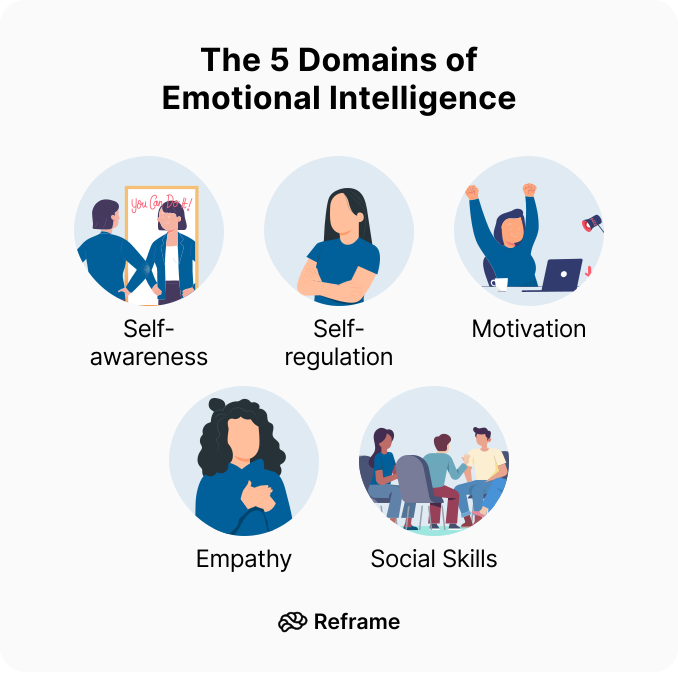


Folks with a high degree of EI are often self-motivated. They're driven by a passion for what they do, rather than by external factors such as money or status. This intrinsic motivation pushes them to achieve their goals, even in the face of adversity.
In the broader landscape of emotional intelligence, motivation fuels achievement and growth. It works with other components of EI, such as self-awareness and self-regulation, to create a holistic approach to understanding and navigating our own emotions and those of others.
Here’s why motivation can be a game changer:
While we’ve just covered motivation as a key domain of emotional intelligence, it’s worth noting that there’s a bit of a friendly debate among experts on this topic. Many now see motivation not as a direct component of EI, but as something that is deeply influenced by it. Think of it this way: emotional intelligence is the foundation, and motivation is the house you build on top of it. A strong foundation makes for a sturdy, resilient house that can withstand storms. Similarly, strong EI skills provide the stability you need to build and sustain your drive.
The connection between the two is undeniable. High emotional intelligence equips you with the self-awareness to understand your own desires and the self-regulation to manage the frustrations and setbacks that inevitably pop up. This emotional resilience is what keeps you going. Research confirms that emotional intelligence is strongly linked to achievement motivation, meaning that people who are skilled at understanding and managing their emotions tend to be more driven to succeed. It’s this ability to stay optimistic and persistent that helps you reach your goals, whether you’re aiming for a promotion or changing your relationship with alcohol.
So, what’s the final verdict? The current consensus suggests that motivation is a separate, distinct quality that is heavily fueled by emotional intelligence. Your EI is the toolkit that allows you to handle your emotions effectively, which in turn protects and strengthens your motivation. One study directly tested this relationship, concluding that motivation is linked to EI but isn't a part of it. Ultimately, by developing your emotional intelligence, you’re creating the ideal internal environment for your motivation to thrive.
Empathy is all about recognizing and understanding others’ feelings. This aspect of EI allows us to tune into the emotional undercurrents in a group or one-on-one interaction and respond with understanding.
Embracing empathy brings the world’s beauty and challenges into clear focus. By cultivating empathy, we’re not only enhancing our personal connections but also contributing to a kinder, more understanding planet.
Here’s why empathy matters:
Keeping our emotions in check is only part of the puzzle. The ability to interact well with others, maintain friendships, manage conflicts, communicate effectively, and work as part of a team are all crucial components of emotional intelligence.
Effective communication is at the heart of social skills. Communication is more than just words strung together — it's the bridge between thoughts, feelings, and understanding. To walk through life effectively, we need to master the art of conveying not just what’s on our mind, but also what's in our heart. Here’s why it’s important:
Another aspect of social skills viewed through the lens of emotional intelligence has to do with feedback. We often need an external perspective to shine light on areas that might be obscure to us.
Here’s how seeking feedback enhances our social skills:
While it’s helpful to understand the components of high emotional intelligence, it’s just as useful to recognize the signs of low EI. This isn’t about judgment; it’s about identifying areas where we can grow. Think of it like noticing a plant that’s a bit droopy — it’s not a bad plant, it just needs a little more attention and the right kind of care. Recognizing these signs in ourselves is the first step toward cultivating stronger emotional skills and building a more fulfilling life.
People with lower emotional intelligence often find it difficult to understand and manage their own feelings, which can create friction in their relationships. According to Verywell Mind, "Individuals with low emotional intelligence often struggle to recognize and manage their own emotions, leading to difficulties in social interactions and relationships." This might show up as frequent arguments that seem to come out of nowhere, a tendency to blame others for their feelings, or an inability to accept constructive criticism. They may also have a hard time showing empathy, making it challenging to connect with others on a deeper level and build a strong support system.
A lack of intrinsic motivation can also be a sign of underdeveloped EI. When you don't have a clear grasp of your own emotions and values, it's tough to know what truly drives you. This can lead to a feeling of aimlessness or a pattern of starting projects but never finishing them. As research from TTI SI notes, "When someone has low motivation, you might see these things: They might not want to get advice on how to improve, or they might ignore it when it's given. They aren't trying to do better than expected." This resistance to feedback isn't about being stubborn; it often stems from a lack of self-awareness and the self-regulation needed to process criticism without becoming defensive.
Developing your emotional intelligence isn't just an exercise in self-reflection; it has tangible benefits that can ripple through every area of your life. From managing daily stress to achieving long-term goals, a higher EI acts as an internal compass, helping you make choices that align with your true self. It strengthens your relationships, improves your well-being, and gives you the resilience to handle whatever life throws your way. Let’s look at some of the key advantages of honing your emotional skills.
One of the most immediate benefits of high EI is a greater ability to handle stress. When you can identify your emotional triggers, you can address them before they spiral out of control. As Verywell Mind explains, "Self-regulation helps us recognize stressors and employ coping strategies rather than getting overwhelmed." Instead of turning to unhealthy habits to numb difficult feelings, you can develop constructive ways to process them. This is especially important when you’re working on changing your relationship with alcohol and practicing mindful drinking, as building a toolkit of healthy coping mechanisms is key to lasting success.
Emotional intelligence is a powerful asset in the workplace. It helps you collaborate with colleagues, communicate your ideas clearly, and lead with empathy. People with high EI are often more driven because their motivation comes from within. According to Obnatus, "Motivated people maintain a generally positive outlook, focusing on opportunities rather than problems. Their intrinsic drive helps them bounce back from failures or disappointments more quickly." This positive, resilient mindset not only leads to better performance but also contributes to greater job satisfaction, as you feel more connected to your work and the people around you.
At its heart, emotional intelligence is about connection—both with yourself and with others. When you understand your own emotions, you’re better equipped to express them clearly and listen with empathy. This creates a foundation of trust and mutual respect in your relationships. As Verywell Mind puts it, "Understanding our emotional responses allows for clearer communication with others, fostering deeper, more genuine connections." These strong bonds form a vital support system that you can lean on during challenging times, which is an invaluable resource for anyone on a path of personal growth.
So, how do all these pieces fit together? The link between emotional intelligence and motivation is resilience. Resilience is that inner strength that allows you to bounce back from setbacks, learn from your mistakes, and keep moving forward. Research confirms that EI is a major factor in building this mental fortitude. According to a study from SciELO, "Emotional intelligence is strongly linked to achievement motivation." The study further explains that "emotional intelligence makes people more resilient, and this resilience then helps them feel more motivated to achieve their goals."
Think of it as a positive feedback loop. When you use your EI to understand and manage your emotions, you become more resilient. You don’t get derailed by a bad day or a moment of weakness. This resilience, in turn, fuels your motivation. You know you can handle challenges, so you’re more willing to pursue ambitious goals, like changing your drinking habits. The journey to a healthier lifestyle is a marathon, not a sprint, and building your EI is like strength training for your mind, giving you the endurance to stay the course.
Our brains are complex structures, and understanding how they function can shed light on why emotional intelligence is so integral to our well-being. Let's unpack the science and discover what happens in our brains when we exercise our emotional intelligence.
At the heart of our emotions lies the limbic system, a set of structures in the brain that function as our emotional hub. Here's a quick rundown:
While the limbic system deals with emotions, the prefrontal cortex is responsible for decision-making, reasoning, and regulating emotions. It helps us think before we act. When our emotional intelligence is in play, this area helps us regulate and manage the impulses from the limbic system, ensuring we respond appropriately.
Several neurotransmitters and hormones also play a role in emotional intelligence:
The neuroscience behind emotional intelligence is empowering. By understanding our brain's workings, we gain insight into how and why certain practices benefit us and how we can harness our brain's potential to enhance emotional intelligence.
Our brains are not rigid — they can change, adapt, and reorganize themselves. This phenomenon is called neuroplasticity. By consistently practicing emotional intelligence skills, we strengthen the neural pathways responsible for emotional regulation, awareness, and understanding. Over time, our brains become better wired for EI, much as a musician’s brain becomes better wired for music with consistent practice.
Here are some ways to harness the power of neuroplasticity:
For people reducing their alcohol intake, emotional intelligence can be a lifesaver. Why? Alcohol often acts as a crutch to deal with stress, anxiety, sadness, or other emotions. With the help of EI, we can better navigate these emotional hurdles, reducing the urge to reach for that drink.
Here’s how EI fits into the alcohol journey:
Emotional intelligence is like a muscle: the more you exercise it, the stronger it becomes. And when you’re trying to change your relationship with alcohol, EI can be a secret weapon, guiding you through emotional challenges and enhancing your well-being.
Beyond individual growth, EI holds the potential to transform our relationships, workplaces, and communities. It is the key to understanding not just ourselves, but also the emotions and needs of those around us. In a world where challenges and conflicts are ever-present, EI offers a beacon of hope — a tool to build bridges of understanding, foster collaboration, and drive meaningful change.
Self-awareness is the foundation of emotional intelligence. It’s about tuning into your own feelings and understanding why you feel the way you do. Without this internal compass, it’s tough to manage your emotions or understand anyone else’s. Think of it as your emotional home base; you have to know where you are before you can decide where to go next. Building this skill isn’t about harsh self-criticism; it’s about gentle curiosity. It’s about asking “What’s going on with me right now?” and listening patiently for the answer. This practice is especially powerful when you’re trying to change a habit, as it helps you see the connection between your feelings and your actions, like the urge to pour a drink after a stressful day.
If your emotions feel like a tangled mess of yarn, journaling is the act of slowly, patiently, untangling each thread. Taking time each day to jot down your feelings can help you track patterns in your emotional responses. You don’t need to write a novel; just a few sentences about what you felt and what was happening at the time can reveal so much. Over time, you might notice that you feel anxious every Sunday evening or irritable after certain meetings. Recognizing these patterns allows you to prepare for and manage emotional triggers more effectively, giving you the power to choose your response instead of reacting on autopilot.
Self-awareness isn’t just about reflecting on your feelings later; it’s the ability to recognize and understand your own emotions in real-time. This skill is about pausing in the middle of a feeling—whether it’s a flash of anger or a wave of sadness—and simply naming it. You can say to yourself, “Okay, this is frustration,” or “I’m feeling disappointed right now.” This simple act of labeling creates a small space between you and the emotion, preventing it from completely taking over. It’s a form of mindfulness that helps you observe your feelings without judgment, which is the first step toward managing them constructively.
Once you have a better handle on your own emotions, you can start to better understand the feelings of others. That’s empathy in a nutshell: the ability to step into someone else’s shoes and see the world from their perspective. It doesn’t mean you have to agree with them or solve their problems. It’s about connecting on a human level and acknowledging their emotional state. Empathy strengthens relationships, builds trust, and fosters compassion. It transforms interactions from transactional exchanges into genuine connections, making you a better friend, partner, and colleague. Cultivating empathy enriches your own emotional world and contributes to a kinder, more understanding community around you.
One of the most enjoyable ways to build your empathy muscle is to get lost in a good book. When you read fiction, you’re not just following a plot; you’re diving into the minds and hearts of complex characters. You experience their triumphs, their struggles, and their inner conflicts from the inside out. This process allows you to practice perspective-taking in a low-stakes environment. Engaging empathetically with characters in a story allows us to experience a broader range of emotions and perspectives, enriching our own emotional intelligence and making it easier to understand the real people in our lives.
While books are a great start, nothing builds empathy like real-world connection. It’s easy to stay in our own social bubbles, surrounded by people who think and live like we do. To truly grow your empathy, make a conscious effort to connect with people from different backgrounds, cultures, and life experiences. Join a new club, volunteer for a cause you care about, or simply strike up a conversation with someone new. Listen with genuine curiosity and an open mind. Hearing someone’s personal story can challenge your assumptions and broaden your understanding of the world in a way that nothing else can.
Social skills are where all the internal work of self-awareness and empathy comes to life. This is how you manage relationships, communicate effectively, and work well with others. It’s about using your emotional understanding to create positive interactions and navigate social situations with grace. Strong social skills aren’t about being the loudest person in the room or having a witty comeback for everything. They’re about making people feel seen, heard, and valued. Effective communication is at the heart of social skills, acting as the bridge that connects your thoughts and feelings with those of others.
One of the simplest ways to improve your social skills is to change the way you ask questions. Instead of asking closed questions that can be answered with a simple “yes” or “no,” practice asking open-ended questions that invite a more detailed response. For example, instead of asking “Did you have a good weekend?” try “What was the best part of your weekend?” This shift encourages deeper conversation and shows that you’re genuinely interested in the other person’s experience. It turns a simple check-in into an opportunity for real connection and helps you understand their world a little better.
So much of our communication is non-verbal. The way you stand, the expression on your face, and your tone of voice can often say more than your words do. Start by paying attention to your own body language. Are you making eye contact? Is your posture open and inviting? Being able to express yourself confidently and clearly empowers you in both personal and professional settings. At the same time, learn to read the non-verbal cues of others. Noticing someone’s slumped shoulders or forced smile can give you valuable insight into their true emotional state, allowing you to respond with greater empathy and understanding.
Motivation, in the context of emotional intelligence, isn’t about external rewards like money or praise. It’s about your internal drive—the passion and persistence you bring to your goals because they genuinely matter to you. This intrinsic motivation is what keeps you going when things get tough. It’s the force that propels you to pursue and achieve your goals, regardless of obstacles. People with high EI are able to tap into this inner fire to push through challenges, stay optimistic, and remain committed to their long-term vision, whether that’s finishing a project or sticking to a new, healthier lifestyle.
Vague goals lead to vague results. If you want to harness your motivation, you need a clear destination. Instead of saying “I want to be healthier,” define what that actually looks like. A more effective goal might be, “I will go for a 30-minute walk four times a week and replace my evening glass of wine with herbal tea.” This kind of specific, measurable goal gives you a clear target to aim for. It removes ambiguity and makes it easier to track your progress, which is a powerful motivator in itself. When you know exactly what you’re working toward, it’s much easier to stay focused and driven.
Having a clear goal is important, but understanding *why* that goal matters to you is the real secret to lasting motivation. Connect your goal to your core values. Why do you want to drink less? Is it to have more energy for your kids, to improve your mental clarity, or to feel more present in your life? This deeper purpose is your "why," and it will be your anchor during challenging moments. As you work toward your goal, make sure to celebrate your small wins along the way. Each milestone you hit is proof that you’re making progress. Acknowledging these achievements provides a regular dose of positive reinforcement that keeps your motivation high.
Emotional intelligence isn't just for our personal lives; it's a critical skill in the modern workplace. A team with high EI is more collaborative, resilient, and innovative. When people understand their own emotions and can empathize with their colleagues, it leads to better communication, less conflict, and a more positive and productive environment. Companies are increasingly recognizing that technical skills alone aren't enough. They need employees who can work well with others, adapt to change, and lead with compassion. Fostering EI at work isn't a "soft" perk; it's a strategic advantage that benefits everyone from new hires to the C-suite.
The culture of a workplace often flows from the top down, which is why managers and leaders must show good emotional intelligence themselves. A leader who is self-aware can recognize how their stress might be affecting the team and take steps to manage it. An empathetic manager listens to their employees' concerns and makes them feel understood and supported. Leaders model EI when they admit mistakes, give constructive feedback with kindness, and remain calm under pressure. This behavior creates an environment of psychological safety where team members feel comfortable taking risks, sharing ideas, and being their authentic selves, which is essential for creativity and growth.
While leaders play a key role, building an emotionally intelligent workplace is a team effort. Companies can support this by offering training to help employees improve their emotional intelligence. Workshops on topics like active listening, conflict resolution, and stress management can provide practical tools that everyone can use. Beyond formal training, fostering a culture of open and clear communication is vital. This means creating channels where employees feel safe to give and receive feedback, share their feelings without fear of judgment, and have honest conversations about challenges. When an organization invests in the emotional well-being of its people, it builds a more resilient, engaged, and successful workforce.
Is emotional intelligence something you're born with, or can you actually improve it? This is a great question, and the answer is really encouraging. Emotional intelligence is not a fixed trait you either have or you don't. Think of it like a muscle. With consistent practice, you can absolutely strengthen it. Your brain has an amazing ability to change and adapt, a concept called neuroplasticity. Every time you practice a skill like naming your emotions or listening with empathy, you're building and reinforcing the neural pathways that make those skills easier over time.
What's the most important component of emotional intelligence to start with? If you're feeling a bit overwhelmed by the five components, my advice is to start with self-awareness. It truly is the foundation for everything else. You can't effectively manage your emotions if you don't first recognize what you're feeling and why. By simply getting curious about your internal world through practices like journaling, you build the base from which all other EI skills, like self-regulation and empathy, can grow.
How exactly does being more emotionally intelligent help me change my drinking habits? Emotional intelligence gives you the tools to understand the "why" behind your urge to drink. Often, a craving isn't about the drink itself, but about an underlying emotion like stress, boredom, or loneliness. By building your EI, you learn to identify these emotional triggers as they happen. Instead of reaching for alcohol to numb or escape the feeling, you can pause and choose a healthier way to manage it because you understand what's really going on.
The article mentions most people think they're self-aware but aren't. How can I tell if I have a blind spot? It's completely normal to have blind spots; we all do! The most effective way to uncover them is to gently and bravely ask for feedback from people you trust. You could ask a close friend or partner something like, "I'm working on understanding my reactions better. Have you ever noticed a time when I seemed to react strongly to something and maybe I didn't realize it?" Approaching it with genuine curiosity, rather than defensiveness, shows others that you value their perspective and are open to growth.
What's the difference between empathy and just being nice? This is a key distinction. Being nice is often about politeness and maintaining social harmony, which is wonderful, but it can sometimes be superficial. Empathy goes much deeper. It's the ability to genuinely try to understand and share the feelings of another person from their point of view. It's not about fixing their problems or even agreeing with them, but about connecting with their emotional experience. Empathy builds true connection, while being nice sometimes just keeps the peace.
Ever wonder what separates people who stick with their goals from those who don't? It often comes down to Emotional Intelligence (EI). This isn't some abstract concept; it's a practical skill for managing your own mind. Understanding the link between motivation emotional intelligence is crucial for building lasting drive and resilience. By exploring the 5 components of emotional intelligence, you can learn to recognize your triggers, manage your reactions, and stay focused on what truly matters. These core domains of emotional intelligence are your roadmap to becoming more self-aware and effective in every part of your life.
Emotional Intelligence, often called EI or EQ (Emotional Quotient), refers to our ability to recognize, understand, manage, and regulate our own emotions and to understand the emotions of others. It guides our interactions, decisions, and reactions.
Here’s a snapshot of how it works. Picture you’re at a gathering, and suddenly someone begins discussing a recent setback they experienced. While most people sympathetically nod, you not only sense the person's distress but also know how to respond in a way that comforts them genuinely. No, you're not a mind reader — you’ve honed your emotional intelligence!
How does EI work at the physical level, and why does it play a pivotal role, especially when you're on a journey to quit or cut back on alcohol? Let’s find out!
At its core, emotional intelligence is the ability to perceive, interpret, and manage your own emotions while also recognizing and influencing the emotions of those around you. It’s not about suppressing feelings, but rather understanding them and using that understanding to guide your thinking and behavior. Think of it as being fluent in the language of emotions. According to experts, emotional intelligence is a set of skills that helps us understand and manage our own feelings and also helps us connect with others on a deeper level. This skill is incredibly powerful, especially when you’re working on changing habits, as it allows you to identify emotional triggers that might lead to drinking and develop healthier coping strategies instead.
Emotional intelligence is generally broken down into five key components: self-awareness (knowing your emotions), self-regulation (managing your emotions), motivation (driving yourself toward goals), empathy (understanding others' emotions), and social skills (managing relationships). When you’re trying to drink less, these skills are your toolkit. Self-awareness helps you recognize a craving is tied to stress, not thirst. Self-regulation gives you the power to pause and choose a different response. And motivation? That’s the inner passion or drive that keeps you committed to your goals, fueled by the satisfaction of making choices that align with the life you want to live. By strengthening your EI, you build resilience and a stronger foundation for lasting change.
The concept of emotional intelligence might seem modern, but its roots trace back further than you might think. Let’s journey through time to understand how the notion of emotional intelligence evolved and became the influential concept it is today.
The journey of emotional intelligence, from ancient philosophy to cutting-edge neuroscience, underscores its enduring importance. As we continue to explore and understand EI, it's clear that it's not just a fleeting trend — it’s a foundational aspect of human nature and potential.
EI is a multifaceted concept that goes beyond just being "good with emotions." It encompasses several domains that help us navigate our internal emotional world and our interactions with others. Here’s a more detailed breakdown of the 5 main components of EI; understanding them can transform how we perceive the world, make decisions, and interact with others.
The cornerstone of EI, self-awareness is the ability to recognize and understand our own emotions in real-time. It’s about being tuned in to how we feel, which then influences how we act. For instance, understanding that we’re feeling anxious before a public speech can allow us to take measures to calm down or prepare more.
At its core, self-awareness means understanding our emotions, strengths, challenges, and behaviors. It’s like being the attentive driver of our emotional vehicle, knowing when to accelerate with confidence and when to slow down and reflect.
Here are the benefits of self-awareness:
While self-awareness sounds straightforward, there's often a huge difference between how self-aware we think we are and how self-aware we actually are. It's a common blind spot. Research from Harvard is pretty eye-opening on this: one study found that while 95% of people believe they're self-aware, only about 10–15% truly are. This isn't about pointing fingers; it's a natural human tendency. Our perception can be skewed by our environment. For instance, the same research suggests that people in positions of power often receive less honest feedback, which can inflate their sense of self-awareness. This gap can make it tough to see our own patterns clearly, especially when it comes to habits like drinking, where we might not recognize the true emotions driving our choices. Building this awareness is the first step toward making meaningful changes.
Recognizing emotions is important — but it's equally crucial to manage them. Self-regulation involves controlling or redirecting disruptive emotions and adapting to changing circumstances. This means not letting temporary setbacks throw us off course and maintaining our composure during a disagreement.
Self-regulation equips us to navigate life's ups and downs with grace and resilience. By mastering this skill, we not only improve our personal lives but also contribute positively to our communities and society at large.
Self-regulation provides so many benefits:
Folks with a high degree of EI are often self-motivated. They're driven by a passion for what they do, rather than by external factors such as money or status. This intrinsic motivation pushes them to achieve their goals, even in the face of adversity.
In the broader landscape of emotional intelligence, motivation fuels achievement and growth. It works with other components of EI, such as self-awareness and self-regulation, to create a holistic approach to understanding and navigating our own emotions and those of others.
Here’s why motivation can be a game changer:
While we’ve just covered motivation as a key domain of emotional intelligence, it’s worth noting that there’s a bit of a friendly debate among experts on this topic. Many now see motivation not as a direct component of EI, but as something that is deeply influenced by it. Think of it this way: emotional intelligence is the foundation, and motivation is the house you build on top of it. A strong foundation makes for a sturdy, resilient house that can withstand storms. Similarly, strong EI skills provide the stability you need to build and sustain your drive.
The connection between the two is undeniable. High emotional intelligence equips you with the self-awareness to understand your own desires and the self-regulation to manage the frustrations and setbacks that inevitably pop up. This emotional resilience is what keeps you going. Research confirms that emotional intelligence is strongly linked to achievement motivation, meaning that people who are skilled at understanding and managing their emotions tend to be more driven to succeed. It’s this ability to stay optimistic and persistent that helps you reach your goals, whether you’re aiming for a promotion or changing your relationship with alcohol.
So, what’s the final verdict? The current consensus suggests that motivation is a separate, distinct quality that is heavily fueled by emotional intelligence. Your EI is the toolkit that allows you to handle your emotions effectively, which in turn protects and strengthens your motivation. One study directly tested this relationship, concluding that motivation is linked to EI but isn't a part of it. Ultimately, by developing your emotional intelligence, you’re creating the ideal internal environment for your motivation to thrive.
Empathy is all about recognizing and understanding others’ feelings. This aspect of EI allows us to tune into the emotional undercurrents in a group or one-on-one interaction and respond with understanding.
Embracing empathy brings the world’s beauty and challenges into clear focus. By cultivating empathy, we’re not only enhancing our personal connections but also contributing to a kinder, more understanding planet.
Here’s why empathy matters:
Keeping our emotions in check is only part of the puzzle. The ability to interact well with others, maintain friendships, manage conflicts, communicate effectively, and work as part of a team are all crucial components of emotional intelligence.
Effective communication is at the heart of social skills. Communication is more than just words strung together — it's the bridge between thoughts, feelings, and understanding. To walk through life effectively, we need to master the art of conveying not just what’s on our mind, but also what's in our heart. Here’s why it’s important:
Another aspect of social skills viewed through the lens of emotional intelligence has to do with feedback. We often need an external perspective to shine light on areas that might be obscure to us.
Here’s how seeking feedback enhances our social skills:
While it’s helpful to understand the components of high emotional intelligence, it’s just as useful to recognize the signs of low EI. This isn’t about judgment; it’s about identifying areas where we can grow. Think of it like noticing a plant that’s a bit droopy — it’s not a bad plant, it just needs a little more attention and the right kind of care. Recognizing these signs in ourselves is the first step toward cultivating stronger emotional skills and building a more fulfilling life.
People with lower emotional intelligence often find it difficult to understand and manage their own feelings, which can create friction in their relationships. According to Verywell Mind, "Individuals with low emotional intelligence often struggle to recognize and manage their own emotions, leading to difficulties in social interactions and relationships." This might show up as frequent arguments that seem to come out of nowhere, a tendency to blame others for their feelings, or an inability to accept constructive criticism. They may also have a hard time showing empathy, making it challenging to connect with others on a deeper level and build a strong support system.
A lack of intrinsic motivation can also be a sign of underdeveloped EI. When you don't have a clear grasp of your own emotions and values, it's tough to know what truly drives you. This can lead to a feeling of aimlessness or a pattern of starting projects but never finishing them. As research from TTI SI notes, "When someone has low motivation, you might see these things: They might not want to get advice on how to improve, or they might ignore it when it's given. They aren't trying to do better than expected." This resistance to feedback isn't about being stubborn; it often stems from a lack of self-awareness and the self-regulation needed to process criticism without becoming defensive.
Developing your emotional intelligence isn't just an exercise in self-reflection; it has tangible benefits that can ripple through every area of your life. From managing daily stress to achieving long-term goals, a higher EI acts as an internal compass, helping you make choices that align with your true self. It strengthens your relationships, improves your well-being, and gives you the resilience to handle whatever life throws your way. Let’s look at some of the key advantages of honing your emotional skills.
One of the most immediate benefits of high EI is a greater ability to handle stress. When you can identify your emotional triggers, you can address them before they spiral out of control. As Verywell Mind explains, "Self-regulation helps us recognize stressors and employ coping strategies rather than getting overwhelmed." Instead of turning to unhealthy habits to numb difficult feelings, you can develop constructive ways to process them. This is especially important when you’re working on changing your relationship with alcohol and practicing mindful drinking, as building a toolkit of healthy coping mechanisms is key to lasting success.
Emotional intelligence is a powerful asset in the workplace. It helps you collaborate with colleagues, communicate your ideas clearly, and lead with empathy. People with high EI are often more driven because their motivation comes from within. According to Obnatus, "Motivated people maintain a generally positive outlook, focusing on opportunities rather than problems. Their intrinsic drive helps them bounce back from failures or disappointments more quickly." This positive, resilient mindset not only leads to better performance but also contributes to greater job satisfaction, as you feel more connected to your work and the people around you.
At its heart, emotional intelligence is about connection—both with yourself and with others. When you understand your own emotions, you’re better equipped to express them clearly and listen with empathy. This creates a foundation of trust and mutual respect in your relationships. As Verywell Mind puts it, "Understanding our emotional responses allows for clearer communication with others, fostering deeper, more genuine connections." These strong bonds form a vital support system that you can lean on during challenging times, which is an invaluable resource for anyone on a path of personal growth.
So, how do all these pieces fit together? The link between emotional intelligence and motivation is resilience. Resilience is that inner strength that allows you to bounce back from setbacks, learn from your mistakes, and keep moving forward. Research confirms that EI is a major factor in building this mental fortitude. According to a study from SciELO, "Emotional intelligence is strongly linked to achievement motivation." The study further explains that "emotional intelligence makes people more resilient, and this resilience then helps them feel more motivated to achieve their goals."
Think of it as a positive feedback loop. When you use your EI to understand and manage your emotions, you become more resilient. You don’t get derailed by a bad day or a moment of weakness. This resilience, in turn, fuels your motivation. You know you can handle challenges, so you’re more willing to pursue ambitious goals, like changing your drinking habits. The journey to a healthier lifestyle is a marathon, not a sprint, and building your EI is like strength training for your mind, giving you the endurance to stay the course.
Our brains are complex structures, and understanding how they function can shed light on why emotional intelligence is so integral to our well-being. Let's unpack the science and discover what happens in our brains when we exercise our emotional intelligence.
At the heart of our emotions lies the limbic system, a set of structures in the brain that function as our emotional hub. Here's a quick rundown:
While the limbic system deals with emotions, the prefrontal cortex is responsible for decision-making, reasoning, and regulating emotions. It helps us think before we act. When our emotional intelligence is in play, this area helps us regulate and manage the impulses from the limbic system, ensuring we respond appropriately.
Several neurotransmitters and hormones also play a role in emotional intelligence:
The neuroscience behind emotional intelligence is empowering. By understanding our brain's workings, we gain insight into how and why certain practices benefit us and how we can harness our brain's potential to enhance emotional intelligence.
Our brains are not rigid — they can change, adapt, and reorganize themselves. This phenomenon is called neuroplasticity. By consistently practicing emotional intelligence skills, we strengthen the neural pathways responsible for emotional regulation, awareness, and understanding. Over time, our brains become better wired for EI, much as a musician’s brain becomes better wired for music with consistent practice.
Here are some ways to harness the power of neuroplasticity:
For people reducing their alcohol intake, emotional intelligence can be a lifesaver. Why? Alcohol often acts as a crutch to deal with stress, anxiety, sadness, or other emotions. With the help of EI, we can better navigate these emotional hurdles, reducing the urge to reach for that drink.
Here’s how EI fits into the alcohol journey:
Emotional intelligence is like a muscle: the more you exercise it, the stronger it becomes. And when you’re trying to change your relationship with alcohol, EI can be a secret weapon, guiding you through emotional challenges and enhancing your well-being.
Beyond individual growth, EI holds the potential to transform our relationships, workplaces, and communities. It is the key to understanding not just ourselves, but also the emotions and needs of those around us. In a world where challenges and conflicts are ever-present, EI offers a beacon of hope — a tool to build bridges of understanding, foster collaboration, and drive meaningful change.
Self-awareness is the foundation of emotional intelligence. It’s about tuning into your own feelings and understanding why you feel the way you do. Without this internal compass, it’s tough to manage your emotions or understand anyone else’s. Think of it as your emotional home base; you have to know where you are before you can decide where to go next. Building this skill isn’t about harsh self-criticism; it’s about gentle curiosity. It’s about asking “What’s going on with me right now?” and listening patiently for the answer. This practice is especially powerful when you’re trying to change a habit, as it helps you see the connection between your feelings and your actions, like the urge to pour a drink after a stressful day.
If your emotions feel like a tangled mess of yarn, journaling is the act of slowly, patiently, untangling each thread. Taking time each day to jot down your feelings can help you track patterns in your emotional responses. You don’t need to write a novel; just a few sentences about what you felt and what was happening at the time can reveal so much. Over time, you might notice that you feel anxious every Sunday evening or irritable after certain meetings. Recognizing these patterns allows you to prepare for and manage emotional triggers more effectively, giving you the power to choose your response instead of reacting on autopilot.
Self-awareness isn’t just about reflecting on your feelings later; it’s the ability to recognize and understand your own emotions in real-time. This skill is about pausing in the middle of a feeling—whether it’s a flash of anger or a wave of sadness—and simply naming it. You can say to yourself, “Okay, this is frustration,” or “I’m feeling disappointed right now.” This simple act of labeling creates a small space between you and the emotion, preventing it from completely taking over. It’s a form of mindfulness that helps you observe your feelings without judgment, which is the first step toward managing them constructively.
Once you have a better handle on your own emotions, you can start to better understand the feelings of others. That’s empathy in a nutshell: the ability to step into someone else’s shoes and see the world from their perspective. It doesn’t mean you have to agree with them or solve their problems. It’s about connecting on a human level and acknowledging their emotional state. Empathy strengthens relationships, builds trust, and fosters compassion. It transforms interactions from transactional exchanges into genuine connections, making you a better friend, partner, and colleague. Cultivating empathy enriches your own emotional world and contributes to a kinder, more understanding community around you.
One of the most enjoyable ways to build your empathy muscle is to get lost in a good book. When you read fiction, you’re not just following a plot; you’re diving into the minds and hearts of complex characters. You experience their triumphs, their struggles, and their inner conflicts from the inside out. This process allows you to practice perspective-taking in a low-stakes environment. Engaging empathetically with characters in a story allows us to experience a broader range of emotions and perspectives, enriching our own emotional intelligence and making it easier to understand the real people in our lives.
While books are a great start, nothing builds empathy like real-world connection. It’s easy to stay in our own social bubbles, surrounded by people who think and live like we do. To truly grow your empathy, make a conscious effort to connect with people from different backgrounds, cultures, and life experiences. Join a new club, volunteer for a cause you care about, or simply strike up a conversation with someone new. Listen with genuine curiosity and an open mind. Hearing someone’s personal story can challenge your assumptions and broaden your understanding of the world in a way that nothing else can.
Social skills are where all the internal work of self-awareness and empathy comes to life. This is how you manage relationships, communicate effectively, and work well with others. It’s about using your emotional understanding to create positive interactions and navigate social situations with grace. Strong social skills aren’t about being the loudest person in the room or having a witty comeback for everything. They’re about making people feel seen, heard, and valued. Effective communication is at the heart of social skills, acting as the bridge that connects your thoughts and feelings with those of others.
One of the simplest ways to improve your social skills is to change the way you ask questions. Instead of asking closed questions that can be answered with a simple “yes” or “no,” practice asking open-ended questions that invite a more detailed response. For example, instead of asking “Did you have a good weekend?” try “What was the best part of your weekend?” This shift encourages deeper conversation and shows that you’re genuinely interested in the other person’s experience. It turns a simple check-in into an opportunity for real connection and helps you understand their world a little better.
So much of our communication is non-verbal. The way you stand, the expression on your face, and your tone of voice can often say more than your words do. Start by paying attention to your own body language. Are you making eye contact? Is your posture open and inviting? Being able to express yourself confidently and clearly empowers you in both personal and professional settings. At the same time, learn to read the non-verbal cues of others. Noticing someone’s slumped shoulders or forced smile can give you valuable insight into their true emotional state, allowing you to respond with greater empathy and understanding.
Motivation, in the context of emotional intelligence, isn’t about external rewards like money or praise. It’s about your internal drive—the passion and persistence you bring to your goals because they genuinely matter to you. This intrinsic motivation is what keeps you going when things get tough. It’s the force that propels you to pursue and achieve your goals, regardless of obstacles. People with high EI are able to tap into this inner fire to push through challenges, stay optimistic, and remain committed to their long-term vision, whether that’s finishing a project or sticking to a new, healthier lifestyle.
Vague goals lead to vague results. If you want to harness your motivation, you need a clear destination. Instead of saying “I want to be healthier,” define what that actually looks like. A more effective goal might be, “I will go for a 30-minute walk four times a week and replace my evening glass of wine with herbal tea.” This kind of specific, measurable goal gives you a clear target to aim for. It removes ambiguity and makes it easier to track your progress, which is a powerful motivator in itself. When you know exactly what you’re working toward, it’s much easier to stay focused and driven.
Having a clear goal is important, but understanding *why* that goal matters to you is the real secret to lasting motivation. Connect your goal to your core values. Why do you want to drink less? Is it to have more energy for your kids, to improve your mental clarity, or to feel more present in your life? This deeper purpose is your "why," and it will be your anchor during challenging moments. As you work toward your goal, make sure to celebrate your small wins along the way. Each milestone you hit is proof that you’re making progress. Acknowledging these achievements provides a regular dose of positive reinforcement that keeps your motivation high.
Emotional intelligence isn't just for our personal lives; it's a critical skill in the modern workplace. A team with high EI is more collaborative, resilient, and innovative. When people understand their own emotions and can empathize with their colleagues, it leads to better communication, less conflict, and a more positive and productive environment. Companies are increasingly recognizing that technical skills alone aren't enough. They need employees who can work well with others, adapt to change, and lead with compassion. Fostering EI at work isn't a "soft" perk; it's a strategic advantage that benefits everyone from new hires to the C-suite.
The culture of a workplace often flows from the top down, which is why managers and leaders must show good emotional intelligence themselves. A leader who is self-aware can recognize how their stress might be affecting the team and take steps to manage it. An empathetic manager listens to their employees' concerns and makes them feel understood and supported. Leaders model EI when they admit mistakes, give constructive feedback with kindness, and remain calm under pressure. This behavior creates an environment of psychological safety where team members feel comfortable taking risks, sharing ideas, and being their authentic selves, which is essential for creativity and growth.
While leaders play a key role, building an emotionally intelligent workplace is a team effort. Companies can support this by offering training to help employees improve their emotional intelligence. Workshops on topics like active listening, conflict resolution, and stress management can provide practical tools that everyone can use. Beyond formal training, fostering a culture of open and clear communication is vital. This means creating channels where employees feel safe to give and receive feedback, share their feelings without fear of judgment, and have honest conversations about challenges. When an organization invests in the emotional well-being of its people, it builds a more resilient, engaged, and successful workforce.
Is emotional intelligence something you're born with, or can you actually improve it? This is a great question, and the answer is really encouraging. Emotional intelligence is not a fixed trait you either have or you don't. Think of it like a muscle. With consistent practice, you can absolutely strengthen it. Your brain has an amazing ability to change and adapt, a concept called neuroplasticity. Every time you practice a skill like naming your emotions or listening with empathy, you're building and reinforcing the neural pathways that make those skills easier over time.
What's the most important component of emotional intelligence to start with? If you're feeling a bit overwhelmed by the five components, my advice is to start with self-awareness. It truly is the foundation for everything else. You can't effectively manage your emotions if you don't first recognize what you're feeling and why. By simply getting curious about your internal world through practices like journaling, you build the base from which all other EI skills, like self-regulation and empathy, can grow.
How exactly does being more emotionally intelligent help me change my drinking habits? Emotional intelligence gives you the tools to understand the "why" behind your urge to drink. Often, a craving isn't about the drink itself, but about an underlying emotion like stress, boredom, or loneliness. By building your EI, you learn to identify these emotional triggers as they happen. Instead of reaching for alcohol to numb or escape the feeling, you can pause and choose a healthier way to manage it because you understand what's really going on.
The article mentions most people think they're self-aware but aren't. How can I tell if I have a blind spot? It's completely normal to have blind spots; we all do! The most effective way to uncover them is to gently and bravely ask for feedback from people you trust. You could ask a close friend or partner something like, "I'm working on understanding my reactions better. Have you ever noticed a time when I seemed to react strongly to something and maybe I didn't realize it?" Approaching it with genuine curiosity, rather than defensiveness, shows others that you value their perspective and are open to growth.
What's the difference between empathy and just being nice? This is a key distinction. Being nice is often about politeness and maintaining social harmony, which is wonderful, but it can sometimes be superficial. Empathy goes much deeper. It's the ability to genuinely try to understand and share the feelings of another person from their point of view. It's not about fixing their problems or even agreeing with them, but about connecting with their emotional experience. Empathy builds true connection, while being nice sometimes just keeps the peace.

How to overcome perfectionism with actionable strategies that truly work. Dive into setting achievable goals, cultivating self-compassion, incorporating mindfulness, restructuring thought patterns, and even seeking professional help. Live a life free from the shackles of perfectionism.
Although it isn’t a treatment for alcohol use disorder (AUD), the Reframe app can help you cut back on drinking gradually, with the science-backed knowledge to empower you 100% of the way. Our proven program has helped millions of people around the world drink less and live more. And we want to help you get there, too!
The Reframe app equips you with the knowledge and skills you need to not only survive drinking less, but to thrive while you navigate the journey. Our daily research-backed readings teach you the neuroscience of alcohol, and our in-app Toolkit provides the resources and activities you need to navigate each challenge.
You’ll meet millions of fellow Reframers in our 24/7 Forum chat and daily Zoom check-in meetings. Receive encouragement from people worldwide who know exactly what you’re going through! You’ll also have the opportunity to connect with our licensed Reframe coaches for more personalized guidance.
Plus, we’re always introducing new features to optimize your in-app experience. We recently launched our in-app chatbot, Melody, powered by the world’s most powerful AI technology. Melody is here to help as you adjust to a life with less (or no) alcohol.
And that’s not all! Every month, we launch fun challenges, like Dry/Damp January, Mental Health May, and Outdoorsy June. You won’t want to miss out on the chance to participate alongside fellow Reframers (or solo if that’s more your thing!).
The Reframe app is free for 7 days, so you don’t have anything to lose by trying it. Are you ready to feel empowered and discover life beyond alcohol? Then download our app through the App Store or Google Play today!
Picture an office space with dimmed lights, the clock ticking closer to midnight, and Angela still hunched over her computer. Her big presentation is tomorrow, and she has been tweaking a single slide for hours, unsatisfied. Even though colleagues praised her work, Angela can't shake the thought that it's just not perfect. She wonders: “When is good enough actually enough?”
It's an enduring question, often raised by perfectionists. There's more to perfectionism than just being a diligent worker or detail-oriented: it's a cognitive pattern that can hinder progress in multiple areas, from personal relationships to behavioral changes like changing our drinking habits. So, how can Angela — and others like her — rein in this impulse? Science offers some compelling answers.
Perfectionism is often mistakenly viewed as an admirable trait that fuels ambition, meticulousness, and high achievement. However, perfectionism isn’t simply about having high standards or an unwavering commitment to excellence.
Perfectionism manifests in various ways across different life domains, including work, relationships, or personal endeavors. It often involves setting unreasonably high standards for ourselves and for others, resulting in dissatisfaction even when we’re performing well. This drive comes from an underlying fear of failure, harsh self-judgment, or an acute sensitivity to others’ evaluations.
The origins of perfectionism are multifaceted, often stemming from a combination of genetic predispositions and environmental influences. Research points to certain personality traits such as conscientiousness and neuroticism as potential predisposing factors. Environmentally, many perfectionists report having grown up in households where high standards were expected and reinforced. Cultural factors also come into play, with some societies placing a greater emphasis on achievement, competition, and social comparison, which can foster perfectionistic tendencies.
While being a perfectionist can drive us to accomplish certain goals, the long-term effects can be debilitating. One significant impact is on mental health. A meta-analysis has shown that perfectionism is positively correlated with depression, anxiety, and stress. Moreover, it can be a risk factor for more severe psychological disorders, including obsessive-compulsive disorder (OCD) and eating disorders.
The physical toll is equally alarming. The constant stress and anxiety that often accompany perfectionism can lead to a host of health issues, including insomnia, digestive problems, and even cardiovascular diseases. Relationships also suffer. A perfectionist's constant striving for flawlessness can create unrealistic expectations in relationships, leading to dissatisfaction, conflict, and, eventually, emotional detachment.
On the career front, the fear of making a mistake can cause paralysis, preventing us from taking risks that are often necessary for growth and innovation. Ironically, the very pursuit of perfection can result in underachievement. Finally, perfectionism can hamper creativity and adaptability — a liability in both professional and personal spheres.
By understanding what perfectionism is, the factors that contribute to it, and its long-term consequences, it’s easier to grasp the urgency of addressing this complex trait. While achieving perfection may seem like an alluring goal, the pursuit can exact a heavy toll. Luckily, awareness is the first step toward making meaningful change.
It's day 30 without a drink, and Mark is celebrating by attending a support group. In the group circle, he shares how he's eliminated alcohol, attended daily gym sessions, and read two self-help books — all within the month. Applause erupts. Yet inside, Mark feels like a fraud. One hiccup, one moment of weakness, he thinks, and all this "perfection" will crumble.
Research highlights the intricate relationship between perfectionism and recovery from issues such as alcohol misuse. The pursuit of flawlessness can both propel and hinder our journey to sobriety or mindful drinking. On the positive side, a perfectionist’s tendency to set high goals can lead to dedicated efforts to let go of an unwanted, unhealthy habit. We may be driven by the fear of failing to meet our internalized standards of excellence, which can act as a powerful motivator. The problem arises, however, when those standards are unattainable.
Studies reveal that perfectionism is linked with higher levels of stress and increased susceptibility to depression, both of which are factors that can contribute to relapse in alcohol misuse recovery. When perfectionists don’t achieve their goals — in this case, moderation or sobriety, or a string of “perfect” days — they tend to engage in negative self-evaluation, which exacerbates the stress and depressive symptoms that may have contributed to the alcohol misuse in the first place.
Perfectionism instills a fear of making mistakes, a notion incompatible with the process of alcohol misuse recovery, which often involves relapses and setbacks. At Reframe, we celebrate progress rather than perfection, encouraging users to embrace mistakes as a natural part of the healing journey. However, for a perfectionist, even a minor slip-up can feel like a monumental failure, sparking a vicious cycle of shame, guilt, and even the abandonment of recovery efforts.
The self-imposed pressures of perfectionism can lead to "paralysis by analysis." In this state, a person becomes so consumed by the details, by the quest for the "perfect recovery," that they become paralyzed — unable to make decisions or progress further. The perfectionist's all-or-nothing mindset can mean that anything less than complete success feels like utter defeat. It's a mental trap that can sap the joy out of accomplishments, turning even a 30-day sobriety milestone into a source of anxiety.
The emotional toll of perfectionism in changing our drinking habits is also worth noting. Constantly striving for an unattainable ideal can lead to emotional exhaustion. This heightened emotional state can additionally stress relationships with family and friends that might already be strained due to the prior drinking behaviors.
So what’s the solution? We need to redefine success in the context of recovery. Success doesn’t have to mean a perfect scorecard; it could be measured by the ability to learn from mistakes, or by the strength it takes to continue the journey despite setbacks. Changing our drinking habits, in the long run, is less about the destination and more about the ongoing process — a concept that can be difficult for perfectionists to internalize, but one that’s crucial for sustainable recovery.

So, what's the playbook for breaking free from perfectionism? Being proactive can make all the difference! Here's a deeper dive into some actionable strategies.
Unrealistic standards are the bane of a perfectionist's existence, often leading to discouragement and inaction. The solution is setting achievable, realistic goals. Start small and build from there. Take exercise, for instance: instead of aiming for an hour of high-intensity interval training daily, why not start with 20 minutes of low-impact exercise, three times a week? Gradually increasing the intensity and duration can make the endeavor more sustainable, while still contributing to our physical well-being.
Setting realistic goals also involves breaking larger tasks into manageable steps. Facing a colossal project at work? Break it down into smaller tasks and deadlines. This step-by-step approach both makes the project less daunting and provides multiple opportunities for small victories along the way, boosting morale and motivation.
The maxim "Don't let the perfect be the enemy of the good" rings particularly true for perfectionists. Adopting a "good enough" philosophy can work wonders. For instance, instead of spending hours honing and revising a single email, allocate a reasonable time limit for its completion. Once the clock hits the set time, press “send,” minor imperfections and all.
The beauty of this approach is its almost universal applicability: it works for everything from house cleaning to preparing presentations. It's not a call for mediocrity, just a rational, time-efficient way to complete tasks satisfactorily. This approach allows for a better work-life balance and reduces the unnecessary stress often generated by the quest for perfection. Good enough is good enough.
Often, perfectionists are their harshest critics, subjecting themselves to a level of scrutiny they wouldn't dare impose on others. Self-compassion can be transformative in this regard. One powerful exercise is writing a compassionate letter to ourselves, particularly after a perceived failure or shortcoming.
Self-compassion involves acknowledging that everyone makes mistakes and is fallible — including us! It means treating ourselves with the same kindness and understanding that we would offer to a good friend in a similar situation. This perspective shift can be incredibly freeing, reducing the emotional weight of setbacks and failures.
Weaving mindfulness into daily life can be revolutionary for anyone caught in the web of perfectionism. Mindfulness meditation is no esoteric concept; it’s a simple, pragmatic practice. Commit to setting aside five minutes each day to focus on breathing patterns and bodily sensations.
This brief mindfulness break helps to cultivate a non-judgmental awareness of the present moment, creating a space between us and our habitual thought patterns. It provides an opportunity to recognize perfectionist tendencies as they arise and to choose a different response, one of acceptance and calm. As this practice becomes habitual, its positive impacts often spill over into other areas of life, promoting a more balanced approach to tasks and challenges.
Cognitive distortions, such as all-or-nothing thinking, feed perfectionist attitudes. In this mindset, anything less than perfect becomes synonymous with failure. One way to dismantle this destructive thought pattern is by rephrasing the internal dialogue. Instead of repeating phrases like "I must be perfect," opt for healthier alternatives like "I aim to do my best" or "Progress, not perfection."
Learning to see life and its myriad challenges on a spectrum rather than as binary outcomes (success or failure, good or bad) opens up a middle ground where most real-world results actually occur. With this more-nuanced understanding, setbacks become opportunities for growth, and “failures” transform into stepping stones rather than stumbling blocks.
Some people find that perfectionism is so deeply rooted that tackling it alone is nearly impossible. In such cases, cognitive behavioral therapy (CBT) has been proven effective in treating perfectionism. This form of therapy helps identify negative thought patterns and offers strategies to change these into more positive and constructive ways of thinking.
CBT provides tools for managing anxiety and stress that often accompany perfectionism, offering a structured framework for sustainable change. It’s like hiring a personal trainer for mental health: yes, we can work out alone, but the expertise and structured guidance of a professional often yield quicker and more sustainable results.
Celebrating small wins may sound trivial, but it’s a powerful method to rewire the brain’s reward system. Whether it's meeting a sub-goal on a big project or making the conscious decision to embrace an imperfection, each small win deserves acknowledgment. Positive reinforcement can involve anything from taking a leisurely walk, enjoying a favorite treat, or spending time with loved ones. This practice provides both immediate gratification and long-term motivation to continue taking steps in the right direction.
Living up to our potential doesn't require perfection. Indeed, being good enough is enough. Whether it's the courage to accept that minor errors might remain in a business presentation, or the self-compassion to forgive ourselves after slipping up on a commitment, true freedom lies in the ability to embrace imperfection. Perfectionism might never be entirely eradicated, but it can be managed, tamed, and put in its rightful place.
Adopting these action steps into daily routines offers the promise of a life less encumbered by perfectionism’s debilitating demands. We can create a life in which every moment isn’t an exam to be aced, but an experience to be lived; a life that’s enriched, not impoverished, by our quirks and imperfections. Embracing this more compassionate approach isn't just a win; it's life-changing.
Picture an office space with dimmed lights, the clock ticking closer to midnight, and Angela still hunched over her computer. Her big presentation is tomorrow, and she has been tweaking a single slide for hours, unsatisfied. Even though colleagues praised her work, Angela can't shake the thought that it's just not perfect. She wonders: “When is good enough actually enough?”
It's an enduring question, often raised by perfectionists. There's more to perfectionism than just being a diligent worker or detail-oriented: it's a cognitive pattern that can hinder progress in multiple areas, from personal relationships to behavioral changes like changing our drinking habits. So, how can Angela — and others like her — rein in this impulse? Science offers some compelling answers.
Perfectionism is often mistakenly viewed as an admirable trait that fuels ambition, meticulousness, and high achievement. However, perfectionism isn’t simply about having high standards or an unwavering commitment to excellence.
Perfectionism manifests in various ways across different life domains, including work, relationships, or personal endeavors. It often involves setting unreasonably high standards for ourselves and for others, resulting in dissatisfaction even when we’re performing well. This drive comes from an underlying fear of failure, harsh self-judgment, or an acute sensitivity to others’ evaluations.
The origins of perfectionism are multifaceted, often stemming from a combination of genetic predispositions and environmental influences. Research points to certain personality traits such as conscientiousness and neuroticism as potential predisposing factors. Environmentally, many perfectionists report having grown up in households where high standards were expected and reinforced. Cultural factors also come into play, with some societies placing a greater emphasis on achievement, competition, and social comparison, which can foster perfectionistic tendencies.
While being a perfectionist can drive us to accomplish certain goals, the long-term effects can be debilitating. One significant impact is on mental health. A meta-analysis has shown that perfectionism is positively correlated with depression, anxiety, and stress. Moreover, it can be a risk factor for more severe psychological disorders, including obsessive-compulsive disorder (OCD) and eating disorders.
The physical toll is equally alarming. The constant stress and anxiety that often accompany perfectionism can lead to a host of health issues, including insomnia, digestive problems, and even cardiovascular diseases. Relationships also suffer. A perfectionist's constant striving for flawlessness can create unrealistic expectations in relationships, leading to dissatisfaction, conflict, and, eventually, emotional detachment.
On the career front, the fear of making a mistake can cause paralysis, preventing us from taking risks that are often necessary for growth and innovation. Ironically, the very pursuit of perfection can result in underachievement. Finally, perfectionism can hamper creativity and adaptability — a liability in both professional and personal spheres.
By understanding what perfectionism is, the factors that contribute to it, and its long-term consequences, it’s easier to grasp the urgency of addressing this complex trait. While achieving perfection may seem like an alluring goal, the pursuit can exact a heavy toll. Luckily, awareness is the first step toward making meaningful change.
It's day 30 without a drink, and Mark is celebrating by attending a support group. In the group circle, he shares how he's eliminated alcohol, attended daily gym sessions, and read two self-help books — all within the month. Applause erupts. Yet inside, Mark feels like a fraud. One hiccup, one moment of weakness, he thinks, and all this "perfection" will crumble.
Research highlights the intricate relationship between perfectionism and recovery from issues such as alcohol misuse. The pursuit of flawlessness can both propel and hinder our journey to sobriety or mindful drinking. On the positive side, a perfectionist’s tendency to set high goals can lead to dedicated efforts to let go of an unwanted, unhealthy habit. We may be driven by the fear of failing to meet our internalized standards of excellence, which can act as a powerful motivator. The problem arises, however, when those standards are unattainable.
Studies reveal that perfectionism is linked with higher levels of stress and increased susceptibility to depression, both of which are factors that can contribute to relapse in alcohol misuse recovery. When perfectionists don’t achieve their goals — in this case, moderation or sobriety, or a string of “perfect” days — they tend to engage in negative self-evaluation, which exacerbates the stress and depressive symptoms that may have contributed to the alcohol misuse in the first place.
Perfectionism instills a fear of making mistakes, a notion incompatible with the process of alcohol misuse recovery, which often involves relapses and setbacks. At Reframe, we celebrate progress rather than perfection, encouraging users to embrace mistakes as a natural part of the healing journey. However, for a perfectionist, even a minor slip-up can feel like a monumental failure, sparking a vicious cycle of shame, guilt, and even the abandonment of recovery efforts.
The self-imposed pressures of perfectionism can lead to "paralysis by analysis." In this state, a person becomes so consumed by the details, by the quest for the "perfect recovery," that they become paralyzed — unable to make decisions or progress further. The perfectionist's all-or-nothing mindset can mean that anything less than complete success feels like utter defeat. It's a mental trap that can sap the joy out of accomplishments, turning even a 30-day sobriety milestone into a source of anxiety.
The emotional toll of perfectionism in changing our drinking habits is also worth noting. Constantly striving for an unattainable ideal can lead to emotional exhaustion. This heightened emotional state can additionally stress relationships with family and friends that might already be strained due to the prior drinking behaviors.
So what’s the solution? We need to redefine success in the context of recovery. Success doesn’t have to mean a perfect scorecard; it could be measured by the ability to learn from mistakes, or by the strength it takes to continue the journey despite setbacks. Changing our drinking habits, in the long run, is less about the destination and more about the ongoing process — a concept that can be difficult for perfectionists to internalize, but one that’s crucial for sustainable recovery.
So, what's the playbook for breaking free from perfectionism? Being proactive can make all the difference! Here's a deeper dive into some actionable strategies.
Unrealistic standards are the bane of a perfectionist's existence, often leading to discouragement and inaction. The solution is setting achievable, realistic goals. Start small and build from there. Take exercise, for instance: instead of aiming for an hour of high-intensity interval training daily, why not start with 20 minutes of low-impact exercise, three times a week? Gradually increasing the intensity and duration can make the endeavor more sustainable, while still contributing to our physical well-being.
Setting realistic goals also involves breaking larger tasks into manageable steps. Facing a colossal project at work? Break it down into smaller tasks and deadlines. This step-by-step approach both makes the project less daunting and provides multiple opportunities for small victories along the way, boosting morale and motivation.
The maxim "Don't let the perfect be the enemy of the good" rings particularly true for perfectionists. Adopting a "good enough" philosophy can work wonders. For instance, instead of spending hours honing and revising a single email, allocate a reasonable time limit for its completion. Once the clock hits the set time, press “send,” minor imperfections and all.
The beauty of this approach is its almost universal applicability: it works for everything from house cleaning to preparing presentations. It's not a call for mediocrity, just a rational, time-efficient way to complete tasks satisfactorily. This approach allows for a better work-life balance and reduces the unnecessary stress often generated by the quest for perfection. Good enough is good enough.
Often, perfectionists are their harshest critics, subjecting themselves to a level of scrutiny they wouldn't dare impose on others. Self-compassion can be transformative in this regard. One powerful exercise is writing a compassionate letter to ourselves, particularly after a perceived failure or shortcoming.
Self-compassion involves acknowledging that everyone makes mistakes and is fallible — including us! It means treating ourselves with the same kindness and understanding that we would offer to a good friend in a similar situation. This perspective shift can be incredibly freeing, reducing the emotional weight of setbacks and failures.
Weaving mindfulness into daily life can be revolutionary for anyone caught in the web of perfectionism. Mindfulness meditation is no esoteric concept; it’s a simple, pragmatic practice. Commit to setting aside five minutes each day to focus on breathing patterns and bodily sensations.
This brief mindfulness break helps to cultivate a non-judgmental awareness of the present moment, creating a space between us and our habitual thought patterns. It provides an opportunity to recognize perfectionist tendencies as they arise and to choose a different response, one of acceptance and calm. As this practice becomes habitual, its positive impacts often spill over into other areas of life, promoting a more balanced approach to tasks and challenges.
Cognitive distortions, such as all-or-nothing thinking, feed perfectionist attitudes. In this mindset, anything less than perfect becomes synonymous with failure. One way to dismantle this destructive thought pattern is by rephrasing the internal dialogue. Instead of repeating phrases like "I must be perfect," opt for healthier alternatives like "I aim to do my best" or "Progress, not perfection."
Learning to see life and its myriad challenges on a spectrum rather than as binary outcomes (success or failure, good or bad) opens up a middle ground where most real-world results actually occur. With this more-nuanced understanding, setbacks become opportunities for growth, and “failures” transform into stepping stones rather than stumbling blocks.
Some people find that perfectionism is so deeply rooted that tackling it alone is nearly impossible. In such cases, cognitive behavioral therapy (CBT) has been proven effective in treating perfectionism. This form of therapy helps identify negative thought patterns and offers strategies to change these into more positive and constructive ways of thinking.
CBT provides tools for managing anxiety and stress that often accompany perfectionism, offering a structured framework for sustainable change. It’s like hiring a personal trainer for mental health: yes, we can work out alone, but the expertise and structured guidance of a professional often yield quicker and more sustainable results.
Celebrating small wins may sound trivial, but it’s a powerful method to rewire the brain’s reward system. Whether it's meeting a sub-goal on a big project or making the conscious decision to embrace an imperfection, each small win deserves acknowledgment. Positive reinforcement can involve anything from taking a leisurely walk, enjoying a favorite treat, or spending time with loved ones. This practice provides both immediate gratification and long-term motivation to continue taking steps in the right direction.
Living up to our potential doesn't require perfection. Indeed, being good enough is enough. Whether it's the courage to accept that minor errors might remain in a business presentation, or the self-compassion to forgive ourselves after slipping up on a commitment, true freedom lies in the ability to embrace imperfection. Perfectionism might never be entirely eradicated, but it can be managed, tamed, and put in its rightful place.
Adopting these action steps into daily routines offers the promise of a life less encumbered by perfectionism’s debilitating demands. We can create a life in which every moment isn’t an exam to be aced, but an experience to be lived; a life that’s enriched, not impoverished, by our quirks and imperfections. Embracing this more compassionate approach isn't just a win; it's life-changing.

Are some of your actions out of alignment with your beliefs? Explore the unpleasant sensation called cognitive dissonance and what we can do to reduce it.
Although it isn’t a treatment for alcohol use disorder (AUD), the Reframe app can help you cut back on drinking gradually, with the science-backed knowledge to empower you 100% of the way. Our proven program has helped millions of people around the world drink less and live more. And we want to help you get there, too!
The Reframe app equips you with the knowledge and skills you need to not only survive drinking less, but to thrive while you navigate the journey. Our daily research-backed readings teach you the neuroscience of alcohol, and our in-app Toolkit provides the resources and activities you need to navigate each challenge.
You’ll meet millions of fellow Reframers in our 24/7 Forum chat and daily Zoom check-in meetings. Receive encouragement from people worldwide who know exactly what you’re going through! You’ll also have the opportunity to connect with our licensed Reframe coaches for more personalized guidance.
Plus, we’re always introducing new features to optimize your in-app experience. We recently launched our in-app chatbot, Melody, powered by the world’s most powerful AI technology. Melody is here to help as you adjust to a life with less (or no) alcohol.
And that’s not all! Every month, we launch fun challenges, like Dry/Damp January, Mental Health May, and Outdoorsy June. You won’t want to miss out on the chance to participate alongside fellow Reframers (or solo if that’s more your thing!).
The Reframe app is free for 7 days, so you don’t have anything to lose by trying it. Are you ready to feel empowered and discover life beyond alcohol? Then download our app through the App Store or Google Play today!
You value your health and believe it’s important to take care of yourself. But you also believe that alcohol is bad for you. So every time you drink, you feel uncomfortable and guilty. To relieve this tension, you convince yourself that you’re only drinking because you’re really stressed. You’re giving yourself a free pass — “just this once.” Sound familiar?
In this post, we’ll explore what cognitive dissonance is, how it occurs, why it can be both bad and good, and finally have answers to questions like “What is dissonance,” and, “What is cognitive dissonance.” We’ll also offer tips for how to reduce any cognitive dissonance we’re experiencing. Let’s dive in!

First and foremost, cognitive dissonance is not a disease or illness: it’s a psychological phenomenon that can happen to all of us. It occurs when we hold two related but conflicting thoughts, beliefs, or attitudes in our mind at the same time. For instance, we might experience cognitive dissonance if we greatly value animals, but we also love eating meat.
Psychologist Leon Festinger came up with the concept in 1957 to describe the discomfort we experience when two of our cognitions — or thoughts — are incompatible with each other. We tend to seek consistency in our attitudes and perception. When there’s inconsistency or incompatibility (dissonance), it can cause a sense of unease or discomfort.
We can experience cognitive dissonance when we learn a new piece of information that disagrees with one of our long-standing beliefs, or when we do something that goes against one of our values. For example, maybe we’re trying to be smart with our money and build up our savings, but continue to spend wildly. When we’re faced with an unexpected expense down the road, we might have feelings of regret or guilt.
We usually like to believe that we are logical, consistent, and good at making decisions. Cognitive dissonance interferes with our self-perceptions and our beliefs about our skills and abilities, which is why it can feel so unpleasant.
Most of us have probably experienced cognitive dissonance at some point — it’s really just part of being human. As imperfect beings, we can’t always behave in ways that match our beliefs, even if no one else knows. But cognitive dissonance is something we feel internally; it’s not something we can observe from the outside. In other words, only we can tell if we’re not living in alignment with our values.
How do we know when we’re experiencing cognitive dissonance? Here are some signs:

Even though anyone can experience cognitive dissonance, certain actions can cause it. Here are three main situations that are likely to trigger cognitive dissonance:

So what exactly happens when we experience cognitive dissonance — what are the ramifications? As we’ve established, cognitive dissonance is an unpleasant experience that can make us feel uneasy and uncomfortable. This discomfort can manifest itself in a variety of ways: we may feel anxious, embarrassed, remorseful, sad, ashamed, or stressed. It can also influence how we feel about ourselves, leading to low self-esteem or self-worth. Living out of integrity with our values can take a toll on our psychological well-being and mental health.
But cognitive dissonance doesn’t just influence how we feel: it also motivates us to take action to reduce those feelings of discomfort. As a result, it can have a powerful influence on our behaviors and actions. To cope with our discomfort, we might do any number of things:
Ultimately, avoiding, delegitimizing, and limiting the impact of cognitive dissonance prevents us from acknowledging our behavior and taking steps to resolve the dissonance.
Sometimes, the way we resolve cognitive dissonance contributes to unhealthy behaviors or poor decisions. For instance, if we have a dissonance related to alcohol use and our health, we might decide that we value alcohol more than we value health. Or we might convince ourselves that the negative health effects have been overstated, or that our health will deteriorate in the long run anyway. By using these types of explanations, we reduce the dissonance while continuing the unhealthy behavior.
Okay, so we know cognitive dissonance can create negative emotions and actions. But, it’s not always bad. In fact, when we realize and acknowledge that our beliefs are unaligned with our actions, cognitive dissonance can prompt us to make positive changes. After all, it is possible to resolve cognitive dissonance by either changing our behavior or changing our beliefs or values so that they’re consistent with each other.
Interestingly, in one study, researchers asked participants to give speeches that would encourage the audience to take a certain action. Before they went on stage, they were told to think of a time when they didn’t exhibit the behavior they were about to extol. The result? The participants felt like hypocrites — but their intention to take the positive action increased.
What does this tell us? It shows us that cognitive dissonance can be motivation and lead to positive cognitive changes. It encourages people to “do the work” to reduce inconsistencies.
For instance, we might become so frustrated from feeling cognitive dissonance every time we drink alcohol that we decide to seek help. Even though it can be challenging to reduce our alcohol consumption, we’re likely to feel relief knowing that we’re living in alignment with what we value: our health.

While it can be difficult to recognize and address cognitive dissonance, it’s an important step for improving our overall well-being. As we’ve established, the most effective way to resolve cognitive dissonance is for us to ensure that our actions are consistent with our values, or vice versa. We can do this in a number of ways:
So, the next time you find yourself experiencing cognitive dissonance, try taking a step back and asking yourself some questions:
Our instinctual nature is to run away from or escape uncomfortable feelings. But calling attention to and acknowledging the dissonance can actually help lessen its intensity.
As we’ve learned, cognitive dissonance isn’t a mental health condition, so it doesn’t necessarily require treatment. However, if we’re having difficulty stopping a behavior or thinking pattern that is causing significant distress, the support of a doctor, counselor or mental health professional can be helpful.
For instance, if we have an addiction, are continually feeling guilt or shame, or are experiencing problems at work, school, or in relationships due to our cognitive dissonance, it’s probably wise to reach out for help.
Cognitive dissonance is the discomfort we feel when we hold two related but conflicting thoughts, beliefs, or attitudes. It creates stress, anxiety, and unease because we generally prefer to have consistency and compatibility in our thoughts and behaviors. While cognitive dissonance can lead to problematic reactions like justification or avoidance, it can also motivate us to make positive changes to ensure we’re living in alignment with our values.
If you’re turning to alcohol to relieve cognitive dissonance, consider trying Reframe. We’re a neuroscience-backed app that has helped millions of people reduce their alcohol consumption and enhance their emotional well-being.
You value your health and believe it’s important to take care of yourself. But you also believe that alcohol is bad for you. So every time you drink, you feel uncomfortable and guilty. To relieve this tension, you convince yourself that you’re only drinking because you’re really stressed. You’re giving yourself a free pass — “just this once.” Sound familiar?
In this post, we’ll explore what cognitive dissonance is, how it occurs, why it can be both bad and good, and finally have answers to questions like “What is dissonance,” and, “What is cognitive dissonance.” We’ll also offer tips for how to reduce any cognitive dissonance we’re experiencing. Let’s dive in!
First and foremost, cognitive dissonance is not a disease or illness: it’s a psychological phenomenon that can happen to all of us. It occurs when we hold two related but conflicting thoughts, beliefs, or attitudes in our mind at the same time. For instance, we might experience cognitive dissonance if we greatly value animals, but we also love eating meat.
Psychologist Leon Festinger came up with the concept in 1957 to describe the discomfort we experience when two of our cognitions — or thoughts — are incompatible with each other. We tend to seek consistency in our attitudes and perception. When there’s inconsistency or incompatibility (dissonance), it can cause a sense of unease or discomfort.
We can experience cognitive dissonance when we learn a new piece of information that disagrees with one of our long-standing beliefs, or when we do something that goes against one of our values. For example, maybe we’re trying to be smart with our money and build up our savings, but continue to spend wildly. When we’re faced with an unexpected expense down the road, we might have feelings of regret or guilt.
We usually like to believe that we are logical, consistent, and good at making decisions. Cognitive dissonance interferes with our self-perceptions and our beliefs about our skills and abilities, which is why it can feel so unpleasant.
Most of us have probably experienced cognitive dissonance at some point — it’s really just part of being human. As imperfect beings, we can’t always behave in ways that match our beliefs, even if no one else knows. But cognitive dissonance is something we feel internally; it’s not something we can observe from the outside. In other words, only we can tell if we’re not living in alignment with our values.
How do we know when we’re experiencing cognitive dissonance? Here are some signs:
Even though anyone can experience cognitive dissonance, certain actions can cause it. Here are three main situations that are likely to trigger cognitive dissonance:
So what exactly happens when we experience cognitive dissonance — what are the ramifications? As we’ve established, cognitive dissonance is an unpleasant experience that can make us feel uneasy and uncomfortable. This discomfort can manifest itself in a variety of ways: we may feel anxious, embarrassed, remorseful, sad, ashamed, or stressed. It can also influence how we feel about ourselves, leading to low self-esteem or self-worth. Living out of integrity with our values can take a toll on our psychological well-being and mental health.
But cognitive dissonance doesn’t just influence how we feel: it also motivates us to take action to reduce those feelings of discomfort. As a result, it can have a powerful influence on our behaviors and actions. To cope with our discomfort, we might do any number of things:
Ultimately, avoiding, delegitimizing, and limiting the impact of cognitive dissonance prevents us from acknowledging our behavior and taking steps to resolve the dissonance.
Sometimes, the way we resolve cognitive dissonance contributes to unhealthy behaviors or poor decisions. For instance, if we have a dissonance related to alcohol use and our health, we might decide that we value alcohol more than we value health. Or we might convince ourselves that the negative health effects have been overstated, or that our health will deteriorate in the long run anyway. By using these types of explanations, we reduce the dissonance while continuing the unhealthy behavior.
Okay, so we know cognitive dissonance can create negative emotions and actions. But, it’s not always bad. In fact, when we realize and acknowledge that our beliefs are unaligned with our actions, cognitive dissonance can prompt us to make positive changes. After all, it is possible to resolve cognitive dissonance by either changing our behavior or changing our beliefs or values so that they’re consistent with each other.
Interestingly, in one study, researchers asked participants to give speeches that would encourage the audience to take a certain action. Before they went on stage, they were told to think of a time when they didn’t exhibit the behavior they were about to extol. The result? The participants felt like hypocrites — but their intention to take the positive action increased.
What does this tell us? It shows us that cognitive dissonance can be motivation and lead to positive cognitive changes. It encourages people to “do the work” to reduce inconsistencies.
For instance, we might become so frustrated from feeling cognitive dissonance every time we drink alcohol that we decide to seek help. Even though it can be challenging to reduce our alcohol consumption, we’re likely to feel relief knowing that we’re living in alignment with what we value: our health.
While it can be difficult to recognize and address cognitive dissonance, it’s an important step for improving our overall well-being. As we’ve established, the most effective way to resolve cognitive dissonance is for us to ensure that our actions are consistent with our values, or vice versa. We can do this in a number of ways:
So, the next time you find yourself experiencing cognitive dissonance, try taking a step back and asking yourself some questions:
Our instinctual nature is to run away from or escape uncomfortable feelings. But calling attention to and acknowledging the dissonance can actually help lessen its intensity.
As we’ve learned, cognitive dissonance isn’t a mental health condition, so it doesn’t necessarily require treatment. However, if we’re having difficulty stopping a behavior or thinking pattern that is causing significant distress, the support of a doctor, counselor or mental health professional can be helpful.
For instance, if we have an addiction, are continually feeling guilt or shame, or are experiencing problems at work, school, or in relationships due to our cognitive dissonance, it’s probably wise to reach out for help.
Cognitive dissonance is the discomfort we feel when we hold two related but conflicting thoughts, beliefs, or attitudes. It creates stress, anxiety, and unease because we generally prefer to have consistency and compatibility in our thoughts and behaviors. While cognitive dissonance can lead to problematic reactions like justification or avoidance, it can also motivate us to make positive changes to ensure we’re living in alignment with our values.
If you’re turning to alcohol to relieve cognitive dissonance, consider trying Reframe. We’re a neuroscience-backed app that has helped millions of people reduce their alcohol consumption and enhance their emotional well-being.

Learn how Byron Katie The Work helps you question stressful thoughts and find clarity. Get practical steps to start using this self-inquiry method today.
Although it isn’t a treatment for alcohol use disorder (AUD), the Reframe app can help you cut back on drinking gradually, with the science-backed knowledge to empower you 100% of the way. Our proven program has helped millions of people around the world drink less and live more. And we want to help you get there, too!
The Reframe app equips you with the knowledge and skills you need to not only survive drinking less, but to thrive while you navigate the journey. Our daily research-backed readings teach you the neuroscience of alcohol, and our in-app Toolkit provides the resources and activities you need to navigate each challenge.
You’ll meet millions of fellow Reframers in our 24/7 Forum chat and daily Zoom check-in meetings. Receive encouragement from people worldwide who know exactly what you’re going through! You’ll also have the opportunity to connect with our licensed Reframe coaches for more personalized guidance.
Plus, we’re always introducing new features to optimize your in-app experience. We recently launched our in-app chatbot, Melody, powered by the world’s most powerful AI technology. Melody is here to help as you adjust to a life with less (or no) alcohol.
And that’s not all! Every month, we launch fun challenges, like Dry/Damp January, Mental Health May, and Outdoorsy June. You won’t want to miss out on the chance to participate alongside fellow Reframers (or solo if that’s more your thing!).
The Reframe app is free for 7 days, so you don’t have anything to lose by trying it. Are you ready to feel empowered and discover life beyond alcohol? Then download our app through the App Store or Google Play today!
A dad sips a beer at the beach, watching his kids play. Suddenly, a thought hits him with a pang of guilt: “Is this how I want to be remembered?” This internal struggle is a familiar story for many of us trying to change our relationship with alcohol. But what if you could question that guilty thought instead of letting it control you? That's the power of Byron Katie The Work. It’s a simple, structured inquiry that helps you dismantle the stressful beliefs behind your drinking, using just four key questions to find clarity and peace.
While the internet is rife with articles and tips about cutting back on alcohol, a shift in focus can be surprisingly effective. This brings us to "The Work" by Byron Katie, a system of self-inquiry designed to shift mental habits. Originally created as a way to address stress, depression, and other forms of emotional suffering, The Work helps us challenge the thoughts that keep us attached to unhealthy behaviors.
Byron Katie is an American author and motivational speaker who is best known for creating a self-inquiry method known as "The Work." Born in 1942, Katie hit a low point in her life in her early 40s, suffering from depression and various other emotional issues. She had a life-altering realization in 1986, which she claims led to a complete end of her suffering. She developed The Work as a method to help millions of others achieve a similar state of peace and clarity.
When people hear the term "The Work," it might conjure up images of labor-intensive endeavors or complicated research projects. However, Byron Katie's The Work is something altogether different. It's a methodology aimed at scrutinizing the thought patterns that lead to emotional distress, harmful behavior, or a cycle of regret.
Here’s a closer look at each component of Katie’s unique mental framework, which consists of four questions and a Turnaround. Remember: for the best results, it’s important to answer these questions as thoroughly and honestly as possible.
Before developing her method, "The Work," Byron Katie was in a place many of us can recognize. In her 40s, she struggled with severe depression, anxiety, and used alcohol to cope with the pain. Her life changed in 1986 with a powerful realization: her suffering wasn't caused by her circumstances, but by her belief in her own stressful thoughts. This personal epiphany became the foundation of her entire philosophy—a simple yet profound way for anyone to question the thoughts that cause them pain. Her journey from deep personal struggle to clarity shows that real change is possible, not by trying to change the world around us, but by changing the mind that perceives it.
The central idea of Byron Katie's philosophy is that we suffer only when we attach to stressful thoughts. Think about the stories you might tell yourself about drinking, regret, or your ability to change your habits. "The Work" provides a framework to investigate these thoughts instead of automatically accepting them as true. It’s about creating a pause and asking, "Is this thought *really* true?" This simple act of questioning can start to dismantle the narratives that keep us feeling stuck. It’s not about forcing yourself to be positive, but about finding clarity, which is a huge part of practicing mindful drinking and building a healthier relationship with alcohol.
This leads to a really empowering conclusion: suffering is optional. When we realize our pain comes from believing our thoughts, we gain the power to choose a different response. We can't always stop a negative or unhelpful thought from popping into our heads, but we don't have to treat it as an undeniable fact. We can learn to simply notice it, question it, and let it go without getting tangled up in it. This is where our freedom lies—in the space between a thought and our reaction to it.
Katie often says that when you argue with reality, you lose—but only 100% of the time. Fighting what is ("I shouldn't have felt that craving," or "I wish I hadn't had that drink last night") is a recipe for stress. Acceptance isn't about being passive or giving up; it's about stopping the pointless fight with what has already happened. This frees up your energy so you can focus on what you can control: your very next choice and the actions you take moving forward.
Imagine walking into a dark room and seeing a snake coiled on the floor. Your heart pounds, you freeze in panic. But when you flip on the light, you realize it was just a rope all along. Our stressful thoughts are the snake; "The Work" is the light switch. It helps us take a second look and see our fears for what they often are—mental projections, not reality. By investigating our thoughts, we can stop reacting to imaginary snakes and see the harmless rope instead.
Imagine thinking "I'm not good enough." Many people grapple with this thought, which can lead to destructive behaviors, such as excessive drinking to numb the feeling of inadequacy. The first question, “Is it true?“ challenges the validity of this thought. This question is compelling because it requires more than a knee-jerk reaction. It asks for evidence, nudging us to really evaluate whether the thought stands up to scrutiny. This question alone can sometimes lead to a breakthrough, as individuals realize that many of their long-held beliefs are not actually true.
Let's say the answer to the first question was "Yes." The second question takes it to another level: "Can you absolutely know that it's true?" This question pushes for an even deeper level of introspection. It's a call to examine the bases of the beliefs and whether they're rock-solid. A closer look often shows that certainty is a mirage. A truth in one context can be a falsehood in another. This question throws a wrench into the machinery of our thought processes, forcing us to reevaluate what we once considered indisputable.
The third question steers the process toward emotional awareness: "How do you react when you believe that thought?" For instance, believing we need alcohol to unwind often leads to repeated drinking, emotional distance from loved ones, and a gnawing sense of dependency. By confronting the emotional and physical reactions that accompany a thought, we see the full impact of that belief, good or bad. This question links thoughts to outcomes, making clear how a single belief can shape our actions and emotional state.
"Who would you be without the thought?" After grappling with the truth, certainty, and emotional aftermath of a thought, answering the fourth question offers us a glimpse into a different reality. It opens the door to envision a life not governed by that particular belief. In the context of alcohol moderation or abstinence, the idea of enjoying social situations without the crutch of alcohol could seem like a newfound freedom.
The final step, the "Turnaround," reverses the original thought to explore its opposite or other variations. For instance, the Turnaround for "I need a drink to relax" could be "I don’t need a drink to relax." It invites a host of alternative truths (“I can relax without a drink,” “I do yoga to relax,” etc.), further diluting the power of the original, troublesome thought.
Simply stating the opposite of a long-held belief isn't always enough to make it stick. The real power comes from finding concrete evidence from your own life that proves the turnaround is true, or even truer, than your original thought. The goal is to find at least three specific, genuine examples. If your original thought was, "I need a drink to relax," and your turnaround is, "I don't need a drink to relax," your examples might look like this: 1. "Last week, I was tense after a long meeting, but listening to a podcast on my walk home made me feel completely at ease." 2. "That time I took a hot bath with lavender oil, I felt my muscles unwind better than they do with a glass of wine." 3. "Playing with my dog in the yard for 15 minutes yesterday made me laugh and forget all about my work stress." These aren't just vague ideas; they are real memories that anchor the new belief in reality, making it much easier for your mind to accept.
The turnaround is more than just flipping a sentence to its direct opposite. It’s a creative process that allows you to examine a belief from multiple angles. Let's take the thought, "My friends will think I'm boring if I don't drink." You can turn this around in a few ways. The direct opposite is, "My friends will *not* think I'm boring if I don't drink." Another form is turning it around to yourself: " *I* will think *I'm* boring if I don't drink," which reveals the pressure might be internal. A third form is turning it to the other: " *I* will think *my friends* are boring if *they* don't drink." This can expose a hidden judgment you hold. Exploring these variations helps dismantle the original thought by showing you other, equally valid perspectives on the situation, which is a key part of practicing mindful drinking.
In combination, these four questions and the Turnaround become a powerful algorithm for dissecting the thoughts that influence behavior and emotional well-being. Each question peels away a layer of unquestioned beliefs, revealing a core that is often malleable and not as deterministic as initially believed. For anyone willing to invest in emotional and psychological betterment, Byron Katie’s exercise serves as a structured, insightful pathway to a less burdened mind.
When it comes to alcohol moderation or complete abstinence, we may find that changing our drinking habits is not as simple as just putting down the bottle. The pull towards alcohol often begins in the mind, rooted in thoughts and beliefs that have been ingrained over time. This is precisely where The Work proves invaluable. By focusing on the mental constructs that underlie drinking behavior, this exercise provides a unique strategy that complements traditional approaches to alcohol moderation, such as behavioral therapy or medication.
If the process of The Work resonates with you, you'll find its core principles woven throughout the Reframe experience. Our program is built on a foundation of neuroscience and evidence-based methods that, much like Byron Katie’s approach, focus on identifying and challenging the thoughts that drive our drinking habits. We help you get curious about the beliefs you hold around alcohol — ideas like “I need a drink to relax” or “Social events are boring without alcohol.” Through daily readings and targeted exercises, we guide you to question these automatic thoughts, essentially asking, “Is that really true?” and exploring the emotional impact they have on your life.
This process of self-inquiry is central to creating lasting change. Reframe provides a daily, structured toolkit to help you practice this skill. Our journaling prompts encourage you to connect with how you feel before, during, and after drinking, which mirrors the third question of The Work: “How do you react when you believe that thought?” By tracking your progress and engaging with our educational courses, you begin to see a new reality for yourself — one where you don’t need alcohol to cope or have fun. This helps you answer that powerful fourth question, “Who would you be without that thought?” and actively build a life that reflects your true goals for mindful drinking and well-being.
Let’s take the commonly-held belief that alcohol is essential for social interactions. Society often glamorizes drinking through media portrayals, telling us that alcohol is synonymous with fun, relaxation, and even sophistication. This creates a mental narrative that suggests we can't be socially adept or enjoy an evening without a drink in hand. The first question of The Work, "Is it true?", calls this assumption into question. Upon reflection, many may find that they have had rewarding social experiences without alcohol. Therefore, the automatic response that alcohol is essential for social enjoyment starts to waver.
Another recurrent thought is that alcohol is a necessary coping mechanism for stress or emotional turmoil. “I need a drink to unwind” or “Alcohol helps me forget my problems” are statements that many have heard or said. The second question, "Can you absolutely know that it's true?", often reveals that these are not universal truths but conditioned responses. Many people unwind or cope with difficulties without relying on alcohol. This realization can be eye-opening, paving the way for exploring healthier coping mechanisms.
The third question, "How do you react when you believe that thought?", allows us to become aware of the emotional and physical toll of our drinking habits. Do we feel guilty after giving in to the urge? Is there a strain on relationships or a decline in work performance? Recognizing these repercussions makes it increasingly hard to ignore the negative consequences of alcohol consumption.
The fourth question, "Who would you be without the thought?", encourages us to envision a life free from the clutches of alcohol dependency. What would it be like to wake up without a hangover, to enjoy a social event without needing a drink to “loosen up,” or to handle stress through exercise or meditation instead of through alcohol? This can be a liberating mental exercise, inspiring changes in behavior.
Finally, the Turnaround offers alternative perspectives that challenge the initial thought, suggesting that not only is it possible to relax, socialize, or cope without alcohol, but it may actually be more rewarding and beneficial.
In summary, The Work provides a comprehensive framework for addressing the psychological underpinnings of alcohol consumption. It equips us with the intellectual tools to question, challenge, and ultimately change the thought patterns that drive us towards alcohol, making it a potent ally in the quest for moderation or abstinence.
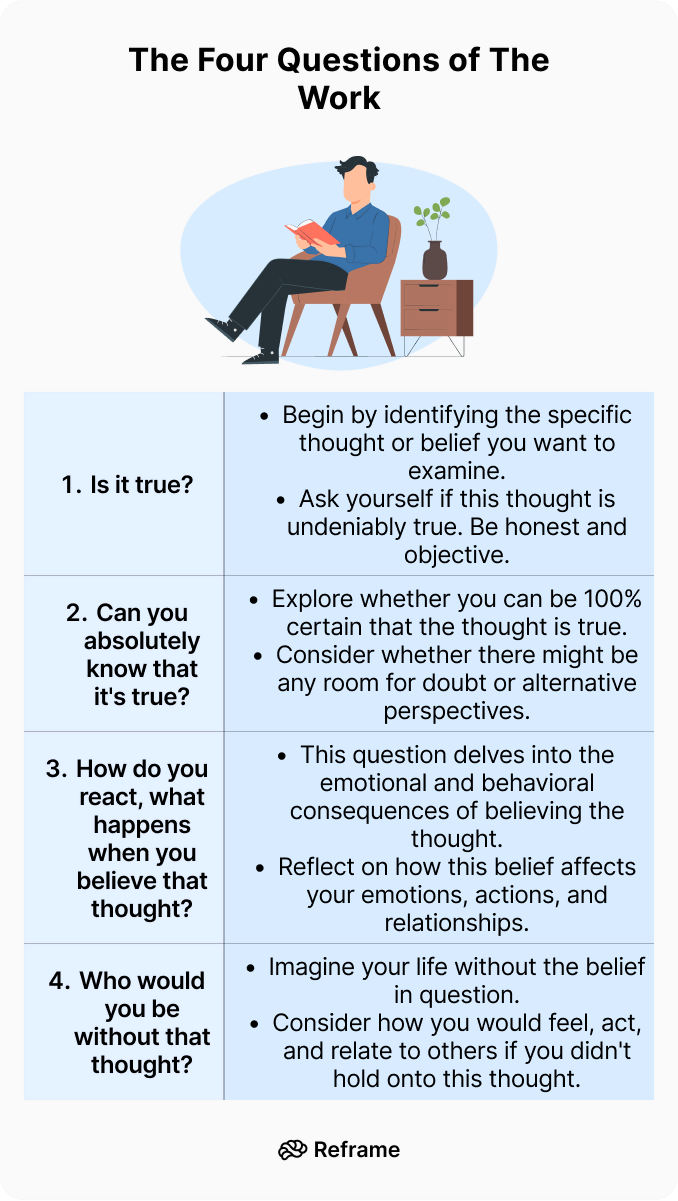
Translating an intellectual understanding of The Work into actionable steps can make all the difference. A seven-step plan brings the principles off the page and into everyday life, offering an effective approach to alcohol moderation or abstinence.
The first action is straightforward but immensely valuable: writing down the thoughts that come up when contemplating drinking. Whether these thoughts are about needing alcohol to unwind or believing that a party won't be enjoyable without a drink, getting them down on paper brings clarity. It's like taking a snapshot of the mind, providing a tangible reference for self-inquiry.
To make this process even more concrete, Katie created the Judge-Your-Neighbor Worksheet. While the name might sound a bit confrontational, it’s not about pointing fingers at others. It’s a tool designed to capture your stressful thoughts about a situation on paper. You write down your uncensored judgments about someone else—or even yourself. This act of writing brings your internal narrative out into the open, making it easier to examine. For example, you might write, "My friend is pressuring me to drink." This worksheet provides the raw material you'll use for the four questions and the Turnaround, giving you a clear and structured way to begin your inquiry.
Once you’ve filled out the worksheet, you apply the four questions to each statement you wrote. Is it true that your friend is pressuring you? Can you absolutely know that’s true? How do you feel when you believe that thought? Who would you be without it? This structured questioning helps you dissect the belief and see how it shapes your emotional response. The final step is the Turnaround, where you find the opposite of your original thought. "My friend is pressuring me to drink" could become "I am pressuring myself to drink" or "My friend is not pressuring me to drink." This simple flip can reveal surprising insights about your own motivations and perceptions, fostering the personal growth needed to change your habits.
With your thoughts in black and white, choose one to scrutinize. Pick a thought that frequently crops up and incites strong emotional or physical reactions, such as the urge to reach for a drink. Identifying such a critical thought provides a focal point for your investigation and increases the likelihood of a meaningful revelation.
Once you’ve picked the thought, dedicate some quiet time to ask Byron Katie's four questions. This is where the rubber meets the road! Be honest and thorough in your answers, possibly jotting down your reflections for each question. This both amplifies your self-awareness and creates a written record that can be revisited to track progress.
After you've gone through the four questions, it's time for the Turnaround. Formulate the opposite of your original thought and examine how this new thought feels. Does it bring relief? Does it seem more valid than the initial thought? This practice challenges the neural pathways accustomed to old thinking patterns, inviting your brain to consider fresh possibilities.
Armed with new insights, try to engage in replacement behaviors the next time the urge to drink arises. If the original thought was about needing alcohol to socialize, consider testing the waters with non-alcoholic beverages at the next social gathering. Pay attention to the experience and note how it differs from events where alcohol was involved.
Sometimes it helps to involve trusted individuals in the process. Share the insights you’ve gained through The Work, and ask for their perspectives. They may offer valuable observations that could add another layer of understanding to the process.
After a reasonable period — say, a few weeks — revisit the original thought and go through the four questions again. Assess any changes in your emotional response or behavior. If the initial insight feels less potent, consider whether another thought that may require scrutiny has taken its place.
By diligently following these steps, you can feel more empowered to deconstruct the beliefs that have fueled your habitual alcohol use. It's a path not just to changing your relationship with alcohol moderation or quitting but also towards greater emotional freedom and self-understanding.
Like any method for personal growth, The Work doesn't exist in a vacuum. It shares similarities with other well-known practices and has also faced its share of scrutiny. Understanding its place in the broader landscape of psychological tools can help you decide if it’s the right fit for your journey. It’s always wise to approach new techniques with an open and informed mind, considering both their potential benefits and the valid concerns that have been raised. This balanced perspective allows you to engage with the process more effectively and mindfully, ensuring it aligns with your personal values and goals for changing your relationship with alcohol.
If you're familiar with Cognitive Behavioral Therapy (CBT) or mindfulness, you might notice some overlap with The Work. Both CBT and The Work focus on identifying and challenging the thoughts that lead to emotional distress. However, The Work is unique because of its highly structured four-question process. While CBT offers a broad range of techniques to reframe negative thinking, The Work provides a specific, repeatable inquiry to dissect stressful beliefs one by one. Similarly, mindfulness encourages observing thoughts without judgment, and The Work takes this a step further by actively investigating those thoughts to dismantle their power over you. It’s a more direct and confrontational approach to the stories we tell ourselves.
While many people have found profound freedom through The Work, it’s important to be aware of some common criticisms. No single method is a perfect solution for everyone, and being mindful of potential pitfalls can help you use this tool more responsibly. The main points of contention often revolve around its application in situations involving trauma and its accessibility for everyone who might need it. Considering these points allows you to approach The Work with a more nuanced understanding, ensuring it serves as a supportive tool rather than an oversimplified fix for complex emotional issues.
One of the most significant criticisms leveled against The Work is that it can feel like a form of victim-blaming. Because the process encourages you to take full responsibility for your thoughts and reactions, some argue it can inadvertently downplay the impact of external factors like systemic injustice or abuse. For example, questioning the thought "My boss mistreated me" could lead to a Turnaround like "I mistreated myself," which might feel invalidating. It's a valid concern, and it highlights the importance of applying The Work with care, especially when dealing with trauma. The goal isn't to deny reality but to find freedom from the suffering your thoughts about reality are causing.
Another practical consideration is accessibility. While Byron Katie offers a wealth of free resources online, including worksheets and videos, accessing personalized support can be a barrier for some. Working with a certified facilitator or attending a workshop can be expensive, which raises questions about who can truly benefit from the full scope of the practice. While you can certainly make progress on your own or with a partner, those who feel they need more intensive guidance might find the cost prohibitive. It’s worth exploring the free materials first to see how far they can take you on your journey.
If you’re ready to try The Work for yourself, the good news is that you don’t need much to begin. The process is designed to be simple and accessible, and there are plenty of resources available to guide you. Whether you prefer reading, writing, or working with others, you can find a method that suits your style. The key is to start where you are, with a single stressful thought. From there, these tools can help you navigate the four questions and the Turnaround, opening up a new way of relating to your mind and the habits you want to change.
For those who like to learn by reading, Byron Katie has written several books that explain her philosophy in depth. Her most famous book, Loving What Is: Four Questions That Can Change Your Life, is the perfect starting point. It lays out the entire method with clear explanations and compelling examples from her work with others. Another great read is A Thousand Names for Joy: Living in Harmony with the Way Things Are, which connects her insights to the ancient wisdom of the Tao Te Ching. These books provide the foundational knowledge and inspiration you might need to fully commit to the practice and see how it can apply to your life.
You don't need to spend any money to get started with The Work. The official website, TheWork.com, is a treasure trove of free resources. You can download various worksheets, including the "Judge-Your-Neighbor" worksheet, which is designed to help you capture your stressful thoughts on paper so you can question them effectively. The site also offers numerous videos of Byron Katie facilitating The Work with others, which can be incredibly helpful for understanding the nuances of the process. These tools are designed to empower you to start your own inquiry right away, making the method accessible to anyone with an internet connection.
The Work is a flexible practice that you can do in several ways. Many people start by doing it alone, using a journal to write down their thoughts and answer the four questions. This can be a powerful form of self-reflection. You can also practice with a partner, taking turns facilitating each other through the inquiry process. Having someone else ask the questions can help you stay focused and go deeper. For more complex or deeply ingrained beliefs, you might consider working with a certified facilitator who is trained to guide you through the process with skill and compassion. This flexibility allows you to tailor the practice to your specific needs and comfort level.
While the journey to cut back or quit alcohol often comes with its set of hurdles, integrating The Work into our routine can be freeing. This exercise doesn’t promise a magic fix, but it provides the tools for healthier decision-making. Imagine a future family beach day where dad joins in building sandcastles with the kids, experiencing genuine happiness and leaving no room for guilt. A future like this is possible, thanks to the power of introspection and the right kind of work!
What if my stressful thought feels undeniably true? This is a common and important question. The Work isn't about denying reality. If your thought is, "I drank too much last night," the fact is you did. The inquiry isn't meant to dispute the event itself, but to investigate the painful story you've attached to it. You can question the thoughts that follow, like "I have no self-control" or "I'll never change." The goal is to separate the neutral facts from the stressful interpretations that cause you suffering.
Isn't this just a form of positive thinking? Not at all. Positive thinking often involves forcing yourself to believe a pleasant thought, even when it doesn't feel true. The Work is about inquiry, not affirmation. It guides you to find your own truth by questioning what you currently believe. The process often leads to a more peaceful perspective, but that peace comes from genuine clarity and seeing things as they are, not from layering a positive statement on top of a painful belief.
The "Turnaround" feels forced, like I'm just lying to myself. How do I make it feel genuine? That feeling is completely normal at first. The key is to treat the Turnaround as an experiment, not a command. After you state the opposite of your original thought, your job is to find at least three specific, real-life examples where that new thought is just as true, or even truer. If you can't find any, that's okay. But the act of sincerely looking for evidence helps your mind see that your original thought isn't the only version of reality available.
How often should I be doing "The Work"? There's no strict rule, and you don't need to turn it into a chore. A great way to start is by using it whenever you notice a particularly stressful thought that keeps coming back. You can set aside 15-20 minutes to sit down with a pen and paper and take one of those thoughts through the four questions. Over time, you might find yourself doing it more naturally in the moment, but starting with a dedicated practice for your most persistent beliefs is highly effective.
Can this process replace therapy or a program like Reframe? Think of The Work as a powerful tool for your personal toolkit, not necessarily a replacement for structured support. It's a form of self-coaching that can be incredibly effective for dissecting the beliefs that drive your habits. It complements programs like Reframe, which provide daily structure, community, and a broader range of cognitive techniques. Using them together can create a comprehensive approach to changing your relationship with alcohol.
A dad sips a beer at the beach, watching his kids play. Suddenly, a thought hits him with a pang of guilt: “Is this how I want to be remembered?” This internal struggle is a familiar story for many of us trying to change our relationship with alcohol. But what if you could question that guilty thought instead of letting it control you? That's the power of Byron Katie The Work. It’s a simple, structured inquiry that helps you dismantle the stressful beliefs behind your drinking, using just four key questions to find clarity and peace.
While the internet is rife with articles and tips about cutting back on alcohol, a shift in focus can be surprisingly effective. This brings us to "The Work" by Byron Katie, a system of self-inquiry designed to shift mental habits. Originally created as a way to address stress, depression, and other forms of emotional suffering, The Work helps us challenge the thoughts that keep us attached to unhealthy behaviors.
Byron Katie is an American author and motivational speaker who is best known for creating a self-inquiry method known as "The Work." Born in 1942, Katie hit a low point in her life in her early 40s, suffering from depression and various other emotional issues. She had a life-altering realization in 1986, which she claims led to a complete end of her suffering. She developed The Work as a method to help millions of others achieve a similar state of peace and clarity.
When people hear the term "The Work," it might conjure up images of labor-intensive endeavors or complicated research projects. However, Byron Katie's The Work is something altogether different. It's a methodology aimed at scrutinizing the thought patterns that lead to emotional distress, harmful behavior, or a cycle of regret.
Here’s a closer look at each component of Katie’s unique mental framework, which consists of four questions and a Turnaround. Remember: for the best results, it’s important to answer these questions as thoroughly and honestly as possible.
Before developing her method, "The Work," Byron Katie was in a place many of us can recognize. In her 40s, she struggled with severe depression, anxiety, and used alcohol to cope with the pain. Her life changed in 1986 with a powerful realization: her suffering wasn't caused by her circumstances, but by her belief in her own stressful thoughts. This personal epiphany became the foundation of her entire philosophy—a simple yet profound way for anyone to question the thoughts that cause them pain. Her journey from deep personal struggle to clarity shows that real change is possible, not by trying to change the world around us, but by changing the mind that perceives it.
The central idea of Byron Katie's philosophy is that we suffer only when we attach to stressful thoughts. Think about the stories you might tell yourself about drinking, regret, or your ability to change your habits. "The Work" provides a framework to investigate these thoughts instead of automatically accepting them as true. It’s about creating a pause and asking, "Is this thought *really* true?" This simple act of questioning can start to dismantle the narratives that keep us feeling stuck. It’s not about forcing yourself to be positive, but about finding clarity, which is a huge part of practicing mindful drinking and building a healthier relationship with alcohol.
This leads to a really empowering conclusion: suffering is optional. When we realize our pain comes from believing our thoughts, we gain the power to choose a different response. We can't always stop a negative or unhelpful thought from popping into our heads, but we don't have to treat it as an undeniable fact. We can learn to simply notice it, question it, and let it go without getting tangled up in it. This is where our freedom lies—in the space between a thought and our reaction to it.
Katie often says that when you argue with reality, you lose—but only 100% of the time. Fighting what is ("I shouldn't have felt that craving," or "I wish I hadn't had that drink last night") is a recipe for stress. Acceptance isn't about being passive or giving up; it's about stopping the pointless fight with what has already happened. This frees up your energy so you can focus on what you can control: your very next choice and the actions you take moving forward.
Imagine walking into a dark room and seeing a snake coiled on the floor. Your heart pounds, you freeze in panic. But when you flip on the light, you realize it was just a rope all along. Our stressful thoughts are the snake; "The Work" is the light switch. It helps us take a second look and see our fears for what they often are—mental projections, not reality. By investigating our thoughts, we can stop reacting to imaginary snakes and see the harmless rope instead.
Imagine thinking "I'm not good enough." Many people grapple with this thought, which can lead to destructive behaviors, such as excessive drinking to numb the feeling of inadequacy. The first question, “Is it true?“ challenges the validity of this thought. This question is compelling because it requires more than a knee-jerk reaction. It asks for evidence, nudging us to really evaluate whether the thought stands up to scrutiny. This question alone can sometimes lead to a breakthrough, as individuals realize that many of their long-held beliefs are not actually true.
Let's say the answer to the first question was "Yes." The second question takes it to another level: "Can you absolutely know that it's true?" This question pushes for an even deeper level of introspection. It's a call to examine the bases of the beliefs and whether they're rock-solid. A closer look often shows that certainty is a mirage. A truth in one context can be a falsehood in another. This question throws a wrench into the machinery of our thought processes, forcing us to reevaluate what we once considered indisputable.
The third question steers the process toward emotional awareness: "How do you react when you believe that thought?" For instance, believing we need alcohol to unwind often leads to repeated drinking, emotional distance from loved ones, and a gnawing sense of dependency. By confronting the emotional and physical reactions that accompany a thought, we see the full impact of that belief, good or bad. This question links thoughts to outcomes, making clear how a single belief can shape our actions and emotional state.
"Who would you be without the thought?" After grappling with the truth, certainty, and emotional aftermath of a thought, answering the fourth question offers us a glimpse into a different reality. It opens the door to envision a life not governed by that particular belief. In the context of alcohol moderation or abstinence, the idea of enjoying social situations without the crutch of alcohol could seem like a newfound freedom.
The final step, the "Turnaround," reverses the original thought to explore its opposite or other variations. For instance, the Turnaround for "I need a drink to relax" could be "I don’t need a drink to relax." It invites a host of alternative truths (“I can relax without a drink,” “I do yoga to relax,” etc.), further diluting the power of the original, troublesome thought.
Simply stating the opposite of a long-held belief isn't always enough to make it stick. The real power comes from finding concrete evidence from your own life that proves the turnaround is true, or even truer, than your original thought. The goal is to find at least three specific, genuine examples. If your original thought was, "I need a drink to relax," and your turnaround is, "I don't need a drink to relax," your examples might look like this: 1. "Last week, I was tense after a long meeting, but listening to a podcast on my walk home made me feel completely at ease." 2. "That time I took a hot bath with lavender oil, I felt my muscles unwind better than they do with a glass of wine." 3. "Playing with my dog in the yard for 15 minutes yesterday made me laugh and forget all about my work stress." These aren't just vague ideas; they are real memories that anchor the new belief in reality, making it much easier for your mind to accept.
The turnaround is more than just flipping a sentence to its direct opposite. It’s a creative process that allows you to examine a belief from multiple angles. Let's take the thought, "My friends will think I'm boring if I don't drink." You can turn this around in a few ways. The direct opposite is, "My friends will *not* think I'm boring if I don't drink." Another form is turning it around to yourself: " *I* will think *I'm* boring if I don't drink," which reveals the pressure might be internal. A third form is turning it to the other: " *I* will think *my friends* are boring if *they* don't drink." This can expose a hidden judgment you hold. Exploring these variations helps dismantle the original thought by showing you other, equally valid perspectives on the situation, which is a key part of practicing mindful drinking.
In combination, these four questions and the Turnaround become a powerful algorithm for dissecting the thoughts that influence behavior and emotional well-being. Each question peels away a layer of unquestioned beliefs, revealing a core that is often malleable and not as deterministic as initially believed. For anyone willing to invest in emotional and psychological betterment, Byron Katie’s exercise serves as a structured, insightful pathway to a less burdened mind.
When it comes to alcohol moderation or complete abstinence, we may find that changing our drinking habits is not as simple as just putting down the bottle. The pull towards alcohol often begins in the mind, rooted in thoughts and beliefs that have been ingrained over time. This is precisely where The Work proves invaluable. By focusing on the mental constructs that underlie drinking behavior, this exercise provides a unique strategy that complements traditional approaches to alcohol moderation, such as behavioral therapy or medication.
If the process of The Work resonates with you, you'll find its core principles woven throughout the Reframe experience. Our program is built on a foundation of neuroscience and evidence-based methods that, much like Byron Katie’s approach, focus on identifying and challenging the thoughts that drive our drinking habits. We help you get curious about the beliefs you hold around alcohol — ideas like “I need a drink to relax” or “Social events are boring without alcohol.” Through daily readings and targeted exercises, we guide you to question these automatic thoughts, essentially asking, “Is that really true?” and exploring the emotional impact they have on your life.
This process of self-inquiry is central to creating lasting change. Reframe provides a daily, structured toolkit to help you practice this skill. Our journaling prompts encourage you to connect with how you feel before, during, and after drinking, which mirrors the third question of The Work: “How do you react when you believe that thought?” By tracking your progress and engaging with our educational courses, you begin to see a new reality for yourself — one where you don’t need alcohol to cope or have fun. This helps you answer that powerful fourth question, “Who would you be without that thought?” and actively build a life that reflects your true goals for mindful drinking and well-being.
Let’s take the commonly-held belief that alcohol is essential for social interactions. Society often glamorizes drinking through media portrayals, telling us that alcohol is synonymous with fun, relaxation, and even sophistication. This creates a mental narrative that suggests we can't be socially adept or enjoy an evening without a drink in hand. The first question of The Work, "Is it true?", calls this assumption into question. Upon reflection, many may find that they have had rewarding social experiences without alcohol. Therefore, the automatic response that alcohol is essential for social enjoyment starts to waver.
Another recurrent thought is that alcohol is a necessary coping mechanism for stress or emotional turmoil. “I need a drink to unwind” or “Alcohol helps me forget my problems” are statements that many have heard or said. The second question, "Can you absolutely know that it's true?", often reveals that these are not universal truths but conditioned responses. Many people unwind or cope with difficulties without relying on alcohol. This realization can be eye-opening, paving the way for exploring healthier coping mechanisms.
The third question, "How do you react when you believe that thought?", allows us to become aware of the emotional and physical toll of our drinking habits. Do we feel guilty after giving in to the urge? Is there a strain on relationships or a decline in work performance? Recognizing these repercussions makes it increasingly hard to ignore the negative consequences of alcohol consumption.
The fourth question, "Who would you be without the thought?", encourages us to envision a life free from the clutches of alcohol dependency. What would it be like to wake up without a hangover, to enjoy a social event without needing a drink to “loosen up,” or to handle stress through exercise or meditation instead of through alcohol? This can be a liberating mental exercise, inspiring changes in behavior.
Finally, the Turnaround offers alternative perspectives that challenge the initial thought, suggesting that not only is it possible to relax, socialize, or cope without alcohol, but it may actually be more rewarding and beneficial.
In summary, The Work provides a comprehensive framework for addressing the psychological underpinnings of alcohol consumption. It equips us with the intellectual tools to question, challenge, and ultimately change the thought patterns that drive us towards alcohol, making it a potent ally in the quest for moderation or abstinence.
Translating an intellectual understanding of The Work into actionable steps can make all the difference. A seven-step plan brings the principles off the page and into everyday life, offering an effective approach to alcohol moderation or abstinence.
The first action is straightforward but immensely valuable: writing down the thoughts that come up when contemplating drinking. Whether these thoughts are about needing alcohol to unwind or believing that a party won't be enjoyable without a drink, getting them down on paper brings clarity. It's like taking a snapshot of the mind, providing a tangible reference for self-inquiry.
To make this process even more concrete, Katie created the Judge-Your-Neighbor Worksheet. While the name might sound a bit confrontational, it’s not about pointing fingers at others. It’s a tool designed to capture your stressful thoughts about a situation on paper. You write down your uncensored judgments about someone else—or even yourself. This act of writing brings your internal narrative out into the open, making it easier to examine. For example, you might write, "My friend is pressuring me to drink." This worksheet provides the raw material you'll use for the four questions and the Turnaround, giving you a clear and structured way to begin your inquiry.
Once you’ve filled out the worksheet, you apply the four questions to each statement you wrote. Is it true that your friend is pressuring you? Can you absolutely know that’s true? How do you feel when you believe that thought? Who would you be without it? This structured questioning helps you dissect the belief and see how it shapes your emotional response. The final step is the Turnaround, where you find the opposite of your original thought. "My friend is pressuring me to drink" could become "I am pressuring myself to drink" or "My friend is not pressuring me to drink." This simple flip can reveal surprising insights about your own motivations and perceptions, fostering the personal growth needed to change your habits.
With your thoughts in black and white, choose one to scrutinize. Pick a thought that frequently crops up and incites strong emotional or physical reactions, such as the urge to reach for a drink. Identifying such a critical thought provides a focal point for your investigation and increases the likelihood of a meaningful revelation.
Once you’ve picked the thought, dedicate some quiet time to ask Byron Katie's four questions. This is where the rubber meets the road! Be honest and thorough in your answers, possibly jotting down your reflections for each question. This both amplifies your self-awareness and creates a written record that can be revisited to track progress.
After you've gone through the four questions, it's time for the Turnaround. Formulate the opposite of your original thought and examine how this new thought feels. Does it bring relief? Does it seem more valid than the initial thought? This practice challenges the neural pathways accustomed to old thinking patterns, inviting your brain to consider fresh possibilities.
Armed with new insights, try to engage in replacement behaviors the next time the urge to drink arises. If the original thought was about needing alcohol to socialize, consider testing the waters with non-alcoholic beverages at the next social gathering. Pay attention to the experience and note how it differs from events where alcohol was involved.
Sometimes it helps to involve trusted individuals in the process. Share the insights you’ve gained through The Work, and ask for their perspectives. They may offer valuable observations that could add another layer of understanding to the process.
After a reasonable period — say, a few weeks — revisit the original thought and go through the four questions again. Assess any changes in your emotional response or behavior. If the initial insight feels less potent, consider whether another thought that may require scrutiny has taken its place.
By diligently following these steps, you can feel more empowered to deconstruct the beliefs that have fueled your habitual alcohol use. It's a path not just to changing your relationship with alcohol moderation or quitting but also towards greater emotional freedom and self-understanding.
Like any method for personal growth, The Work doesn't exist in a vacuum. It shares similarities with other well-known practices and has also faced its share of scrutiny. Understanding its place in the broader landscape of psychological tools can help you decide if it’s the right fit for your journey. It’s always wise to approach new techniques with an open and informed mind, considering both their potential benefits and the valid concerns that have been raised. This balanced perspective allows you to engage with the process more effectively and mindfully, ensuring it aligns with your personal values and goals for changing your relationship with alcohol.
If you're familiar with Cognitive Behavioral Therapy (CBT) or mindfulness, you might notice some overlap with The Work. Both CBT and The Work focus on identifying and challenging the thoughts that lead to emotional distress. However, The Work is unique because of its highly structured four-question process. While CBT offers a broad range of techniques to reframe negative thinking, The Work provides a specific, repeatable inquiry to dissect stressful beliefs one by one. Similarly, mindfulness encourages observing thoughts without judgment, and The Work takes this a step further by actively investigating those thoughts to dismantle their power over you. It’s a more direct and confrontational approach to the stories we tell ourselves.
While many people have found profound freedom through The Work, it’s important to be aware of some common criticisms. No single method is a perfect solution for everyone, and being mindful of potential pitfalls can help you use this tool more responsibly. The main points of contention often revolve around its application in situations involving trauma and its accessibility for everyone who might need it. Considering these points allows you to approach The Work with a more nuanced understanding, ensuring it serves as a supportive tool rather than an oversimplified fix for complex emotional issues.
One of the most significant criticisms leveled against The Work is that it can feel like a form of victim-blaming. Because the process encourages you to take full responsibility for your thoughts and reactions, some argue it can inadvertently downplay the impact of external factors like systemic injustice or abuse. For example, questioning the thought "My boss mistreated me" could lead to a Turnaround like "I mistreated myself," which might feel invalidating. It's a valid concern, and it highlights the importance of applying The Work with care, especially when dealing with trauma. The goal isn't to deny reality but to find freedom from the suffering your thoughts about reality are causing.
Another practical consideration is accessibility. While Byron Katie offers a wealth of free resources online, including worksheets and videos, accessing personalized support can be a barrier for some. Working with a certified facilitator or attending a workshop can be expensive, which raises questions about who can truly benefit from the full scope of the practice. While you can certainly make progress on your own or with a partner, those who feel they need more intensive guidance might find the cost prohibitive. It’s worth exploring the free materials first to see how far they can take you on your journey.
If you’re ready to try The Work for yourself, the good news is that you don’t need much to begin. The process is designed to be simple and accessible, and there are plenty of resources available to guide you. Whether you prefer reading, writing, or working with others, you can find a method that suits your style. The key is to start where you are, with a single stressful thought. From there, these tools can help you navigate the four questions and the Turnaround, opening up a new way of relating to your mind and the habits you want to change.
For those who like to learn by reading, Byron Katie has written several books that explain her philosophy in depth. Her most famous book, Loving What Is: Four Questions That Can Change Your Life, is the perfect starting point. It lays out the entire method with clear explanations and compelling examples from her work with others. Another great read is A Thousand Names for Joy: Living in Harmony with the Way Things Are, which connects her insights to the ancient wisdom of the Tao Te Ching. These books provide the foundational knowledge and inspiration you might need to fully commit to the practice and see how it can apply to your life.
You don't need to spend any money to get started with The Work. The official website, TheWork.com, is a treasure trove of free resources. You can download various worksheets, including the "Judge-Your-Neighbor" worksheet, which is designed to help you capture your stressful thoughts on paper so you can question them effectively. The site also offers numerous videos of Byron Katie facilitating The Work with others, which can be incredibly helpful for understanding the nuances of the process. These tools are designed to empower you to start your own inquiry right away, making the method accessible to anyone with an internet connection.
The Work is a flexible practice that you can do in several ways. Many people start by doing it alone, using a journal to write down their thoughts and answer the four questions. This can be a powerful form of self-reflection. You can also practice with a partner, taking turns facilitating each other through the inquiry process. Having someone else ask the questions can help you stay focused and go deeper. For more complex or deeply ingrained beliefs, you might consider working with a certified facilitator who is trained to guide you through the process with skill and compassion. This flexibility allows you to tailor the practice to your specific needs and comfort level.
While the journey to cut back or quit alcohol often comes with its set of hurdles, integrating The Work into our routine can be freeing. This exercise doesn’t promise a magic fix, but it provides the tools for healthier decision-making. Imagine a future family beach day where dad joins in building sandcastles with the kids, experiencing genuine happiness and leaving no room for guilt. A future like this is possible, thanks to the power of introspection and the right kind of work!
What if my stressful thought feels undeniably true? This is a common and important question. The Work isn't about denying reality. If your thought is, "I drank too much last night," the fact is you did. The inquiry isn't meant to dispute the event itself, but to investigate the painful story you've attached to it. You can question the thoughts that follow, like "I have no self-control" or "I'll never change." The goal is to separate the neutral facts from the stressful interpretations that cause you suffering.
Isn't this just a form of positive thinking? Not at all. Positive thinking often involves forcing yourself to believe a pleasant thought, even when it doesn't feel true. The Work is about inquiry, not affirmation. It guides you to find your own truth by questioning what you currently believe. The process often leads to a more peaceful perspective, but that peace comes from genuine clarity and seeing things as they are, not from layering a positive statement on top of a painful belief.
The "Turnaround" feels forced, like I'm just lying to myself. How do I make it feel genuine? That feeling is completely normal at first. The key is to treat the Turnaround as an experiment, not a command. After you state the opposite of your original thought, your job is to find at least three specific, real-life examples where that new thought is just as true, or even truer. If you can't find any, that's okay. But the act of sincerely looking for evidence helps your mind see that your original thought isn't the only version of reality available.
How often should I be doing "The Work"? There's no strict rule, and you don't need to turn it into a chore. A great way to start is by using it whenever you notice a particularly stressful thought that keeps coming back. You can set aside 15-20 minutes to sit down with a pen and paper and take one of those thoughts through the four questions. Over time, you might find yourself doing it more naturally in the moment, but starting with a dedicated practice for your most persistent beliefs is highly effective.
Can this process replace therapy or a program like Reframe? Think of The Work as a powerful tool for your personal toolkit, not necessarily a replacement for structured support. It's a form of self-coaching that can be incredibly effective for dissecting the beliefs that drive your habits. It complements programs like Reframe, which provide daily structure, community, and a broader range of cognitive techniques. Using them together can create a comprehensive approach to changing your relationship with alcohol.

Learn what decision fatigue is, how it affects your daily choices, and get practical tips to overcome mental exhaustion and make better decisions.
Although it isn’t a treatment for alcohol use disorder (AUD), the Reframe app can help you cut back on drinking gradually, with the science-backed knowledge to empower you 100% of the way. Our proven program has helped millions of people around the world drink less and live more. And we want to help you get there, too!
The Reframe app equips you with the knowledge and skills you need to not only survive drinking less, but to thrive while you navigate the journey. Our daily research-backed readings teach you the neuroscience of alcohol, and our in-app Toolkit provides the resources and activities you need to navigate each challenge.
You’ll meet millions of fellow Reframers in our 24/7 Forum chat and daily Zoom check-in meetings. Receive encouragement from people worldwide who know exactly what you’re going through! You’ll also have the opportunity to connect with our licensed Reframe coaches for more personalized guidance.
Plus, we’re always introducing new features to optimize your in-app experience. We recently launched our in-app chatbot, Melody, powered by the world’s most powerful AI technology. Melody is here to help as you adjust to a life with less (or no) alcohol.
And that’s not all! Every month, we launch fun challenges, like Dry/Damp January, Mental Health May, and Outdoorsy June. You won’t want to miss out on the chance to participate alongside fellow Reframers (or solo if that’s more your thing!).
The Reframe app is free for 7 days, so you don’t have anything to lose by trying it. Are you ready to feel empowered and discover life beyond alcohol? Then download our app through the App Store or Google Play today!
You’ve pulled through a grueling workday, making countless choices along the way. Now you're home, staring into the fridge, and that bottle of wine is calling your name. Why does saying 'no' feel like the hardest decision of the day? It's not a lack of willpower. It's decision fatigue—the mental exhaustion from all those earlier choices. This choice fatigue is a classic trigger, explaining the strong link between alcohol and fatigue. We'll show you how to protect your mental energy so that making a healthier choice doesn't feel like another battle.
Sound familiar? In the neverending decision-making that characterizes modern life, the phenomenon known as "decision fatigue" often pulls the strings, especially when it comes to habits like drinking. But don’t worry: today we’re discussing science-backed ways to navigate this conundrum and make decisions towards a healthier you.
Decision fatigue isn't simply confined to choosing between a glass of wine or sparkling water at the end of a long day. In fact, it infiltrates multiple facets of daily life, impacting not just personal habits, but also relationships, professional output, and overall well-being.
It might sound unbelievable, but research suggests the average person makes around 35,000 decisions every single day. This count starts the moment your alarm goes off: Should you hit snooze? What will you wear? What’s for breakfast? These small choices pile up, and that’s before you even get to the bigger, more complex decisions at work or in your personal life. Each choice, no matter how minor, chips away at your mental energy. By the time evening rolls around, your brain has run a marathon. It’s no wonder that when faced with the choice of whether to have a drink, the path of least resistance—the familiar habit—often feels like the only one you have the energy for.
So, how do you know if you’re dealing with decision fatigue? It’s more than just feeling a little tired or indecisive. This mental exhaustion shows up in distinct ways, affecting your thoughts, emotions, and even your physical body. Recognizing these signs is the first step toward managing them. When you can pinpoint what’s happening, you can start to understand why you might be reaching for a drink instead of sticking to your goals. Let’s look at some of the common symptoms you might experience when your decision-making power is running on empty.
When your brain is overloaded, its processing power slows way down. Cognitively, decision fatigue can make it much harder to think clearly, especially when you need to solve problems or use your reasoning skills. You might find yourself procrastinating on simple tasks, making impulsive choices you later regret, or avoiding decisions altogether. This is often described as “analysis paralysis,” where you get stuck overthinking without ever moving forward. It’s your mind’s way of waving a white flag, signaling that it just can’t handle another complex thought process right now.
Emotionally, decision fatigue can leave you feeling completely drained. You might experience what’s often called “brain fog,” where your thoughts feel hazy and unfocused. Irritability is another classic sign; small annoyances that you’d normally brush off can suddenly feel like major issues. This emotional depletion can make you feel apathetic or less empathetic toward others because you simply don’t have the mental bandwidth to engage. When you’re in this state, the immediate comfort of a drink can seem like a welcome escape from the overwhelming feeling of being mentally and emotionally exhausted.
The mental stress of constant decision-making doesn’t just stay in your head—it can manifest physically, too. According to the Cleveland Clinic, this strain can lead to tension headaches, persistent eye twitching, or even stomach issues like nausea. Your body keeps the score, and when your mind is overworked, it can trigger a physical stress response. If you’ve ever felt physically unwell after a particularly demanding day, even if you haven’t done much physical activity, decision fatigue could be the culprit. It’s a powerful reminder of the deep connection between our mental and physical health.
If you need a powerful, real-world example of decision fatigue in action, look no further than a famous study on parole board judges. Researchers found that a prisoner’s chance of being granted parole depended heavily on the time of day their case was heard. At the beginning of a session, judges granted parole about 65% of the time. However, as the day wore on, that number steadily dropped to nearly zero. After the judges took a food break, the approval rate shot right back up to 65% before declining again. This study perfectly illustrates that as mental energy wanes, people tend to default to the safest, simplest option—in this case, denying parole and maintaining the status quo.
The leading theory behind decision fatigue is a concept called “ego depletion.” Think of your willpower and self-control as a finite resource, like gas in a car. Every decision you make, from choosing your outfit to resisting a donut in the breakroom, uses up a little bit of that fuel. By the end of the day, your tank is low, making it much harder to exert self-control for the choices that really matter, like sticking to your drinking goals. While this is a popular and useful model, it’s worth noting that the concept of ego depletion is debated among some researchers. Regardless of the exact mechanism, the experience of feeling mentally drained after a long day of choices is something many of us can relate to.
Let's dive into the scientific underpinnings a bit. Baumeister et al. (1998) coined the term "ego depletion" to describe the idea that self-control or willpower operates like a finite resource. In their seminal study, they found that subjects who resisted the temptation of cookies and chocolate were later less able to persist in a problem-solving task. This led to the hypothesis that exerting willpower in one task depletes a general resource, leaving less of it for subsequent tasks.
For example, imagine you're on a strict diet, and you've committed to not eating any sweets or unhealthy snacks. One day, you find a plate of freshly baked chocolate chip cookies in your office lunchroom. You love chocolate chip cookies, and they smell amazing. But you remember your diet commitment, and with a tremendous amount of willpower, you resist the temptation and walk away without taking a cookie.
Later in the evening, you find yourself needing to study for an upcoming exam. Normally, you'd aim to study for a couple of hours. However, you find it unusually difficult to concentrate. After just 30 minutes, you feel drained and decide to stop studying and watch TV instead.
In this example, the act of resisting the cookies earlier in the day depleted your reserve of self-control or willpower, making it harder for you to persist in your studying later on. Your willpower was stretched thin by the initial act of resistance, which left less of this "finite resource" for the subsequent task of studying.
The brain plays a pivotal role in decision-making, with specific neurotransmitters like dopamine and serotonin influencing how choices are made. Exerting self-control tends to lower levels of glucose in the brain, which is the primary energy source for neural activity. A study by Gailliot et al. (2007) found that replenishing glucose levels could actually restore self-control, giving a physiological explanation for why making many decisions can be so exhausting.
From the moment the alarm buzzes in the morning to the final glance at a smartphone before sleep, modern life is replete with micro-decisions. What to wear, what to eat, how to prioritize work tasks — the list is never-ending. Each of these decisions, no matter how trivial, taps into the brain's decision-making reservoir. By the time evening rolls around, the well might be running dry, which often results in opting for the path of least resistance: pouring that extra glass of wine, binging on unhealthy snacks, or zoning out in front of the TV.
When decision fatigue sets in, the quality of our choices deteriorates — and our capacity for future planning also takes a hit. A study by Hagger et al. (2010) found that ego depletion negatively affects future planning, attention, and task performance. It's a snowball effect: poor decisions deplete resources, which leads to further poor decisions, creating a cycle that's hard to break.
Research has identified certain times of day when people are most susceptible to decision fatigue. It turns out that self-control and the ability to make good choices actually follow a diurnal pattern, generally peaking in the morning and declining as the day progresses. This explains why, by the time wine o'clock comes around, the willpower muscle is not just tired — it's utterly fatigued.
Interestingly, the social environment can either alleviate or exacerbate decision fatigue. Supportive relationships, work settings that foster autonomy, and a social milieu that bolsters self-esteem all act as buffers. However, environments rife with stress, criticism, and high demands can accelerate the rate at which decision-making resources are drained.
Decision avoidance or decision simplification is a strategy to reduce decision fatigue by minimizing or automating trivial choices to conserve mental energy for more important tasks. Methods include adopting a minimalist wardrobe, meal planning, automating recurring decisions like bill payments, and time-blocking activities. By delegating, limiting options, or using heuristics for minor choices, we can streamline our decision-making process, preserving our cognitive resources and enabling better focus and performance in areas that truly matter. Overall, decision avoidance aims to improve well-being by prioritizing meaningful decisions over trivial ones.
Understanding the multifaceted nature of decision fatigue helps us implement changes that facilitate better choices, especially when it comes to ingrained habits like alcohol consumption. The objective isn't just to make fewer decisions, but to make better ones by mitigating the factors that lead to decision fatigue.
The impact of decision fatigue doesn't stop when you close the refrigerator door. This mental drain quietly spills over into nearly every corner of our lives, influencing everything from what we buy at the grocery store to how we interact with the people we love most. When our willpower is running on empty, we tend to take the path of least resistance, which can have significant consequences for our finances, relationships, and overall happiness. Recognizing how this fatigue shows up in different areas is the first step toward managing it effectively and making choices that align with our long-term goals, rather than just our immediate exhaustion.
Have you ever gone to the store for just a few essentials and walked out with a cart full of things you didn't need? That’s often decision fatigue at play. After a long day of making choices, your brain is tired of weighing pros and cons. As a result, you're more likely to give in to impulse buys and opt for convenience over careful consideration. That brightly packaged snack or on-sale item you don't really need suddenly seems like a great idea because it requires zero mental effort. These small, unplanned purchases can add up, potentially derailing your budget and causing financial stress, which can be a major trigger for other habits you're trying to change. You might be surprised to see how much you can save by being more mindful of these moments.
Decision fatigue can also take a toll on your personal relationships. When you’re mentally exhausted, your patience wears thin, making you more prone to irritability and short-tempered responses with partners, family, or friends. You might find yourself picking a fight over something trivial or withdrawing because you simply don't have the energy for a meaningful conversation. The social environment is a two-way street; supportive relationships can act as a buffer against stress, helping you recharge your mental batteries. However, demanding or critical environments can drain your decision-making resources even faster, making it harder to show up as the patient and engaged person you want to be for your loved ones.
Beyond impulse shopping, decision fatigue can have a broader impact on your financial health. Important financial tasks—like creating a budget, reviewing your investment portfolio, or planning for retirement—require significant mental energy. When you're already drained from daily choices, it's easy to put these big decisions on the back burner, a phenomenon known as decision avoidance. This procrastination can lead to missed opportunities or costly mistakes. One powerful strategy is to simplify and automate. By setting up automatic bill payments or recurring savings transfers, you reduce the number of financial decisions you have to make each month, freeing up mental space for the choices that truly matter for your long-term well-being.
On the surface, the relationship between decision fatigue and alcohol consumption might seem indirect or even non-existent. However, upon closer inspection, it becomes evident that the two are intricately connected, impacting each other in ways that could either hinder or aid in the quest for healthier drinking habits.
Alcohol consumption, especially habitual drinking, often comes under the purview of "automatic behavior," with little conscious thought involved. Automatic behaviors are regulated by the brain's reward system, which releases dopamine to reinforce actions it finds pleasurable. When trying to reduce or quit alcohol, conscious effort and self-control must override this ingrained neurological pattern. This, in turn, depletes your limited willpower reservoir. What's particularly challenging is that you’re also expending willpower in various other tasks throughout the day. When faced with the choice to drink or not to drink, the odds are stacked against you, thanks to decision fatigue.
Time of day plays a crucial role. Many people find that their craving for a drink peaks in the late afternoon or evening — coincidentally, around the same time that decision fatigue usually sets in. This is no coincidence! It’s a synchronization of factors that work against the goal of cutting back on alcohol or quitting.
It's worth mentioning the role of emotions. Emotional decisions, such as those triggered by stress or negative feelings, often require higher amounts of self-control to regulate. Work-related stress, relationship issues, and regular daily hassles can compound decision fatigue, making it more difficult to resist a drink.
Another complicating factor is the domino effect begun by the first drink. Alcohol impairs judgment and diminishes self-control, traits already compromised by decision fatigue. After the first drink, each subsequent decision about having another becomes progressively harder to make responsibly.
Succumbing to temptation can result in negative emotions like guilt or self-blame, which (ironically) many people try to "drown" by consuming more alcohol, thus perpetuating a cycle. This entire sequence often begins with decision fatigue, which undermines the initial resolve to not drink.
A 2012 study published in the journal Alcoholism: Clinical and Experimental Research found a direct relationship between depleted self-control resources and increased alcohol consumption. Participants who engaged in tasks that depleted their self-control were more likely to drink alcohol afterward, supporting the concept that decision fatigue can lead to lapses in attempts to control drinking.
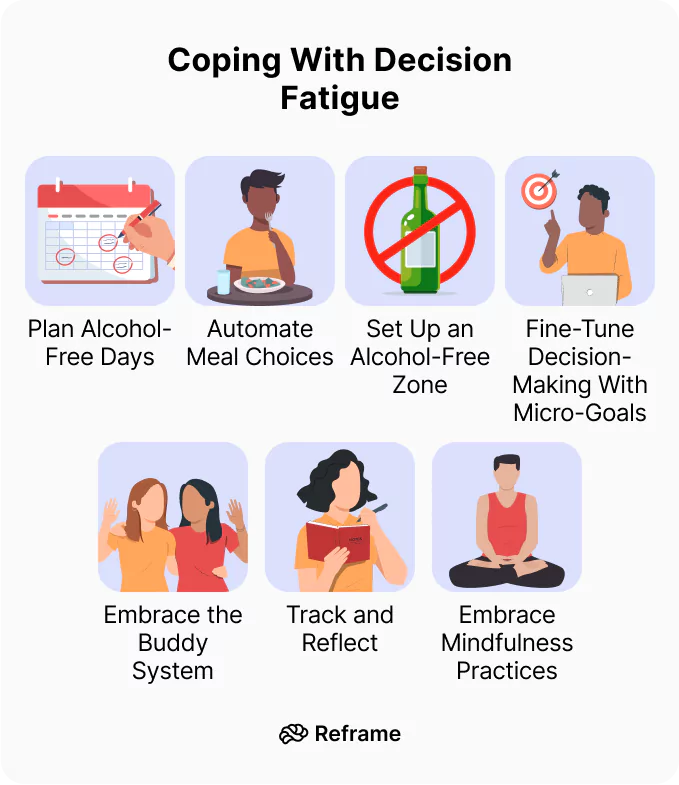
Understanding this link between decision fatigue and alcohol consumption provides valuable insights. It emphasizes the need for strategies designed to conserve mental energy, especially at vulnerable moments, as a part of any effort to reduce or quit drinking. Here are seven ways we can do just that.
Have you ever noticed that it’s easier to stick to your goals at 9 a.m. than at 9 p.m.? That’s because your willpower is at its peak early in the day. Research shows that our ability to make good choices follows a diurnal pattern, meaning it’s strongest in the morning and gradually fades as the day wears on. Use this to your advantage. Instead of waiting until you’re tired and stressed in the evening to decide whether or not to drink, make that choice in the morning. Plan your evening ahead of time. Decide what you’ll eat for dinner, what you’ll watch on TV, and what delicious alcohol-free drink you’ll enjoy. By making the decision when your resolve is high, you set yourself up for success later.
Some of the most successful people on the planet intentionally limit their daily choices. Former President Barack Obama, Steve Jobs, and Mark Zuckerberg famously wore similar outfits every day. Why? To save their mental energy for more important decisions. You can apply this same logic to your own life. Automate and simplify wherever possible. Plan your meals for the week, lay out your clothes the night before, and create routines that run on autopilot. Each small decision you eliminate is a little more willpower you save. This frees up cognitive resources, leaving you with more mental strength at the end of the day to focus on what truly matters, like your commitment to mindful drinking.
You don’t have to carry the weight of every decision. Learning to delegate is a powerful way to reduce your mental load. At work, this might mean trusting a colleague to lead a project. At home, it could be as simple as letting your partner or kids decide what’s for dinner. Delegating isn’t about losing control; it’s about strategically preserving your energy for the choices only you can make. It also helps to break down overwhelming projects into smaller, more manageable tasks. Instead of facing one massive decision, you can tackle a series of smaller ones. This approach makes big goals feel less daunting and reduces the stress that can often lead to reaching for a drink.
When you feel your focus slipping and your patience wearing thin, that’s your brain telling you it needs a break. Pushing through will only deplete your decision-making ability further. Instead of powering on, take a strategic pause. This doesn’t have to be a long vacation; even five to ten minutes can make a difference. Step away from your screen, go for a short walk, listen to your favorite song, or simply sit and do nothing. These small moments of rest act like a reset button for your brain, helping to restore your capacity for thoughtful choices. By recharging throughout the day, you’ll have more energy in the evening to stick with your health goals.
Once you’ve made a decision, let it be. Constantly questioning your choices—whether it’s what you said in a meeting or the brand of almond milk you bought—is a huge drain on your mental energy. Trust that you made the best choice you could with the information you had at the time. This is especially important when it comes to changing your drinking habits. If you decide to skip alcohol for the night, commit to it. Don’t waste the evening wondering if you’re missing out. And if you do have a drink, avoid falling into a spiral of guilt. Acknowledge the choice and focus on the next one. You can always find support and answers to common questions on our FAQ page.
Reserve certain days of the week as alcohol-free days. Mark these on a physical calendar, stick a note on your refrigerator, or use reminders on your phone (which you can do through the Reframe app!). The brilliance of this strategy lies in its preemptive nature: the decision to abstain is made well in advance, eliminating the need for willpower on the designated day. This ensures that no mental energy is expended in making the “drink or not to drink” decision when the day arrives. It’s already set in stone, leaving your cognitive resources available for other tasks.
Meal planning can seem like a minor chore, but every decision, no matter how small, contributes to decision fatigue. Automate this aspect of your life by planning meals for the week or opting for a meal kit delivery service. Not only does this eliminate decision making, but a well-fed brain is much better at making good decisions. Research has shown that low glucose levels impair self-control, increasing the likelihood of making poor choices like overindulging in alcohol. By automating meal choices, you remove one more variable from the equation, preserving your willpower for the more significant decisions like abstaining from alcohol or drinking less.
An environment that supports your goals can be a game-changer. Designate an entirely alcohol-free space in your home: a particular room, a comfy reading chair, or even a mocktail station stocked with all your favorite non-alcoholic beverages. The psychology behind this is rooted in environmental cues that influence behavior. When the choice to not drink is seamlessly integrated into your surroundings, the decision becomes much easier. The decision is almost outsourced to the environment, reducing the cognitive load on you.
Broad goals like "I'll drink less" sound ambitious, but they often lack the actionable specificity needed for successful implementation. The brain struggles with ambiguity and, in the absence of a clear plan, it’s more likely to revert to familiar habits when fatigued. Instead of making sweeping declarations, break the goal into smaller, manageable decisions such as "I'll only have one drink at dinner" or "I'll choose a mocktail at the office party." Small, concrete decisions reduce the cognitive load, making each decision less taxing on the brain's finite pool of resources. Numerous studies, including one by psychologist Roy F. Baumeister, underscore the effectiveness of breaking down large goals into specific actions for better self-regulation. This strategy makes it easier to monitor progress and make course corrections, preserving willpower for other decisions throughout the day.
Embarking on a journey to change your drinking habits doesn't have to be lonely. Partnering with a friend who shares the same goal offers multiple benefits. First, it cuts down on the number of solo decisions we have to make, reducing overall decision fatigue. Also, it introduces an accountability factor that can act as an additional layer of reinforcement. Studies have found that accountability to someone else can significantly improve the chances of reaching a set goal. The mere act of having to report your choices to someone else can act as a powerful deterrent against poor decisions. This dual-pronged approach provides a built-in safety net that makes each step of the journey easier to navigate.
In the world of behavioral psychology, what gets measured gets managed. Maintaining a simple journal or even a digital log that tracks each drinking episode (which you can do through Reframe!) — and equally important, each successfully avoided opportunity to drink — can provide a goldmine of insights. A visual representation of choices, plotted over time, serves as a continuous feedback loop. This tactile involvement with your goal provides both a record and, importantly, a sense of accomplishment, reinforcing positive behavior. It's akin to the dopamine release associated with achieving micro-goals, further strengthening resolve and diminishing decision fatigue.
While eliminating decision fatigue may not be feasible, certain practices mitigate its impact. Activities like 10-minute meditation sessions or even a brisk jog around the block act as cognitive refreshers. Research has found that engaging in mindfulness activities restores self-control and decision-making abilities. These brief moments of respite recharge the decision-making battery, providing new energy to make healthier choices about alcohol consumption.
If that feeling of being mentally drained sticks around for more than just an evening, you might be dealing with something more than simple decision fatigue. It’s easy to confuse it with burnout, as they can feel similar, but they are distinct conditions. Decision fatigue is a temporary state of mental exhaustion caused by a day packed with choices. According to the Cleveland Clinic, its effects are short-term; you should feel mentally refreshed after a good night's sleep or a restful day. Think of it as a cognitive muscle that’s sore after a heavy workout — it just needs a little time to recover.
Burnout, on the other hand, is a much deeper and more persistent state of emotional, physical, and mental exhaustion. It’s often the result of prolonged stress and feeling overwhelmed for an extended period. The American Medical Association highlights key signs of burnout, such as extreme tiredness, feeling cynical or negative about your work, and a sense of professional inadequacy. While chronic decision fatigue can certainly contribute to burnout, the key difference is duration. If the exhaustion, irritability, and lack of motivation are your constant companions rather than just end-of-day visitors, you may be experiencing burnout.
Recognizing when you need extra support is a sign of strength. While the strategies we’ve discussed are effective for managing decision fatigue, they may not be enough if you’re dealing with burnout or another underlying issue. If your feelings of exhaustion and overwhelm don't improve with rest and you’re experiencing symptoms daily, it’s a good idea to speak with a healthcare professional. Persistent low mood, a loss of interest in things you once enjoyed, or consistently using alcohol to cope are all signals that it’s time to seek guidance. A doctor or therapist can help you understand what’s going on and create a plan to get you back on track. While supportive communities, like the one in the Reframe app, are valuable, they are not a substitute for professional medical advice.
Adopting these strategic approaches makes the battle against decision fatigue less daunting. Each action item complements the other, creating an interwoven defense specifically designed to outsmart decision fatigue. The trick lies not just in making fewer decisions, but in making more efficient ones — and making sure they align with our overarching goal of reducing alcohol consumption.
Is decision fatigue just a fancy term for feeling tired? Not quite. While both can leave you feeling drained, regular tiredness is more about physical exhaustion. Decision fatigue is specifically mental exhaustion that comes from making a constant stream of choices. Think of it as your brain's processing power running low. You might feel physically fine, but the quality of your judgment declines, making you more likely to make impulsive choices or simply take the easiest path available.
Why does planning small things like my outfit or meals actually help with bigger goals like drinking less? It might seem unrelated, but it's all about conserving your mental energy. Your willpower is a finite resource, and every single choice you make, no matter how small, takes a little bit out of that tank. By automating minor daily decisions, you're essentially plugging those tiny energy leaks. This leaves you with a fuller tank at the end of the day, giving you more mental strength to make the choices that truly align with your long-term goals.
I feel great in the morning, but by evening, my resolve is gone. Is there a way to make my willpower last all day? This is a completely normal experience, and it's the classic sign of decision fatigue. Instead of trying to stretch your willpower, the key is to work with its natural rhythm. Use your morning clarity to your advantage by making important decisions then, like planning a relaxing, alcohol-free evening. Throughout the day, take short, strategic breaks to recharge your mental batteries so you aren't running on empty by the time you get home.
What's the difference between having a bad day with decision fatigue and actual burnout? The main difference comes down to duration and recovery. Decision fatigue is a short-term state; you should feel mentally refreshed after a good night's sleep or a restful day off. Burnout is a much deeper, more chronic state of emotional and physical exhaustion that doesn't go away with a little rest. If that feeling of being overwhelmed, cynical, and depleted is your constant reality, it might be more than just decision fatigue.
What if I try these strategies but still end up having a drink when I didn't plan to? Changing habits is a process, and it's rarely a straight line. A single choice doesn't define your entire journey. Instead of viewing it as a failure, try to see it as a piece of information. It might highlight that you were particularly drained that day, which is a powerful insight. The goal is progress, not perfection. Acknowledge the moment, be kind to yourself, and focus on the very next choice you get to make.
You’ve pulled through a grueling workday, making countless choices along the way. Now you're home, staring into the fridge, and that bottle of wine is calling your name. Why does saying 'no' feel like the hardest decision of the day? It's not a lack of willpower. It's decision fatigue—the mental exhaustion from all those earlier choices. This choice fatigue is a classic trigger, explaining the strong link between alcohol and fatigue. We'll show you how to protect your mental energy so that making a healthier choice doesn't feel like another battle.
Sound familiar? In the neverending decision-making that characterizes modern life, the phenomenon known as "decision fatigue" often pulls the strings, especially when it comes to habits like drinking. But don’t worry: today we’re discussing science-backed ways to navigate this conundrum and make decisions towards a healthier you.
Decision fatigue isn't simply confined to choosing between a glass of wine or sparkling water at the end of a long day. In fact, it infiltrates multiple facets of daily life, impacting not just personal habits, but also relationships, professional output, and overall well-being.
It might sound unbelievable, but research suggests the average person makes around 35,000 decisions every single day. This count starts the moment your alarm goes off: Should you hit snooze? What will you wear? What’s for breakfast? These small choices pile up, and that’s before you even get to the bigger, more complex decisions at work or in your personal life. Each choice, no matter how minor, chips away at your mental energy. By the time evening rolls around, your brain has run a marathon. It’s no wonder that when faced with the choice of whether to have a drink, the path of least resistance—the familiar habit—often feels like the only one you have the energy for.
So, how do you know if you’re dealing with decision fatigue? It’s more than just feeling a little tired or indecisive. This mental exhaustion shows up in distinct ways, affecting your thoughts, emotions, and even your physical body. Recognizing these signs is the first step toward managing them. When you can pinpoint what’s happening, you can start to understand why you might be reaching for a drink instead of sticking to your goals. Let’s look at some of the common symptoms you might experience when your decision-making power is running on empty.
When your brain is overloaded, its processing power slows way down. Cognitively, decision fatigue can make it much harder to think clearly, especially when you need to solve problems or use your reasoning skills. You might find yourself procrastinating on simple tasks, making impulsive choices you later regret, or avoiding decisions altogether. This is often described as “analysis paralysis,” where you get stuck overthinking without ever moving forward. It’s your mind’s way of waving a white flag, signaling that it just can’t handle another complex thought process right now.
Emotionally, decision fatigue can leave you feeling completely drained. You might experience what’s often called “brain fog,” where your thoughts feel hazy and unfocused. Irritability is another classic sign; small annoyances that you’d normally brush off can suddenly feel like major issues. This emotional depletion can make you feel apathetic or less empathetic toward others because you simply don’t have the mental bandwidth to engage. When you’re in this state, the immediate comfort of a drink can seem like a welcome escape from the overwhelming feeling of being mentally and emotionally exhausted.
The mental stress of constant decision-making doesn’t just stay in your head—it can manifest physically, too. According to the Cleveland Clinic, this strain can lead to tension headaches, persistent eye twitching, or even stomach issues like nausea. Your body keeps the score, and when your mind is overworked, it can trigger a physical stress response. If you’ve ever felt physically unwell after a particularly demanding day, even if you haven’t done much physical activity, decision fatigue could be the culprit. It’s a powerful reminder of the deep connection between our mental and physical health.
If you need a powerful, real-world example of decision fatigue in action, look no further than a famous study on parole board judges. Researchers found that a prisoner’s chance of being granted parole depended heavily on the time of day their case was heard. At the beginning of a session, judges granted parole about 65% of the time. However, as the day wore on, that number steadily dropped to nearly zero. After the judges took a food break, the approval rate shot right back up to 65% before declining again. This study perfectly illustrates that as mental energy wanes, people tend to default to the safest, simplest option—in this case, denying parole and maintaining the status quo.
The leading theory behind decision fatigue is a concept called “ego depletion.” Think of your willpower and self-control as a finite resource, like gas in a car. Every decision you make, from choosing your outfit to resisting a donut in the breakroom, uses up a little bit of that fuel. By the end of the day, your tank is low, making it much harder to exert self-control for the choices that really matter, like sticking to your drinking goals. While this is a popular and useful model, it’s worth noting that the concept of ego depletion is debated among some researchers. Regardless of the exact mechanism, the experience of feeling mentally drained after a long day of choices is something many of us can relate to.
Let's dive into the scientific underpinnings a bit. Baumeister et al. (1998) coined the term "ego depletion" to describe the idea that self-control or willpower operates like a finite resource. In their seminal study, they found that subjects who resisted the temptation of cookies and chocolate were later less able to persist in a problem-solving task. This led to the hypothesis that exerting willpower in one task depletes a general resource, leaving less of it for subsequent tasks.
For example, imagine you're on a strict diet, and you've committed to not eating any sweets or unhealthy snacks. One day, you find a plate of freshly baked chocolate chip cookies in your office lunchroom. You love chocolate chip cookies, and they smell amazing. But you remember your diet commitment, and with a tremendous amount of willpower, you resist the temptation and walk away without taking a cookie.
Later in the evening, you find yourself needing to study for an upcoming exam. Normally, you'd aim to study for a couple of hours. However, you find it unusually difficult to concentrate. After just 30 minutes, you feel drained and decide to stop studying and watch TV instead.
In this example, the act of resisting the cookies earlier in the day depleted your reserve of self-control or willpower, making it harder for you to persist in your studying later on. Your willpower was stretched thin by the initial act of resistance, which left less of this "finite resource" for the subsequent task of studying.
The brain plays a pivotal role in decision-making, with specific neurotransmitters like dopamine and serotonin influencing how choices are made. Exerting self-control tends to lower levels of glucose in the brain, which is the primary energy source for neural activity. A study by Gailliot et al. (2007) found that replenishing glucose levels could actually restore self-control, giving a physiological explanation for why making many decisions can be so exhausting.
From the moment the alarm buzzes in the morning to the final glance at a smartphone before sleep, modern life is replete with micro-decisions. What to wear, what to eat, how to prioritize work tasks — the list is never-ending. Each of these decisions, no matter how trivial, taps into the brain's decision-making reservoir. By the time evening rolls around, the well might be running dry, which often results in opting for the path of least resistance: pouring that extra glass of wine, binging on unhealthy snacks, or zoning out in front of the TV.
When decision fatigue sets in, the quality of our choices deteriorates — and our capacity for future planning also takes a hit. A study by Hagger et al. (2010) found that ego depletion negatively affects future planning, attention, and task performance. It's a snowball effect: poor decisions deplete resources, which leads to further poor decisions, creating a cycle that's hard to break.
Research has identified certain times of day when people are most susceptible to decision fatigue. It turns out that self-control and the ability to make good choices actually follow a diurnal pattern, generally peaking in the morning and declining as the day progresses. This explains why, by the time wine o'clock comes around, the willpower muscle is not just tired — it's utterly fatigued.
Interestingly, the social environment can either alleviate or exacerbate decision fatigue. Supportive relationships, work settings that foster autonomy, and a social milieu that bolsters self-esteem all act as buffers. However, environments rife with stress, criticism, and high demands can accelerate the rate at which decision-making resources are drained.
Decision avoidance or decision simplification is a strategy to reduce decision fatigue by minimizing or automating trivial choices to conserve mental energy for more important tasks. Methods include adopting a minimalist wardrobe, meal planning, automating recurring decisions like bill payments, and time-blocking activities. By delegating, limiting options, or using heuristics for minor choices, we can streamline our decision-making process, preserving our cognitive resources and enabling better focus and performance in areas that truly matter. Overall, decision avoidance aims to improve well-being by prioritizing meaningful decisions over trivial ones.
Understanding the multifaceted nature of decision fatigue helps us implement changes that facilitate better choices, especially when it comes to ingrained habits like alcohol consumption. The objective isn't just to make fewer decisions, but to make better ones by mitigating the factors that lead to decision fatigue.
The impact of decision fatigue doesn't stop when you close the refrigerator door. This mental drain quietly spills over into nearly every corner of our lives, influencing everything from what we buy at the grocery store to how we interact with the people we love most. When our willpower is running on empty, we tend to take the path of least resistance, which can have significant consequences for our finances, relationships, and overall happiness. Recognizing how this fatigue shows up in different areas is the first step toward managing it effectively and making choices that align with our long-term goals, rather than just our immediate exhaustion.
Have you ever gone to the store for just a few essentials and walked out with a cart full of things you didn't need? That’s often decision fatigue at play. After a long day of making choices, your brain is tired of weighing pros and cons. As a result, you're more likely to give in to impulse buys and opt for convenience over careful consideration. That brightly packaged snack or on-sale item you don't really need suddenly seems like a great idea because it requires zero mental effort. These small, unplanned purchases can add up, potentially derailing your budget and causing financial stress, which can be a major trigger for other habits you're trying to change. You might be surprised to see how much you can save by being more mindful of these moments.
Decision fatigue can also take a toll on your personal relationships. When you’re mentally exhausted, your patience wears thin, making you more prone to irritability and short-tempered responses with partners, family, or friends. You might find yourself picking a fight over something trivial or withdrawing because you simply don't have the energy for a meaningful conversation. The social environment is a two-way street; supportive relationships can act as a buffer against stress, helping you recharge your mental batteries. However, demanding or critical environments can drain your decision-making resources even faster, making it harder to show up as the patient and engaged person you want to be for your loved ones.
Beyond impulse shopping, decision fatigue can have a broader impact on your financial health. Important financial tasks—like creating a budget, reviewing your investment portfolio, or planning for retirement—require significant mental energy. When you're already drained from daily choices, it's easy to put these big decisions on the back burner, a phenomenon known as decision avoidance. This procrastination can lead to missed opportunities or costly mistakes. One powerful strategy is to simplify and automate. By setting up automatic bill payments or recurring savings transfers, you reduce the number of financial decisions you have to make each month, freeing up mental space for the choices that truly matter for your long-term well-being.
On the surface, the relationship between decision fatigue and alcohol consumption might seem indirect or even non-existent. However, upon closer inspection, it becomes evident that the two are intricately connected, impacting each other in ways that could either hinder or aid in the quest for healthier drinking habits.
Alcohol consumption, especially habitual drinking, often comes under the purview of "automatic behavior," with little conscious thought involved. Automatic behaviors are regulated by the brain's reward system, which releases dopamine to reinforce actions it finds pleasurable. When trying to reduce or quit alcohol, conscious effort and self-control must override this ingrained neurological pattern. This, in turn, depletes your limited willpower reservoir. What's particularly challenging is that you’re also expending willpower in various other tasks throughout the day. When faced with the choice to drink or not to drink, the odds are stacked against you, thanks to decision fatigue.
Time of day plays a crucial role. Many people find that their craving for a drink peaks in the late afternoon or evening — coincidentally, around the same time that decision fatigue usually sets in. This is no coincidence! It’s a synchronization of factors that work against the goal of cutting back on alcohol or quitting.
It's worth mentioning the role of emotions. Emotional decisions, such as those triggered by stress or negative feelings, often require higher amounts of self-control to regulate. Work-related stress, relationship issues, and regular daily hassles can compound decision fatigue, making it more difficult to resist a drink.
Another complicating factor is the domino effect begun by the first drink. Alcohol impairs judgment and diminishes self-control, traits already compromised by decision fatigue. After the first drink, each subsequent decision about having another becomes progressively harder to make responsibly.
Succumbing to temptation can result in negative emotions like guilt or self-blame, which (ironically) many people try to "drown" by consuming more alcohol, thus perpetuating a cycle. This entire sequence often begins with decision fatigue, which undermines the initial resolve to not drink.
A 2012 study published in the journal Alcoholism: Clinical and Experimental Research found a direct relationship between depleted self-control resources and increased alcohol consumption. Participants who engaged in tasks that depleted their self-control were more likely to drink alcohol afterward, supporting the concept that decision fatigue can lead to lapses in attempts to control drinking.
Understanding this link between decision fatigue and alcohol consumption provides valuable insights. It emphasizes the need for strategies designed to conserve mental energy, especially at vulnerable moments, as a part of any effort to reduce or quit drinking. Here are seven ways we can do just that.
Have you ever noticed that it’s easier to stick to your goals at 9 a.m. than at 9 p.m.? That’s because your willpower is at its peak early in the day. Research shows that our ability to make good choices follows a diurnal pattern, meaning it’s strongest in the morning and gradually fades as the day wears on. Use this to your advantage. Instead of waiting until you’re tired and stressed in the evening to decide whether or not to drink, make that choice in the morning. Plan your evening ahead of time. Decide what you’ll eat for dinner, what you’ll watch on TV, and what delicious alcohol-free drink you’ll enjoy. By making the decision when your resolve is high, you set yourself up for success later.
Some of the most successful people on the planet intentionally limit their daily choices. Former President Barack Obama, Steve Jobs, and Mark Zuckerberg famously wore similar outfits every day. Why? To save their mental energy for more important decisions. You can apply this same logic to your own life. Automate and simplify wherever possible. Plan your meals for the week, lay out your clothes the night before, and create routines that run on autopilot. Each small decision you eliminate is a little more willpower you save. This frees up cognitive resources, leaving you with more mental strength at the end of the day to focus on what truly matters, like your commitment to mindful drinking.
You don’t have to carry the weight of every decision. Learning to delegate is a powerful way to reduce your mental load. At work, this might mean trusting a colleague to lead a project. At home, it could be as simple as letting your partner or kids decide what’s for dinner. Delegating isn’t about losing control; it’s about strategically preserving your energy for the choices only you can make. It also helps to break down overwhelming projects into smaller, more manageable tasks. Instead of facing one massive decision, you can tackle a series of smaller ones. This approach makes big goals feel less daunting and reduces the stress that can often lead to reaching for a drink.
When you feel your focus slipping and your patience wearing thin, that’s your brain telling you it needs a break. Pushing through will only deplete your decision-making ability further. Instead of powering on, take a strategic pause. This doesn’t have to be a long vacation; even five to ten minutes can make a difference. Step away from your screen, go for a short walk, listen to your favorite song, or simply sit and do nothing. These small moments of rest act like a reset button for your brain, helping to restore your capacity for thoughtful choices. By recharging throughout the day, you’ll have more energy in the evening to stick with your health goals.
Once you’ve made a decision, let it be. Constantly questioning your choices—whether it’s what you said in a meeting or the brand of almond milk you bought—is a huge drain on your mental energy. Trust that you made the best choice you could with the information you had at the time. This is especially important when it comes to changing your drinking habits. If you decide to skip alcohol for the night, commit to it. Don’t waste the evening wondering if you’re missing out. And if you do have a drink, avoid falling into a spiral of guilt. Acknowledge the choice and focus on the next one. You can always find support and answers to common questions on our FAQ page.
Reserve certain days of the week as alcohol-free days. Mark these on a physical calendar, stick a note on your refrigerator, or use reminders on your phone (which you can do through the Reframe app!). The brilliance of this strategy lies in its preemptive nature: the decision to abstain is made well in advance, eliminating the need for willpower on the designated day. This ensures that no mental energy is expended in making the “drink or not to drink” decision when the day arrives. It’s already set in stone, leaving your cognitive resources available for other tasks.
Meal planning can seem like a minor chore, but every decision, no matter how small, contributes to decision fatigue. Automate this aspect of your life by planning meals for the week or opting for a meal kit delivery service. Not only does this eliminate decision making, but a well-fed brain is much better at making good decisions. Research has shown that low glucose levels impair self-control, increasing the likelihood of making poor choices like overindulging in alcohol. By automating meal choices, you remove one more variable from the equation, preserving your willpower for the more significant decisions like abstaining from alcohol or drinking less.
An environment that supports your goals can be a game-changer. Designate an entirely alcohol-free space in your home: a particular room, a comfy reading chair, or even a mocktail station stocked with all your favorite non-alcoholic beverages. The psychology behind this is rooted in environmental cues that influence behavior. When the choice to not drink is seamlessly integrated into your surroundings, the decision becomes much easier. The decision is almost outsourced to the environment, reducing the cognitive load on you.
Broad goals like "I'll drink less" sound ambitious, but they often lack the actionable specificity needed for successful implementation. The brain struggles with ambiguity and, in the absence of a clear plan, it’s more likely to revert to familiar habits when fatigued. Instead of making sweeping declarations, break the goal into smaller, manageable decisions such as "I'll only have one drink at dinner" or "I'll choose a mocktail at the office party." Small, concrete decisions reduce the cognitive load, making each decision less taxing on the brain's finite pool of resources. Numerous studies, including one by psychologist Roy F. Baumeister, underscore the effectiveness of breaking down large goals into specific actions for better self-regulation. This strategy makes it easier to monitor progress and make course corrections, preserving willpower for other decisions throughout the day.
Embarking on a journey to change your drinking habits doesn't have to be lonely. Partnering with a friend who shares the same goal offers multiple benefits. First, it cuts down on the number of solo decisions we have to make, reducing overall decision fatigue. Also, it introduces an accountability factor that can act as an additional layer of reinforcement. Studies have found that accountability to someone else can significantly improve the chances of reaching a set goal. The mere act of having to report your choices to someone else can act as a powerful deterrent against poor decisions. This dual-pronged approach provides a built-in safety net that makes each step of the journey easier to navigate.
In the world of behavioral psychology, what gets measured gets managed. Maintaining a simple journal or even a digital log that tracks each drinking episode (which you can do through Reframe!) — and equally important, each successfully avoided opportunity to drink — can provide a goldmine of insights. A visual representation of choices, plotted over time, serves as a continuous feedback loop. This tactile involvement with your goal provides both a record and, importantly, a sense of accomplishment, reinforcing positive behavior. It's akin to the dopamine release associated with achieving micro-goals, further strengthening resolve and diminishing decision fatigue.
While eliminating decision fatigue may not be feasible, certain practices mitigate its impact. Activities like 10-minute meditation sessions or even a brisk jog around the block act as cognitive refreshers. Research has found that engaging in mindfulness activities restores self-control and decision-making abilities. These brief moments of respite recharge the decision-making battery, providing new energy to make healthier choices about alcohol consumption.
If that feeling of being mentally drained sticks around for more than just an evening, you might be dealing with something more than simple decision fatigue. It’s easy to confuse it with burnout, as they can feel similar, but they are distinct conditions. Decision fatigue is a temporary state of mental exhaustion caused by a day packed with choices. According to the Cleveland Clinic, its effects are short-term; you should feel mentally refreshed after a good night's sleep or a restful day. Think of it as a cognitive muscle that’s sore after a heavy workout — it just needs a little time to recover.
Burnout, on the other hand, is a much deeper and more persistent state of emotional, physical, and mental exhaustion. It’s often the result of prolonged stress and feeling overwhelmed for an extended period. The American Medical Association highlights key signs of burnout, such as extreme tiredness, feeling cynical or negative about your work, and a sense of professional inadequacy. While chronic decision fatigue can certainly contribute to burnout, the key difference is duration. If the exhaustion, irritability, and lack of motivation are your constant companions rather than just end-of-day visitors, you may be experiencing burnout.
Recognizing when you need extra support is a sign of strength. While the strategies we’ve discussed are effective for managing decision fatigue, they may not be enough if you’re dealing with burnout or another underlying issue. If your feelings of exhaustion and overwhelm don't improve with rest and you’re experiencing symptoms daily, it’s a good idea to speak with a healthcare professional. Persistent low mood, a loss of interest in things you once enjoyed, or consistently using alcohol to cope are all signals that it’s time to seek guidance. A doctor or therapist can help you understand what’s going on and create a plan to get you back on track. While supportive communities, like the one in the Reframe app, are valuable, they are not a substitute for professional medical advice.
Adopting these strategic approaches makes the battle against decision fatigue less daunting. Each action item complements the other, creating an interwoven defense specifically designed to outsmart decision fatigue. The trick lies not just in making fewer decisions, but in making more efficient ones — and making sure they align with our overarching goal of reducing alcohol consumption.
Is decision fatigue just a fancy term for feeling tired? Not quite. While both can leave you feeling drained, regular tiredness is more about physical exhaustion. Decision fatigue is specifically mental exhaustion that comes from making a constant stream of choices. Think of it as your brain's processing power running low. You might feel physically fine, but the quality of your judgment declines, making you more likely to make impulsive choices or simply take the easiest path available.
Why does planning small things like my outfit or meals actually help with bigger goals like drinking less? It might seem unrelated, but it's all about conserving your mental energy. Your willpower is a finite resource, and every single choice you make, no matter how small, takes a little bit out of that tank. By automating minor daily decisions, you're essentially plugging those tiny energy leaks. This leaves you with a fuller tank at the end of the day, giving you more mental strength to make the choices that truly align with your long-term goals.
I feel great in the morning, but by evening, my resolve is gone. Is there a way to make my willpower last all day? This is a completely normal experience, and it's the classic sign of decision fatigue. Instead of trying to stretch your willpower, the key is to work with its natural rhythm. Use your morning clarity to your advantage by making important decisions then, like planning a relaxing, alcohol-free evening. Throughout the day, take short, strategic breaks to recharge your mental batteries so you aren't running on empty by the time you get home.
What's the difference between having a bad day with decision fatigue and actual burnout? The main difference comes down to duration and recovery. Decision fatigue is a short-term state; you should feel mentally refreshed after a good night's sleep or a restful day off. Burnout is a much deeper, more chronic state of emotional and physical exhaustion that doesn't go away with a little rest. If that feeling of being overwhelmed, cynical, and depleted is your constant reality, it might be more than just decision fatigue.
What if I try these strategies but still end up having a drink when I didn't plan to? Changing habits is a process, and it's rarely a straight line. A single choice doesn't define your entire journey. Instead of viewing it as a failure, try to see it as a piece of information. It might highlight that you were particularly drained that day, which is a powerful insight. The goal is progress, not perfection. Acknowledge the moment, be kind to yourself, and focus on the very next choice you get to make.

EMDR therapy helps you process trauma and painful memories. Learn how EMDR works, who it helps, and what to expect from this effective treatment.

Although it isn’t a treatment for alcohol use disorder (AUD), the Reframe app can help you cut back on drinking gradually, with the science-backed knowledge to empower you 100% of the way. Our proven program has helped millions of people around the world drink less and live more. And we want to help you get there, too!
The Reframe app equips you with the knowledge and skills you need to not only survive drinking less, but to thrive while you navigate the journey. Our daily research-backed readings teach you the neuroscience of alcohol, and our in-app Toolkit provides the resources and activities you need to navigate each challenge.
You’ll meet millions of fellow Reframers in our 24/7 Forum chat and daily Zoom check-in meetings. Receive encouragement from people worldwide who know exactly what you’re going through! You’ll also have the opportunity to connect with our licensed Reframe coaches for more personalized guidance.
Plus, we’re always introducing new features to optimize your in-app experience. We recently launched our in-app chatbot, Melody, powered by the world’s most powerful AI technology. Melody is here to help as you adjust to a life with less (or no) alcohol.
And that’s not all! Every month, we launch fun challenges, like Dry/Damp January, Mental Health May, and Outdoorsy June. You won’t want to miss out on the chance to participate alongside fellow Reframers (or solo if that’s more your thing!).
The Reframe app is free for 7 days, so you don’t have anything to lose by trying it. Are you ready to feel empowered and discover life beyond alcohol? Then download our app through the App Store or Google Play today!
On the surface, you seem to have it all together. You go about your days just fine—work, friends, adulting. But underneath, you feel a heaviness, a deep-seated pain that weighs you down. You try to push it away, but it's always there, maybe even showing up as tension in your body. This could be a sign of unhealed trauma. If you're ready for real relief, it might be time to learn about EMDR therapy. So, what is EMDR therapy? It’s a structured approach that helps your brain properly process painful memories, and we'll explore the 8 phases of EMDR to show you exactly how it works.
A treatment known as eye movement desensitization and reprocessing (EMDR) therapy can help us heal from trauma or painful life experiences. What is EMDR therapy? We’ll also explore who can most benefit from it, and what to expect if we decide to try it. Let’s get started!

EMDR therapy is a relatively new psychotherapy or mental health technique that can help us heal from trauma and relieve psychological stress. It was initially developed in the late 1980s by psychologist Francine Shapiro, who randomly discovered that eye movements appeared to decrease the negative emotion associated with her own distressing memories.
Shapiro eventually developed a protocol that could be duplicated and studied, which is now known as EMDR therapy. It was first used to treat people suffering from post-traumatic stress disorder (PTSD), but it’s now used to treat a variety of mental health conditions, such as alcohol and drug misuse, anxiety, chronic pain, depression, eating disorders, panic attacks, and phobias.
The goal of EMDR is to reduce symptoms of trauma or other distressing life experiences by changing how our memories are stored in our brain. According to the theory behind this method, traumatic and painful memories can cause PTSD when we don’t fully process them, or when we process them effectively. When we experience certain sights, sounds, words, or smells that trigger unprocessed memories, we re-experience them, triggering the emotional distress and other symptoms associated with PTSD.
With EMDR therapy, a trained professional typically leads us through a series of rhythmic left-right (side-to-side) eye movements as we recall traumatic or triggering experiences in small segments. These bilateral eye movements, along with focusing on the traumatic memory, are thought to reduce the memory’s emotional impact. As a result, we begin to heal from the fear or pain associated with trauma.
Unlike other forms of therapy that focus on changing our emotions, thoughts, and behaviors, EMDR therapy focuses directly on the specific memory to change the way it’s stored in our brain.

Like many great discoveries, EMDR therapy came about by accident. In the late 1980s, psychologist Francine Shapiro was walking in a park when she noticed something curious. As she brought up some of her own distressing memories, her eyes began moving back and forth rapidly, and she realized this movement seemed to lessen the memory’s emotional sting. Intrigued, she began to research the phenomenon and eventually developed a structured protocol that could be studied and replicated. This new therapy was first used to help people with post-traumatic stress disorder (PTSD), but its application has since expanded. Today, it’s used to treat a variety of mental health conditions, including anxiety, depression, and challenges with alcohol misuse, offering a powerful path to heal from trauma.
While EMDR is now a widely accepted treatment, its unique methods did spark some debate in the scientific community early on. The main question was whether the signature eye movements were truly necessary for healing, or if the therapy’s success was due to other established therapeutic elements, like simply recalling the traumatic event in a safe space (a process known as exposure therapy). Over time, however, a consensus has formed: EMDR is an effective treatment, particularly for PTSD. The guiding theory is that trauma can cause memories to be stored improperly in the brain. EMDR helps the brain reprocess these memories correctly, so they no longer trigger the same intense emotional and physical reactions. It’s a unique approach that works directly with the memory itself, rather than focusing only on changing the thoughts and behaviors that stem from it.
So, who can benefit from EMDR? According to research, a lot of us! While the most widespread use of EMDR is for treating PTSD, mental healthcare providers have also used it to treat anxiety disorders, depression, eating disorders, obsessive-compulsive disorder, and alcohol and drug misuse. In fact, since the discovery of EMDR, meaningful change has been achieved in many areas, making it one of the most recommended psychotherapeutic treatments of trauma.
As for its effectiveness, research has a lot to say on that, too. In fact, one review concluded that EMDR therapy was useful for relieving distress caused by trauma and that it may work more quickly and effectively than trauma-focused cognitive behavioral therapy (CBT). In fact, research findings have led the American Psychological Association (APA) to recommend EMDR for the treatment of PTSD.
Here’s a closer look at what the research says about who can benefit from EMDR therapy:

When people hear about EMDR, they often think of PTSD, and for good reason—it’s incredibly effective for it. But its reach extends far beyond that. EMDR therapy has shown great promise in addressing a variety of mental health conditions that many of us experience. If you're dealing with persistent feelings of sadness, overwhelming panic, or other emotional struggles, EMDR might be a path worth exploring. It’s a versatile tool that helps people find relief from different kinds of emotional distress, not just major traumatic events.
For instance, research suggests EMDR can be a powerful treatment for depression, with one study finding that 70% of participants achieved complete remission from their symptoms. It’s also been shown to be as effective as CBT for panic disorder, helping to significantly reduce panic attacks and the scary physical symptoms that come with them, like a racing heart or chest pain. This therapy helps your brain reprocess the memories that are often at the root of these feelings, offering a chance for lasting change.
The benefits don't stop there. A comprehensive review found that EMDR improves trauma-associated symptoms in people with a range of conditions, including anxiety disorders, substance use disorders, and even chronic pain. This is key, as unresolved trauma can often be a hidden driver behind habits like drinking to cope. While more research is needed for certain conditions like psychosis, the existing evidence shows that EMDR can help decrease delusions and paranoia. It’s a powerful option for getting to the core of what’s causing distress.
When you’re considering a new form of therapy, the first question is usually, “Does it actually work?” When it comes to EMDR, the answer is a resounding yes, backed by extensive research and recognition from major health organizations worldwide. It’s not just a promising new idea; it’s a proven method for helping people process and heal from distressing life events. The evidence shows that for many, EMDR can provide relief that once took years to achieve with other therapeutic approaches, making it a powerful tool for reclaiming your mental well-being.
The numbers behind EMDR are pretty compelling. Research from the EMDR Institute highlights its efficiency, especially for those dealing with specific traumatic events. For instance, studies have shown that 84% to 90% of people who experienced a single trauma no longer had PTSD after just three 90-minute sessions. Another study found that after six 50-minute sessions, 100% of single-trauma victims and 77% of those with multiple traumas were free of PTSD. These statistics show how EMDR can accelerate the healing process, offering a more direct path to relief without years of therapy.
EMDR isn't just supported by individual success stories; it's also endorsed by some of the most respected health institutions in the world. Organizations like the American Psychiatric Association, the World Health Organization (WHO), and even the U.S. Department of Defense recognize EMDR as an effective treatment for trauma. The EMDR International Association emphasizes that the therapy is "extensively researched and proven effective." This widespread professional consensus provides a strong foundation of trust, confirming that EMDR is a legitimate and reliable therapeutic option for those seeking to heal from past wounds.
Like any therapeutic approach, EMDR has its own set of strengths and potential challenges. Understanding both sides can help you decide if it’s the right fit for your personal healing journey. While it offers a unique and often faster way to process trauma, it’s also important to be aware of what the experience might entail. A balanced view allows you to go in with realistic expectations, prepared for the process and ready to work with your therapist to get the most out of your sessions.
One of the biggest advantages of EMDR is its efficiency. Many people find they can process traumatic memories and see significant improvement in fewer sessions compared to other types of therapy. Instead of talking through an event in detail week after week, EMDR helps your brain restart its natural healing process. This can be particularly helpful if you find it difficult or re-traumatizing to speak at length about painful experiences. The focus is less on verbalizing the trauma and more on allowing your brain to reprocess it in a way that removes its emotional charge.
While highly effective, EMDR isn’t a universal solution. It may not be the best fit for everyone, particularly individuals with severe dissociative disorders who may need a different kind of foundational support first. The most common side effect is the emergence of negative thoughts or feelings between sessions as your brain continues to process the memories. However, a skilled EMDR therapist will equip you with coping strategies to manage these feelings. It’s a normal part of the healing process, but it’s something to be prepared for as you begin treatment.
So now that we know what EMDR therapy is and who it can benefit, let’s look at what we can expect if we try it. Keep in mind that EMDR can be used on its own or in conjunction with medications or other psychotherapy techniques, such as cognitive behavioral therapy (CBT).
EMDR therapy usually takes about 3 months of weekly sessions under the supervision of a trained EMDR therapy provider. Treatment typically involves eight phases that focus on the past, present, and future. Each phase is designed to help us work through emotional distress and learn coping skills to better handle future stress.
Let’s take a closer look at each of the 8 phases.
EMDR might sound a bit mysterious, but it’s built on some solid, understandable ideas about how our brains work and heal. It’s not about erasing memories but about changing our relationship with them. At its heart, EMDR is based on the idea that our minds have a natural ability to heal, just like our bodies do. Sometimes, though, that process gets blocked, especially after a traumatic event, leaving the painful memory stuck. This is where EMDR comes in. It works to get that natural healing process back on track. Let’s look at the three core principles that explain how it all works.
The main theory behind EMDR is the Adaptive Information Processing (AIP) model. Think of your brain as a super-efficient filing system that processes and stores your daily experiences. Usually, it does a great job. But when something traumatic happens, the memory can get filed incorrectly — it’s raw, unprocessed, and easily triggered. The AIP model suggests that the psychological distress from this memory isn't about the event itself, but about how it was stored. EMDR therapy helps your brain properly reprocess these memories, connecting them to more helpful information so that remembering what happened no longer feels like you're reliving it.
Have you ever noticed how you feel better about a problem after a good night's sleep? That’s partly because of what happens during REM (rapid eye movement) sleep, when your brain processes the day's events. EMDR’s side-to-side eye movements are thought to mimic this natural process. The therapy taps into your brain's innate healing system to work through difficult memories, much like your body heals a cut. If something is blocking that mental healing — like a traumatic memory — it continues to cause pain. EMDR is designed to help remove those blocks, allowing your mind to finally heal itself.
For many of us, the thought of rehashing a painful experience over and over is what keeps us from seeking help. This is where EMDR really differs from other therapies. Unlike traditional talk therapy, EMDR doesn't require you to talk in great detail about the distressing event. You don’t have to spend hours describing what happened or complete extensive homework between sessions. Instead, the focus is on allowing your brain to make new connections and restart its own natural healing process. This can be a huge relief, as it allows you to heal without having to constantly re-traumatize yourself by verbally reliving the experience.
This first phase involves providing our therapist with a complete history and overview of our life. This includes discussing our early childhood, family of origin and upbringing, and significant trauma or negative life experiences which cause distress or pain. These can range from general unpleasant life events and hardship, such as humiliation, bullying, rejection, or divorce, to extreme trauma like sexual abuse or near-death experiences.
The main goal is to identify past experiences which have led us to have negative beliefs about ourselves or the world. Based on our history, our therapist will work with us to develop a treatment plan that targets specific memories or incidents. While painful memories and emotions can be difficult to discuss, this is an essential component of EMDR and contributes to the healing process.
In the preparation phase, our therapist prepares us for the EMDR process by walking us through what to expect. It’s not uncommon for unpleasant emotions or memories to arise from the EMDR process, but it’s important to remain present and allow the processing to take place. Our therapist equips us with tools to cope with distressing feelings, such as mindfulness, deep breathing, guided imagery, and progressive muscle relaxation.
During the assessment phase, the therapist works with us to select a targeted memory or event from phase one, along with images, beliefs, feelings, and sensations about the event. For instance, if you were persistently bullied as a child, you might be asked to recollect a vivid mental image related to that, a negative belief about yourself that resulted from that (i.e. “I’m not worthy”), and any related emotions and body sensations. We’re also asked to rate the memory on a scale of 1-10 of how distressing it is. Furthermore, the therapist helps us identify positive beliefs that we would like to have about ourselves going forward.
This is when the actual EMDR processing of the memory and negative beliefs actually occurs. While focusing on the targeted memory or event, our therapist leads us through multiple bilateral stimulation sets to stimulate our brain to process whatever trauma is currently in our mind. These sets may include eye movements, tactile taps, or auditory tones.
After each set, our therapist will instruct us to clear our mind and discuss any thoughts, feelings, images, or sensations that arose. We’ll also be asked to rescale the intensity of our experience of the memory on a scale from 1-10 after each set. Whatever negative sensations we’re still feeling will become the focus of the next set, and this process will continue until we reach a lower level of intensity — or until the target memory no longer causes distress.
Bilateral stimulation might sound technical, but it's a straightforward concept. It simply refers to any kind of sensory input that rhythmically crosses the body's midline, engaging both the left and right sides of the brain. During an EMDR session, your therapist will guide you through this process. The most well-known method involves following the therapist's finger with your eyes from side to side. However, it can also be done with alternating sounds played in each ear through headphones or by gentle tapping on your hands or shoulders. The specific method used is often tailored to what feels most comfortable for you, but the goal remains the same: to create a gentle, rhythmic back-and-forth stimulation while you hold a specific memory in your mind.
So, why the back-and-forth movement? The theory is that this bilateral stimulation helps the brain process the traumatic memory differently. When you focus on the distressing memory while also engaging in the rhythmic stimulation, it seems to reduce the memory's vividness and emotional intensity. It's like your brain is being gently nudged to file the memory away in a more manageable place, where it no longer triggers a strong fight-or-flight response. This process helps connect the traumatic memory with more positive or neutral information, allowing you to heal from the associated pain and develop new, healthier perspectives on the experience.
In the installation phase, our therapist works with us to strengthen the positive beliefs we came up with in step 3. The goal is for these new, more adaptive and positive beliefs to replace the negative views that we formerly held as a result of the unprocessed memory. For instance, we might focus on beliefs such as “I am safe,” “I am loveable,” and “I am worthy.” While thinking of the target memory and positive belief, our therapist guides us through more simulation sets to help embed it in our psyche. This is what we might call the “letting go” phase, when we’re making peace with the original unpleasant incident and any negativity associated with it.
During this phase, the therapist encourages us to attentively scan our body and notice any lingering physical sensations related to the distressing memory or incident. Trauma tends to be physiologically stored in the body, often manifesting in various physical sensations, such as tension, numbness, tingling, heat rashes, etc. If we have any lingering physiological disturbances, our therapist will perform more stimulation sets until it's fully resolved.
Closure comes at the end of the EMDR session to help return us to a calm state whether the reprocessing is complete or not. As it can take several sessions just to fully process one memory, it’s important not to leave the session in a more distressed state. In these cases, our therapist will use a series of calming exercises — such as guided imagery or meditations — so we can peacefully re-enter our normal life. We’ll then return to processing the memory in the next session. Our therapist also might assign homework to help maintain progress between sessions. For instance, they might ask us to journal, practice relaxation techniques, or use imagery that allows us to picture what it would be like to gradually face our fears.
Every new EMDR therapy session begins with reevaluation, in which we discuss our current psychological state and whether we feel the treatment and techniques are working. Our therapist might ask if any targeted memories have arisen since the previous session, and help us determine if we need to work through other distressing experiences.
Keep in mind that if any negative emotions and views of self have returned or are still present in our memory of the incident, that’s usually a sign that more stimulation sets are needed. Our therapist will help guide us through the steps above to ensure that healthier, more adaptive beliefs become fully installed on a more permanent level.

Like any therapy that breaks from the traditional mold, EMDR has a few myths floating around. It’s easy to get the wrong idea about a process that involves eye movements and tapping, but separating fact from fiction is key to making an informed decision about your mental health. When we understand what a therapy is — and what it isn’t — we can approach it with confidence and realistic expectations. Let's clear up some of the most common misunderstandings about this powerful healing method.
The use of bilateral stimulation, like guided eye movements, can sometimes make people think EMDR is a type of hypnosis. However, the two are very different. During an EMDR session, you are fully awake, alert, and in control of the entire process — not in a trance or a suggestible state. You are an active participant, consciously recalling memories while the therapist guides you. The goal is to engage your brain's natural information processing system to re-file the memory correctly, not to put you into an altered state of consciousness where you're open to suggestion.
A common worry is that EMDR might implant false memories or alter existing ones. This is a significant concern, but it's unfounded. EMDR therapy works with memories that are already stored in your brain; it doesn't create new ones. The process is designed to help you process and integrate these existing memories, reducing the intense emotional charge they carry. The therapy doesn't change the story of what happened, but it changes how the story makes you feel. It helps your brain file the memory away as a past event, rather than something that feels like it's happening right now.
While EMDR is known for being efficient, it's not a magical one-session fix. Healing from deep-seated trauma or distressing life experiences is a journey, and it takes time. The eight-phase structure of EMDR is thorough for a reason. While some people may experience significant relief after just a few sessions, most individuals require a full course of treatment to effectively process their memories and achieve lasting change. The number of sessions needed varies from person to person, depending on their history and the complexity of the issues being addressed. Patience with the process is key.
If we decide to try EMDR, it’s important to keep a few things in mind. First and foremost, be sure to find a trained professional, as EMDR is a specialized therapy that requires specific training. Consider browsing the EMDR International Association’s website to find a qualified EMDR therapist. Also inquire about the therapist’s specific experience with EMDR, as not all EMDR therapists specialize in every mental health condition.
Furthermore, although EMDR is considered safe, it’s important to remember that thinking about traumatic events can be distressing, particularly as we start therapy. However, our therapist can work with us to find healthy ways to cope with our feelings.
Finally, EMDR is not a quick fix. While it can provide rapid relief, results often take multiple sessions. But sticking with it is worthwhile, as a sense of freedom comes from fully confronting and healing from trauma.
If you’re using alcohol to numb painful emotions and memories, consider trying Reframe. We’re a neuroscience-backed app that has helped millions of people reduce their alcohol consumption and experience emotional healing.
While EMDR can be a powerful tool for healing, it’s helpful to know about possible side effects so you can feel prepared. Because you are revisiting painful memories, it’s common to feel more upset or distressed at first. You might experience intense emotions like sadness or anxiety during or after a session, which can last for a few hours or days. Some people also notice physical reactions like muscle tension or tiredness. It’s also possible for old, forgotten memories to resurface or to have more vivid dreams as your brain works to process the trauma. This is all a normal part of the process, and your therapist is there to help you manage these feelings and ensure the therapy moves at a pace that feels safe for you.
EMDR is effective for many, but it isn’t the right fit for everyone, especially at first. People who experience severe dissociation — a feeling of being disconnected from your thoughts, feelings, or body — may need to build foundational coping skills before starting trauma work. Jumping into EMDR too soon could make these feelings worse. A thorough assessment with a mental health professional is crucial to determine if EMDR is the right approach for you at this time. They can help you build the necessary skills for emotional stability, ensuring you’re ready to approach trauma processing in a way that promotes healing rather than distress.
EMDR therapy is a structured process, not a one-time fix. A typical course of treatment often takes about three months of weekly sessions, though this can vary based on individual needs and the complexity of the trauma being addressed. The therapy is organized into eight distinct phases that guide you through processing past events, managing present triggers, and building skills for the future. This methodical approach ensures that you have the support and tools you need at every stage of your healing. Your therapist will work with you to create a treatment plan that feels right for your specific situation and goals.
If you decide to try EMDR, the most important step is to find a properly trained professional. EMDR is a specialized therapy that requires specific training and certification to be administered safely and effectively. An untrained individual could do more harm than good. A great resource is the EMDR International Association’s website, which allows you to search for qualified therapists in your area. When you connect with a potential therapist, don’t hesitate to ask about their training and experience with EMDR. Working with a skilled professional ensures you have a knowledgeable guide to support you through the healing process.
Do I have to talk about my trauma in detail? This is one of the most common concerns, and it’s what sets EMDR apart. Unlike many talk therapies, you don’t have to verbally describe the distressing event over and over. While you’ll share your history with your therapist in the beginning, the core processing work is internal. You’ll bring the memory to mind, and the bilateral stimulation helps your brain do the reprocessing without you needing to narrate every painful detail.
What does an EMDR session actually feel like? During the processing phases, you’ll be fully awake, alert, and in control. As you focus on a specific memory while doing the eye movements or other stimulation, you might notice different thoughts, feelings, or body sensations coming up. It can feel like you’re watching a movie of the memory rather than reliving it. Your therapist is there to guide you, checking in frequently and ensuring you feel safe throughout the entire process.
Is EMDR only for major traumatic events? Not at all. While EMDR is well-known for treating PTSD from major events like combat or accidents, it’s also incredibly effective for what some call "small t" traumas. These are distressing life experiences that can get stuck and impact your self-worth and daily life, such as persistent bullying, a difficult breakup, public humiliation, or ongoing criticism during childhood. If a memory still holds a strong emotional charge for you, EMDR can likely help.
What if I get overwhelmed by my emotions during a session? A trained EMDR therapist is skilled at helping you stay within a manageable emotional window. Before you even begin processing difficult memories, your therapist will spend time equipping you with coping and relaxation techniques. If at any point a session feels too intense, your therapist will guide you through these exercises to help you feel calm and grounded again. You are always in control of the pace.
How will I know if the therapy is working? You’ll notice the change in a couple of ways. During sessions, your therapist will ask you to rate the level of distress the target memory causes. A key sign of progress is seeing that number decrease until the memory no longer feels disturbing. Outside of therapy, you may notice that things that used to trigger you don’t have the same power, you feel less reactive in certain situations, and the negative beliefs you held about yourself begin to feel less true.
On the surface, you seem to have it all together. You go about your days just fine—work, friends, adulting. But underneath, you feel a heaviness, a deep-seated pain that weighs you down. You try to push it away, but it's always there, maybe even showing up as tension in your body. This could be a sign of unhealed trauma. If you're ready for real relief, it might be time to learn about EMDR therapy. So, what is EMDR therapy? It’s a structured approach that helps your brain properly process painful memories, and we'll explore the 8 phases of EMDR to show you exactly how it works.
A treatment known as eye movement desensitization and reprocessing (EMDR) therapy can help us heal from trauma or painful life experiences. What is EMDR therapy? We’ll also explore who can most benefit from it, and what to expect if we decide to try it. Let’s get started!
EMDR therapy is a relatively new psychotherapy or mental health technique that can help us heal from trauma and relieve psychological stress. It was initially developed in the late 1980s by psychologist Francine Shapiro, who randomly discovered that eye movements appeared to decrease the negative emotion associated with her own distressing memories.
Shapiro eventually developed a protocol that could be duplicated and studied, which is now known as EMDR therapy. It was first used to treat people suffering from post-traumatic stress disorder (PTSD), but it’s now used to treat a variety of mental health conditions, such as alcohol and drug misuse, anxiety, chronic pain, depression, eating disorders, panic attacks, and phobias.
The goal of EMDR is to reduce symptoms of trauma or other distressing life experiences by changing how our memories are stored in our brain. According to the theory behind this method, traumatic and painful memories can cause PTSD when we don’t fully process them, or when we process them effectively. When we experience certain sights, sounds, words, or smells that trigger unprocessed memories, we re-experience them, triggering the emotional distress and other symptoms associated with PTSD.
With EMDR therapy, a trained professional typically leads us through a series of rhythmic left-right (side-to-side) eye movements as we recall traumatic or triggering experiences in small segments. These bilateral eye movements, along with focusing on the traumatic memory, are thought to reduce the memory’s emotional impact. As a result, we begin to heal from the fear or pain associated with trauma.
Unlike other forms of therapy that focus on changing our emotions, thoughts, and behaviors, EMDR therapy focuses directly on the specific memory to change the way it’s stored in our brain.
Like many great discoveries, EMDR therapy came about by accident. In the late 1980s, psychologist Francine Shapiro was walking in a park when she noticed something curious. As she brought up some of her own distressing memories, her eyes began moving back and forth rapidly, and she realized this movement seemed to lessen the memory’s emotional sting. Intrigued, she began to research the phenomenon and eventually developed a structured protocol that could be studied and replicated. This new therapy was first used to help people with post-traumatic stress disorder (PTSD), but its application has since expanded. Today, it’s used to treat a variety of mental health conditions, including anxiety, depression, and challenges with alcohol misuse, offering a powerful path to heal from trauma.
While EMDR is now a widely accepted treatment, its unique methods did spark some debate in the scientific community early on. The main question was whether the signature eye movements were truly necessary for healing, or if the therapy’s success was due to other established therapeutic elements, like simply recalling the traumatic event in a safe space (a process known as exposure therapy). Over time, however, a consensus has formed: EMDR is an effective treatment, particularly for PTSD. The guiding theory is that trauma can cause memories to be stored improperly in the brain. EMDR helps the brain reprocess these memories correctly, so they no longer trigger the same intense emotional and physical reactions. It’s a unique approach that works directly with the memory itself, rather than focusing only on changing the thoughts and behaviors that stem from it.
So, who can benefit from EMDR? According to research, a lot of us! While the most widespread use of EMDR is for treating PTSD, mental healthcare providers have also used it to treat anxiety disorders, depression, eating disorders, obsessive-compulsive disorder, and alcohol and drug misuse. In fact, since the discovery of EMDR, meaningful change has been achieved in many areas, making it one of the most recommended psychotherapeutic treatments of trauma.
As for its effectiveness, research has a lot to say on that, too. In fact, one review concluded that EMDR therapy was useful for relieving distress caused by trauma and that it may work more quickly and effectively than trauma-focused cognitive behavioral therapy (CBT). In fact, research findings have led the American Psychological Association (APA) to recommend EMDR for the treatment of PTSD.
Here’s a closer look at what the research says about who can benefit from EMDR therapy:
When people hear about EMDR, they often think of PTSD, and for good reason—it’s incredibly effective for it. But its reach extends far beyond that. EMDR therapy has shown great promise in addressing a variety of mental health conditions that many of us experience. If you're dealing with persistent feelings of sadness, overwhelming panic, or other emotional struggles, EMDR might be a path worth exploring. It’s a versatile tool that helps people find relief from different kinds of emotional distress, not just major traumatic events.
For instance, research suggests EMDR can be a powerful treatment for depression, with one study finding that 70% of participants achieved complete remission from their symptoms. It’s also been shown to be as effective as CBT for panic disorder, helping to significantly reduce panic attacks and the scary physical symptoms that come with them, like a racing heart or chest pain. This therapy helps your brain reprocess the memories that are often at the root of these feelings, offering a chance for lasting change.
The benefits don't stop there. A comprehensive review found that EMDR improves trauma-associated symptoms in people with a range of conditions, including anxiety disorders, substance use disorders, and even chronic pain. This is key, as unresolved trauma can often be a hidden driver behind habits like drinking to cope. While more research is needed for certain conditions like psychosis, the existing evidence shows that EMDR can help decrease delusions and paranoia. It’s a powerful option for getting to the core of what’s causing distress.
When you’re considering a new form of therapy, the first question is usually, “Does it actually work?” When it comes to EMDR, the answer is a resounding yes, backed by extensive research and recognition from major health organizations worldwide. It’s not just a promising new idea; it’s a proven method for helping people process and heal from distressing life events. The evidence shows that for many, EMDR can provide relief that once took years to achieve with other therapeutic approaches, making it a powerful tool for reclaiming your mental well-being.
The numbers behind EMDR are pretty compelling. Research from the EMDR Institute highlights its efficiency, especially for those dealing with specific traumatic events. For instance, studies have shown that 84% to 90% of people who experienced a single trauma no longer had PTSD after just three 90-minute sessions. Another study found that after six 50-minute sessions, 100% of single-trauma victims and 77% of those with multiple traumas were free of PTSD. These statistics show how EMDR can accelerate the healing process, offering a more direct path to relief without years of therapy.
EMDR isn't just supported by individual success stories; it's also endorsed by some of the most respected health institutions in the world. Organizations like the American Psychiatric Association, the World Health Organization (WHO), and even the U.S. Department of Defense recognize EMDR as an effective treatment for trauma. The EMDR International Association emphasizes that the therapy is "extensively researched and proven effective." This widespread professional consensus provides a strong foundation of trust, confirming that EMDR is a legitimate and reliable therapeutic option for those seeking to heal from past wounds.
Like any therapeutic approach, EMDR has its own set of strengths and potential challenges. Understanding both sides can help you decide if it’s the right fit for your personal healing journey. While it offers a unique and often faster way to process trauma, it’s also important to be aware of what the experience might entail. A balanced view allows you to go in with realistic expectations, prepared for the process and ready to work with your therapist to get the most out of your sessions.
One of the biggest advantages of EMDR is its efficiency. Many people find they can process traumatic memories and see significant improvement in fewer sessions compared to other types of therapy. Instead of talking through an event in detail week after week, EMDR helps your brain restart its natural healing process. This can be particularly helpful if you find it difficult or re-traumatizing to speak at length about painful experiences. The focus is less on verbalizing the trauma and more on allowing your brain to reprocess it in a way that removes its emotional charge.
While highly effective, EMDR isn’t a universal solution. It may not be the best fit for everyone, particularly individuals with severe dissociative disorders who may need a different kind of foundational support first. The most common side effect is the emergence of negative thoughts or feelings between sessions as your brain continues to process the memories. However, a skilled EMDR therapist will equip you with coping strategies to manage these feelings. It’s a normal part of the healing process, but it’s something to be prepared for as you begin treatment.
So now that we know what EMDR therapy is and who it can benefit, let’s look at what we can expect if we try it. Keep in mind that EMDR can be used on its own or in conjunction with medications or other psychotherapy techniques, such as cognitive behavioral therapy (CBT).
EMDR therapy usually takes about 3 months of weekly sessions under the supervision of a trained EMDR therapy provider. Treatment typically involves eight phases that focus on the past, present, and future. Each phase is designed to help us work through emotional distress and learn coping skills to better handle future stress.
Let’s take a closer look at each of the 8 phases.
EMDR might sound a bit mysterious, but it’s built on some solid, understandable ideas about how our brains work and heal. It’s not about erasing memories but about changing our relationship with them. At its heart, EMDR is based on the idea that our minds have a natural ability to heal, just like our bodies do. Sometimes, though, that process gets blocked, especially after a traumatic event, leaving the painful memory stuck. This is where EMDR comes in. It works to get that natural healing process back on track. Let’s look at the three core principles that explain how it all works.
The main theory behind EMDR is the Adaptive Information Processing (AIP) model. Think of your brain as a super-efficient filing system that processes and stores your daily experiences. Usually, it does a great job. But when something traumatic happens, the memory can get filed incorrectly — it’s raw, unprocessed, and easily triggered. The AIP model suggests that the psychological distress from this memory isn't about the event itself, but about how it was stored. EMDR therapy helps your brain properly reprocess these memories, connecting them to more helpful information so that remembering what happened no longer feels like you're reliving it.
Have you ever noticed how you feel better about a problem after a good night's sleep? That’s partly because of what happens during REM (rapid eye movement) sleep, when your brain processes the day's events. EMDR’s side-to-side eye movements are thought to mimic this natural process. The therapy taps into your brain's innate healing system to work through difficult memories, much like your body heals a cut. If something is blocking that mental healing — like a traumatic memory — it continues to cause pain. EMDR is designed to help remove those blocks, allowing your mind to finally heal itself.
For many of us, the thought of rehashing a painful experience over and over is what keeps us from seeking help. This is where EMDR really differs from other therapies. Unlike traditional talk therapy, EMDR doesn't require you to talk in great detail about the distressing event. You don’t have to spend hours describing what happened or complete extensive homework between sessions. Instead, the focus is on allowing your brain to make new connections and restart its own natural healing process. This can be a huge relief, as it allows you to heal without having to constantly re-traumatize yourself by verbally reliving the experience.
This first phase involves providing our therapist with a complete history and overview of our life. This includes discussing our early childhood, family of origin and upbringing, and significant trauma or negative life experiences which cause distress or pain. These can range from general unpleasant life events and hardship, such as humiliation, bullying, rejection, or divorce, to extreme trauma like sexual abuse or near-death experiences.
The main goal is to identify past experiences which have led us to have negative beliefs about ourselves or the world. Based on our history, our therapist will work with us to develop a treatment plan that targets specific memories or incidents. While painful memories and emotions can be difficult to discuss, this is an essential component of EMDR and contributes to the healing process.
In the preparation phase, our therapist prepares us for the EMDR process by walking us through what to expect. It’s not uncommon for unpleasant emotions or memories to arise from the EMDR process, but it’s important to remain present and allow the processing to take place. Our therapist equips us with tools to cope with distressing feelings, such as mindfulness, deep breathing, guided imagery, and progressive muscle relaxation.
During the assessment phase, the therapist works with us to select a targeted memory or event from phase one, along with images, beliefs, feelings, and sensations about the event. For instance, if you were persistently bullied as a child, you might be asked to recollect a vivid mental image related to that, a negative belief about yourself that resulted from that (i.e. “I’m not worthy”), and any related emotions and body sensations. We’re also asked to rate the memory on a scale of 1-10 of how distressing it is. Furthermore, the therapist helps us identify positive beliefs that we would like to have about ourselves going forward.
This is when the actual EMDR processing of the memory and negative beliefs actually occurs. While focusing on the targeted memory or event, our therapist leads us through multiple bilateral stimulation sets to stimulate our brain to process whatever trauma is currently in our mind. These sets may include eye movements, tactile taps, or auditory tones.
After each set, our therapist will instruct us to clear our mind and discuss any thoughts, feelings, images, or sensations that arose. We’ll also be asked to rescale the intensity of our experience of the memory on a scale from 1-10 after each set. Whatever negative sensations we’re still feeling will become the focus of the next set, and this process will continue until we reach a lower level of intensity — or until the target memory no longer causes distress.
Bilateral stimulation might sound technical, but it's a straightforward concept. It simply refers to any kind of sensory input that rhythmically crosses the body's midline, engaging both the left and right sides of the brain. During an EMDR session, your therapist will guide you through this process. The most well-known method involves following the therapist's finger with your eyes from side to side. However, it can also be done with alternating sounds played in each ear through headphones or by gentle tapping on your hands or shoulders. The specific method used is often tailored to what feels most comfortable for you, but the goal remains the same: to create a gentle, rhythmic back-and-forth stimulation while you hold a specific memory in your mind.
So, why the back-and-forth movement? The theory is that this bilateral stimulation helps the brain process the traumatic memory differently. When you focus on the distressing memory while also engaging in the rhythmic stimulation, it seems to reduce the memory's vividness and emotional intensity. It's like your brain is being gently nudged to file the memory away in a more manageable place, where it no longer triggers a strong fight-or-flight response. This process helps connect the traumatic memory with more positive or neutral information, allowing you to heal from the associated pain and develop new, healthier perspectives on the experience.
In the installation phase, our therapist works with us to strengthen the positive beliefs we came up with in step 3. The goal is for these new, more adaptive and positive beliefs to replace the negative views that we formerly held as a result of the unprocessed memory. For instance, we might focus on beliefs such as “I am safe,” “I am loveable,” and “I am worthy.” While thinking of the target memory and positive belief, our therapist guides us through more simulation sets to help embed it in our psyche. This is what we might call the “letting go” phase, when we’re making peace with the original unpleasant incident and any negativity associated with it.
During this phase, the therapist encourages us to attentively scan our body and notice any lingering physical sensations related to the distressing memory or incident. Trauma tends to be physiologically stored in the body, often manifesting in various physical sensations, such as tension, numbness, tingling, heat rashes, etc. If we have any lingering physiological disturbances, our therapist will perform more stimulation sets until it's fully resolved.
Closure comes at the end of the EMDR session to help return us to a calm state whether the reprocessing is complete or not. As it can take several sessions just to fully process one memory, it’s important not to leave the session in a more distressed state. In these cases, our therapist will use a series of calming exercises — such as guided imagery or meditations — so we can peacefully re-enter our normal life. We’ll then return to processing the memory in the next session. Our therapist also might assign homework to help maintain progress between sessions. For instance, they might ask us to journal, practice relaxation techniques, or use imagery that allows us to picture what it would be like to gradually face our fears.
Every new EMDR therapy session begins with reevaluation, in which we discuss our current psychological state and whether we feel the treatment and techniques are working. Our therapist might ask if any targeted memories have arisen since the previous session, and help us determine if we need to work through other distressing experiences.
Keep in mind that if any negative emotions and views of self have returned or are still present in our memory of the incident, that’s usually a sign that more stimulation sets are needed. Our therapist will help guide us through the steps above to ensure that healthier, more adaptive beliefs become fully installed on a more permanent level.
Like any therapy that breaks from the traditional mold, EMDR has a few myths floating around. It’s easy to get the wrong idea about a process that involves eye movements and tapping, but separating fact from fiction is key to making an informed decision about your mental health. When we understand what a therapy is — and what it isn’t — we can approach it with confidence and realistic expectations. Let's clear up some of the most common misunderstandings about this powerful healing method.
The use of bilateral stimulation, like guided eye movements, can sometimes make people think EMDR is a type of hypnosis. However, the two are very different. During an EMDR session, you are fully awake, alert, and in control of the entire process — not in a trance or a suggestible state. You are an active participant, consciously recalling memories while the therapist guides you. The goal is to engage your brain's natural information processing system to re-file the memory correctly, not to put you into an altered state of consciousness where you're open to suggestion.
A common worry is that EMDR might implant false memories or alter existing ones. This is a significant concern, but it's unfounded. EMDR therapy works with memories that are already stored in your brain; it doesn't create new ones. The process is designed to help you process and integrate these existing memories, reducing the intense emotional charge they carry. The therapy doesn't change the story of what happened, but it changes how the story makes you feel. It helps your brain file the memory away as a past event, rather than something that feels like it's happening right now.
While EMDR is known for being efficient, it's not a magical one-session fix. Healing from deep-seated trauma or distressing life experiences is a journey, and it takes time. The eight-phase structure of EMDR is thorough for a reason. While some people may experience significant relief after just a few sessions, most individuals require a full course of treatment to effectively process their memories and achieve lasting change. The number of sessions needed varies from person to person, depending on their history and the complexity of the issues being addressed. Patience with the process is key.
If we decide to try EMDR, it’s important to keep a few things in mind. First and foremost, be sure to find a trained professional, as EMDR is a specialized therapy that requires specific training. Consider browsing the EMDR International Association’s website to find a qualified EMDR therapist. Also inquire about the therapist’s specific experience with EMDR, as not all EMDR therapists specialize in every mental health condition.
Furthermore, although EMDR is considered safe, it’s important to remember that thinking about traumatic events can be distressing, particularly as we start therapy. However, our therapist can work with us to find healthy ways to cope with our feelings.
Finally, EMDR is not a quick fix. While it can provide rapid relief, results often take multiple sessions. But sticking with it is worthwhile, as a sense of freedom comes from fully confronting and healing from trauma.
If you’re using alcohol to numb painful emotions and memories, consider trying Reframe. We’re a neuroscience-backed app that has helped millions of people reduce their alcohol consumption and experience emotional healing.
While EMDR can be a powerful tool for healing, it’s helpful to know about possible side effects so you can feel prepared. Because you are revisiting painful memories, it’s common to feel more upset or distressed at first. You might experience intense emotions like sadness or anxiety during or after a session, which can last for a few hours or days. Some people also notice physical reactions like muscle tension or tiredness. It’s also possible for old, forgotten memories to resurface or to have more vivid dreams as your brain works to process the trauma. This is all a normal part of the process, and your therapist is there to help you manage these feelings and ensure the therapy moves at a pace that feels safe for you.
EMDR is effective for many, but it isn’t the right fit for everyone, especially at first. People who experience severe dissociation — a feeling of being disconnected from your thoughts, feelings, or body — may need to build foundational coping skills before starting trauma work. Jumping into EMDR too soon could make these feelings worse. A thorough assessment with a mental health professional is crucial to determine if EMDR is the right approach for you at this time. They can help you build the necessary skills for emotional stability, ensuring you’re ready to approach trauma processing in a way that promotes healing rather than distress.
EMDR therapy is a structured process, not a one-time fix. A typical course of treatment often takes about three months of weekly sessions, though this can vary based on individual needs and the complexity of the trauma being addressed. The therapy is organized into eight distinct phases that guide you through processing past events, managing present triggers, and building skills for the future. This methodical approach ensures that you have the support and tools you need at every stage of your healing. Your therapist will work with you to create a treatment plan that feels right for your specific situation and goals.
If you decide to try EMDR, the most important step is to find a properly trained professional. EMDR is a specialized therapy that requires specific training and certification to be administered safely and effectively. An untrained individual could do more harm than good. A great resource is the EMDR International Association’s website, which allows you to search for qualified therapists in your area. When you connect with a potential therapist, don’t hesitate to ask about their training and experience with EMDR. Working with a skilled professional ensures you have a knowledgeable guide to support you through the healing process.
Do I have to talk about my trauma in detail? This is one of the most common concerns, and it’s what sets EMDR apart. Unlike many talk therapies, you don’t have to verbally describe the distressing event over and over. While you’ll share your history with your therapist in the beginning, the core processing work is internal. You’ll bring the memory to mind, and the bilateral stimulation helps your brain do the reprocessing without you needing to narrate every painful detail.
What does an EMDR session actually feel like? During the processing phases, you’ll be fully awake, alert, and in control. As you focus on a specific memory while doing the eye movements or other stimulation, you might notice different thoughts, feelings, or body sensations coming up. It can feel like you’re watching a movie of the memory rather than reliving it. Your therapist is there to guide you, checking in frequently and ensuring you feel safe throughout the entire process.
Is EMDR only for major traumatic events? Not at all. While EMDR is well-known for treating PTSD from major events like combat or accidents, it’s also incredibly effective for what some call "small t" traumas. These are distressing life experiences that can get stuck and impact your self-worth and daily life, such as persistent bullying, a difficult breakup, public humiliation, or ongoing criticism during childhood. If a memory still holds a strong emotional charge for you, EMDR can likely help.
What if I get overwhelmed by my emotions during a session? A trained EMDR therapist is skilled at helping you stay within a manageable emotional window. Before you even begin processing difficult memories, your therapist will spend time equipping you with coping and relaxation techniques. If at any point a session feels too intense, your therapist will guide you through these exercises to help you feel calm and grounded again. You are always in control of the pace.
How will I know if the therapy is working? You’ll notice the change in a couple of ways. During sessions, your therapist will ask you to rate the level of distress the target memory causes. A key sign of progress is seeing that number decrease until the memory no longer feels disturbing. Outside of therapy, you may notice that things that used to trigger you don’t have the same power, you feel less reactive in certain situations, and the negative beliefs you held about yourself begin to feel less true.

Is the green-eyed monster getting the best of you? Here are ten strategies to help you overcome jealousy and gain control of your emotions.

Although it isn’t a treatment for alcohol use disorder (AUD), the Reframe app can help you cut back on drinking gradually, with the science-backed knowledge to empower you 100% of the way. Our proven program has helped millions of people around the world drink less and live more. And we want to help you get there, too!
The Reframe app equips you with the knowledge and skills you need to not only survive drinking less, but to thrive while you navigate the journey. Our daily research-backed readings teach you the neuroscience of alcohol, and our in-app Toolkit provides the resources and activities you need to navigate each challenge.
You’ll meet millions of fellow Reframers in our 24/7 Forum chat and daily Zoom check-in meetings. Receive encouragement from people worldwide who know exactly what you’re going through! You’ll also have the opportunity to connect with our licensed Reframe coaches for more personalized guidance.
Plus, we’re always introducing new features to optimize your in-app experience. We recently launched our in-app chatbot, Melody, powered by the world’s most powerful AI technology. Melody is here to help as you adjust to a life with less (or no) alcohol.
And that’s not all! Every month, we launch fun challenges, like Dry/Damp January, Mental Health May, and Outdoorsy June. You won’t want to miss out on the chance to participate alongside fellow Reframers (or solo if that’s more your thing!).
The Reframe app is free for 7 days, so you don’t have anything to lose by trying it. Are you ready to feel empowered and discover life beyond alcohol? Then download our app through the App Store or Google Play today!
Your partner has been spending a lot of time with a new coworker on a work project. This particular coworker is very intelligent and good looking, and you start worrying your partner might find them attractive. Pretty soon, these worries turn into bitterness and anger, and you start scrolling through social media for signs that your partner is cheating on you.
Jealousy is a powerful emotion that can be difficult to tame. It can quickly create a whirlwind of chaos, drive a wedge in relationships, and prevent us from living a happy, healthy life. If you’re wondering how to overcome jealousy, how to handle a jealous partner, or how to stop jealousy for interfering in your relationships, it’s time to dig deeper. In this post, we’ll explore what jealousy is and why it can be so problematic. We’ll also explore tips for managing jealousy in healthy, effective ways. Let’s get started!

We’ve all experienced that green-eyed monster, otherwise known as jealousy. We’ve likely been warned of its destructive nature or told something to the effect of “jealousy ruins relationships.” Maybe we’ve even told others, “Don’t be jealous!”
Jealousy is a complex emotion that usually arises when we’re worried about losing someone or something important to us. It’s different from envy, which involves wanting something that belongs to someone else. For instance, we might envy our friend’s brand new car, or envy a colleague’s career success.
But jealousy is often accompanied by feelings of resentment, anger, hostility, inadequacy, and bitterness. It typically stems from insecurity, low self-esteem, or a fundamental fear of unworthiness. It can also range in intensity. In severe cases, jealousy can lead to paranoia, distrust, abuse, or even physical violence.
Jealousy is most often associated with romantic relationships. For instance, feelings of jealousy might arise if our partner spends time hanging out or talking at length with someone who seems threatening to the relationship. Studies show that men tend to feel jealous over a third party’s dominance and are more concerned about sexual infidelity, whereas women tend to feel jealous of a third party’s attractiveness and are more concerned about emotional infidelity.
But jealousy can also show up in our professional environment, within friendships, families, and elsewhere. For instance, if a sibling accomplishes a major feat and receives a lot of attention for it, we might experience jealousy. Or when a coworker receives a promotion or reward that we thought we deserved, we might become jealous.
Tracking with studies about relationship jealousy, one study found that women are more prone than men to get jealous over their employers’ physical attractiveness. Men, on the other hand, are more prone to feel jealous over their employers’ physical dominance.
For as negative a reputation as it has, jealousy is actually a very natural emotion. In fact, research suggests that jealousy is not inherently bad: in small doses, it can serve as a reminder to cherish a close relationship. For instance, one study found that friendship jealousy — which arises when a person is threatened by their friend’s romantic relationship or new friend — can help protect and maintain friendships.
The main problem with jealousy isn’t that we feel it; the problem is what it does to us when we don’t know how to deal with it. When we don’t control our jealousy, it can overpower or shape the way we feel about ourselves and the world.
In other words, while it’s not an inherently bad emotion, unchecked jealousy can be problematic, preventing us from maintaining healthy relationships. It can even cause physical symptoms, such as headaches, stomach aches, chest pain, high blood pressure, weight gain or loss, insomnia, heart palpitations, and weakened immunity.
Pathological jealousy can be particularly dangerous. This type of jealousy is often irrational; it may result from an underlying mental health disorder, such as anxiety disorder, obsessive-compulsive disorder, schizophrenia, or a mood disorder. Usually this type of jealousy requires professional treatment.

Now that we have a better understanding of what jealousy is and how it can become problematic, let’s look at how to handle jealousy effectively. Understanding where our jealousy comes from and learning to control it in healthy, adaptive ways improves many areas of our lives, from our relationships to our careers and personal goals.
So if you’re wondering how to combat jealousy effectively, here are 10 effective ways.
The most important step in learning how to handle jealousy is to acknowledge that you’re having jealous feelings. We can’t fix a problem unless we admit there’s a problem! When you notice jealousy creeping in, ask yourself what, exactly, you’re jealous about. But don’t judge yourself! Doing so will only increase jealousy’s power over you. Instead, recognize that you’re having jealous feelings and tell yourself it’s ok — because it is! Jealousy is a normal part of the human experience. There’s power in naming our emotions, even the uglier ones.
What lies at the root of our jealousy? One of the best ways to deal with jealousy is to recognize where it’s actually coming from. For instance, maybe you realize that your friend’s new relationship is causing jealousy because you haven’t had much luck dating, and you worry that you’ll never find the right person. Or maybe you realize that when your partner starts spending a lot of time with a new friend, you feel jealous because that was the first sign you noticed when a previous partner cheated. Whether our jealousy stems from insecurity, fear, or past relationship patterns, knowing more about the causes can help us confront it.
If someone’s actions trigger jealous feelings, it’s important to discuss this with them as soon as possible. Opening up about our jealousy can help the other person understand where we’re coming from, and they might decide to adjust their behaviors to help us feel more secure. Voicing our concerns opens communications that keep our relationship strong. Remember not to “attack” the other person with an accusatory tone. The goal is to calmly and rationally explain our feelings.
Jealousy can teach us about ourselves and our needs. Instead of thinking of jealousy as something “bad” that we should ignore or eliminate, consider it a source of information. For instance, jealousy can tell us there’s a difference between what we have and what we want. Try asking yourself what need isn’t being met, and how you can work to fulfill it. For instance, maybe you feel jealous of your best friend because they’re pursuing a career as an artist, while we’re afraid to take that step. This might be a sign to rethink your career path. Remaining curious about our emotions can lead us to greater insights and truths.
Jealousy often correlates with low self-esteem and can be caused by insecurity. It can also come from harsh inner criticism in the form of negative self-talk. Self-compassion and self-love can boost our self-esteem and counter feelings of jealousy. How do we do this? By reminding ourselves of our positive traits, strengths, and skills; speaking gently to ourselves as we would a friend; practicing daily affirmations; and making time to engage in the activities we enjoy.
We might also consider writing down all of the things we like about ourselves and our life, such as our relationships, job, or how much we’ve grown in the past few years. Whenever we’re feeling jealous, we can turn to this list to help us feel more confident and secure.
Mindfulness techniques help us pay attention to our thoughts and feelings without judging or criticizing them. Increasing our awareness around jealousy can help us notice any patterns it follows, including our jealousy triggers. Mindfulness can also help us accept our jealousy as part of our human emotional experience and move on, rather than letting it consume us or turn into self-blame. (We can’t say this enough: don’t judge yourself!)
Counting our blessings can go a long way in reducing feelings of jealousy, in addition to boosting our mood and mental health. When we’re struggling with jealousy, it can be difficult to see the good things in our life. Try keeping a gratitude journal and listing 3 things you’re grateful for every day. These can be both big and small things, like the fact that we have a roof over our head, access to nutritious food, a partner who loves us, or a new pair of gloves. Appreciating small things can help us realize that we have a lot to be grateful for, diminishing our jealousy of others.
It’s important not to avoid making rash decisions when feeling jealous. Choices made and words spoken during a heightened emotional state can have long-lasting negative consequences. Sometimes, it’s helpful to take a break from our feelings, gain some perspective, and self-soothe. We can do this by journaling, meditating, or exercising. Physically moving our body or “walking it off” can have a calming effect and bring a renewed perspective.
A trusted friend can give us a healthy outlet to vent our frustrations. Keeping things in, suppressing them, or trying to deal with them on our own is usually ineffective. Ask to sit down with a loved one to tell them that you're struggling. Be open and honest. Simply voicing concerns out loud can provide a sense of relief and help us gain some perspective.
Sometimes, it helps to talk things out with a licensed counselor or therapist. There’s nothing wrong with this! A trained provider can help us uncover the root cause of our jealousy and offer strategies to help us overcome it. Jealousy usually sends us a message about the unhealed parts of ourselves, and a therapist can help guide us through the process of inner healing.
Sometimes, jealousy is rooted in events that happened in our early childhood. For instance, if we constantly struggle with self-worth and feel like everyone is going to leave us, we might have an insecure attachment style. Therapy can help us become more confident to prevent this from becoming a self-fulfilling prophecy.
We should probably consider therapy if our jealousy leads to obsessive, fixated or uncontrollable thoughts, compulsive behaviors, violent thoughts or urges, or prevents us from functioning normally day-to-day.
Jealousy is a normal human emotion; we all experience it from time to time. The problem arises when our jealousy overpowers us and prevents us from maintaining healthy relationships. This is why knowing how to handle our jealousy can make a world of difference. The most important thing we can do is acknowledge whenever we’re having jealous feelings. Ignoring, suppressing, or denying jealousy only makes it worse.
If you’re using alcohol as a way to deal with jealousy, consider trying Reframe. We’re a neuroscience-backed app that has helped millions of people reduce their alcohol consumption, develop healthier lifestyle habits, and enhance their well-being.
Your partner has been spending a lot of time with a new coworker on a work project. This particular coworker is very intelligent and good looking, and you start worrying your partner might find them attractive. Pretty soon, these worries turn into bitterness and anger, and you start scrolling through social media for signs that your partner is cheating on you.
Jealousy is a powerful emotion that can be difficult to tame. It can quickly create a whirlwind of chaos, drive a wedge in relationships, and prevent us from living a happy, healthy life. If you’re wondering how to overcome jealousy, how to handle a jealous partner, or how to stop jealousy for interfering in your relationships, it’s time to dig deeper. In this post, we’ll explore what jealousy is and why it can be so problematic. We’ll also explore tips for managing jealousy in healthy, effective ways. Let’s get started!
We’ve all experienced that green-eyed monster, otherwise known as jealousy. We’ve likely been warned of its destructive nature or told something to the effect of “jealousy ruins relationships.” Maybe we’ve even told others, “Don’t be jealous!”
Jealousy is a complex emotion that usually arises when we’re worried about losing someone or something important to us. It’s different from envy, which involves wanting something that belongs to someone else. For instance, we might envy our friend’s brand new car, or envy a colleague’s career success.
But jealousy is often accompanied by feelings of resentment, anger, hostility, inadequacy, and bitterness. It typically stems from insecurity, low self-esteem, or a fundamental fear of unworthiness. It can also range in intensity. In severe cases, jealousy can lead to paranoia, distrust, abuse, or even physical violence.
Jealousy is most often associated with romantic relationships. For instance, feelings of jealousy might arise if our partner spends time hanging out or talking at length with someone who seems threatening to the relationship. Studies show that men tend to feel jealous over a third party’s dominance and are more concerned about sexual infidelity, whereas women tend to feel jealous of a third party’s attractiveness and are more concerned about emotional infidelity.
But jealousy can also show up in our professional environment, within friendships, families, and elsewhere. For instance, if a sibling accomplishes a major feat and receives a lot of attention for it, we might experience jealousy. Or when a coworker receives a promotion or reward that we thought we deserved, we might become jealous.
Tracking with studies about relationship jealousy, one study found that women are more prone than men to get jealous over their employers’ physical attractiveness. Men, on the other hand, are more prone to feel jealous over their employers’ physical dominance.
For as negative a reputation as it has, jealousy is actually a very natural emotion. In fact, research suggests that jealousy is not inherently bad: in small doses, it can serve as a reminder to cherish a close relationship. For instance, one study found that friendship jealousy — which arises when a person is threatened by their friend’s romantic relationship or new friend — can help protect and maintain friendships.
The main problem with jealousy isn’t that we feel it; the problem is what it does to us when we don’t know how to deal with it. When we don’t control our jealousy, it can overpower or shape the way we feel about ourselves and the world.
In other words, while it’s not an inherently bad emotion, unchecked jealousy can be problematic, preventing us from maintaining healthy relationships. It can even cause physical symptoms, such as headaches, stomach aches, chest pain, high blood pressure, weight gain or loss, insomnia, heart palpitations, and weakened immunity.
Pathological jealousy can be particularly dangerous. This type of jealousy is often irrational; it may result from an underlying mental health disorder, such as anxiety disorder, obsessive-compulsive disorder, schizophrenia, or a mood disorder. Usually this type of jealousy requires professional treatment.
Now that we have a better understanding of what jealousy is and how it can become problematic, let’s look at how to handle jealousy effectively. Understanding where our jealousy comes from and learning to control it in healthy, adaptive ways improves many areas of our lives, from our relationships to our careers and personal goals.
So if you’re wondering how to combat jealousy effectively, here are 10 effective ways.
The most important step in learning how to handle jealousy is to acknowledge that you’re having jealous feelings. We can’t fix a problem unless we admit there’s a problem! When you notice jealousy creeping in, ask yourself what, exactly, you’re jealous about. But don’t judge yourself! Doing so will only increase jealousy’s power over you. Instead, recognize that you’re having jealous feelings and tell yourself it’s ok — because it is! Jealousy is a normal part of the human experience. There’s power in naming our emotions, even the uglier ones.
What lies at the root of our jealousy? One of the best ways to deal with jealousy is to recognize where it’s actually coming from. For instance, maybe you realize that your friend’s new relationship is causing jealousy because you haven’t had much luck dating, and you worry that you’ll never find the right person. Or maybe you realize that when your partner starts spending a lot of time with a new friend, you feel jealous because that was the first sign you noticed when a previous partner cheated. Whether our jealousy stems from insecurity, fear, or past relationship patterns, knowing more about the causes can help us confront it.
If someone’s actions trigger jealous feelings, it’s important to discuss this with them as soon as possible. Opening up about our jealousy can help the other person understand where we’re coming from, and they might decide to adjust their behaviors to help us feel more secure. Voicing our concerns opens communications that keep our relationship strong. Remember not to “attack” the other person with an accusatory tone. The goal is to calmly and rationally explain our feelings.
Jealousy can teach us about ourselves and our needs. Instead of thinking of jealousy as something “bad” that we should ignore or eliminate, consider it a source of information. For instance, jealousy can tell us there’s a difference between what we have and what we want. Try asking yourself what need isn’t being met, and how you can work to fulfill it. For instance, maybe you feel jealous of your best friend because they’re pursuing a career as an artist, while we’re afraid to take that step. This might be a sign to rethink your career path. Remaining curious about our emotions can lead us to greater insights and truths.
Jealousy often correlates with low self-esteem and can be caused by insecurity. It can also come from harsh inner criticism in the form of negative self-talk. Self-compassion and self-love can boost our self-esteem and counter feelings of jealousy. How do we do this? By reminding ourselves of our positive traits, strengths, and skills; speaking gently to ourselves as we would a friend; practicing daily affirmations; and making time to engage in the activities we enjoy.
We might also consider writing down all of the things we like about ourselves and our life, such as our relationships, job, or how much we’ve grown in the past few years. Whenever we’re feeling jealous, we can turn to this list to help us feel more confident and secure.
Mindfulness techniques help us pay attention to our thoughts and feelings without judging or criticizing them. Increasing our awareness around jealousy can help us notice any patterns it follows, including our jealousy triggers. Mindfulness can also help us accept our jealousy as part of our human emotional experience and move on, rather than letting it consume us or turn into self-blame. (We can’t say this enough: don’t judge yourself!)
Counting our blessings can go a long way in reducing feelings of jealousy, in addition to boosting our mood and mental health. When we’re struggling with jealousy, it can be difficult to see the good things in our life. Try keeping a gratitude journal and listing 3 things you’re grateful for every day. These can be both big and small things, like the fact that we have a roof over our head, access to nutritious food, a partner who loves us, or a new pair of gloves. Appreciating small things can help us realize that we have a lot to be grateful for, diminishing our jealousy of others.
It’s important not to avoid making rash decisions when feeling jealous. Choices made and words spoken during a heightened emotional state can have long-lasting negative consequences. Sometimes, it’s helpful to take a break from our feelings, gain some perspective, and self-soothe. We can do this by journaling, meditating, or exercising. Physically moving our body or “walking it off” can have a calming effect and bring a renewed perspective.
A trusted friend can give us a healthy outlet to vent our frustrations. Keeping things in, suppressing them, or trying to deal with them on our own is usually ineffective. Ask to sit down with a loved one to tell them that you're struggling. Be open and honest. Simply voicing concerns out loud can provide a sense of relief and help us gain some perspective.
Sometimes, it helps to talk things out with a licensed counselor or therapist. There’s nothing wrong with this! A trained provider can help us uncover the root cause of our jealousy and offer strategies to help us overcome it. Jealousy usually sends us a message about the unhealed parts of ourselves, and a therapist can help guide us through the process of inner healing.
Sometimes, jealousy is rooted in events that happened in our early childhood. For instance, if we constantly struggle with self-worth and feel like everyone is going to leave us, we might have an insecure attachment style. Therapy can help us become more confident to prevent this from becoming a self-fulfilling prophecy.
We should probably consider therapy if our jealousy leads to obsessive, fixated or uncontrollable thoughts, compulsive behaviors, violent thoughts or urges, or prevents us from functioning normally day-to-day.
Jealousy is a normal human emotion; we all experience it from time to time. The problem arises when our jealousy overpowers us and prevents us from maintaining healthy relationships. This is why knowing how to handle our jealousy can make a world of difference. The most important thing we can do is acknowledge whenever we’re having jealous feelings. Ignoring, suppressing, or denying jealousy only makes it worse.
If you’re using alcohol as a way to deal with jealousy, consider trying Reframe. We’re a neuroscience-backed app that has helped millions of people reduce their alcohol consumption, develop healthier lifestyle habits, and enhance their well-being.

What is FOMO? It's more than a buzzword — it's a real psychological hurdle, especially when you're trying to cut back on alcohol or quit.
Although it isn’t a treatment for alcohol use disorder (AUD), the Reframe app can help you cut back on drinking gradually, with the science-backed knowledge to empower you 100% of the way. Our proven program has helped millions of people around the world drink less and live more. And we want to help you get there, too!
The Reframe app equips you with the knowledge and skills you need to not only survive drinking less, but to thrive while you navigate the journey. Our daily research-backed readings teach you the neuroscience of alcohol, and our in-app Toolkit provides the resources and activities you need to navigate each challenge.
You’ll meet millions of fellow Reframers in our 24/7 Forum chat and daily Zoom check-in meetings. Receive encouragement from people worldwide who know exactly what you’re going through! You’ll also have the opportunity to connect with our licensed Reframe coaches for more personalized guidance.
Plus, we’re always introducing new features to optimize your in-app experience. We recently launched our in-app chatbot, Melody, powered by the world’s most powerful AI technology. Melody is here to help as you adjust to a life with less (or no) alcohol.
And that’s not all! Every month, we launch fun challenges, like Dry/Damp January, Mental Health May, and Outdoorsy June. You won’t want to miss out on the chance to participate alongside fellow Reframers (or solo if that’s more your thing!).
The Reframe app is free for 7 days, so you don’t have anything to lose by trying it. Are you ready to feel empowered and discover life beyond alcohol? Then download our app through the App Store or Google Play today!
Imagine attending a weekend barbecue where every sense seems to be engaged in the celebration. The smoky aroma of burgers on the grill fills the air, punctuated by bursts of laughter and chatter. In the background, the soundtrack of clinking beer bottles and wine glasses seems to affirm that everyone is enjoying themselves. For many, this setting is the epitome of weekend relaxation and social connection.
However, for those of us who have made the conscious decision to change our drinking habits, the same environment transforms into a landscape of temptations and tests. Each clink of glass may reverberate as a reminder of the choice we’ve made, casting a shadow on our social experience. What was once a leisurely get-together can feel like navigating a minefield of social expectations and self-imposed limitations. This is one of the challenges o

When it comes to making healthier choices, especially concerning alcohol consumption, it's often easier said than done. A major roadblock people face is not just the physiological craving for alcohol but the psychological dread associated with missing out on something seemingly important — commonly known as the fear of missing out, or FOMO.
FOMO has garnered a lot of attention from the scientific community. Researchers at the University of Essex, for instance, demonstrated that FOMO is linked to lower life satisfaction and poorer emotional well-being. FOMO has been shown to induce a form of social anxiety, making people more susceptible to external pressures, like peer influence. This is why the fear feels so potent — it's not just a figment of imagination but is rooted in actual psychological disturbances.
From a neuroscience standpoint, FOMO is closely related to the brain's reward system, which involves neurotransmitters like dopamine. When contemplating the decision to skip drinks at a social event, the brain weighs the potential "loss" heavily. A 2016 study discovered neural correlates of FOMO, highlighting that it activates the same areas of the brain that are associated with rewards and pleasure. In essence, the brain tricks itself into believing that not partaking in alcohol is missing out on a rewarding experience, making the decision to abstain or cut back exceedingly difficult.
Alcohol consumption, particularly in social settings, can land us in major FOMO territory. It's not merely the elixir in the glass that beckons; it's the entire ambiance. The toast with colleagues, the celebratory chug among friends, or even a simple wine toast at a romantic dinner — all these contribute to a heightened sense of loss when abstaining or cutting back. Moreover, the social acceptability of drinking culture makes alcohol a convenient social lubricant, further complicating the internal tug-of-war between the intention to change our drinking habits and the fear of missing out.
It might be tempting to dismiss FOMO as trivial, but its implications go beyond that Friday night hangout. Studies have shown that chronic exposure to high levels of social stressors, such as FOMO, can adversely affect both mental and physical health. It increases the risk of developing anxiety disorders and contributes to higher levels of stress hormones, like cortisol, which are harmful in the long term. In a way, this forms a vicious cycle — stress leads to FOMO, which then leads to actions like excessive drinking that induce more stress, thereby fueling a continuing loop of unhealthy behavior.
The relationship between FOMO, meaningful interactions, and alcohol consumption is multi-dimensional. It is influenced by individual personality traits, socio-cultural norms, and even brain chemistry. Its understanding requires an interdisciplinary approach that blends insights from psychology, neuroscience, and social science. The importance of unraveling this complex interplay cannot be overstated, especially when considering the far-reaching impacts on mental and physical health.
Understanding the science behind FOMO and its relationship with alcohol provides crucial insights into how deeply ingrained this phenomenon is. It's not just a fleeting concern but a significant psychological and neurological event that can shape choices and influence behavior in impactful ways. Armed with this knowledge, the path towards healthier habits may still be challenging, but it's one illuminated with the light of understanding.
While the initial decision to quit or cut back on alcohol might come with a sense of empowerment and optimism, what often follows is a more nuanced emotional landscape that includes the resurgence of FOMO. This fear tends to strike hardest during the first weeks and months of changing our drinking habits, but its echo can persist much longer.
Consider social invitations, the harbingers of temptation. The simple act of receiving an invite to a happy hour or a wine-and-cheese soiree might instigate internal conflict. The immediate reaction could be an excitement, promptly followed by the remembrance of the commitment to sobriety or reduced drinking. Now, the excitement is tinged with anxiety. The prospect of being the only one not drinking, or worse, having to explain the decision to abstain, can stir a variety of apprehensions. These apprehensions often root themselves in FOMO — the fear that by saying “no” to alcohol, we are also saying “no” to social connections, fun, and even opportunities.
In the age of social media, FOMO finds another arena to flourish. Picture friends sharing Instagram Stories or posts from a raucous night out, complete with artisanal cocktails and champagne toasts. Witnessing such narratives can make anyone reconsider their choices, even when intellectually aware that social media is but a curated highlight reel. FOMO capitalizes on these moments of vulnerability, exacerbating the feeling that everyone else is having a better time — probably because they're freely enjoying alcohol.
It's not only individual neurochemistry at play here; social pressures significantly bolster FOMO. In many cultures, alcohol consumption is not merely tolerated but celebrated. There are toasts for milestones, drinks for celebrations, and spirits to lighten spirits. To abstain or cut back can sometimes feel like swimming against a very persistent tide. It’s not just the fear of missing out on the drink but also the bonding, the shared laughter, and the communal experience that comes with it.
Strangely enough, being aware of FOMO doesn't necessarily make it easier to combat. Knowledge doesn't always translate into emotional immunity. However, awareness does offer a starting point for developing coping mechanisms. It allows for the space to dissect why the fear arises, what triggers it, and how it can be either sidestepped or confronted.
So, for those of us on the path to reducing alcohol intake or quitting altogether, be prepared: FOMO will try to make an uninvited comeback. But understanding its many faces — social, psychological, and neurological — can better equip us to fend off its insidious influence.

Let's face it, changing a deeply entrenched habit like alcohol consumption isn't just about willpower; it's also about reengineering social experiences. The temporary void that is left behind when we decide to change our drinking habits can be rather daunting. This is where intentionally curating new social activities can play a game-changing role. Here are some ways to reroute the course of social life that don't involve alcohol.
A common reason why FOMO surges during alcohol abstinence or reduction is that our social calendar may suddenly look depressingly empty. But who said fun and socializing can only happen over drinks? Organizing a game night with board games or video games can offer an equally exhilarating social experience. If the outdoors beckon, a nature hike or even a simple picnic can serve as a bonding activity that also benefits physical health. Movie outings, cooking parties, or even joining group classes — be it dance, pottery, or cooking — are great ways to socialize and learn something new. You can even join a community meeting our check out one of our science-backed courses on the Reframe app! By keeping our calendar brimming with alternative social plans, FOMO's grip loosens, and our mind gets increasingly preoccupied with new forms of enjoyment.
One powerful antidote to FOMO is JOMO, or the "joy of missing out." This is about relishing the present and appreciating the unique benefits that come from changing our drinking habits. Instead of looking at pictures of friends with cocktails and feeling left out, the focus shifts to the physical and psychological improvements we experience. Better sleep quality, improved liver function, increased energy levels, and clearer skin are just the tip of the iceberg. The psychological boosts can include enhanced focus, less anxiety, and a more robust emotional equilibrium. By consciously shifting focus to these gains, the so-called “losses” begin to pale in comparison.
Journeying alone on the path of alcohol reduction or sobriety can sometimes make the challenges appear insurmountable. This is why having an alcohol-free or alcohol-conscious buddy can make a world of difference. It could be a friend, a family member, or even a co-worker who shares the same goal. When there's another person invested in the same objective, it establishes a support system that's reciprocal. Sharing struggles, strategies, and small victories adds an accountability factor that can be incredibly motivating. Plus, the emotional support that comes from someone who understands the specific challenges makes the entire process less lonely and more attainable.
One of the toughest aspects of cutting back on alcohol or quitting altogether is the inevitable explanation that seems required when declining a drink. How about eliminating that awkwardness from the get-go? Honesty can be a fantastic tool in this journey. If it feels comfortable, letting friends or event hosts know about the decision to cut back or quit drinking can work wonders. This straightforward approach has multiple benefits. Firstly, it lifts the emotional burden and internal tension that comes from trying to dodge the issue. Secondly, it usually reduces peer pressure; most people respect a clearly stated personal choice. Lastly, it may even inspire others to be more mindful of their drinking habits. Transparency can turn an internal struggle into an external declaration of self-care.
Music is often referred to as the soul’s therapy for good reason. The emotional impact of a well-curated playlist can be as uplifting as any social drink. As part of this alcohol-free or alcohol-conscious journey, consider making a “No Drink” playlist filled with favorite songs that evoke happiness, nostalgia, or even empowerment. Turn on this playlist while getting ready to go out or even during a gathering at home. Let the music serve as both an emotional boost and a reminder of the ability to feel good — no alcohol necessary!
Social gatherings often pose the challenge of how to gracefully decline an offer to drink. Why not prepare for these moments in advance? Having a pre-practiced “script” or a set of polite, assertive responses can be incredibly helpful. It could be as simple as saying, “I’m focusing on my health right now, so I’m skipping the alcohol tonight.” No need for elaborate explanations; clarity trumps verbosity. The script doesn’t just make it easier to say no; it also reduces the stress and anxiety associated with such moments.
Humans are motivated by rewards. That’s basic psychology. So why not use this to our advantage? Setting achievable milestones — like completing a week or a month without alcohol — and rewarding ourselves upon reaching them can be highly motivating. These rewards can range from small indulgences like a spa day to more grand experiences like a weekend getaway. The key is to make the rewards appealing enough to act as a strong incentive to stick to the goal of changing our drinking habits.
While it may feel all-encompassing at the beginning of the journey to cut back on or quit alcohol, it's essential to remember that FOMO is not a life sentence. As the days turn into weeks and the weeks into months, something incredible begins to happen: new habits form, and the old ones, the ones that used to induce FOMO, start to fade away.
As the benefits of this new lifestyle accumulate, they serve as reinforcing loops. Imagine waking up fresh every morning, without the haze of last night's drinks clouding the mind. Visualize the physical changes, perhaps weight loss or clearer skin, that become noticeable and add a spring to every step. These tangible benefits have a way of pushing out the old worries and fears. The social scenarios that once seemed impossible without alcohol suddenly become manageable, even enjoyable.
So while the journey may begin with that single step, it certainly doesn't end there. It evolves into a trek of discovery, one where each milestone is a beacon illuminating the many rewards that lie ahead.
Imagine attending a weekend barbecue where every sense seems to be engaged in the celebration. The smoky aroma of burgers on the grill fills the air, punctuated by bursts of laughter and chatter. In the background, the soundtrack of clinking beer bottles and wine glasses seems to affirm that everyone is enjoying themselves. For many, this setting is the epitome of weekend relaxation and social connection.
However, for those of us who have made the conscious decision to change our drinking habits, the same environment transforms into a landscape of temptations and tests. Each clink of glass may reverberate as a reminder of the choice we’ve made, casting a shadow on our social experience. What was once a leisurely get-together can feel like navigating a minefield of social expectations and self-imposed limitations. This is one of the challenges o
When it comes to making healthier choices, especially concerning alcohol consumption, it's often easier said than done. A major roadblock people face is not just the physiological craving for alcohol but the psychological dread associated with missing out on something seemingly important — commonly known as the fear of missing out, or FOMO.
FOMO has garnered a lot of attention from the scientific community. Researchers at the University of Essex, for instance, demonstrated that FOMO is linked to lower life satisfaction and poorer emotional well-being. FOMO has been shown to induce a form of social anxiety, making people more susceptible to external pressures, like peer influence. This is why the fear feels so potent — it's not just a figment of imagination but is rooted in actual psychological disturbances.
From a neuroscience standpoint, FOMO is closely related to the brain's reward system, which involves neurotransmitters like dopamine. When contemplating the decision to skip drinks at a social event, the brain weighs the potential "loss" heavily. A 2016 study discovered neural correlates of FOMO, highlighting that it activates the same areas of the brain that are associated with rewards and pleasure. In essence, the brain tricks itself into believing that not partaking in alcohol is missing out on a rewarding experience, making the decision to abstain or cut back exceedingly difficult.
Alcohol consumption, particularly in social settings, can land us in major FOMO territory. It's not merely the elixir in the glass that beckons; it's the entire ambiance. The toast with colleagues, the celebratory chug among friends, or even a simple wine toast at a romantic dinner — all these contribute to a heightened sense of loss when abstaining or cutting back. Moreover, the social acceptability of drinking culture makes alcohol a convenient social lubricant, further complicating the internal tug-of-war between the intention to change our drinking habits and the fear of missing out.
It might be tempting to dismiss FOMO as trivial, but its implications go beyond that Friday night hangout. Studies have shown that chronic exposure to high levels of social stressors, such as FOMO, can adversely affect both mental and physical health. It increases the risk of developing anxiety disorders and contributes to higher levels of stress hormones, like cortisol, which are harmful in the long term. In a way, this forms a vicious cycle — stress leads to FOMO, which then leads to actions like excessive drinking that induce more stress, thereby fueling a continuing loop of unhealthy behavior.
The relationship between FOMO, meaningful interactions, and alcohol consumption is multi-dimensional. It is influenced by individual personality traits, socio-cultural norms, and even brain chemistry. Its understanding requires an interdisciplinary approach that blends insights from psychology, neuroscience, and social science. The importance of unraveling this complex interplay cannot be overstated, especially when considering the far-reaching impacts on mental and physical health.
Understanding the science behind FOMO and its relationship with alcohol provides crucial insights into how deeply ingrained this phenomenon is. It's not just a fleeting concern but a significant psychological and neurological event that can shape choices and influence behavior in impactful ways. Armed with this knowledge, the path towards healthier habits may still be challenging, but it's one illuminated with the light of understanding.
While the initial decision to quit or cut back on alcohol might come with a sense of empowerment and optimism, what often follows is a more nuanced emotional landscape that includes the resurgence of FOMO. This fear tends to strike hardest during the first weeks and months of changing our drinking habits, but its echo can persist much longer.
Consider social invitations, the harbingers of temptation. The simple act of receiving an invite to a happy hour or a wine-and-cheese soiree might instigate internal conflict. The immediate reaction could be an excitement, promptly followed by the remembrance of the commitment to sobriety or reduced drinking. Now, the excitement is tinged with anxiety. The prospect of being the only one not drinking, or worse, having to explain the decision to abstain, can stir a variety of apprehensions. These apprehensions often root themselves in FOMO — the fear that by saying “no” to alcohol, we are also saying “no” to social connections, fun, and even opportunities.
In the age of social media, FOMO finds another arena to flourish. Picture friends sharing Instagram Stories or posts from a raucous night out, complete with artisanal cocktails and champagne toasts. Witnessing such narratives can make anyone reconsider their choices, even when intellectually aware that social media is but a curated highlight reel. FOMO capitalizes on these moments of vulnerability, exacerbating the feeling that everyone else is having a better time — probably because they're freely enjoying alcohol.
It's not only individual neurochemistry at play here; social pressures significantly bolster FOMO. In many cultures, alcohol consumption is not merely tolerated but celebrated. There are toasts for milestones, drinks for celebrations, and spirits to lighten spirits. To abstain or cut back can sometimes feel like swimming against a very persistent tide. It’s not just the fear of missing out on the drink but also the bonding, the shared laughter, and the communal experience that comes with it.
Strangely enough, being aware of FOMO doesn't necessarily make it easier to combat. Knowledge doesn't always translate into emotional immunity. However, awareness does offer a starting point for developing coping mechanisms. It allows for the space to dissect why the fear arises, what triggers it, and how it can be either sidestepped or confronted.
So, for those of us on the path to reducing alcohol intake or quitting altogether, be prepared: FOMO will try to make an uninvited comeback. But understanding its many faces — social, psychological, and neurological — can better equip us to fend off its insidious influence.
Let's face it, changing a deeply entrenched habit like alcohol consumption isn't just about willpower; it's also about reengineering social experiences. The temporary void that is left behind when we decide to change our drinking habits can be rather daunting. This is where intentionally curating new social activities can play a game-changing role. Here are some ways to reroute the course of social life that don't involve alcohol.
A common reason why FOMO surges during alcohol abstinence or reduction is that our social calendar may suddenly look depressingly empty. But who said fun and socializing can only happen over drinks? Organizing a game night with board games or video games can offer an equally exhilarating social experience. If the outdoors beckon, a nature hike or even a simple picnic can serve as a bonding activity that also benefits physical health. Movie outings, cooking parties, or even joining group classes — be it dance, pottery, or cooking — are great ways to socialize and learn something new. You can even join a community meeting our check out one of our science-backed courses on the Reframe app! By keeping our calendar brimming with alternative social plans, FOMO's grip loosens, and our mind gets increasingly preoccupied with new forms of enjoyment.
One powerful antidote to FOMO is JOMO, or the "joy of missing out." This is about relishing the present and appreciating the unique benefits that come from changing our drinking habits. Instead of looking at pictures of friends with cocktails and feeling left out, the focus shifts to the physical and psychological improvements we experience. Better sleep quality, improved liver function, increased energy levels, and clearer skin are just the tip of the iceberg. The psychological boosts can include enhanced focus, less anxiety, and a more robust emotional equilibrium. By consciously shifting focus to these gains, the so-called “losses” begin to pale in comparison.
Journeying alone on the path of alcohol reduction or sobriety can sometimes make the challenges appear insurmountable. This is why having an alcohol-free or alcohol-conscious buddy can make a world of difference. It could be a friend, a family member, or even a co-worker who shares the same goal. When there's another person invested in the same objective, it establishes a support system that's reciprocal. Sharing struggles, strategies, and small victories adds an accountability factor that can be incredibly motivating. Plus, the emotional support that comes from someone who understands the specific challenges makes the entire process less lonely and more attainable.
One of the toughest aspects of cutting back on alcohol or quitting altogether is the inevitable explanation that seems required when declining a drink. How about eliminating that awkwardness from the get-go? Honesty can be a fantastic tool in this journey. If it feels comfortable, letting friends or event hosts know about the decision to cut back or quit drinking can work wonders. This straightforward approach has multiple benefits. Firstly, it lifts the emotional burden and internal tension that comes from trying to dodge the issue. Secondly, it usually reduces peer pressure; most people respect a clearly stated personal choice. Lastly, it may even inspire others to be more mindful of their drinking habits. Transparency can turn an internal struggle into an external declaration of self-care.
Music is often referred to as the soul’s therapy for good reason. The emotional impact of a well-curated playlist can be as uplifting as any social drink. As part of this alcohol-free or alcohol-conscious journey, consider making a “No Drink” playlist filled with favorite songs that evoke happiness, nostalgia, or even empowerment. Turn on this playlist while getting ready to go out or even during a gathering at home. Let the music serve as both an emotional boost and a reminder of the ability to feel good — no alcohol necessary!
Social gatherings often pose the challenge of how to gracefully decline an offer to drink. Why not prepare for these moments in advance? Having a pre-practiced “script” or a set of polite, assertive responses can be incredibly helpful. It could be as simple as saying, “I’m focusing on my health right now, so I’m skipping the alcohol tonight.” No need for elaborate explanations; clarity trumps verbosity. The script doesn’t just make it easier to say no; it also reduces the stress and anxiety associated with such moments.
Humans are motivated by rewards. That’s basic psychology. So why not use this to our advantage? Setting achievable milestones — like completing a week or a month without alcohol — and rewarding ourselves upon reaching them can be highly motivating. These rewards can range from small indulgences like a spa day to more grand experiences like a weekend getaway. The key is to make the rewards appealing enough to act as a strong incentive to stick to the goal of changing our drinking habits.
While it may feel all-encompassing at the beginning of the journey to cut back on or quit alcohol, it's essential to remember that FOMO is not a life sentence. As the days turn into weeks and the weeks into months, something incredible begins to happen: new habits form, and the old ones, the ones that used to induce FOMO, start to fade away.
As the benefits of this new lifestyle accumulate, they serve as reinforcing loops. Imagine waking up fresh every morning, without the haze of last night's drinks clouding the mind. Visualize the physical changes, perhaps weight loss or clearer skin, that become noticeable and add a spring to every step. These tangible benefits have a way of pushing out the old worries and fears. The social scenarios that once seemed impossible without alcohol suddenly become manageable, even enjoyable.
So while the journey may begin with that single step, it certainly doesn't end there. It evolves into a trek of discovery, one where each milestone is a beacon illuminating the many rewards that lie ahead.

Step into the vibrant world of neurodiversity with our newest blog post! From ADHD to autism, uncover the intricacies of our brain's vast spectrum.
Although it isn’t a treatment for alcohol use disorder (AUD), the Reframe app can help you cut back on drinking gradually, with the science-backed knowledge to empower you 100% of the way. Our proven program has helped millions of people around the world drink less and live more. And we want to help you get there, too!
The Reframe app equips you with the knowledge and skills you need to not only survive drinking less, but to thrive while you navigate the journey. Our daily research-backed readings teach you the neuroscience of alcohol, and our in-app Toolkit provides the resources and activities you need to navigate each challenge.
You’ll meet millions of fellow Reframers in our 24/7 Forum chat and daily Zoom check-in meetings. Receive encouragement from people worldwide who know exactly what you’re going through! You’ll also have the opportunity to connect with our licensed Reframe coaches for more personalized guidance.
Plus, we’re always introducing new features to optimize your in-app experience. We recently launched our in-app chatbot, Melody, powered by the world’s most powerful AI technology. Melody is here to help as you adjust to a life with less (or no) alcohol.
And that’s not all! Every month, we launch fun challenges, like Dry/Damp January, Mental Health May, and Outdoorsy June. You won’t want to miss out on the chance to participate alongside fellow Reframers (or solo if that’s more your thing!).
The Reframe app is free for 7 days, so you don’t have anything to lose by trying it. Are you ready to feel empowered and discover life beyond alcohol? Then download our app through the App Store or Google Play today!
For a long time, having a mind that’s wired differently was seen as a problem rather than as a sign of the valuable diversity that exists among us. However, as author, activist, and neurodiversity advocate Temple Grandin says, ““The world needs all types of minds.”
Neurodiversity is a term that highlights the natural variations in how human brains function. Instead of treating differences like ADHD, autism, or dyslexia as disorders or abnormalities, neurodiversity embraces them as part of the broad spectrum of human brain variations. Just like no two fingerprints are the same, our brains too have their own unique signatures! Let’s explore the intricacies of navigating the world through the neurodivergent lens and learn how these differences can ultimately be inspiring and make our communities creative, resilient, and compassionate.
Neurodiversity isn't just a 21st-century buzzword. The journey of its understanding and acceptance has deep roots that have evolved over the decades.
The modern perspective on neurodiversity has shifted towards acceptance, understanding, and appreciation of neurological differences. From schools implementing inclusive educational practices to businesses recognizing the unique strengths of neurodiverse employees, the movement continues to gain momentum.
Genetic studies and advanced brain imaging have shown that variations in neural structures and functions are super common. In fact, no two brains are identical. It's these very differences that give rise to the vast array of talents, perspectives, and ways of problem-solving! Let's explore the main avenues of research that changed how we see neurodiversity today:
Science is still unraveling the myriad mysteries of our brain, but one thing is clear: neurodiversity is a natural, inherent, and vital aspect of the human experience. It's not just about labels or conditions — it's about recognizing the wondrous spectrum of human cognition and capability.

Now, let’s examine five of the main types of neurodiversity in more detail.
ADHD, which stands for Attention-Deficit/Hyperactivity Disorder, is often characterized in popular culture by hyperactive children bouncing off walls or daydreaming students who seem "elsewhere." But there's so much more depth to this neurodiverse condition!
While ADHD is characterized by symptoms such as inattention, impulsivity, and hyperactivity, the degree to which these traits are expressed is unique for everyone. The different subtypes of ADHD include predominantly inattentive, predominantly hyperactive-impulsive, and combined presentation.
Despite its challenges, ADHD can come with a silver lining. Many with the condition possess unique strengths such as creativity, enthusiasm, resilience, and the ability to think outside the box. Some even thrive in high-pressure situations, demonstrating an uncanny ability to hyperfocus on tasks they're passionate about.
While medications can be effective for managing some ADHD symptoms, a comprehensive approach often includes behavioral therapies, counseling, educational support, and lifestyle adjustments. Tailored strategies, such as using visual aids or breaking tasks into manageable chunks, can make a world of difference.
ADHD, far from being a one-size-fits-all label, is a rich tapestry of experiences, challenges, and strengths. As society grows in understanding, the narrative is shifting from mere symptom management to embracing the unique perspectives and capabilities of those with ADHD. It’s not about "fixing" anyone — it’s about understanding, supporting, and celebrating the vibrant diversity of the human experience.
Autism, or Autism Spectrum Disorder (ASD), is one of the most discussed yet often misunderstood conditions in the realm of neurodiversity. Often simplified to repetitive behaviors or social challenges, autism encompasses a vast array of experiences and abilities.
While autism is characterized by varying degrees of social communication challenges and repetitive behaviors, it's called a "spectrum" because of the wide range of symptoms, strengths, and levels of disability that can manifest in different people.
While signs of autism can be noticed in early childhood — delayed speech, intense focus on specific interests, or challenges with eye contact are the big ones — the journey continues into adulthood. With the right support, many adults with autism lead independent, fulfilling lives, while some might require ongoing assistance.
Movies and media often portray a narrow image of autism — either a non-verbal individual needing constant care or a genius with a unique talent. While these representations can be accurate for some, they don't capture the vast middle ground where many on the spectrum live their lives.
Autism brings with it a plethora of strengths. Many autistic individuals have profound abilities in specific areas such as music, math, visual arts, or memory. Their unique perspective on the world can lead to innovative problem-solving and creativity.
Autism, in all its complexity, teaches us that there's no singular way to experience the world. As awareness grows and myths are dispelled, society is slowly but surely moving towards a more inclusive and understanding space for the autistic community that celebrates the spectrum of experiences and strengths that autism brings!
Dyslexia — a neurologically-based learning difference that affects one's ability to read, write, and spell — is a term many have heard but few truly understand. While it’s often associated with "reading letters backward," the reality is much more intricate.
First things first: dyslexia is not about intelligence or a lack of effort — dyslexic brains process language differently. And while some people with dyslexia might, indeed, reverse letters, the condition spans much broader challenges.
Dyslexia is often termed an "invisible" learning difference. Because of this, it can go undetected for years. Early detection and support can make a significant difference, allowing individuals to develop strategies that harness their strengths.
Modern technology is a boon for those with dyslexia. Tools such as text-to-speech software, spell-checkers, audiobooks, and apps specifically designed for dyslexic learners are leveling the academic playing field and offering newfound independence.
But dyslexia itself isn't just about challenges — it comes with a host of strengths! Many with dyslexia excel in big-picture thinking, problem-solving, and creativity. Their unique brain wiring often lends itself to out-of-the-box insights and spatial reasoning abilities.
Dyslexia offers a fresh perspective on the world of language and learning. Recognizing, understanding, and supporting those with dyslexia means appreciating that there isn't just one "right" way to learn or process information.
When we think of learning differences, we often zoom in on reading, writing, and arithmetic. But what about tying shoelaces, buttoning shirts, or coordinating body movements? Enter dyspraxia — a lesser-known neurodivergent condition that affects motor coordination.
While dyspraxia primarily affects motor skills, it isn't limited to the physical. It's not about being "clumsy" but rather about the brain processing movement differently.
In our technology-driven world, adaptive tools can be game-changers. Whether it's voice-to-text software for those who find typing tough or specialized utensils designed for easier grip, innovations are making daily tasks more accessible.
Plus, dyspraxia, like many neurodiverse conditions, comes with its set of strengths. Folks with dyspraxia often develop heightened resilience, problem-solving skills, and empathy, having faced unique challenges themselves.
In the vast realm of neurodiversity, Tourette's Syndrome (often simply called Tourette's) holds a special place. Often reduced to a caricature of involuntary swearing in pop culture, the truth about Tourette's is layered.
Tourette's is a neurological condition characterized by repetitive, involuntary movements and vocalizations called "tics." These tics can be motor (like blinking or shrugging) or vocal (like humming or throat-clearing). However, there’s more to it:
While there's no "cure" for Tourette's, behavioral therapies, medications, and supportive interventions can help manage symptoms. Over time, many people also develop their own coping strategies, from deep breathing exercises to engaging in activities that channel their energy positively.
Facing daily challenges often cultivates resilience. Many with Tourette's develop strong problem-solving skills, empathy, and a deep-seated sense of perseverance. Their unique experiences often endow them with a rich perspective on life.
Tourette's teaches us the profound lesson of looking beyond the surface. By delving deeper into understanding this condition, we move towards a world where every twitch, hum, or unexpected sound is met with understanding!
When we appreciate and understand neurodiversity, we foster environments where everyone’s strengths are acknowledged, empowering people to flourish in their unique ways. Plus, diversified teams in workplaces or schools tend to be more creative and resilient. So, it’s a win-win for everyone!
One effective way to do so is by creating so-called safe spaces — a term that has become a bit of a buzzword, but refers to a powerful and practical strategy. A "safe space" in the context of neurodiversity refers to an environment (physical, social, or digital) where neurodiverse members can be themselves, without fear of judgment, stigma, or sensory overload. It's where understanding reigns, and accommodations are made to ensure everyone can participate comfortably.
A pioneer in this arena, EventWell founder Helen Moon, stands as a great example of addressing the need for neuroinclusive spaces, especially in events and hospitality. EventWell has made strides in educating professionals and advocating for positive change. Their focus? Ensuring every event is not just an experience but an inclusive celebration for all attendees through the following widely applicable strategies:
One of the areas where the influence of neurodiversity is particularly salient is in our relationship with alcohol. Understanding how our unique neurological makeup interacts with alcohol can pave the way for a more mindful approach to drinking.
For many neurodiverse people, social situations can be overwhelming. In settings where alcohol is present, it may seem as a potential “buffer” against social anxiety, sensory overload, or other challenges. For some, it might provide temporary relief from the feelings of being "different" or "out of place."
Neurodiverse individuals might also experience heightened sensitivities to substances, including alcohol. For example, some people with autism might have a heightened sensitivity to tastes, smells, and the physical effects of alcohol, making the experience of drinking quite intense.
Recognizing and understanding one's neurological differences is a crucial step towards mindful alcohol consumption. By being more in tune with how one’s body and mind respond to alcohol, we can make informed decisions about when to drink, how much to consume, or whether to abstain entirely.
For those on a journey to reduce or quit alcohol, integrating this understanding can lead to more sustainable and personalized strategies, ensuring the path chosen aligns with their unique neurological narrative. Here are some strategies:
Feeling inspired to dive deeper into the world of neurodiversity? Here are some steps to engage with, understand, and advocate for it:
In a world that's constantly evolving, understanding and embracing neurodiversity is not just the right thing to do — it's the smart thing to do. It’s about seeing potential, fostering creativity, and building a society where everyone has a place to shine. So, when we meet someone who thinks or behaves differently than us, we can appreciate their strengths and learn from their resilience and adaptability.
Neurodiversity enriches our collective experience, offering diverse perspectives, talents, and ways of engaging with the world. When we create spaces that respect and celebrate these differences, we're not only championing inclusion — we're acknowledging the immense value of every person within them!
For a long time, having a mind that’s wired differently was seen as a problem rather than as a sign of the valuable diversity that exists among us. However, as author, activist, and neurodiversity advocate Temple Grandin says, ““The world needs all types of minds.”
Neurodiversity is a term that highlights the natural variations in how human brains function. Instead of treating differences like ADHD, autism, or dyslexia as disorders or abnormalities, neurodiversity embraces them as part of the broad spectrum of human brain variations. Just like no two fingerprints are the same, our brains too have their own unique signatures! Let’s explore the intricacies of navigating the world through the neurodivergent lens and learn how these differences can ultimately be inspiring and make our communities creative, resilient, and compassionate.
Neurodiversity isn't just a 21st-century buzzword. The journey of its understanding and acceptance has deep roots that have evolved over the decades.
The modern perspective on neurodiversity has shifted towards acceptance, understanding, and appreciation of neurological differences. From schools implementing inclusive educational practices to businesses recognizing the unique strengths of neurodiverse employees, the movement continues to gain momentum.
Genetic studies and advanced brain imaging have shown that variations in neural structures and functions are super common. In fact, no two brains are identical. It's these very differences that give rise to the vast array of talents, perspectives, and ways of problem-solving! Let's explore the main avenues of research that changed how we see neurodiversity today:
Science is still unraveling the myriad mysteries of our brain, but one thing is clear: neurodiversity is a natural, inherent, and vital aspect of the human experience. It's not just about labels or conditions — it's about recognizing the wondrous spectrum of human cognition and capability.
Now, let’s examine five of the main types of neurodiversity in more detail.
ADHD, which stands for Attention-Deficit/Hyperactivity Disorder, is often characterized in popular culture by hyperactive children bouncing off walls or daydreaming students who seem "elsewhere." But there's so much more depth to this neurodiverse condition!
While ADHD is characterized by symptoms such as inattention, impulsivity, and hyperactivity, the degree to which these traits are expressed is unique for everyone. The different subtypes of ADHD include predominantly inattentive, predominantly hyperactive-impulsive, and combined presentation.
Despite its challenges, ADHD can come with a silver lining. Many with the condition possess unique strengths such as creativity, enthusiasm, resilience, and the ability to think outside the box. Some even thrive in high-pressure situations, demonstrating an uncanny ability to hyperfocus on tasks they're passionate about.
While medications can be effective for managing some ADHD symptoms, a comprehensive approach often includes behavioral therapies, counseling, educational support, and lifestyle adjustments. Tailored strategies, such as using visual aids or breaking tasks into manageable chunks, can make a world of difference.
ADHD, far from being a one-size-fits-all label, is a rich tapestry of experiences, challenges, and strengths. As society grows in understanding, the narrative is shifting from mere symptom management to embracing the unique perspectives and capabilities of those with ADHD. It’s not about "fixing" anyone — it’s about understanding, supporting, and celebrating the vibrant diversity of the human experience.
Autism, or Autism Spectrum Disorder (ASD), is one of the most discussed yet often misunderstood conditions in the realm of neurodiversity. Often simplified to repetitive behaviors or social challenges, autism encompasses a vast array of experiences and abilities.
While autism is characterized by varying degrees of social communication challenges and repetitive behaviors, it's called a "spectrum" because of the wide range of symptoms, strengths, and levels of disability that can manifest in different people.
While signs of autism can be noticed in early childhood — delayed speech, intense focus on specific interests, or challenges with eye contact are the big ones — the journey continues into adulthood. With the right support, many adults with autism lead independent, fulfilling lives, while some might require ongoing assistance.
Movies and media often portray a narrow image of autism — either a non-verbal individual needing constant care or a genius with a unique talent. While these representations can be accurate for some, they don't capture the vast middle ground where many on the spectrum live their lives.
Autism brings with it a plethora of strengths. Many autistic individuals have profound abilities in specific areas such as music, math, visual arts, or memory. Their unique perspective on the world can lead to innovative problem-solving and creativity.
Autism, in all its complexity, teaches us that there's no singular way to experience the world. As awareness grows and myths are dispelled, society is slowly but surely moving towards a more inclusive and understanding space for the autistic community that celebrates the spectrum of experiences and strengths that autism brings!
Dyslexia — a neurologically-based learning difference that affects one's ability to read, write, and spell — is a term many have heard but few truly understand. While it’s often associated with "reading letters backward," the reality is much more intricate.
First things first: dyslexia is not about intelligence or a lack of effort — dyslexic brains process language differently. And while some people with dyslexia might, indeed, reverse letters, the condition spans much broader challenges.
Dyslexia is often termed an "invisible" learning difference. Because of this, it can go undetected for years. Early detection and support can make a significant difference, allowing individuals to develop strategies that harness their strengths.
Modern technology is a boon for those with dyslexia. Tools such as text-to-speech software, spell-checkers, audiobooks, and apps specifically designed for dyslexic learners are leveling the academic playing field and offering newfound independence.
But dyslexia itself isn't just about challenges — it comes with a host of strengths! Many with dyslexia excel in big-picture thinking, problem-solving, and creativity. Their unique brain wiring often lends itself to out-of-the-box insights and spatial reasoning abilities.
Dyslexia offers a fresh perspective on the world of language and learning. Recognizing, understanding, and supporting those with dyslexia means appreciating that there isn't just one "right" way to learn or process information.
When we think of learning differences, we often zoom in on reading, writing, and arithmetic. But what about tying shoelaces, buttoning shirts, or coordinating body movements? Enter dyspraxia — a lesser-known neurodivergent condition that affects motor coordination.
While dyspraxia primarily affects motor skills, it isn't limited to the physical. It's not about being "clumsy" but rather about the brain processing movement differently.
In our technology-driven world, adaptive tools can be game-changers. Whether it's voice-to-text software for those who find typing tough or specialized utensils designed for easier grip, innovations are making daily tasks more accessible.
Plus, dyspraxia, like many neurodiverse conditions, comes with its set of strengths. Folks with dyspraxia often develop heightened resilience, problem-solving skills, and empathy, having faced unique challenges themselves.
In the vast realm of neurodiversity, Tourette's Syndrome (often simply called Tourette's) holds a special place. Often reduced to a caricature of involuntary swearing in pop culture, the truth about Tourette's is layered.
Tourette's is a neurological condition characterized by repetitive, involuntary movements and vocalizations called "tics." These tics can be motor (like blinking or shrugging) or vocal (like humming or throat-clearing). However, there’s more to it:
While there's no "cure" for Tourette's, behavioral therapies, medications, and supportive interventions can help manage symptoms. Over time, many people also develop their own coping strategies, from deep breathing exercises to engaging in activities that channel their energy positively.
Facing daily challenges often cultivates resilience. Many with Tourette's develop strong problem-solving skills, empathy, and a deep-seated sense of perseverance. Their unique experiences often endow them with a rich perspective on life.
Tourette's teaches us the profound lesson of looking beyond the surface. By delving deeper into understanding this condition, we move towards a world where every twitch, hum, or unexpected sound is met with understanding!
When we appreciate and understand neurodiversity, we foster environments where everyone’s strengths are acknowledged, empowering people to flourish in their unique ways. Plus, diversified teams in workplaces or schools tend to be more creative and resilient. So, it’s a win-win for everyone!
One effective way to do so is by creating so-called safe spaces — a term that has become a bit of a buzzword, but refers to a powerful and practical strategy. A "safe space" in the context of neurodiversity refers to an environment (physical, social, or digital) where neurodiverse members can be themselves, without fear of judgment, stigma, or sensory overload. It's where understanding reigns, and accommodations are made to ensure everyone can participate comfortably.
A pioneer in this arena, EventWell founder Helen Moon, stands as a great example of addressing the need for neuroinclusive spaces, especially in events and hospitality. EventWell has made strides in educating professionals and advocating for positive change. Their focus? Ensuring every event is not just an experience but an inclusive celebration for all attendees through the following widely applicable strategies:
One of the areas where the influence of neurodiversity is particularly salient is in our relationship with alcohol. Understanding how our unique neurological makeup interacts with alcohol can pave the way for a more mindful approach to drinking.
For many neurodiverse people, social situations can be overwhelming. In settings where alcohol is present, it may seem as a potential “buffer” against social anxiety, sensory overload, or other challenges. For some, it might provide temporary relief from the feelings of being "different" or "out of place."
Neurodiverse individuals might also experience heightened sensitivities to substances, including alcohol. For example, some people with autism might have a heightened sensitivity to tastes, smells, and the physical effects of alcohol, making the experience of drinking quite intense.
Recognizing and understanding one's neurological differences is a crucial step towards mindful alcohol consumption. By being more in tune with how one’s body and mind respond to alcohol, we can make informed decisions about when to drink, how much to consume, or whether to abstain entirely.
For those on a journey to reduce or quit alcohol, integrating this understanding can lead to more sustainable and personalized strategies, ensuring the path chosen aligns with their unique neurological narrative. Here are some strategies:
Feeling inspired to dive deeper into the world of neurodiversity? Here are some steps to engage with, understand, and advocate for it:
In a world that's constantly evolving, understanding and embracing neurodiversity is not just the right thing to do — it's the smart thing to do. It’s about seeing potential, fostering creativity, and building a society where everyone has a place to shine. So, when we meet someone who thinks or behaves differently than us, we can appreciate their strengths and learn from their resilience and adaptability.
Neurodiversity enriches our collective experience, offering diverse perspectives, talents, and ways of engaging with the world. When we create spaces that respect and celebrate these differences, we're not only championing inclusion — we're acknowledging the immense value of every person within them!
