

Curious about the benefits of reducing alcohol consumption? There are plenty of reasons to drink less — and unlocking your full potential may just depend on it!

Although it isn’t a treatment for alcohol use disorder (AUD), the Reframe app can help you cut back on drinking gradually, with the science-backed knowledge to empower you 100% of the way. Our proven program has helped millions of people around the world drink less and live more. And we want to help you get there, too!
The Reframe app equips you with the knowledge and skills you need to not only survive drinking less, but to thrive while you navigate the journey. Our daily research-backed readings teach you the neuroscience of alcohol, and our in-app Toolkit provides the resources and activities you need to navigate each challenge.
You’ll meet hundreds of fellow Reframers in our 24/7 Forum chat and daily Zoom check-in meetings. Receive encouragement from people worldwide who know exactly what you’re going through! You’ll also have the opportunity to connect with our licensed Reframe coaches for more personalized guidance.
Plus, we’re always introducing new features to optimize your in-app experience. We recently launched our in-app chatbot, Melody, powered by the world’s most powerful AI technology. Melody is here to help as you adjust to a life with less (or no) alcohol.
And that’s not all! Every month, we launch fun challenges, like Dry/Damp January, Mental Health May, and Outdoorsy June. You won’t want to miss out on the chance to participate alongside fellow Reframers (or solo if that’s more your thing!).
The Reframe app is free for 7 days, so you don’t have anything to lose by trying it. Are you ready to feel empowered and discover life beyond alcohol? Then download our app through the App Store or Google Play today!
Many of us start out with big goals and dreams of unlocking our full potential and testing the limits of what’s possible. And inspiring voices around us encourage us to do so. For example, poet Ben Okri writes,
“Our time here is magic! It’s the only space you have to realize whatever it is that is beautiful, whatever is true, whatever is great, whatever is potential, whatever is rare, whatever is unique, in. It’s the only space.”
However, that’s sometimes easier said than done. Our dreams have a way of getting put on the back burner, and we might find ourselves feeling as if we can never quite catch up, let alone have extra time to explore the range of our possibilities. There are always deadlines to meet, lunches to pack, bills to pay, dishes to clean — and before we know it, it’s the next day, and we have to do it all over again. And so we wait, hoping that one day we’ll finally have enough time, energy, and resources to unlock that “highest potential.”
But what if the trick behind unlocking your full potential was as simple as cutting back on your nightly wine habit? Let’s dive into the science behind alcohol’s impact on the brain and explore why drinking less might just be the key to unlocking your full potential.

If you’re looking for reasons to abstain from alcohol, we’ve got you! It’s no secret that alcohol isn’t great for us — in fact, the World Health Organization, or WHO, maintains no amount is considered safe for our health. But let’s look on the bright side of things: the benefits of reducing alcohol consumption. What happens when we drink less? Get ready for some great news ahead!
“A typical neuron makes about ten thousand connections to neighboring neurons. Given the billions of neurons, this means there are as many connections in a single cubic centimeter of brain tissue as there are stars in the Milky Way galaxy.” — David Eagleman
Did you know that alcohol can shrink your brain? And that’s not all! Here’s an overview of how alcohol affects the brain — and how reducing the amount we drink can boost our brainpower.
Want to learn more? Check out “How Alcohol Affects the Brain: A Look Into the Science.”

One of the best benefits of drinking less alcohol, increased brainpower is a key aspect of unlocking our full potential. Here’s why:
Improving our brainpower brings us one step closer to achieving our full potential, but there are so many more benefits of drinking less!
“Take care of your body. It’s the only place you have to live.” — Jim Rohn
It’s not just our brain that benefits from drinking less — the rest of our body does too. Just about every system in the body feels alcohol’s negative effects — and the positive effects that happen when we drink less! For an in-depth look, check out “How Does Alcohol Affect Your Health?” For now, here’s the gist:
These changes are just the tip of the iceberg when it comes to the perks we can look forward to when we start drinking less. It’s enough motivation all on its own — and the great news is that we start feeling the benefits within weeks of lowering our intake. Get ready to feel your best!
It’s obvious that being in good physical shape comes with plenty of benefits, but how does it help us fulfill our full potential? Let’s take a closer look:
Our body works hard for us every day, and it will thank us for the reduction in booze. It’s a great way to say thank you to your body and get closer to unlocking your full potential!

“When our emotional health is in a bad state, so is our level of self-esteem. We have to slow down and deal with what is troubling us, so that we can enjoy the simple joy of being happy and at peace with ourselves.” ― Jess C. Scott
Just as our physical health takes a hit when alcohol becomes a frequent presence, our emotional health suffers too. As we already know, alcohol throws a wrench in the delicate balance of neurotransmitters in our brain. While this imbalance saps our brainpower, it also tanks our mood! Here’s how the situation improves when we drink less:
Our moods get more even. Without alcohol rocking the boat by disrupting the balance of our neurotransmitters, triggering the stress response, and activating the amygdala (the brain’s emotional center), the emotional seas get calmer.
Depression lifts. Remember how we said alcohol messes with our sleep? Science shows those sleep disturbances are also linked to depression. Besides, as a depressant, alcohol can lead to a low mood all on its own. When we drink less, things start looking up! Studies show that symptoms of depression tend to lift within weeks of leaving alcohol behind.
Want to dig deeper? Check out “Understanding How Alcohol Affects Mood Stability
Here’s how emotional stability helps us reach our full potential:
These positive changes in mood don’t only affect us physically, but they help us achieve a healthy social and professional life as well!
“Don’t be satisfied with stories, how things have gone with others. Unfold your own myth.” ― Rumi
We all hear about writers, artists, and musicians who were also big drinkers. Ernest Hemingway claimed he drank “to make other people more interesting,” but if we look carefully, it becomes obvious that the creative accomplishments happened in spite of — not because of — the booze.
Sadly, alcohol cut short many talented lives — F. Scott Fitzgerald, Edgar Allen Poe, Truman Capote, to name few. And those who eventually sought treatment emerged more creative and productive than ever. John Cheever, for one, came out of rehab saying “twenty pounds lighter and howling with pleasure.”
Why is creativity important to unlocking our full potential? Here are a few reasons:
With the combination of our improved brainpower and enhanced creativity, we’re setting ourselves up for success both in and out of the workplace!

“There is no happiness like that of being loved by your fellow creatures, and feeling that your presence is an addition to their comfort.” ― Charlotte Brontë
Alcohol is often seen as “social glue,” but in reality it’s anything but. Science says that alcohol doesn’t foster authentic social interactions. The illusion of camaraderie is superficial and quickly fades, often giving way to teary confessionals or inexplicable irritations. Here’s why drinking less is the key to unlocking our full “friendship potential”:
Want some tips on rebuilding your social life in sobriety? Check out “Reconstructing Your Social Life and Developing Healthy Habits After Going Alcohol-Free” for some advice!
Having a healthy social life goes hand-in-hand with the other aspects of health we mentioned, and is equally as affected when we cut out the booze!
So now that we know how drinking less can transform our life, how do we go about it? Here are some tips to start with:
And remember, Reframe is here to support you, cheer you on, and connect you to a thriving community of like-minded people who are eager to share their own stories and advice!


In the end, unlocking our full potential is in our hands. In the words of writer Anne Lamott,
“There is almost nothing outside of you that will help in any kind of lasting way, unless you’re waiting for an organ. You can’t buy, achieve or date serenity and peace of mind … it’s an inside job.”
Let’s remember that this inner peace is exactly what we need to let our true self emerge. And no external factor — let alone alcohol, which often ends up derailing us from our life path — can help us achieve it. If we give our potential room to grow and thrive, there’s no limit to what we can achieve!
Many of us start out with big goals and dreams of unlocking our full potential and testing the limits of what’s possible. And inspiring voices around us encourage us to do so. For example, poet Ben Okri writes,
“Our time here is magic! It’s the only space you have to realize whatever it is that is beautiful, whatever is true, whatever is great, whatever is potential, whatever is rare, whatever is unique, in. It’s the only space.”
However, that’s sometimes easier said than done. Our dreams have a way of getting put on the back burner, and we might find ourselves feeling as if we can never quite catch up, let alone have extra time to explore the range of our possibilities. There are always deadlines to meet, lunches to pack, bills to pay, dishes to clean — and before we know it, it’s the next day, and we have to do it all over again. And so we wait, hoping that one day we’ll finally have enough time, energy, and resources to unlock that “highest potential.”
But what if the trick behind unlocking your full potential was as simple as cutting back on your nightly wine habit? Let’s dive into the science behind alcohol’s impact on the brain and explore why drinking less might just be the key to unlocking your full potential.
If you’re looking for reasons to abstain from alcohol, we’ve got you! It’s no secret that alcohol isn’t great for us — in fact, the World Health Organization, or WHO, maintains no amount is considered safe for our health. But let’s look on the bright side of things: the benefits of reducing alcohol consumption. What happens when we drink less? Get ready for some great news ahead!
“A typical neuron makes about ten thousand connections to neighboring neurons. Given the billions of neurons, this means there are as many connections in a single cubic centimeter of brain tissue as there are stars in the Milky Way galaxy.” — David Eagleman
Did you know that alcohol can shrink your brain? And that’s not all! Here’s an overview of how alcohol affects the brain — and how reducing the amount we drink can boost our brainpower.
Want to learn more? Check out “How Alcohol Affects the Brain: A Look Into the Science.”
One of the best benefits of drinking less alcohol, increased brainpower is a key aspect of unlocking our full potential. Here’s why:
Improving our brainpower brings us one step closer to achieving our full potential, but there are so many more benefits of drinking less!
“Take care of your body. It’s the only place you have to live.” — Jim Rohn
It’s not just our brain that benefits from drinking less — the rest of our body does too. Just about every system in the body feels alcohol’s negative effects — and the positive effects that happen when we drink less! For an in-depth look, check out “How Does Alcohol Affect Your Health?” For now, here’s the gist:
These changes are just the tip of the iceberg when it comes to the perks we can look forward to when we start drinking less. It’s enough motivation all on its own — and the great news is that we start feeling the benefits within weeks of lowering our intake. Get ready to feel your best!
It’s obvious that being in good physical shape comes with plenty of benefits, but how does it help us fulfill our full potential? Let’s take a closer look:
Our body works hard for us every day, and it will thank us for the reduction in booze. It’s a great way to say thank you to your body and get closer to unlocking your full potential!
“When our emotional health is in a bad state, so is our level of self-esteem. We have to slow down and deal with what is troubling us, so that we can enjoy the simple joy of being happy and at peace with ourselves.” ― Jess C. Scott
Just as our physical health takes a hit when alcohol becomes a frequent presence, our emotional health suffers too. As we already know, alcohol throws a wrench in the delicate balance of neurotransmitters in our brain. While this imbalance saps our brainpower, it also tanks our mood! Here’s how the situation improves when we drink less:
Our moods get more even. Without alcohol rocking the boat by disrupting the balance of our neurotransmitters, triggering the stress response, and activating the amygdala (the brain’s emotional center), the emotional seas get calmer.
Depression lifts. Remember how we said alcohol messes with our sleep? Science shows those sleep disturbances are also linked to depression. Besides, as a depressant, alcohol can lead to a low mood all on its own. When we drink less, things start looking up! Studies show that symptoms of depression tend to lift within weeks of leaving alcohol behind.
Want to dig deeper? Check out “Understanding How Alcohol Affects Mood Stability
Here’s how emotional stability helps us reach our full potential:
These positive changes in mood don’t only affect us physically, but they help us achieve a healthy social and professional life as well!
“Don’t be satisfied with stories, how things have gone with others. Unfold your own myth.” ― Rumi
We all hear about writers, artists, and musicians who were also big drinkers. Ernest Hemingway claimed he drank “to make other people more interesting,” but if we look carefully, it becomes obvious that the creative accomplishments happened in spite of — not because of — the booze.
Sadly, alcohol cut short many talented lives — F. Scott Fitzgerald, Edgar Allen Poe, Truman Capote, to name few. And those who eventually sought treatment emerged more creative and productive than ever. John Cheever, for one, came out of rehab saying “twenty pounds lighter and howling with pleasure.”
Why is creativity important to unlocking our full potential? Here are a few reasons:
With the combination of our improved brainpower and enhanced creativity, we’re setting ourselves up for success both in and out of the workplace!
“There is no happiness like that of being loved by your fellow creatures, and feeling that your presence is an addition to their comfort.” ― Charlotte Brontë
Alcohol is often seen as “social glue,” but in reality it’s anything but. Science says that alcohol doesn’t foster authentic social interactions. The illusion of camaraderie is superficial and quickly fades, often giving way to teary confessionals or inexplicable irritations. Here’s why drinking less is the key to unlocking our full “friendship potential”:
Want some tips on rebuilding your social life in sobriety? Check out “Reconstructing Your Social Life and Developing Healthy Habits After Going Alcohol-Free” for some advice!
Having a healthy social life goes hand-in-hand with the other aspects of health we mentioned, and is equally as affected when we cut out the booze!
So now that we know how drinking less can transform our life, how do we go about it? Here are some tips to start with:
And remember, Reframe is here to support you, cheer you on, and connect you to a thriving community of like-minded people who are eager to share their own stories and advice!
In the end, unlocking our full potential is in our hands. In the words of writer Anne Lamott,
“There is almost nothing outside of you that will help in any kind of lasting way, unless you’re waiting for an organ. You can’t buy, achieve or date serenity and peace of mind … it’s an inside job.”
Let’s remember that this inner peace is exactly what we need to let our true self emerge. And no external factor — let alone alcohol, which often ends up derailing us from our life path — can help us achieve it. If we give our potential room to grow and thrive, there’s no limit to what we can achieve!

Alcohol and productivity don’t mix. From slowing down our thinking to messing with sleep, drinking disrupts our pursuits. Discover the difference sobriety can make!
Although it isn’t a treatment for alcohol use disorder (AUD), the Reframe app can help you cut back on drinking gradually, with the science-backed knowledge to empower you 100% of the way. Our proven program has helped millions of people around the world drink less and live more. And we want to help you get there, too!
The Reframe app equips you with the knowledge and skills you need to not only survive drinking less, but to thrive while you navigate the journey. Our daily research-backed readings teach you the neuroscience of alcohol, and our in-app Toolkit provides the resources and activities you need to navigate each challenge.
You’ll meet hundreds of fellow Reframers in our 24/7 Forum chat and daily Zoom check-in meetings. Receive encouragement from people worldwide who know exactly what you’re going through! You’ll also have the opportunity to connect with our licensed Reframe coaches for more personalized guidance.
Plus, we’re always introducing new features to optimize your in-app experience. We recently launched our in-app chatbot, Melody, powered by the world’s most powerful AI technology. Melody is here to help as you adjust to a life with less (or no) alcohol.
And that’s not all! Every month, we launch fun challenges, like Dry/Damp January, Mental Health May, and Outdoorsy June. You won’t want to miss out on the chance to participate alongside fellow Reframers (or solo if that’s more your thing!).
The Reframe app is free for 7 days, so you don’t have anything to lose by trying it. Are you ready to feel empowered and discover life beyond alcohol? Then download our app through the App Store or Google Play today!
There are plenty of “productivity hacks” out there. Most of them give us different ways to tweak our daily routine: waking up an hour earlier, making to-do lists, getting the least pleasant task out of the way first (a.k.a. “eat the frog” method).
But no “frog-eating” in the world is going to help us if we let habits that derail our productivity get in the way. One of the most common ones? You guessed it — alcohol. Let’s explore the relationship between alcohol and productivity and see some real-life examples of the difference in productivity levels before and after alcohol is in the picture.

How do we measure productivity? In the end, it’s all about our daily habits. As productivity expert Eric Thomas writes,
“Don’t think about what can happen in a month. Don’t think about what can happen in a year. Just focus on the 24 hours in front of you and do what you can to get closer to where you want to be.”
In other words, we are productive when our daily activities align with our larger goals and intentions. Want to write a book? Start by writing a page every morning. Planning to sign up for a marathon? Start by jogging a mile in the neighborhood park, then gradually increase the distance.
However, alcohol can derail our personal and professional goals alike. Here’s why:
Now that we see why booze and productivity don’t mix, let’s look at some success stories to get inspired to drink less and be more productive.

Annie Grace, author of This Naked Mind: Control Alcohol, Find Freedom, Discover Happiness, and Change Your Life, knows all about the productivity-sapping effects of alcohol firsthand. At 26, she was the picture of success. The youngest vice president at a marketing company, she joined the ranks of older executives and less than a decade later took charge of campaigns in 28 countries. Board meetings and conferences came with the territory, and alcohol was ever-present, with Grace feeling pressured to “hold her liquor” along with the older execs. Alcohol was seen as the fuel for creativity and a networking must.
However, after leaving booze behind, Grace saw that booze never actually delivered on its promises. The “creative juice” that powered the brainstorming meetings at the advertising agency where she began her career didn’t actually do the trick: she doesn’t recall a single one that actually gave rise to usable ideas. And while Grace herself stayed “functional” throughout the day and kept her eventual two-wine-bottles-a-day habit confined to evening hours, she now sees that her productivity suffered as a result.
She writes about the contrast between her drinking days and the clarity and energy that are now her “new normal”:
“I completely forgot how it felt to have tons of energy. Now I’m often surprised by how much I can get done, while still feeling motivated and happy. It is staggering to realize what we are capable of when we are mentally and physically strong.”
This newfound clarity and vigor directly translated into higher productivity in her professional and personal life. A prolific writer, motivational speaker, and business owner, Grace is a picture of productivity. Her daily writing output alone is impressive:
“When I am writing I can easily write 2,000 — 5,000 words a day. I’ve written 10,000 words in a single day before. But again, I will then have months of writing almost nothing.”
As for those nonwriting periods, they’re productive in a different way: Grace switches modes and becomes a voracious reader, devouring 60-75 books per year. And that’s on top of producing a podcast with more than 1.6 million downloads and running an online program that helps thousands follow in her footsteps.

Another “functional” drinker with a “two bottles a night” habit, Craig Beck struggled with booze and bought into the “lies” of alcohol for almost two decades. In his book Alcohol Lied to Me, he talks about his journey of leaving booze behind.
One of the crucial steps that led Beck to put down the bottle for good was realizing how much alcohol stole from his life without giving anything it promised in return. In addition to adding up to over $9,000 a year, it stole something even more precious: time. Beck writes that his nightly wine habit made him tired. Ready to hit the hay by 8 p.m., Beck would power through until a more “decent” adult bedtime — around 9 p.m. — and fall into another night of sleep that never left him feeling rested or refreshed, no matter how many hours he clocked in. He writes:
“Over ten years, I spent 9,100 hours knocked out and unconscious … That is time I will never get back. How many opportunities and experiences can you fit into nearly 10,000 hours?”
So, Beck finally called it quits. The result? A new level of success and productivity he could never imagine when alcohol was in the picture:
"Once I stopped drinking, I noticed an immediate improvement in my ability to focus and achieve my goals. My productivity at work soared, and I was accomplishing tasks in half the time it used to take me.”
Today, Beck is a bestselling author, motivational speaker, and coach. With over 50 published books under his belt, he takes his message about alcohol (a.k.a. “the evil clown” that pretends to entertain but is actually out to get you) around the world. His seminars, workshops, and speeches have a relatable and humorous touch.

As Catherine Gray writes in the first pages of The Unexpected Joy of Being Sober, she never intended to write a book. Had she been able to time travel and tell her former drinking self “who was desperately trying to hide her empty bottles, shaking hands and shattered soul,” she would have been horrified to hear the words “you’re going to write a book about this one day.”
And yet, years later, this is exactly what Gray did. Not only did she write a book about her experience — she wrote a bestseller and became more productive than ever before. She writes:
“Over ten years, I spent 9,100 hours knocked out and unconscious … That is time I will never get back. How many opportunities and experiences can you fit into nearly 10,000 hours?”
Gray attributes her increased productivity to better sleep, higher energy levels, and improved cognitive functions. As she explains, “Sobriety didn't just change my life; it changed my output at work. I was faster, sharper, and more creative than I had ever been while drinking.”

Lifestyle writer and founder of the online magazine The Numinous, Ruby Warrington is all about exploring our potential as humans and bridging the “mystical and the mainstream.” In her book, Sober Curious: The Blissful Sleep, Greater Focus, Limitless Presence, and Deep Connection Awaiting Us All on the Other Side of Alcohol, she discusses the subtleties of her relationship with alcohol and the cultural implications of drinking.
One of the most important aspects of Warrington’s work is that it applies to all of us — whether or not our drinking has progressed to the level of alcohol misuse. Warrington shares, “Removing alcohol from my daily routine freed up so much energy and time, it was like discovering an extra couple of hours in my day.”
Warrington found that even if our drinking isn’t directly interfering with our life or threatening our health in an obvious way, it’s still doing its share of damage, especially as far as our productivity is concerned. She describes it as returning to our natural state of peace and happiness:
“Peace and happiness which it could be said are not only the goal, but the baseline, default state of being that we naturally return to — once whatever led to anxiety, anger, or sadness stepping in has been resolved … Could it be that joy was there all along, like a balloon held underwater always trying to bob to the surface? Since alcohol is a known depressant, it makes sense that the immediate aftereffects of quitting drinking may include some buoyant skipping down of streets and eruptions of laughter. But once the initial bounce-back has passed, our newfound clarity will likely lead us to dig deeper into and address the root causes of our anxiety, anger, sadness, etc.”
In other words, leaving alcohol behind freed up some much-needed space, allowing Warrington to not only become more productive in her career, but also in her personal journey of spiritual and emotional wellness.

A former British Army paratrooper who served in Iraq, William Porter knows all about addiction. His struggles with alcohol and smoking led to a deep exploration of the physiological and psychological effects of drinking, culminating in his bestselling book Alcohol Explained.
He describes his own experience saying, “The mental bandwidth that alcohol occupied is astounding. Post-sobriety, the clarity and focus I gained felt like turning on a light in a room that had been dim for years.”
Porter’s enhanced mental clarity directly improved his ability to work effectively, handle complex tasks, and pursue new intellectual challenges.
All five of these stories have something in common: they all demonstrate a noticeable difference before and after alcohol. So, how can we tap into this, too?
Now that we’ve explored the productivity-boosting power of giving up booze and seen how others did it, let’s explore some ways we can apply this to our own lives!
One thing that all the stories we touched on have in common is that they began with a shift in mindset. Instead of using willpower, the five former drinkers shifted their mindset about alcohol in a way that allowed them to see through its illusions. The result? It simply became irrelevant, and avoiding it was the natural fallout.
Science says that having a specific goal boosts our chances of success. Set your productivity goals in different areas of life, including your career, family, social life, and personal pursuits. Then, make a daily plan for reaching them, one step at a time.
There’s no need to do everything all at once! Author of Atomic Habits James Clear suggests cultivating small-scale habits for large gains:
“All big things come from small beginnings. The seed of every habit is a single, tiny decision. But as that decision is repeated, a habit sprouts and grows stronger. Roots entrench themselves and branches grow. The task of breaking a bad habit is like uprooting a powerful oak within us. And the task of building a good habit is like cultivating a delicate flower one day at a time.”
So start small, and keep those habits growing! It can be as simple as waking up five minutes earlier than yesterday and making yourself a great cup of coffee to get the day started. Or, have one glass of wine instead of two (perhaps eventually quitting altogether) and go to bed five minutes earlier than yesterday. Before you know it, you may be in bed an hour earlier each night and wake up each morning with renewed energy and more productivity.
Research shows that curiosity changes our brain chemistry in ways that encourage innovation and creativity. And guess what that means? That’s right — we get more productive. In James Clear’s words, “When you fall in love with the process rather than the product, you don’t have to wait to give yourself permission to be happy. You can be satisfied anytime your system is running.” Enjoying our creative pursuits rather than focusing on the end goal makes it easier for us to achieve it!
Sharing your story with authors allows you to reach new levels of sober recovery and productivity by reflecting on how far you’ve come, building motivation to go further. Plus, you help others when you share your experience!
And remember, the Reframe community is a great place to share your journey and ask others for tips and feedback. We’re here to support you every step of the way!
If your goal today was to read an entire Reframe blog post, congratulations! Just by making an effort to quit or cut back on booze, you’re already on your first step to increasing productivity and achieving your goals. And by giving up booze and boosting productivity, who knows what you’ll have accomplished by this time next week, next month, or next year?
There are plenty of “productivity hacks” out there. Most of them give us different ways to tweak our daily routine: waking up an hour earlier, making to-do lists, getting the least pleasant task out of the way first (a.k.a. “eat the frog” method).
But no “frog-eating” in the world is going to help us if we let habits that derail our productivity get in the way. One of the most common ones? You guessed it — alcohol. Let’s explore the relationship between alcohol and productivity and see some real-life examples of the difference in productivity levels before and after alcohol is in the picture.
How do we measure productivity? In the end, it’s all about our daily habits. As productivity expert Eric Thomas writes,
“Don’t think about what can happen in a month. Don’t think about what can happen in a year. Just focus on the 24 hours in front of you and do what you can to get closer to where you want to be.”
In other words, we are productive when our daily activities align with our larger goals and intentions. Want to write a book? Start by writing a page every morning. Planning to sign up for a marathon? Start by jogging a mile in the neighborhood park, then gradually increase the distance.
However, alcohol can derail our personal and professional goals alike. Here’s why:
Now that we see why booze and productivity don’t mix, let’s look at some success stories to get inspired to drink less and be more productive.
Annie Grace, author of This Naked Mind: Control Alcohol, Find Freedom, Discover Happiness, and Change Your Life, knows all about the productivity-sapping effects of alcohol firsthand. At 26, she was the picture of success. The youngest vice president at a marketing company, she joined the ranks of older executives and less than a decade later took charge of campaigns in 28 countries. Board meetings and conferences came with the territory, and alcohol was ever-present, with Grace feeling pressured to “hold her liquor” along with the older execs. Alcohol was seen as the fuel for creativity and a networking must.
However, after leaving booze behind, Grace saw that booze never actually delivered on its promises. The “creative juice” that powered the brainstorming meetings at the advertising agency where she began her career didn’t actually do the trick: she doesn’t recall a single one that actually gave rise to usable ideas. And while Grace herself stayed “functional” throughout the day and kept her eventual two-wine-bottles-a-day habit confined to evening hours, she now sees that her productivity suffered as a result.
She writes about the contrast between her drinking days and the clarity and energy that are now her “new normal”:
“I completely forgot how it felt to have tons of energy. Now I’m often surprised by how much I can get done, while still feeling motivated and happy. It is staggering to realize what we are capable of when we are mentally and physically strong.”
This newfound clarity and vigor directly translated into higher productivity in her professional and personal life. A prolific writer, motivational speaker, and business owner, Grace is a picture of productivity. Her daily writing output alone is impressive:
“When I am writing I can easily write 2,000 — 5,000 words a day. I’ve written 10,000 words in a single day before. But again, I will then have months of writing almost nothing.”
As for those nonwriting periods, they’re productive in a different way: Grace switches modes and becomes a voracious reader, devouring 60-75 books per year. And that’s on top of producing a podcast with more than 1.6 million downloads and running an online program that helps thousands follow in her footsteps.
Another “functional” drinker with a “two bottles a night” habit, Craig Beck struggled with booze and bought into the “lies” of alcohol for almost two decades. In his book Alcohol Lied to Me, he talks about his journey of leaving booze behind.
One of the crucial steps that led Beck to put down the bottle for good was realizing how much alcohol stole from his life without giving anything it promised in return. In addition to adding up to over $9,000 a year, it stole something even more precious: time. Beck writes that his nightly wine habit made him tired. Ready to hit the hay by 8 p.m., Beck would power through until a more “decent” adult bedtime — around 9 p.m. — and fall into another night of sleep that never left him feeling rested or refreshed, no matter how many hours he clocked in. He writes:
“Over ten years, I spent 9,100 hours knocked out and unconscious … That is time I will never get back. How many opportunities and experiences can you fit into nearly 10,000 hours?”
So, Beck finally called it quits. The result? A new level of success and productivity he could never imagine when alcohol was in the picture:
"Once I stopped drinking, I noticed an immediate improvement in my ability to focus and achieve my goals. My productivity at work soared, and I was accomplishing tasks in half the time it used to take me.”
Today, Beck is a bestselling author, motivational speaker, and coach. With over 50 published books under his belt, he takes his message about alcohol (a.k.a. “the evil clown” that pretends to entertain but is actually out to get you) around the world. His seminars, workshops, and speeches have a relatable and humorous touch.
As Catherine Gray writes in the first pages of The Unexpected Joy of Being Sober, she never intended to write a book. Had she been able to time travel and tell her former drinking self “who was desperately trying to hide her empty bottles, shaking hands and shattered soul,” she would have been horrified to hear the words “you’re going to write a book about this one day.”
And yet, years later, this is exactly what Gray did. Not only did she write a book about her experience — she wrote a bestseller and became more productive than ever before. She writes:
“Over ten years, I spent 9,100 hours knocked out and unconscious … That is time I will never get back. How many opportunities and experiences can you fit into nearly 10,000 hours?”
Gray attributes her increased productivity to better sleep, higher energy levels, and improved cognitive functions. As she explains, “Sobriety didn't just change my life; it changed my output at work. I was faster, sharper, and more creative than I had ever been while drinking.”
Lifestyle writer and founder of the online magazine The Numinous, Ruby Warrington is all about exploring our potential as humans and bridging the “mystical and the mainstream.” In her book, Sober Curious: The Blissful Sleep, Greater Focus, Limitless Presence, and Deep Connection Awaiting Us All on the Other Side of Alcohol, she discusses the subtleties of her relationship with alcohol and the cultural implications of drinking.
One of the most important aspects of Warrington’s work is that it applies to all of us — whether or not our drinking has progressed to the level of alcohol misuse. Warrington shares, “Removing alcohol from my daily routine freed up so much energy and time, it was like discovering an extra couple of hours in my day.”
Warrington found that even if our drinking isn’t directly interfering with our life or threatening our health in an obvious way, it’s still doing its share of damage, especially as far as our productivity is concerned. She describes it as returning to our natural state of peace and happiness:
“Peace and happiness which it could be said are not only the goal, but the baseline, default state of being that we naturally return to — once whatever led to anxiety, anger, or sadness stepping in has been resolved … Could it be that joy was there all along, like a balloon held underwater always trying to bob to the surface? Since alcohol is a known depressant, it makes sense that the immediate aftereffects of quitting drinking may include some buoyant skipping down of streets and eruptions of laughter. But once the initial bounce-back has passed, our newfound clarity will likely lead us to dig deeper into and address the root causes of our anxiety, anger, sadness, etc.”
In other words, leaving alcohol behind freed up some much-needed space, allowing Warrington to not only become more productive in her career, but also in her personal journey of spiritual and emotional wellness.
A former British Army paratrooper who served in Iraq, William Porter knows all about addiction. His struggles with alcohol and smoking led to a deep exploration of the physiological and psychological effects of drinking, culminating in his bestselling book Alcohol Explained.
He describes his own experience saying, “The mental bandwidth that alcohol occupied is astounding. Post-sobriety, the clarity and focus I gained felt like turning on a light in a room that had been dim for years.”
Porter’s enhanced mental clarity directly improved his ability to work effectively, handle complex tasks, and pursue new intellectual challenges.
All five of these stories have something in common: they all demonstrate a noticeable difference before and after alcohol. So, how can we tap into this, too?
Now that we’ve explored the productivity-boosting power of giving up booze and seen how others did it, let’s explore some ways we can apply this to our own lives!
One thing that all the stories we touched on have in common is that they began with a shift in mindset. Instead of using willpower, the five former drinkers shifted their mindset about alcohol in a way that allowed them to see through its illusions. The result? It simply became irrelevant, and avoiding it was the natural fallout.
Science says that having a specific goal boosts our chances of success. Set your productivity goals in different areas of life, including your career, family, social life, and personal pursuits. Then, make a daily plan for reaching them, one step at a time.
There’s no need to do everything all at once! Author of Atomic Habits James Clear suggests cultivating small-scale habits for large gains:
“All big things come from small beginnings. The seed of every habit is a single, tiny decision. But as that decision is repeated, a habit sprouts and grows stronger. Roots entrench themselves and branches grow. The task of breaking a bad habit is like uprooting a powerful oak within us. And the task of building a good habit is like cultivating a delicate flower one day at a time.”
So start small, and keep those habits growing! It can be as simple as waking up five minutes earlier than yesterday and making yourself a great cup of coffee to get the day started. Or, have one glass of wine instead of two (perhaps eventually quitting altogether) and go to bed five minutes earlier than yesterday. Before you know it, you may be in bed an hour earlier each night and wake up each morning with renewed energy and more productivity.
Research shows that curiosity changes our brain chemistry in ways that encourage innovation and creativity. And guess what that means? That’s right — we get more productive. In James Clear’s words, “When you fall in love with the process rather than the product, you don’t have to wait to give yourself permission to be happy. You can be satisfied anytime your system is running.” Enjoying our creative pursuits rather than focusing on the end goal makes it easier for us to achieve it!
Sharing your story with authors allows you to reach new levels of sober recovery and productivity by reflecting on how far you’ve come, building motivation to go further. Plus, you help others when you share your experience!
And remember, the Reframe community is a great place to share your journey and ask others for tips and feedback. We’re here to support you every step of the way!
If your goal today was to read an entire Reframe blog post, congratulations! Just by making an effort to quit or cut back on booze, you’re already on your first step to increasing productivity and achieving your goals. And by giving up booze and boosting productivity, who knows what you’ll have accomplished by this time next week, next month, or next year?

Achieve your health goals with these effective reduce alcohol consumption strategies. Learn practical tips, seek support, and explore useful resources today!
Although it isn’t a treatment for alcohol use disorder (AUD), the Reframe app can help you cut back on drinking gradually with the science-backed knowledge to empower you 100% of the way. Our proven program has helped millions of people around the world drink less and live more. And we want to help you get there, too!
The Reframe app equips you with the knowledge and skills you need to not only survive drinking less, but to thrive while you navigate the journey. Our daily research-backed readings teach you the neuroscience of alcohol, and our in-app Toolkit provides the resources and activities you need to navigate each challenge.
You’ll meet millions of fellow Reframers in our 24/7 Forum chat and daily Zoom check-in meetings. Receive encouragement from people worldwide who know exactly what you’re going through! You’ll also have the opportunity to connect with our licensed Reframe coaches for more personalized guidance.
Plus, we’re always introducing new features to optimize your in-app experience. We recently launched our in-app chatbot, Melody, powered by the world’s most powerful AI technology. Melody is here to help as you adjust to a life with less (or no) alcohol.
And that’s not all! Every month, we launch fun challenges, like Dry/Damp January, Mental Health May, and Outdoorsy June. You won’t want to miss out on the chance to participate alongside fellow Reframers (or solo if that’s more your thing!).
The Reframe app is free for 7 days, so you don’t have anything to lose by trying it. Are you ready to feel empowered and discover life beyond alcohol? Then download our app through the App Store or Google Play today!
Reducing alcohol consumption is a significant health goal for many individuals. Excessive drinking can lead to various health issues, including liver disease, heart problems, and mental health disorders. This article explores various strategies and resources available to help individuals cut down on their alcohol intake.

The Substance Abuse and Mental Health Services Administration (SAMHSA) offers a confidential helpline that provides information and referrals for individuals seeking help with alcohol-related issues. The helpline is available 24/7 and can connect individuals with local treatment services.
Key Takeaway: If you or someone you know is struggling with alcohol use, reaching out to a helpline can be a crucial first step.
Rethinking Drinking emphasizes the importance of tracking alcohol intake and setting personal goals for drinking. It suggests strategies such as:
Key Takeaway: Understanding your drinking habits and planning can significantly help in reducing alcohol consumption.
Harvard Health provides practical tips for individuals concerned about their drinking. Recommendations include:
Key Takeaway: Keeping a diary can help individuals become more aware of their drinking patterns and motivate them to change.
This Australian resource focuses on educating the public about the health risks associated with alcohol. It provides tools for reducing drinking and understanding alcohol guidelines. Key strategies include:
Key Takeaway: Educating oneself about alcohol and its effects can empower individuals to make healthier choices.
The National Health Service (NHS) offers tips for individuals who consume more than 14 units of alcohol per week. Suggestions include:
Key Takeaway: Gradual reduction and planning can lead to sustainable changes in drinking habits.
The Centers for Disease Control and Prevention (CDC) highlights effective strategies to prevent excessive alcohol use. These include:
Key Takeaway: Community support and regulations can play a significant role in reducing alcohol consumption.
This resource emphasizes the importance of consulting a doctor before making changes to drinking habits, especially for heavy drinkers. It suggests developing a clear plan that includes:
Key Takeaway: Professional guidance can help individuals safely reduce or quit alcohol.
The concept of "Dry January" encourages individuals to abstain from alcohol for the month of January. This initiative has led to increased awareness of alcohol's effects and has shown that many people are opting to reduce their intake. Benefits of reducing alcohol consumption include improved sleep quality and better overall health.
Key Takeaway: Participating in initiatives like Dry January can motivate individuals to reconsider their drinking habits.
Effective strategies include tracking intake, setting goals, planning alcohol-free days, and seeking professional help. Resources such as SAMHSA's National Helpline and Rethinking Drinking provide valuable guidance.
Community interventions and regulations can create an environment that supports healthier drinking habits. The CDC highlights strategies like regulating alcohol outlet density and implementing community-based interventions.
Benefits include improved mood, better sleep, reduced risk of liver disease, heart problems, and mental health disorders. Participating in initiatives like Dry January can also help individuals experience these benefits.
Resources such as SAMHSA's National Helpline provide confidential support and referrals to local treatment services.
Family and friends can support by providing encouragement, helping to plan alcohol-free activities, and being understanding of the challenges involved.
Long-term effects can include improved mental clarity, reduced anxiety and depression, and better overall mental health. More research and information on this topic could provide valuable insights.
By utilizing these strategies and resources, individuals can take meaningful steps toward reducing their alcohol consumption and improving their overall health.
Reducing alcohol consumption is a significant health goal for many individuals. Excessive drinking can lead to various health issues, including liver disease, heart problems, and mental health disorders. This article explores various strategies and resources available to help individuals cut down on their alcohol intake.
The Substance Abuse and Mental Health Services Administration (SAMHSA) offers a confidential helpline that provides information and referrals for individuals seeking help with alcohol-related issues. The helpline is available 24/7 and can connect individuals with local treatment services.
Key Takeaway: If you or someone you know is struggling with alcohol use, reaching out to a helpline can be a crucial first step.
Rethinking Drinking emphasizes the importance of tracking alcohol intake and setting personal goals for drinking. It suggests strategies such as:
Key Takeaway: Understanding your drinking habits and planning can significantly help in reducing alcohol consumption.
Harvard Health provides practical tips for individuals concerned about their drinking. Recommendations include:
Key Takeaway: Keeping a diary can help individuals become more aware of their drinking patterns and motivate them to change.
This Australian resource focuses on educating the public about the health risks associated with alcohol. It provides tools for reducing drinking and understanding alcohol guidelines. Key strategies include:
Key Takeaway: Educating oneself about alcohol and its effects can empower individuals to make healthier choices.
The National Health Service (NHS) offers tips for individuals who consume more than 14 units of alcohol per week. Suggestions include:
Key Takeaway: Gradual reduction and planning can lead to sustainable changes in drinking habits.
The Centers for Disease Control and Prevention (CDC) highlights effective strategies to prevent excessive alcohol use. These include:
Key Takeaway: Community support and regulations can play a significant role in reducing alcohol consumption.
This resource emphasizes the importance of consulting a doctor before making changes to drinking habits, especially for heavy drinkers. It suggests developing a clear plan that includes:
Key Takeaway: Professional guidance can help individuals safely reduce or quit alcohol.
The concept of "Dry January" encourages individuals to abstain from alcohol for the month of January. This initiative has led to increased awareness of alcohol's effects and has shown that many people are opting to reduce their intake. Benefits of reducing alcohol consumption include improved sleep quality and better overall health.
Key Takeaway: Participating in initiatives like Dry January can motivate individuals to reconsider their drinking habits.
Effective strategies include tracking intake, setting goals, planning alcohol-free days, and seeking professional help. Resources such as SAMHSA's National Helpline and Rethinking Drinking provide valuable guidance.
Community interventions and regulations can create an environment that supports healthier drinking habits. The CDC highlights strategies like regulating alcohol outlet density and implementing community-based interventions.
Benefits include improved mood, better sleep, reduced risk of liver disease, heart problems, and mental health disorders. Participating in initiatives like Dry January can also help individuals experience these benefits.
Resources such as SAMHSA's National Helpline provide confidential support and referrals to local treatment services.
Family and friends can support by providing encouragement, helping to plan alcohol-free activities, and being understanding of the challenges involved.
Long-term effects can include improved mental clarity, reduced anxiety and depression, and better overall mental health. More research and information on this topic could provide valuable insights.
By utilizing these strategies and resources, individuals can take meaningful steps toward reducing their alcohol consumption and improving their overall health.

Find practical alcohol reduction strategies and create an alcohol reduction plan that fits your lifestyle, with tips for healthier habits and lasting change.
Although it isn’t a treatment for alcohol use disorder (AUD), the Reframe app can help you cut back on drinking gradually with the science-backed knowledge to empower you 100% of the way. Our proven program has helped millions of people around the world drink less and live more. And we want to help you get there, too!
The Reframe app equips you with the knowledge and skills you need to not only survive drinking less, but to thrive while you navigate the journey. Our daily research-backed readings teach you the neuroscience of alcohol, and our in-app Toolkit provides the resources and activities you need to navigate each challenge.
You’ll meet millions of fellow Reframers in our 24/7 Forum chat and daily Zoom check-in meetings. Receive encouragement from people worldwide who know exactly what you’re going through! You’ll also have the opportunity to connect with our licensed Reframe coaches for more personalized guidance.
Plus, we’re always introducing new features to optimize your in-app experience. We recently launched our in-app chatbot, Melody, powered by the world’s most powerful AI technology. Melody is here to help as you adjust to a life with less (or no) alcohol.
And that’s not all! Every month, we launch fun challenges, like Dry/Damp January, Mental Health May, and Outdoorsy June. You won’t want to miss out on the chance to participate alongside fellow Reframers (or solo if that’s more your thing!).
The Reframe app is free for 7 days, so you don’t have anything to lose by trying it. Are you ready to feel empowered and discover life beyond alcohol? Then download our app through the App Store or Google Play today!
Deciding to reduce alcohol consumption is a powerful choice for your health. But let's be real—it's not always easy. Drinking is often tied to how we relax, celebrate, and connect with others, making it a tough habit to change. The key isn't just willpower; it's about understanding the patterns behind your habits. This guide provides simple, effective alcohol reduction strategies based on behavior science. We'll help you create a personal alcohol reduction plan that works for you, without feeling like you're missing out on life.

Reinforcement learning (RL) is a type of machine learning where an agent learns to make decisions by performing actions and receiving feedback from the environment. This concept can be applied to behavior change, including reducing alcohol consumption, by reinforcing positive behaviors and discouraging negative ones.
Reinforcement learning involves three main components:
In the context of reducing alcohol consumption, the individual is the agent, their daily life is the environment, and the rewards are the benefits they experience from reducing their intake.
Deciding to reduce your alcohol intake is a powerful choice that pays off in ways you can feel almost immediately and appreciate for years to come. It’s not just about avoiding the negative effects of drinking too much; it’s about gaining a whole new level of physical and mental clarity. The positive changes can be surprising, affecting everything from your energy levels in the morning to your long-term health outlook. By focusing on these rewards, you can create a positive feedback loop that makes it easier to stick with your goals and build healthier habits that last a lifetime.
One of the first things people notice when they cut back on alcohol is how much better they feel day-to-day. Waking up without that groggy, dehydrated feeling is a game-changer, often leading to more energy and productivity throughout the day. You might also see a difference in the mirror, as better hydration and less inflammation can lead to clearer, brighter skin. According to the NHS, drinking less also helps you manage your weight more effectively. These quick wins are incredibly motivating and serve as a great reminder that your efforts are paying off right away, making the practice of mindful drinking feel rewarding from the start.
Beyond the immediate perks, the long-term health benefits of drinking less are profound. Many people report a significant improvement in their mood, especially if they’ve struggled with feelings of anxiety, as heavy drinking can disrupt the brain chemicals that regulate our emotions. Your sleep quality will likely improve, too. While a drink might make you feel sleepy, it actually disrupts restorative REM sleep, leaving you tired the next day. Reducing your intake allows your body to get the deep, restful sleep it needs. Over time, you’re also lowering your risk for serious conditions like heart problems and strengthening your immune system, making you less susceptible to common illnesses.
The habit loop consists of three components: cue, routine, and reward. By identifying the cues that trigger drinking and replacing the routine with a healthier behavior, individuals can break the cycle of excessive drinking.
Positive reinforcement involves rewarding oneself for making healthier choices. For instance, treating oneself to a favorite activity or a small gift after a week of reduced drinking can reinforce the positive behavior.
Classical conditioning can be used to associate non-drinking with positive outcomes. For example, pairing social activities with non-alcoholic beverages can help create a positive association with sobriety.
Habit stacking involves linking a new habit to an existing one. For example, if you have a habit of drinking a glass of wine after dinner, you could stack a new habit of drinking herbal tea instead.
Sometimes, professional guidance is necessary. Understanding why rehab doesn’t work for everyone can help in choosing the right kind of support, such as therapy or a structured program.
When you drink heavily and regularly, your body can become physically dependent on alcohol. If you decide to cut back or stop completely, you might experience withdrawal symptoms. These can range from mild shakiness and anxiety to more severe and even dangerous effects. Experiencing withdrawal is a serious warning sign that your body has become dependent on alcohol. This is why quitting "cold turkey" without medical supervision can be risky. If you notice any withdrawal symptoms, it's crucial to talk to a doctor or health professional. They can help you create a safe plan to reduce your drinking without putting your health in jeopardy.
Tracking alcohol intake and setting personal goals are fundamental strategies. Tools like the Reframe app offer personalized drink tracking and evidence-based behavior change programs to help individuals monitor their progress and stay motivated.
Before you can track your drinks, you have to know what you’re actually tracking. The concept of a "standard drink" can feel a bit fuzzy, especially since a restaurant pour of wine might be much larger than what you’d pour at home. In the United States, a standard drink contains about 14 grams of pure alcohol. This translates to a 12-ounce regular beer (around 5% alcohol), a 5-ounce glass of wine (about 12% alcohol), or a 1.5-ounce shot of 80-proof spirits. Getting familiar with these measurements is key to accurately gauging your intake and making more mindful choices.
Once you’re clear on what counts as one drink, you can see how your habits compare to established health guidelines. This isn't about being rigid; it's about protecting your long-term health. The Centers for Disease Control and Prevention (CDC) defines moderate drinking as up to one standard drink per day for women and up to two for men. Following these recommendations can significantly lower your risk of developing chronic health issues later on, such as liver and heart disease. Think of these guidelines as a helpful tool for mindful consumption that keeps you aligned with your personal wellness goals.
Scheduling alcohol-free days can help break the habit of daily drinking. Gradually increasing the number of alcohol-free days each week can lead to significant reductions in overall consumption.
Recognizing situations or emotions that trigger drinking is crucial. Common triggers include stress, social settings, and certain times of the day. Once identified, strategies can be developed to manage these triggers without resorting to alcohol.
Your environment plays a huge role in shaping your habits, and your relationship with alcohol is no exception. This means being mindful of the people, places, and activities you associate with drinking. If happy hour with coworkers always leads to more than one drink, suggest a coffee or lunch outing instead. It’s a simple swap, but health experts recommend you avoid situations that trigger your desire to drink. Managing your spending is another powerful strategy. Setting a firm budget for alcohol can be an eye-opening exercise. Decide ahead of time how much you’re willing to spend on drinks for the week and only bring that amount of cash with you, leaving the cards at home. You might be surprised to see how the costs add up; using an alcohol spend calculator can help you visualize the financial benefits of cutting back and give you another reason to stay motivated.
Learning about the health risks associated with alcohol can be a powerful motivator. Resources like the CDC and NHS provide valuable information on the dangers of excessive drinking and the benefits of cutting back.
Going from your current drinking level to zero overnight can be a shock to your system. A gentler and often more sustainable approach is to create a tapering schedule. This simply means you gradually reduce how much you drink over a set period, giving your body and mind time to adjust. This method can make the process feel much more manageable and minimize potential withdrawal symptoms. Think of it as slowly turning down the volume instead of hitting the mute button all at once, which helps set you up for long-term success by making the change a gradual part of your routine.
Before you can reduce your intake, you need a clear picture of what you’re currently drinking. Spend about a week honestly tracking every drink without trying to change anything just yet. This isn’t about judgment; it’s about gathering data so you can set realistic goals. You can use a simple notebook or an app like Reframe to make tracking easy. The goal is to understand your patterns so you can create a plan that actually works for you. You might even be surprised to see how much you could save by using an alcohol spend calculator to see the financial impact.
Once you have your baseline, you can build your schedule. A common strategy recommended by health experts like the NHS is to reduce your total weekly consumption by about 10% each week. For example, if you normally have 20 drinks a week, your goal for the next week would be 18. It's a small enough change that it won't feel like a huge sacrifice. As part of your plan, start scheduling specific alcohol-free days. This helps break the habit of daily drinking and gives your body a chance to rest and recover, which is a key part of building a healthier lifestyle.
Your tapering plan isn't set in stone. It's important to monitor how you feel and be ready to adjust as needed. Some weeks might be easier than others, and that's completely normal. Keep tracking your progress to see how far you've come—it can be a huge motivator. And don't forget to celebrate your wins! When you hit a goal, acknowledge it. This reinforces the positive changes you're making, which is a core part of building new, healthier habits. This approach aligns perfectly with the principles of mindful drinking, which focuses on intention and awareness.
Finding new hobbies and activities to replace drinking can be very effective. Exercise, reading, cooking, or engaging in creative pursuits can provide fulfilling alternatives to alcohol consumption.
Changing your relationship with alcohol is less about restriction and more about making intentional choices. When you decide to drink, being mindful of what and how you're drinking puts you in control. This shift allows you to enjoy social events without derailing your health goals or waking up with regret. It's about gaining confidence and proving to yourself that you're in the driver's seat, making decisions that align with your well-being and helping you feel your best.
A simple but powerful adjustment is checking the alcohol by volume (ABV) on your drinks. A craft beer can easily have twice the alcohol of a light lager. When you can, choose drinks with a lower ABV or ask for smaller sizes, like a half-pint or a standard 5-ounce glass of wine. This lets you enjoy the social side of drinking while significantly reducing your overall intake, helping you stay present and in control of your evening.
It's easy to lose track when you're having fun. To slow down, try alternating every alcoholic drink with a glass of water. This keeps you hydrated and creates a natural pause, giving you a moment to check in with yourself before ordering another round. This simple habit is a core part of mindful drinking, helping you savor the experience and stay in control so you feel great during the event and the next day.
Joining support groups or engaging with a community of individuals with similar goals can provide encouragement and accountability. Online forums, local groups, and apps like Reframe offer platforms for sharing experiences and receiving support.
Effective strategies include tracking intake, setting goals, planning alcohol-free days, identifying triggers, seeking professional help, and engaging in alternative activities.
Community interventions and regulations can create an environment that supports healthier drinking habits. Support groups and social networks provide encouragement and accountability.
Benefits include improved mood, better sleep, reduced risk of liver disease, heart problems, and mental health disorders.
Family and friends can offer emotional support, help identify triggers, participate in alcohol-free activities, and encourage the individual to seek professional help if needed.
Long-term effects include improved mental clarity, reduced anxiety and depression, better stress management, and overall enhanced well-being.
By utilizing these strategies and resources, individuals can take meaningful steps toward reducing their alcohol consumption and improving their overall health.
If you've decided to significantly cut back or stop drinking, it's helpful to know what your body might go through. The alcohol detox timeline isn't the same for everyone—it depends on factors like how much and how often you drank—but there's a general symptom timeline you can expect. Withdrawal symptoms often begin within 12 to 24 hours after your last drink. Initially, these can be relatively mild, like a persistent headache, slight shakiness in your hands (tremors), and a feeling of anxiety or nervousness. This is your body starting to adjust to the absence of alcohol. Being aware of this first stage can help you prepare mentally and physically for the process ahead.
As you move further into detox, typically between 48 and 72 hours, the symptoms can become more intense. This is the period when more severe withdrawal effects, such as hallucinations, seizures, or a condition known as delirium tremens (DTs), can occur. DTs are serious and can involve confusion, a rapid heart rate, and fever. Because of these potential risks, it's incredibly important to have support. Detoxing from alcohol on your own can be dangerous, which is why medical professionals strongly recommend a supervised detox program. Having a professional team to monitor your health ensures you can manage withdrawal safely and effectively.
Deciding to reduce alcohol consumption is a powerful choice for your health. But let's be real—it's not always easy. Drinking is often tied to how we relax, celebrate, and connect with others, making it a tough habit to change. The key isn't just willpower; it's about understanding the patterns behind your habits. This guide provides simple, effective alcohol reduction strategies based on behavior science. We'll help you create a personal alcohol reduction plan that works for you, without feeling like you're missing out on life.
Reinforcement learning (RL) is a type of machine learning where an agent learns to make decisions by performing actions and receiving feedback from the environment. This concept can be applied to behavior change, including reducing alcohol consumption, by reinforcing positive behaviors and discouraging negative ones.
Reinforcement learning involves three main components:
In the context of reducing alcohol consumption, the individual is the agent, their daily life is the environment, and the rewards are the benefits they experience from reducing their intake.
Deciding to reduce your alcohol intake is a powerful choice that pays off in ways you can feel almost immediately and appreciate for years to come. It’s not just about avoiding the negative effects of drinking too much; it’s about gaining a whole new level of physical and mental clarity. The positive changes can be surprising, affecting everything from your energy levels in the morning to your long-term health outlook. By focusing on these rewards, you can create a positive feedback loop that makes it easier to stick with your goals and build healthier habits that last a lifetime.
One of the first things people notice when they cut back on alcohol is how much better they feel day-to-day. Waking up without that groggy, dehydrated feeling is a game-changer, often leading to more energy and productivity throughout the day. You might also see a difference in the mirror, as better hydration and less inflammation can lead to clearer, brighter skin. According to the NHS, drinking less also helps you manage your weight more effectively. These quick wins are incredibly motivating and serve as a great reminder that your efforts are paying off right away, making the practice of mindful drinking feel rewarding from the start.
Beyond the immediate perks, the long-term health benefits of drinking less are profound. Many people report a significant improvement in their mood, especially if they’ve struggled with feelings of anxiety, as heavy drinking can disrupt the brain chemicals that regulate our emotions. Your sleep quality will likely improve, too. While a drink might make you feel sleepy, it actually disrupts restorative REM sleep, leaving you tired the next day. Reducing your intake allows your body to get the deep, restful sleep it needs. Over time, you’re also lowering your risk for serious conditions like heart problems and strengthening your immune system, making you less susceptible to common illnesses.
The habit loop consists of three components: cue, routine, and reward. By identifying the cues that trigger drinking and replacing the routine with a healthier behavior, individuals can break the cycle of excessive drinking.
Positive reinforcement involves rewarding oneself for making healthier choices. For instance, treating oneself to a favorite activity or a small gift after a week of reduced drinking can reinforce the positive behavior.
Classical conditioning can be used to associate non-drinking with positive outcomes. For example, pairing social activities with non-alcoholic beverages can help create a positive association with sobriety.
Habit stacking involves linking a new habit to an existing one. For example, if you have a habit of drinking a glass of wine after dinner, you could stack a new habit of drinking herbal tea instead.
Sometimes, professional guidance is necessary. Understanding why rehab doesn’t work for everyone can help in choosing the right kind of support, such as therapy or a structured program.
When you drink heavily and regularly, your body can become physically dependent on alcohol. If you decide to cut back or stop completely, you might experience withdrawal symptoms. These can range from mild shakiness and anxiety to more severe and even dangerous effects. Experiencing withdrawal is a serious warning sign that your body has become dependent on alcohol. This is why quitting "cold turkey" without medical supervision can be risky. If you notice any withdrawal symptoms, it's crucial to talk to a doctor or health professional. They can help you create a safe plan to reduce your drinking without putting your health in jeopardy.
Tracking alcohol intake and setting personal goals are fundamental strategies. Tools like the Reframe app offer personalized drink tracking and evidence-based behavior change programs to help individuals monitor their progress and stay motivated.
Before you can track your drinks, you have to know what you’re actually tracking. The concept of a "standard drink" can feel a bit fuzzy, especially since a restaurant pour of wine might be much larger than what you’d pour at home. In the United States, a standard drink contains about 14 grams of pure alcohol. This translates to a 12-ounce regular beer (around 5% alcohol), a 5-ounce glass of wine (about 12% alcohol), or a 1.5-ounce shot of 80-proof spirits. Getting familiar with these measurements is key to accurately gauging your intake and making more mindful choices.
Once you’re clear on what counts as one drink, you can see how your habits compare to established health guidelines. This isn't about being rigid; it's about protecting your long-term health. The Centers for Disease Control and Prevention (CDC) defines moderate drinking as up to one standard drink per day for women and up to two for men. Following these recommendations can significantly lower your risk of developing chronic health issues later on, such as liver and heart disease. Think of these guidelines as a helpful tool for mindful consumption that keeps you aligned with your personal wellness goals.
Scheduling alcohol-free days can help break the habit of daily drinking. Gradually increasing the number of alcohol-free days each week can lead to significant reductions in overall consumption.
Recognizing situations or emotions that trigger drinking is crucial. Common triggers include stress, social settings, and certain times of the day. Once identified, strategies can be developed to manage these triggers without resorting to alcohol.
Your environment plays a huge role in shaping your habits, and your relationship with alcohol is no exception. This means being mindful of the people, places, and activities you associate with drinking. If happy hour with coworkers always leads to more than one drink, suggest a coffee or lunch outing instead. It’s a simple swap, but health experts recommend you avoid situations that trigger your desire to drink. Managing your spending is another powerful strategy. Setting a firm budget for alcohol can be an eye-opening exercise. Decide ahead of time how much you’re willing to spend on drinks for the week and only bring that amount of cash with you, leaving the cards at home. You might be surprised to see how the costs add up; using an alcohol spend calculator can help you visualize the financial benefits of cutting back and give you another reason to stay motivated.
Learning about the health risks associated with alcohol can be a powerful motivator. Resources like the CDC and NHS provide valuable information on the dangers of excessive drinking and the benefits of cutting back.
Going from your current drinking level to zero overnight can be a shock to your system. A gentler and often more sustainable approach is to create a tapering schedule. This simply means you gradually reduce how much you drink over a set period, giving your body and mind time to adjust. This method can make the process feel much more manageable and minimize potential withdrawal symptoms. Think of it as slowly turning down the volume instead of hitting the mute button all at once, which helps set you up for long-term success by making the change a gradual part of your routine.
Before you can reduce your intake, you need a clear picture of what you’re currently drinking. Spend about a week honestly tracking every drink without trying to change anything just yet. This isn’t about judgment; it’s about gathering data so you can set realistic goals. You can use a simple notebook or an app like Reframe to make tracking easy. The goal is to understand your patterns so you can create a plan that actually works for you. You might even be surprised to see how much you could save by using an alcohol spend calculator to see the financial impact.
Once you have your baseline, you can build your schedule. A common strategy recommended by health experts like the NHS is to reduce your total weekly consumption by about 10% each week. For example, if you normally have 20 drinks a week, your goal for the next week would be 18. It's a small enough change that it won't feel like a huge sacrifice. As part of your plan, start scheduling specific alcohol-free days. This helps break the habit of daily drinking and gives your body a chance to rest and recover, which is a key part of building a healthier lifestyle.
Your tapering plan isn't set in stone. It's important to monitor how you feel and be ready to adjust as needed. Some weeks might be easier than others, and that's completely normal. Keep tracking your progress to see how far you've come—it can be a huge motivator. And don't forget to celebrate your wins! When you hit a goal, acknowledge it. This reinforces the positive changes you're making, which is a core part of building new, healthier habits. This approach aligns perfectly with the principles of mindful drinking, which focuses on intention and awareness.
Finding new hobbies and activities to replace drinking can be very effective. Exercise, reading, cooking, or engaging in creative pursuits can provide fulfilling alternatives to alcohol consumption.
Changing your relationship with alcohol is less about restriction and more about making intentional choices. When you decide to drink, being mindful of what and how you're drinking puts you in control. This shift allows you to enjoy social events without derailing your health goals or waking up with regret. It's about gaining confidence and proving to yourself that you're in the driver's seat, making decisions that align with your well-being and helping you feel your best.
A simple but powerful adjustment is checking the alcohol by volume (ABV) on your drinks. A craft beer can easily have twice the alcohol of a light lager. When you can, choose drinks with a lower ABV or ask for smaller sizes, like a half-pint or a standard 5-ounce glass of wine. This lets you enjoy the social side of drinking while significantly reducing your overall intake, helping you stay present and in control of your evening.
It's easy to lose track when you're having fun. To slow down, try alternating every alcoholic drink with a glass of water. This keeps you hydrated and creates a natural pause, giving you a moment to check in with yourself before ordering another round. This simple habit is a core part of mindful drinking, helping you savor the experience and stay in control so you feel great during the event and the next day.
Joining support groups or engaging with a community of individuals with similar goals can provide encouragement and accountability. Online forums, local groups, and apps like Reframe offer platforms for sharing experiences and receiving support.
Effective strategies include tracking intake, setting goals, planning alcohol-free days, identifying triggers, seeking professional help, and engaging in alternative activities.
Community interventions and regulations can create an environment that supports healthier drinking habits. Support groups and social networks provide encouragement and accountability.
Benefits include improved mood, better sleep, reduced risk of liver disease, heart problems, and mental health disorders.
Family and friends can offer emotional support, help identify triggers, participate in alcohol-free activities, and encourage the individual to seek professional help if needed.
Long-term effects include improved mental clarity, reduced anxiety and depression, better stress management, and overall enhanced well-being.
By utilizing these strategies and resources, individuals can take meaningful steps toward reducing their alcohol consumption and improving their overall health.
If you've decided to significantly cut back or stop drinking, it's helpful to know what your body might go through. The alcohol detox timeline isn't the same for everyone—it depends on factors like how much and how often you drank—but there's a general symptom timeline you can expect. Withdrawal symptoms often begin within 12 to 24 hours after your last drink. Initially, these can be relatively mild, like a persistent headache, slight shakiness in your hands (tremors), and a feeling of anxiety or nervousness. This is your body starting to adjust to the absence of alcohol. Being aware of this first stage can help you prepare mentally and physically for the process ahead.
As you move further into detox, typically between 48 and 72 hours, the symptoms can become more intense. This is the period when more severe withdrawal effects, such as hallucinations, seizures, or a condition known as delirium tremens (DTs), can occur. DTs are serious and can involve confusion, a rapid heart rate, and fever. Because of these potential risks, it's incredibly important to have support. Detoxing from alcohol on your own can be dangerous, which is why medical professionals strongly recommend a supervised detox program. Having a professional team to monitor your health ensures you can manage withdrawal safely and effectively.

Get practical tips for Sober October social events and find out what to drink during Sober October so you can enjoy every gathering without missing out.
Although it isn’t a treatment for alcohol use disorder (AUD), the Reframe app can help you cut back on drinking gradually, with the science-backed knowledge to empower you 100% of the way. Our proven program has helped millions of people around the world drink less and live more. And we want to help you get there, too!
The Reframe app equips you with the knowledge and skills you need to not only survive drinking less, but to thrive while you navigate the journey. Our daily research-backed readings teach you the neuroscience of alcohol, and our in-app Toolkit provides the resources and activities you need to navigate each challenge.
You’ll meet hundreds of fellow Reframers in our 24/7 Forum chat and daily Zoom check-in meetings. Receive encouragement from people worldwide who know exactly what you’re going through! You’ll also have the opportunity to connect with our licensed Reframe coaches for more personalized guidance.
Plus, we’re always introducing new features to optimize your in-app experience. We recently launched our in-app chatbot, Melody, powered by the world’s most powerful AI technology. Melody is here to help as you adjust to a life with less (or no) alcohol.
And that’s not all! Every month, we launch fun challenges, like Dry/Damp January, Mental Health May, and Outdoorsy June. You won’t want to miss out on the chance to participate alongside fellow Reframers (or solo if that’s more your thing!).
The Reframe app is free for 7 days, so you don’t have anything to lose by trying it. Are you ready to feel empowered and discover life beyond alcohol? Then download our app through the App Store or Google Play today!
October is here, and you've committed to the Sober October challenge. No more tipsy Teletubbies after a boozy Halloween bash for you! The first few days felt easy. You're sleeping better, your skin is glowing, and your wallet is definitely happier. But as happy hour approaches, the big question looms: what to drink during Sober October? Sticking to the Sober October rules doesn't mean you're stuck with boring seltzer. You just need better options. We've got plenty of delicious drinks and sober social ideas to make this month feel like an upgrade, not a sacrifice.
But then, as that weekend draws closer, doubts start creeping in. What are you going to order when everyone is having a round of beers at the bar? And what about Halloween? Are you really going to skip all the Halloweek festivities? Eager as you are to “go sober for October,” you realize you need a bit of help. And that’s what we’re here for!

What’s Sober October all about? As the name suggests, it’s all about spending the month of October without booze. It’s the “fall flavor” of alcohol-free challenges such as Dry January and Dry July.
However, there’s also a humanitarian twist to it. The challenge began as a fundraiser for Macmillan Cancer Support, a U.K.-based charity. Its Australian counterpart, originally dubbed Ocsober (nope, it’s not a typo), raises money for Life Education Australia.
In the U.S., Sober October gathered steam in the past couple of years after podcaster Joe Rogan jumped on the bandwagon. And whatever you might think of Joe Rogan, the challenge is certainly worth a try, given the many benefits of cutting back on booze. (To learn more, check out “The Benefits of Doing a Sober October Challenge.”)
Beyond the sense of accomplishment, taking a month-long break from alcohol offers some pretty amazing rewards for your mind and body. Think of it as a reset button. When you stop drinking, you give your body a chance to heal and recalibrate. You might be surprised by how quickly you start to notice positive changes, from the way you feel when you wake up in the morning to how you look in the mirror. These benefits aren't just temporary perks; they can be the catalyst for building healthier, more mindful habits that last well beyond October. Let’s look at some of the specific health benefits you can expect.
Taking a break from alcohol, even for just one month, can lead to significant health and wellness benefits. Your liver, which works hard to process alcohol, gets a much-needed rest, allowing it to focus on its other vital functions. Many people report better sleep within the first week, as alcohol can disrupt your natural sleep cycle. You might also notice clearer, more hydrated skin and reduced puffiness. This short-term challenge is a fantastic way to build good habits and become more aware of your body’s needs, setting the stage for long-term well-being.
If you’re looking to manage your weight, skipping alcohol for a month can make a real difference. Alcoholic drinks often contain more calories than we realize, and they're usually "empty" calories with little nutritional value. A single craft beer can have over 200 calories, and a margarita can easily top 300. Cutting these out can create a calorie deficit without you having to change much else about your diet. Since many alcoholic drinks have extra calories and sugar, removing them can help you reach your fitness goals faster. Think of all the calories and cash you'll save—you can even calculate it!
Do you ever feel sluggish the day after a couple of drinks, even if you don't feel hungover? That’s because alcohol metabolism takes a toll on your body. When you stop drinking, your body doesn't have to work overtime processing toxins. As a result, you might feel more energetic and less tired. This boost is also linked to improved sleep quality. Without alcohol interfering with your REM sleep, you’ll wake up feeling more genuinely rested and ready to take on the day. This newfound energy can inspire you to be more active, creating a positive cycle of healthy choices.
While Sober October is a positive challenge for many, it's crucial to approach it safely. If you are a regular, heavy drinker, stopping abruptly can be dangerous and lead to withdrawal symptoms. These can range from mild anxiety and shakiness to more severe complications. Because of this risk, it's important to talk to your doctor before starting a sober month. A medical professional can help you create a safe plan to reduce your intake. Your health is the top priority, so getting personalized advice is the best first step on your journey to change your relationship with alcohol.
Before we talk strategy, let’s dispel a few myths about alcohol and socializing.
Alcohol is often seen as the “social glue” that draws people together, gets the conversation going, and allows us to let loose and relax. The reality is, more often than not, this “glue” just creates a sticky mess. Here’s why:
It’s clear that alcohol isn’t really the social elixir it claims to be. That said, it’s sometimes easier said than done to change a long-standing habit. Science to the rescue! Let’s look at some neuroscience-backed ways to make Sober October not only doable, but exciting, meaningful, and fun.

From shifting our thinking about booze to stocking our toolbox with practical tricks to coast through cravings, there’s plenty we can do to keep our October as “sober” as we want it to be.
First things first: we have to start out in the right mindset. We can draw on cognitive behavioral therapy for some useful ways to reframe any cognitive distortions we might have about booze. Here are some common ones, along with ways to kick them to the curb:
Now that we’ve got our mindset tuned to a more optimistic cognitive station, it’s time to get practical. Let’s get ready for the party!
Parties are normally not something we practice for. After all, it’s all about letting loose and going with the flow, right?
Not quite. If we’re used to drinking at social events, deciding to let the chips land where they may and hoping for the best could potentially get us in trouble. Instead, we can recruit a trusted friend to practice triggering scenarios through role-play. It’s all about assertive communication: science says it activates the prefrontal cortex and helps us keep our cool in tricky situations. Besides, telling someone else about our plans will help keep us accountable!
Here are some potential responses to try out if someone offers you a drink or asks why there’s no vodka in your vodka tonic:
And, of course, you can always tell them the real reason: “I’m doing Sober October and loving every minute of it.” After all, it’s something to be proud of!
For more tips, check out “Drinking With Friends: How To Avoid Peer Pressure When You Cut Back” and “Strategies and Tips for Navigating Social Events Without Alcohol: Changing Social Habits.”
Just because we’re not planning to drink alcohol doesn’t mean we can’t have fun with drinks. Mocktails are more popular than ever, and this October it’s time to take our mocktail game up a notch. Here are a few ideas:
Need some inspiration? Check out our “Guide to the Best Healthy Mocktails.”
The market for non-alcoholic drinks has exploded, which is great news for us. Gone are the days when your only options were soda or plain water. Now, you can find a huge variety of sophisticated, ready-to-drink beverages that are perfect for any occasion. Think canned mocktails, sparkling botanical drinks, and alcohol-free wines that actually taste good. These are fantastic to bring to a party or to have stocked in your fridge for when you want something special without the fuss. This shift toward mindful drinking means you can easily grab a delicious, complex beverage that feels just as celebratory as a traditional cocktail, making it simpler than ever to stick to your goals.
If you enjoy the ritual of mixing a drink, you’ll love exploring the world of non-alcoholic spirits. These are crafted to mimic the flavors of gin, whiskey, rum, and other liquors, giving you the complexity of a cocktail without the alcohol. You can use them exactly as you would their alcoholic counterparts to create classic drinks like a zero-proof gin and tonic or a Moscow mule. Brands like Mocktail Club and MEDASE even offer canned, zero-proof drinks inspired by popular cocktails. Having a bottle of a non-alcoholic spirit on your bar cart makes it easy to whip up an impressive mocktail for yourself or for guests, ensuring you never feel like you’re missing out on the experience.
Making your own mocktails is a fun way to get creative and control exactly what goes into your glass. You don’t need to be a professional mixologist to make something delicious. A great starting point is to practice making mocktails at home before you go to an event. Try a simple formula: combine a sparkling base like club soda or ginger ale with muddled fruit (like berries or citrus) and fresh herbs (like mint or rosemary). A splash of fruit juice can add sweetness and color. Don’t forget a fun garnish! Experimenting with different combinations is part of the fun, and you’ll quickly find a signature drink you can enjoy all month long.
What else starts with an “m” and is gaining traction faster than ever in wellness communities and beyond? Mindfulness. Science shows that the benefits of this simple practice of being in the moment and observing it without judgment has a host of benefits including better sleep, less stress, an increase in brain power, and lower cravings. Here’s how to make it work for you:
And remember, you can make mindfulness part of your life beyond Sober October. To see how it helps reduce or quit drinking in the long term, check out “How Can Meditation Help Me Overcome Alcohol Misuse?”
One way to keep our mind away from booze and on the event is active listening — being fully present in our interactions with the other guests. In addition to thinking less about what’s in our glass, we’re likely to leave the party more “socially satisfied”: science says that active listening strengthens social bonds, making interactions more rewarding. We can practice it by making a conscious effort to listen, maintaining eye contact, nodding, and asking follow-up questions.
You can also turn it into a game! In This Naked Mind, Annie Grace writes: “Asking questions, listening and learning, these things make you a more interesting person. You become the type of person others want to be around.” She suggests asking questions to learn 10 facts about each person you talk to at a social event. Here’s what this simple game can do:
And if learning 10 facts seems like biting off more than you can chew (or the music is too loud), no problem. Just focus on learning (and remembering!) as many names as possible. It’s harder than it seems, which also makes it more fun. And people love it when someone remembers their name!
Instead of worrying about what to do at a party where alcohol flows freely, why not partake in activities of your own with the “no booze” rule built in from the get-go? Here are some fun fall-themed ideas:
Whatever you end up doing, the important thing is to have fun with it! Even if you decide to stay home and watch a scary movie, you’ll still be enjoying the benefits of a booze-free month.
With Thanksgiving coming up next month, the fall season is all about being grateful. Science says gratitude can change the brain, boost dopamine levels naturally, and help us dismiss the urge to drink.
This October, harness the power of gratitude to coast through cravings by keeping a daily gratitude journal. The items don’t have to be big or dramatic: anything from seeing a rabbit on your lawn, biting into fruit that’s in season again, or planting an herb garden on your windowsill counts.
And when a craving hits, you can use gratitude as an urge-surfing tool that’s backed by science! Just make a mental list of 10 things you’re grateful for — by the time you’re done, chances are it will have lost some of its punch. (Check out “10 Benefits of a Daily Gratitude Practice” for a deep dive.)
Let’s be realistic — sometimes no matter how well we rehearse beforehand and how great our mocktail recipes are, it’s just not happening. The host is on her fifth margarita, the “name game” isn’t helping, and the music is too loud to listen to anyone (let alone listen actively). In other words, the party’s a bust and you want to leave — now.
That’s perfectly okay! You just need an exit strategy. Whether it’s another sober friend, an Uber, or a bus ride, it’s important to know how to get home, especially if you end up leaving by yourself.
The strategy extends to the time you get home. It’s a good idea to have a fun evening ritual or activity to take your mind off our less-than-pleasant evening. That could mean saving the last episode of Love Is Blind to watch on the sofa, a sound healing meditation to listen to, or a cup of calming chamomile tea to brew. Whatever it is, have it ready to go so you can get right into “relaxation mode” as soon as you’re home.
Having a well-defined, powerful reason is key when making any type of change. The same is true about the Sober October challenge! Keeping your motivation at the forefront activates the brain’s reward system, making it easier to stay focused on your goals.
Define your “why” from the get-go. Are you looking forward to better sleep, a sharper memory, more time to spend with family, extra cash to shop for the holidays, or a way to kick-start your weight loss journey? Whatever it is, write it down and keep it visible. When you find yourself questioning if there’s more to Sober October than a catchy name that rhymes, your “why” can act as the compass that will get you back on track.
Need some inspiration? Check out “10 Compelling Reasons Not To Drink Alcohol.”
Last but not least, join the Sober October Challenge with other Reframers! Our thriving global community is all about shifting our relationship with alcohol through the power of neuroscience. With thousands of members who’ve been where you are and are eager to share their own tips and tricks for “surviving Sober October,” our community is a great source of inspiration and support.
If you’re taking on Sober October, you’re in good company. This challenge is part of a much larger cultural shift toward mindful drinking. More and more people are getting curious about their relationship with alcohol and exploring what life feels like with less of it. It’s not about all-or-nothing thinking; it’s about being intentional with your choices. This growing movement shows that you don’t have to have a “problem” to want to change your habits. People are choosing to cut back for all sorts of reasons — better sleep, clearer skin, more energy, and deeper connections — and finding that they aren’t missing out at all.
One of the best parts of this trend is that the market has responded in a big way. Gone are the days when your only non-alcoholic options were soda or water. The market for high-quality, adult non-alcoholic beverages has exploded, with production increasing by 20% in the last five years. You can now find delicious alcohol-free wines, craft beers, and complex spirits designed for sophisticated mocktails. With more than 50 non-alcoholic bars operating across the country, there are entire venues dedicated to creating amazing social experiences without the booze. This means you can still enjoy the ritual and flavor of a great drink, without any of the downsides of alcohol.
The popularity of challenges like Sober October is proof that this isn't just a niche trend. A recent survey found that one in four Americans planned to participate in Sober October, showing a significant interest in taking a month-long break from alcohol. This aligns with a broader pattern of declining alcohol consumption. The percentage of adults in the U.S. who drink alcohol has dropped from 62% to 54% in recent years. These numbers tell a clear story: choosing to drink less is becoming more common. You’re not an outlier for wanting to explore sobriety; you’re part of a growing community making conscious choices for their well-being.
In the end, it’s not just about “surviving” Sober October — it’s about learning to thrive without booze. And don’t worry if it takes some time to get used to sober socializing and develop lasting bonds. Here’s how Catherine Gray puts it in The Unexpected Joy of Being Sober:
“Drunk bonding is like a glue stick. It’s cheap and it sticks quickly. But it’s also easily torn asunder. Whereas sober bonding is more like cement. It takes a heck of a lot longer to set. More effort.”
But guess what? Cement can last for a lifetime. Isn’t it worth it?
What happens if I slip up and have a drink? Is my Sober October ruined? Absolutely not. This challenge is about being more mindful, not about achieving perfection. If you have a drink, don’t see it as a failure that negates all your effort. Just acknowledge it and get right back on track with your next choice. The point is to learn more about your habits, and sometimes that process involves a few bumps. Be kind to yourself and keep going.
Do I really need to tell everyone why I'm not drinking? You don't owe anyone a detailed explanation. A simple, "No thanks, I'm good for now" is a complete answer. If you feel like sharing, you can say you're doing a health challenge, but it's entirely up to you. Often, the easiest strategy is to just have a non-alcoholic drink in your hand—people are much less likely to ask questions if you're already sipping on something.
Will I actually notice a difference after just one month? Many people are surprised by how quickly they start to feel the benefits. Better sleep, more energy in the mornings, and clearer skin are often some of the first changes people report. You might also notice a boost in your mood and a little extra money in your bank account. While everyone's experience is different, a month is definitely long enough to get a real taste of the positive effects of drinking less.
I'm not a big mocktail person. What are some other fun, sober activities for October? This is the perfect opportunity to rediscover hobbies or try new things that don't revolve around alcohol. Plan a weekend hike to see the fall colors, host a scary movie marathon with gourmet popcorn and hot apple cider, or visit a local pumpkin patch or apple orchard. You could also sign up for a class you've been curious about, like pottery or cooking. The goal is to fill your time with activities that you genuinely enjoy.
How can I make these new habits stick after October ends? Think of Sober October as an experiment. Pay attention to how you feel physically and mentally throughout the month. Notice which social situations are tricky and which are surprisingly easy without alcohol. As the month ends, you can use this information to decide how you want to approach drinking moving forward. It's not about quitting forever unless you want to; it's about making more intentional choices that serve your well-being long-term.
October is here, and you've committed to the Sober October challenge. No more tipsy Teletubbies after a boozy Halloween bash for you! The first few days felt easy. You're sleeping better, your skin is glowing, and your wallet is definitely happier. But as happy hour approaches, the big question looms: what to drink during Sober October? Sticking to the Sober October rules doesn't mean you're stuck with boring seltzer. You just need better options. We've got plenty of delicious drinks and sober social ideas to make this month feel like an upgrade, not a sacrifice.
But then, as that weekend draws closer, doubts start creeping in. What are you going to order when everyone is having a round of beers at the bar? And what about Halloween? Are you really going to skip all the Halloweek festivities? Eager as you are to “go sober for October,” you realize you need a bit of help. And that’s what we’re here for!
What’s Sober October all about? As the name suggests, it’s all about spending the month of October without booze. It’s the “fall flavor” of alcohol-free challenges such as Dry January and Dry July.
However, there’s also a humanitarian twist to it. The challenge began as a fundraiser for Macmillan Cancer Support, a U.K.-based charity. Its Australian counterpart, originally dubbed Ocsober (nope, it’s not a typo), raises money for Life Education Australia.
In the U.S., Sober October gathered steam in the past couple of years after podcaster Joe Rogan jumped on the bandwagon. And whatever you might think of Joe Rogan, the challenge is certainly worth a try, given the many benefits of cutting back on booze. (To learn more, check out “The Benefits of Doing a Sober October Challenge.”)
Beyond the sense of accomplishment, taking a month-long break from alcohol offers some pretty amazing rewards for your mind and body. Think of it as a reset button. When you stop drinking, you give your body a chance to heal and recalibrate. You might be surprised by how quickly you start to notice positive changes, from the way you feel when you wake up in the morning to how you look in the mirror. These benefits aren't just temporary perks; they can be the catalyst for building healthier, more mindful habits that last well beyond October. Let’s look at some of the specific health benefits you can expect.
Taking a break from alcohol, even for just one month, can lead to significant health and wellness benefits. Your liver, which works hard to process alcohol, gets a much-needed rest, allowing it to focus on its other vital functions. Many people report better sleep within the first week, as alcohol can disrupt your natural sleep cycle. You might also notice clearer, more hydrated skin and reduced puffiness. This short-term challenge is a fantastic way to build good habits and become more aware of your body’s needs, setting the stage for long-term well-being.
If you’re looking to manage your weight, skipping alcohol for a month can make a real difference. Alcoholic drinks often contain more calories than we realize, and they're usually "empty" calories with little nutritional value. A single craft beer can have over 200 calories, and a margarita can easily top 300. Cutting these out can create a calorie deficit without you having to change much else about your diet. Since many alcoholic drinks have extra calories and sugar, removing them can help you reach your fitness goals faster. Think of all the calories and cash you'll save—you can even calculate it!
Do you ever feel sluggish the day after a couple of drinks, even if you don't feel hungover? That’s because alcohol metabolism takes a toll on your body. When you stop drinking, your body doesn't have to work overtime processing toxins. As a result, you might feel more energetic and less tired. This boost is also linked to improved sleep quality. Without alcohol interfering with your REM sleep, you’ll wake up feeling more genuinely rested and ready to take on the day. This newfound energy can inspire you to be more active, creating a positive cycle of healthy choices.
While Sober October is a positive challenge for many, it's crucial to approach it safely. If you are a regular, heavy drinker, stopping abruptly can be dangerous and lead to withdrawal symptoms. These can range from mild anxiety and shakiness to more severe complications. Because of this risk, it's important to talk to your doctor before starting a sober month. A medical professional can help you create a safe plan to reduce your intake. Your health is the top priority, so getting personalized advice is the best first step on your journey to change your relationship with alcohol.
Before we talk strategy, let’s dispel a few myths about alcohol and socializing.
Alcohol is often seen as the “social glue” that draws people together, gets the conversation going, and allows us to let loose and relax. The reality is, more often than not, this “glue” just creates a sticky mess. Here’s why:
It’s clear that alcohol isn’t really the social elixir it claims to be. That said, it’s sometimes easier said than done to change a long-standing habit. Science to the rescue! Let’s look at some neuroscience-backed ways to make Sober October not only doable, but exciting, meaningful, and fun.
From shifting our thinking about booze to stocking our toolbox with practical tricks to coast through cravings, there’s plenty we can do to keep our October as “sober” as we want it to be.
First things first: we have to start out in the right mindset. We can draw on cognitive behavioral therapy for some useful ways to reframe any cognitive distortions we might have about booze. Here are some common ones, along with ways to kick them to the curb:
Now that we’ve got our mindset tuned to a more optimistic cognitive station, it’s time to get practical. Let’s get ready for the party!
Parties are normally not something we practice for. After all, it’s all about letting loose and going with the flow, right?
Not quite. If we’re used to drinking at social events, deciding to let the chips land where they may and hoping for the best could potentially get us in trouble. Instead, we can recruit a trusted friend to practice triggering scenarios through role-play. It’s all about assertive communication: science says it activates the prefrontal cortex and helps us keep our cool in tricky situations. Besides, telling someone else about our plans will help keep us accountable!
Here are some potential responses to try out if someone offers you a drink or asks why there’s no vodka in your vodka tonic:
And, of course, you can always tell them the real reason: “I’m doing Sober October and loving every minute of it.” After all, it’s something to be proud of!
For more tips, check out “Drinking With Friends: How To Avoid Peer Pressure When You Cut Back” and “Strategies and Tips for Navigating Social Events Without Alcohol: Changing Social Habits.”
Just because we’re not planning to drink alcohol doesn’t mean we can’t have fun with drinks. Mocktails are more popular than ever, and this October it’s time to take our mocktail game up a notch. Here are a few ideas:
Need some inspiration? Check out our “Guide to the Best Healthy Mocktails.”
The market for non-alcoholic drinks has exploded, which is great news for us. Gone are the days when your only options were soda or plain water. Now, you can find a huge variety of sophisticated, ready-to-drink beverages that are perfect for any occasion. Think canned mocktails, sparkling botanical drinks, and alcohol-free wines that actually taste good. These are fantastic to bring to a party or to have stocked in your fridge for when you want something special without the fuss. This shift toward mindful drinking means you can easily grab a delicious, complex beverage that feels just as celebratory as a traditional cocktail, making it simpler than ever to stick to your goals.
If you enjoy the ritual of mixing a drink, you’ll love exploring the world of non-alcoholic spirits. These are crafted to mimic the flavors of gin, whiskey, rum, and other liquors, giving you the complexity of a cocktail without the alcohol. You can use them exactly as you would their alcoholic counterparts to create classic drinks like a zero-proof gin and tonic or a Moscow mule. Brands like Mocktail Club and MEDASE even offer canned, zero-proof drinks inspired by popular cocktails. Having a bottle of a non-alcoholic spirit on your bar cart makes it easy to whip up an impressive mocktail for yourself or for guests, ensuring you never feel like you’re missing out on the experience.
Making your own mocktails is a fun way to get creative and control exactly what goes into your glass. You don’t need to be a professional mixologist to make something delicious. A great starting point is to practice making mocktails at home before you go to an event. Try a simple formula: combine a sparkling base like club soda or ginger ale with muddled fruit (like berries or citrus) and fresh herbs (like mint or rosemary). A splash of fruit juice can add sweetness and color. Don’t forget a fun garnish! Experimenting with different combinations is part of the fun, and you’ll quickly find a signature drink you can enjoy all month long.
What else starts with an “m” and is gaining traction faster than ever in wellness communities and beyond? Mindfulness. Science shows that the benefits of this simple practice of being in the moment and observing it without judgment has a host of benefits including better sleep, less stress, an increase in brain power, and lower cravings. Here’s how to make it work for you:
And remember, you can make mindfulness part of your life beyond Sober October. To see how it helps reduce or quit drinking in the long term, check out “How Can Meditation Help Me Overcome Alcohol Misuse?”
One way to keep our mind away from booze and on the event is active listening — being fully present in our interactions with the other guests. In addition to thinking less about what’s in our glass, we’re likely to leave the party more “socially satisfied”: science says that active listening strengthens social bonds, making interactions more rewarding. We can practice it by making a conscious effort to listen, maintaining eye contact, nodding, and asking follow-up questions.
You can also turn it into a game! In This Naked Mind, Annie Grace writes: “Asking questions, listening and learning, these things make you a more interesting person. You become the type of person others want to be around.” She suggests asking questions to learn 10 facts about each person you talk to at a social event. Here’s what this simple game can do:
And if learning 10 facts seems like biting off more than you can chew (or the music is too loud), no problem. Just focus on learning (and remembering!) as many names as possible. It’s harder than it seems, which also makes it more fun. And people love it when someone remembers their name!
Instead of worrying about what to do at a party where alcohol flows freely, why not partake in activities of your own with the “no booze” rule built in from the get-go? Here are some fun fall-themed ideas:
Whatever you end up doing, the important thing is to have fun with it! Even if you decide to stay home and watch a scary movie, you’ll still be enjoying the benefits of a booze-free month.
With Thanksgiving coming up next month, the fall season is all about being grateful. Science says gratitude can change the brain, boost dopamine levels naturally, and help us dismiss the urge to drink.
This October, harness the power of gratitude to coast through cravings by keeping a daily gratitude journal. The items don’t have to be big or dramatic: anything from seeing a rabbit on your lawn, biting into fruit that’s in season again, or planting an herb garden on your windowsill counts.
And when a craving hits, you can use gratitude as an urge-surfing tool that’s backed by science! Just make a mental list of 10 things you’re grateful for — by the time you’re done, chances are it will have lost some of its punch. (Check out “10 Benefits of a Daily Gratitude Practice” for a deep dive.)
Let’s be realistic — sometimes no matter how well we rehearse beforehand and how great our mocktail recipes are, it’s just not happening. The host is on her fifth margarita, the “name game” isn’t helping, and the music is too loud to listen to anyone (let alone listen actively). In other words, the party’s a bust and you want to leave — now.
That’s perfectly okay! You just need an exit strategy. Whether it’s another sober friend, an Uber, or a bus ride, it’s important to know how to get home, especially if you end up leaving by yourself.
The strategy extends to the time you get home. It’s a good idea to have a fun evening ritual or activity to take your mind off our less-than-pleasant evening. That could mean saving the last episode of Love Is Blind to watch on the sofa, a sound healing meditation to listen to, or a cup of calming chamomile tea to brew. Whatever it is, have it ready to go so you can get right into “relaxation mode” as soon as you’re home.
Having a well-defined, powerful reason is key when making any type of change. The same is true about the Sober October challenge! Keeping your motivation at the forefront activates the brain’s reward system, making it easier to stay focused on your goals.
Define your “why” from the get-go. Are you looking forward to better sleep, a sharper memory, more time to spend with family, extra cash to shop for the holidays, or a way to kick-start your weight loss journey? Whatever it is, write it down and keep it visible. When you find yourself questioning if there’s more to Sober October than a catchy name that rhymes, your “why” can act as the compass that will get you back on track.
Need some inspiration? Check out “10 Compelling Reasons Not To Drink Alcohol.”
Last but not least, join the Sober October Challenge with other Reframers! Our thriving global community is all about shifting our relationship with alcohol through the power of neuroscience. With thousands of members who’ve been where you are and are eager to share their own tips and tricks for “surviving Sober October,” our community is a great source of inspiration and support.
If you’re taking on Sober October, you’re in good company. This challenge is part of a much larger cultural shift toward mindful drinking. More and more people are getting curious about their relationship with alcohol and exploring what life feels like with less of it. It’s not about all-or-nothing thinking; it’s about being intentional with your choices. This growing movement shows that you don’t have to have a “problem” to want to change your habits. People are choosing to cut back for all sorts of reasons — better sleep, clearer skin, more energy, and deeper connections — and finding that they aren’t missing out at all.
One of the best parts of this trend is that the market has responded in a big way. Gone are the days when your only non-alcoholic options were soda or water. The market for high-quality, adult non-alcoholic beverages has exploded, with production increasing by 20% in the last five years. You can now find delicious alcohol-free wines, craft beers, and complex spirits designed for sophisticated mocktails. With more than 50 non-alcoholic bars operating across the country, there are entire venues dedicated to creating amazing social experiences without the booze. This means you can still enjoy the ritual and flavor of a great drink, without any of the downsides of alcohol.
The popularity of challenges like Sober October is proof that this isn't just a niche trend. A recent survey found that one in four Americans planned to participate in Sober October, showing a significant interest in taking a month-long break from alcohol. This aligns with a broader pattern of declining alcohol consumption. The percentage of adults in the U.S. who drink alcohol has dropped from 62% to 54% in recent years. These numbers tell a clear story: choosing to drink less is becoming more common. You’re not an outlier for wanting to explore sobriety; you’re part of a growing community making conscious choices for their well-being.
In the end, it’s not just about “surviving” Sober October — it’s about learning to thrive without booze. And don’t worry if it takes some time to get used to sober socializing and develop lasting bonds. Here’s how Catherine Gray puts it in The Unexpected Joy of Being Sober:
“Drunk bonding is like a glue stick. It’s cheap and it sticks quickly. But it’s also easily torn asunder. Whereas sober bonding is more like cement. It takes a heck of a lot longer to set. More effort.”
But guess what? Cement can last for a lifetime. Isn’t it worth it?
What happens if I slip up and have a drink? Is my Sober October ruined? Absolutely not. This challenge is about being more mindful, not about achieving perfection. If you have a drink, don’t see it as a failure that negates all your effort. Just acknowledge it and get right back on track with your next choice. The point is to learn more about your habits, and sometimes that process involves a few bumps. Be kind to yourself and keep going.
Do I really need to tell everyone why I'm not drinking? You don't owe anyone a detailed explanation. A simple, "No thanks, I'm good for now" is a complete answer. If you feel like sharing, you can say you're doing a health challenge, but it's entirely up to you. Often, the easiest strategy is to just have a non-alcoholic drink in your hand—people are much less likely to ask questions if you're already sipping on something.
Will I actually notice a difference after just one month? Many people are surprised by how quickly they start to feel the benefits. Better sleep, more energy in the mornings, and clearer skin are often some of the first changes people report. You might also notice a boost in your mood and a little extra money in your bank account. While everyone's experience is different, a month is definitely long enough to get a real taste of the positive effects of drinking less.
I'm not a big mocktail person. What are some other fun, sober activities for October? This is the perfect opportunity to rediscover hobbies or try new things that don't revolve around alcohol. Plan a weekend hike to see the fall colors, host a scary movie marathon with gourmet popcorn and hot apple cider, or visit a local pumpkin patch or apple orchard. You could also sign up for a class you've been curious about, like pottery or cooking. The goal is to fill your time with activities that you genuinely enjoy.
How can I make these new habits stick after October ends? Think of Sober October as an experiment. Pay attention to how you feel physically and mentally throughout the month. Notice which social situations are tricky and which are surprisingly easy without alcohol. As the month ends, you can use this information to decide how you want to approach drinking moving forward. It's not about quitting forever unless you want to; it's about making more intentional choices that serve your well-being long-term.

Setting goals in recovery is key. From getting specific to using visual aids, our tips and tricks will help your recovery goals stick.
Although it isn’t a treatment for alcohol use disorder (AUD), the Reframe app can help you cut back on drinking gradually, with the science-backed knowledge to empower you 100% of the way. Our proven program has helped millions of people around the world drink less and live more. And we want to help you get there, too!
The Reframe app equips you with the knowledge and skills you need to not only survive drinking less, but to thrive while you navigate the journey. Our daily research-backed readings teach you the neuroscience of alcohol, and our in-app Toolkit provides the resources and activities you need to navigate each challenge.
You’ll meet hundreds of fellow Reframers in our 24/7 Forum chat and daily Zoom check-in meetings. Receive encouragement from people worldwide who know exactly what you’re going through! You’ll also have the opportunity to connect with our licensed Reframe coaches for more personalized guidance.
Plus, we’re always introducing new features to optimize your in-app experience. We recently launched our in-app chatbot, Melody, powered by the world’s most powerful AI technology. Melody is here to help as you adjust to a life with less (or no) alcohol.
And that’s not all! Every month, we launch fun challenges, like Dry/Damp January, Mental Health May, and Outdoorsy June. You won’t want to miss out on the chance to participate alongside fellow Reframers (or solo if that’s more your thing!).
The Reframe app is free for 7 days, so you don’t have anything to lose by trying it. Are you ready to feel empowered and discover life beyond alcohol? Then download our app through the App Store or Google Play today!
You’ve decided that alcohol was taking more than it was giving, and it was time to kick it to the curb. Congrats! Taking that first step is crucial. But in the words of Yogi Berra, “If you don't know where you are going, you'll end up someplace else.” And while that’s true for any pursuit, goal setting in addiction recovery is especially important.
When it comes to setting goals in recovery, it’s good to be SMART. And we don’t just mean brainy (although we’re all about the brainy side of things here at Reframe). What we’re talking about is SMART goals — ones that are specific, measurable, achievable, relevant, and time-bound. A gold standard in the world of business and psychology, SMART goals are all about breaking down abstract concepts into practical, digestible chunks to create a clear path to recovery (or whatever our objective is).
However, even SMART goals can sometimes feel overwhelming, and a bit of extra guidance comes in handy. How can we make sure that our recovery goals stick? Let’s find out!

Goal setting in addiction recovery is key to making the process easy and manageable. SMART goals were originally introduced as a business tactic by George T. Doran in the Management Review and were made popular by Robert S. Rubin, who brought them to a wider audience. (For a deep dive, check out “What Are SMART Goals in Recovery?”)
SMART goals are also backed by science! They’re all about activating the reward system. This network of pathways evolved to keep habits going by rewarding us with a boost of pleasure when we engage in an action our brain thinks we need for survival. This neurochemical “gold star” comes in the form of dopamine, the feel-good neurotransmitter that motivates us to repeat the behavior.
Unfortunately, this system is easy to hijack, and substances such as alcohol do just that by artificially boosting dopamine levels that keep us coming back for more. SMART goals let us take our power back by tapping into a healthier way to get a dopamine “hit” — accomplishing small recovery-related tasks in a way that keeps us motivated to move forward. Achieving small milestones along the way keeps the dopamine flowing, reinforcing our progress and making our new habits stick.
Before diving into strategies for sticking to your goals, it helps to understand what SMART means in the context of reducing or quitting alcohol. SMART stands for:
Specific: Define exactly what you want to achieve (e.g., “I will not drink alcohol on weekdays”).
Measurable: Choose goals you can track (e.g., “I will limit myself to two drinks per week”).
Achievable: Set realistic targets that build momentum (e.g., “I will reduce my drinking by one drink per week”).
Relevant: Make sure your goal aligns with your personal values (e.g., better health or being present for family).
Time-bound: Attach a timeframe to your goal (e.g., “I will be alcohol-free for 30 days”).These structured examples give a clear foundation for both setting and implementing SMART goals in your recovery journey.
However, sometimes even SMART goals can start to feel slippery. It comes down to what neuroscientists refer to as the “will” as well as the “way” to change. While the “way” is cognitive (it’s all about planning and strategizing — the job of the prefrontal cortex), the “will” is about intrinsic motivation driven by that reward system we mentioned earlier. That said, “will” doesn’t equal “willpower” — the motivation is driven by our shifting relationship with alcohol. And while SMART goals aim to provide rewards and bring lofty ambitions down to Earth, we might need to tweak our approach to make them work for us.
Now, let’s get into the nitty-gritty by checking out some specific strategies for setting goals in recovery using the SMART system and actually sticking to them.
“You select one of your aspirations, then come up with a bunch of specific behaviors that can help you achieve your aspiration.” ― B.J. Fogg
We know that SMART goals are specific, guiding us to define exactly what we want to achieve. For example, if we’re cutting back on booze, defining the exact drink limit sets us up for success.
However, sometimes it turns out that we need to go even smaller. Here are a few examples:
“As I accumulated dozens of new habits — mostly tiny ones — they combined to create a transformation. Sustaining all this did not feel hard. Pursuing change in this way felt natural and oddly fun.” ― B.J. Fogg
It’s also important that we don’t bite off more than we can chew: planning to train for a marathon, change jobs, and go vegan in the first month of recovery might be a bit much. SMART goals are all about breaking down goals into digestible chunks to get the prefrontal cortex on board with ease and make it easier to plan and execute steps. For example, one study showed that people were more willing to participate in a monthly savings program that called on them to contribute $5 per day rather than part with the entire $150 in one go.
However, if you find that even these “digestible” chunks are a bit too hard to swallow, it’s time to go smaller. Here are some tips to try:
Make it stick: Clarify your commitment. In addition to making your goals smaller, make sure that you’re fully committed to them. That drink limit we mentioned earlier? It needs to be realistic. If you know ahead of time that you’re not totally on board, it’s time to set a more achievable target.

“To conquer frustration, one must remain intensely focused on the outcome, not the obstacles.” ― T.F. Hodge
Know how they say “You have to see it to believe it?” Science says that’s true! Visual aids tap into our brain’s visual processing areas, making goals more tangible.
Seeing a record of your success or the perks you can look forward to when you reach your goal might give you that extra bit of dopamine you need to build momentum and keep going. Here are some ways to use visual aids when setting goals in recovery:
Make it stick: Use digital tools. Haven’t touched poster board and markers since your high school days (and aren’t about to)? No problem! These days, visual reminders have gone digital! Use Canva to create a digital vision board, put digital post-it notes on your laptop, make it your phone wallpaper, and set alarms throughout the day to make them flash on your screen. And, of course, remember to check out Reframe’s visual aids such as progress charts, drink trackers, and celebratory “recoins” that will help you stay on track.
“Lack of direction, not lack of time, is the problem. We all have twenty-four hour days.” ― Zig Ziglar
We’re much less likely to stick to tasks that feel like busy work or don’t feel relevant to our lives. It’s all about being truly excited about the changes we’re working towards.
Here’s how you can make the results matter more:
Make it stick: Create something new. Make something creative out of your “why,” such as a digital collage or a poem. Personalizing it in this way will make it even more special (and getting your creative juices flowing will provide an extra dopamine boost!).
“A dream you dream together is not always a reality, but it is definitely the first necessary step towards making it one.” ― Shellen Lubin
You may have heard that “accountability is the bridge between commitment and results.” And it’s true! As soon as we tell someone else about our recovery goals, we boost our chances of actually getting there.
Another great thing about accountability? It helps us stick to deadlines. We know that “tomorrow” never actually comes — it’s always “today.” So planning on achieving a task “someday” is a sure way to put it on the back burner. This becomes less so if we know there’s someone waiting for that daily text or weekly phone call!
Here are some tips for staying accountable:
Make it stick: Find support. Check out the Reframe community to join forces with others who are working toward similar goals. Group chats, forum posts, and monthly challenges are all great ways to stay accountable while making friends along the way. At times when your in-person supports are not available, taking your commitments online can make all the difference!
“Celebrating small wins gives them something to repattern our life around.” ― B.J. Fogg
When thinking about ways to engage the reward system as we go about setting goals in recovery, let’s not forget the obvious — rewards! Treating yourself to something you enjoy (as long as it’s healthy and not booze-related) activates the reward system directly and keeps that dopamine flowing. Over time, the positive feedback loop gets stronger, and sticking to your SMART goals gets more and more fun. You know a reward is on the horizon!
Here are some tips to try:
Make it stick: Save up. Set aside some of the money you saved from ditching booze to keep that reward fund growing.
“Embrace mistakes as discoveries and use them to move forward.” ― B.J. Fogg
Sometimes, no matter how “SMART” we are about setting our recovery goals and trying to stick to them, things go amiss. Maybe you slip up and drink; maybe your exercise routine falls by the wayside; or maybe you find yourself missing your check-ins with supports a few times in a row. It happens to all of us!
The key is to see “mistakes” as “discoveries.” There’s always a message there, and that message isn’t “you failed.” Maybe you simply got tired, had a hard week at work, or dealt with an interpersonal conflict. Or, perhaps, you need to revisit your goals, trim them down a bit more and make them more manageable. Whatever got you there, see the setback as an opportunity to pause and regroup — it will end up being a testament to your resilience! You can even make reaching a certain number of goals — say 9 out of 10 — a goal in itself.
In the end, there’s no such thing as going “too slowly” or “going backwards”: as soon as you set foot on the path to changing your relationship with alcohol, your journey has begun. Here’s how James Clear puts it in Atomic Habits:
“When nothing seems to help, I go and look at a stonecutter hammering away at his rock, perhaps a hundred times without as much as a crack showing in it. Yet at the hundred and first blow it will split in two, and I know it was not that last blow that did it — but all that had gone before.”
Here are some tips for seeing setbacks as opportunities when setting goals in recovery:
Make it stick: Talk to yourself. Choose a mantra to repeat to yourself when a setback happens. You can even address it directly, saying, “Thank you for the opportunity!” to instantly shift to a positive mindset.
As you keep going on your journey, your SMART goals will evolve and change. Make sure to reevaluate them often, set new targets, or scale back when necessary.
As James Clear urges, “Be the designer of your world and not merely the consumer of it.” Every stumbling block along the way is only an opportunity to learn something about yourself, change tactics, and keep designing your new world with a greater understanding of what recovery means to you. We’re rooting for you!
You’ve decided that alcohol was taking more than it was giving, and it was time to kick it to the curb. Congrats! Taking that first step is crucial. But in the words of Yogi Berra, “If you don't know where you are going, you'll end up someplace else.” And while that’s true for any pursuit, goal setting in addiction recovery is especially important.
When it comes to setting goals in recovery, it’s good to be SMART. And we don’t just mean brainy (although we’re all about the brainy side of things here at Reframe). What we’re talking about is SMART goals — ones that are specific, measurable, achievable, relevant, and time-bound. A gold standard in the world of business and psychology, SMART goals are all about breaking down abstract concepts into practical, digestible chunks to create a clear path to recovery (or whatever our objective is).
However, even SMART goals can sometimes feel overwhelming, and a bit of extra guidance comes in handy. How can we make sure that our recovery goals stick? Let’s find out!
Goal setting in addiction recovery is key to making the process easy and manageable. SMART goals were originally introduced as a business tactic by George T. Doran in the Management Review and were made popular by Robert S. Rubin, who brought them to a wider audience. (For a deep dive, check out “What Are SMART Goals in Recovery?”)
SMART goals are also backed by science! They’re all about activating the reward system. This network of pathways evolved to keep habits going by rewarding us with a boost of pleasure when we engage in an action our brain thinks we need for survival. This neurochemical “gold star” comes in the form of dopamine, the feel-good neurotransmitter that motivates us to repeat the behavior.
Unfortunately, this system is easy to hijack, and substances such as alcohol do just that by artificially boosting dopamine levels that keep us coming back for more. SMART goals let us take our power back by tapping into a healthier way to get a dopamine “hit” — accomplishing small recovery-related tasks in a way that keeps us motivated to move forward. Achieving small milestones along the way keeps the dopamine flowing, reinforcing our progress and making our new habits stick.
Before diving into strategies for sticking to your goals, it helps to understand what SMART means in the context of reducing or quitting alcohol. SMART stands for:
Specific: Define exactly what you want to achieve (e.g., “I will not drink alcohol on weekdays”).
Measurable: Choose goals you can track (e.g., “I will limit myself to two drinks per week”).
Achievable: Set realistic targets that build momentum (e.g., “I will reduce my drinking by one drink per week”).
Relevant: Make sure your goal aligns with your personal values (e.g., better health or being present for family).
Time-bound: Attach a timeframe to your goal (e.g., “I will be alcohol-free for 30 days”).These structured examples give a clear foundation for both setting and implementing SMART goals in your recovery journey.
However, sometimes even SMART goals can start to feel slippery. It comes down to what neuroscientists refer to as the “will” as well as the “way” to change. While the “way” is cognitive (it’s all about planning and strategizing — the job of the prefrontal cortex), the “will” is about intrinsic motivation driven by that reward system we mentioned earlier. That said, “will” doesn’t equal “willpower” — the motivation is driven by our shifting relationship with alcohol. And while SMART goals aim to provide rewards and bring lofty ambitions down to Earth, we might need to tweak our approach to make them work for us.
Now, let’s get into the nitty-gritty by checking out some specific strategies for setting goals in recovery using the SMART system and actually sticking to them.
“You select one of your aspirations, then come up with a bunch of specific behaviors that can help you achieve your aspiration.” ― B.J. Fogg
We know that SMART goals are specific, guiding us to define exactly what we want to achieve. For example, if we’re cutting back on booze, defining the exact drink limit sets us up for success.
However, sometimes it turns out that we need to go even smaller. Here are a few examples:
“As I accumulated dozens of new habits — mostly tiny ones — they combined to create a transformation. Sustaining all this did not feel hard. Pursuing change in this way felt natural and oddly fun.” ― B.J. Fogg
It’s also important that we don’t bite off more than we can chew: planning to train for a marathon, change jobs, and go vegan in the first month of recovery might be a bit much. SMART goals are all about breaking down goals into digestible chunks to get the prefrontal cortex on board with ease and make it easier to plan and execute steps. For example, one study showed that people were more willing to participate in a monthly savings program that called on them to contribute $5 per day rather than part with the entire $150 in one go.
However, if you find that even these “digestible” chunks are a bit too hard to swallow, it’s time to go smaller. Here are some tips to try:
Make it stick: Clarify your commitment. In addition to making your goals smaller, make sure that you’re fully committed to them. That drink limit we mentioned earlier? It needs to be realistic. If you know ahead of time that you’re not totally on board, it’s time to set a more achievable target.
“To conquer frustration, one must remain intensely focused on the outcome, not the obstacles.” ― T.F. Hodge
Know how they say “You have to see it to believe it?” Science says that’s true! Visual aids tap into our brain’s visual processing areas, making goals more tangible.
Seeing a record of your success or the perks you can look forward to when you reach your goal might give you that extra bit of dopamine you need to build momentum and keep going. Here are some ways to use visual aids when setting goals in recovery:
Make it stick: Use digital tools. Haven’t touched poster board and markers since your high school days (and aren’t about to)? No problem! These days, visual reminders have gone digital! Use Canva to create a digital vision board, put digital post-it notes on your laptop, make it your phone wallpaper, and set alarms throughout the day to make them flash on your screen. And, of course, remember to check out Reframe’s visual aids such as progress charts, drink trackers, and celebratory “recoins” that will help you stay on track.
“Lack of direction, not lack of time, is the problem. We all have twenty-four hour days.” ― Zig Ziglar
We’re much less likely to stick to tasks that feel like busy work or don’t feel relevant to our lives. It’s all about being truly excited about the changes we’re working towards.
Here’s how you can make the results matter more:
Make it stick: Create something new. Make something creative out of your “why,” such as a digital collage or a poem. Personalizing it in this way will make it even more special (and getting your creative juices flowing will provide an extra dopamine boost!).
“A dream you dream together is not always a reality, but it is definitely the first necessary step towards making it one.” ― Shellen Lubin
You may have heard that “accountability is the bridge between commitment and results.” And it’s true! As soon as we tell someone else about our recovery goals, we boost our chances of actually getting there.
Another great thing about accountability? It helps us stick to deadlines. We know that “tomorrow” never actually comes — it’s always “today.” So planning on achieving a task “someday” is a sure way to put it on the back burner. This becomes less so if we know there’s someone waiting for that daily text or weekly phone call!
Here are some tips for staying accountable:
Make it stick: Find support. Check out the Reframe community to join forces with others who are working toward similar goals. Group chats, forum posts, and monthly challenges are all great ways to stay accountable while making friends along the way. At times when your in-person supports are not available, taking your commitments online can make all the difference!
“Celebrating small wins gives them something to repattern our life around.” ― B.J. Fogg
When thinking about ways to engage the reward system as we go about setting goals in recovery, let’s not forget the obvious — rewards! Treating yourself to something you enjoy (as long as it’s healthy and not booze-related) activates the reward system directly and keeps that dopamine flowing. Over time, the positive feedback loop gets stronger, and sticking to your SMART goals gets more and more fun. You know a reward is on the horizon!
Here are some tips to try:
Make it stick: Save up. Set aside some of the money you saved from ditching booze to keep that reward fund growing.
“Embrace mistakes as discoveries and use them to move forward.” ― B.J. Fogg
Sometimes, no matter how “SMART” we are about setting our recovery goals and trying to stick to them, things go amiss. Maybe you slip up and drink; maybe your exercise routine falls by the wayside; or maybe you find yourself missing your check-ins with supports a few times in a row. It happens to all of us!
The key is to see “mistakes” as “discoveries.” There’s always a message there, and that message isn’t “you failed.” Maybe you simply got tired, had a hard week at work, or dealt with an interpersonal conflict. Or, perhaps, you need to revisit your goals, trim them down a bit more and make them more manageable. Whatever got you there, see the setback as an opportunity to pause and regroup — it will end up being a testament to your resilience! You can even make reaching a certain number of goals — say 9 out of 10 — a goal in itself.
In the end, there’s no such thing as going “too slowly” or “going backwards”: as soon as you set foot on the path to changing your relationship with alcohol, your journey has begun. Here’s how James Clear puts it in Atomic Habits:
“When nothing seems to help, I go and look at a stonecutter hammering away at his rock, perhaps a hundred times without as much as a crack showing in it. Yet at the hundred and first blow it will split in two, and I know it was not that last blow that did it — but all that had gone before.”
Here are some tips for seeing setbacks as opportunities when setting goals in recovery:
Make it stick: Talk to yourself. Choose a mantra to repeat to yourself when a setback happens. You can even address it directly, saying, “Thank you for the opportunity!” to instantly shift to a positive mindset.
As you keep going on your journey, your SMART goals will evolve and change. Make sure to reevaluate them often, set new targets, or scale back when necessary.
As James Clear urges, “Be the designer of your world and not merely the consumer of it.” Every stumbling block along the way is only an opportunity to learn something about yourself, change tactics, and keep designing your new world with a greater understanding of what recovery means to you. We’re rooting for you!

Find out how alcohol shapes social connections and learn practical ways to build authentic relationships at work with help from the usconnect app.
Although it isn’t a treatment for alcohol use disorder (AUD), the Reframe app can help you cut back on drinking gradually, with the science-backed knowledge to empower you 100% of the way. Our proven program has helped millions of people around the world drink less and live more. And we want to help you get there, too!
The Reframe app equips you with the knowledge and skills you need to not only survive drinking less, but to thrive while you navigate the journey. Our daily research-backed readings teach you the neuroscience of alcohol, and our in-app Toolkit provides the resources and activities you need to navigate each challenge.
You’ll meet hundreds of fellow Reframers in our 24/7 Forum chat and daily Zoom check-in meetings. Receive encouragement from people worldwide who know exactly what you’re going through! You’ll also have the opportunity to connect with our licensed Reframe coaches for more personalized guidance.
Plus, we’re always introducing new features to optimize your in-app experience. We recently launched our in-app chatbot, Melody, powered by the world’s most powerful AI technology. Melody is here to help as you adjust to a life with less (or no) alcohol.
And that’s not all! Every month, we launch fun challenges, like Dry/Damp January, Mental Health May, and Outdoorsy June. You won’t want to miss out on the chance to participate alongside fellow Reframers (or solo if that’s more your thing!).
The Reframe app is free for 7 days, so you don’t have anything to lose by trying it. Are you ready to feel empowered and discover life beyond alcohol? Then download our app through the App Store or Google Play today!
In the classic sitcom How I Met Your Mother, Barney Stinson’s signature catchphrase was, “Have you met Ted?” to break the ice. In real life, we often reach for a drink to lubricate social interactions, especially at work happy hours. But what if we could build more genuine connections without alcohol? Instead of relying on drinks that can sometimes cloud our judgment, we can create opportunities for real conversation. This is where the usconnect app comes in. It helps foster that positive, social vibe right in your office, turning a simple coffee break into a meaningful interaction.
While alcohol can seem to smooth awkward social interactions or social anxiety, it’s the unfiltered interactions that truly build meaningful relationships. By embracing new strategies for socializing, whether through shared interests, engaging activities, or simply being open and present, we create deeper and more authentic connections. Let’s explore how alcohol affects our social life to understand why skipping the drink can help us form more lasting bonds.

Alcohol has played a significant part in celebrations for thousands of years. Ever since tribal hunters came home with a deer carcass for a feast, their fermented beverages — the earliest alcoholic drinks — invariably appeared to wash down the hard-earned meal. What was once a way for the tribe to come together after a hunt became an integral part of all kinds of celebrations. It also was a way for the tribe to develop a sense of community, which was beneficial to their survival. Fast forward to today and the camaraderie of drinking still brings people together. But there’s a downside: the normalcy of alcohol consumption can make social drinking mindless rather than mindful.
Drinking affects our body and mind (more on that later), upping our mood and helping us relax. But do the perceived social benefits outweigh alcohol’s harms? Some may say the positive feelings are worth it, arguing that alcohol helps them connect when they otherwise wouldn’t. Why?
Ever heard the term “liquid courage”? That’s how many folks, especially those who are shy or feel awkward in social situations, think of alcohol. The “courage” comes from the way alcohol affects our body and brain.
When we drink, alcohol enters our bloodstream and travels to our brain and the rest of our body, targeting the central nervous system (CNS). The CNS sends messages within the brain and from the brain to the rest of the body, known as our body’s processing center. It controls most of our body’s functions including movement, thinking, speech, awareness, and our five senses.
Alcohol is a depressant, which means that it slows down our body’s processes. Physiologically, alcohol lowers our heart rate and blood pressure, helping us feel more relaxed. Neurologically, alcohol slows cognitive function, lowering our inhibitions and impairing our thinking. Alcohol also affects certain neurotransmitters (chemical messengers) in our brain. Specifically, it boosts our “feel-good” hormones, dopamine and serotonin, giving us a temporary feeling of pleasure or happiness when drinking. This boost in mood help us feel more relaxed and open to socializing with others. We become more talkative when we drink and say things we wouldn’t say while sober.
Since alcohol stifles our reasoning skills and impacts our usual processes for contemplating the consequences of our actions, we tend to say whatever comes to mind when intoxicated (although it doesn’t necessarily make us more truthful). Alcohol also enhances certain personality traits, which lead to subtle differences in how we act when we’re intoxicated. The different alcohol effects on personality lead to different types of “drunks”:
Recognizing the different types of “drunks” helps us understand individual behaviors, but it’s equally important to address how these behaviors impact our relationships. In addition to these specific effects from imbibing, the mere act of sharing something contributes to social bonding. For example, food is a universal language, regardless of our linguistic or cultural background. Alcohol fits in same category — something we can share regardless of our differing backgrounds or interests. However, while alcohol might facilitate social interactions in some ways, it’s essential to consider the potential consequences alcohol has on our relationships and social connections.
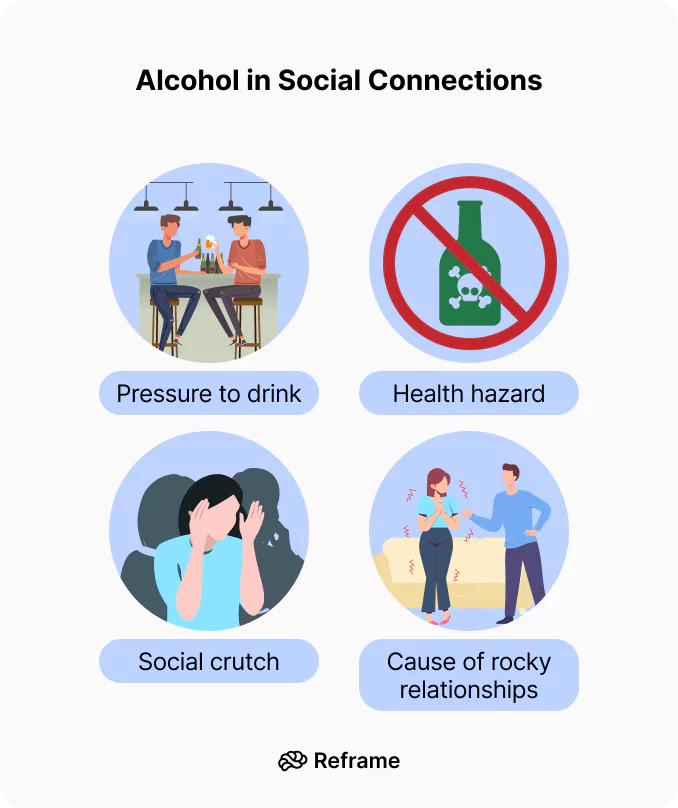
Alcohol is so woven into our social fabric that we can become oblivious to its consequences. But alcohol’s presence in our social connections comes with a variety of risks:
So, while we might feel that alcohol helps us connect with others, those connections are not always positive ones. To unlearn the deep-rooted practices of social drinking, let’s learn about alternative ways to develop more genuine connections.
The first step in developing authentic connections is understanding what they are. An authentic relationship is one that is built on mutual trust and respect. It allows us to be vulnerable and our genuine selves while allowing the other person to be the same. Key characteristics of genuine relationships include open communication, connection, respect, and vulnerability. So, how can we foster these connections?
We can practice these skills by engaging in alternative social activities. Prioritize non-alcoholic gatherings and events, schedule interactive activities, and try mindfulness and wellness practices together. By doing this, we can transition away from alcohol-centered socializing. Let’s take a deeper dive into how we can make this transition effectively.
We can develop more authentic connections when we transition away from alcohol-centered socializing through these practices:
Just questioning the role of alcohol in social contexts can be an important step in developing more genuine relationships. Now that we know how to develop more authentic connections, we can take this curiosity to the next level to live healthier, more fulfilling lives by quitting or cutting back on alcohol.
Alcohol often operates under the guise of social lubricant, bringing people together and helps us connect. But we now know that the connection alcohol promotes isn’t the most authentic. Authentic connections are centered around communication, respect, and vulnerability, all of which alcohol can affect negatively. Although we may feel awkward at first, we can offer a more genuine version of ourselves and attract others who do the same by shifting away from alcohol-centered social interactions. Ditch the booze and choose to connect authentically!
If your workplace has smart vending machines or a self-checkout kiosk for snacks and meals, you might have noticed the USConnect® logo. The USConnectMe app is the companion tool for this system, designed to make your break-time purchases smoother and more rewarding. Think of it as a digital wallet and loyalty card rolled into one, specifically for the food and drink options available at your office. It connects you directly to the USConnect loyalty program, allowing you to pay for items, get special deals, and keep track of your account all from your phone. It’s built to work with specific smart vending machines, Bistro to Go! self-checkout kiosks, and other approved food service terminals that are part of the USConnect network.
At its core, the USConnectMe app is designed to streamline how you buy snacks, drinks, and fresh food at work. Instead of fumbling for cash or a credit card, you can simply use the app to make a purchase. It’s part of a broader ecosystem created by USConnect to offer a more modern and convenient vending experience. The app serves as your personal account hub for their loyalty program, where you can load funds and earn rewards on your daily coffee or lunch. This system is particularly useful in busy work environments where speed and convenience are key. It transforms a simple vending machine into an interactive retail point that remembers you and rewards you for your loyalty.
The USConnectMe app packs several functions into one platform to simplify your workplace purchases. It’s more than just a way to pay; it’s a tool for managing your account, accessing deals, and earning rewards. The main goal is to create a seamless experience, from adding funds to your account to redeeming points for a free snack. Each feature is designed to make the process of grabbing a quick bite at work easier and more beneficial. Let's look at the three primary functions that you'll use most often: making purchases, earning rewards, and managing your account details. Understanding these features will help you get the most out of the app if your workplace uses the USConnect system.
The most fundamental feature of the USConnectMe app is its payment capability. You can link a payment method to add funds to your account and then use your phone to buy items from compatible machines. This eliminates the need to carry a wallet to the breakroom. Beyond simple payments, the app also serves as a gateway to exclusive deals. According to its page on the Apple App Store, users can take advantage of special promotions directly through the app. This could mean discounts on certain items or special combo offers, adding a layer of savings to your daily purchases. The convenience of a single app for both payment and promotions makes it an integrated tool for your workplace dining.
A major draw of the USConnectMe app is its loyalty program. Every time you make a purchase using your account, you earn reward points. These points accumulate over time and can be redeemed for free items from the vending machines or kiosks. This system turns routine purchases into an opportunity to earn something back. The process is straightforward: you buy your usual coffee or snack, and the points are automatically added to your account. Once you’ve collected enough, you can use them to treat yourself. This feature encourages consistent use of the platform and provides a tangible benefit for being a loyal customer, making your workplace snack runs a little more rewarding.
The app also gives you full control over your account management. You can easily check your current balance at any time to see how much money you have available. If you're running low, you can add more funds directly within the app using your linked payment method. This feature ensures you’re always ready to make a purchase without any hassle. Additionally, the app keeps a detailed record of all your transactions. You can view your purchase history to see exactly what you've bought and when. This transparency is great for keeping track of your spending and managing your snack budget effectively, putting all the essential account information right at your fingertips.
Before you get too excited about earning points on your afternoon snack, it’s important to know if you can even use the USConnectMe app. Its functionality is tied to a specific network of machines, so it won’t work with just any vending machine. The app is also designed for specific devices, so you’ll need to make sure your smartphone is compatible. Luckily, checking for compatibility is a simple process, and the app is widely available for the most common mobile operating systems. Taking a moment to confirm these details will save you the trouble of downloading an app you can’t use. Here’s what you need to know about whether the USConnectMe app will work for you.
So, how do you know if your office vending machine or micro-market is part of the USConnect network? The easiest way is to simply look for the USConnect® logo. You should find it displayed prominently on the vending machines, payment kiosks, or even on your employee ID badge if your company has fully integrated the system. According to the app’s description on the Google Play Store, it is exclusively designed for this system and will not work with others. If you don’t see the logo, it’s safe to assume the app won’t be of use to you. A quick visual check is all it takes to determine if you can start using the app for your workplace purchases.
The USConnectMe app is accessible to a broad audience, as it is available for both major mobile platforms. You can download it whether you have an iPhone or an Android device, ensuring that most smartphone users are covered. The app is available in English, making it straightforward for users in the United States. The setup process is designed to be simple on either platform, requiring you to create an account and link a payment method to get started. This wide availability means that if your workplace has the compatible hardware, you and your colleagues should have no trouble getting the app up and running on your personal devices.
While the features of the USConnectMe app sound convenient, it’s always a good idea to see what actual users have to say. App performance in the real world can sometimes differ from what’s advertised. User reviews and ratings provide valuable insight into the app's reliability, ease of use, and overall customer satisfaction. Looking at this feedback can help you set realistic expectations and be aware of potential issues you might encounter. The app has been on the market for a while, so there's a decent amount of user data available to give you a clearer picture of its strengths and weaknesses. Let's examine the store ratings and common issues reported by users.
Looking at the numbers, the USConnectMe app has a mixed reception. On the Google Play Store, for instance, it holds a rating of 3.1 out of 5 stars, based on over 300 reviews. This rating suggests that while the app works for some, a significant number of users have run into problems. A rating in this range often indicates that the core functionality is there, but it may be hampered by bugs or a less-than-intuitive user experience. It’s not a top-rated app, but it’s also not at the very bottom of the barrel. This feedback implies that your experience could be a bit of a gamble, potentially depending on the specific setup at your location or your device.
Diving into the user reviews reveals several recurring complaints. Many users have reported technical glitches that disrupt the experience. Common issues cited in Google Play Store reviews include payment errors where transactions fail, users being unexpectedly logged out of their accounts, and difficulties with the process of adding funds. Some have also mentioned frustrations with getting refunds for failed purchases. These reports suggest that the app's reliability can be inconsistent. While the convenience is a great idea in theory, these potential technical hiccups are worth keeping in mind. It might be a good idea to have a backup payment method handy, just in case the app isn't cooperating when you need it.
Understanding who is behind the USConnectMe app can provide some context for its services and reach. The app is not a standalone product but rather one piece of a much larger corporate food service operation. It is managed by GlobalConnect®, a major player in the unattended retail market in the United States. This company provides the technology and infrastructure that power the smart vending machines and micro-markets where the app is used. Knowing that a large, established company is behind the service helps explain its presence in major corporate offices across the country. It also highlights the scale of the network you're tapping into when you use the app.
GlobalConnect positions itself as a leading provider of corporate food services, specializing in safe, "contactless" dining solutions. According to its company website, its network is one of the largest in the country, focusing on providing fresh food options through automated retail. This is the company that partners with employers to install and manage the Bistro to Go! kiosks and smart vending machines. Their business model is built on providing a comprehensive service that includes the hardware, the food supply, and the payment technology like the USConnectMe app. Their services are trusted by some of the biggest corporations in the world, including industry giants like Amazon, T-Mobile, American Express, and Walmart, which speaks to their significant presence in the corporate wellness and amenities space.
Beyond the standard features of payment and rewards, the USConnect program includes a unique element that adds a layer of social responsibility to your purchases. This particular feature sets it apart from many other loyalty programs and connects your daily spending to a greater good. It’s a small but meaningful aspect of the program that allows employees to feel like their purchases are making a positive impact. This charitable component is an interesting incentive that aligns with the values of many modern companies and their employees, turning a simple transaction into an act of giving. It’s a thoughtful touch that adds another dimension to the user experience.
One of the most notable features of the USConnect program is its commitment to charity. With every purchase you make using your USConnectMe account, a portion of the sale is automatically donated to a charitable cause. Specifically, 1.5% of your total purchase amount is contributed to a charity that you, as an employee, can help select. According to Refreshments Inc., a partner in the network, this program allows employees to support causes they care about simply by buying their lunch or a snack. This "everyday philanthropy" is built directly into the system, making it an effortless way to contribute to the community. It’s a compelling feature that adds a feel-good element to an otherwise routine transaction.
In an age where digital privacy is a major concern, it's essential to understand what information an app collects and how it's used. The USConnectMe app, like most payment and loyalty apps, requires access to some of your personal data to function correctly. Being aware of its data collection policies can help you make an informed decision about whether you're comfortable using the service. The information an app gathers can range from basic contact details to more sensitive financial and usage data. Taking a moment to review the privacy policy is a smart step before you sign up and start sharing your information.
When you use the USConnectMe app, you are sharing a significant amount of personal information. According to the data privacy section on its App Store page, the app collects data that is directly linked to your identity. This includes your purchase history, financial information from your linked payment methods, and your contact details. It also tracks usage data, which means it monitors how you interact with the app. This information is used to manage your account, process transactions, and provide you with a personalized experience. While this level of data collection is common for apps of this nature, it's important for you to be aware of what you're sharing when you sign up for the service.
Why do I feel like I need a drink just to relax and be myself around other people? That feeling of needing "liquid courage" is incredibly common. Alcohol is a depressant, which means it slows down your central nervous system. This can temporarily quiet the part of your brain that worries about what others think, making you feel less inhibited. Over time, your brain can start to associate that feeling of social ease with alcohol, making it feel like a necessary tool rather than a choice.
If I stop drinking at parties, won't I just be boring and awkward? This is a major fear for many people, but it’s often not the reality. Your personality and sense of humor are what make you interesting, not the beverage in your hand. Shifting your focus from drinking to genuine curiosity can be a game-changer. Concentrate on actively listening and asking people questions about themselves. You might find that you build stronger connections when you're fully present and engaged.
Are the friendships I make over drinks less authentic? While alcohol can certainly create a fast sense of camaraderie, those bonds can sometimes be superficial. Think of it this way: genuine connection is built on trust, respect, and clear communication. Alcohol can impair judgment and blur emotional lines, which sometimes gets in the way of those core elements. Building relationships without it allows you to connect with people on a clearer, more honest level.
What’s a simple way to say no to a drink without making things weird? The key is to be simple and confident. You don't owe anyone a detailed explanation. A friendly, "I'm all set for now, thanks!" or "I'm sticking with sparkling water tonight" is perfectly fine. Most people won't press the issue. Having a non-alcoholic drink already in your hand also helps signal that you're not looking for another.
How can I meet new people or hang out with friends without going to a bar? Shifting your social life away from alcohol opens up a lot of new doors. Think about activities that create a shared experience. You could suggest trying a new coffee shop, joining a local hiking group, taking a pottery class, or starting a book club. When the focus is on the activity itself, the pressure to drink disappears, and you can connect over a shared interest instead.
In the classic sitcom How I Met Your Mother, Barney Stinson’s signature catchphrase was, “Have you met Ted?” to break the ice. In real life, we often reach for a drink to lubricate social interactions, especially at work happy hours. But what if we could build more genuine connections without alcohol? Instead of relying on drinks that can sometimes cloud our judgment, we can create opportunities for real conversation. This is where the usconnect app comes in. It helps foster that positive, social vibe right in your office, turning a simple coffee break into a meaningful interaction.
While alcohol can seem to smooth awkward social interactions or social anxiety, it’s the unfiltered interactions that truly build meaningful relationships. By embracing new strategies for socializing, whether through shared interests, engaging activities, or simply being open and present, we create deeper and more authentic connections. Let’s explore how alcohol affects our social life to understand why skipping the drink can help us form more lasting bonds.
Alcohol has played a significant part in celebrations for thousands of years. Ever since tribal hunters came home with a deer carcass for a feast, their fermented beverages — the earliest alcoholic drinks — invariably appeared to wash down the hard-earned meal. What was once a way for the tribe to come together after a hunt became an integral part of all kinds of celebrations. It also was a way for the tribe to develop a sense of community, which was beneficial to their survival. Fast forward to today and the camaraderie of drinking still brings people together. But there’s a downside: the normalcy of alcohol consumption can make social drinking mindless rather than mindful.
Drinking affects our body and mind (more on that later), upping our mood and helping us relax. But do the perceived social benefits outweigh alcohol’s harms? Some may say the positive feelings are worth it, arguing that alcohol helps them connect when they otherwise wouldn’t. Why?
Ever heard the term “liquid courage”? That’s how many folks, especially those who are shy or feel awkward in social situations, think of alcohol. The “courage” comes from the way alcohol affects our body and brain.
When we drink, alcohol enters our bloodstream and travels to our brain and the rest of our body, targeting the central nervous system (CNS). The CNS sends messages within the brain and from the brain to the rest of the body, known as our body’s processing center. It controls most of our body’s functions including movement, thinking, speech, awareness, and our five senses.
Alcohol is a depressant, which means that it slows down our body’s processes. Physiologically, alcohol lowers our heart rate and blood pressure, helping us feel more relaxed. Neurologically, alcohol slows cognitive function, lowering our inhibitions and impairing our thinking. Alcohol also affects certain neurotransmitters (chemical messengers) in our brain. Specifically, it boosts our “feel-good” hormones, dopamine and serotonin, giving us a temporary feeling of pleasure or happiness when drinking. This boost in mood help us feel more relaxed and open to socializing with others. We become more talkative when we drink and say things we wouldn’t say while sober.
Since alcohol stifles our reasoning skills and impacts our usual processes for contemplating the consequences of our actions, we tend to say whatever comes to mind when intoxicated (although it doesn’t necessarily make us more truthful). Alcohol also enhances certain personality traits, which lead to subtle differences in how we act when we’re intoxicated. The different alcohol effects on personality lead to different types of “drunks”:
Recognizing the different types of “drunks” helps us understand individual behaviors, but it’s equally important to address how these behaviors impact our relationships. In addition to these specific effects from imbibing, the mere act of sharing something contributes to social bonding. For example, food is a universal language, regardless of our linguistic or cultural background. Alcohol fits in same category — something we can share regardless of our differing backgrounds or interests. However, while alcohol might facilitate social interactions in some ways, it’s essential to consider the potential consequences alcohol has on our relationships and social connections.
Alcohol is so woven into our social fabric that we can become oblivious to its consequences. But alcohol’s presence in our social connections comes with a variety of risks:
So, while we might feel that alcohol helps us connect with others, those connections are not always positive ones. To unlearn the deep-rooted practices of social drinking, let’s learn about alternative ways to develop more genuine connections.
The first step in developing authentic connections is understanding what they are. An authentic relationship is one that is built on mutual trust and respect. It allows us to be vulnerable and our genuine selves while allowing the other person to be the same. Key characteristics of genuine relationships include open communication, connection, respect, and vulnerability. So, how can we foster these connections?
We can practice these skills by engaging in alternative social activities. Prioritize non-alcoholic gatherings and events, schedule interactive activities, and try mindfulness and wellness practices together. By doing this, we can transition away from alcohol-centered socializing. Let’s take a deeper dive into how we can make this transition effectively.
We can develop more authentic connections when we transition away from alcohol-centered socializing through these practices:
Just questioning the role of alcohol in social contexts can be an important step in developing more genuine relationships. Now that we know how to develop more authentic connections, we can take this curiosity to the next level to live healthier, more fulfilling lives by quitting or cutting back on alcohol.
Alcohol often operates under the guise of social lubricant, bringing people together and helps us connect. But we now know that the connection alcohol promotes isn’t the most authentic. Authentic connections are centered around communication, respect, and vulnerability, all of which alcohol can affect negatively. Although we may feel awkward at first, we can offer a more genuine version of ourselves and attract others who do the same by shifting away from alcohol-centered social interactions. Ditch the booze and choose to connect authentically!
If your workplace has smart vending machines or a self-checkout kiosk for snacks and meals, you might have noticed the USConnect® logo. The USConnectMe app is the companion tool for this system, designed to make your break-time purchases smoother and more rewarding. Think of it as a digital wallet and loyalty card rolled into one, specifically for the food and drink options available at your office. It connects you directly to the USConnect loyalty program, allowing you to pay for items, get special deals, and keep track of your account all from your phone. It’s built to work with specific smart vending machines, Bistro to Go! self-checkout kiosks, and other approved food service terminals that are part of the USConnect network.
At its core, the USConnectMe app is designed to streamline how you buy snacks, drinks, and fresh food at work. Instead of fumbling for cash or a credit card, you can simply use the app to make a purchase. It’s part of a broader ecosystem created by USConnect to offer a more modern and convenient vending experience. The app serves as your personal account hub for their loyalty program, where you can load funds and earn rewards on your daily coffee or lunch. This system is particularly useful in busy work environments where speed and convenience are key. It transforms a simple vending machine into an interactive retail point that remembers you and rewards you for your loyalty.
The USConnectMe app packs several functions into one platform to simplify your workplace purchases. It’s more than just a way to pay; it’s a tool for managing your account, accessing deals, and earning rewards. The main goal is to create a seamless experience, from adding funds to your account to redeeming points for a free snack. Each feature is designed to make the process of grabbing a quick bite at work easier and more beneficial. Let's look at the three primary functions that you'll use most often: making purchases, earning rewards, and managing your account details. Understanding these features will help you get the most out of the app if your workplace uses the USConnect system.
The most fundamental feature of the USConnectMe app is its payment capability. You can link a payment method to add funds to your account and then use your phone to buy items from compatible machines. This eliminates the need to carry a wallet to the breakroom. Beyond simple payments, the app also serves as a gateway to exclusive deals. According to its page on the Apple App Store, users can take advantage of special promotions directly through the app. This could mean discounts on certain items or special combo offers, adding a layer of savings to your daily purchases. The convenience of a single app for both payment and promotions makes it an integrated tool for your workplace dining.
A major draw of the USConnectMe app is its loyalty program. Every time you make a purchase using your account, you earn reward points. These points accumulate over time and can be redeemed for free items from the vending machines or kiosks. This system turns routine purchases into an opportunity to earn something back. The process is straightforward: you buy your usual coffee or snack, and the points are automatically added to your account. Once you’ve collected enough, you can use them to treat yourself. This feature encourages consistent use of the platform and provides a tangible benefit for being a loyal customer, making your workplace snack runs a little more rewarding.
The app also gives you full control over your account management. You can easily check your current balance at any time to see how much money you have available. If you're running low, you can add more funds directly within the app using your linked payment method. This feature ensures you’re always ready to make a purchase without any hassle. Additionally, the app keeps a detailed record of all your transactions. You can view your purchase history to see exactly what you've bought and when. This transparency is great for keeping track of your spending and managing your snack budget effectively, putting all the essential account information right at your fingertips.
Before you get too excited about earning points on your afternoon snack, it’s important to know if you can even use the USConnectMe app. Its functionality is tied to a specific network of machines, so it won’t work with just any vending machine. The app is also designed for specific devices, so you’ll need to make sure your smartphone is compatible. Luckily, checking for compatibility is a simple process, and the app is widely available for the most common mobile operating systems. Taking a moment to confirm these details will save you the trouble of downloading an app you can’t use. Here’s what you need to know about whether the USConnectMe app will work for you.
So, how do you know if your office vending machine or micro-market is part of the USConnect network? The easiest way is to simply look for the USConnect® logo. You should find it displayed prominently on the vending machines, payment kiosks, or even on your employee ID badge if your company has fully integrated the system. According to the app’s description on the Google Play Store, it is exclusively designed for this system and will not work with others. If you don’t see the logo, it’s safe to assume the app won’t be of use to you. A quick visual check is all it takes to determine if you can start using the app for your workplace purchases.
The USConnectMe app is accessible to a broad audience, as it is available for both major mobile platforms. You can download it whether you have an iPhone or an Android device, ensuring that most smartphone users are covered. The app is available in English, making it straightforward for users in the United States. The setup process is designed to be simple on either platform, requiring you to create an account and link a payment method to get started. This wide availability means that if your workplace has the compatible hardware, you and your colleagues should have no trouble getting the app up and running on your personal devices.
While the features of the USConnectMe app sound convenient, it’s always a good idea to see what actual users have to say. App performance in the real world can sometimes differ from what’s advertised. User reviews and ratings provide valuable insight into the app's reliability, ease of use, and overall customer satisfaction. Looking at this feedback can help you set realistic expectations and be aware of potential issues you might encounter. The app has been on the market for a while, so there's a decent amount of user data available to give you a clearer picture of its strengths and weaknesses. Let's examine the store ratings and common issues reported by users.
Looking at the numbers, the USConnectMe app has a mixed reception. On the Google Play Store, for instance, it holds a rating of 3.1 out of 5 stars, based on over 300 reviews. This rating suggests that while the app works for some, a significant number of users have run into problems. A rating in this range often indicates that the core functionality is there, but it may be hampered by bugs or a less-than-intuitive user experience. It’s not a top-rated app, but it’s also not at the very bottom of the barrel. This feedback implies that your experience could be a bit of a gamble, potentially depending on the specific setup at your location or your device.
Diving into the user reviews reveals several recurring complaints. Many users have reported technical glitches that disrupt the experience. Common issues cited in Google Play Store reviews include payment errors where transactions fail, users being unexpectedly logged out of their accounts, and difficulties with the process of adding funds. Some have also mentioned frustrations with getting refunds for failed purchases. These reports suggest that the app's reliability can be inconsistent. While the convenience is a great idea in theory, these potential technical hiccups are worth keeping in mind. It might be a good idea to have a backup payment method handy, just in case the app isn't cooperating when you need it.
Understanding who is behind the USConnectMe app can provide some context for its services and reach. The app is not a standalone product but rather one piece of a much larger corporate food service operation. It is managed by GlobalConnect®, a major player in the unattended retail market in the United States. This company provides the technology and infrastructure that power the smart vending machines and micro-markets where the app is used. Knowing that a large, established company is behind the service helps explain its presence in major corporate offices across the country. It also highlights the scale of the network you're tapping into when you use the app.
GlobalConnect positions itself as a leading provider of corporate food services, specializing in safe, "contactless" dining solutions. According to its company website, its network is one of the largest in the country, focusing on providing fresh food options through automated retail. This is the company that partners with employers to install and manage the Bistro to Go! kiosks and smart vending machines. Their business model is built on providing a comprehensive service that includes the hardware, the food supply, and the payment technology like the USConnectMe app. Their services are trusted by some of the biggest corporations in the world, including industry giants like Amazon, T-Mobile, American Express, and Walmart, which speaks to their significant presence in the corporate wellness and amenities space.
Beyond the standard features of payment and rewards, the USConnect program includes a unique element that adds a layer of social responsibility to your purchases. This particular feature sets it apart from many other loyalty programs and connects your daily spending to a greater good. It’s a small but meaningful aspect of the program that allows employees to feel like their purchases are making a positive impact. This charitable component is an interesting incentive that aligns with the values of many modern companies and their employees, turning a simple transaction into an act of giving. It’s a thoughtful touch that adds another dimension to the user experience.
One of the most notable features of the USConnect program is its commitment to charity. With every purchase you make using your USConnectMe account, a portion of the sale is automatically donated to a charitable cause. Specifically, 1.5% of your total purchase amount is contributed to a charity that you, as an employee, can help select. According to Refreshments Inc., a partner in the network, this program allows employees to support causes they care about simply by buying their lunch or a snack. This "everyday philanthropy" is built directly into the system, making it an effortless way to contribute to the community. It’s a compelling feature that adds a feel-good element to an otherwise routine transaction.
In an age where digital privacy is a major concern, it's essential to understand what information an app collects and how it's used. The USConnectMe app, like most payment and loyalty apps, requires access to some of your personal data to function correctly. Being aware of its data collection policies can help you make an informed decision about whether you're comfortable using the service. The information an app gathers can range from basic contact details to more sensitive financial and usage data. Taking a moment to review the privacy policy is a smart step before you sign up and start sharing your information.
When you use the USConnectMe app, you are sharing a significant amount of personal information. According to the data privacy section on its App Store page, the app collects data that is directly linked to your identity. This includes your purchase history, financial information from your linked payment methods, and your contact details. It also tracks usage data, which means it monitors how you interact with the app. This information is used to manage your account, process transactions, and provide you with a personalized experience. While this level of data collection is common for apps of this nature, it's important for you to be aware of what you're sharing when you sign up for the service.
Why do I feel like I need a drink just to relax and be myself around other people? That feeling of needing "liquid courage" is incredibly common. Alcohol is a depressant, which means it slows down your central nervous system. This can temporarily quiet the part of your brain that worries about what others think, making you feel less inhibited. Over time, your brain can start to associate that feeling of social ease with alcohol, making it feel like a necessary tool rather than a choice.
If I stop drinking at parties, won't I just be boring and awkward? This is a major fear for many people, but it’s often not the reality. Your personality and sense of humor are what make you interesting, not the beverage in your hand. Shifting your focus from drinking to genuine curiosity can be a game-changer. Concentrate on actively listening and asking people questions about themselves. You might find that you build stronger connections when you're fully present and engaged.
Are the friendships I make over drinks less authentic? While alcohol can certainly create a fast sense of camaraderie, those bonds can sometimes be superficial. Think of it this way: genuine connection is built on trust, respect, and clear communication. Alcohol can impair judgment and blur emotional lines, which sometimes gets in the way of those core elements. Building relationships without it allows you to connect with people on a clearer, more honest level.
What’s a simple way to say no to a drink without making things weird? The key is to be simple and confident. You don't owe anyone a detailed explanation. A friendly, "I'm all set for now, thanks!" or "I'm sticking with sparkling water tonight" is perfectly fine. Most people won't press the issue. Having a non-alcoholic drink already in your hand also helps signal that you're not looking for another.
How can I meet new people or hang out with friends without going to a bar? Shifting your social life away from alcohol opens up a lot of new doors. Think about activities that create a shared experience. You could suggest trying a new coffee shop, joining a local hiking group, taking a pottery class, or starting a book club. When the focus is on the activity itself, the pressure to drink disappears, and you can connect over a shared interest instead.

How do we enjoy sober camping if those around us are drinking? Check out our blog for more info on camping, drinking, and preparing for a successful sober camping trip.
Although it isn’t a treatment for alcohol use disorder (AUD), the Reframe app can help you cut back on drinking gradually, with the science-backed knowledge to empower you 100% of the way. Our proven program has helped millions of people around the world drink less and live more. And we want to help you get there, too!
The Reframe app equips you with the knowledge and skills you need to not only survive drinking less, but to thrive while you navigate the journey. Our daily research-backed readings teach you the neuroscience of alcohol, and our in-app Toolkit provides the resources and activities you need to navigate each challenge.
You’ll meet hundreds of fellow Reframers in our 24/7 Forum chat and daily Zoom check-in meetings. Receive encouragement from people worldwide who know exactly what you’re going through! You’ll also have the opportunity to connect with our licensed Reframe coaches for more personalized guidance.
Plus, we’re always introducing new features to optimize your in-app experience. We recently launched our in-app chatbot, Melody, powered by the world’s most powerful AI technology. Melody is here to help as you adjust to a life with less (or no) alcohol.
And that’s not all! Every month, we launch fun challenges, like Dry/Damp January, Mental Health May, and Outdoorsy June. You won’t want to miss out on the chance to participate alongside fellow Reframers (or solo if that’s more your thing!).
The Reframe app is free for 7 days, so you don’t have anything to lose by trying it. Are you ready to feel empowered and discover life beyond alcohol? Then download our app through the App Store or Google Play today!
There’s an episode in Parks and Recreation where Leslie Knope, always the spirited leader, has orchestrated a camping trip for her colleagues in the Pawnee Parks Department. As they gather around the campfire, everyone’s buzzing with excitement — and perhaps a bit too much alcohol. Ron Swanson, the stoic director and always the voice of reason, opts out of drinking, choosing instead to soak in the tranquility of nature. The next day, everyone is feeling the aftermath: sluggish, groggy, and less than thrilled about the day’s activities. Meanwhile, Ron is up early, enjoying a peaceful morning by the lake, immersed in the splendor of the natural world.
This scene illustrates a key insight — camping doesn’t need to be synonymous with alcohol. In fact, choosing a sober camping experience can open up our world to richer connections and more profound enjoyment of what the outdoors has to offer. Let’s walk through some key tips to ensure your sober camping trip is filled with nature and nurture.
Planning is key to setting ourselves up for success. Keep these in mind before embarking on your next sober camping adventure:

When it comes to sober camping, location matters. If you’re aiming to shift focus towards alcohol-free activities and prevent temptation, avoid super busy campsites where larger groups may be drinking or are disruptive. Although not all campsites have websites, reading the Google reviews can give us a better idea of what we’re getting into. Choose less busy times of the year and more remote locations to fully enjoy the outdoors. (Although take this advice with caution — such as increased chances of encountering wild animals and less access to help should you need it, especially if you’re alone. Be sure you understand wilderness survival and have the proper gear if you plan to do this!)
We can also check if the campsite has cell service or choose a location not too far from home so we can get away from a sticky situation if we need to. When we’re trying to stay away from alcohol, being able to access our support system when we need it is crucial. While this may defeat the point of camping and getting off the grid, our safety is the most important thing!
If we’re camping as a group, we won’t always be in control of the location. This is where these other tips will come in handy!
Have non-alcoholic options available to join in on the social aspect of drinking without the adverse health effects. When others are drinking, or if we feel an urge to drink, we'll have options planned out to help us stick to our goals for avoiding alcohol.
There are plenty of non-alcoholic wine and beer options, zero-proof campfire classics, and creative campfire cocktails (keep reading for more specifics), which give us all the positives of drinking: the camaraderie of sharing a drink with others, celebrating something, or creating a certain mood, but without the negative effects.
Boredom can be a driver for drinking. Fill up your schedule with alcohol-free activities to have healthy distractions and get the most out of what the surroundings have to offer. Of course, resting and relaxing are also important when camping, but having a pre-planned itinerary can give us options when we’re feeling restless or needing a distraction from urges to drink. We can always cross something off the list, but researching things to do when we’re already at our destination may not be possible miles away from the nearest Wi-Fi router.
Explore the surroundings with various activities:
But we get it — we’re not all avid explorers. If you’re looking for something more chill, bring a book or some card games, try out new campfire recipes, journal your thoughts, or meditate in the forest for some much-needed R and R.
Along with essential camping gear, having a toolkit of coping mechanisms and strategies to overcome triggers for drinking helps us be prepared to handle anything that comes our way. These triggers can be anything, but may include being alone, being with others who are drinking, being in an unfamiliar environment, and more.
Try slow, deep breathing, count to 10, or repeat positive affirmations. Make a list of the tools that work best for you so you can whip them out whenever you need to. Being in a different environment puts us in situations that we may not usually encounter, so being more prepared can only be beneficial.
“We are stronger when we listen, and smarter when we share.” - Rania Al-Abdullah, Queen of Jordan
If we’re traveling with companions, not everyone may be on the same page to avoid drinking during the trip. Communicating with the people we’re traveling with ahead of time helps them make accommodations if needed and ensures that everyone is respectful of your decision.
We can also opt for sober-only camping groups, such as The Camping Trip, or search for other sober camping groups on Facebook or Meetups.
If we’re going camping solo, it’s still helpful to communicate with our support system. They can better understand our needs, help us develop coping strategies, and check in on us during our trip (if we have service). For more information on communicating with your support system, check out “8 Ways to Improve Communication in Your Relationships.”
If we’re in recovery, sometimes medication is a part of our treatment plan. It can be helpful to consult with your doctor about specific precautions to take and ensure that we have enough medication or medical support we may need for our excursion.
Even if we’re not taking medication for alcohol use disorder (AUD), a health check-up beforehand isn’t a bad idea. It increases our safety and may help prevent any health-related issues that could trigger our drinking.
While Aunt Martha’s infamous camp-arita may have been a long-standing tradition in previous family camping trips, it’s had its time and place. We can develop new non-alcoholic traditions to replace old ones with more memorable and meaningful experiences.
Choose your favorite campfire classics to sing along to, invent a new fireside favorite snack, or host a storytelling contest where everyone shares the most adventurous tales. Anything goes when it comes to developing new traditions, so get creative and have fun!
Go into this new sober experience with ideas for what you want to take away from it. Whether it’s connecting authentically with others or de-stressing in nature, there’s much more to camping than being an opportunity to drink. Instead of seeing it as a camping trip without alcohol. It’s a camping trip with more connection, more mental clarity, and more energy.
By adopting a positive mindset and preparing effectively, we’re already on our way to reaping the many benefits of sober camping.
Many of us may commonly associate alcohol with having a good time, but ditching the booze has many benefits. Sober camping enhances our outdoor experience in many ways:
As we can see, removing the alcohol from camping has numerous benefits for the experience. But food and drinks can be an integral part of our outdoor adventures. So, what can we opt for instead?
When it comes to camping, beverages can improve our outdoor experience. Whether we’re looking for a refreshing drink to escape the heat or cozy creations to enjoy by the campfire, there are plenty of non-alcoholic drink options for every moment under the stars. Get the flavor and camaraderie of classic and creative campfire sips, minus the alcohol, with these non-alcoholic camping drink choices:
While sipping non-alcoholic drinks can enhance our camping experience, providing support to sober loved ones goes beyond what’s in our cups. Let’s explore ways we can foster a supportive environment for our sober companions during a camping adventure.

Thoughtful approaches and meaningful gestures can make a camping trip an enjoyable and empowering experience for everyone. Implementing these practices fosters an inclusive and positive atmosphere that honors everyone’s journey:
The most important thing to remember is that camping is ultimately about connection, whether that’s with nature, with loved ones, or with yourself. Respecting ourselves and our camping companions will set us up for a great experience!
As we venture into the wild with these key sober camping tips, we’re not only planning a trip, we’re crafting an experience where clarity and connection take center stage. Whether we’re looking to bond with friends or find peace within ourselves, sober camping allows us to embrace the full beauty and benefits of the great outdoors. It comes with benefits such as fostering deeper connections and fewer adverse health effects. So, let’s pack our gear, skip the booze, and raise a toast to the fulfilling adventures of sober camping!
There’s an episode in Parks and Recreation where Leslie Knope, always the spirited leader, has orchestrated a camping trip for her colleagues in the Pawnee Parks Department. As they gather around the campfire, everyone’s buzzing with excitement — and perhaps a bit too much alcohol. Ron Swanson, the stoic director and always the voice of reason, opts out of drinking, choosing instead to soak in the tranquility of nature. The next day, everyone is feeling the aftermath: sluggish, groggy, and less than thrilled about the day’s activities. Meanwhile, Ron is up early, enjoying a peaceful morning by the lake, immersed in the splendor of the natural world.
This scene illustrates a key insight — camping doesn’t need to be synonymous with alcohol. In fact, choosing a sober camping experience can open up our world to richer connections and more profound enjoyment of what the outdoors has to offer. Let’s walk through some key tips to ensure your sober camping trip is filled with nature and nurture.
Planning is key to setting ourselves up for success. Keep these in mind before embarking on your next sober camping adventure:
When it comes to sober camping, location matters. If you’re aiming to shift focus towards alcohol-free activities and prevent temptation, avoid super busy campsites where larger groups may be drinking or are disruptive. Although not all campsites have websites, reading the Google reviews can give us a better idea of what we’re getting into. Choose less busy times of the year and more remote locations to fully enjoy the outdoors. (Although take this advice with caution — such as increased chances of encountering wild animals and less access to help should you need it, especially if you’re alone. Be sure you understand wilderness survival and have the proper gear if you plan to do this!)
We can also check if the campsite has cell service or choose a location not too far from home so we can get away from a sticky situation if we need to. When we’re trying to stay away from alcohol, being able to access our support system when we need it is crucial. While this may defeat the point of camping and getting off the grid, our safety is the most important thing!
If we’re camping as a group, we won’t always be in control of the location. This is where these other tips will come in handy!
Have non-alcoholic options available to join in on the social aspect of drinking without the adverse health effects. When others are drinking, or if we feel an urge to drink, we'll have options planned out to help us stick to our goals for avoiding alcohol.
There are plenty of non-alcoholic wine and beer options, zero-proof campfire classics, and creative campfire cocktails (keep reading for more specifics), which give us all the positives of drinking: the camaraderie of sharing a drink with others, celebrating something, or creating a certain mood, but without the negative effects.
Boredom can be a driver for drinking. Fill up your schedule with alcohol-free activities to have healthy distractions and get the most out of what the surroundings have to offer. Of course, resting and relaxing are also important when camping, but having a pre-planned itinerary can give us options when we’re feeling restless or needing a distraction from urges to drink. We can always cross something off the list, but researching things to do when we’re already at our destination may not be possible miles away from the nearest Wi-Fi router.
Explore the surroundings with various activities:
But we get it — we’re not all avid explorers. If you’re looking for something more chill, bring a book or some card games, try out new campfire recipes, journal your thoughts, or meditate in the forest for some much-needed R and R.
Along with essential camping gear, having a toolkit of coping mechanisms and strategies to overcome triggers for drinking helps us be prepared to handle anything that comes our way. These triggers can be anything, but may include being alone, being with others who are drinking, being in an unfamiliar environment, and more.
Try slow, deep breathing, count to 10, or repeat positive affirmations. Make a list of the tools that work best for you so you can whip them out whenever you need to. Being in a different environment puts us in situations that we may not usually encounter, so being more prepared can only be beneficial.
“We are stronger when we listen, and smarter when we share.” - Rania Al-Abdullah, Queen of Jordan
If we’re traveling with companions, not everyone may be on the same page to avoid drinking during the trip. Communicating with the people we’re traveling with ahead of time helps them make accommodations if needed and ensures that everyone is respectful of your decision.
We can also opt for sober-only camping groups, such as The Camping Trip, or search for other sober camping groups on Facebook or Meetups.
If we’re going camping solo, it’s still helpful to communicate with our support system. They can better understand our needs, help us develop coping strategies, and check in on us during our trip (if we have service). For more information on communicating with your support system, check out “8 Ways to Improve Communication in Your Relationships.”
If we’re in recovery, sometimes medication is a part of our treatment plan. It can be helpful to consult with your doctor about specific precautions to take and ensure that we have enough medication or medical support we may need for our excursion.
Even if we’re not taking medication for alcohol use disorder (AUD), a health check-up beforehand isn’t a bad idea. It increases our safety and may help prevent any health-related issues that could trigger our drinking.
While Aunt Martha’s infamous camp-arita may have been a long-standing tradition in previous family camping trips, it’s had its time and place. We can develop new non-alcoholic traditions to replace old ones with more memorable and meaningful experiences.
Choose your favorite campfire classics to sing along to, invent a new fireside favorite snack, or host a storytelling contest where everyone shares the most adventurous tales. Anything goes when it comes to developing new traditions, so get creative and have fun!
Go into this new sober experience with ideas for what you want to take away from it. Whether it’s connecting authentically with others or de-stressing in nature, there’s much more to camping than being an opportunity to drink. Instead of seeing it as a camping trip without alcohol. It’s a camping trip with more connection, more mental clarity, and more energy.
By adopting a positive mindset and preparing effectively, we’re already on our way to reaping the many benefits of sober camping.
Many of us may commonly associate alcohol with having a good time, but ditching the booze has many benefits. Sober camping enhances our outdoor experience in many ways:
As we can see, removing the alcohol from camping has numerous benefits for the experience. But food and drinks can be an integral part of our outdoor adventures. So, what can we opt for instead?
When it comes to camping, beverages can improve our outdoor experience. Whether we’re looking for a refreshing drink to escape the heat or cozy creations to enjoy by the campfire, there are plenty of non-alcoholic drink options for every moment under the stars. Get the flavor and camaraderie of classic and creative campfire sips, minus the alcohol, with these non-alcoholic camping drink choices:
While sipping non-alcoholic drinks can enhance our camping experience, providing support to sober loved ones goes beyond what’s in our cups. Let’s explore ways we can foster a supportive environment for our sober companions during a camping adventure.
Thoughtful approaches and meaningful gestures can make a camping trip an enjoyable and empowering experience for everyone. Implementing these practices fosters an inclusive and positive atmosphere that honors everyone’s journey:
The most important thing to remember is that camping is ultimately about connection, whether that’s with nature, with loved ones, or with yourself. Respecting ourselves and our camping companions will set us up for a great experience!
As we venture into the wild with these key sober camping tips, we’re not only planning a trip, we’re crafting an experience where clarity and connection take center stage. Whether we’re looking to bond with friends or find peace within ourselves, sober camping allows us to embrace the full beauty and benefits of the great outdoors. It comes with benefits such as fostering deeper connections and fewer adverse health effects. So, let’s pack our gear, skip the booze, and raise a toast to the fulfilling adventures of sober camping!

Explore alcohol-free celebrations for personal milestones. From themed parties to wellness days, discover healthier ways to commemorate achievements and foster meaningful, memorable experiences that promote well-being and positive social change.
Although it isn’t a treatment for alcohol use disorder (AUD), the Reframe app can help you cut back on drinking gradually with the science-backed knowledge to empower you 100% of the way. Our proven program has helped millions of people around the world drink less and live more. And we want to help you get there, too!
The Reframe app equips you with the knowledge and skills you need to not only survive drinking less, but to thrive while you navigate the journey. Our daily research-backed readings teach you the neuroscience of alcohol, and our in-app Toolkit provides the resources and activities you need to navigate each challenge.
You’ll meet millions of fellow Reframers in our 24/7 Forum chat and daily Zoom check-in meetings. Receive encouragement from people worldwide who know exactly what you’re going through! You’ll also have the opportunity to connect with our licensed Reframe coaches for more personalized guidance.
Plus, we’re always introducing new features to optimize your in-app experience. We recently launched our in-app chatbot, Melody, powered by the world’s most powerful AI technology. Melody is here to help as you adjust to a life with less (or no) alcohol.
And that’s not all! Every month, we launch fun challenges, like Dry/Damp January, Mental Health May, and Outdoorsy June. You won’t want to miss out on the chance to participate alongside fellow Reframers (or solo if that’s more your thing!).
The Reframe app is free for 7 days, so you don’t have anything to lose by trying it. Are you ready to feel empowered and discover life beyond alcohol? Then download our app through the App Store or Google Play today!
Changing social habits, particularly those related to alcohol consumption, can be challenging yet incredibly rewarding. Celebrating personal milestones and achievements without indulging in alcohol is not only healthier but can also lead to more meaningful and memorable experiences. Here, we explore various alcohol-free ways to commemorate your significant moments, helping you build healthier drinking habits and reframe your relationship with alcohol.

In many cultures, alcohol has become synonymous with celebration. Birthdays, promotions, anniversaries, and other milestones are often marked with clinking glasses and toasts. However, the reliance on alcohol can overshadow the true essence of these achievements. Celebrations should be about joy, recognition, and shared experiences, not defined by the presence of alcohol.
Themed parties are a fantastic way to bring excitement to any celebration. Choose a theme that resonates with your milestone—be it a "Roaring '20s" party, a tropical luau, or a masquerade ball. Focus on decorations, costumes, and activities that immerse your guests in the theme. You can serve mocktails that match the theme, such as a pineapple smoothie bar for the luau or sparkling water with fruit garnishes for the masquerade. 10 Alcohol-Free Drink Recipes
Celebrate your achievements by nurturing your body and mind. Plan a wellness day that includes activities such as yoga, meditation, spa treatments, and healthy eating. Invite friends or family to join you in this rejuvenating experience. Not only will it be a unique way to celebrate, but it will also promote long-term well-being. Green Exercise: What It Is and How To Practice
A change of scenery can make a celebration feel special. Consider planning a trip that focuses on relaxation, adventure, or exploring new cultures. Whether it’s a weekend camping trip, a beach retreat, or a visit to a new city, the key is to focus on creating memorable experiences rather than relying on alcohol. Sober Tourism: Why Alcohol-Free Vacations Are Trending
Food has a way of bringing people together. Host a dinner party or a cooking class where you and your guests can enjoy preparing and eating delicious meals. You can also explore different cuisines or have a potluck where everyone brings a dish. Pair your food with non-alcoholic beverages that complement the flavors, such as herbal teas, infused waters, or artisanal sodas.
Nature has a unique way of enhancing celebrations. Plan an outdoor adventure that matches your interests—hiking, kayaking, cycling, or even a picnic in the park. The physical activity coupled with the beauty of nature can create a memorable and refreshing celebration. 10 Fun (Alcohol-Free) Things To Do Each Season
Celebrate your personal achievements by making a positive impact on others. Organize a volunteer day where you and your friends can give back to the community. Whether it’s working at a local food bank, participating in a charity run, or helping out at an animal shelter, the act of giving can add a profound sense of fulfillment to your celebration. What Is Altruism? How Can I Practice It?
Reframing how we celebrate life’s milestones plays a crucial role in changing broader social habits. By opting for alcohol-free celebrations, you contribute to a cultural shift where health and genuine connections take precedence over substance use. Over time, these choices can lead to a more supportive environment for everyone aiming to lead a healthier lifestyle.
Your decision to celebrate without alcohol can have a ripple effect. It can inspire others to reconsider their drinking habits and explore alternative ways to enjoy social gatherings. As more people choose alcohol-free celebrations, it can lead to a more inclusive and health-conscious culture. 7 Ways To Celebrate Recovery Milestones
Change can be challenging, especially when it involves deeply ingrained social habits. However, with commitment and creativity, embracing alcohol-free celebrations can become a rewarding part of your life. It’s about finding joy in the moment and appreciating the true essence of your achievements.
Celebrating personal milestones and achievements without the reliance on alcohol is a powerful step towards healthier drinking habits and more meaningful celebrations. By exploring alternative ways to mark these occasions, you not only improve your well-being but also contribute to a positive cultural shift. Embrace the journey of reframing your relationship with alcohol and discovering the joy in alcohol-free celebrations. The benefits are far-reaching, impacting not just your life but also those around you, creating a healthier and more supportive community.
Changing social habits, particularly those related to alcohol consumption, can be challenging yet incredibly rewarding. Celebrating personal milestones and achievements without indulging in alcohol is not only healthier but can also lead to more meaningful and memorable experiences. Here, we explore various alcohol-free ways to commemorate your significant moments, helping you build healthier drinking habits and reframe your relationship with alcohol.
In many cultures, alcohol has become synonymous with celebration. Birthdays, promotions, anniversaries, and other milestones are often marked with clinking glasses and toasts. However, the reliance on alcohol can overshadow the true essence of these achievements. Celebrations should be about joy, recognition, and shared experiences, not defined by the presence of alcohol.
Themed parties are a fantastic way to bring excitement to any celebration. Choose a theme that resonates with your milestone—be it a "Roaring '20s" party, a tropical luau, or a masquerade ball. Focus on decorations, costumes, and activities that immerse your guests in the theme. You can serve mocktails that match the theme, such as a pineapple smoothie bar for the luau or sparkling water with fruit garnishes for the masquerade. 10 Alcohol-Free Drink Recipes
Celebrate your achievements by nurturing your body and mind. Plan a wellness day that includes activities such as yoga, meditation, spa treatments, and healthy eating. Invite friends or family to join you in this rejuvenating experience. Not only will it be a unique way to celebrate, but it will also promote long-term well-being. Green Exercise: What It Is and How To Practice
A change of scenery can make a celebration feel special. Consider planning a trip that focuses on relaxation, adventure, or exploring new cultures. Whether it’s a weekend camping trip, a beach retreat, or a visit to a new city, the key is to focus on creating memorable experiences rather than relying on alcohol. Sober Tourism: Why Alcohol-Free Vacations Are Trending
Food has a way of bringing people together. Host a dinner party or a cooking class where you and your guests can enjoy preparing and eating delicious meals. You can also explore different cuisines or have a potluck where everyone brings a dish. Pair your food with non-alcoholic beverages that complement the flavors, such as herbal teas, infused waters, or artisanal sodas.
Nature has a unique way of enhancing celebrations. Plan an outdoor adventure that matches your interests—hiking, kayaking, cycling, or even a picnic in the park. The physical activity coupled with the beauty of nature can create a memorable and refreshing celebration. 10 Fun (Alcohol-Free) Things To Do Each Season
Celebrate your personal achievements by making a positive impact on others. Organize a volunteer day where you and your friends can give back to the community. Whether it’s working at a local food bank, participating in a charity run, or helping out at an animal shelter, the act of giving can add a profound sense of fulfillment to your celebration. What Is Altruism? How Can I Practice It?
Reframing how we celebrate life’s milestones plays a crucial role in changing broader social habits. By opting for alcohol-free celebrations, you contribute to a cultural shift where health and genuine connections take precedence over substance use. Over time, these choices can lead to a more supportive environment for everyone aiming to lead a healthier lifestyle.
Your decision to celebrate without alcohol can have a ripple effect. It can inspire others to reconsider their drinking habits and explore alternative ways to enjoy social gatherings. As more people choose alcohol-free celebrations, it can lead to a more inclusive and health-conscious culture. 7 Ways To Celebrate Recovery Milestones
Change can be challenging, especially when it involves deeply ingrained social habits. However, with commitment and creativity, embracing alcohol-free celebrations can become a rewarding part of your life. It’s about finding joy in the moment and appreciating the true essence of your achievements.
Celebrating personal milestones and achievements without the reliance on alcohol is a powerful step towards healthier drinking habits and more meaningful celebrations. By exploring alternative ways to mark these occasions, you not only improve your well-being but also contribute to a positive cultural shift. Embrace the journey of reframing your relationship with alcohol and discovering the joy in alcohol-free celebrations. The benefits are far-reaching, impacting not just your life but also those around you, creating a healthier and more supportive community.
