

Learn effective strategies to address conflicts in relationships where alcohol makes you lower your standards, fostering healthier connections and communication.

Although it isn’t a treatment for alcohol use disorder (AUD), the Reframe app can help you cut back on drinking gradually, with the science-backed knowledge to empower you 100% of the way. Our proven program has helped millions of people around the world drink less and live more. And we want to help you get there, too!
The Reframe app equips you with the knowledge and skills you need to not only survive drinking less, but to thrive while you navigate the journey. Our daily research-backed readings teach you the neuroscience of alcohol, and our in-app Toolkit provides the resources and activities you need to navigate each challenge.
You’ll meet millions of fellow Reframers in our 24/7 Forum chat and daily Zoom check-in meetings. Receive encouragement from people worldwide who know exactly what you’re going through! You’ll also have the opportunity to connect with our licensed Reframe coaches for more personalized guidance.
Plus, we’re always introducing new features to optimize your in-app experience. We recently launched our in-app chatbot, Melody, powered by the world’s most powerful AI technology. Melody is here to help as you adjust to a life with less (or no) alcohol.
And that’s not all! Every month, we launch fun challenges, like Dry/Damp January, Mental Health May, and Outdoorsy June. You won’t want to miss out on the chance to participate alongside fellow Reframers (or solo if that’s more your thing!).
The Reframe app is free for 7 days, so you don’t have anything to lose by trying it. Are you ready to feel empowered and discover life beyond alcohol? Then download our app today!
Alcohol has a way of turning small disagreements into major clashes. It can change personalities, create distance, and fuel arguments that seem to appear out of nowhere. Over time, you might feel that alcohol makes you lower your standards in relationships, accepting a new normal filled with tension. These ongoing conflicts of substance are exhausting. But you don't have to accept the negative effects of alcohol on relationships. This guide is about giving you the tools to resolve these issues and foster a healthier, more present connection with the people you care about.

Alcohol consumption can affect relationships in various ways. It can impair judgment, reduce inhibitions, and lead to behaviors that might not occur when sober. This can result in arguments, misunderstandings, and even long-term damage to the relationship.
Have you ever said something in the heat of a moment, fueled by a drink or two, that you later regretted? There’s a scientific reason for that. Alcohol’s first stop in the brain is the frontal lobe, the very area responsible for sound judgment and self-control. As one person aptly put it, alcohol essentially poisons the part of your brain that helps you make good decisions. When this area is impaired, your ability to think clearly and weigh consequences diminishes. This is why a minor disagreement can escalate into a major fight after a few drinks. Your inhibitions are lowered, making you more likely to act on impulse rather than reason, which can be a recipe for conflict in any relationship.
When our actions don’t align with our core values, we often experience an internal conflict. To resolve this discomfort, sometimes it’s easier to change our standards than to change our behavior. One writer who struggled with alcohol use described this perfectly, explaining how she continuously lowered her personal standards to match her actions while drinking. In a relationship, this might look like accepting disrespectful behavior from yourself or your partner that you would never tolerate while sober. It creates a dangerous cycle where the baseline for what’s acceptable keeps dropping, making it harder to recognize when a line has been crossed and damaging the foundation of respect the relationship was built on.
Interestingly, the amount of alcohol someone drinks isn't always the biggest source of conflict. Instead, research shows that one partner's perception of the other's drinking as problematic has a much greater impact on relationship satisfaction. It’s less about counting drinks and more about how the behavior feels to the other person. If your partner’s drinking makes you feel anxious, unimportant, or unsafe, that emotional reality is what truly strains the connection. This is a crucial distinction because it shifts the focus from arguing about "how much is too much" to discussing the real emotional impact and finding a path forward that makes both partners feel secure and valued.
The effects of alcohol-related conflict don't stop with a couple. They create ripples that can affect the entire family, especially children. When drinking is a regular source of tension, it changes the atmosphere of a home, often replacing feelings of safety and stability with anxiety and unpredictability. The patterns established between partners can shape the environment in which children grow, influencing their own understanding of relationships and healthy coping mechanisms. Addressing these issues is not just about improving a partnership, but about fostering a healthier, more supportive home for everyone in it.
The numbers paint a stark picture of how deeply alcohol use can affect family life. In the United States, an estimated five million children live with a parent who has an Alcohol Use Disorder. Furthermore, alcohol is a factor in a staggering 40% of all reported domestic violence incidents. These aren't just abstract figures; they represent millions of families navigating incredibly difficult circumstances. For parents, making a conscious choice to change their relationship with alcohol can be one of the most powerful ways to protect their children and build a more stable future. Taking that first step toward mindful drinking can transform a family's dynamic for generations to come.
Money is a common source of tension for any couple, but alcohol can add a significant layer of financial stress. The costs go far beyond just the price of drinks. As the Gateway Foundation highlights, excessive drinking can lead to overspending, job loss, and higher medical bills, causing major financial instability for couples. This strain can turn shared financial goals into a source of conflict. If you’re curious about the real cost, using an alcohol spend calculator can be an eye-opening exercise. Seeing the numbers in black and white often provides the clarity needed to start a conversation and work together toward financial health.
True intimacy is built on connection, vulnerability, and being present with one another—qualities that alcohol can easily diminish. When drinking becomes a regular habit, it can be difficult to connect on a deeper emotional level. According to the Positive Sobriety Institute, heavy drinking affects both sexual and emotional closeness. Conversations may become superficial, memories of shared moments can get hazy, and the emotional safety required for a strong bond starts to fade. Rebuilding that intimacy often begins with clear-headed, honest communication, which is much easier to achieve without the fog of alcohol getting in the way.
Sometimes, in an effort to help, a partner can unintentionally enable a drinking problem. This pattern is known as codependency, where one person’s actions support the other’s unhealthy habits. It might look like making excuses for a partner’s behavior, covering for their responsibilities, or avoiding conflict just to keep the peace. The Gateway Foundation explains that through these actions, partners can accidentally help the addiction continue. This creates a difficult cycle where the root issue is never addressed, and resentment quietly builds on both sides. Breaking this pattern requires setting healthy boundaries and fostering a more balanced, honest dynamic.
When alcohol is a source of conflict in a household, its effects extend to everyone, especially children. Kids are incredibly perceptive and can easily pick up on tension, instability, and emotional distance. A home environment affected by alcohol use can leave children feeling lonely, confused, and anxious. According to research from the Gateway Foundation, children of parents with alcohol use disorder may experience long-term loneliness, sadness, and difficulty trusting others. Creating a stable and supportive home is one of the most important things we can do for our kids, and that often means addressing our own relationship with alcohol first.
The consequences of drinking can sometimes spill out of the home and into the legal system. Impaired judgment from alcohol can lead to reckless decisions with serious repercussions, such as driving under the influence. As the Positive Sobriety Institute points out, this behavior can lead to legal trouble that adds immense stress to the entire family. Facing legal issues creates not only a financial burden but also a layer of shame and conflict that can strain a relationship to its breaking point. Understanding your limits is key, and a Blood Alcohol Content (BAC) calculator can help illustrate just how quickly alcohol impairs judgment.
It’s not always a single, dramatic event that signals a problem. More often, the negative impact of alcohol on a relationship builds slowly over time through a series of smaller, repeated patterns. You might start to notice subtle shifts in your partner’s behavior or in the dynamic you share. These changes can be easy to dismiss at first, but recognizing them as potential warning signs is the first step toward addressing the issue before it causes deeper damage. Paying attention to these red flags isn’t about placing blame; it’s about protecting the health and happiness of your relationship and everyone in it.
Have you ever felt like you’re talking to a different person when your partner has been drinking? Alcohol can significantly alter someone’s personality. A normally calm person might become aggressive, or an outgoing partner might become withdrawn and sullen. The Positive Sobriety Institute notes that alcohol can make individuals more impulsive or emotionally sensitive. Beyond personality shifts, you might also notice a change in priorities. If happy hours consistently take precedence over date nights or family commitments, it’s a clear sign that alcohol is taking up too much space in your relationship and pushing your connection to the side.
Trust is the foundation of any healthy relationship, and nothing erodes it faster than secrecy. When someone starts hiding how much or how often they’re drinking, it creates a major rift. You might find hidden bottles, notice discrepancies in their stories, or just have a gut feeling that you’re not getting the whole truth. The Positive Sobriety Institute states that people often lie about their drinking, which breaks trust. This dishonesty forces the other partner into the role of a detective, creating a stressful and suspicious environment where genuine connection can’t thrive. Rebuilding that trust requires honesty, starting with being honest with oneself about drinking habits.
Remember when you used to go on hikes, try new restaurants, or just enjoy a quiet night in together? If those shared activities are now consistently replaced by or centered around drinking, it’s a significant warning sign. According to the Gateway Foundation, a key problem arises when alcohol becomes more important than your loved ones or plans. When a partner turns down an activity because there won’t be alcohol, or insists on drinking during every outing, it shows that their priorities have shifted. A strong relationship is built on shared experiences and quality time, and when alcohol consistently gets in the way, the bond between you can weaken.
Communication is the cornerstone of any healthy relationship. When addressing alcohol-related issues, it's crucial to have open and honest conversations.
Establishing clear boundaries can help manage alcohol-related conflicts.

Sometimes, conflicts arising from alcohol use may require professional intervention.
For individuals with a significant physical dependence on alcohol, quitting suddenly can be dangerous. Medically supervised withdrawal, or detox, provides a safe environment to manage the physical symptoms that come with stopping. Alcohol directly impacts the brain's frontal lobe, the area responsible for sound judgment. This impairment in decision-making is why professional oversight is so important. Under medical care, a person can safely clear the substance from their system, creating a stable foundation to begin addressing the emotional and relational challenges ahead. This step prioritizes physical safety, which is essential before any meaningful psychological healing can begin.
Once detox is complete, or for those who don't require it, structured programs offer the next level of support. Inpatient programs provide an immersive, residential setting away from daily triggers, while outpatient programs allow individuals to attend therapy while living at home. Both are designed to address the core issues driving alcohol use. As one treatment center notes, alcohol can destabilize relationships by causing broken promises, emotional distance, and a loss of respect. These programs provide the tools to rebuild trust and learn healthier coping mechanisms, often including family counseling to help repair the relationship dynamic itself.
Traditional programs aren't the only path, and they may not be the right fit for everyone. Digital support systems offer a private, flexible, and accessible way to change your relationship with alcohol. Research shows that one partner's perception of the other's drinking can affect relationship satisfaction more than the actual amount consumed. This is where self-awareness becomes a powerful tool for change. Apps like Reframe use a neuroscience-based approach to help you understand your own drinking habits and triggers. With personalized programs, educational courses, and a supportive community, you can work on your goals discreetly, fostering changes that positively impact how you feel and interact within your relationships.
Learning and implementing coping strategies can help manage and resolve conflicts more effectively.
Understanding the effects of alcohol and addiction can foster empathy and provide insights into managing conflicts.
Having a clear action plan can help both parties feel more in control and committed to resolving the issue.
Alcohol use is often a symptom of deeper issues such as stress, anxiety, or depression. Addressing these underlying issues can reduce reliance on alcohol.
When your partner decides to change their relationship with alcohol, it’s a significant step that affects you both. Supporting them is important, but this journey is as much about protecting your own peace as it is about helping them find theirs. Your role isn’t to fix them but to be a steady source of encouragement while also tending to your own needs. This process requires patience, empathy, and a strong commitment to your own well-being. Here’s how you can support your partner effectively while also taking care of yourself.
It’s easy to get completely absorbed in your partner's journey, but your well-being has to come first. When a loved one’s drinking habits become problematic, it can chip away at your own self-worth and leave you feeling drained. You can't be a source of strength for someone else if you're running on empty. Make a conscious effort to continue pursuing your own hobbies and friendships. Set aside time for activities that recharge you, whether it's reading, exercising, or just having a quiet evening to yourself. Seeking individual therapy can also provide you with a private space to process your feelings and develop coping strategies for the stress you might be experiencing.
Your home should feel like a safe harbor for both of you. Creating a supportive environment can make a huge difference in your partner’s success and your relationship's health. This might mean removing alcohol from the house to eliminate temptation, but it’s also about filling that space with new, positive experiences. When you practice mindful drinking or go alcohol-free together, you open the door to deeper connection. You can have better conversations and solve problems more clearly. Focus on finding new activities you both enjoy, like cooking a new recipe, going for a hike, or starting a creative project. This shifts the focus from what you’re giving up to what you’re gaining: a more present and authentic relationship.
As much as you want to help, you cannot force your partner to change or control their path to recovery. Their journey is their own to lead. Alcohol can significantly alter a person's mood and behavior, often causing them to act in ways that push loved ones away. Trying to manage their actions, tracking their progress, or nagging them about their choices can create resentment and make you feel more like a warden than a partner. Instead, focus on being a stable and loving presence. Offer your support, listen without judgment, and celebrate their victories, but allow them the autonomy to navigate their own path. Your trust in their ability to lead their own change is one of the most powerful forms of support you can offer.
You don’t have to go through this alone. Supporting a partner who is changing their drinking habits can be an isolating and emotionally taxing experience, especially when dealing with broken promises or instability. It's essential to have your own network of people to lean on. Talk to trusted friends or family members who can offer a listening ear and a different perspective. You might also find immense value in support groups specifically for the loved ones of people dealing with alcohol issues, such as Al-Anon. Connecting with others who understand what you’re going through can validate your feelings and provide you with practical advice for handling difficult situations, ensuring you have the strength to continue supporting both your partner and yourself.
Conflicts arising from alcohol use can be challenging, but with the right strategies, they can be managed and resolved. Open communication, clear boundaries, professional help, and addressing underlying issues are key to fostering healthier relationships. Remember, it's essential to approach these conflicts with empathy and a willingness to understand and support each other.
When our actions don't align with our values, it creates a deep sense of internal conflict. As one writer for HuffPost shared, heavy drinking can lead to a pattern of lowering your personal standards to match your behavior, rather than improving your behavior to meet your standards. This cycle can slowly chip away at your self-worth, making you feel disconnected from the person you want to be. Taking control of your drinking habits is a powerful way to reverse this. Every time you make a choice that aligns with your well-being, you're casting a vote for your own self-respect. This isn't about perfection; it's about progress. By practicing mindful drinking and taking consistent steps, you begin to rebuild trust in yourself, which is the foundation for showing up as a confident and present partner in your relationship.
Cutting back on alcohol isn't just about removing a source of conflict; it's about creating space for positive growth. When alcohol is no longer clouding judgment or fueling arguments, you and your partner can address underlying issues with more clarity and compassion. As experts at Monument note, sobriety can clear a path for moving forward and growing as a couple. You might find you have more energy for shared hobbies, more patience for difficult conversations, and more emotional presence for one another. The financial benefits can be significant, too. Have you ever considered how much you spend on alcohol? Using an alcohol spend calculator can be an eye-opening experience, revealing funds that could be redirected toward shared goals, like a vacation or a down payment, building a better future together.
My partner doesn’t think their drinking is a problem, but it’s affecting me. What should I do? This is a really common and difficult situation. It’s important to remember that your feelings are valid, even if your partner doesn’t see the issue. The key is to shift the conversation from being about them to being about you and the relationship. Instead of saying "You have a drinking problem," try framing it around your own experience using "I" statements. For example, "I feel anxious when we argue after you've been drinking," or "I miss spending quality time together without alcohol." This makes it less of an accusation and more of an invitation to solve a shared problem: its impact on your connection.
How can I bring this up without starting a huge argument? Timing and tone are everything. The absolute worst time to have this conversation is when one or both of you have been drinking. Choose a moment when you're both sober, calm, and have some privacy. Approach it as a team, framing your concern as a desire to strengthen your relationship. You could start by saying something like, "I love you and I love our relationship, and I want to talk about something that I think could make us even stronger." This sets a collaborative tone from the start, making it clear that your goal is connection, not conflict.
Is it possible for our relationship to truly heal after so much conflict caused by alcohol? Yes, it is absolutely possible, but it requires genuine commitment from both people. Healing isn't about erasing the past, but about building a new future on a foundation of honesty and trust. It involves replacing old, damaging patterns with new, healthy ones. This means learning to communicate differently, finding new ways to have fun together, and consistently showing up for one another without the influence of alcohol. It takes time and patience, but many couples find their relationship becomes stronger and more authentic than ever before.
I'm worried I might be enabling my partner's drinking. What does that actually look like? Enabling often comes from a place of love, but it can unintentionally prolong the problem. It can look like making excuses for your partner's behavior to friends or family, calling in sick to work for them after a night of heavy drinking, or consistently taking on their share of chores and responsibilities that they neglect. Essentially, you are shielding them from the natural consequences of their actions. Breaking this cycle means allowing them to face those consequences, which can be the catalyst they need to recognize the need for change.
What if I'm the one who needs to change my drinking habits? Where do I even start? Recognizing that you want to make a change is the most important first step, and it takes a lot of courage. You don't have to figure it all out at once. Start small by simply becoming more aware of your habits. You could keep a journal for a week to track when and why you drink. This helps you identify your triggers. From there, you can explore resources designed to support you, like the neuroscience-based programs in the Reframe app, which help you understand your own patterns and build healthier habits at your own pace.
Alcohol has a way of turning small disagreements into major clashes. It can change personalities, create distance, and fuel arguments that seem to appear out of nowhere. Over time, you might feel that alcohol makes you lower your standards in relationships, accepting a new normal filled with tension. These ongoing conflicts of substance are exhausting. But you don't have to accept the negative effects of alcohol on relationships. This guide is about giving you the tools to resolve these issues and foster a healthier, more present connection with the people you care about.
Alcohol consumption can affect relationships in various ways. It can impair judgment, reduce inhibitions, and lead to behaviors that might not occur when sober. This can result in arguments, misunderstandings, and even long-term damage to the relationship.
Have you ever said something in the heat of a moment, fueled by a drink or two, that you later regretted? There’s a scientific reason for that. Alcohol’s first stop in the brain is the frontal lobe, the very area responsible for sound judgment and self-control. As one person aptly put it, alcohol essentially poisons the part of your brain that helps you make good decisions. When this area is impaired, your ability to think clearly and weigh consequences diminishes. This is why a minor disagreement can escalate into a major fight after a few drinks. Your inhibitions are lowered, making you more likely to act on impulse rather than reason, which can be a recipe for conflict in any relationship.
When our actions don’t align with our core values, we often experience an internal conflict. To resolve this discomfort, sometimes it’s easier to change our standards than to change our behavior. One writer who struggled with alcohol use described this perfectly, explaining how she continuously lowered her personal standards to match her actions while drinking. In a relationship, this might look like accepting disrespectful behavior from yourself or your partner that you would never tolerate while sober. It creates a dangerous cycle where the baseline for what’s acceptable keeps dropping, making it harder to recognize when a line has been crossed and damaging the foundation of respect the relationship was built on.
Interestingly, the amount of alcohol someone drinks isn't always the biggest source of conflict. Instead, research shows that one partner's perception of the other's drinking as problematic has a much greater impact on relationship satisfaction. It’s less about counting drinks and more about how the behavior feels to the other person. If your partner’s drinking makes you feel anxious, unimportant, or unsafe, that emotional reality is what truly strains the connection. This is a crucial distinction because it shifts the focus from arguing about "how much is too much" to discussing the real emotional impact and finding a path forward that makes both partners feel secure and valued.
The effects of alcohol-related conflict don't stop with a couple. They create ripples that can affect the entire family, especially children. When drinking is a regular source of tension, it changes the atmosphere of a home, often replacing feelings of safety and stability with anxiety and unpredictability. The patterns established between partners can shape the environment in which children grow, influencing their own understanding of relationships and healthy coping mechanisms. Addressing these issues is not just about improving a partnership, but about fostering a healthier, more supportive home for everyone in it.
The numbers paint a stark picture of how deeply alcohol use can affect family life. In the United States, an estimated five million children live with a parent who has an Alcohol Use Disorder. Furthermore, alcohol is a factor in a staggering 40% of all reported domestic violence incidents. These aren't just abstract figures; they represent millions of families navigating incredibly difficult circumstances. For parents, making a conscious choice to change their relationship with alcohol can be one of the most powerful ways to protect their children and build a more stable future. Taking that first step toward mindful drinking can transform a family's dynamic for generations to come.
Money is a common source of tension for any couple, but alcohol can add a significant layer of financial stress. The costs go far beyond just the price of drinks. As the Gateway Foundation highlights, excessive drinking can lead to overspending, job loss, and higher medical bills, causing major financial instability for couples. This strain can turn shared financial goals into a source of conflict. If you’re curious about the real cost, using an alcohol spend calculator can be an eye-opening exercise. Seeing the numbers in black and white often provides the clarity needed to start a conversation and work together toward financial health.
True intimacy is built on connection, vulnerability, and being present with one another—qualities that alcohol can easily diminish. When drinking becomes a regular habit, it can be difficult to connect on a deeper emotional level. According to the Positive Sobriety Institute, heavy drinking affects both sexual and emotional closeness. Conversations may become superficial, memories of shared moments can get hazy, and the emotional safety required for a strong bond starts to fade. Rebuilding that intimacy often begins with clear-headed, honest communication, which is much easier to achieve without the fog of alcohol getting in the way.
Sometimes, in an effort to help, a partner can unintentionally enable a drinking problem. This pattern is known as codependency, where one person’s actions support the other’s unhealthy habits. It might look like making excuses for a partner’s behavior, covering for their responsibilities, or avoiding conflict just to keep the peace. The Gateway Foundation explains that through these actions, partners can accidentally help the addiction continue. This creates a difficult cycle where the root issue is never addressed, and resentment quietly builds on both sides. Breaking this pattern requires setting healthy boundaries and fostering a more balanced, honest dynamic.
When alcohol is a source of conflict in a household, its effects extend to everyone, especially children. Kids are incredibly perceptive and can easily pick up on tension, instability, and emotional distance. A home environment affected by alcohol use can leave children feeling lonely, confused, and anxious. According to research from the Gateway Foundation, children of parents with alcohol use disorder may experience long-term loneliness, sadness, and difficulty trusting others. Creating a stable and supportive home is one of the most important things we can do for our kids, and that often means addressing our own relationship with alcohol first.
The consequences of drinking can sometimes spill out of the home and into the legal system. Impaired judgment from alcohol can lead to reckless decisions with serious repercussions, such as driving under the influence. As the Positive Sobriety Institute points out, this behavior can lead to legal trouble that adds immense stress to the entire family. Facing legal issues creates not only a financial burden but also a layer of shame and conflict that can strain a relationship to its breaking point. Understanding your limits is key, and a Blood Alcohol Content (BAC) calculator can help illustrate just how quickly alcohol impairs judgment.
It’s not always a single, dramatic event that signals a problem. More often, the negative impact of alcohol on a relationship builds slowly over time through a series of smaller, repeated patterns. You might start to notice subtle shifts in your partner’s behavior or in the dynamic you share. These changes can be easy to dismiss at first, but recognizing them as potential warning signs is the first step toward addressing the issue before it causes deeper damage. Paying attention to these red flags isn’t about placing blame; it’s about protecting the health and happiness of your relationship and everyone in it.
Have you ever felt like you’re talking to a different person when your partner has been drinking? Alcohol can significantly alter someone’s personality. A normally calm person might become aggressive, or an outgoing partner might become withdrawn and sullen. The Positive Sobriety Institute notes that alcohol can make individuals more impulsive or emotionally sensitive. Beyond personality shifts, you might also notice a change in priorities. If happy hours consistently take precedence over date nights or family commitments, it’s a clear sign that alcohol is taking up too much space in your relationship and pushing your connection to the side.
Trust is the foundation of any healthy relationship, and nothing erodes it faster than secrecy. When someone starts hiding how much or how often they’re drinking, it creates a major rift. You might find hidden bottles, notice discrepancies in their stories, or just have a gut feeling that you’re not getting the whole truth. The Positive Sobriety Institute states that people often lie about their drinking, which breaks trust. This dishonesty forces the other partner into the role of a detective, creating a stressful and suspicious environment where genuine connection can’t thrive. Rebuilding that trust requires honesty, starting with being honest with oneself about drinking habits.
Remember when you used to go on hikes, try new restaurants, or just enjoy a quiet night in together? If those shared activities are now consistently replaced by or centered around drinking, it’s a significant warning sign. According to the Gateway Foundation, a key problem arises when alcohol becomes more important than your loved ones or plans. When a partner turns down an activity because there won’t be alcohol, or insists on drinking during every outing, it shows that their priorities have shifted. A strong relationship is built on shared experiences and quality time, and when alcohol consistently gets in the way, the bond between you can weaken.
Communication is the cornerstone of any healthy relationship. When addressing alcohol-related issues, it's crucial to have open and honest conversations.
Establishing clear boundaries can help manage alcohol-related conflicts.
Sometimes, conflicts arising from alcohol use may require professional intervention.
For individuals with a significant physical dependence on alcohol, quitting suddenly can be dangerous. Medically supervised withdrawal, or detox, provides a safe environment to manage the physical symptoms that come with stopping. Alcohol directly impacts the brain's frontal lobe, the area responsible for sound judgment. This impairment in decision-making is why professional oversight is so important. Under medical care, a person can safely clear the substance from their system, creating a stable foundation to begin addressing the emotional and relational challenges ahead. This step prioritizes physical safety, which is essential before any meaningful psychological healing can begin.
Once detox is complete, or for those who don't require it, structured programs offer the next level of support. Inpatient programs provide an immersive, residential setting away from daily triggers, while outpatient programs allow individuals to attend therapy while living at home. Both are designed to address the core issues driving alcohol use. As one treatment center notes, alcohol can destabilize relationships by causing broken promises, emotional distance, and a loss of respect. These programs provide the tools to rebuild trust and learn healthier coping mechanisms, often including family counseling to help repair the relationship dynamic itself.
Traditional programs aren't the only path, and they may not be the right fit for everyone. Digital support systems offer a private, flexible, and accessible way to change your relationship with alcohol. Research shows that one partner's perception of the other's drinking can affect relationship satisfaction more than the actual amount consumed. This is where self-awareness becomes a powerful tool for change. Apps like Reframe use a neuroscience-based approach to help you understand your own drinking habits and triggers. With personalized programs, educational courses, and a supportive community, you can work on your goals discreetly, fostering changes that positively impact how you feel and interact within your relationships.
Learning and implementing coping strategies can help manage and resolve conflicts more effectively.
Understanding the effects of alcohol and addiction can foster empathy and provide insights into managing conflicts.
Having a clear action plan can help both parties feel more in control and committed to resolving the issue.
Alcohol use is often a symptom of deeper issues such as stress, anxiety, or depression. Addressing these underlying issues can reduce reliance on alcohol.
When your partner decides to change their relationship with alcohol, it’s a significant step that affects you both. Supporting them is important, but this journey is as much about protecting your own peace as it is about helping them find theirs. Your role isn’t to fix them but to be a steady source of encouragement while also tending to your own needs. This process requires patience, empathy, and a strong commitment to your own well-being. Here’s how you can support your partner effectively while also taking care of yourself.
It’s easy to get completely absorbed in your partner's journey, but your well-being has to come first. When a loved one’s drinking habits become problematic, it can chip away at your own self-worth and leave you feeling drained. You can't be a source of strength for someone else if you're running on empty. Make a conscious effort to continue pursuing your own hobbies and friendships. Set aside time for activities that recharge you, whether it's reading, exercising, or just having a quiet evening to yourself. Seeking individual therapy can also provide you with a private space to process your feelings and develop coping strategies for the stress you might be experiencing.
Your home should feel like a safe harbor for both of you. Creating a supportive environment can make a huge difference in your partner’s success and your relationship's health. This might mean removing alcohol from the house to eliminate temptation, but it’s also about filling that space with new, positive experiences. When you practice mindful drinking or go alcohol-free together, you open the door to deeper connection. You can have better conversations and solve problems more clearly. Focus on finding new activities you both enjoy, like cooking a new recipe, going for a hike, or starting a creative project. This shifts the focus from what you’re giving up to what you’re gaining: a more present and authentic relationship.
As much as you want to help, you cannot force your partner to change or control their path to recovery. Their journey is their own to lead. Alcohol can significantly alter a person's mood and behavior, often causing them to act in ways that push loved ones away. Trying to manage their actions, tracking their progress, or nagging them about their choices can create resentment and make you feel more like a warden than a partner. Instead, focus on being a stable and loving presence. Offer your support, listen without judgment, and celebrate their victories, but allow them the autonomy to navigate their own path. Your trust in their ability to lead their own change is one of the most powerful forms of support you can offer.
You don’t have to go through this alone. Supporting a partner who is changing their drinking habits can be an isolating and emotionally taxing experience, especially when dealing with broken promises or instability. It's essential to have your own network of people to lean on. Talk to trusted friends or family members who can offer a listening ear and a different perspective. You might also find immense value in support groups specifically for the loved ones of people dealing with alcohol issues, such as Al-Anon. Connecting with others who understand what you’re going through can validate your feelings and provide you with practical advice for handling difficult situations, ensuring you have the strength to continue supporting both your partner and yourself.
Conflicts arising from alcohol use can be challenging, but with the right strategies, they can be managed and resolved. Open communication, clear boundaries, professional help, and addressing underlying issues are key to fostering healthier relationships. Remember, it's essential to approach these conflicts with empathy and a willingness to understand and support each other.
When our actions don't align with our values, it creates a deep sense of internal conflict. As one writer for HuffPost shared, heavy drinking can lead to a pattern of lowering your personal standards to match your behavior, rather than improving your behavior to meet your standards. This cycle can slowly chip away at your self-worth, making you feel disconnected from the person you want to be. Taking control of your drinking habits is a powerful way to reverse this. Every time you make a choice that aligns with your well-being, you're casting a vote for your own self-respect. This isn't about perfection; it's about progress. By practicing mindful drinking and taking consistent steps, you begin to rebuild trust in yourself, which is the foundation for showing up as a confident and present partner in your relationship.
Cutting back on alcohol isn't just about removing a source of conflict; it's about creating space for positive growth. When alcohol is no longer clouding judgment or fueling arguments, you and your partner can address underlying issues with more clarity and compassion. As experts at Monument note, sobriety can clear a path for moving forward and growing as a couple. You might find you have more energy for shared hobbies, more patience for difficult conversations, and more emotional presence for one another. The financial benefits can be significant, too. Have you ever considered how much you spend on alcohol? Using an alcohol spend calculator can be an eye-opening experience, revealing funds that could be redirected toward shared goals, like a vacation or a down payment, building a better future together.
My partner doesn’t think their drinking is a problem, but it’s affecting me. What should I do? This is a really common and difficult situation. It’s important to remember that your feelings are valid, even if your partner doesn’t see the issue. The key is to shift the conversation from being about them to being about you and the relationship. Instead of saying "You have a drinking problem," try framing it around your own experience using "I" statements. For example, "I feel anxious when we argue after you've been drinking," or "I miss spending quality time together without alcohol." This makes it less of an accusation and more of an invitation to solve a shared problem: its impact on your connection.
How can I bring this up without starting a huge argument? Timing and tone are everything. The absolute worst time to have this conversation is when one or both of you have been drinking. Choose a moment when you're both sober, calm, and have some privacy. Approach it as a team, framing your concern as a desire to strengthen your relationship. You could start by saying something like, "I love you and I love our relationship, and I want to talk about something that I think could make us even stronger." This sets a collaborative tone from the start, making it clear that your goal is connection, not conflict.
Is it possible for our relationship to truly heal after so much conflict caused by alcohol? Yes, it is absolutely possible, but it requires genuine commitment from both people. Healing isn't about erasing the past, but about building a new future on a foundation of honesty and trust. It involves replacing old, damaging patterns with new, healthy ones. This means learning to communicate differently, finding new ways to have fun together, and consistently showing up for one another without the influence of alcohol. It takes time and patience, but many couples find their relationship becomes stronger and more authentic than ever before.
I'm worried I might be enabling my partner's drinking. What does that actually look like? Enabling often comes from a place of love, but it can unintentionally prolong the problem. It can look like making excuses for your partner's behavior to friends or family, calling in sick to work for them after a night of heavy drinking, or consistently taking on their share of chores and responsibilities that they neglect. Essentially, you are shielding them from the natural consequences of their actions. Breaking this cycle means allowing them to face those consequences, which can be the catalyst they need to recognize the need for change.
What if I'm the one who needs to change my drinking habits? Where do I even start? Recognizing that you want to make a change is the most important first step, and it takes a lot of courage. You don't have to figure it all out at once. Start small by simply becoming more aware of your habits. You could keep a journal for a week to track when and why you drink. This helps you identify your triggers. From there, you can explore resources designed to support you, like the neuroscience-based programs in the Reframe app, which help you understand your own patterns and build healthier habits at your own pace.

Discover how to host an engaging, fun, and sober party for National Sober Day with our step-by-step guide, from planning and invitations to activities and supportive atmospheres.

Although it isn’t a treatment for alcohol use disorder (AUD), the Reframe app can help you cut back on drinking gradually, with the science-backed knowledge to empower you 100% of the way. Our proven program has helped millions of people around the world drink less and live more. And we want to help you get there, too!
The Reframe app equips you with the knowledge and skills you need to not only survive drinking less, but to thrive while you navigate the journey. Our daily research-backed readings teach you the neuroscience of alcohol, and our in-app Toolkit provides the resources and activities you need to navigate each challenge.
You’ll meet millions of fellow Reframers in our 24/7 Forum chat and daily Zoom check-in meetings. Receive encouragement from people worldwide who know exactly what you’re going through! You’ll also have the opportunity to connect with our licensed Reframe coaches for more personalized guidance.
Plus, we’re always introducing new features to optimize your in-app experience. We recently launched our in-app chatbot, Melody, powered by the world’s most powerful AI technology. Melody is here to help as you adjust to a life with less (or no) alcohol.
And that’s not all! Every month, we launch fun challenges, like Dry/Damp January, Mental Health May, and Outdoorsy June. You won’t want to miss out on the chance to participate alongside fellow Reframers (or solo if that’s more your thing!).
The Reframe app is free for 7 days, so you don’t have anything to lose by trying it. Are you ready to feel empowered and discover life beyond alcohol? Then download our app through the App Store or Google Play today!
National Sober Day is an excellent opportunity to celebrate sobriety and encourage healthier drinking habits. Hosting a sober party can be just as fun and engaging as any other celebration, and it’s a great way to support friends and family who are on their journey to sobriety. Here’s a step-by-step guide to planning an engaging, fun, and sober party in celebration of National Sober Day.
Choosing a theme can add an extra layer of excitement to your party. Whether it’s a tropical luau, a retro 80s party, or a simple garden gathering, a theme helps set the tone and makes planning easier.
Design and send out invitations well in advance. Make sure to highlight that it’s a sober event to set expectations. You can use online invitation tools or go old-school with printed invites.
Consider inviting a mix of friends and family who support a sober lifestyle. If some of your friends are still navigating their relationship with alcohol, this could be a great way to show them that fun doesn't require alcohol.
Decorate your venue to match the chosen theme. Use balloons, streamers, and table settings that align with your theme to create a festive atmosphere.
Ensure there is plenty of seating and areas for guests to relax and mingle. Comfortable seating arrangements encourage conversation and interaction.
Good lighting can transform your space and set a welcoming mood. Use string lights, lanterns, or candles to create a warm and inviting ambiance.
Engaging activities are key to a successful sober party. Consider activities such as:
Create a playlist that caters to your guests' tastes. Music can uplift the mood and get everyone dancing.
Consider hosting a short workshop or class, such as a cooking demonstration, a dance class, or an art session. Interactive activities can keep guests engaged and provide a unique experience.
Create a menu of refreshing non-alcoholic drinks. You can find inspiration from our Top 21 Mocktails Every Bar Should Serve. Drinks like virgin mojitos, alcohol-free moscow mules, and sparkling mint limeades can be both delicious and fun.
Offer a variety of snacks and finger foods. Think about including options like:
Create a signature mocktail for the event. For example, a "Lavender Lemon Sparkler" can be a sophisticated and refreshing choice.
Encourage guests to mingle and make new friends. You can facilitate this by organizing ice-breaker activities or team-based games.
Have information available on local support groups or resources for those who are new to sobriety. This can be a great way to provide ongoing support beyond the party.
If any of your guests are celebrating sobriety milestones, acknowledge their achievements. This can be done through a small speech, a toast with non-alcoholic beverages, or a special dessert.
As the host, make sure to engage with all your guests. Your enthusiasm and energy will set the tone for the party.
Being present and attentive to your guests' needs will ensure everyone feels welcome and included.
Be prepared for guests who arrive early or stay late. Have a few extra activities or snacks ready to keep them entertained.
Hosting a sober party for National Sober Day can be a rewarding and enjoyable experience. By planning engaging activities, offering delicious food and drinks, and creating a supportive atmosphere, you can ensure that your guests have a great time without the need for alcohol.
For more tips on hosting sober events, check out our article on Fun Sober Things to Do On a Friday Night.
National Sober Day is an excellent opportunity to celebrate sobriety and encourage healthier drinking habits. Hosting a sober party can be just as fun and engaging as any other celebration, and it’s a great way to support friends and family who are on their journey to sobriety. Here’s a step-by-step guide to planning an engaging, fun, and sober party in celebration of National Sober Day.
Choosing a theme can add an extra layer of excitement to your party. Whether it’s a tropical luau, a retro 80s party, or a simple garden gathering, a theme helps set the tone and makes planning easier.
Design and send out invitations well in advance. Make sure to highlight that it’s a sober event to set expectations. You can use online invitation tools or go old-school with printed invites.
Consider inviting a mix of friends and family who support a sober lifestyle. If some of your friends are still navigating their relationship with alcohol, this could be a great way to show them that fun doesn't require alcohol.
Decorate your venue to match the chosen theme. Use balloons, streamers, and table settings that align with your theme to create a festive atmosphere.
Ensure there is plenty of seating and areas for guests to relax and mingle. Comfortable seating arrangements encourage conversation and interaction.
Good lighting can transform your space and set a welcoming mood. Use string lights, lanterns, or candles to create a warm and inviting ambiance.
Engaging activities are key to a successful sober party. Consider activities such as:
Create a playlist that caters to your guests' tastes. Music can uplift the mood and get everyone dancing.
Consider hosting a short workshop or class, such as a cooking demonstration, a dance class, or an art session. Interactive activities can keep guests engaged and provide a unique experience.
Create a menu of refreshing non-alcoholic drinks. You can find inspiration from our Top 21 Mocktails Every Bar Should Serve. Drinks like virgin mojitos, alcohol-free moscow mules, and sparkling mint limeades can be both delicious and fun.
Offer a variety of snacks and finger foods. Think about including options like:
Create a signature mocktail for the event. For example, a "Lavender Lemon Sparkler" can be a sophisticated and refreshing choice.
Encourage guests to mingle and make new friends. You can facilitate this by organizing ice-breaker activities or team-based games.
Have information available on local support groups or resources for those who are new to sobriety. This can be a great way to provide ongoing support beyond the party.
If any of your guests are celebrating sobriety milestones, acknowledge their achievements. This can be done through a small speech, a toast with non-alcoholic beverages, or a special dessert.
As the host, make sure to engage with all your guests. Your enthusiasm and energy will set the tone for the party.
Being present and attentive to your guests' needs will ensure everyone feels welcome and included.
Be prepared for guests who arrive early or stay late. Have a few extra activities or snacks ready to keep them entertained.
Hosting a sober party for National Sober Day can be a rewarding and enjoyable experience. By planning engaging activities, offering delicious food and drinks, and creating a supportive atmosphere, you can ensure that your guests have a great time without the need for alcohol.
For more tips on hosting sober events, check out our article on Fun Sober Things to Do On a Friday Night.

Explore how workplace environments and events shape drinking behaviors, from peer pressure and stress to corporate parties, and learn strategies for fostering healthier habits and supportive cultures.

Although it isn’t a treatment for alcohol use disorder (AUD), the Reframe app can help you cut back on drinking gradually with the science-backed knowledge to empower you 100% of the way. Our proven program has helped millions of people around the world drink less and live more. And we want to help you get there, too!
The Reframe app equips you with the knowledge and skills you need to not only survive drinking less, but to thrive while you navigate the journey. Our daily research-backed readings teach you the neuroscience of alcohol, and our in-app Toolkit provides the resources and activities you need to navigate each challenge.
You’ll meet millions of fellow Reframers in our 24/7 Forum chat and daily Zoom check-in meetings. Receive encouragement from people worldwide who know exactly what you’re going through! You’ll also have the opportunity to connect with our licensed Reframe coaches for more personalized guidance.
Plus, we’re always introducing new features to optimize your in-app experience. We recently launched our in-app chatbot, Melody, powered by the world’s most powerful AI technology. Melody is here to help as you adjust to a life with less (or no) alcohol.
And that’s not all! Every month, we launch fun challenges, like Dry/Damp January, Mental Health May, and Outdoorsy June. You won’t want to miss out on the chance to participate alongside fellow Reframers (or solo if that’s more your thing!).
The Reframe app is free for 7 days, so you don’t have anything to lose by trying it. Are you ready to feel empowered and discover life beyond alcohol? Then download our app through the App Store or Google Play today!
Workplace environments and events play a significant role in shaping our drinking behaviors. From after-work happy hours to corporate parties, the culture and social dynamics at work can influence how and when we consume alcohol. Understanding these influences is crucial for fostering healthier drinking habits and creating supportive workplace environments.
Workplace culture often establishes social norms that can either encourage or discourage drinking. In some industries, like finance or advertising, heavy drinking may be seen as a rite of passage or a way to bond with colleagues. This culture can create peer pressure, making employees feel obligated to drink to fit in or advance their careers.
For instance, attending happy hours or corporate events where alcohol is prevalent can lead to excessive drinking. This phenomenon is discussed in the article How Can I Stop Binge Drinking?, which highlights how social gatherings with open bars can pressure individuals into binge drinking.
Work-related stress is another significant factor that influences drinking behaviors. High-pressure environments can lead employees to use alcohol as a coping mechanism. Stressful jobs with long hours and high demands may push individuals to seek relief through drinking, often leading to unhealthy patterns.
In the article What Are Common Triggers for Drinking Alcohol?, it is noted that stressful days at work can be a trigger for drinking, as individuals seek to unwind and de-stress through alcohol consumption.
Corporate events, such as holiday parties, team-building activities, and celebrations for company milestones, often involve alcohol. While these events aim to foster camaraderie and celebrate achievements, they can also encourage excessive drinking. The availability of alcohol and the festive atmosphere can lower inhibitions, leading to overconsumption.
Networking events are another common setting where alcohol is often present. These events provide opportunities for employees to connect with colleagues, clients, and industry professionals. However, the presence of alcohol can blur professional boundaries and lead to situations where individuals drink more than they intended.
Implicit biases in the workplace can also influence drinking behaviors. For example, if certain groups within the company are more likely to be invited to events where alcohol is served, this can create an environment where drinking becomes a norm for some but not others. Addressing implicit biases and promoting inclusivity can help create a more balanced approach to alcohol at work events.
The article Implicit Bias: Definition, Consequences, and Overcoming It discusses how implicit biases can shape various aspects of workplace behavior and decision-making, including social events and the culture around drinking.
One effective way to influence drinking behaviors in the workplace is to establish clear policies regarding alcohol consumption. These policies can set expectations for behavior at work-related events and provide guidelines for responsible drinking.
Offering alcohol-free events or providing non-alcoholic options at corporate gatherings can also help promote healthier drinking habits. By normalizing the presence of non-alcoholic beverages, companies can create an inclusive environment that does not pressure employees to drink.
Providing support and resources for employees who may be struggling with alcohol can make a significant difference. This can include offering access to counseling services, creating support groups, and promoting programs that focus on building healthier drinking habits.
Encouraging a balanced lifestyle that includes stress management techniques, physical activity, and healthy eating can also help reduce the reliance on alcohol as a coping mechanism. Promoting work-life balance and providing opportunities for relaxation and recreation can support overall well-being.
Workplace environments and events have a profound impact on drinking behaviors. By understanding the social and cultural influences that drive these behaviors, companies can take proactive steps to foster healthier drinking habits. Establishing clear policies, promoting inclusivity, offering support, and encouraging a balanced lifestyle are all essential strategies for creating a supportive workplace environment.
By addressing the factors that influence drinking behaviors, we can create workplaces that prioritize the well-being of employees and promote healthier relationships with alcohol.
Workplace environments and events play a significant role in shaping our drinking behaviors. From after-work happy hours to corporate parties, the culture and social dynamics at work can influence how and when we consume alcohol. Understanding these influences is crucial for fostering healthier drinking habits and creating supportive workplace environments.
Workplace culture often establishes social norms that can either encourage or discourage drinking. In some industries, like finance or advertising, heavy drinking may be seen as a rite of passage or a way to bond with colleagues. This culture can create peer pressure, making employees feel obligated to drink to fit in or advance their careers.
For instance, attending happy hours or corporate events where alcohol is prevalent can lead to excessive drinking. This phenomenon is discussed in the article How Can I Stop Binge Drinking?, which highlights how social gatherings with open bars can pressure individuals into binge drinking.
Work-related stress is another significant factor that influences drinking behaviors. High-pressure environments can lead employees to use alcohol as a coping mechanism. Stressful jobs with long hours and high demands may push individuals to seek relief through drinking, often leading to unhealthy patterns.
In the article What Are Common Triggers for Drinking Alcohol?, it is noted that stressful days at work can be a trigger for drinking, as individuals seek to unwind and de-stress through alcohol consumption.
Corporate events, such as holiday parties, team-building activities, and celebrations for company milestones, often involve alcohol. While these events aim to foster camaraderie and celebrate achievements, they can also encourage excessive drinking. The availability of alcohol and the festive atmosphere can lower inhibitions, leading to overconsumption.
Networking events are another common setting where alcohol is often present. These events provide opportunities for employees to connect with colleagues, clients, and industry professionals. However, the presence of alcohol can blur professional boundaries and lead to situations where individuals drink more than they intended.
Implicit biases in the workplace can also influence drinking behaviors. For example, if certain groups within the company are more likely to be invited to events where alcohol is served, this can create an environment where drinking becomes a norm for some but not others. Addressing implicit biases and promoting inclusivity can help create a more balanced approach to alcohol at work events.
The article Implicit Bias: Definition, Consequences, and Overcoming It discusses how implicit biases can shape various aspects of workplace behavior and decision-making, including social events and the culture around drinking.
One effective way to influence drinking behaviors in the workplace is to establish clear policies regarding alcohol consumption. These policies can set expectations for behavior at work-related events and provide guidelines for responsible drinking.
Offering alcohol-free events or providing non-alcoholic options at corporate gatherings can also help promote healthier drinking habits. By normalizing the presence of non-alcoholic beverages, companies can create an inclusive environment that does not pressure employees to drink.
Providing support and resources for employees who may be struggling with alcohol can make a significant difference. This can include offering access to counseling services, creating support groups, and promoting programs that focus on building healthier drinking habits.
Encouraging a balanced lifestyle that includes stress management techniques, physical activity, and healthy eating can also help reduce the reliance on alcohol as a coping mechanism. Promoting work-life balance and providing opportunities for relaxation and recreation can support overall well-being.
Workplace environments and events have a profound impact on drinking behaviors. By understanding the social and cultural influences that drive these behaviors, companies can take proactive steps to foster healthier drinking habits. Establishing clear policies, promoting inclusivity, offering support, and encouraging a balanced lifestyle are all essential strategies for creating a supportive workplace environment.
By addressing the factors that influence drinking behaviors, we can create workplaces that prioritize the well-being of employees and promote healthier relationships with alcohol.

Explore effective coping mechanisms to handle triggers and maintain sobriety during National Sober Day, focusing on mindfulness, physical activity, support networks, and more for a healthier lifestyle.
Although it isn’t a treatment for alcohol use disorder (AUD), the Reframe app can help you cut back on drinking gradually with the science-backed knowledge to empower you 100% of the way. Our proven program has helped millions of people around the world drink less and live more. And we want to help you get there, too!
The Reframe app equips you with the knowledge and skills you need to not only survive drinking less, but to thrive while you navigate the journey. Our daily research-backed readings teach you the neuroscience of alcohol, and our in-app Toolkit provides the resources and activities you need to navigate each challenge.
You’ll meet millions of fellow Reframers in our 24/7 Forum chat and daily Zoom check-in meetings. Receive encouragement from people worldwide who know exactly what you’re going through! You’ll also have the opportunity to connect with our licensed Reframe coaches for more personalized guidance.
Plus, we’re always introducing new features to optimize your in-app experience. We recently launched our in-app chatbot, Melody, powered by the world’s most powerful AI technology. Melody is here to help as you adjust to a life with less (or no) alcohol.
And that’s not all! Every month, we launch fun challenges, like Dry/Damp January, Mental Health May, and Outdoorsy June. You won’t want to miss out on the chance to participate alongside fellow Reframers (or solo if that’s more your thing!).
The Reframe app is free for 7 days, so you don’t have anything to lose by trying it. Are you ready to feel empowered and discover life beyond alcohol? Then download our app through the App Store or Google Play today!
National Sober Day is a pivotal moment for individuals committed to sobriety. It serves as both a celebration and a reminder of the journey undertaken to achieve a healthier lifestyle. During such events, it can be challenging to maintain sobriety, especially when faced with various triggers. This article delves into effective coping mechanisms that can help individuals handle triggers and maintain their sobriety during National Sober Day and beyond.
Triggers are stimuli that can prompt cravings or urges to drink. They can be external, such as seeing others drink at a party, or internal, such as feeling stressed or anxious. Understanding and identifying these triggers is the first step in managing them effectively.
Common triggers for drinking can vary widely among individuals. They might include social gatherings, stressful situations, or even specific times of the day. Recognizing these triggers is crucial for developing strategies to avoid or cope with them.
For more detailed information on identifying and understanding triggers, you can refer to our article on What Are Common Triggers for Drinking Alcohol?.
Once you've identified your triggers, the next step is to avoid or manage them. Avoidance might involve steering clear of certain social situations or environments that you associate with drinking. However, it's not always possible to avoid triggers entirely, so it's essential to develop coping strategies.
For insights into avoiding triggers, check out our article on How To Avoid Your Triggers for Drinking Alcohol.
Coping mechanisms are strategies and tools that help individuals manage their emotions and handle difficult situations without resorting to alcohol. Here are some effective coping mechanisms:
Mindfulness and meditation can help ground you in the present moment, making it easier to handle cravings and triggers. Techniques such as deep breathing, progressive muscle relaxation, and guided imagery can reduce stress and enhance emotional regulation.
Engaging in physical activities can be a great way to cope with triggers. Exercise releases endorphins, which can improve mood and reduce stress. Activities like walking, running, yoga, or even dancing can be effective.
Having a strong support network is vital for maintaining sobriety. Surround yourself with friends, family, or support groups who understand your journey and can provide encouragement and accountability.
Journaling can be a powerful tool for self-reflection and emotional release. Writing about your thoughts, feelings, and experiences can help you process them and identify patterns or triggers that need addressing.
Engaging in hobbies or activities that you enjoy can provide a healthy distraction from cravings. Whether it's reading, painting, gardening, or playing a musical instrument, find something that keeps your mind occupied and away from thoughts of drinking.
Sometimes, professional help is necessary to develop effective coping mechanisms. Therapists, counselors, and support groups can offer guidance and support tailored to your specific needs.
National Sober Day can be a challenging time as it often involves social gatherings and celebrations. Here are some tips to help you maintain your sobriety during this special day:
Planning ahead can help you navigate potentially triggering situations. If you're attending a social event, consider bringing your own non-alcoholic beverages and have a plan for how you'll handle offers of alcohol.
It can be difficult to decline drinks, especially in social settings. Practice saying no in a firm but polite manner. Having a rehearsed response can make it easier to stick to your commitment.
Stay connected with your support network throughout the day. Check in with a friend or family member who supports your sobriety, or attend a support group meeting if you need extra encouragement.
Celebrate your achievements and focus on the positive aspects of your sobriety. Remind yourself of the benefits you've experienced and the reasons why you chose to stay sober.
Maintaining sobriety, especially during events like National Sober Day, requires preparation, self-awareness, and effective coping mechanisms. By understanding your triggers and developing strategies to manage them, you can navigate social situations and continue on your path to a healthier, alcohol-free life.
For more insights and tips on coping mechanisms and maintaining sobriety, explore our related articles:
Navigating sobriety is a journey, and every step you take is a victory. Celebrate your progress, stay mindful of your triggers, and keep utilizing the coping mechanisms that work best for you. Happy National Sober Day!
National Sober Day is a pivotal moment for individuals committed to sobriety. It serves as both a celebration and a reminder of the journey undertaken to achieve a healthier lifestyle. During such events, it can be challenging to maintain sobriety, especially when faced with various triggers. This article delves into effective coping mechanisms that can help individuals handle triggers and maintain their sobriety during National Sober Day and beyond.
Triggers are stimuli that can prompt cravings or urges to drink. They can be external, such as seeing others drink at a party, or internal, such as feeling stressed or anxious. Understanding and identifying these triggers is the first step in managing them effectively.
Common triggers for drinking can vary widely among individuals. They might include social gatherings, stressful situations, or even specific times of the day. Recognizing these triggers is crucial for developing strategies to avoid or cope with them.
For more detailed information on identifying and understanding triggers, you can refer to our article on What Are Common Triggers for Drinking Alcohol?.
Once you've identified your triggers, the next step is to avoid or manage them. Avoidance might involve steering clear of certain social situations or environments that you associate with drinking. However, it's not always possible to avoid triggers entirely, so it's essential to develop coping strategies.
For insights into avoiding triggers, check out our article on How To Avoid Your Triggers for Drinking Alcohol.
Coping mechanisms are strategies and tools that help individuals manage their emotions and handle difficult situations without resorting to alcohol. Here are some effective coping mechanisms:
Mindfulness and meditation can help ground you in the present moment, making it easier to handle cravings and triggers. Techniques such as deep breathing, progressive muscle relaxation, and guided imagery can reduce stress and enhance emotional regulation.
Engaging in physical activities can be a great way to cope with triggers. Exercise releases endorphins, which can improve mood and reduce stress. Activities like walking, running, yoga, or even dancing can be effective.
Having a strong support network is vital for maintaining sobriety. Surround yourself with friends, family, or support groups who understand your journey and can provide encouragement and accountability.
Journaling can be a powerful tool for self-reflection and emotional release. Writing about your thoughts, feelings, and experiences can help you process them and identify patterns or triggers that need addressing.
Engaging in hobbies or activities that you enjoy can provide a healthy distraction from cravings. Whether it's reading, painting, gardening, or playing a musical instrument, find something that keeps your mind occupied and away from thoughts of drinking.
Sometimes, professional help is necessary to develop effective coping mechanisms. Therapists, counselors, and support groups can offer guidance and support tailored to your specific needs.
National Sober Day can be a challenging time as it often involves social gatherings and celebrations. Here are some tips to help you maintain your sobriety during this special day:
Planning ahead can help you navigate potentially triggering situations. If you're attending a social event, consider bringing your own non-alcoholic beverages and have a plan for how you'll handle offers of alcohol.
It can be difficult to decline drinks, especially in social settings. Practice saying no in a firm but polite manner. Having a rehearsed response can make it easier to stick to your commitment.
Stay connected with your support network throughout the day. Check in with a friend or family member who supports your sobriety, or attend a support group meeting if you need extra encouragement.
Celebrate your achievements and focus on the positive aspects of your sobriety. Remind yourself of the benefits you've experienced and the reasons why you chose to stay sober.
Maintaining sobriety, especially during events like National Sober Day, requires preparation, self-awareness, and effective coping mechanisms. By understanding your triggers and developing strategies to manage them, you can navigate social situations and continue on your path to a healthier, alcohol-free life.
For more insights and tips on coping mechanisms and maintaining sobriety, explore our related articles:
Navigating sobriety is a journey, and every step you take is a victory. Celebrate your progress, stay mindful of your triggers, and keep utilizing the coping mechanisms that work best for you. Happy National Sober Day!

Quitting alcohol is the first step to being sober, but there’s more to come. Learn all about this and more in our latest blog!
Although it isn’t a treatment for alcohol use disorder (AUD), the Reframe app can help you cut back on drinking gradually with the science-backed knowledge to empower you 100% of the way. Our proven program has helped millions of people around the world drink less and live more. And we want to help you get there, too!
The Reframe app equips you with the knowledge and skills you need to not only survive drinking less, but to thrive while you navigate the journey. Our daily research-backed readings teach you the neuroscience of alcohol, and our in-app Toolkit provides the resources and activities you need to navigate each challenge.
You’ll meet millions of fellow Reframers in our 24/7 Forum chat and daily Zoom check-in meetings. Receive encouragement from people worldwide who know exactly what you’re going through! You’ll also have the opportunity to connect with our licensed Reframe coaches for more personalized guidance.
Plus, we’re always introducing new features to optimize your in-app experience. We recently launched our in-app chatbot, Melody, powered by the world’s most powerful AI technology. Melody is here to help as you adjust to a life with less (or no) alcohol.
And that’s not all! Every month, we launch fun challenges, like Dry/Damp January, Mental Health May, and Outdoorsy June. You won’t want to miss out on the chance to participate alongside fellow Reframers (or solo if that’s more your thing!).
The Reframe app is free for 7 days, so you don’t have anything to lose by trying it. Are you ready to feel empowered and discover life beyond alcohol? Then download our app today!
You’ve done it. You’ve finally quit alcohol, and it wasn’t easy to get there. But now what? How do you stay sober and not lose all that hard work you just did? Let’s unpack what it means to stay sober, and how we can do so after recovering from alcoholism.
“Staying sober” means we completely abstain from alcohol or drugs, but it also means we strive to be a healthier version of ourselves by prioritizing our health and avoiding situations where we may be tempted to drink.
The time it takes for us to become sober varies, but it can take years in some cases. There are four broad stages in the recovery process:
These steps aren’t always easy to follow. In fact, around 60% of those recovering from alcohol use disorder (AUD) relapse after only 6 months of sobriety, and one study reports that up to 85% of those in recovery relapse at some point. Don’t let these numbers frighten you, though. It is possible to stay sober, but it’s a process.
So what can we do to stay sober? The first thing we need to know about staying sober is how to prevent relapse.
The first thing to remember about relapse is that it is very common. Another thing to remember is that it has a formula, and knowing the formula can help us stop a relapse in its tracks before it gets out of control. Let’s unpack it a bit more!
A relapse doesn’t happen overnight. Relapses may be brewing for weeks or even months, and they typically involve a chain of events:
The key takeaway here is to spot a potential relapse early. If we’re tired, stressed, and overwhelmed every day, we may be headed for trouble.
The key to avoiding relapse is implementing tangible steps and habits into our lifestyle. Luckily, we have a few right here to share:
For even more tips on how to stay sober, check out our blog about staying sober long term.
Let’s say we’ve done these tips; we’re feeling great; we’ve got a handle on it. But what if our family or loved ones don’t approve?
Don’t worry, you don’t have to disown your whole family and move to the top of a mountain somewhere (unless you really want to — we won’t stop you!). Let’s explore some things you can say or do when put on the spot, so you’ll be prepared when those situations that come up.
We can say, “Maybe later, I’ve got plans at home.” You don’t have to actually join them later, but hopefully, it will get them off your back.
We can say, “I don’t anymore. I’m really enjoying this club soda right now!”
We can say, “I don’t drink anymore, and one sip is out of the question. But I’m happy to toast a sparkling cider instead.”
We can say, “I’d rather go to the museum or the park. If you’re up for that, let me know.”
We can say, “I’m focused on the here and now, and right now, I don’t miss it.”
The bottom line is to practice what you might say to people so it comes automatically. And, unfortunately, if it gets to the point where family or friends continue to disrespect your sobriety and pressure you, it may be time to cut some ties. Your health comes first.
Now that we’ve dealt with family and friends, let’s deal with another obstacle: cravings. Those pesky cravings may be the hardest thing to overcome during recovery, but luckily there are ways we can handle them.
Let’s explore some healthy ways we can tackle those pesky cravings and stay strong in our recovery process.
Wait 20 minutes. Some health research suggests that if we have a food craving and wait 20 minutes, our craving will dissipate, and we can apply that same principle to alcohol. Do some laundry, chop some onions, check your email, go do yoga – whatever it takes to distract yourself for 20 minutes — and you may forget all about your craving. For more information about alcohol cravings, check out our blog “How Urge Surfing Can Help You Overcome Alcohol Cravings.”
Journal it out. Writing about habits and cravings can help get the thoughts out of our head. Expressive writing in general is a therapeutic way to address your cravings and try to pinpoint why you crave them.
Practice mindfulness and meditation. Mindfulness and meditation help reduce stress, which often causes cravings. They also help us control our thoughts and behaviors, which can help control urges to drink in the future.
Consider medication. Some medications help us control alcohol cravings. For more information about this, check out our blog “How To Stop Alcohol Cravings.”
Of course, there are more ways we can tackle alcohol cravings, and there is no “one way” that will work for everyone, so we need to try different techniques and find what works for us. Remember, nothing lasts forever — including cravings — so if you’re feeling uncomfortable, just remember that you’ll feel better soon. And you’ll be glad you put in the work, because now you can benefit from everything that being sober has to offer.


Living our new booze-free life comes with countless benefits, from physical health to mental health:
But that’s just the beginning! We’re opening ourselves up to more meaningful experiences in every aspect of our life. Not to mention there’s a whole world of sober activities just waiting for us.
If you’re unsure of what to do that doesn’t involve booze, try some of these sober activities:
All of these activities will help you not only avoid alcohol but also build meaningful connections and add variety to your life. You’ll be surprised by how much there is to do and enjoy without booze.
Being sober doesn’t just happen. It isn’t a finish line we cross once and celebrate. It’s a commitment. It requires us to wake up every day and choose this lifestyle. Think of it like a marriage — we make a vow and choose it day after day, and we’re excited by the future it holds. Being sober is a vow we make to ourselves, something we choose for ourselves day after day, and we should be excited about the new, beautiful life we have in store for us. And if times get tough, and you feel like the discomfort is unbearable, remember the old saying, “This too shall pass,” and take your journey one day at a time.
You’ve done it. You’ve finally quit alcohol, and it wasn’t easy to get there. But now what? How do you stay sober and not lose all that hard work you just did? Let’s unpack what it means to stay sober, and how we can do so after recovering from alcoholism.
“Staying sober” means we completely abstain from alcohol or drugs, but it also means we strive to be a healthier version of ourselves by prioritizing our health and avoiding situations where we may be tempted to drink.
The time it takes for us to become sober varies, but it can take years in some cases. There are four broad stages in the recovery process:
These steps aren’t always easy to follow. In fact, around 60% of those recovering from alcohol use disorder (AUD) relapse after only 6 months of sobriety, and one study reports that up to 85% of those in recovery relapse at some point. Don’t let these numbers frighten you, though. It is possible to stay sober, but it’s a process.
So what can we do to stay sober? The first thing we need to know about staying sober is how to prevent relapse.
The first thing to remember about relapse is that it is very common. Another thing to remember is that it has a formula, and knowing the formula can help us stop a relapse in its tracks before it gets out of control. Let’s unpack it a bit more!
A relapse doesn’t happen overnight. Relapses may be brewing for weeks or even months, and they typically involve a chain of events:
The key takeaway here is to spot a potential relapse early. If we’re tired, stressed, and overwhelmed every day, we may be headed for trouble.
The key to avoiding relapse is implementing tangible steps and habits into our lifestyle. Luckily, we have a few right here to share:
For even more tips on how to stay sober, check out our blog about staying sober long term.
Let’s say we’ve done these tips; we’re feeling great; we’ve got a handle on it. But what if our family or loved ones don’t approve?
Don’t worry, you don’t have to disown your whole family and move to the top of a mountain somewhere (unless you really want to — we won’t stop you!). Let’s explore some things you can say or do when put on the spot, so you’ll be prepared when those situations that come up.
We can say, “Maybe later, I’ve got plans at home.” You don’t have to actually join them later, but hopefully, it will get them off your back.
We can say, “I don’t anymore. I’m really enjoying this club soda right now!”
We can say, “I don’t drink anymore, and one sip is out of the question. But I’m happy to toast a sparkling cider instead.”
We can say, “I’d rather go to the museum or the park. If you’re up for that, let me know.”
We can say, “I’m focused on the here and now, and right now, I don’t miss it.”
The bottom line is to practice what you might say to people so it comes automatically. And, unfortunately, if it gets to the point where family or friends continue to disrespect your sobriety and pressure you, it may be time to cut some ties. Your health comes first.
Now that we’ve dealt with family and friends, let’s deal with another obstacle: cravings. Those pesky cravings may be the hardest thing to overcome during recovery, but luckily there are ways we can handle them.
Let’s explore some healthy ways we can tackle those pesky cravings and stay strong in our recovery process.
Wait 20 minutes. Some health research suggests that if we have a food craving and wait 20 minutes, our craving will dissipate, and we can apply that same principle to alcohol. Do some laundry, chop some onions, check your email, go do yoga – whatever it takes to distract yourself for 20 minutes — and you may forget all about your craving. For more information about alcohol cravings, check out our blog “How Urge Surfing Can Help You Overcome Alcohol Cravings.”
Journal it out. Writing about habits and cravings can help get the thoughts out of our head. Expressive writing in general is a therapeutic way to address your cravings and try to pinpoint why you crave them.
Practice mindfulness and meditation. Mindfulness and meditation help reduce stress, which often causes cravings. They also help us control our thoughts and behaviors, which can help control urges to drink in the future.
Consider medication. Some medications help us control alcohol cravings. For more information about this, check out our blog “How To Stop Alcohol Cravings.”
Of course, there are more ways we can tackle alcohol cravings, and there is no “one way” that will work for everyone, so we need to try different techniques and find what works for us. Remember, nothing lasts forever — including cravings — so if you’re feeling uncomfortable, just remember that you’ll feel better soon. And you’ll be glad you put in the work, because now you can benefit from everything that being sober has to offer.
Living our new booze-free life comes with countless benefits, from physical health to mental health:
But that’s just the beginning! We’re opening ourselves up to more meaningful experiences in every aspect of our life. Not to mention there’s a whole world of sober activities just waiting for us.
If you’re unsure of what to do that doesn’t involve booze, try some of these sober activities:
All of these activities will help you not only avoid alcohol but also build meaningful connections and add variety to your life. You’ll be surprised by how much there is to do and enjoy without booze.
Being sober doesn’t just happen. It isn’t a finish line we cross once and celebrate. It’s a commitment. It requires us to wake up every day and choose this lifestyle. Think of it like a marriage — we make a vow and choose it day after day, and we’re excited by the future it holds. Being sober is a vow we make to ourselves, something we choose for ourselves day after day, and we should be excited about the new, beautiful life we have in store for us. And if times get tough, and you feel like the discomfort is unbearable, remember the old saying, “This too shall pass,” and take your journey one day at a time.

What are the risks of underage drinking, and what can we do to help? Check out our latest blog to learn more about alcohol and teenagers, and why the two are a dangerous mix.

Although it isn’t a treatment for alcohol use disorder (AUD), the Reframe app can help you cut back on drinking gradually with the science-backed knowledge to empower you 100% of the way. Our proven program has helped millions of people around the world drink less and live more. And we want to help you get there, too!
The Reframe app equips you with the knowledge and skills you need to not only survive drinking less, but to thrive while you navigate the journey. Our daily research-backed readings teach you the neuroscience of alcohol, and our in-app Toolkit provides the resources and activities you need to navigate each challenge.
You’ll meet millions of fellow Reframers in our 24/7 Forum chat and daily Zoom check-in meetings. Receive encouragement from people worldwide who know exactly what you’re going through! You’ll also have the opportunity to connect with our licensed Reframe coaches for more personalized guidance.
Plus, we’re always introducing new features to optimize your in-app experience. We recently launched our in-app chatbot, Melody, powered by the world’s most powerful AI technology. Melody is here to help as you adjust to a life with less (or no) alcohol.
And that’s not all! Every month, we launch fun challenges, like Dry/Damp January, Mental Health May, and Outdoorsy June. You won’t want to miss out on the chance to participate alongside fellow Reframers (or solo if that’s more your thing!).
The Reframe app is free for 7 days, so you don’t have anything to lose by trying it. Are you ready to feel empowered and discover life beyond alcohol? Then download our app through the App Store or Google Play today!
It’s a fact of life for many: telling our kids not to do something all but guarantees they’ll do it. Maybe you remember those ubiquitous red cups with the questionable “punch” in orange coolers in your freshman dorm. Or maybe you played truth-or-dare in your parents’ basement in 10th grade and someone dared you to go take a swig of vodka in the kitchen. Maybe you even struggled with alcohol during your teenage years.
Whatever our experience, when it comes to our kids, we hope for the best but naturally fear the worst. Surely they won’t stumble out of a frat house after falling asleep on a beer-soaked couch? Or wake up with a blinding headache and parched lips as they leaf through their calculus textbook, trying to make sense of the blurry numbers swimming across the page? But ready or not, the truth is that teenagers rebel (yes, even the “good” ones) and underage drinking is a reality. So, how can we understand it better? And how can we prevent teenage drinking (or at least minimize the risks)? Let’s take a closer look.
Underage drinking is a fact — and a sobering one at that. According to the NIAAA, teens often start drinking during early adolescence but are more likely to do so as they get farther into their teenage years.
Let’s look at the statistics:
We all know the downsides of drinking too much, including the costs.
Among underage drinkers, according to the CDC, excessive alcohol consumption among underage drinkers cost the U.S. $24 billion in 2010 alone. But the cost is so much more than that, one that goes way past any monetary costs.
According to the NIAAA, those who start drinking before the age of 15 are more likely to develop alcohol use disorder (AUD) when they’re older. By the time we’re 26 and older, we’re 3.5 more likely to report having AUD if we started drinking before age 15!
Alcohol misuse can wreak havoc on our health, and when we’re talking about underage drinking, the risks — and the stakes — are even higher. According to a Pediatrics article, binge drinking in particular — defined as 5 or more drinks in one sitting for men and 4 or more for women — takes an especially high toll. Let’s take a closer look at the dangers.

It can sometimes be difficult to untangle the exact reasons behind drinking or to separate causes from effects when it comes to its consequences. An NIH publication touches on this question, pointing out that there are other factors at play, especially when it comes to impulsivity — a trademark characteristic of youth.
That said, there are many reasons behind underage drinking. Let’s explore some of the most common ones.
Wanting to fit in isn’t unique to teens, but those high school (and sometimes college) years are when things ramp up in the social department. There’s a whole genre of movies dedicated to high school “drama”; depending on your generation, it may be Heathers, 10 Things I Hate About You, Mean Girls, and so forth.
Alcohol often comes up as a plot element in these films, and social pressures are certainly a major reason why a lot of teens end up drinking. Science backs this idea up as well: a Journal of Drug Education study found that peer drinking in particular had a strong effect when it came to influencing underage drinking and driving by young men.
Studies show that there’s a relationship between adult and adolescent drinking patterns. For example, a study in the American Journal of Preventive Medicine shows a connection between binge drinking among adults and the chance of underage drinking.
Likewise, an Addiction study found a correlation between drinking patterns in the community and the rates of underage alcohol use. As it turned out, adolescent drinking “appears to be influenced by community-level adult drinking.” Specifically, “bar density” was linked to higher rates due to “perceived alcohol availability and approval of alcohol use.”
Finally, it’s no secret that our brain continues to develop well into our mid-20s, and during our adolescent years, we’re simply not quite there yet. We’re more likely to make impulsive decisions, especially when additional risk factors are part of the picture. A study in Alcohol Research and Health shows a link between executive functions and alcohol misuse in adolescents, with factors such as conduct disorder and attentional disorders amping up the risk.
According to the NIAAA, it’s essential to use prevention strategies to curb underage drinking and address problems before they escalate. And, as the SAMHSA 2021 survey shows, prevention works: “Between 2002 and 2019, current drinking by 12- to 20-year-olds declined from 29 percent to 19 percent. From 2015 to 2018, binge drinking and heavy alcohol use declined from 13 percent to 11 percent and 3 percent to 2 percent, respectively.”
Alcohol education can take place both at school and at home. It’s important to hear the message in different contexts. What our parents tell us and what we learn from teachers at school tends to land differently — the more information we have, the better equipped we can be to understand the potential impact of alcohol on our lives.
Here’s what alcohol education involves:
The NIAAA and the American Academy of Pediatrics both recommend regular screening by medical professionals who can spot underage drinking early and address it before it gets out of hand. It can also be easier for teens to talk to an adult who is not a teacher or family member about sensitive questions, knowing that they’re with a professional who knows what they’re doing and will be discreet while offering tangible advice.
Laws and regulations to prevent underage drinking can make a difference. These can include enforcing a minimum legal drinking age, creating penalties for supplying alcohol to minors, and supporting laws that limit driving privileges to underage minors who drink.
Social media can be a double-edged sword when it comes to underage drinking. On the one hand, technology can promote alcohol use; on the other, it can be a valuable prevention tool with apps and online resources fostering education and support.
So how do we talk to teens about alcohol? It’s not exactly the easiest topic to bring up. Here are some ideas:
As Daniel Handler writes in The Basic Eight, “Maybe, generations ago, young people rebelled out of some clear motive, but now, we know we’re rebelling. Between teen movies and sex-ed textbooks we’re so ready for our rebellious phase we can’t help but feel it’s safe, contained.” And yet, the reality is that it’s not always as safe as it might seem if alcohol is in the picture.
But while rebellion might be a natural part of adolescence, alcohol misuse doesn’t have to be. Let’s work together to keep our kids healthy as we continue our own journeys to the happiest and healthiest versions of ourselves!
It’s a fact of life for many: telling our kids not to do something all but guarantees they’ll do it. Maybe you remember those ubiquitous red cups with the questionable “punch” in orange coolers in your freshman dorm. Or maybe you played truth-or-dare in your parents’ basement in 10th grade and someone dared you to go take a swig of vodka in the kitchen. Maybe you even struggled with alcohol during your teenage years.
Whatever our experience, when it comes to our kids, we hope for the best but naturally fear the worst. Surely they won’t stumble out of a frat house after falling asleep on a beer-soaked couch? Or wake up with a blinding headache and parched lips as they leaf through their calculus textbook, trying to make sense of the blurry numbers swimming across the page? But ready or not, the truth is that teenagers rebel (yes, even the “good” ones) and underage drinking is a reality. So, how can we understand it better? And how can we prevent teenage drinking (or at least minimize the risks)? Let’s take a closer look.
Underage drinking is a fact — and a sobering one at that. According to the NIAAA, teens often start drinking during early adolescence but are more likely to do so as they get farther into their teenage years.
Let’s look at the statistics:
We all know the downsides of drinking too much, including the costs.
Among underage drinkers, according to the CDC, excessive alcohol consumption among underage drinkers cost the U.S. $24 billion in 2010 alone. But the cost is so much more than that, one that goes way past any monetary costs.
According to the NIAAA, those who start drinking before the age of 15 are more likely to develop alcohol use disorder (AUD) when they’re older. By the time we’re 26 and older, we’re 3.5 more likely to report having AUD if we started drinking before age 15!
Alcohol misuse can wreak havoc on our health, and when we’re talking about underage drinking, the risks — and the stakes — are even higher. According to a Pediatrics article, binge drinking in particular — defined as 5 or more drinks in one sitting for men and 4 or more for women — takes an especially high toll. Let’s take a closer look at the dangers.
It can sometimes be difficult to untangle the exact reasons behind drinking or to separate causes from effects when it comes to its consequences. An NIH publication touches on this question, pointing out that there are other factors at play, especially when it comes to impulsivity — a trademark characteristic of youth.
That said, there are many reasons behind underage drinking. Let’s explore some of the most common ones.
Wanting to fit in isn’t unique to teens, but those high school (and sometimes college) years are when things ramp up in the social department. There’s a whole genre of movies dedicated to high school “drama”; depending on your generation, it may be Heathers, 10 Things I Hate About You, Mean Girls, and so forth.
Alcohol often comes up as a plot element in these films, and social pressures are certainly a major reason why a lot of teens end up drinking. Science backs this idea up as well: a Journal of Drug Education study found that peer drinking in particular had a strong effect when it came to influencing underage drinking and driving by young men.
Studies show that there’s a relationship between adult and adolescent drinking patterns. For example, a study in the American Journal of Preventive Medicine shows a connection between binge drinking among adults and the chance of underage drinking.
Likewise, an Addiction study found a correlation between drinking patterns in the community and the rates of underage alcohol use. As it turned out, adolescent drinking “appears to be influenced by community-level adult drinking.” Specifically, “bar density” was linked to higher rates due to “perceived alcohol availability and approval of alcohol use.”
Finally, it’s no secret that our brain continues to develop well into our mid-20s, and during our adolescent years, we’re simply not quite there yet. We’re more likely to make impulsive decisions, especially when additional risk factors are part of the picture. A study in Alcohol Research and Health shows a link between executive functions and alcohol misuse in adolescents, with factors such as conduct disorder and attentional disorders amping up the risk.
According to the NIAAA, it’s essential to use prevention strategies to curb underage drinking and address problems before they escalate. And, as the SAMHSA 2021 survey shows, prevention works: “Between 2002 and 2019, current drinking by 12- to 20-year-olds declined from 29 percent to 19 percent. From 2015 to 2018, binge drinking and heavy alcohol use declined from 13 percent to 11 percent and 3 percent to 2 percent, respectively.”
Alcohol education can take place both at school and at home. It’s important to hear the message in different contexts. What our parents tell us and what we learn from teachers at school tends to land differently — the more information we have, the better equipped we can be to understand the potential impact of alcohol on our lives.
Here’s what alcohol education involves:
The NIAAA and the American Academy of Pediatrics both recommend regular screening by medical professionals who can spot underage drinking early and address it before it gets out of hand. It can also be easier for teens to talk to an adult who is not a teacher or family member about sensitive questions, knowing that they’re with a professional who knows what they’re doing and will be discreet while offering tangible advice.
Laws and regulations to prevent underage drinking can make a difference. These can include enforcing a minimum legal drinking age, creating penalties for supplying alcohol to minors, and supporting laws that limit driving privileges to underage minors who drink.
Social media can be a double-edged sword when it comes to underage drinking. On the one hand, technology can promote alcohol use; on the other, it can be a valuable prevention tool with apps and online resources fostering education and support.
So how do we talk to teens about alcohol? It’s not exactly the easiest topic to bring up. Here are some ideas:
As Daniel Handler writes in The Basic Eight, “Maybe, generations ago, young people rebelled out of some clear motive, but now, we know we’re rebelling. Between teen movies and sex-ed textbooks we’re so ready for our rebellious phase we can’t help but feel it’s safe, contained.” And yet, the reality is that it’s not always as safe as it might seem if alcohol is in the picture.
But while rebellion might be a natural part of adolescence, alcohol misuse doesn’t have to be. Let’s work together to keep our kids healthy as we continue our own journeys to the happiest and healthiest versions of ourselves!

If you feel alcohol is ruining my marriage, you’re not alone. Learn practical steps and supportive strategies to rebuild trust and connection with your partner.

Although it isn’t a treatment for alcohol use disorder (AUD), the Reframe app can help you cut back on drinking gradually, with the science-backed knowledge to empower you 100% of the way. Our proven program has helped millions of people around the world drink less and live more. And we want to help you get there, too!
The Reframe app equips you with the knowledge and skills you need to not only survive drinking less, but to thrive while you navigate the journey. Our daily research-backed readings teach you the neuroscience of alcohol, and our in-app Toolkit provides the resources and activities you need to navigate each challenge.
You’ll meet millions of fellow Reframers in our 24/7 Forum chat and daily Zoom check-in meetings. Receive encouragement from people worldwide who know exactly what you’re going through! You’ll also have the opportunity to connect with our licensed Reframe coaches for more personalized guidance.
Plus, we’re always introducing new features to optimize your in-app experience. We recently launched our in-app chatbot, Melody, powered by the world’s most powerful AI technology. Melody is here to help as you adjust to a life with less (or no) alcohol.
And that’s not all! Every month, we launch fun challenges, like Dry/Damp January, Mental Health May, and Outdoorsy June. You won’t want to miss out on the chance to participate alongside fellow Reframers (or solo if that’s more your thing!).
The Reframe app is free for 7 days, so you don’t have anything to lose by trying it. Are you ready to feel empowered and discover life beyond alcohol? Then download our app today!
If you're searching for answers because you feel like "alcohol is ruining my marriage," the statistics can be terrifying. Maybe you're thinking, 'my husband's drinking is ruining our marriage,' and you're not wrong to be concerned. Studies show that verbal abuse is twice as likely when alcohol is involved, and the risk of physical aggression skyrockets. But these numbers don't have to be your story. Recognizing the problem is the first, most powerful step toward healing and creating a new path forward together.
Marriage is a partnership, but when alcohol misuse gets mixed in, things can go haywire quickly. Whether you’re living with an alcoholic spouse or you’re the one struggling with alcohol misuse yourself, the challenge can feel overwhelming. However, by understanding the dynamics and adopting some science-based strategies, each partner can help the other steer towards calmer waters.

When it comes to relationships, alcohol can really shake things up. Scientifically speaking, it can alter brain chemistry, leading to changes in behavior by disrupting the neurotransmitters that are responsible for mood regulation, decision-making, and impulse control. The result? Mood swings, aggression, or withdrawal — and a strain on the emotional connection that’s the bedrock of marriage.
For the non-drinking spouse, the repeated stress can trigger a cascade of psychological effects, including anxiety, depression, and even symptoms of post-traumatic stress. Alcohol drives the partners apart, creating an environment where both may feel misunderstood and alone.
Let's take a closer look at how alcohol misuse can affect relationship dynamics:
It’s a term you’ve probably heard before, but what does it really mean? A "functioning alcoholic" isn't a clinical diagnosis. Instead, it describes someone who struggles with alcohol misuse but still manages to keep up with daily responsibilities like work, family, and social commitments. Because they seem to have it all together on the outside, it can be incredibly difficult to spot the problem — for them and for you. Doctors would classify this pattern of drinking as alcohol use disorder, and recognizing the subtle signs is the first step toward addressing it.
Since a high-functioning person with alcohol use disorder doesn't fit the stereotypical image of someone whose life is falling apart, the signs can be easy to miss. They might frequently drink more than intended, drink alone or in secret, or consistently use alcohol as a reward or a way to de-stress. You might also notice them becoming irritable or defensive if you bring up their drinking habits. They often rationalize their behavior with thoughts like, "I'm successful at work, so my drinking can't be that bad," or "Everyone I know drinks this much." This justification makes it hard for them to see the negative impact alcohol is having on their health and relationships.
Denial is a powerful defense mechanism that often goes hand-in-hand with alcohol misuse. Because the person can still pay their bills and maintain friendships, they genuinely may not believe they have a problem. This denial isn't necessarily about lying; it's a cognitive blind spot that protects them from the shame and fear associated with addiction. According to experts, this denial is one of the biggest barriers to seeking help. Acknowledging the issue feels like admitting failure, which is especially difficult for someone who prides themselves on being successful and in control. Breaking through this denial requires compassion and understanding, not confrontation.
The effects of alcohol misuse aren’t limited to just the couple — they can ripple out to affect family life, social relationships, and work. It's a chain reaction, with the strain in the marriage leading to tensions in other relationships.
If you feel like alcohol is driving a wedge in your marriage, you’re not imagining things. The connection between drinking and relationship problems is well-documented, and the research paints a clear picture of how it can systematically weaken a partnership. Looking at the science can help validate your feelings and pinpoint exactly where the strain is coming from. It’s not just about a few bad arguments; it’s about a pattern of behavior that can affect everything from daily happiness to the long-term stability of your relationship.
The link between heavy drinking and divorce is unfortunately strong. Research from Sanford Behavioral Health confirms that when one partner drinks heavily, the likelihood of divorce goes up significantly. Alcohol rarely creates problems in a vacuum. Instead, it often acts as a catalyst, amplifying existing issues like financial stress or communication gaps and creating new ones like infidelity or constant conflict. This puts an immense and sustained pressure on the partnership, and over time, that strain can cause even the strongest foundations to crack, pushing a couple toward separation.
Marital satisfaction naturally has its ups and downs, but consistent alcohol misuse can lead to a steady decline in happiness for both people. A study in the journal Psychology of Addictive Behaviors found a direct link between heavy drinking and lower marital happiness. This isn't just about the fallout from a single night of drinking too much. It’s more like a slow erosion of the joy, trust, and connection that holds a couple together. This creates a cycle of disappointment and resentment that makes it incredibly difficult for either partner to feel positive about the relationship or hopeful about the future.
Healthy communication is the lifeblood of a partnership, but alcohol can poison those interactions. Research shows that couples dealing with alcohol misuse tend to have more negative exchanges, like criticism or hostility, and fewer positive ones, like showing empathy or sharing a laugh. This imbalance creates a tense dynamic where it feels like you’re walking on eggshells. Instead of working as a team, you might feel like you’re constantly on the defensive. This breakdown in communication makes it nearly impossible to resolve conflicts, provide support, or simply enjoy being together, which only deepens the emotional divide.
If you're the one grappling with alcohol misuse, know that your journey towards a healthier lifestyle is pivotal, not just for your own well-being, but for the health of your marriage. It's time to look at this challenge with fresh eyes and a determined heart. Here's how you can make significant strides in the right direction.

Living with an alcoholic wife or alcoholic husband can bring on a flood of intense emotions. It's a challenging situation, but your resilience and understanding can make a world of difference! Here's how to navigate this journey while maintaining your own well-being and nurturing your relationship.
When alcohol misuse enters a marriage, its effects don't stop with the couple. Like a stone tossed into a pond, the impact creates ripples that touch every family member, especially children. The constant stress can lead to a host of problems, affecting the family’s emotional, social, and financial well-being. Partners often feel emotionally exhausted from trying to hold everything together, and the financial strain from the cost of alcohol and related issues can be immense. You can even calculate the spending to see the tangible impact. This environment of instability and tension can be particularly damaging for children, who may experience anxiety and insecurity, shaping their emotional development and future relationships in profound ways.
To cope with the chaos, family members often unconsciously adopt specific roles. These are survival tactics, but they can create unhealthy dynamics. You might recognize some of these: The Enabler (often the spouse) covers up the problem, making excuses to shield their partner from consequences. The Hero, typically an older child, becomes a high achiever to bring a sense of pride to the family. The Scapegoat acts out and gets blamed for all the family’s troubles, diverting attention from the drinking. The Lost Child flies under the radar, staying quiet and invisible to avoid conflict. Finally, The Mascot uses humor to ease the tension. While these roles help the family function day-to-day, they prevent everyone from addressing the root issue and can have lasting effects on each person’s identity and well-being.
If this all sounds a bit daunting, there's good news: recognizing these challenges is a huge step towards addressing them. With the right tools, support, and a dash of perseverance, steering your marriage back to a healthier place is absolutely possible.
Open, honest communication can be a lifeline when it comes to marriage problems. The right approach can pave the way for mutual support and recovery.
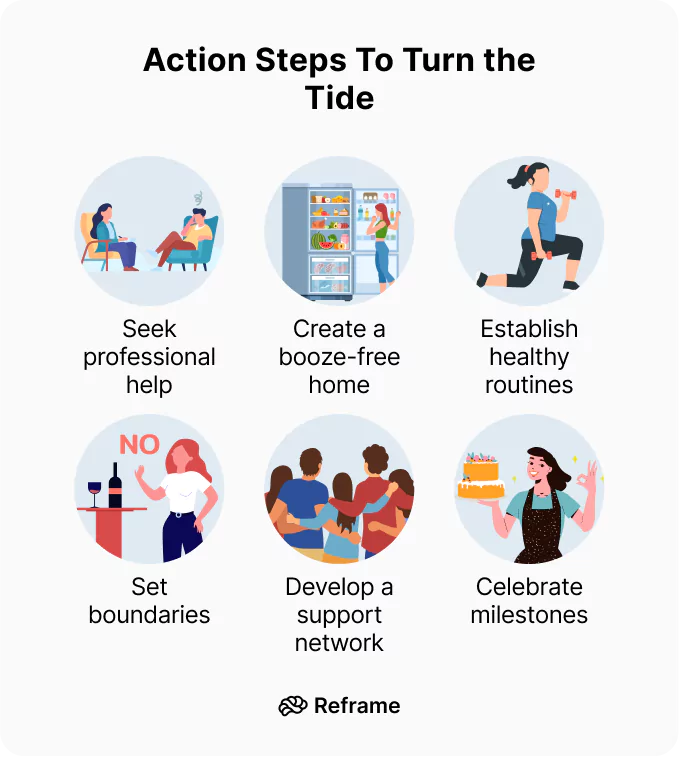
Finally, here are some additional action steps to help you and your partner address the challenge of alcohol misuse head-on in your marriage.
When you're dealing with a partner's drinking, it's easy to feel powerless. The key is to shift your focus from trying to change them to managing your own actions and environment. This isn't about giving up; it's about taking your power back and creating a healthier space for yourself, which can, in turn, inspire change.
Setting boundaries is one of the most important things you can do for your own well-being. Think of them not as rules for your partner, but as guidelines for yourself to protect your peace and safety. For example, a boundary might be, "I will not engage in arguments when you've been drinking," or "I will take the kids to my parents' house if there is drinking during family dinner." These aren't punishments; they are clear, consistent actions you take to create a respectful and stable environment. By upholding them, you encourage your spouse to take responsibility for their choices while safeguarding your own mental health.
It's important to distinguish between a healthy boundary and an ultimatum you aren't prepared to enforce. While it can be tempting to say, "If you drink again, I'm leaving," this can cause more harm than good if you don't mean it. Empty threats can damage trust and make your partner take your concerns less seriously over time. Before you state a consequence, ask yourself if you are truly ready and able to follow through. Your words carry weight, and using them carefully ensures that when you do set a firm line, it's respected because it's backed by genuine intention.
This can be the hardest truth to accept: you cannot force your partner to change. The motivation to address their drinking has to come from within them. Trying to control their behavior through nagging, pleading, or threats often backfires, creating resentment and pushing them further away. While you can't make the decision for them, you can create an environment that encourages self-reflection. Your role is to offer support, maintain your boundaries, and take care of yourself. By focusing on your own health and happiness, you model a positive alternative and show that change is possible, but the first step must be theirs.
Taking the step to find support is a powerful move, whether it’s for you or your partner. The good news is there are many paths to getting help, from immediate phone support to long-term professional guidance. It’s all about finding the right fit for your family’s unique situation. Remember, reaching out is a sign of strength and the first step toward rebuilding a healthier, more connected life together. Below are several resources that can provide the support and information you need to get started on this journey.
When you need to talk to someone right away, helplines offer a confidential and immediate connection to support. These services are staffed by trained individuals who can provide information, offer a listening ear, and guide you to the next appropriate step. They are an invaluable resource for moments of crisis or when you simply don't know where else to turn. Think of them as a knowledgeable and compassionate first point of contact on the road to recovery and healing for your family.
The Substance Abuse and Mental Health Services Administration (SAMHSA) runs a National Helpline that is free, confidential, and available 24/7. You can call anytime to get referrals to local treatment facilities, support groups, and community-based organizations. It’s not a crisis line, but rather an information service that connects you with the resources in your area that can provide long-term help for substance use disorders.
If your partner’s drinking is affecting you, Al-Anon is a resource created specifically for the friends and family members of people struggling with alcohol misuse. It’s a support group where you can share your experiences and learn coping strategies from others who truly understand what you’re going through. Many find the community incredibly validating and helpful, and they have online meetings, making it accessible no matter where you are.
For a more structured approach, professional treatment offers evidence-based strategies to address alcohol misuse. These paths are guided by healthcare providers, therapists, and specialists who can create a personalized plan. Professional treatment addresses not just the drinking itself, but also the underlying psychological factors that contribute to it. This comprehensive approach is often key to creating lasting change and rebuilding the trust and communication within your marriage.
For someone with a physical dependence on alcohol, stopping suddenly can be dangerous. Medically supervised detoxification ensures that the process is managed safely under the care of healthcare professionals. This is often the first step in a formal treatment program, as it clears the body of alcohol while managing withdrawal symptoms, creating a stable foundation for the therapeutic work ahead.
Treatment programs come in different formats to fit various needs. Residential (or inpatient) programs offer an immersive environment where the individual lives at a treatment facility, providing 24/7 support. Outpatient programs are more flexible, allowing the person to live at home while attending scheduled therapy and counseling sessions. Both are effective options for helping rebuild trust and relationships.
Therapy, whether it’s individual, couples, or family counseling, provides a safe space to explore the root causes of alcohol misuse and develop healthier coping mechanisms. A therapist can guide you and your partner in improving communication and resolving conflicts. Aftercare, which includes ongoing support groups or therapy sessions after a formal program ends, is crucial for maintaining progress long-term.
In addition to traditional support systems, digital tools have emerged as a powerful and accessible way to foster new habits. Apps can provide daily encouragement, educational resources, and a supportive community right at your fingertips. They offer a private and convenient way to track progress and learn new skills, making them an excellent supplement to other forms of support. This approach allows you to integrate habit-change work into your daily life seamlessly.
Apps like Reframe are designed to help you change your relationship with alcohol through a science-backed approach. Based on neuroscience, Reframe offers tools like personalized drink tracking, which can be a real eye-opener and a catalyst for change. The app also provides daily readings, skill-building exercises, and access to a large, supportive community of peers and coaches. By helping you understand the "why" behind your habits, Reframe empowers you to build a healthier, more mindful lifestyle.
Alcohol misuse can indeed put a strain on marriage, but it doesn’t have to be the narrative of your relationship. With the right tools, understanding, and action, both partners can work towards a healthier, happier union free from the shadow of alcohol.
It’s not just about navigating away from alcohol; it’s about steering towards a shared vision of your life together. Take it one step at a time, support each other, and keep your eyes on the horizon of a fulfilling, alcohol-free future.
How do I bring up my partner's drinking without starting a huge argument? The key is to approach the conversation with care, not criticism. Choose a calm, private moment when neither of you is stressed or has been drinking. Frame your concerns around your own feelings by using "I" statements, like "I feel lonely when we don't connect in the evenings," instead of "You always drink too much." The goal isn't to accuse them but to share how their behavior impacts you and the relationship, opening the door for a discussion rather than shutting it with blame.
My partner seems to handle their responsibilities just fine. Could their drinking still be a problem? Absolutely. This is often what a "functioning" alcohol use disorder looks like. Just because someone is succeeding at work and meeting daily obligations doesn't mean alcohol isn't causing harm. The real damage is often hidden, eroding trust, emotional intimacy, and communication within the marriage. If their drinking is causing tension or you feel it's creating distance between you, then it's a problem for your relationship, regardless of how well they manage other parts of their life.
What if my partner completely denies they have a drinking problem? This is a very common and frustrating situation. The most important thing to remember is that you cannot force someone to see what they aren't ready to acknowledge. Instead of trying to convince them, shift your focus to what you can control: your own actions and well-being. This is where setting firm, healthy boundaries becomes essential. You can also seek support for yourself through resources like Al-Anon or a therapist, which can help you cope with the situation and learn how to protect your own peace.
Is it really possible to save our marriage if alcohol has caused so much damage? Yes, it is possible, but it requires a real commitment from both people. Healing a relationship strained by alcohol misuse is a process that takes time, patience, and often professional help. The journey begins when the issue is brought into the open and both partners are willing to work on rebuilding trust and communication. It won't happen overnight, but many couples find their way back to a stronger, healthier partnership.
I feel so overwhelmed. What is the single most important thing I can do for myself right now? Focus on your own support system. It's easy to get completely wrapped up in your partner's issues, but you cannot pour from an empty cup. Your first step should be to find someone you can talk to, whether it's a trusted friend, a family member, or a professional counselor. Joining a support group like Al-Anon can also be incredibly helpful because you'll connect with others who understand exactly what you're going through. Taking care of your own emotional health gives you the strength to handle the challenges ahead.
If you're searching for answers because you feel like "alcohol is ruining my marriage," the statistics can be terrifying. Maybe you're thinking, 'my husband's drinking is ruining our marriage,' and you're not wrong to be concerned. Studies show that verbal abuse is twice as likely when alcohol is involved, and the risk of physical aggression skyrockets. But these numbers don't have to be your story. Recognizing the problem is the first, most powerful step toward healing and creating a new path forward together.
Marriage is a partnership, but when alcohol misuse gets mixed in, things can go haywire quickly. Whether you’re living with an alcoholic spouse or you’re the one struggling with alcohol misuse yourself, the challenge can feel overwhelming. However, by understanding the dynamics and adopting some science-based strategies, each partner can help the other steer towards calmer waters.
When it comes to relationships, alcohol can really shake things up. Scientifically speaking, it can alter brain chemistry, leading to changes in behavior by disrupting the neurotransmitters that are responsible for mood regulation, decision-making, and impulse control. The result? Mood swings, aggression, or withdrawal — and a strain on the emotional connection that’s the bedrock of marriage.
For the non-drinking spouse, the repeated stress can trigger a cascade of psychological effects, including anxiety, depression, and even symptoms of post-traumatic stress. Alcohol drives the partners apart, creating an environment where both may feel misunderstood and alone.
Let's take a closer look at how alcohol misuse can affect relationship dynamics:
It’s a term you’ve probably heard before, but what does it really mean? A "functioning alcoholic" isn't a clinical diagnosis. Instead, it describes someone who struggles with alcohol misuse but still manages to keep up with daily responsibilities like work, family, and social commitments. Because they seem to have it all together on the outside, it can be incredibly difficult to spot the problem — for them and for you. Doctors would classify this pattern of drinking as alcohol use disorder, and recognizing the subtle signs is the first step toward addressing it.
Since a high-functioning person with alcohol use disorder doesn't fit the stereotypical image of someone whose life is falling apart, the signs can be easy to miss. They might frequently drink more than intended, drink alone or in secret, or consistently use alcohol as a reward or a way to de-stress. You might also notice them becoming irritable or defensive if you bring up their drinking habits. They often rationalize their behavior with thoughts like, "I'm successful at work, so my drinking can't be that bad," or "Everyone I know drinks this much." This justification makes it hard for them to see the negative impact alcohol is having on their health and relationships.
Denial is a powerful defense mechanism that often goes hand-in-hand with alcohol misuse. Because the person can still pay their bills and maintain friendships, they genuinely may not believe they have a problem. This denial isn't necessarily about lying; it's a cognitive blind spot that protects them from the shame and fear associated with addiction. According to experts, this denial is one of the biggest barriers to seeking help. Acknowledging the issue feels like admitting failure, which is especially difficult for someone who prides themselves on being successful and in control. Breaking through this denial requires compassion and understanding, not confrontation.
The effects of alcohol misuse aren’t limited to just the couple — they can ripple out to affect family life, social relationships, and work. It's a chain reaction, with the strain in the marriage leading to tensions in other relationships.
If you feel like alcohol is driving a wedge in your marriage, you’re not imagining things. The connection between drinking and relationship problems is well-documented, and the research paints a clear picture of how it can systematically weaken a partnership. Looking at the science can help validate your feelings and pinpoint exactly where the strain is coming from. It’s not just about a few bad arguments; it’s about a pattern of behavior that can affect everything from daily happiness to the long-term stability of your relationship.
The link between heavy drinking and divorce is unfortunately strong. Research from Sanford Behavioral Health confirms that when one partner drinks heavily, the likelihood of divorce goes up significantly. Alcohol rarely creates problems in a vacuum. Instead, it often acts as a catalyst, amplifying existing issues like financial stress or communication gaps and creating new ones like infidelity or constant conflict. This puts an immense and sustained pressure on the partnership, and over time, that strain can cause even the strongest foundations to crack, pushing a couple toward separation.
Marital satisfaction naturally has its ups and downs, but consistent alcohol misuse can lead to a steady decline in happiness for both people. A study in the journal Psychology of Addictive Behaviors found a direct link between heavy drinking and lower marital happiness. This isn't just about the fallout from a single night of drinking too much. It’s more like a slow erosion of the joy, trust, and connection that holds a couple together. This creates a cycle of disappointment and resentment that makes it incredibly difficult for either partner to feel positive about the relationship or hopeful about the future.
Healthy communication is the lifeblood of a partnership, but alcohol can poison those interactions. Research shows that couples dealing with alcohol misuse tend to have more negative exchanges, like criticism or hostility, and fewer positive ones, like showing empathy or sharing a laugh. This imbalance creates a tense dynamic where it feels like you’re walking on eggshells. Instead of working as a team, you might feel like you’re constantly on the defensive. This breakdown in communication makes it nearly impossible to resolve conflicts, provide support, or simply enjoy being together, which only deepens the emotional divide.
If you're the one grappling with alcohol misuse, know that your journey towards a healthier lifestyle is pivotal, not just for your own well-being, but for the health of your marriage. It's time to look at this challenge with fresh eyes and a determined heart. Here's how you can make significant strides in the right direction.
Living with an alcoholic wife or alcoholic husband can bring on a flood of intense emotions. It's a challenging situation, but your resilience and understanding can make a world of difference! Here's how to navigate this journey while maintaining your own well-being and nurturing your relationship.
When alcohol misuse enters a marriage, its effects don't stop with the couple. Like a stone tossed into a pond, the impact creates ripples that touch every family member, especially children. The constant stress can lead to a host of problems, affecting the family’s emotional, social, and financial well-being. Partners often feel emotionally exhausted from trying to hold everything together, and the financial strain from the cost of alcohol and related issues can be immense. You can even calculate the spending to see the tangible impact. This environment of instability and tension can be particularly damaging for children, who may experience anxiety and insecurity, shaping their emotional development and future relationships in profound ways.
To cope with the chaos, family members often unconsciously adopt specific roles. These are survival tactics, but they can create unhealthy dynamics. You might recognize some of these: The Enabler (often the spouse) covers up the problem, making excuses to shield their partner from consequences. The Hero, typically an older child, becomes a high achiever to bring a sense of pride to the family. The Scapegoat acts out and gets blamed for all the family’s troubles, diverting attention from the drinking. The Lost Child flies under the radar, staying quiet and invisible to avoid conflict. Finally, The Mascot uses humor to ease the tension. While these roles help the family function day-to-day, they prevent everyone from addressing the root issue and can have lasting effects on each person’s identity and well-being.
If this all sounds a bit daunting, there's good news: recognizing these challenges is a huge step towards addressing them. With the right tools, support, and a dash of perseverance, steering your marriage back to a healthier place is absolutely possible.
Open, honest communication can be a lifeline when it comes to marriage problems. The right approach can pave the way for mutual support and recovery.
Finally, here are some additional action steps to help you and your partner address the challenge of alcohol misuse head-on in your marriage.
When you're dealing with a partner's drinking, it's easy to feel powerless. The key is to shift your focus from trying to change them to managing your own actions and environment. This isn't about giving up; it's about taking your power back and creating a healthier space for yourself, which can, in turn, inspire change.
Setting boundaries is one of the most important things you can do for your own well-being. Think of them not as rules for your partner, but as guidelines for yourself to protect your peace and safety. For example, a boundary might be, "I will not engage in arguments when you've been drinking," or "I will take the kids to my parents' house if there is drinking during family dinner." These aren't punishments; they are clear, consistent actions you take to create a respectful and stable environment. By upholding them, you encourage your spouse to take responsibility for their choices while safeguarding your own mental health.
It's important to distinguish between a healthy boundary and an ultimatum you aren't prepared to enforce. While it can be tempting to say, "If you drink again, I'm leaving," this can cause more harm than good if you don't mean it. Empty threats can damage trust and make your partner take your concerns less seriously over time. Before you state a consequence, ask yourself if you are truly ready and able to follow through. Your words carry weight, and using them carefully ensures that when you do set a firm line, it's respected because it's backed by genuine intention.
This can be the hardest truth to accept: you cannot force your partner to change. The motivation to address their drinking has to come from within them. Trying to control their behavior through nagging, pleading, or threats often backfires, creating resentment and pushing them further away. While you can't make the decision for them, you can create an environment that encourages self-reflection. Your role is to offer support, maintain your boundaries, and take care of yourself. By focusing on your own health and happiness, you model a positive alternative and show that change is possible, but the first step must be theirs.
Taking the step to find support is a powerful move, whether it’s for you or your partner. The good news is there are many paths to getting help, from immediate phone support to long-term professional guidance. It’s all about finding the right fit for your family’s unique situation. Remember, reaching out is a sign of strength and the first step toward rebuilding a healthier, more connected life together. Below are several resources that can provide the support and information you need to get started on this journey.
When you need to talk to someone right away, helplines offer a confidential and immediate connection to support. These services are staffed by trained individuals who can provide information, offer a listening ear, and guide you to the next appropriate step. They are an invaluable resource for moments of crisis or when you simply don't know where else to turn. Think of them as a knowledgeable and compassionate first point of contact on the road to recovery and healing for your family.
The Substance Abuse and Mental Health Services Administration (SAMHSA) runs a National Helpline that is free, confidential, and available 24/7. You can call anytime to get referrals to local treatment facilities, support groups, and community-based organizations. It’s not a crisis line, but rather an information service that connects you with the resources in your area that can provide long-term help for substance use disorders.
If your partner’s drinking is affecting you, Al-Anon is a resource created specifically for the friends and family members of people struggling with alcohol misuse. It’s a support group where you can share your experiences and learn coping strategies from others who truly understand what you’re going through. Many find the community incredibly validating and helpful, and they have online meetings, making it accessible no matter where you are.
For a more structured approach, professional treatment offers evidence-based strategies to address alcohol misuse. These paths are guided by healthcare providers, therapists, and specialists who can create a personalized plan. Professional treatment addresses not just the drinking itself, but also the underlying psychological factors that contribute to it. This comprehensive approach is often key to creating lasting change and rebuilding the trust and communication within your marriage.
For someone with a physical dependence on alcohol, stopping suddenly can be dangerous. Medically supervised detoxification ensures that the process is managed safely under the care of healthcare professionals. This is often the first step in a formal treatment program, as it clears the body of alcohol while managing withdrawal symptoms, creating a stable foundation for the therapeutic work ahead.
Treatment programs come in different formats to fit various needs. Residential (or inpatient) programs offer an immersive environment where the individual lives at a treatment facility, providing 24/7 support. Outpatient programs are more flexible, allowing the person to live at home while attending scheduled therapy and counseling sessions. Both are effective options for helping rebuild trust and relationships.
Therapy, whether it’s individual, couples, or family counseling, provides a safe space to explore the root causes of alcohol misuse and develop healthier coping mechanisms. A therapist can guide you and your partner in improving communication and resolving conflicts. Aftercare, which includes ongoing support groups or therapy sessions after a formal program ends, is crucial for maintaining progress long-term.
In addition to traditional support systems, digital tools have emerged as a powerful and accessible way to foster new habits. Apps can provide daily encouragement, educational resources, and a supportive community right at your fingertips. They offer a private and convenient way to track progress and learn new skills, making them an excellent supplement to other forms of support. This approach allows you to integrate habit-change work into your daily life seamlessly.
Apps like Reframe are designed to help you change your relationship with alcohol through a science-backed approach. Based on neuroscience, Reframe offers tools like personalized drink tracking, which can be a real eye-opener and a catalyst for change. The app also provides daily readings, skill-building exercises, and access to a large, supportive community of peers and coaches. By helping you understand the "why" behind your habits, Reframe empowers you to build a healthier, more mindful lifestyle.
Alcohol misuse can indeed put a strain on marriage, but it doesn’t have to be the narrative of your relationship. With the right tools, understanding, and action, both partners can work towards a healthier, happier union free from the shadow of alcohol.
It’s not just about navigating away from alcohol; it’s about steering towards a shared vision of your life together. Take it one step at a time, support each other, and keep your eyes on the horizon of a fulfilling, alcohol-free future.
How do I bring up my partner's drinking without starting a huge argument? The key is to approach the conversation with care, not criticism. Choose a calm, private moment when neither of you is stressed or has been drinking. Frame your concerns around your own feelings by using "I" statements, like "I feel lonely when we don't connect in the evenings," instead of "You always drink too much." The goal isn't to accuse them but to share how their behavior impacts you and the relationship, opening the door for a discussion rather than shutting it with blame.
My partner seems to handle their responsibilities just fine. Could their drinking still be a problem? Absolutely. This is often what a "functioning" alcohol use disorder looks like. Just because someone is succeeding at work and meeting daily obligations doesn't mean alcohol isn't causing harm. The real damage is often hidden, eroding trust, emotional intimacy, and communication within the marriage. If their drinking is causing tension or you feel it's creating distance between you, then it's a problem for your relationship, regardless of how well they manage other parts of their life.
What if my partner completely denies they have a drinking problem? This is a very common and frustrating situation. The most important thing to remember is that you cannot force someone to see what they aren't ready to acknowledge. Instead of trying to convince them, shift your focus to what you can control: your own actions and well-being. This is where setting firm, healthy boundaries becomes essential. You can also seek support for yourself through resources like Al-Anon or a therapist, which can help you cope with the situation and learn how to protect your own peace.
Is it really possible to save our marriage if alcohol has caused so much damage? Yes, it is possible, but it requires a real commitment from both people. Healing a relationship strained by alcohol misuse is a process that takes time, patience, and often professional help. The journey begins when the issue is brought into the open and both partners are willing to work on rebuilding trust and communication. It won't happen overnight, but many couples find their way back to a stronger, healthier partnership.
I feel so overwhelmed. What is the single most important thing I can do for myself right now? Focus on your own support system. It's easy to get completely wrapped up in your partner's issues, but you cannot pour from an empty cup. Your first step should be to find someone you can talk to, whether it's a trusted friend, a family member, or a professional counselor. Joining a support group like Al-Anon can also be incredibly helpful because you'll connect with others who understand exactly what you're going through. Taking care of your own emotional health gives you the strength to handle the challenges ahead.

Alcohol cravings are common. Why exactly do they happen, though? And what can we do about them? Learn the science-backed strategies and insights.
Although it isn’t a treatment for alcohol use disorder (AUD), the Reframe app can help you cut back on drinking gradually, with the science-backed knowledge to empower you 100% of the way. Our proven program has helped millions of people around the world drink less and live more. And we want to help you get there, too!
The Reframe app equips you with the knowledge and skills you need to not only survive drinking less, but to thrive while you navigate the journey. Our daily research-backed readings teach you the neuroscience of alcohol, and our in-app Toolkit provides the resources and activities you need to navigate each challenge.
You’ll meet millions of fellow Reframers in our 24/7 Forum chat and daily Zoom check-in meetings. Receive encouragement from people worldwide who know exactly what you’re going through! You’ll also have the opportunity to connect with our licensed Reframe coaches for more personalized guidance.
Plus, we’re always introducing new features to optimize your in-app experience. We recently launched our in-app chatbot, Melody, powered by the world’s most powerful AI technology. Melody is here to help as you adjust to a life with less (or no) alcohol.
And that’s not all! Every month, we launch fun challenges, like Dry/Damp January, Mental Health May, and Outdoorsy June. You won’t want to miss out on the chance to participate alongside fellow Reframers (or solo if that’s more your thing!).
The Reframe app is free for 7 days, so you don’t have anything to lose by trying it. Are you ready to feel empowered and discover life beyond alcohol? Then download our app through the App Store or Google Play today!
Are you tired of constantly battling the urge to drink? Do you feel like those pesky cravings come out of nowhere? Is reducing your alcohol consumption starting to feel like an uphill battle? We know exactly how you feel, and we want you to know that you’re not the only one. Tens of millions of people worldwide struggle with alcohol misuse. And alcohol use disorder (AUD) affects over 14 million adults in the U.S. alone.
Overcoming alcohol cravings can be a game-changer for our well-being as we cut back on alcohol or quit drinking altogether. It's never too late to take control and break free from the vicious cravings cycle so many of us find ourselves in. In this blog post, we’ll discuss some effective ways how to curb alcohol cravings and kickstart our journey towards a happier, healthier life.
Cravings aren’t just willpower battles , they’re rooted in how your brain has learned to associate alcohol with certain feelings, emotions, and situations. When you crave a drink, it’s often your brain signaling a learned psychological response rather than a physical need. Stress, social cues, or habitual emotional links (like associating alcohol with relaxation or celebration) can trigger strong urges. Recognizing these psychological triggers, and how they work is a key first step toward managing and reducing cravings over time.
One effective way to reduce alcohol cravings is to avoid triggers that may lead to cravings. What are triggers? Triggers are certain situations or emotions that induce strong urges to drink. They can vary from person to person, but some common examples include social events, stress, and boredom. Once we’ve pinpointed our triggers, we can find ways to avoid or cope with them. For instance, if our office’s Friday pizza tradition triggers cravings for beer, we can consider stepping out for lunch that day or bringing a non-alcoholic beverage that we’ll enjoy.
Also, if we typically drink when we’re stressed or anxious, we can instead engage in alcohol-free activities when we feel these emotions. Exercising, meditating, or simply grabbing a tall glass of water can combat the craving. We may consider avoiding or minimizing time in certain social situations or environments where alcohol is present, at least until we feel confident in our ability to resist cravings.
Another helpful way to combat cravings is to develop a support system. This may include friends, family, or even professional help. It can be challenging to overcome alcohol cravings alone, so having others in our corner to provide encouragement and accountability makes a significant difference.
Professional help, such as counseling or support groups, can also give us the tools and resources necessary to reduce our alcohol cravings. Therapists can provide us with evidence-based strategies for conquering cravings, and they may refer us to a medical professional if medication is necessary (more on this below).
We can also find our people through Reframe! The app provides a supportive community of like-minded folks from around the globe through our 24/7 anonymous Forum chat. If we want to surround ourselves with people who “get it” and who can give us helpful insights into our own relationship with alcohol, the Reframe Forum is the place to be.
Coping mechanisms are key to managing cravings (and to navigate life’s ups and downs!). Deep breathing techniques calm our body and mind when cravings pop up.
Mindfulness also helps us develop more awareness around our cravings and when they are likely to arise.
Mindfulness is the practice of being present and aware of our thoughts, feelings, and surroundings. When it comes to stopping alcohol cravings, this present moment awareness is a powerful tool. Instead of trying to resist the craving, take a moment to observe it with curiosity and without judgment. This allows us to detach from the urge and ultimately reduce its intensity.
Similarly, engaging in activities that provide a sense of satisfaction or pleasure, such as indulging in a favorite hobby or spending time with loved ones, distract us from cravings. When we feel the urge to drink, we can redirect our attention to something enjoyable: reading a book, going for a walk, or playing a game. The key is to find an activity that we find intrinsically engaging and fun. Research actually shows that engaging in pleasurable activities can reduce cravings.
A critical component of stopping alcohol cravings is self-care. Many of us might picture luxurious spa days or meditation retreats when we hear that, but self-care is pretty simple. It includes anything that promotes physical and emotional well-being, such as exercise, healthy eating, and getting enough sleep. Taking care of ourselves reduces stress and anxiety, common triggers for alcohol cravings.
It's essential to note that stopping alcohol cravings and reducing alcohol consumption requires a gradual process. Abruptly cutting back on alcohol (especially if we’ve been drinking heavily) can sometimes lead to withdrawal symptoms, which can be dangerous without medical supervision. That’s why we recommend cutting down by no more than 10% per week. Professional support can guide us in safely reducing or ending our alcohol consumption over time, as well.
For some of us, reducing or eliminating alcohol might require medical intervention. And that’s okay! Medication can offer a helping hand as we build new coping mechanisms. In the initial stages of going alcohol-free or cutting back, certain medications have been shown to suppress alcohol cravings:
However, it's important to note that these medications aren't magic. They work best in conjunction with other treatments, such as counseling. Moreover, they might have contraindications with other medications or medical conditions. Before considering these options, it's essential to discuss with a healthcare professional who can provide guidance on potential risks, benefits, and monitoring.
Taking a comprehensive approach, which may include medication, can enhance our chances of successfully curbing those alcohol cravings and setting ourselves on a healthier path.

We’re not here to tout one diet over another, and we know that dietary preferences will vary. However, optimal nutrition is key to stopping alcohol cravings and improving our overall health. Here are a few nutrition-related changes that can keep pesky cravings at bay.
When our blood sugar dips too low, we face a greater risk of cravings. Our bodies know that alcohol quickly spikes our glucose levels, bringing about a quick state change. However, long-term heavy alcohol use puts us at higher risk for frequent hypoglycemia (low blood sugar), which means our blood sugar may already be imbalanced when we remove alcohol. This is why a nutritious diet and healthy eating habits are essential for curbing cravings.
Focus on whole foods: healthy fats (olive oil, avocados, nuts), protein (chicken, eggs, fish), complex carbohydrates (quinoa, brown rice, beans, legumes), fruits, and vegetables. Avoid or limit processed foods, as these can lead to further blood sugar imbalances.
When choosing what to eat, focus on hitting three categories with each meal and snack: fiber, protein, and healthy fats. Fiber feeds the good bacteria in our gut and keeps us full. Protein and healthy fats also encourage satiety. Snacks high in refined sugar, refined carbs (i.e., white bread or crackers), or saturated fats don’t check all of the nutritional boxes that keep us satiated and properly fueling our bodies. When our food intake is balanced and covers several categories, we can stay focused and energized throughout the day. And this means fewer cravings!
It can be tempting to skip meals, especially if we’re swamped at work or have many nagging responsibilities. Unfortunately, skipping meals only makes us hangry and leads to poor concentration. Eating at regular intervals is especially important for maintaining balanced blood sugar levels throughout the day. We should aim to eat something with protein, complex carbs, and healthy fats every three to four hours to keep our blood sugar stable and avoid those dreaded hunger-related mood swings. This also keeps our metabolism firing, which maintains a healthy body weight. And, of course, it’ll keep us from falling into the cravings trap.
Breakfast is the most important meal of the day for a reason: by keeping our blood sugar levels from dropping too low, it reduces cravings.
The key is to choose our first meal of the day wisely. We can make improvements to our breakfast by making sure it’s balanced and full of protein. When we “break” our body’s overnight “fast” with a nutritious and satisfying meal, we provide fuel and energy for a good day. Eggs, protein smoothies, oatmeal with a little nut butter mixed in — all of these are excellent options for a breakfast that properly fuels us. When we’re appropriately nourished, we’re less likely to succumb to cravings.
When tweaking dietary habits (or any habit, for that matter), always start small. When doing something new, like changing our relationship with alcohol, we don’t want to overwhelm ourselves with drastic changes in too many other areas, such as nutrition. Pick just one area — like eating meals at regular intervals, grabbing a balanced afternoon snack, or meal prepping on the weekends — and see how that feels. We should carry on with the changes that support our ability to stave off cravings and adjust the ones that don’t. We’ll be surprised at how much a change in our eating habits can affect how often — and how intensely — we experience alcohol cravings.
Figuring out how to curb alcohol cravings and change our relationship with alcohol is a personal process that requires dedication and motivation. Slips and setbacks are normal, and we shouldn’t be discouraged if we encounter them.
Work on one coping strategy at a time as you quit alcohol or reduce your intake. For instance, start with a mindfulness practice or make adjustments to your diet. With each change, you’ll fortify yourself against the pull of cravings and grow stronger each day. Incorporating these strategies into your daily routine can reduce your desire for alcohol and improve your overall well-being.
And remember: it’s also okay to seek help from a medical professional or mental health expert. Changing our relationship with alcohol requires a multifaceted approach, and there’s nothing wrong with needing outside help. You are worth the effort and you deserve to live your healthiest and most empowered life! Let’s get there together, one conquered craving at a time.
Are you tired of constantly battling the urge to drink? Do you feel like those pesky cravings come out of nowhere? Is reducing your alcohol consumption starting to feel like an uphill battle? We know exactly how you feel, and we want you to know that you’re not the only one. Tens of millions of people worldwide struggle with alcohol misuse. And alcohol use disorder (AUD) affects over 14 million adults in the U.S. alone.
Overcoming alcohol cravings can be a game-changer for our well-being as we cut back on alcohol or quit drinking altogether. It's never too late to take control and break free from the vicious cravings cycle so many of us find ourselves in. In this blog post, we’ll discuss some effective ways how to curb alcohol cravings and kickstart our journey towards a happier, healthier life.
Cravings aren’t just willpower battles , they’re rooted in how your brain has learned to associate alcohol with certain feelings, emotions, and situations. When you crave a drink, it’s often your brain signaling a learned psychological response rather than a physical need. Stress, social cues, or habitual emotional links (like associating alcohol with relaxation or celebration) can trigger strong urges. Recognizing these psychological triggers, and how they work is a key first step toward managing and reducing cravings over time.
One effective way to reduce alcohol cravings is to avoid triggers that may lead to cravings. What are triggers? Triggers are certain situations or emotions that induce strong urges to drink. They can vary from person to person, but some common examples include social events, stress, and boredom. Once we’ve pinpointed our triggers, we can find ways to avoid or cope with them. For instance, if our office’s Friday pizza tradition triggers cravings for beer, we can consider stepping out for lunch that day or bringing a non-alcoholic beverage that we’ll enjoy.
Also, if we typically drink when we’re stressed or anxious, we can instead engage in alcohol-free activities when we feel these emotions. Exercising, meditating, or simply grabbing a tall glass of water can combat the craving. We may consider avoiding or minimizing time in certain social situations or environments where alcohol is present, at least until we feel confident in our ability to resist cravings.
Another helpful way to combat cravings is to develop a support system. This may include friends, family, or even professional help. It can be challenging to overcome alcohol cravings alone, so having others in our corner to provide encouragement and accountability makes a significant difference.
Professional help, such as counseling or support groups, can also give us the tools and resources necessary to reduce our alcohol cravings. Therapists can provide us with evidence-based strategies for conquering cravings, and they may refer us to a medical professional if medication is necessary (more on this below).
We can also find our people through Reframe! The app provides a supportive community of like-minded folks from around the globe through our 24/7 anonymous Forum chat. If we want to surround ourselves with people who “get it” and who can give us helpful insights into our own relationship with alcohol, the Reframe Forum is the place to be.
Coping mechanisms are key to managing cravings (and to navigate life’s ups and downs!). Deep breathing techniques calm our body and mind when cravings pop up.
Mindfulness also helps us develop more awareness around our cravings and when they are likely to arise.
Mindfulness is the practice of being present and aware of our thoughts, feelings, and surroundings. When it comes to stopping alcohol cravings, this present moment awareness is a powerful tool. Instead of trying to resist the craving, take a moment to observe it with curiosity and without judgment. This allows us to detach from the urge and ultimately reduce its intensity.
Similarly, engaging in activities that provide a sense of satisfaction or pleasure, such as indulging in a favorite hobby or spending time with loved ones, distract us from cravings. When we feel the urge to drink, we can redirect our attention to something enjoyable: reading a book, going for a walk, or playing a game. The key is to find an activity that we find intrinsically engaging and fun. Research actually shows that engaging in pleasurable activities can reduce cravings.
A critical component of stopping alcohol cravings is self-care. Many of us might picture luxurious spa days or meditation retreats when we hear that, but self-care is pretty simple. It includes anything that promotes physical and emotional well-being, such as exercise, healthy eating, and getting enough sleep. Taking care of ourselves reduces stress and anxiety, common triggers for alcohol cravings.
It's essential to note that stopping alcohol cravings and reducing alcohol consumption requires a gradual process. Abruptly cutting back on alcohol (especially if we’ve been drinking heavily) can sometimes lead to withdrawal symptoms, which can be dangerous without medical supervision. That’s why we recommend cutting down by no more than 10% per week. Professional support can guide us in safely reducing or ending our alcohol consumption over time, as well.
For some of us, reducing or eliminating alcohol might require medical intervention. And that’s okay! Medication can offer a helping hand as we build new coping mechanisms. In the initial stages of going alcohol-free or cutting back, certain medications have been shown to suppress alcohol cravings:
However, it's important to note that these medications aren't magic. They work best in conjunction with other treatments, such as counseling. Moreover, they might have contraindications with other medications or medical conditions. Before considering these options, it's essential to discuss with a healthcare professional who can provide guidance on potential risks, benefits, and monitoring.
Taking a comprehensive approach, which may include medication, can enhance our chances of successfully curbing those alcohol cravings and setting ourselves on a healthier path.
We’re not here to tout one diet over another, and we know that dietary preferences will vary. However, optimal nutrition is key to stopping alcohol cravings and improving our overall health. Here are a few nutrition-related changes that can keep pesky cravings at bay.
When our blood sugar dips too low, we face a greater risk of cravings. Our bodies know that alcohol quickly spikes our glucose levels, bringing about a quick state change. However, long-term heavy alcohol use puts us at higher risk for frequent hypoglycemia (low blood sugar), which means our blood sugar may already be imbalanced when we remove alcohol. This is why a nutritious diet and healthy eating habits are essential for curbing cravings.
Focus on whole foods: healthy fats (olive oil, avocados, nuts), protein (chicken, eggs, fish), complex carbohydrates (quinoa, brown rice, beans, legumes), fruits, and vegetables. Avoid or limit processed foods, as these can lead to further blood sugar imbalances.
When choosing what to eat, focus on hitting three categories with each meal and snack: fiber, protein, and healthy fats. Fiber feeds the good bacteria in our gut and keeps us full. Protein and healthy fats also encourage satiety. Snacks high in refined sugar, refined carbs (i.e., white bread or crackers), or saturated fats don’t check all of the nutritional boxes that keep us satiated and properly fueling our bodies. When our food intake is balanced and covers several categories, we can stay focused and energized throughout the day. And this means fewer cravings!
It can be tempting to skip meals, especially if we’re swamped at work or have many nagging responsibilities. Unfortunately, skipping meals only makes us hangry and leads to poor concentration. Eating at regular intervals is especially important for maintaining balanced blood sugar levels throughout the day. We should aim to eat something with protein, complex carbs, and healthy fats every three to four hours to keep our blood sugar stable and avoid those dreaded hunger-related mood swings. This also keeps our metabolism firing, which maintains a healthy body weight. And, of course, it’ll keep us from falling into the cravings trap.
Breakfast is the most important meal of the day for a reason: by keeping our blood sugar levels from dropping too low, it reduces cravings.
The key is to choose our first meal of the day wisely. We can make improvements to our breakfast by making sure it’s balanced and full of protein. When we “break” our body’s overnight “fast” with a nutritious and satisfying meal, we provide fuel and energy for a good day. Eggs, protein smoothies, oatmeal with a little nut butter mixed in — all of these are excellent options for a breakfast that properly fuels us. When we’re appropriately nourished, we’re less likely to succumb to cravings.
When tweaking dietary habits (or any habit, for that matter), always start small. When doing something new, like changing our relationship with alcohol, we don’t want to overwhelm ourselves with drastic changes in too many other areas, such as nutrition. Pick just one area — like eating meals at regular intervals, grabbing a balanced afternoon snack, or meal prepping on the weekends — and see how that feels. We should carry on with the changes that support our ability to stave off cravings and adjust the ones that don’t. We’ll be surprised at how much a change in our eating habits can affect how often — and how intensely — we experience alcohol cravings.
Figuring out how to curb alcohol cravings and change our relationship with alcohol is a personal process that requires dedication and motivation. Slips and setbacks are normal, and we shouldn’t be discouraged if we encounter them.
Work on one coping strategy at a time as you quit alcohol or reduce your intake. For instance, start with a mindfulness practice or make adjustments to your diet. With each change, you’ll fortify yourself against the pull of cravings and grow stronger each day. Incorporating these strategies into your daily routine can reduce your desire for alcohol and improve your overall well-being.
And remember: it’s also okay to seek help from a medical professional or mental health expert. Changing our relationship with alcohol requires a multifaceted approach, and there’s nothing wrong with needing outside help. You are worth the effort and you deserve to live your healthiest and most empowered life! Let’s get there together, one conquered craving at a time.

If we’ve used alcohol to decompress or relax in the past, our brain has formed an association between drinking alcohol with a feeling of relief and reward. So whenever we’re stressed, our brain recalls the positive experience with alcohol and sends a “craving” signal.
Although it isn’t a treatment for alcohol use disorder (AUD), the Reframe app can help you cut back on drinking gradually, with the science-backed knowledge to empower you 100% of the way. Our proven program has helped millions of people around the world drink less and live more. And we want to help you get there, too!
The Reframe app equips you with the knowledge and skills you need to not only survive drinking less, but to thrive while you navigate the journey. Our daily research-backed readings teach you the neuroscience of alcohol, and our in-app Toolkit provides the resources and activities you need to navigate each challenge.
You’ll meet millions of fellow Reframers in our 24/7 Forum chat and daily Zoom check-in meetings. Receive encouragement from people worldwide who know exactly what you’re going through! You’ll also have the opportunity to connect with our licensed Reframe coaches for more personalized guidance.
Plus, we’re always introducing new features to optimize your in-app experience. We recently launched our in-app chatbot, Melody, powered by the world’s most powerful AI technology. Melody is here to help as you adjust to a life with less (or no) alcohol.
And that’s not all! Every month, we launch fun challenges, like Dry/Damp January, Mental Health May, and Outdoorsy June. You won’t want to miss out on the chance to participate alongside fellow Reframers (or solo if that’s more your thing!).
The Reframe app is free for 7 days, so you don’t have anything to lose by trying it. Are you ready to feel empowered and discover life beyond alcohol? Then download our app through the App Store or Google Play today!
Many of us can probably relate: we’re driving home from a stressful day at the office and can’t wait to walk in the door, uncork a bottle of wine, and plop down on the couch. Or we reach the end of a week from hell and want nothing more than to crack open a cold beer. In other words, when our stress levels spike, so do our alcohol cravings.
There’s a well-established link between stress and alcohol use. In fact, many people who struggle with alcohol misuse report social stressors such as family or workplace conflict as triggers of craving and relapse. But, why do we crave alcohol when we’re stressed? Let’s dive in!

Drinking alcohol activates our brain’s reward system. Like other drugs, alcohol floods our brain with dopamine — that “feel good” chemical that keeps us coming back for more. As soon as we start drinking, our dopamine levels spike, creating a sense of happiness or euphoria and an apparent ease of stress and anxiety.
When we use alcohol to destress, decompress, or relax (as many of us do) our brain begins to form associations. It starts connecting drinking alcohol with a feeling of relief and reward. As we continue to use alcohol in these moments, the association is strengthened in our brain’s pleasure center.
If this association becomes strong enough, even just the thought of having a drink can increase dopamine levels. When we do consume alcohol, even more dopamine is released. As the dopamine continues to ramp up, it can lead to an acceleration of consumption. In other words, what we said would be just one drink to “take the edge off” suddenly becomes several.
Eventually, cravings become an automatic response to a trigger, such as a stressful situation. Our brain immediately remembers the positive experience with alcohol and sends signals, or cravings, that encourage the behavior.
Besides stress, there are many different types of triggers, both internal and external. Internal triggers include memories, thoughts, or other emotions like sadness, anger, or anxiety that prompt the urge to drink. External triggers refer to environmental cues that we link to alcohol, such as particular places, times, people or situations. This is why a craving can occur spontaneously — for instance, by seeing those around us drinking or walking by our favorite bar.

Interestingly, while many of us have learned to turn to alcohol for relaxation and as a way to deal with stress, the relationship between alcohol and stress is complicated. Research indicates that alcohol triggers chemical changes in our brain that lead to short-term relaxation, but long-term stress. Alcohol also changes how our body responds to stress, making it harder to cope without it.
Here’s how it works: as a depressant, alcohol has the power to calm us down and make us feel more relaxed in the moment. However, alcohol also activates the hypothalamic-pituitary-adrenocortical (HPA) axis — a major part of our body’s stress response system.
The HPA axis regulates metabolism, the immune system, and the autonomous nervous system to help our body maintain homeostasis. Adding alcohol to our system throws off this balance, making it harder to return to a healthy state.
Alcohol causes higher amounts of cortisol, the stress hormone, to be released in our brain, altering its chemistry and resetting what our body considers “normal.” It also shifts our hormonal balance and changes the way our body perceives and responds to stress.
In fact, studies have found that people who drink heavily are more likely to experience higher anxiety under stress compared to people who don’t drink or who drink in moderation. Although alcohol seems to provide temporary relief from stress, people who drink more will have higher levels of stress over the long term.

Now that we know that alcohol actually leads to more stress, it’s best to avoid turning to it as a coping mechanism. But, what happens when that craving comes? What are some healthier alternatives to managing stress? And what are some methods to stop alcohol cravings?
We need to be careful not to replace our alcohol craving with something equally addictive, like smoking or gambling. Instead, we should focus on doing things that support our overall health and well-being.
Keep in mind that when a craving for alcohol strikes, it can help to acknowledge it and remind ourselves that it will usually go away in a few minutes. Here are some healthier alternatives to turn to when we’re feeling stressed:
At Reframe, we help people not only cut back on their alcohol consumption, but build healthier habits that lead to enhanced physical and mental well-being. If alcohol has been your go-to stress reliever for years, you’re not alone! Reframe has helped millions of people like you develop a healthier way of living.
Many of us can probably relate: we’re driving home from a stressful day at the office and can’t wait to walk in the door, uncork a bottle of wine, and plop down on the couch. Or we reach the end of a week from hell and want nothing more than to crack open a cold beer. In other words, when our stress levels spike, so do our alcohol cravings.
There’s a well-established link between stress and alcohol use. In fact, many people who struggle with alcohol misuse report social stressors such as family or workplace conflict as triggers of craving and relapse. But, why do we crave alcohol when we’re stressed? Let’s dive in!
Drinking alcohol activates our brain’s reward system. Like other drugs, alcohol floods our brain with dopamine — that “feel good” chemical that keeps us coming back for more. As soon as we start drinking, our dopamine levels spike, creating a sense of happiness or euphoria and an apparent ease of stress and anxiety.
When we use alcohol to destress, decompress, or relax (as many of us do) our brain begins to form associations. It starts connecting drinking alcohol with a feeling of relief and reward. As we continue to use alcohol in these moments, the association is strengthened in our brain’s pleasure center.
If this association becomes strong enough, even just the thought of having a drink can increase dopamine levels. When we do consume alcohol, even more dopamine is released. As the dopamine continues to ramp up, it can lead to an acceleration of consumption. In other words, what we said would be just one drink to “take the edge off” suddenly becomes several.
Eventually, cravings become an automatic response to a trigger, such as a stressful situation. Our brain immediately remembers the positive experience with alcohol and sends signals, or cravings, that encourage the behavior.
Besides stress, there are many different types of triggers, both internal and external. Internal triggers include memories, thoughts, or other emotions like sadness, anger, or anxiety that prompt the urge to drink. External triggers refer to environmental cues that we link to alcohol, such as particular places, times, people or situations. This is why a craving can occur spontaneously — for instance, by seeing those around us drinking or walking by our favorite bar.
Interestingly, while many of us have learned to turn to alcohol for relaxation and as a way to deal with stress, the relationship between alcohol and stress is complicated. Research indicates that alcohol triggers chemical changes in our brain that lead to short-term relaxation, but long-term stress. Alcohol also changes how our body responds to stress, making it harder to cope without it.
Here’s how it works: as a depressant, alcohol has the power to calm us down and make us feel more relaxed in the moment. However, alcohol also activates the hypothalamic-pituitary-adrenocortical (HPA) axis — a major part of our body’s stress response system.
The HPA axis regulates metabolism, the immune system, and the autonomous nervous system to help our body maintain homeostasis. Adding alcohol to our system throws off this balance, making it harder to return to a healthy state.
Alcohol causes higher amounts of cortisol, the stress hormone, to be released in our brain, altering its chemistry and resetting what our body considers “normal.” It also shifts our hormonal balance and changes the way our body perceives and responds to stress.
In fact, studies have found that people who drink heavily are more likely to experience higher anxiety under stress compared to people who don’t drink or who drink in moderation. Although alcohol seems to provide temporary relief from stress, people who drink more will have higher levels of stress over the long term.
Now that we know that alcohol actually leads to more stress, it’s best to avoid turning to it as a coping mechanism. But, what happens when that craving comes? What are some healthier alternatives to managing stress? And what are some methods to stop alcohol cravings?
We need to be careful not to replace our alcohol craving with something equally addictive, like smoking or gambling. Instead, we should focus on doing things that support our overall health and well-being.
Keep in mind that when a craving for alcohol strikes, it can help to acknowledge it and remind ourselves that it will usually go away in a few minutes. Here are some healthier alternatives to turn to when we’re feeling stressed:
At Reframe, we help people not only cut back on their alcohol consumption, but build healthier habits that lead to enhanced physical and mental well-being. If alcohol has been your go-to stress reliever for years, you’re not alone! Reframe has helped millions of people like you develop a healthier way of living.
