

Find practical strategies for staying sober on Blackout Wednesday, handle social pressure with confidence, and enjoy reconnecting with friends alcohol-free.

Although it isn’t a treatment for alcohol use disorder (AUD), the Reframe app can help you cut back on drinking gradually with the science-backed knowledge to empower you 100% of the way. Our proven program has helped millions of people around the world drink less and live more. And we want to help you get there, too!
The Reframe app equips you with the knowledge and skills you need to not only survive drinking less, but to thrive while you navigate the journey. Our daily research-backed readings teach you the neuroscience of alcohol, and our in-app Toolkit provides the resources and activities you need to navigate each challenge.
You’ll meet millions of fellow Reframers in our 24/7 Forum chat and daily Zoom check-in meetings. Receive encouragement from people worldwide who know exactly what you’re going through! You’ll also have the opportunity to connect with our licensed Reframe coaches for more personalized guidance.
Plus, we’re always introducing new features to optimize your in-app experience. We recently launched our in-app chatbot, Melody, powered by the world’s most powerful AI technology. Melody is here to help as you adjust to a life with less (or no) alcohol.
And that’s not all! Every month, we launch fun challenges, like Dry/Damp January, Mental Health May, and Outdoorsy June. You won’t want to miss out on the chance to participate alongside fellow Reframers (or solo if that’s more your thing!).
The Reframe app is free for 7 days, so you don’t have anything to lose by trying it. Are you ready to feel empowered and discover life beyond alcohol? Then download our app through the App Store or Google Play today!
The night before Thanksgiving, also known as Blackout Wednesday, comes with a lot of pressure to drink. It's often seen as the biggest party night of the year. But choosing to stay sober doesn't mean you have to miss out on reconnecting with old friends. In fact, it’s about giving yourself a better experience—one where you wake up on Thanksgiving morning feeling refreshed and ready for the holiday. This guide is full of practical tips to help you feel confident in your choice, handle any questions with ease, and show you exactly how to be more social without alcohol.

Blackout Wednesday is often seen as the unofficial start of Thanksgiving celebrations. This night has gained cultural significance, especially among the younger generation, due to the tradition of catching up with old friends over drinks. The term "blackout" refers to excessive drinking that can lead to memory loss and other serious consequences.
If you're striving for a booze-free holiday, it's important to approach Blackout Wednesday with a mindful celebration plan. It's a night filled with potential triggers, but with intentional planning and support, you can enjoy the festivities without alcohol.
The Wednesday before Thanksgiving has earned a few nicknames over the years, most notably "Blackout Wednesday" and "Dranksgiving." While the term "Dranksgiving" only popped up around 2007, the tradition of going out for a big night of drinking before the family holiday has been around for decades. It’s fueled by a perfect storm of circumstances: college students are home for break, and young professionals have the next day off from work. This creates a massive, informal reunion night where old friends reconnect at local bars. In some areas, like the suburbs of Chicago, it has become an even bigger party night than New Year's Eve or St. Patrick's Day, making it a challenging environment if you're trying to change your relationship with alcohol.
While the social aspect sounds fun, the reality of Blackout Wednesday is much more serious. This single night has become one of the most dangerous of the year for drunk driving incidents. The surge in alcohol consumption leads to more impaired drivers on the road, creating a significant risk for everyone. According to Mothers Against Drunk Driving (MADD), the Thanksgiving holiday period consistently sees more people killed in drunk driving crashes than the Christmas holiday period. These aren't just numbers; they represent preventable tragedies that underscore the importance of making safe, conscious choices about drinking, especially during high-risk times like this.
The sheer scale of drinking on Blackout Wednesday is reflected in alcohol sales figures. On this day, beer sales can increase by as much as 270%, and liquor sales often jump by 114% compared to the Wednesday before. This massive spike shows just how deeply ingrained heavy drinking has become in the pre-Thanksgiving tradition for many. It also highlights the financial impact of these celebrations. If you're curious about how much these nights out can add up, you can use a tool to calculate your spending on alcohol over time, which can be a real eye-opener and a powerful motivator for cutting back.
Many people underestimate how quickly alcohol affects their judgment and coordination. Blood Alcohol Content (BAC) is the measure of alcohol in your bloodstream, and even a small amount can be impairing. For the average person, it can take just two or three drinks to reach the legal limit of .08 BAC. However, impairment begins long before that point. A BAC of just .05, which can be reached after only one drink, is enough to affect your ability to drive safely. Understanding how alcohol impacts your body is a key part of mindful drinking and helps you make informed decisions to keep yourself and others safe.
The festive atmosphere of Blackout Wednesday often masks a serious threat: a sharp increase in drunk driving incidents. With so many people home for the holiday and eager to celebrate with friends, the roads become significantly more dangerous. This isn't just a feeling; statistics show that this night is one of the most hazardous for travel all year. The combination of late-night celebrations and high alcohol consumption means more impaired drivers are on the road. Even if you're sober, your safety depends on the choices of others. Understanding the risks is the first step in protecting yourself and making responsible decisions, whether you're behind the wheel or a passenger. It’s crucial to remember how alcohol affects judgment and motor skills, making driving a perilous activity after even a few drinks.
Staying safe means being vigilant. Impaired drivers often exhibit clear warning signs, such as swerving or drifting between lanes, driving unusually slow or fast, braking erratically, or making wide turns. If you notice a car behaving this way, your priority is to keep yourself safe. Don't try to pass them or get their attention. Instead, increase the distance between your vehicle and theirs. If you can, pull over to a safe location and call 911. Provide the dispatcher with the vehicle's make, model, color, and license plate number, along with its location and direction of travel. Police are extra watchful on this night, and your report could prevent a tragedy.
Whether you plan to drink or not, having a safety plan is non-negotiable. If you are going to drink, make sure you have a sober ride home lined up before you even take the first sip. Designate a driver, save money for a rideshare service, or check local public transit schedules. For those staying sober, it’s still important to be an extra-defensive driver. Be aware of your surroundings, especially at intersections and on highways late at night. This night is a powerful reminder of the importance of mindful drinking and making choices that protect not only yourself but everyone else on the road. Planning ahead is the simplest way to ensure the holiday weekend starts on a positive and safe note.
Because of the heightened risks, law enforcement agencies across the country step up their presence on Blackout Wednesday. In some cities, this night is unfortunately the worst of the year for drunk driving accidents. As a result, you can expect to see more police patrols and sobriety checkpoints on major roads. This increased enforcement isn't meant to ruin the fun; it's a necessary response to a serious public safety issue. Knowing that police are actively looking for impaired drivers should serve as a strong deterrent. The consequences of a DUI are severe—from hefty fines and license suspension to jail time—and they pale in comparison to the irreversible harm of causing an accident.
Before you even step out the door, it’s helpful to recognize what might make you want to drink. The holidays can be a perfect storm of triggers. You might be back in your hometown, surrounded by old friends and familiar places that bring back memories of past drinking habits. There's also the social pressure — the expectation to have a drink in hand at parties can create a serious fear of missing out (FOMO). On top of that, holidays can stir up complex emotions like stress, loneliness, or even nostalgia, all of which can make reaching for a drink feel like an easy solution. Simply being aware of these potential challenges is a huge first step in practicing mindful drinking and staying in control of your choices for the night.
One of the most effective ways to stay sober is to plan ahead. Before the night begins, set clear intentions about your sobriety. Decide on a strategy for how you'll handle offers of alcohol and think about potential triggers you might encounter. Having a plan in place can help you navigate the night with confidence.
Carrying your own non-alcoholic beverage can be a game-changer. Not only does it give you something to hold and sip on, but it also prevents others from offering you alcoholic drinks. Whether it's a sparkling water, a non-alcoholic beer, or a homemade mocktail, having a drink in hand can make socializing easier.
If you find yourself in a situation where the pressure to drink becomes overwhelming, it's important to have an exit strategy. This could mean having a trusted friend on standby to call for support or having a pre-planned excuse to leave the event early. Knowing you have a way out can reduce anxiety and help you stay committed to your sobriety.

The core of Blackout Wednesday is about reconnecting with friends and family. Focus on the conversations and the quality time spent with loved ones rather than the drinks. Engage in meaningful discussions, reminisce about old times, and enjoy the company without the need for alcohol.
Keeping yourself occupied can help distract from the urge to drink. Offer to help with party preparations, engage in party games, or start a dance-off. Staying active and involved can reduce the temptation to drink and keep your mind off alcohol.
Taking care of yourself is crucial, especially during social events. Ensure you're well-rested, hydrated, and have eaten before heading out. Self-care practices like deep breathing, meditation, or even a quick walk can help manage stress and keep your resolve strong.
Don't be afraid to lean on your support system. Whether it's a friend who's also staying sober, a support group, or an online community, having people who understand and support your goals can make a significant difference. Share your intentions with trusted individuals who can help keep you accountable.
Remind yourself why you chose to stay sober. Reflect on the benefits you've experienced from sobriety, such as improved health, better relationships, and mental clarity. Keeping your goals in mind can strengthen your resolve and help you stay committed.

An idle mind can be a tricky thing in a room full of drinks. Instead of standing around feeling awkward, give yourself a job. This doesn't have to be a chore; it can be fun! Offer to manage the music playlist, help the host pass out snacks, or organize a round of a party game. If you’re feeling social, make it your mission to talk to three new people. Keeping your hands and mind engaged makes it much easier to bypass the bar. This is a core principle of mindful drinking; by staying present and active in your environment, you shift the focus away from the automatic habit of reaching for a drink and toward genuine connection and enjoyment.
Give your future self something to look forward to. The immediate gratification of a drink pales in comparison to a truly rewarding experience you can plan for the next day. Maybe it’s waking up hangover-free to enjoy a special Thanksgiving breakfast, going for a peaceful morning walk, or having the energy to be fully present with your family. This shifts your mindset from one of deprivation to one of positive anticipation. You’re not just avoiding alcohol; you’re choosing a better tomorrow. Think about the money you're saving, too—it could go toward a coffee, a new book, or something else that brings you joy.
Sometimes, the simplest approach is to be honest about your choice to stay sober. You don't need to go into detail, but a straightforward explanation, such as "I'm taking a break from drinking," can often be enough. Most people will respect your decision.
If you prefer to avoid the conversation altogether, use a decoy drink. Carrying a non-alcoholic beverage that looks like an alcoholic one can help you blend in without drawing attention to your sobriety.
It's okay to say no to offers of alcohol. Practice a few polite but firm responses, such as "No thanks, I'm good," or "I'm sticking to non-alcoholic drinks tonight." Having these responses ready can make it easier to decline offers without feeling awkward.
Spend time with friends who respect your decision and won't pressure you to drink. If you're attending a gathering where you know there will be heavy drinking, consider bringing a sober buddy for added support.
Staying sober on Blackout Wednesday doesn't mean you have to miss out on the fun. With intentional planning, supportive friends, and a focus on meaningful connections, you can enjoy the night without alcohol. Remember that the true essence of the holiday season is about connecting with loved ones and creating lasting memories—not the drinks you consume.
By redefining your approach to Blackout Wednesday, you can turn it into a night of joy, connection, and clarity. Celebrate your commitment to sobriety and take pride in your decision to prioritize your well-being.
Waking up clear-headed after a night like Blackout Wednesday is a huge win, so take a moment to be proud of your success. You honored your commitment to yourself and sidestepped the significant risks of a night notorious for heavy drinking. The Thanksgiving holiday period often sees a spike in drunk driving incidents, and understanding the dangers of a high blood alcohol content (BAC) is a powerful reminder of the safe, healthy choice you made. Use this momentum as you head into Thanksgiving Day, which can bring its own set of social pressures and triggers. Create a simple self-care plan for the day ahead—maybe it's a 15-minute walk, having your favorite non-alcoholic drink on hand, or texting a supportive friend. Continuing to prioritize your well-being is the key to enjoying the entire holiday on your own terms.
How can I avoid feeling like the "boring" one if I'm not drinking? It's easy to think that fun is tied to alcohol, but the real source of a good time is connection. Instead of focusing on what's in your cup, turn your attention to the conversations you're having. You'll be more present, remember the funny stories clearly, and can be the one to make sure everyone gets home safely. True confidence comes from owning your choices, and there's nothing boring about being the person who wakes up feeling great on Thanksgiving morning.
Is it better to just skip going out on Blackout Wednesday altogether? There's no right or wrong answer here—it's about what feels best for you. If the thought of going out feels incredibly stressful or puts your sobriety at risk, then staying home and protecting your peace is a powerful and valid choice. However, if you feel prepared with a plan, going out and successfully enjoying the night on your own terms can be a huge confidence builder. Check in with yourself honestly and choose the path that supports your well-being.
What if a friend keeps pressuring me to drink after I've already said no? Setting a boundary is key, and you don't owe anyone a long explanation. A simple and firm, "I appreciate it, but I'm all set for tonight," is often enough. If they persist, you can change the subject or physically move to another conversation. Remember, a true friend will respect your decision, even if they don't fully understand it. Your health and goals are more important than making someone else feel comfortable with your choices.
What are some easy, go-to non-alcoholic drinks I can order at a bar? Having a few simple options in your back pocket makes ordering a breeze. You can never go wrong with club soda with a lime or a splash of cranberry—it looks like a cocktail and is incredibly refreshing. Ginger ale or a non-alcoholic beer are also great choices. Don't be afraid to ask the bartender to make you a creative mocktail; most are happy to mix something up for you using juices, sodas, and syrups.
What if I slip up and have a drink? Does that mean I've failed? Absolutely not. Changing your relationship with alcohol is a process, and a single drink doesn't erase all your progress. Instead of viewing it as a failure, try to see it as a learning opportunity. Get curious about what led to that moment without judging yourself. The most important thing is how you move forward. Be kind to yourself and refocus on your "why" for the next day.
The night before Thanksgiving, also known as Blackout Wednesday, comes with a lot of pressure to drink. It's often seen as the biggest party night of the year. But choosing to stay sober doesn't mean you have to miss out on reconnecting with old friends. In fact, it’s about giving yourself a better experience—one where you wake up on Thanksgiving morning feeling refreshed and ready for the holiday. This guide is full of practical tips to help you feel confident in your choice, handle any questions with ease, and show you exactly how to be more social without alcohol.
Blackout Wednesday is often seen as the unofficial start of Thanksgiving celebrations. This night has gained cultural significance, especially among the younger generation, due to the tradition of catching up with old friends over drinks. The term "blackout" refers to excessive drinking that can lead to memory loss and other serious consequences.
If you're striving for a booze-free holiday, it's important to approach Blackout Wednesday with a mindful celebration plan. It's a night filled with potential triggers, but with intentional planning and support, you can enjoy the festivities without alcohol.
The Wednesday before Thanksgiving has earned a few nicknames over the years, most notably "Blackout Wednesday" and "Dranksgiving." While the term "Dranksgiving" only popped up around 2007, the tradition of going out for a big night of drinking before the family holiday has been around for decades. It’s fueled by a perfect storm of circumstances: college students are home for break, and young professionals have the next day off from work. This creates a massive, informal reunion night where old friends reconnect at local bars. In some areas, like the suburbs of Chicago, it has become an even bigger party night than New Year's Eve or St. Patrick's Day, making it a challenging environment if you're trying to change your relationship with alcohol.
While the social aspect sounds fun, the reality of Blackout Wednesday is much more serious. This single night has become one of the most dangerous of the year for drunk driving incidents. The surge in alcohol consumption leads to more impaired drivers on the road, creating a significant risk for everyone. According to Mothers Against Drunk Driving (MADD), the Thanksgiving holiday period consistently sees more people killed in drunk driving crashes than the Christmas holiday period. These aren't just numbers; they represent preventable tragedies that underscore the importance of making safe, conscious choices about drinking, especially during high-risk times like this.
The sheer scale of drinking on Blackout Wednesday is reflected in alcohol sales figures. On this day, beer sales can increase by as much as 270%, and liquor sales often jump by 114% compared to the Wednesday before. This massive spike shows just how deeply ingrained heavy drinking has become in the pre-Thanksgiving tradition for many. It also highlights the financial impact of these celebrations. If you're curious about how much these nights out can add up, you can use a tool to calculate your spending on alcohol over time, which can be a real eye-opener and a powerful motivator for cutting back.
Many people underestimate how quickly alcohol affects their judgment and coordination. Blood Alcohol Content (BAC) is the measure of alcohol in your bloodstream, and even a small amount can be impairing. For the average person, it can take just two or three drinks to reach the legal limit of .08 BAC. However, impairment begins long before that point. A BAC of just .05, which can be reached after only one drink, is enough to affect your ability to drive safely. Understanding how alcohol impacts your body is a key part of mindful drinking and helps you make informed decisions to keep yourself and others safe.
The festive atmosphere of Blackout Wednesday often masks a serious threat: a sharp increase in drunk driving incidents. With so many people home for the holiday and eager to celebrate with friends, the roads become significantly more dangerous. This isn't just a feeling; statistics show that this night is one of the most hazardous for travel all year. The combination of late-night celebrations and high alcohol consumption means more impaired drivers are on the road. Even if you're sober, your safety depends on the choices of others. Understanding the risks is the first step in protecting yourself and making responsible decisions, whether you're behind the wheel or a passenger. It’s crucial to remember how alcohol affects judgment and motor skills, making driving a perilous activity after even a few drinks.
Staying safe means being vigilant. Impaired drivers often exhibit clear warning signs, such as swerving or drifting between lanes, driving unusually slow or fast, braking erratically, or making wide turns. If you notice a car behaving this way, your priority is to keep yourself safe. Don't try to pass them or get their attention. Instead, increase the distance between your vehicle and theirs. If you can, pull over to a safe location and call 911. Provide the dispatcher with the vehicle's make, model, color, and license plate number, along with its location and direction of travel. Police are extra watchful on this night, and your report could prevent a tragedy.
Whether you plan to drink or not, having a safety plan is non-negotiable. If you are going to drink, make sure you have a sober ride home lined up before you even take the first sip. Designate a driver, save money for a rideshare service, or check local public transit schedules. For those staying sober, it’s still important to be an extra-defensive driver. Be aware of your surroundings, especially at intersections and on highways late at night. This night is a powerful reminder of the importance of mindful drinking and making choices that protect not only yourself but everyone else on the road. Planning ahead is the simplest way to ensure the holiday weekend starts on a positive and safe note.
Because of the heightened risks, law enforcement agencies across the country step up their presence on Blackout Wednesday. In some cities, this night is unfortunately the worst of the year for drunk driving accidents. As a result, you can expect to see more police patrols and sobriety checkpoints on major roads. This increased enforcement isn't meant to ruin the fun; it's a necessary response to a serious public safety issue. Knowing that police are actively looking for impaired drivers should serve as a strong deterrent. The consequences of a DUI are severe—from hefty fines and license suspension to jail time—and they pale in comparison to the irreversible harm of causing an accident.
Before you even step out the door, it’s helpful to recognize what might make you want to drink. The holidays can be a perfect storm of triggers. You might be back in your hometown, surrounded by old friends and familiar places that bring back memories of past drinking habits. There's also the social pressure — the expectation to have a drink in hand at parties can create a serious fear of missing out (FOMO). On top of that, holidays can stir up complex emotions like stress, loneliness, or even nostalgia, all of which can make reaching for a drink feel like an easy solution. Simply being aware of these potential challenges is a huge first step in practicing mindful drinking and staying in control of your choices for the night.
One of the most effective ways to stay sober is to plan ahead. Before the night begins, set clear intentions about your sobriety. Decide on a strategy for how you'll handle offers of alcohol and think about potential triggers you might encounter. Having a plan in place can help you navigate the night with confidence.
Carrying your own non-alcoholic beverage can be a game-changer. Not only does it give you something to hold and sip on, but it also prevents others from offering you alcoholic drinks. Whether it's a sparkling water, a non-alcoholic beer, or a homemade mocktail, having a drink in hand can make socializing easier.
If you find yourself in a situation where the pressure to drink becomes overwhelming, it's important to have an exit strategy. This could mean having a trusted friend on standby to call for support or having a pre-planned excuse to leave the event early. Knowing you have a way out can reduce anxiety and help you stay committed to your sobriety.
The core of Blackout Wednesday is about reconnecting with friends and family. Focus on the conversations and the quality time spent with loved ones rather than the drinks. Engage in meaningful discussions, reminisce about old times, and enjoy the company without the need for alcohol.
Keeping yourself occupied can help distract from the urge to drink. Offer to help with party preparations, engage in party games, or start a dance-off. Staying active and involved can reduce the temptation to drink and keep your mind off alcohol.
Taking care of yourself is crucial, especially during social events. Ensure you're well-rested, hydrated, and have eaten before heading out. Self-care practices like deep breathing, meditation, or even a quick walk can help manage stress and keep your resolve strong.
Don't be afraid to lean on your support system. Whether it's a friend who's also staying sober, a support group, or an online community, having people who understand and support your goals can make a significant difference. Share your intentions with trusted individuals who can help keep you accountable.
Remind yourself why you chose to stay sober. Reflect on the benefits you've experienced from sobriety, such as improved health, better relationships, and mental clarity. Keeping your goals in mind can strengthen your resolve and help you stay committed.
An idle mind can be a tricky thing in a room full of drinks. Instead of standing around feeling awkward, give yourself a job. This doesn't have to be a chore; it can be fun! Offer to manage the music playlist, help the host pass out snacks, or organize a round of a party game. If you’re feeling social, make it your mission to talk to three new people. Keeping your hands and mind engaged makes it much easier to bypass the bar. This is a core principle of mindful drinking; by staying present and active in your environment, you shift the focus away from the automatic habit of reaching for a drink and toward genuine connection and enjoyment.
Give your future self something to look forward to. The immediate gratification of a drink pales in comparison to a truly rewarding experience you can plan for the next day. Maybe it’s waking up hangover-free to enjoy a special Thanksgiving breakfast, going for a peaceful morning walk, or having the energy to be fully present with your family. This shifts your mindset from one of deprivation to one of positive anticipation. You’re not just avoiding alcohol; you’re choosing a better tomorrow. Think about the money you're saving, too—it could go toward a coffee, a new book, or something else that brings you joy.
Sometimes, the simplest approach is to be honest about your choice to stay sober. You don't need to go into detail, but a straightforward explanation, such as "I'm taking a break from drinking," can often be enough. Most people will respect your decision.
If you prefer to avoid the conversation altogether, use a decoy drink. Carrying a non-alcoholic beverage that looks like an alcoholic one can help you blend in without drawing attention to your sobriety.
It's okay to say no to offers of alcohol. Practice a few polite but firm responses, such as "No thanks, I'm good," or "I'm sticking to non-alcoholic drinks tonight." Having these responses ready can make it easier to decline offers without feeling awkward.
Spend time with friends who respect your decision and won't pressure you to drink. If you're attending a gathering where you know there will be heavy drinking, consider bringing a sober buddy for added support.
Staying sober on Blackout Wednesday doesn't mean you have to miss out on the fun. With intentional planning, supportive friends, and a focus on meaningful connections, you can enjoy the night without alcohol. Remember that the true essence of the holiday season is about connecting with loved ones and creating lasting memories—not the drinks you consume.
By redefining your approach to Blackout Wednesday, you can turn it into a night of joy, connection, and clarity. Celebrate your commitment to sobriety and take pride in your decision to prioritize your well-being.
Waking up clear-headed after a night like Blackout Wednesday is a huge win, so take a moment to be proud of your success. You honored your commitment to yourself and sidestepped the significant risks of a night notorious for heavy drinking. The Thanksgiving holiday period often sees a spike in drunk driving incidents, and understanding the dangers of a high blood alcohol content (BAC) is a powerful reminder of the safe, healthy choice you made. Use this momentum as you head into Thanksgiving Day, which can bring its own set of social pressures and triggers. Create a simple self-care plan for the day ahead—maybe it's a 15-minute walk, having your favorite non-alcoholic drink on hand, or texting a supportive friend. Continuing to prioritize your well-being is the key to enjoying the entire holiday on your own terms.
How can I avoid feeling like the "boring" one if I'm not drinking? It's easy to think that fun is tied to alcohol, but the real source of a good time is connection. Instead of focusing on what's in your cup, turn your attention to the conversations you're having. You'll be more present, remember the funny stories clearly, and can be the one to make sure everyone gets home safely. True confidence comes from owning your choices, and there's nothing boring about being the person who wakes up feeling great on Thanksgiving morning.
Is it better to just skip going out on Blackout Wednesday altogether? There's no right or wrong answer here—it's about what feels best for you. If the thought of going out feels incredibly stressful or puts your sobriety at risk, then staying home and protecting your peace is a powerful and valid choice. However, if you feel prepared with a plan, going out and successfully enjoying the night on your own terms can be a huge confidence builder. Check in with yourself honestly and choose the path that supports your well-being.
What if a friend keeps pressuring me to drink after I've already said no? Setting a boundary is key, and you don't owe anyone a long explanation. A simple and firm, "I appreciate it, but I'm all set for tonight," is often enough. If they persist, you can change the subject or physically move to another conversation. Remember, a true friend will respect your decision, even if they don't fully understand it. Your health and goals are more important than making someone else feel comfortable with your choices.
What are some easy, go-to non-alcoholic drinks I can order at a bar? Having a few simple options in your back pocket makes ordering a breeze. You can never go wrong with club soda with a lime or a splash of cranberry—it looks like a cocktail and is incredibly refreshing. Ginger ale or a non-alcoholic beer are also great choices. Don't be afraid to ask the bartender to make you a creative mocktail; most are happy to mix something up for you using juices, sodas, and syrups.
What if I slip up and have a drink? Does that mean I've failed? Absolutely not. Changing your relationship with alcohol is a process, and a single drink doesn't erase all your progress. Instead of viewing it as a failure, try to see it as a learning opportunity. Get curious about what led to that moment without judging yourself. The most important thing is how you move forward. Be kind to yourself and refocus on your "why" for the next day.

Explore the ICD-10 code F10.239 for alcohol withdrawal, its role in diagnosis, management strategies, and the importance of standardized care for effective treatment and research.
Although it isn’t a treatment for alcohol use disorder (AUD), the Reframe app can help you cut back on drinking gradually with the science-backed knowledge to empower you 100% of the way. Our proven program has helped millions of people around the world drink less and live more. And we want to help you get there, too!
The Reframe app equips you with the knowledge and skills you need to not only survive drinking less, but to thrive while you navigate the journey. Our daily research-backed readings teach you the neuroscience of alcohol, and our in-app Toolkit provides the resources and activities you need to navigate each challenge.
You’ll meet millions of fellow Reframers in our 24/7 Forum chat and daily Zoom check-in meetings. Receive encouragement from people worldwide who know exactly what you’re going through! You’ll also have the opportunity to connect with our licensed Reframe coaches for more personalized guidance.
Plus, we’re always introducing new features to optimize your in-app experience. We recently launched our in-app chatbot, Melody, powered by the world’s most powerful AI technology. Melody is here to help as you adjust to a life with less (or no) alcohol.
And that’s not all! Every month, we launch fun challenges, like Dry/Damp January, Mental Health May, and Outdoorsy June. You won’t want to miss out on the chance to participate alongside fellow Reframers (or solo if that’s more your thing!).
The Reframe app is free for 7 days, so you don’t have anything to lose by trying it. Are you ready to feel empowered and discover life beyond alcohol? Then download our app through the App Store or Google Play today!
Alcohol withdrawal is a significant and potentially life-threatening condition that occurs when an individual who has been consuming alcohol heavily for a prolonged period suddenly stops or drastically reduces their intake. This article delves into the ICD-10 code for alcohol withdrawal, exploring its use in diagnosing and managing alcohol withdrawal symptoms.
The International Classification of Diseases, Tenth Revision (ICD-10) is a global standard for diagnosing and classifying health conditions. The ICD-10 code for alcohol withdrawal is F10.239. This code is used by healthcare professionals to document and diagnose cases of alcohol withdrawal, enabling a standardized approach to treatment and research.
Alcohol withdrawal symptoms can vary widely in severity and duration. Common symptoms include:
In severe cases, individuals may experience delirium tremens (DTs), a condition characterized by severe confusion, hallucinations, and seizures. According to an article on alcohol withdrawal timelines, the onset of DTs typically occurs 48-72 hours after the last drink but can be delayed in some cases.
Healthcare providers use the ICD-10 code F10.239 to assess the severity of alcohol withdrawal. The Clinical Institute Withdrawal Assessment for Alcohol (CIWA-Ar) is a common tool used to quantify the severity of withdrawal symptoms and guide treatment decisions.
Management of alcohol withdrawal often requires medical intervention, especially in severe cases. Treatment may include:
Supportive care is crucial for individuals undergoing alcohol withdrawal. This includes:
In an article on how long alcohol withdrawal symptoms last, it's emphasized that the timeline and severity of symptoms can vary, making personalized care essential.
The ICD-10 code F10.239 helps standardize the diagnosis and treatment of alcohol withdrawal. This standardization is critical for ensuring consistent care across different healthcare settings and improving the accuracy of health records.
Accurate coding is essential for research and data collection. By using the ICD-10 code, researchers can track the prevalence and outcomes of alcohol withdrawal, identify trends, and develop better treatment protocols.
After the acute phase of alcohol withdrawal, individuals may experience Post-Acute Withdrawal Syndrome (PAWS). Symptoms of PAWS include:
These symptoms can persist for weeks or even months and require ongoing management. Effective coping strategies and a robust support system are crucial during this stage.
Building a strong support system is vital for long-term recovery. This may include:
In the alcohol withdrawal timeline article, the importance of maintaining healthy habits and celebrating milestones in sobriety is highlighted as essential for continued recovery.
Understanding the ICD-10 code for alcohol withdrawal and its application in diagnosis and management is crucial for healthcare providers and individuals alike. Proper diagnosis, medical intervention, and supportive care are essential for managing withdrawal symptoms and promoting long-term recovery. By recognizing the symptoms, utilizing standardized diagnostic codes, and implementing effective treatment strategies, we can better support those on their journey to healthier, alcohol-free lives.
Alcohol withdrawal is a significant and potentially life-threatening condition that occurs when an individual who has been consuming alcohol heavily for a prolonged period suddenly stops or drastically reduces their intake. This article delves into the ICD-10 code for alcohol withdrawal, exploring its use in diagnosing and managing alcohol withdrawal symptoms.
The International Classification of Diseases, Tenth Revision (ICD-10) is a global standard for diagnosing and classifying health conditions. The ICD-10 code for alcohol withdrawal is F10.239. This code is used by healthcare professionals to document and diagnose cases of alcohol withdrawal, enabling a standardized approach to treatment and research.
Alcohol withdrawal symptoms can vary widely in severity and duration. Common symptoms include:
In severe cases, individuals may experience delirium tremens (DTs), a condition characterized by severe confusion, hallucinations, and seizures. According to an article on alcohol withdrawal timelines, the onset of DTs typically occurs 48-72 hours after the last drink but can be delayed in some cases.
Healthcare providers use the ICD-10 code F10.239 to assess the severity of alcohol withdrawal. The Clinical Institute Withdrawal Assessment for Alcohol (CIWA-Ar) is a common tool used to quantify the severity of withdrawal symptoms and guide treatment decisions.
Management of alcohol withdrawal often requires medical intervention, especially in severe cases. Treatment may include:
Supportive care is crucial for individuals undergoing alcohol withdrawal. This includes:
In an article on how long alcohol withdrawal symptoms last, it's emphasized that the timeline and severity of symptoms can vary, making personalized care essential.
The ICD-10 code F10.239 helps standardize the diagnosis and treatment of alcohol withdrawal. This standardization is critical for ensuring consistent care across different healthcare settings and improving the accuracy of health records.
Accurate coding is essential for research and data collection. By using the ICD-10 code, researchers can track the prevalence and outcomes of alcohol withdrawal, identify trends, and develop better treatment protocols.
After the acute phase of alcohol withdrawal, individuals may experience Post-Acute Withdrawal Syndrome (PAWS). Symptoms of PAWS include:
These symptoms can persist for weeks or even months and require ongoing management. Effective coping strategies and a robust support system are crucial during this stage.
Building a strong support system is vital for long-term recovery. This may include:
In the alcohol withdrawal timeline article, the importance of maintaining healthy habits and celebrating milestones in sobriety is highlighted as essential for continued recovery.
Understanding the ICD-10 code for alcohol withdrawal and its application in diagnosis and management is crucial for healthcare providers and individuals alike. Proper diagnosis, medical intervention, and supportive care are essential for managing withdrawal symptoms and promoting long-term recovery. By recognizing the symptoms, utilizing standardized diagnostic codes, and implementing effective treatment strategies, we can better support those on their journey to healthier, alcohol-free lives.

Explore creative and engaging ways to celebrate National Sober Day with activities like outdoor adventures, sober picnics, mocktail parties, and more, proving that fun doesn't require alcohol.
Although it isn’t a treatment for alcohol use disorder (AUD), the Reframe app can help you cut back on drinking gradually with the science-backed knowledge to empower you 100% of the way. Our proven program has helped millions of people around the world drink less and live more. And we want to help you get there, too!
The Reframe app equips you with the knowledge and skills you need to not only survive drinking less, but to thrive while you navigate the journey. Our daily research-backed readings teach you the neuroscience of alcohol, and our in-app Toolkit provides the resources and activities you need to navigate each challenge.
You’ll meet millions of fellow Reframers in our 24/7 Forum chat and daily Zoom check-in meetings. Receive encouragement from people worldwide who know exactly what you’re going through! You’ll also have the opportunity to connect with our licensed Reframe coaches for more personalized guidance.
Plus, we’re always introducing new features to optimize your in-app experience. We recently launched our in-app chatbot, Melody, powered by the world’s most powerful AI technology. Melody is here to help as you adjust to a life with less (or no) alcohol.
And that’s not all! Every month, we launch fun challenges, like Dry/Damp January, Mental Health May, and Outdoorsy June. You won’t want to miss out on the chance to participate alongside fellow Reframers (or solo if that’s more your thing!).
The Reframe app is free for 7 days, so you don’t have anything to lose by trying it. Are you ready to feel empowered and discover life beyond alcohol? Then download our app through the App Store or Google Play today!
National Sober Day is an excellent opportunity to celebrate sobriety and show that fun doesn't need to involve alcohol. Whether you are in recovery, supporting someone who is, or simply choosing to enjoy an alcohol-free lifestyle, there are plenty of ways to make this day enjoyable and memorable. Here are some creative and engaging event ideas to help you celebrate National Sober Day in style.
One fantastic way to celebrate National Sober Day is by organizing an outdoor adventure. Whether it's hiking in a nearby nature reserve, going for a scenic bike ride, or planning a beach day, being in nature can be incredibly rejuvenating. Outdoor activities offer a great way to bond with friends and family while enjoying the beauty of the natural world.
A sober picnic is a delightful way to spend National Sober Day. Pack a basket with delicious snacks, non-alcoholic beverages, and a cozy blanket. Choose a beautiful park or a serene lakeside spot to set up your picnic. You can include fun activities like frisbee, badminton, or board games to keep everyone entertained.
Host a mocktail party where guests can create and sample a variety of non-alcoholic beverages. Set up a mocktail bar with an assortment of juices, sparkling water, fresh fruits, and herbs. Encourage guests to get creative and come up with their own signature mocktail recipes. This can be a fun and interactive way to enjoy delicious drinks without any alcohol.
Organize a game night with friends and family. Gather a collection of board games, card games, and party games that everyone can enjoy. Game nights are a fantastic way to have fun and engage in friendly competition without the need for alcohol. You can even include some fun prizes for the winners to make it more exciting.
Host a movie marathon featuring a selection of your favorite films or a series you've been wanting to watch. Create a cozy movie-watching environment with comfortable seating, popcorn, and other snacks. Choose a theme for your movie marathon, such as classic comedies, action-packed adventures, or heartwarming dramas, to keep everyone entertained.
Plan a creative workshop where participants can engage in artistic activities like painting, pottery, or crafting. Provide all the necessary materials and let everyone unleash their creativity. Artistic activities can be therapeutic and provide a sense of accomplishment. Plus, everyone gets to take home their unique creations as a memento of the day.
Organize a fitness challenge or a group workout session. Whether it's a yoga class, a dance workout, or a group run, physical activities are a great way to boost endorphins and promote a healthy lifestyle. You can also set up fitness stations with different exercises and encourage participants to complete them all for a fun and energetic experience.
Host a cooking class where participants can learn to prepare delicious and healthy dishes. Choose a cuisine or a theme for the class, such as Italian pasta making, sushi rolling, or vegan cooking. Cooking classes are a fantastic way to learn new skills, enjoy great food, and bond with others in a relaxed and alcohol-free environment.
Organize a scavenger hunt in your local area. Create a list of items or landmarks that participants need to find or photograph. You can make it more challenging by including riddles or clues that lead to each item. Scavenger hunts are exciting, interactive, and a great way to explore your surroundings while having fun.
Spend the day giving back to the community by organizing a group volunteer activity. Whether it's helping out at a local food bank, participating in a community clean-up, or volunteering at an animal shelter, giving back can be incredibly rewarding. It's a meaningful way to spend time with others and make a positive impact.
Host a dance party with great music, fun lighting, and a lively atmosphere. Create a playlist of upbeat songs that will get everyone moving. Dancing is a fantastic way to have fun, relieve stress, and enjoy the moment without the need for alcohol. Encourage everyone to let loose and have a blast on the dance floor.
If you and your friends enjoy reading, organize a book club meeting for National Sober Day. Choose a book that everyone will read ahead of time and then gather to discuss it. You can also include some fun activities related to the book, such as themed snacks or a trivia quiz. Book club meetings provide an excellent opportunity for meaningful conversations and connections.
National Sober Day is a wonderful opportunity to celebrate sobriety and show that you can have a great time without alcohol. Whether you choose to go on an outdoor adventure, host a mocktail party, or engage in creative activities, there are plenty of ways to make this day special and enjoyable. Embrace the joy of sobriety and have a fantastic National Sober Day!
National Sober Day is an excellent opportunity to celebrate sobriety and show that fun doesn't need to involve alcohol. Whether you are in recovery, supporting someone who is, or simply choosing to enjoy an alcohol-free lifestyle, there are plenty of ways to make this day enjoyable and memorable. Here are some creative and engaging event ideas to help you celebrate National Sober Day in style.
One fantastic way to celebrate National Sober Day is by organizing an outdoor adventure. Whether it's hiking in a nearby nature reserve, going for a scenic bike ride, or planning a beach day, being in nature can be incredibly rejuvenating. Outdoor activities offer a great way to bond with friends and family while enjoying the beauty of the natural world.
A sober picnic is a delightful way to spend National Sober Day. Pack a basket with delicious snacks, non-alcoholic beverages, and a cozy blanket. Choose a beautiful park or a serene lakeside spot to set up your picnic. You can include fun activities like frisbee, badminton, or board games to keep everyone entertained.
Host a mocktail party where guests can create and sample a variety of non-alcoholic beverages. Set up a mocktail bar with an assortment of juices, sparkling water, fresh fruits, and herbs. Encourage guests to get creative and come up with their own signature mocktail recipes. This can be a fun and interactive way to enjoy delicious drinks without any alcohol.
Organize a game night with friends and family. Gather a collection of board games, card games, and party games that everyone can enjoy. Game nights are a fantastic way to have fun and engage in friendly competition without the need for alcohol. You can even include some fun prizes for the winners to make it more exciting.
Host a movie marathon featuring a selection of your favorite films or a series you've been wanting to watch. Create a cozy movie-watching environment with comfortable seating, popcorn, and other snacks. Choose a theme for your movie marathon, such as classic comedies, action-packed adventures, or heartwarming dramas, to keep everyone entertained.
Plan a creative workshop where participants can engage in artistic activities like painting, pottery, or crafting. Provide all the necessary materials and let everyone unleash their creativity. Artistic activities can be therapeutic and provide a sense of accomplishment. Plus, everyone gets to take home their unique creations as a memento of the day.
Organize a fitness challenge or a group workout session. Whether it's a yoga class, a dance workout, or a group run, physical activities are a great way to boost endorphins and promote a healthy lifestyle. You can also set up fitness stations with different exercises and encourage participants to complete them all for a fun and energetic experience.
Host a cooking class where participants can learn to prepare delicious and healthy dishes. Choose a cuisine or a theme for the class, such as Italian pasta making, sushi rolling, or vegan cooking. Cooking classes are a fantastic way to learn new skills, enjoy great food, and bond with others in a relaxed and alcohol-free environment.
Organize a scavenger hunt in your local area. Create a list of items or landmarks that participants need to find or photograph. You can make it more challenging by including riddles or clues that lead to each item. Scavenger hunts are exciting, interactive, and a great way to explore your surroundings while having fun.
Spend the day giving back to the community by organizing a group volunteer activity. Whether it's helping out at a local food bank, participating in a community clean-up, or volunteering at an animal shelter, giving back can be incredibly rewarding. It's a meaningful way to spend time with others and make a positive impact.
Host a dance party with great music, fun lighting, and a lively atmosphere. Create a playlist of upbeat songs that will get everyone moving. Dancing is a fantastic way to have fun, relieve stress, and enjoy the moment without the need for alcohol. Encourage everyone to let loose and have a blast on the dance floor.
If you and your friends enjoy reading, organize a book club meeting for National Sober Day. Choose a book that everyone will read ahead of time and then gather to discuss it. You can also include some fun activities related to the book, such as themed snacks or a trivia quiz. Book club meetings provide an excellent opportunity for meaningful conversations and connections.
National Sober Day is a wonderful opportunity to celebrate sobriety and show that you can have a great time without alcohol. Whether you choose to go on an outdoor adventure, host a mocktail party, or engage in creative activities, there are plenty of ways to make this day special and enjoyable. Embrace the joy of sobriety and have a fantastic National Sober Day!

How long is an AA meeting? While most are kept to an hour, some might last for an hour and a half. Find out more in our latest blog and learn about alternative ways to spend that hour working toward your recovery.

Although it isn’t a treatment for alcohol use disorder (AUD), the Reframe app can help you cut back on drinking gradually, with the science-backed knowledge to empower you 100% of the way. Our proven program has helped millions of people around the world drink less and live more. And we want to help you get there, too!
The Reframe app equips you with the knowledge and skills you need to not only survive drinking less, but to thrive while you navigate the journey. Our daily research-backed readings teach you the neuroscience of alcohol, and our in-app Toolkit provides the resources and activities you need to navigate each challenge.
You’ll meet millions of fellow Reframers in our 24/7 Forum chat and daily Zoom check-in meetings. Receive encouragement from people worldwide who know exactly what you’re going through! You’ll also have the opportunity to connect with our licensed Reframe coaches for more personalized guidance.
Plus, we’re always introducing new features to optimize your in-app experience. We recently launched our in-app chatbot, Melody, powered by the world’s most powerful AI technology. Melody is here to help as you adjust to a life with less (or no) alcohol.
And that’s not all! Every month, we launch fun challenges, like Dry/Damp January, Mental Health May, and Outdoorsy June. You won’t want to miss out on the chance to participate alongside fellow Reframers (or solo if that’s more your thing!).
The Reframe app is free for 7 days, so you don’t have anything to lose by trying it. Are you ready to feel empowered and discover life beyond alcohol? Then download our app through the App Store or Google Play today!
Most Alcohol Anonymous meetings last one hour, but some (especially speaker meetings) might last an hour and a half.
After a few too many nights that led to waking up on your friend’s couch, still wearing your shoes and regretting that last margarita, you decided to give alcohol the boot. You’ve heard of AA, your uncle has been going to meetings for decades and swears by them, and you decide to give it a try. You might have questions — maybe lots of them. Who will be there? Do I have to say I’m an alcoholic? And how long do AA meetings last? This last question might be nagging at you the most (How will I sit through it? What if it’s too long?) Let’s find out!
In short, AA meetings are the cornerstone of the AA program. And if you’re imagining a room with dozens of people, that’s not always the case. In fact, the very first AA meeting had a whopping two participants: the founder, Bill Wilson (a.k.a. Bill W.) and his friend “Dr. Bob.” According to AA literature, that’s all you need — at least two people sharing their “experience, strength, and hope” with others for a mutually beneficial effect (those who were able to ditch booze help others, and in doing so solidify their own sobriety). Symbiosis in action!
Meetings will vary in format. Speaker meetings (as the name suggests) feature a speaker sharing their story. Discussion meetings, on the other hand, involve members going around taking turns sharing. Finally, “Big Book,” “Twelve Step,” and “AA Reflections” meetings focus on specific AA texts as prompts for discussion.
However, the gist of all meetings is the same: it’s all about sharing and, most importantly, sharing stories of successful recovery. Most follow a similar format, which lends them a certain familiarity and comfort. Once you’ve been to a particular meeting, you know exactly what to expect. And once you’ve been to a few different ones, you pretty much know what to expect across the board.
The length of these meetings can vary, but there’s a general pattern most of them follow.
As we can see by leafing through an AA meeting pamphlet or finding it on the AA meetings website, the overwhelming majority of meetings last an hour. Why the one-hour standard? There are a few reasons behind it:
That said, there’s often an informal “meeting after the meeting” that gives members a chance to chat, exchange phone numbers, or grab a bite to eat. In fact, many are encouraged to do so, since the program itself is based on mutual support.
However, the one-hour time frame for official meetings isn’t true across the board, either. It all comes down to the type of meeting we’re talking about.
There’s another thing to keep in mind when it comes to meetings running longer than we might expect. A lot of times members of AA will take on “service positions” to help set up before the meeting, clean up afterwards, or meet to discuss practical matters of scheduling and making other arrangements. While AA is always free, it does depend on financial contributions from members to keep going, and these contributions need to be processed by somebody — usually the meeting “bookie” or secretary. And those cookies and coffee that are nearly ubiquitous in some meetings? Well, someone needs to get them from the grocery store, bring them over, and set them up.
So what goes on during that hour? For a deep dive, check out “What To Expect at an AA Meeting.” For now, here’s the gist:
Now that we have some idea of what to expect during that hour (or hour and a half), we can see for ourselves if it’s right for us or if a different (perhaps more science-based) approach might work better.
Sat through that hour-long meeting a few times but found it doesn’t jibe with you? No problem! AA is definitely not for everyone, and that’s okay! Check out “Best Alternatives to AA” for a deep dive, but for now, let’s get a general idea of what else is out there.


If AA isn’t right for you after all, no problem! These days, there are plenty of alternatives to choose from when it comes to changing your relationship with alcohol.
All in all, the crucial thing to remember is that you’ve taken the first step: you decided to change your relationship with alcohol. Congratulations! All the other pieces will fall into place, and we’re here to make the journey as easy, empowering, and enjoyable as possible!
Most Alcohol Anonymous meetings last one hour, but some (especially speaker meetings) might last an hour and a half.
After a few too many nights that led to waking up on your friend’s couch, still wearing your shoes and regretting that last margarita, you decided to give alcohol the boot. You’ve heard of AA, your uncle has been going to meetings for decades and swears by them, and you decide to give it a try. You might have questions — maybe lots of them. Who will be there? Do I have to say I’m an alcoholic? And how long do AA meetings last? This last question might be nagging at you the most (How will I sit through it? What if it’s too long?) Let’s find out!
In short, AA meetings are the cornerstone of the AA program. And if you’re imagining a room with dozens of people, that’s not always the case. In fact, the very first AA meeting had a whopping two participants: the founder, Bill Wilson (a.k.a. Bill W.) and his friend “Dr. Bob.” According to AA literature, that’s all you need — at least two people sharing their “experience, strength, and hope” with others for a mutually beneficial effect (those who were able to ditch booze help others, and in doing so solidify their own sobriety). Symbiosis in action!
Meetings will vary in format. Speaker meetings (as the name suggests) feature a speaker sharing their story. Discussion meetings, on the other hand, involve members going around taking turns sharing. Finally, “Big Book,” “Twelve Step,” and “AA Reflections” meetings focus on specific AA texts as prompts for discussion.
However, the gist of all meetings is the same: it’s all about sharing and, most importantly, sharing stories of successful recovery. Most follow a similar format, which lends them a certain familiarity and comfort. Once you’ve been to a particular meeting, you know exactly what to expect. And once you’ve been to a few different ones, you pretty much know what to expect across the board.
The length of these meetings can vary, but there’s a general pattern most of them follow.
As we can see by leafing through an AA meeting pamphlet or finding it on the AA meetings website, the overwhelming majority of meetings last an hour. Why the one-hour standard? There are a few reasons behind it:
That said, there’s often an informal “meeting after the meeting” that gives members a chance to chat, exchange phone numbers, or grab a bite to eat. In fact, many are encouraged to do so, since the program itself is based on mutual support.
However, the one-hour time frame for official meetings isn’t true across the board, either. It all comes down to the type of meeting we’re talking about.
There’s another thing to keep in mind when it comes to meetings running longer than we might expect. A lot of times members of AA will take on “service positions” to help set up before the meeting, clean up afterwards, or meet to discuss practical matters of scheduling and making other arrangements. While AA is always free, it does depend on financial contributions from members to keep going, and these contributions need to be processed by somebody — usually the meeting “bookie” or secretary. And those cookies and coffee that are nearly ubiquitous in some meetings? Well, someone needs to get them from the grocery store, bring them over, and set them up.
So what goes on during that hour? For a deep dive, check out “What To Expect at an AA Meeting.” For now, here’s the gist:
Now that we have some idea of what to expect during that hour (or hour and a half), we can see for ourselves if it’s right for us or if a different (perhaps more science-based) approach might work better.
Sat through that hour-long meeting a few times but found it doesn’t jibe with you? No problem! AA is definitely not for everyone, and that’s okay! Check out “Best Alternatives to AA” for a deep dive, but for now, let’s get a general idea of what else is out there.
If AA isn’t right for you after all, no problem! These days, there are plenty of alternatives to choose from when it comes to changing your relationship with alcohol.
All in all, the crucial thing to remember is that you’ve taken the first step: you decided to change your relationship with alcohol. Congratulations! All the other pieces will fall into place, and we’re here to make the journey as easy, empowering, and enjoyable as possible!

Wondering what the AA Daily Reflections book is all about? Learn about this practice — as well as some non-AA alternatives to passage meditation — in our latest blog.
Although it isn’t a treatment for alcohol use disorder (AUD), the Reframe app can help you cut back on drinking gradually, with the science-backed knowledge to empower you 100% of the way. Our proven program has helped millions of people around the world drink less and live more. And we want to help you get there, too!
The Reframe app equips you with the knowledge and skills you need to not only survive drinking less, but to thrive while you navigate the journey. Our daily research-backed readings teach you the neuroscience of alcohol, and our in-app Toolkit provides the resources and activities you need to navigate each challenge.
You’ll meet millions of fellow Reframers in our 24/7 Forum chat and daily Zoom check-in meetings. Receive encouragement from people worldwide who know exactly what you’re going through! You’ll also have the opportunity to connect with our licensed Reframe coaches for more personalized guidance.
Plus, we’re always introducing new features to optimize your in-app experience. We recently launched our in-app chatbot, Melody, powered by the world’s most powerful AI technology. Melody is here to help as you adjust to a life with less (or no) alcohol.
And that’s not all! Every month, we launch fun challenges, like Dry/Damp January, Mental Health May, and Outdoorsy June. You won’t want to miss out on the chance to participate alongside fellow Reframers (or solo if that’s more your thing!).
The Reframe app is free for 7 days, so you don’t have anything to lose by trying it. Are you ready to feel empowered and discover life beyond alcohol? Then download our app through the App Store or Google Play today!
AA Daily Reflections is a book of annotated passages taken from The Big Book (Alcoholics Anonymous). The passages are organized by date, with one “reflection” for each day of the year. The reflections provide insights, inspiration, and encouragement to help those in recovery stay on track and gain a deeper understanding of their relationship with alcohol.
Imagine this: You’re sitting on a bus, and the woman next to you is holding two books. The first has that blue and yellow telltale cover that you recognize as The Big Book (Alcoholics Anonymous), or simply The Big Book. She must be on her way to an AA meeting — you’ve dabbled in it in the past, and while you decided it wasn’t for you after a few meetings, you recognize the cover from across the room.
But what’s that other tiny one? It says “Daily Reflections” on the cover. Are the two related? Or will she just sneak an extra something to the meeting in case things get boring? Nope! (Well, at least that’s not the primary reason.) AA Daily Reflections is part of the program. This small book contains a quote from The Big Book for each day of the year, with an “AA reflection of the day” for each one. But how exactly do they fit into the AA program? And how can we make the practice of reflecting daily on inspiring passages part of our own journey, even if it doesn’t involve AA? Let’s dig into the details!
The roots of AA go back to the 1930s, when a certain stockbroker named Bill Wilson (thereafter known as Bill W.) found himself in a nearly hopeless situation — he couldn’t stop drinking. Even his doctors had well-nigh given up trying to save him, but then — lo and behold — Bill saved himself. After having what he called a “spiritual awakening,” he experienced what’s sometimes called spontaneous sobriety — and started Alcoholics Anonymous. The self-help group he launched relies on members who struggle with alcohol use helping each other in a way nobody else ever could (at least according to them).
Since the AA reflections are based directly on The Big Book, it’s worth looking into before we explore what daily reflections, AA-style, are all about.
The Big Book serves as an AA manual, spiritual text, autobiography, and story collection all in one. The idea came after Bill W. met Dr. Bob, a fellow with a similar recovery story who played an instrumental role in starting AA. Written in 1938 and published a year later, it has served as the “AA basic” text for generations. The second edition alone ran to 1,150,000 copies, and for the past two decades it has also been available online. Apparently, U.S. President Richard Nixon was presented with the millionth copy, while the 30-millionth was given to the American Medical Association in 2010, honoring it for defining alcoholism as an illness back in 1956.
Living up to its name, the book is over 400 pages long. It begins with “Bill W.’s Story” and “Dr. Bob’s Nightmare.” This intense start is followed by the personal stories of others who recovered as well as detailed advice about “the solution.” The 12 Steps, which are at the core of AA’s recovery program, appear frequently.
The whole thing is a somewhat odd mix of helpful advice and problematic claims regarding science (there isn’t much), sexism, spirituality (which feels more like religion), and stilted language.
That said, there’s an encouraging message in there, if we’re willing to dig for it. And that’s where the AA Daily Reflections book comes in.
As poet Robert Burns writes, “I pick my favorite quotations and store them in my mind as ready armor, offensive or defensive, amid the struggle of this turbulent existence.” (That’s right, it’s a quote about quotes — we couldn’t resist.)
When it comes to alcohol misuse and recovery from it, it can be useful to muse on quotations and stories by those who came before us. That’s what the AA Daily Reflections book is all about. As we already mentioned, the “small book” of reflections contains a short quote from The Big Book, followed by a couple of paragraphs of explanation. Each one is referred to as the “AA reflection of the day.”
They’re meant to be read anywhere (it helps that the book is just slightly bigger than an iPhone), but are often read in meetings to spark a discussion as people around the room give their take on the passage. Here’s the purpose behind them:
Curious to see examples? Let’s look at some, but be forewarned — the interpretations, the way they’re phrased in the official version of the Daily Reflections, lean pretty heavily on the religious (rather than purely spiritual) side) That said, there’s nothing like looking at the real thing to get a better idea of what they’re all about.
Here are some examples of AA daily reflections, followed by a “translation” in non-AA language:
June 1: AA reflection of the day: “A Changed Outlook”
June 19: AA reflection of the day: AA Regeneration
P.S.: John Barleycorn is Scottish slang for booze. The name appears in a 1970 “John Barleycorn Must Die” album by the band Traffic, long before the Dixie Chicks would sing “Earl Has To Die.” (Incidentally, the latter is about an abusive partner, just like alcohol can be for some.)
As we can see, the AA Daily Reflections book serves as an annotation manual and practical tool. That said, you’ve probably noticed that the language of these annotations is still very AA-heavy (and, as such, is not for everyone). But let’s not throw the baby out with the bathwater — it’s worth looking at daily reflections from a scientific point of view and then see how others have incorporated the practice into their lives sans AA.
And while we can take AA, The Big Book (as well as Bill himself), and even the official AA Daily Reflections with a grain of salt, there’s power in daily reflection in general. Here’s why:
Now that we know the benefits, how can we add a daily reflection to our day if AA or The Big Book isn’t our cup of tea? There are plenty of ways to do so!

Many meditative practices around the world use “passage meditation” — reflecting on an inspiring bit of text, quote, or even poetry or song lyrics — as part of the process of self-discovery. One prominent figure who comes to mind is Eknath Easwaran (1910-1999) — a prolific spiritual author who published over 40 books and is credited as the “originator of passage meditation.”
You wouldn’t know it unless he told you, but Easwaran started out, well, like a hot mess. Back in the day, he struggled with emotional problems and felt that the life he was leading wasn’t quite what he signed up for. So Easwaran switched gears, moved “from education for degrees to education for living.” He went on to give many talks on meditation and, in 1961, founded the Blue Mountain Center of Meditation.
At the heart of his program is the so-called “Passage Meditation.” He first got a glimpse of how helpful meditating on a certain passage can be after a particularly dark time in his early life. He writes, “Almost instinctively … I went to my room and picked up my [Bhagavad] Gita, most of which I knew by heart. I closed my eyes, and as I began to repeat the verses silently to myself, the words opened up and took me deep, deep in.”
Easwaran went on to expand his meditation repertoire, adding passages from a number of different spiritual traditions — texts by Catholic mystics, Buddhist scripture, Sufi poetry, and more. He writes, “The passages were lifelines, guiding me to the source of wisdom deep within and then guiding me back into daily life.”
There are many, but the Prayer of Saint Francis is one of his favorites:
“Lord, make me an instrument of thy peace.
Where there is hatred, let me sow love;
Where there is injury, pardon;
Where there is doubt, faith;
Where there is despair, hope;
Where there is darkness, light;
Where there is sadness, joy.”
And here’s one from The Dhammapada known as the “Twin Verses”:
“All that we are is the result of what we have thought: we are formed and molded by our thoughts. Those whose minds are shaped by selfish thoughts cause misery when they speak or act. Sorrows roll over them as the wheels of a cart roll over the tracks of the bullock that draws it.
“All that we are is the result of what we have thought: we are formed and molded by our thoughts. Those whose minds are shaped by selfless thoughts give joy whenever they speak or act. Joy follows them like a shadow that never leaves them.”
Interestingly, both passages are very much in line with modern science, including cognitive behavioral therapy (CBT). The message is very “CBT”: it’s about dealing with cognitive distortions to get “unstuck” from unhelpful thought patterns, CBT-style. Just as cognitive behavioral therapy helps us see life from a different perspective, these passages are all about mental shifts and cognitive restructuring!
How can you tap into the power of daily reflection without AA?
Looking for quotes to add to your practice? Check out “Recovery Quotes: Words To Inspire Your Journey.” Then, dive into the inspiring quotes you’ll receive daily from our app when you sign up!
All in all, reflecting on the words of others tends to lead back to us — specifically, to that deep place within ourselves where authenticity and true intentions thrive. In the words of Ralph Waldo Emerson, “Every man is a quotation from all his ancestors.” As “quotes” ourselves, it’s no wonder that words by others resonate so deeply within us.
AA Daily Reflections is a book of annotated passages taken from The Big Book (Alcoholics Anonymous). The passages are organized by date, with one “reflection” for each day of the year. The reflections provide insights, inspiration, and encouragement to help those in recovery stay on track and gain a deeper understanding of their relationship with alcohol.
Imagine this: You’re sitting on a bus, and the woman next to you is holding two books. The first has that blue and yellow telltale cover that you recognize as The Big Book (Alcoholics Anonymous), or simply The Big Book. She must be on her way to an AA meeting — you’ve dabbled in it in the past, and while you decided it wasn’t for you after a few meetings, you recognize the cover from across the room.
But what’s that other tiny one? It says “Daily Reflections” on the cover. Are the two related? Or will she just sneak an extra something to the meeting in case things get boring? Nope! (Well, at least that’s not the primary reason.) AA Daily Reflections is part of the program. This small book contains a quote from The Big Book for each day of the year, with an “AA reflection of the day” for each one. But how exactly do they fit into the AA program? And how can we make the practice of reflecting daily on inspiring passages part of our own journey, even if it doesn’t involve AA? Let’s dig into the details!
The roots of AA go back to the 1930s, when a certain stockbroker named Bill Wilson (thereafter known as Bill W.) found himself in a nearly hopeless situation — he couldn’t stop drinking. Even his doctors had well-nigh given up trying to save him, but then — lo and behold — Bill saved himself. After having what he called a “spiritual awakening,” he experienced what’s sometimes called spontaneous sobriety — and started Alcoholics Anonymous. The self-help group he launched relies on members who struggle with alcohol use helping each other in a way nobody else ever could (at least according to them).
Since the AA reflections are based directly on The Big Book, it’s worth looking into before we explore what daily reflections, AA-style, are all about.
The Big Book serves as an AA manual, spiritual text, autobiography, and story collection all in one. The idea came after Bill W. met Dr. Bob, a fellow with a similar recovery story who played an instrumental role in starting AA. Written in 1938 and published a year later, it has served as the “AA basic” text for generations. The second edition alone ran to 1,150,000 copies, and for the past two decades it has also been available online. Apparently, U.S. President Richard Nixon was presented with the millionth copy, while the 30-millionth was given to the American Medical Association in 2010, honoring it for defining alcoholism as an illness back in 1956.
Living up to its name, the book is over 400 pages long. It begins with “Bill W.’s Story” and “Dr. Bob’s Nightmare.” This intense start is followed by the personal stories of others who recovered as well as detailed advice about “the solution.” The 12 Steps, which are at the core of AA’s recovery program, appear frequently.
The whole thing is a somewhat odd mix of helpful advice and problematic claims regarding science (there isn’t much), sexism, spirituality (which feels more like religion), and stilted language.
That said, there’s an encouraging message in there, if we’re willing to dig for it. And that’s where the AA Daily Reflections book comes in.
As poet Robert Burns writes, “I pick my favorite quotations and store them in my mind as ready armor, offensive or defensive, amid the struggle of this turbulent existence.” (That’s right, it’s a quote about quotes — we couldn’t resist.)
When it comes to alcohol misuse and recovery from it, it can be useful to muse on quotations and stories by those who came before us. That’s what the AA Daily Reflections book is all about. As we already mentioned, the “small book” of reflections contains a short quote from The Big Book, followed by a couple of paragraphs of explanation. Each one is referred to as the “AA reflection of the day.”
They’re meant to be read anywhere (it helps that the book is just slightly bigger than an iPhone), but are often read in meetings to spark a discussion as people around the room give their take on the passage. Here’s the purpose behind them:
Curious to see examples? Let’s look at some, but be forewarned — the interpretations, the way they’re phrased in the official version of the Daily Reflections, lean pretty heavily on the religious (rather than purely spiritual) side) That said, there’s nothing like looking at the real thing to get a better idea of what they’re all about.
Here are some examples of AA daily reflections, followed by a “translation” in non-AA language:
June 1: AA reflection of the day: “A Changed Outlook”
June 19: AA reflection of the day: AA Regeneration
P.S.: John Barleycorn is Scottish slang for booze. The name appears in a 1970 “John Barleycorn Must Die” album by the band Traffic, long before the Dixie Chicks would sing “Earl Has To Die.” (Incidentally, the latter is about an abusive partner, just like alcohol can be for some.)
As we can see, the AA Daily Reflections book serves as an annotation manual and practical tool. That said, you’ve probably noticed that the language of these annotations is still very AA-heavy (and, as such, is not for everyone). But let’s not throw the baby out with the bathwater — it’s worth looking at daily reflections from a scientific point of view and then see how others have incorporated the practice into their lives sans AA.
And while we can take AA, The Big Book (as well as Bill himself), and even the official AA Daily Reflections with a grain of salt, there’s power in daily reflection in general. Here’s why:
Now that we know the benefits, how can we add a daily reflection to our day if AA or The Big Book isn’t our cup of tea? There are plenty of ways to do so!
Many meditative practices around the world use “passage meditation” — reflecting on an inspiring bit of text, quote, or even poetry or song lyrics — as part of the process of self-discovery. One prominent figure who comes to mind is Eknath Easwaran (1910-1999) — a prolific spiritual author who published over 40 books and is credited as the “originator of passage meditation.”
You wouldn’t know it unless he told you, but Easwaran started out, well, like a hot mess. Back in the day, he struggled with emotional problems and felt that the life he was leading wasn’t quite what he signed up for. So Easwaran switched gears, moved “from education for degrees to education for living.” He went on to give many talks on meditation and, in 1961, founded the Blue Mountain Center of Meditation.
At the heart of his program is the so-called “Passage Meditation.” He first got a glimpse of how helpful meditating on a certain passage can be after a particularly dark time in his early life. He writes, “Almost instinctively … I went to my room and picked up my [Bhagavad] Gita, most of which I knew by heart. I closed my eyes, and as I began to repeat the verses silently to myself, the words opened up and took me deep, deep in.”
Easwaran went on to expand his meditation repertoire, adding passages from a number of different spiritual traditions — texts by Catholic mystics, Buddhist scripture, Sufi poetry, and more. He writes, “The passages were lifelines, guiding me to the source of wisdom deep within and then guiding me back into daily life.”
There are many, but the Prayer of Saint Francis is one of his favorites:
“Lord, make me an instrument of thy peace.
Where there is hatred, let me sow love;
Where there is injury, pardon;
Where there is doubt, faith;
Where there is despair, hope;
Where there is darkness, light;
Where there is sadness, joy.”
And here’s one from The Dhammapada known as the “Twin Verses”:
“All that we are is the result of what we have thought: we are formed and molded by our thoughts. Those whose minds are shaped by selfish thoughts cause misery when they speak or act. Sorrows roll over them as the wheels of a cart roll over the tracks of the bullock that draws it.
“All that we are is the result of what we have thought: we are formed and molded by our thoughts. Those whose minds are shaped by selfless thoughts give joy whenever they speak or act. Joy follows them like a shadow that never leaves them.”
Interestingly, both passages are very much in line with modern science, including cognitive behavioral therapy (CBT). The message is very “CBT”: it’s about dealing with cognitive distortions to get “unstuck” from unhelpful thought patterns, CBT-style. Just as cognitive behavioral therapy helps us see life from a different perspective, these passages are all about mental shifts and cognitive restructuring!
How can you tap into the power of daily reflection without AA?
Looking for quotes to add to your practice? Check out “Recovery Quotes: Words To Inspire Your Journey.” Then, dive into the inspiring quotes you’ll receive daily from our app when you sign up!
All in all, reflecting on the words of others tends to lead back to us — specifically, to that deep place within ourselves where authenticity and true intentions thrive. In the words of Ralph Waldo Emerson, “Every man is a quotation from all his ancestors.” As “quotes” ourselves, it’s no wonder that words by others resonate so deeply within us.

Sober shaming makes it tough to stick to your goals. Learn what sober shaming is, why it happens, and how to handle it with confidence and support.
Although it isn’t a treatment for alcohol use disorder (AUD), the Reframe app can help you cut back on drinking gradually, with the science-backed knowledge to empower you 100% of the way. Our proven program has helped millions of people around the world drink less and live more. And we want to help you get there, too!
The Reframe app equips you with the knowledge and skills you need to not only survive drinking less, but to thrive while you navigate the journey. Our daily research-backed readings teach you the neuroscience of alcohol, and our in-app Toolkit provides the resources and activities you need to navigate each challenge.
You’ll meet millions of fellow Reframers in our 24/7 Forum chat and daily Zoom check-in meetings. Receive encouragement from people worldwide who know exactly what you’re going through! You’ll also have the opportunity to connect with our licensed Reframe coaches for more personalized guidance.
Plus, we’re always introducing new features to optimize your in-app experience. We recently launched our in-app chatbot, Melody, powered by the world’s most powerful AI technology. Melody is here to help as you adjust to a life with less (or no) alcohol.
And that’s not all! Every month, we launch fun challenges, like Dry/Damp January, Mental Health May, and Outdoorsy June. You won’t want to miss out on the chance to participate alongside fellow Reframers (or solo if that’s more your thing!).
The Reframe app is free for 7 days, so you don’t have anything to lose by trying it. Are you ready to feel empowered and discover life beyond alcohol? Then download our app through the App Store or Google Play today!
Ever taken a break from drinking, maybe after a successful Dry January, only to find some people aren't exactly cheering you on? Instead of high-fives for making a positive change, you might get criticized, alienated, or even ridiculed for not drinking. This frustrating experience has a name: sober shaming. It’s the bizarre social pressure to justify a healthy choice, and it can leave you feeling isolated or even talked about behind your back. We're here to help you understand the real sober shaming meaning and give you the tools to handle it with confidence.
Let us be the first to say we’re so sorry if you’ve ever experienced this! This phenomenon is called “sober shaming,” and it’s fairly common. Sadly, you may have been on the receiving end of sober shaming without realizing it was even a thing. In this blog, we’ll define “sober shaming,” explain why it happens, and offer helpful strategies for how we can stop it before it starts.
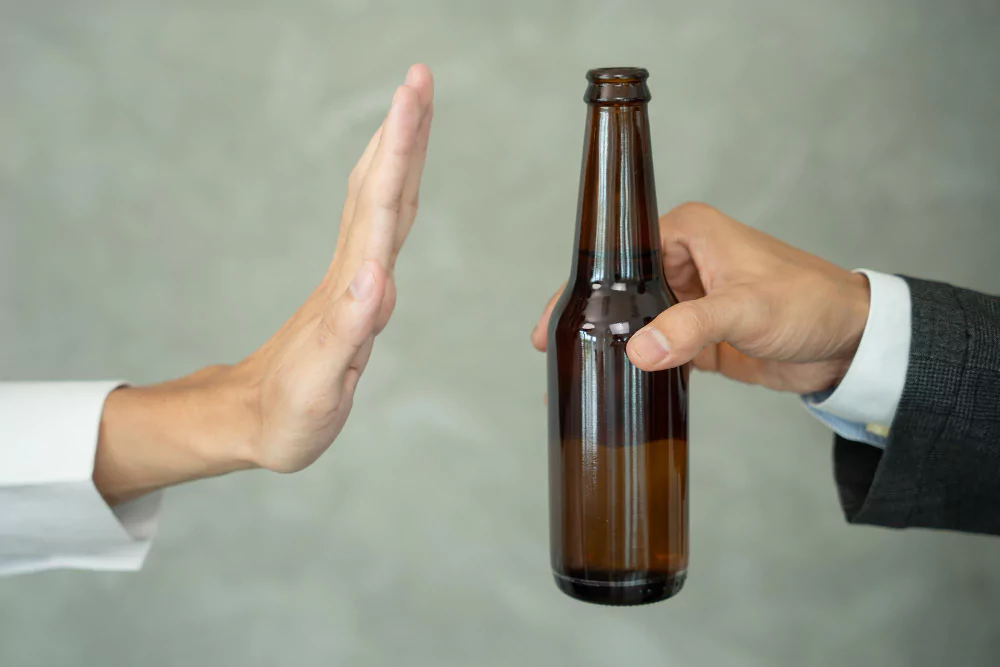
These days, “shaming” is a word we hear far too often in a variety of contexts. Shaming is defined as criticizing, judging, or making fun of someone based on their appearance, actions, or beliefs.
Sobriety or choosing not to drink alcohol is no exception. Sober shaming happens when someone makes us feel uncomfortable for our personal choice to drink less or stay sober. They may make us feel like our decision to not drink is wrong, boring, or even offensive.
Choosing to not drink alcohol — whether for an evening, a month, or permanently — is a personal decision we can make freely. When people shame us for making the choice to quit or cut back on drinking, we may start to second-guess ourselves. When we sober shame others, we contribute to a culture where drinking is the default accepted way of being, not a personal choice.
Many of us have probably brushed off a friend’s “joking” comment that was actually a way of shaming. It was probably even unintentional on their part! Nevertheless, shaming can creep into our psyche in sly ways that might not be easy to identify at first. Once we’re able to pinpoint some common shaming behaviors or phrases, it becomes easier to prevent and diffuse them.
Here are some common, all-too-familiar sober shaming phrases:
Do any of these comments sound familiar? It’s no fun to be on the receiving end of this kind of pressure or witness it happening to others. The good news is now that you’re aware of what sober shaming looks like, you can help prevent it from happening — and overcome it when it does.
Those seemingly harmless comments and playful jabs can have a much bigger effect than the person saying them might realize. Sober shaming isn’t just about feeling awkward at a party; it can have a real and lasting impact on our mental health and reinforce unhealthy social standards around alcohol. When someone questions or criticizes our personal choice to not drink, it can make us feel pressured, upset, or even angry. Understanding the deeper consequences helps us see why it’s so important to address this behavior and create more supportive environments for everyone, regardless of what’s in their cup.
When you’re working hard to build healthier habits, the last thing you need is someone making you feel bad about your progress. Sober shaming can leave you feeling humiliated, embarrassed, and vulnerable. These feelings are incredibly damaging and can seriously undermine your confidence. For someone in recovery or actively trying to change their relationship with alcohol, this external pressure can be a powerful trigger, potentially pushing them to drink just to escape the discomfort. It’s a heavy emotional weight to carry, and it can make the journey of changing your habits feel isolating and unnecessarily difficult.
Beyond the personal sting, sober shaming plays a role in upholding the idea that drinking is the only “normal” way to socialize. Because alcohol is so ingrained in our culture — used for celebrations, commiserations, and everything in between — many people don’t even recognize their comments as shaming. This perpetuates a social script where not drinking is seen as strange or antisocial. We need to challenge this norm so that everyone feels free to make their own choices without needing to justify them. Creating a culture of acceptance allows personal well-being to take priority over outdated social expectations.
Sober shaming is rarely an overt attempt to do harm — often, it’s a projection of much deeper and more complex issues. A recent public health survey determined that 41% of Americans are actively trying to drink less, including 50% of millennials and 61% of Gen Z.
Those shifting attitudes toward sobriety reflect the changing tides of social attitudes toward sobriety, but there is still plenty of pressure out there. A 2019 survey of drinkers in the UK found that 30% drank when they didn’t want to as a result of peer pressure to drink. So, why do others react so strongly about our decision to quit or cut back on drinking? Sober shaming can happen for a variety of reasons. News flash: It’s usually not about the sober person.
Here are some reasons why someone may sober shame:
Our social network is a crucial part of our recovery journey. When we cultivate an environment that affirms our choice to stop drinking, we feel empowered and encouraged to stay committed to ourselves. This can look like joining a support group, identifying sober friends, or checking in with a 24/7 community like the Forum on the Reframe app.
If we decide to keep a relationship with a sober-shaming friend or family member, it’s important to balance it by interacting constructively with sobriety-supportive people in a safe environment.

Let’s face it: alcohol is deeply woven into the fabric of our social lives. From after-work happy hours to weekend brunches and holiday celebrations, drinking is often the main event. When you decide to step away from that norm, even for a night, it can feel like you’re breaking an unwritten rule. This is where sober shaming often comes into play. It’s the act of someone making you feel awkward, boring, or even rude for your personal choice to drink less or not at all. This pressure isn’t just in your head; it’s a real reaction from people who may feel that your decision challenges the status quo, making them uncomfortable with their own choices.
Sober shaming can pop up anywhere, but it’s especially common in environments where drinking is the expected activity. Think about places like bars, pubs, work events, nightclubs, concerts, and even family gatherings. In these settings, holding a non-alcoholic drink can sometimes feel like you’re under a spotlight. The social expectation to “join in” is strong, and when you don’t, it can lead to unwanted questions and comments from others who see your sobriety as a deviation from the group’s behavior. Recognizing these high-pressure environments ahead of time can help you prepare your responses and feel more confident in your choice.
If you’ve ever felt pressured for not drinking, you are far from alone. The numbers show that this is a widespread issue, particularly for men. While a growing number of people are embracing a more mindful approach to drinking, with one study showing 61% of men trying to consume less alcohol, the social pushback remains significant. The same research highlights a startling statistic: 64% of British men report being sober-shamed by their own friends and family. This data paints a clear picture of the conflict many people face: they want to make healthier choices, but the social culture around them often makes it incredibly difficult to do so without facing judgment.
Interestingly, research suggests that men and women often experience social pressure around sobriety differently. While anyone can be sober-shamed, studies indicate that men may feel the heat more intensely. For example, one survey found that 22% of sober men feel uncomfortable when others are drinking, compared to 16% of sober women. Similarly, 18% of men reported feeling judged by their friends for not drinking, while only 12% of women felt the same way. This gap could be tied to traditional social norms where drinking is often linked to male bonding and camaraderie, making the choice to abstain feel like a bigger social hurdle.
The fear of being shamed can lead people to change their behavior in significant ways, often to their own detriment. To avoid ridicule or awkward conversations, many people simply hide their choice. A survey revealed that 61% of people have ordered soft drinks disguised as alcoholic beverages just so their friends wouldn't make fun of them. The pressure can also lead to social isolation. To limit their drinking, 62% of men and 48% of women admitted to avoiding pubs and bars on evenings and weekends altogether. These behaviors show just how powerful sober shaming can be, forcing people to either conceal their choices or miss out on social events entirely.
Despite the persistence of sober shaming, a powerful counter-movement is gaining momentum. More people than ever are becoming “sober curious,” which means they’re reevaluating their relationship with alcohol and exploring the benefits of drinking less. This isn't about an all-or-nothing approach; it’s about mindful consumption and making intentional choices that align with your personal wellness goals. The rise of this movement is a direct challenge to the outdated social norms that fuel sober shaming. It creates a more inclusive and understanding environment where choosing not to drink is seen as a valid and respectable personal decision, not a reason for judgment.
The cultural tide is turning. A recent public health survey found that 41% of Americans are actively trying to drink less, a figure that jumps to 50% for millennials and an impressive 61% for Gen Z. These numbers show a significant shift in how younger generations view alcohol and its role in their lives. The conversation is moving away from binge drinking as a social default and toward a more conscious approach. While these shifting attitudes are incredibly encouraging, social pressure hasn't disappeared entirely. The sober curious movement provides a sense of community and validation, making it easier to stand firm in your choices when faced with outdated expectations from others.
Choosing to drink less — whether for a night, a month, or for good — is a personal decision that comes with a host of benefits. People who practice mindful drinking often report better sleep, increased energy, improved mental clarity, and a stronger sense of self-awareness. There are financial perks, too; cutting back on alcohol can lead to significant savings over time. When you create an environment that supports your choice, you feel empowered and motivated to stick with it. This personal empowerment is the ultimate antidote to sober shaming, as your confidence in your decision makes external judgment less impactful.
One of the most exciting developments fueling the sober curious movement is the explosion of high-quality, alcohol-free alternatives. Gone are the days when your only non-alcoholic options were soda or water. The market is now filled with sophisticated non-alcoholic beers, wines, and spirits that make it easy to enjoy a complex, celebratory drink without the alcohol. In fact, the number of UK adults who regularly choose low or no-alcohol drinks is steadily rising. This growing availability means you can socialize in any setting without feeling left out, effectively taking the power away from common sober-shaming taunts about being “boring.”
If we’re in a situation where we feel like we’re being shamed, there are some helpful strategies that can stop the negativity in its tracks.
We hope it never escalates to this point, but if you ever feel threatened or are in physical danger from someone’s negative behavior toward you, seek emergency help or try to leave the situation and find safety ASAP.
Remember, your decision to drink less or not at all is a personal choice, and you don’t owe anyone an explanation. Setting boundaries is a powerful act of self-respect. When someone pressures you, they are crossing a line, and it’s perfectly okay to hold that line firmly. Confidence comes from knowing your “why” and honoring it, regardless of others' opinions. You’re not being “boring” or difficult; you’re prioritizing your health and well-being. Standing your ground can feel awkward at first, but it gets easier with practice and reinforces your commitment to yourself. Your journey is about you, not about making others comfortable with their own choices.
Having a few simple, direct responses ready can make a world of difference. You don’t need an elaborate excuse. Try a calm and simple, “I’m not drinking tonight,” or “Thanks, but I’m good.” If they press, a friendly but firm, “I just feel better when I don’t drink,” is a great follow-up that’s hard to argue with. The key is to be brief and then change the subject. This isn’t a debate, and you don’t have to engage in one. By preparing these responses, you can handle instances of sober shaming without feeling caught off guard, allowing you to stay in control of the conversation and confident in your decision.
One of the best ways to counteract social pressure is to shift the focus from what you’re avoiding to what you’re creating. Building a supportive environment is key to feeling empowered on your journey. This might mean being the one to suggest activities that don’t revolve around alcohol. Think about what you genuinely enjoy — hiking, trying a new cafe, checking out a museum, or hosting a game night. When you organize the event, you set the tone. This proactive approach not only helps you stick to your goals but also shows your friends that you can have a great time together without booze being the main event.
There truly is strength in numbers. If you have a friend who is also sober or practicing mindful drinking, team up with them before heading to a social gathering. Having an ally by your side can make it much easier to deflect pressure and stay accountable. You can also create new traditions by organizing your own sober get-togethers. This helps cultivate friendships based on shared interests rather than just a shared habit. Over time, you’ll build a social life that not only supports your decision but enriches your life in ways you might not have expected, filled with genuine connection and fun.
What if you see others doing some sober shaming? Is there any way to help sober friends when they’re being shamed? Each situation is different, but there are some subtle ways to step in without stepping on anyone’s toes.
Sobriety thrives in supportive environments. Just remember: you’re not there to fight anyone’s battles, but you can definitely hand them a shield! And most importantly, by getting better at identifying others’ sober-shaming behaviors, you can make sure you don’t do it to others subconsciously.
When a friend tells you they’re not drinking, the best response is often the simplest: just accept it. There’s no need to ask a dozen questions or make a big deal out of their choice. Think about how you’d react if a friend said they quit smoking — you’d likely be supportive, not interrogative. Apply that same kindness here. It’s natural to be curious, but if you do ask questions, approach the conversation with genuine care, not judgment. Making their decision seem strange or unusual can feel isolating. A simple, “That’s great, how are you feeling?” shows you support them without putting them on the spot to defend their personal health choices.
Being a true ally to your sober friends means more than just not shaming them; it means actively creating a supportive space. If you see someone giving your friend a hard time for not drinking, don’t be afraid to step in. As the saying goes, “If you see something, say something!” You can gently change the subject or directly call out the shaming behavior. A simple check-in via text can also make a huge difference, letting your friend know you’re thinking of them and that they have your support. Remember, surrounding yourself with people who affirm your choices is crucial, and you can be that person for someone else.
So now that we’re aware that sober shaming exists, how can we be sure we don’t contribute to it and accidentally shame someone? Here are some helpful tips for overcoming — and stopping — sober shaming.
With these practices in mind, we hope you feel equipped to stop sober shaming and, instead, provide encouragement to those around you who are making positive changes in their lives (yes, you too!).
When we support our friends, family members, and colleagues who choose not to drink, we show them they are valuable to us exactly as they are, and we champion their choice to make their lives better. If we catch ourselves having a negative or uncomfortable reaction to a friend or family member’s choice to not drink alcohol, it might be time for us to look at our own relationship with alcohol and maybe make some changes.
In closing, we’re bummed that sober shaming is a reality, but we’re glad to be raising awareness that it exists so we can be sure it doesn’t keep happening. Wherever you are on your journey, we’re here to support you at every step! Now, let’s go out there and stop sober shaming together.
What if the person shaming me is a close friend or family member? This is incredibly tough, and it hurts more when it comes from someone you care about. Often, their reaction isn't really about you, but about their own relationship with alcohol or their discomfort with change. The best approach is to have a calm, private conversation. You can say something like, "I feel hurt when you make comments about me not drinking. This is an important choice for my well-being, and I would love your support." Setting this boundary is about protecting your peace, not punishing them.
I feel like I have to make up an excuse for not drinking. Is there a better way? It's completely understandable to want to avoid a big conversation, but you don't have to create elaborate stories. The most powerful responses are often the simplest and briefest. A simple, "I'm not drinking tonight," or "I'm taking a break," is a complete answer. If they push, you can follow up with, "I just feel better when I don't," and then immediately change the subject. Remember, you're not obligated to justify a personal health decision to anyone.
Is it ever okay to ask someone why they're not drinking? It really depends on your relationship and the setting. In a loud, public group, putting someone on the spot with that question can feel like an interrogation. A better way to show you care is to simply accept their choice without comment. If you're a close friend and are genuinely concerned or curious, bring it up privately and gently. A simple, "I noticed you're not drinking lately, I hope you're doing well," shows support without demanding an explanation.
I think I might have accidentally sober-shamed someone in the past. What can I do now? First, give yourself some grace. Many of us have participated in this culture without realizing the harm. The most important thing is what you do now. You don't necessarily need to have a big, awkward apology session unless you feel it's right. The best way to make amends is to change your behavior. Be the person who offers cool non-alcoholic drinks, who changes the subject when someone is getting grilled, and who vocally supports a friend's choice to not drink. Your actions moving forward will speak volumes.
How can I still have a fun social life without feeling pressured or left out? This is all about shifting your focus from what you're avoiding to what you're creating. Start suggesting activities that don't revolve around bars, like trying a new restaurant, going for a hike, or hosting a game night. When you are in a drinking environment, find an ally who supports you or bring your own exciting alcohol-free beverage so you have something special to sip on. Over time, you'll build a social life that feels authentic and supportive of your goals.
Ever taken a break from drinking, maybe after a successful Dry January, only to find some people aren't exactly cheering you on? Instead of high-fives for making a positive change, you might get criticized, alienated, or even ridiculed for not drinking. This frustrating experience has a name: sober shaming. It’s the bizarre social pressure to justify a healthy choice, and it can leave you feeling isolated or even talked about behind your back. We're here to help you understand the real sober shaming meaning and give you the tools to handle it with confidence.
Let us be the first to say we’re so sorry if you’ve ever experienced this! This phenomenon is called “sober shaming,” and it’s fairly common. Sadly, you may have been on the receiving end of sober shaming without realizing it was even a thing. In this blog, we’ll define “sober shaming,” explain why it happens, and offer helpful strategies for how we can stop it before it starts.
These days, “shaming” is a word we hear far too often in a variety of contexts. Shaming is defined as criticizing, judging, or making fun of someone based on their appearance, actions, or beliefs.
Sobriety or choosing not to drink alcohol is no exception. Sober shaming happens when someone makes us feel uncomfortable for our personal choice to drink less or stay sober. They may make us feel like our decision to not drink is wrong, boring, or even offensive.
Choosing to not drink alcohol — whether for an evening, a month, or permanently — is a personal decision we can make freely. When people shame us for making the choice to quit or cut back on drinking, we may start to second-guess ourselves. When we sober shame others, we contribute to a culture where drinking is the default accepted way of being, not a personal choice.
Many of us have probably brushed off a friend’s “joking” comment that was actually a way of shaming. It was probably even unintentional on their part! Nevertheless, shaming can creep into our psyche in sly ways that might not be easy to identify at first. Once we’re able to pinpoint some common shaming behaviors or phrases, it becomes easier to prevent and diffuse them.
Here are some common, all-too-familiar sober shaming phrases:
Do any of these comments sound familiar? It’s no fun to be on the receiving end of this kind of pressure or witness it happening to others. The good news is now that you’re aware of what sober shaming looks like, you can help prevent it from happening — and overcome it when it does.
Those seemingly harmless comments and playful jabs can have a much bigger effect than the person saying them might realize. Sober shaming isn’t just about feeling awkward at a party; it can have a real and lasting impact on our mental health and reinforce unhealthy social standards around alcohol. When someone questions or criticizes our personal choice to not drink, it can make us feel pressured, upset, or even angry. Understanding the deeper consequences helps us see why it’s so important to address this behavior and create more supportive environments for everyone, regardless of what’s in their cup.
When you’re working hard to build healthier habits, the last thing you need is someone making you feel bad about your progress. Sober shaming can leave you feeling humiliated, embarrassed, and vulnerable. These feelings are incredibly damaging and can seriously undermine your confidence. For someone in recovery or actively trying to change their relationship with alcohol, this external pressure can be a powerful trigger, potentially pushing them to drink just to escape the discomfort. It’s a heavy emotional weight to carry, and it can make the journey of changing your habits feel isolating and unnecessarily difficult.
Beyond the personal sting, sober shaming plays a role in upholding the idea that drinking is the only “normal” way to socialize. Because alcohol is so ingrained in our culture — used for celebrations, commiserations, and everything in between — many people don’t even recognize their comments as shaming. This perpetuates a social script where not drinking is seen as strange or antisocial. We need to challenge this norm so that everyone feels free to make their own choices without needing to justify them. Creating a culture of acceptance allows personal well-being to take priority over outdated social expectations.
Sober shaming is rarely an overt attempt to do harm — often, it’s a projection of much deeper and more complex issues. A recent public health survey determined that 41% of Americans are actively trying to drink less, including 50% of millennials and 61% of Gen Z.
Those shifting attitudes toward sobriety reflect the changing tides of social attitudes toward sobriety, but there is still plenty of pressure out there. A 2019 survey of drinkers in the UK found that 30% drank when they didn’t want to as a result of peer pressure to drink. So, why do others react so strongly about our decision to quit or cut back on drinking? Sober shaming can happen for a variety of reasons. News flash: It’s usually not about the sober person.
Here are some reasons why someone may sober shame:
Our social network is a crucial part of our recovery journey. When we cultivate an environment that affirms our choice to stop drinking, we feel empowered and encouraged to stay committed to ourselves. This can look like joining a support group, identifying sober friends, or checking in with a 24/7 community like the Forum on the Reframe app.
If we decide to keep a relationship with a sober-shaming friend or family member, it’s important to balance it by interacting constructively with sobriety-supportive people in a safe environment.
Let’s face it: alcohol is deeply woven into the fabric of our social lives. From after-work happy hours to weekend brunches and holiday celebrations, drinking is often the main event. When you decide to step away from that norm, even for a night, it can feel like you’re breaking an unwritten rule. This is where sober shaming often comes into play. It’s the act of someone making you feel awkward, boring, or even rude for your personal choice to drink less or not at all. This pressure isn’t just in your head; it’s a real reaction from people who may feel that your decision challenges the status quo, making them uncomfortable with their own choices.
Sober shaming can pop up anywhere, but it’s especially common in environments where drinking is the expected activity. Think about places like bars, pubs, work events, nightclubs, concerts, and even family gatherings. In these settings, holding a non-alcoholic drink can sometimes feel like you’re under a spotlight. The social expectation to “join in” is strong, and when you don’t, it can lead to unwanted questions and comments from others who see your sobriety as a deviation from the group’s behavior. Recognizing these high-pressure environments ahead of time can help you prepare your responses and feel more confident in your choice.
If you’ve ever felt pressured for not drinking, you are far from alone. The numbers show that this is a widespread issue, particularly for men. While a growing number of people are embracing a more mindful approach to drinking, with one study showing 61% of men trying to consume less alcohol, the social pushback remains significant. The same research highlights a startling statistic: 64% of British men report being sober-shamed by their own friends and family. This data paints a clear picture of the conflict many people face: they want to make healthier choices, but the social culture around them often makes it incredibly difficult to do so without facing judgment.
Interestingly, research suggests that men and women often experience social pressure around sobriety differently. While anyone can be sober-shamed, studies indicate that men may feel the heat more intensely. For example, one survey found that 22% of sober men feel uncomfortable when others are drinking, compared to 16% of sober women. Similarly, 18% of men reported feeling judged by their friends for not drinking, while only 12% of women felt the same way. This gap could be tied to traditional social norms where drinking is often linked to male bonding and camaraderie, making the choice to abstain feel like a bigger social hurdle.
The fear of being shamed can lead people to change their behavior in significant ways, often to their own detriment. To avoid ridicule or awkward conversations, many people simply hide their choice. A survey revealed that 61% of people have ordered soft drinks disguised as alcoholic beverages just so their friends wouldn't make fun of them. The pressure can also lead to social isolation. To limit their drinking, 62% of men and 48% of women admitted to avoiding pubs and bars on evenings and weekends altogether. These behaviors show just how powerful sober shaming can be, forcing people to either conceal their choices or miss out on social events entirely.
Despite the persistence of sober shaming, a powerful counter-movement is gaining momentum. More people than ever are becoming “sober curious,” which means they’re reevaluating their relationship with alcohol and exploring the benefits of drinking less. This isn't about an all-or-nothing approach; it’s about mindful consumption and making intentional choices that align with your personal wellness goals. The rise of this movement is a direct challenge to the outdated social norms that fuel sober shaming. It creates a more inclusive and understanding environment where choosing not to drink is seen as a valid and respectable personal decision, not a reason for judgment.
The cultural tide is turning. A recent public health survey found that 41% of Americans are actively trying to drink less, a figure that jumps to 50% for millennials and an impressive 61% for Gen Z. These numbers show a significant shift in how younger generations view alcohol and its role in their lives. The conversation is moving away from binge drinking as a social default and toward a more conscious approach. While these shifting attitudes are incredibly encouraging, social pressure hasn't disappeared entirely. The sober curious movement provides a sense of community and validation, making it easier to stand firm in your choices when faced with outdated expectations from others.
Choosing to drink less — whether for a night, a month, or for good — is a personal decision that comes with a host of benefits. People who practice mindful drinking often report better sleep, increased energy, improved mental clarity, and a stronger sense of self-awareness. There are financial perks, too; cutting back on alcohol can lead to significant savings over time. When you create an environment that supports your choice, you feel empowered and motivated to stick with it. This personal empowerment is the ultimate antidote to sober shaming, as your confidence in your decision makes external judgment less impactful.
One of the most exciting developments fueling the sober curious movement is the explosion of high-quality, alcohol-free alternatives. Gone are the days when your only non-alcoholic options were soda or water. The market is now filled with sophisticated non-alcoholic beers, wines, and spirits that make it easy to enjoy a complex, celebratory drink without the alcohol. In fact, the number of UK adults who regularly choose low or no-alcohol drinks is steadily rising. This growing availability means you can socialize in any setting without feeling left out, effectively taking the power away from common sober-shaming taunts about being “boring.”
If we’re in a situation where we feel like we’re being shamed, there are some helpful strategies that can stop the negativity in its tracks.
We hope it never escalates to this point, but if you ever feel threatened or are in physical danger from someone’s negative behavior toward you, seek emergency help or try to leave the situation and find safety ASAP.
Remember, your decision to drink less or not at all is a personal choice, and you don’t owe anyone an explanation. Setting boundaries is a powerful act of self-respect. When someone pressures you, they are crossing a line, and it’s perfectly okay to hold that line firmly. Confidence comes from knowing your “why” and honoring it, regardless of others' opinions. You’re not being “boring” or difficult; you’re prioritizing your health and well-being. Standing your ground can feel awkward at first, but it gets easier with practice and reinforces your commitment to yourself. Your journey is about you, not about making others comfortable with their own choices.
Having a few simple, direct responses ready can make a world of difference. You don’t need an elaborate excuse. Try a calm and simple, “I’m not drinking tonight,” or “Thanks, but I’m good.” If they press, a friendly but firm, “I just feel better when I don’t drink,” is a great follow-up that’s hard to argue with. The key is to be brief and then change the subject. This isn’t a debate, and you don’t have to engage in one. By preparing these responses, you can handle instances of sober shaming without feeling caught off guard, allowing you to stay in control of the conversation and confident in your decision.
One of the best ways to counteract social pressure is to shift the focus from what you’re avoiding to what you’re creating. Building a supportive environment is key to feeling empowered on your journey. This might mean being the one to suggest activities that don’t revolve around alcohol. Think about what you genuinely enjoy — hiking, trying a new cafe, checking out a museum, or hosting a game night. When you organize the event, you set the tone. This proactive approach not only helps you stick to your goals but also shows your friends that you can have a great time together without booze being the main event.
There truly is strength in numbers. If you have a friend who is also sober or practicing mindful drinking, team up with them before heading to a social gathering. Having an ally by your side can make it much easier to deflect pressure and stay accountable. You can also create new traditions by organizing your own sober get-togethers. This helps cultivate friendships based on shared interests rather than just a shared habit. Over time, you’ll build a social life that not only supports your decision but enriches your life in ways you might not have expected, filled with genuine connection and fun.
What if you see others doing some sober shaming? Is there any way to help sober friends when they’re being shamed? Each situation is different, but there are some subtle ways to step in without stepping on anyone’s toes.
Sobriety thrives in supportive environments. Just remember: you’re not there to fight anyone’s battles, but you can definitely hand them a shield! And most importantly, by getting better at identifying others’ sober-shaming behaviors, you can make sure you don’t do it to others subconsciously.
When a friend tells you they’re not drinking, the best response is often the simplest: just accept it. There’s no need to ask a dozen questions or make a big deal out of their choice. Think about how you’d react if a friend said they quit smoking — you’d likely be supportive, not interrogative. Apply that same kindness here. It’s natural to be curious, but if you do ask questions, approach the conversation with genuine care, not judgment. Making their decision seem strange or unusual can feel isolating. A simple, “That’s great, how are you feeling?” shows you support them without putting them on the spot to defend their personal health choices.
Being a true ally to your sober friends means more than just not shaming them; it means actively creating a supportive space. If you see someone giving your friend a hard time for not drinking, don’t be afraid to step in. As the saying goes, “If you see something, say something!” You can gently change the subject or directly call out the shaming behavior. A simple check-in via text can also make a huge difference, letting your friend know you’re thinking of them and that they have your support. Remember, surrounding yourself with people who affirm your choices is crucial, and you can be that person for someone else.
So now that we’re aware that sober shaming exists, how can we be sure we don’t contribute to it and accidentally shame someone? Here are some helpful tips for overcoming — and stopping — sober shaming.
With these practices in mind, we hope you feel equipped to stop sober shaming and, instead, provide encouragement to those around you who are making positive changes in their lives (yes, you too!).
When we support our friends, family members, and colleagues who choose not to drink, we show them they are valuable to us exactly as they are, and we champion their choice to make their lives better. If we catch ourselves having a negative or uncomfortable reaction to a friend or family member’s choice to not drink alcohol, it might be time for us to look at our own relationship with alcohol and maybe make some changes.
In closing, we’re bummed that sober shaming is a reality, but we’re glad to be raising awareness that it exists so we can be sure it doesn’t keep happening. Wherever you are on your journey, we’re here to support you at every step! Now, let’s go out there and stop sober shaming together.
What if the person shaming me is a close friend or family member? This is incredibly tough, and it hurts more when it comes from someone you care about. Often, their reaction isn't really about you, but about their own relationship with alcohol or their discomfort with change. The best approach is to have a calm, private conversation. You can say something like, "I feel hurt when you make comments about me not drinking. This is an important choice for my well-being, and I would love your support." Setting this boundary is about protecting your peace, not punishing them.
I feel like I have to make up an excuse for not drinking. Is there a better way? It's completely understandable to want to avoid a big conversation, but you don't have to create elaborate stories. The most powerful responses are often the simplest and briefest. A simple, "I'm not drinking tonight," or "I'm taking a break," is a complete answer. If they push, you can follow up with, "I just feel better when I don't," and then immediately change the subject. Remember, you're not obligated to justify a personal health decision to anyone.
Is it ever okay to ask someone why they're not drinking? It really depends on your relationship and the setting. In a loud, public group, putting someone on the spot with that question can feel like an interrogation. A better way to show you care is to simply accept their choice without comment. If you're a close friend and are genuinely concerned or curious, bring it up privately and gently. A simple, "I noticed you're not drinking lately, I hope you're doing well," shows support without demanding an explanation.
I think I might have accidentally sober-shamed someone in the past. What can I do now? First, give yourself some grace. Many of us have participated in this culture without realizing the harm. The most important thing is what you do now. You don't necessarily need to have a big, awkward apology session unless you feel it's right. The best way to make amends is to change your behavior. Be the person who offers cool non-alcoholic drinks, who changes the subject when someone is getting grilled, and who vocally supports a friend's choice to not drink. Your actions moving forward will speak volumes.
How can I still have a fun social life without feeling pressured or left out? This is all about shifting your focus from what you're avoiding to what you're creating. Start suggesting activities that don't revolve around bars, like trying a new restaurant, going for a hike, or hosting a game night. When you are in a drinking environment, find an ally who supports you or bring your own exciting alcohol-free beverage so you have something special to sip on. Over time, you'll build a social life that feels authentic and supportive of your goals.

Recovery from alcohol addiction may require a personalized approach. Check out our latest blog for more info on passive and active recovery to decide which one works best for you.
Although it isn’t a treatment for alcohol use disorder (AUD), the Reframe app can help you cut back on drinking gradually, with the science-backed knowledge to empower you 100% of the way. Our proven program has helped millions of people around the world drink less and live more. And we want to help you get there, too!
The Reframe app equips you with the knowledge and skills you need to not only survive drinking less, but to thrive while you navigate the journey. Our daily research-backed readings teach you the neuroscience of alcohol, and our in-app Toolkit provides the resources and activities you need to navigate each challenge.
You’ll meet millions of fellow Reframers in our 24/7 Forum chat and daily Zoom check-in meetings. Receive encouragement from people worldwide who know exactly what you’re going through! You’ll also have the opportunity to connect with our licensed Reframe coaches for more personalized guidance.
Plus, we’re always introducing new features to optimize your in-app experience. We recently launched our in-app chatbot, Melody, powered by the world’s most powerful AI technology. Melody is here to help as you adjust to a life with less (or no) alcohol.
And that’s not all! Every month, we launch fun challenges, like Dry/Damp January, Mental Health May, and Outdoorsy June. You won’t want to miss out on the chance to participate alongside fellow Reframers (or solo if that’s more your thing!).
The Reframe app is free for 7 days, so you don’t have anything to lose by trying it. Are you ready to feel empowered and discover life beyond alcohol? Then download our app through the App Store or Google Play today!
Active recovery from alcohol addiction means taking responsibility for our actions and making continual efforts towards quitting or cutting back on alcohol. On the other hand, passive recovery means taking the steps to quit or cut back but waiting for external factors to facilitate change. Although there’s no right or wrong way to recover, an active approach has been shown to be more beneficial.
There’s a memorable episode of How I Met Your Mother when Barney Stinson faces a moment of reckoning. He tries to cut back on his wild drinking habits passively, relying on his friends and hoping the change will come naturally. But it’s not until he actively takes charge that he begins to see real improvement.
This scene illustrates a crucial aspect of recovery from alcohol addiction: the difference between passive and active recovery. Passive recovery is similar to going through the motions without full commitment, while active recovery involves taking intentional steps toward a better relationship with alcohol. Let’s further explore these two recovery paths to help guide us on our journey toward a healthier, alcohol-free life.
The official definition of recovery from addiction, according to the National Institute on Alcohol Abuse and Alcoholism (NIAAA), is “the process through which an individual pursues both remission from alcohol use disorder (AUD) and cessation from heavy drinking.” In short, it means no longer meeting the criteria for AUD (excluding cravings) and not participating in excessive drinking. Excessive drinking refers to more than 15 standard drinks per week or 5 drinks in a day for men and 8 drinks per week or 4 drinks in a day for women.
While this is the official definition of recovering from AUD, sobriety is a spectrum and can encompass the entirety of our efforts to quit or cut back on alcohol. It can be anything from becoming “sober curious” and questioning our drinking habits to full abstinence.
In general, recovery is broken up into four stages: abstinence, withdrawal, repair, and growth (For more information on these stages, check out our blog “How To Stay Sober After Recovering From Alcoholism.”) These stages summarize common experiences that those of us quitting or cutting back on alcohol experience. However, no two journeys will look exactly the same. Along with different experiences, there are also two main approaches to recovery. Let’s explore the first path: passive recovery.
Passive recovery is just what it sounds like. It can include doing all the “recovery things” such as avoiding alcohol, attending a rehab program, sitting in counseling sessions, and attending support groups. However, we may not yet accept full responsibility for our actions and decisions; instead, we’re waiting for external factors to facilitate change rather than ourselves. It’s similar to “going through the motions” of recovery.
In passive recovery, there’s usually a disconnect between our actions and our mindset. Let’s use religion as an example. Say we’re looking to strengthen our Christian faith and develop a stronger relationship with God. A passive approach to this can mean attending church and Bible study every week and waiting for the change to happen. However, we may not be actively participating in discussions or fully believe that we can become closer to God. While change can still happen, a passive approach to recovery is like taking a backseat.
Passive recovery isn’t a “wrong” path to recovery, but research shows that taking a more active approach can forge a more direct path and lead to more desirable outcomes. Let’s learn more about taking an active approach.
If passive recovery is like taking a backseat, then active recovery is like being the driver. There’s no official active recovery definition, but it refers to taking the necessary actions such as avoiding alcohol but also taking responsibility for our choices and actions. Instead of waiting for change to happen, we take matters into our own hands by making continued efforts toward our goals to quit or cut back.
Going back to our religion example, an active approach would consist of doing daily prayers, reading the Bible, participating in discussions, and believing that we can continue to strengthen our faith. An active approach doesn’t only consist of taking the right actions, but emphasizes personal responsibility, self-reflection, and active engagement.
Let’s break it down further to understand how exactly passive and active approaches in recovery are different from one another.
The key differences between active and passive recovery are more internal. This means that we alone may be able to recognize whether we’re taking a passive or active approach and make the changes to support our decision. Active and passive recovery are different in two main ways:
While both passive and active approaches can help us reach our recovery goals, active methods promote more sustainable and speedy progress by actively engaging our mind and body in the healing process. Let’s take a look at some other benefits of active recovery.
The “fake it till you make it” mentality can only get us so far. Ultimately, if we don’t fully commit or believe that we can recover, it makes us vulnerable to relapse. Taking an active approach can have many benefits:
Active recovery can help us live a healthier, happier life, but how can we get there?

Active addiction, more aptly referred to as alcohol use disorder (AUD), is actively drinking and not being able to quit or cut back despite negative consequences. It differs from active recovery because recovery refers to taking steps to improve our relationship with alcohol even though we may not be sober or completely abstinent. The transition from active addiction to active recovery through these strategies is the first step in developing a healthier relationship with alcohol:
If we notice that we’re taking more of a passive approach, we can use these same strategies to transition from passive to active recovery.
No matter where we are in our relationship with alcohol, it’s never too late to commit to recovery. When we’re in recovery, we can take a backseat (passive) approach or take direct control (active) in the driver’s seat. While both may get us to our destination, an active approach helps to strengthen our commitment and address the root causes of our habits — leading to a more self-directed path toward quitting or cutting back on alcohol. Ultimately, we have the power to choose our path forward by deciding whether we’ll take a passive or active approach to recovery.
Active recovery from alcohol addiction means taking responsibility for our actions and making continual efforts towards quitting or cutting back on alcohol. On the other hand, passive recovery means taking the steps to quit or cut back but waiting for external factors to facilitate change. Although there’s no right or wrong way to recover, an active approach has been shown to be more beneficial.
There’s a memorable episode of How I Met Your Mother when Barney Stinson faces a moment of reckoning. He tries to cut back on his wild drinking habits passively, relying on his friends and hoping the change will come naturally. But it’s not until he actively takes charge that he begins to see real improvement.
This scene illustrates a crucial aspect of recovery from alcohol addiction: the difference between passive and active recovery. Passive recovery is similar to going through the motions without full commitment, while active recovery involves taking intentional steps toward a better relationship with alcohol. Let’s further explore these two recovery paths to help guide us on our journey toward a healthier, alcohol-free life.
The official definition of recovery from addiction, according to the National Institute on Alcohol Abuse and Alcoholism (NIAAA), is “the process through which an individual pursues both remission from alcohol use disorder (AUD) and cessation from heavy drinking.” In short, it means no longer meeting the criteria for AUD (excluding cravings) and not participating in excessive drinking. Excessive drinking refers to more than 15 standard drinks per week or 5 drinks in a day for men and 8 drinks per week or 4 drinks in a day for women.
While this is the official definition of recovering from AUD, sobriety is a spectrum and can encompass the entirety of our efforts to quit or cut back on alcohol. It can be anything from becoming “sober curious” and questioning our drinking habits to full abstinence.
In general, recovery is broken up into four stages: abstinence, withdrawal, repair, and growth (For more information on these stages, check out our blog “How To Stay Sober After Recovering From Alcoholism.”) These stages summarize common experiences that those of us quitting or cutting back on alcohol experience. However, no two journeys will look exactly the same. Along with different experiences, there are also two main approaches to recovery. Let’s explore the first path: passive recovery.
Passive recovery is just what it sounds like. It can include doing all the “recovery things” such as avoiding alcohol, attending a rehab program, sitting in counseling sessions, and attending support groups. However, we may not yet accept full responsibility for our actions and decisions; instead, we’re waiting for external factors to facilitate change rather than ourselves. It’s similar to “going through the motions” of recovery.
In passive recovery, there’s usually a disconnect between our actions and our mindset. Let’s use religion as an example. Say we’re looking to strengthen our Christian faith and develop a stronger relationship with God. A passive approach to this can mean attending church and Bible study every week and waiting for the change to happen. However, we may not be actively participating in discussions or fully believe that we can become closer to God. While change can still happen, a passive approach to recovery is like taking a backseat.
Passive recovery isn’t a “wrong” path to recovery, but research shows that taking a more active approach can forge a more direct path and lead to more desirable outcomes. Let’s learn more about taking an active approach.
If passive recovery is like taking a backseat, then active recovery is like being the driver. There’s no official active recovery definition, but it refers to taking the necessary actions such as avoiding alcohol but also taking responsibility for our choices and actions. Instead of waiting for change to happen, we take matters into our own hands by making continued efforts toward our goals to quit or cut back.
Going back to our religion example, an active approach would consist of doing daily prayers, reading the Bible, participating in discussions, and believing that we can continue to strengthen our faith. An active approach doesn’t only consist of taking the right actions, but emphasizes personal responsibility, self-reflection, and active engagement.
Let’s break it down further to understand how exactly passive and active approaches in recovery are different from one another.
The key differences between active and passive recovery are more internal. This means that we alone may be able to recognize whether we’re taking a passive or active approach and make the changes to support our decision. Active and passive recovery are different in two main ways:
While both passive and active approaches can help us reach our recovery goals, active methods promote more sustainable and speedy progress by actively engaging our mind and body in the healing process. Let’s take a look at some other benefits of active recovery.
The “fake it till you make it” mentality can only get us so far. Ultimately, if we don’t fully commit or believe that we can recover, it makes us vulnerable to relapse. Taking an active approach can have many benefits:
Active recovery can help us live a healthier, happier life, but how can we get there?
Active addiction, more aptly referred to as alcohol use disorder (AUD), is actively drinking and not being able to quit or cut back despite negative consequences. It differs from active recovery because recovery refers to taking steps to improve our relationship with alcohol even though we may not be sober or completely abstinent. The transition from active addiction to active recovery through these strategies is the first step in developing a healthier relationship with alcohol:
If we notice that we’re taking more of a passive approach, we can use these same strategies to transition from passive to active recovery.
No matter where we are in our relationship with alcohol, it’s never too late to commit to recovery. When we’re in recovery, we can take a backseat (passive) approach or take direct control (active) in the driver’s seat. While both may get us to our destination, an active approach helps to strengthen our commitment and address the root causes of our habits — leading to a more self-directed path toward quitting or cutting back on alcohol. Ultimately, we have the power to choose our path forward by deciding whether we’ll take a passive or active approach to recovery.

Curious if mindful drinking can help you quit? Learn how the best mindful drinking apps support healthier habits and make cutting back easier.
Although it isn’t a treatment for alcohol use disorder (AUD), the Reframe app can help you cut back on drinking gradually, with the science-backed knowledge to empower you 100% of the way. Our proven program has helped millions of people around the world drink less and live more. And we want to help you get there, too!
The Reframe app equips you with the knowledge and skills you need to not only survive drinking less, but to thrive while you navigate the journey. Our daily research-backed readings teach you the neuroscience of alcohol, and our in-app Toolkit provides the resources and activities you need to navigate each challenge.
You’ll meet millions of fellow Reframers in our 24/7 Forum chat and daily Zoom check-in meetings. Receive encouragement from people worldwide who know exactly what you’re going through! You’ll also have the opportunity to connect with our licensed Reframe coaches for more personalized guidance.
Plus, we’re always introducing new features to optimize your in-app experience. We recently launched our in-app chatbot, Melody, powered by the world’s most powerful AI technology. Melody is here to help as you adjust to a life with less (or no) alcohol.
And that’s not all! Every month, we launch fun challenges, like Dry/Damp January, Mental Health May, and Outdoorsy June. You won’t want to miss out on the chance to participate alongside fellow Reframers (or solo if that’s more your thing!).
The Reframe app is free for 7 days, so you don’t have anything to lose by trying it. Are you ready to feel empowered and discover life beyond alcohol? Then download our app through the App Store or Google Play today!
It seems like mindfulness is the solution for everything these days, and for good reason. It’s a powerful tool for changing our habits, especially our relationship with alcohol. Mindful drinking is simply about being more present and intentional with your choices. It's not about strict rules, but about understanding why you're drinking and how it makes you feel. This simple shift in awareness can make a huge difference. To help you get started, we’ve reviewed the best mindful drinking apps, including some great free mindful drinking app options and even the best quit drinking app for those on a different path.
Meditation, for those of us who are unfamiliar with it, may not seem like an effective strategy to quit drinking. However, there have been numerous scientific studies looking into the specific benefits of mindfulness, one of which is developing a healthier relationship with alcohol. But what if we’re looking to quit alcohol? Let’s learn more about mindful drinking strategies and how they can help us transition to sobriety.

Mindful drinking is the practice of developing a healthier, more conscious relationship with alcohol. It promotes questioning why we’re drinking and reflecting on how much we’re drinking, without judgment. Mindful drinking differs from moderation or sobriety, as they are more like end goals whereas mindfulness is a practice that involves actionable steps to help us reach these goals of quitting or cutting back.
Some mindful drinking practices include the following:
These practices create a strong framework to help us quit or cut back on alcohol by promoting greater intention with our choices. Helping us develop better habits ultimately leads to better physical and mental health. Mindful drinking promises many benefits, but how does it actually work?
When you practice mindful drinking, the positive changes aren't just abstract ideas—they're real, tangible shifts you can feel. Paying closer attention to your habits creates a ripple effect across your entire well-being, starting with small adjustments that build into significant improvements. These aren't vague wellness concepts; they are concrete benefits that can change your day-to-day life for the better. From waking up feeling rested to having more cash in your wallet, the rewards of cutting back are tangible and incredibly motivating.
One of the first things people often notice when they reduce their alcohol intake is a dramatic improvement in their sleep. While a glass of wine might make you feel sleepy, alcohol actually disrupts your sleep cycle, particularly the restorative REM stage. This is why you can sleep for eight hours after drinking and still wake up feeling exhausted. Mindful drinking can lead to good things like better sleep, more energy, a stronger immune system, and a better mood. When you give your body a break from processing alcohol overnight, you allow it to get the deep, uninterrupted rest it needs. This naturally translates to more energy and mental clarity throughout the day.
Feeling run down or catching every cold that goes around? Your drinking habits might be playing a role. Alcohol can suppress your immune system, making it harder for your body to fight off infections. By drinking less, you give your immune system the chance to function at its best. As many users of habit-change apps report, the benefits extend beyond just physical health; they also include improving their diet, saving money, and generally feeling happier. Seeing how much you can save is a powerful motivator, and you can even use an alcohol spend calculator to see the financial benefits add up in real-time.
A core principle of this approach is simply paying attention. Mindful drinking means paying close attention to how much alcohol you drink and how it impacts your health and daily life. It’s about becoming a curious observer of your own habits without judgment. You start to ask questions: Why am I reaching for a drink right now? How do I feel before, during, and after? What situations trigger my desire to drink? This self-awareness is the first step toward making intentional choices rather than falling into old patterns. It’s not about restriction; it’s about empowerment through understanding.
This is where technology can be an incredible ally. Instead of relying on memory alone, you can use tools to help you track your consumption and identify your triggers. Apps like Reframe are designed to support this process by providing a structured way to monitor your habits and gain insights. As the SF Standard notes, these apps offer different ways to help, like coaching, online communities, and educational tools. At Reframe, we combine neuroscience-backed daily readings, personalized drink tracking, and a supportive community to give you a comprehensive toolkit for changing your relationship with alcohol for good.
If we’re looking to start developing a healthier relationship with alcohol, the first step is to get “sober curious.” This idea involves questioning our personal and societal reasons we drink rather than mindlessly sipping. Getting “sober curious” increases our awareness of our drinking habits, already dipping our toe into mindful drinking strategies.
After realizing we may want to quit or cut back on alcohol, we may be looking for how to sober up. Alcohol hijacks our brain’s reward system, making it challenging to stop drinking even if we want to. On top of that, we may get withdrawal symptoms that make the experience even more unpleasant. We can explore ways to safely detox at home or find monitored options to increase our safety.
Once we’re ready to embark on our journey of quitting or cutting back, we can find support options that work best for us. There’s no shortage of treatment options, from behavioral programs, peer support groups, and a newer option that helps meet us no matter where we are in our journey — mindful drinking apps. If you’re looking to learn more about the best “quit drinking” apps, check out “Sip with Purpose: The 10 Best Mindful Drinking Apps”. There are plenty of options to choose from, but let’s take a deep dive into the top alcohol reduction app — Reframe.
If "being present" with your drink feels a little abstract, a structured approach might be more your speed. The 3-2-1 drinking rule is a straightforward guideline to help you pace yourself and stay in control. The rule is simple: limit yourself to a maximum of three drinks per day, no more than two on any single occasion, and only one drink per hour. This isn't about deprivation; it's about creating a framework for intentionality. By setting clear boundaries before you take the first sip, you can shift from mindless consumption to a more conscious experience, making it easier to practice mindful drinking.
This framework does more than just limit your intake; it builds awareness. The one-drink-per-hour rule is powerful because it forces a pause, giving your body time to metabolize the alcohol and maintain a lower Blood Alcohol Content (BAC). In that space between drinks, you can check in with yourself: How are you feeling? Are you drinking out of habit or genuine enjoyment? This deliberate pacing prevents you from drinking more than intended and can lead to benefits like better sleep and more stable moods, helping you build a healthier relationship with alcohol on your own terms.
Let’s take a walkthrough of the Reframe app to see how it can help us develop mindful drinking strategies and help us work towards an alcohol-free life. Here’s how it works:
Reframe’s habit-changing program is the heart of the app. The neuroscience-based alcohol reduction program is developed by leading experts in the field of mental health and medicine to help us change our relationship with alcohol and build positive habits using scientific practices.
By participating in daily tasks to learn something new every day, we get one step closer to sobriety and a healthier, more fulfilling life. As we learn ways to change our habits, we can effectively develop skills to eventually quit alcohol for good.
Tracking our alcohol consumption helps us get a better idea of what our drinking habits look like over time. Reframe’s personalized drink tracker allows us to set targets that help us stay accountable day by day. It also allows us to track our progress over time, helping us adjust our goals and work toward quitting alcohol.
Ditch the old pen and paper and prevent forgetting to log a drink. Logging our consumption right there and then not only helps us more accurately keep track of our alcohol consumption but also increases our awareness of how much we’re drinking while it happens.
The journey to sobriety can be filled with a spectrum of challenging emotions. We can tune into different guided meditations and mindfulness activities to help us relax and find inner peace during any wave of emotion we may be feeling. Check out meditations from inspiration-focused ones such as “Initiating Freedom” to stress-reducing ones such as “You Are Water”.
Meditation and mindfulness practices might feel uncomfortable at first, especially in the fast-paced world we live in today. However, meditation is a scientifically proven tool to help reduce stress and quiet the mind. And some even better news? We can slowly develop these practices through Reframe’s mindfulness and meditation activities to hopefully be able to use them on our own one day!
Learn new life skills through Reframe’s science-backed courses. We can explore a range of topics to acquire practical strategies to help us quit or cut back and build a healthier and more meaningful life in general. Some course topics include alcohol and digestion, stress and the body, improving our sleep, understanding the risks of hard liquor, and much more. Don’t worry, the courses provide recorded and live videos to present everything in an informational yet entertaining way.
But there’s more! We can participate in challenges that give us the opportunity to apply our learned skills in a fun way. Monthly challenges such as Reflect December, Dry/Damp January, Mental Health May, and Outdoorsy June are just some activities you won’t want to miss. Joining Reframe’s courses and challenges is the perfect way to apply mindfulness to drinking. Educational information from the courses helps to increase our awareness, and challenges help us to use those tools to make more intentional decisions. Practice mindful drinking in a way that’s enjoyable and doesn’t seem like a chore with Reframe!
Join a thriving community of over a million Reframers that’s there to support you 24/7. The Reframe community is a private, anonymous community that allows you to celebrate milestones or give and receive support from those who may know exactly what you’re going through. In addition to staying connected to others through peer matching and group challenges, we can also get more personalized guidance through check-ins with certified coaches. Quitting or cutting back on alcohol can be a challenging journey, but we don’t have to go through it alone!
Support during recovery can be much more than just a network of acquaintances. Research shows that human connection can be a powerful tool for change and growth. During our journey to sobriety, which can be filled with overcoming uncomfortable emotions and facing the aftermath of life-altering experiences, a support system can help pick us back up and motivate us to continue to work toward a brighter future.
Reframe puts everything you need to help quit or cut back on alcohol all in one place. Ditch the need for scrambling to find a pen and paper when we need to write something down or scrolling through myriad online videos to find one that distracts us or motivates us to stay committed to the journey.
If we’re looking to quit drinking, apps like Reframe allow us to tune in to a guided meditation, play a distracting game, or watch inspirational videos to help the cravings fade away. This sets us up for success, as all our tools and resources are right there at our fingertips. If we’re looking to take that leap from mindful drinking to full sobriety, how can we make that final push?
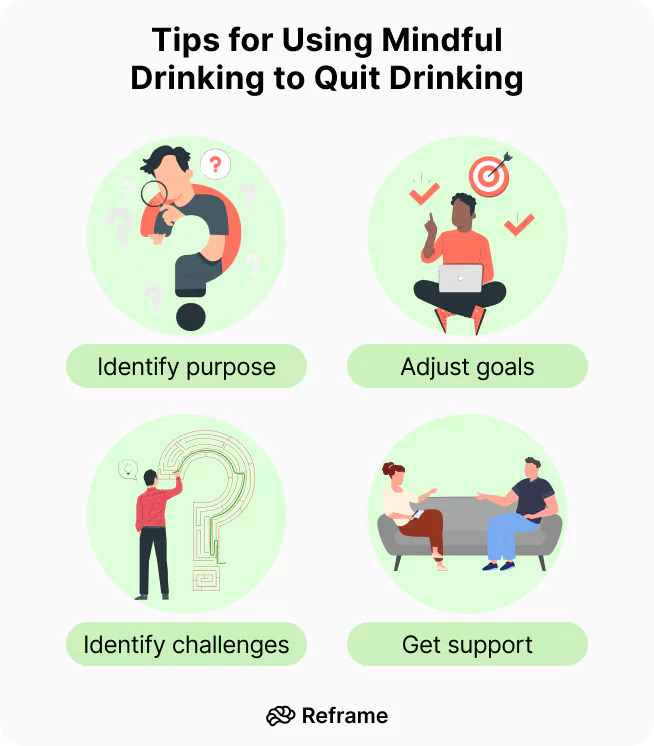
Beyond meditation, your toolkit includes a variety of engaging content designed to occupy your mind when cravings strike. You can find distracting games that help you refocus your attention or listen to insightful podcasts that reinforce your goals. These tools are more than just time-fillers; they are practical, on-demand resources that make it easier to build new routines. Studies and user experiences show that mindful drinking apps really do help people drink less by providing these kinds of accessible, in-the-moment support systems. Having these options readily available means you're better equipped to handle challenging moments and reaffirm your commitment.
The entire Reframe program is built on a foundation of science, specifically neuroscience and psychology. It wasn't just designed to feel good; it was developed by medical and mental health professionals to create lasting change. The daily habit-building exercises are rooted in principles of neuroplasticity, helping you rewire your brain’s response to alcohol. The emphasis on community isn't just for moral support—it leverages the proven power of human connection in behavior change. Every tool, from the guided meditations to the educational courses, is there because evidence shows it works. This science-backed approach means you’re not just trying something new; you’re using a structured, effective method to change your relationship with alcohol for good.
While Reframe offers a comprehensive, science-backed program to help you change your relationship with alcohol, we know that everyone’s journey is unique. Finding the right tool that clicks with your personality and goals is what matters most. Exploring different options can help you find the perfect companion for your path to mindful drinking or sobriety. Think of it like trying on shoes — you want to find the pair that offers the best support and comfort for the road ahead. Here are a few other popular apps in the space, each with its own distinct approach to helping you build healthier habits.
As you explore different mindful drinking apps, you’ll notice a few common threads. Most top-tier apps provide tools to track your alcohol consumption and your mood, which helps you connect the dots between how you feel and your drinking patterns. They also typically offer a library of articles and resources to help you learn more about the science of habits and alcohol’s effects on your body. Another key feature is social support, whether it’s a large anonymous forum or a small group chat. These core components create a solid foundation, giving you the awareness, knowledge, and connection needed to make lasting changes.
If your goal is to cut back rather than quit completely, Sunnyside might be a great fit. This app is built around the idea of mindful moderation, helping you build healthier habits without the pressure of all-or-nothing thinking. It uses a system of personalized plans and text-based coaching to help you stay on track with your weekly goals. Sunnyside focuses on progress, not perfection, making it an approachable option for anyone who is just starting to become more intentional about their drinking and wants to reduce their consumption in a sustainable, judgment-free way.
For those motivated by tangible results, TryDry is a fantastic free tool. Developed by the charity Alcohol Change UK, this app goes beyond simple drink tracking. It helps you visualize your progress by calculating how much money you’ve saved, the number of calories you’ve avoided, and even how your sleep quality improves over time. Seeing these concrete benefits laid out in clear graphs and numbers can be a powerful motivator. It’s a great way to stay focused on the positive changes you’re making, turning abstract goals into measurable achievements you can see every day.
WEConnect takes a holistic approach, focusing on overall well-being as a cornerstone of recovery. What sets this app apart is its emphasis on live, real-time connection. It offers a packed schedule of free online support meetings, including peer groups, wellness activities, and spiritual sessions. This focus on community and routine helps you build a supportive structure for your day. If you thrive on connection and feel that consistent, scheduled support would help you stay accountable, WEConnect provides a powerful network to lean on throughout your journey.
As the name suggests, I Am Sober is geared toward those who are committed to achieving and maintaining sobriety. The app is centered around tracking your sober days and celebrating key milestones, which provides a steady stream of positive reinforcement. Beyond the counter, it offers daily motivational pledges, workbooks, and a vibrant community where you can share your experiences with others on the same path. It’s a structured and encouraging environment designed to help you build momentum and stay motivated, one day at a time.
One of the biggest challenges when you stop drinking can be rebuilding your social life. Loosid is designed to solve that exact problem. It’s less of a tracking app and more of a social network for the sober community. You can use it to find sober friends or even start dating people who share your lifestyle. The app also features city guides for alcohol-free events, activities, and restaurants, making it easier to get out and have fun without feeling pressured to drink. It’s an excellent tool for building new, healthy social connections.
If you’re a data-driven person, DrinkControl might be the straightforward tool you’re looking for. This app focuses on one thing and does it well: tracking your alcohol consumption. It allows you to see your drinking patterns over weeks, months, and years, presenting the information in easy-to-read charts and graphs. You can also track how much you’re spending on alcohol, which can be a real eye-opener. By putting the hard data right in front of you, DrinkControl helps you objectively assess your habits and make informed decisions about the changes you want to make.
Sometimes, simplicity is key. Less is a free, beautifully designed app that makes tracking your drinks feel less like a chore. It uses a clever visual metaphor — an animated sailing ship — to represent your progress. As you stick to your goals, your ship sails smoothly; if you go over your limit, the seas get a little choppy. This lighthearted, gamified approach can make the process of cutting back feel more engaging and less clinical. It’s a great choice for anyone who wants a simple, visually appealing tool to help them stay mindful of their consumption.
While large communities can be great, some people find more strength in smaller, more intimate groups. Drinker's Helper is designed around this idea, connecting users in small support groups with others who have similar goals. This fosters a strong sense of accountability and camaraderie, as you get to know the people you’re sharing the journey with. The app also offers exercises based on cognitive behavioral therapy (CBT) to help you manage cravings and identify triggers, providing both peer support and practical, evidence-based tools for change.
Finch isn’t strictly a mindful drinking app, but its unique approach to self-care can be a powerful ally on your journey. In this app, you care for a virtual pet penguin by completing your own self-care goals. You can set goals related to drinking less, but also for things like meditating, journaling, or getting outside. As you check off your real-life tasks, your little penguin grows and goes on adventures. This fun, gamified system makes building healthy habits feel rewarding and can be a gentle way to incorporate mindfulness into your daily routine.
For those whose primary goal is to stop drinking entirely, Sobriety Counter (EasyQuit) offers a focused and motivating experience. The app is built around tracking your sober time down to the second, but it also includes features to keep you inspired. It shows you the health benefits you’re regaining over time, such as improved organ function, and includes memory games to help you fight off cravings. It’s a straightforward, no-frills tool designed to provide constant encouragement for anyone committed to a life of sobriety.
While apps are incredible tools for building awareness, fostering community, and learning new coping skills, it’s crucial to recognize their limitations. They are designed for support, not as a substitute for professional medical treatment. If you are experiencing significant withdrawal symptoms when you try to cut back, or if you believe you may have a severe Alcohol Use Disorder (AUD), an app alone is not enough. Symptoms like shaking, anxiety, nausea, or seizures can be dangerous and require medical supervision. A healthcare professional can create a safe detoxification plan and connect you with the appropriate level of care, which might include therapy, medication, or inpatient programs. Your health and safety are the top priority, so please reach out for professional help if you feel your drinking has become a serious health concern.
There’s no right or wrong way to reach sobriety, nor any correct timeline for it. If we feel ready to take that next step from mindful drinking to sobriety, we can continue to implement these same strategies with a different end goal in mind:
Quitting cold turkey may work for some of us, but for others, we may be looking to transition into sobriety. Whichever we choose, tools like mindful drinking apps that promote science-based strategies can help us reach our goals.
Mindful drinking isn’t a magical solution, but it can be an incredibly beneficial tool not only for developing a better relationship with alcohol but also for quitting it altogether. The two main mechanisms of increasing our awareness and making more intentional decisions help us reach sobriety in a transitional way. Luckily, there are many helpful tools to guide us on our mindful drinking journey, including mindful drinking apps like Reframe! Take the first step towards a healthier, happier life by embracing mindful drinking!
Is mindful drinking just another term for moderation? Not exactly. Think of moderation as a potential outcome, like a destination on a map. Mindful drinking is the practice you use to get there—it's the act of paying attention to your route. It’s about asking why you’re reaching for a drink and noticing how it affects you, which empowers you to make intentional choices. This awareness is what helps you naturally reduce your intake, rather than just following a strict rule.
Do I have to want to quit drinking forever to benefit from an app like Reframe? Absolutely not. These tools are designed to meet you wherever you are. Whether your goal is to cut back for Dry January, stick to a certain number of drinks per week, or explore a completely sober lifestyle, the focus is on building self-awareness. The app provides the framework to help you understand your habits and work toward whatever goal feels right for you, without pressure or judgment.
What if I try mindful drinking but still have a night where I drink more than I intended? That’s completely normal, and it’s important to approach it with curiosity, not criticism. A slip-up doesn't erase your progress. Instead of feeling guilty, you can use it as a learning opportunity. Ask yourself what led to that situation and what you might do differently next time. This is a journey of building new skills, and every step—even the wobbly ones—is part of the process.
How is using a mindful drinking app different from just tracking my drinks in a notebook? While a notebook is a great start for building awareness, a dedicated app like Reframe offers a much more comprehensive toolkit. Beyond simple tracking, it provides a structured, science-backed program, guided meditations to manage cravings, educational courses, and a supportive community of people who understand what you're going through. It’s the difference between having a map and having a full navigation system with a co-pilot.
Can mindful drinking apps replace professional help for a serious drinking problem? No, and this is a crucial distinction. These apps are powerful tools for support, education, and habit change, but they are not a substitute for medical treatment. If you experience withdrawal symptoms like shaking or severe anxiety when you try to stop drinking, or if you feel your consumption is a serious health concern, it is essential to speak with a doctor or a qualified professional. Your safety always comes first.
It seems like mindfulness is the solution for everything these days, and for good reason. It’s a powerful tool for changing our habits, especially our relationship with alcohol. Mindful drinking is simply about being more present and intentional with your choices. It's not about strict rules, but about understanding why you're drinking and how it makes you feel. This simple shift in awareness can make a huge difference. To help you get started, we’ve reviewed the best mindful drinking apps, including some great free mindful drinking app options and even the best quit drinking app for those on a different path.
Meditation, for those of us who are unfamiliar with it, may not seem like an effective strategy to quit drinking. However, there have been numerous scientific studies looking into the specific benefits of mindfulness, one of which is developing a healthier relationship with alcohol. But what if we’re looking to quit alcohol? Let’s learn more about mindful drinking strategies and how they can help us transition to sobriety.
Mindful drinking is the practice of developing a healthier, more conscious relationship with alcohol. It promotes questioning why we’re drinking and reflecting on how much we’re drinking, without judgment. Mindful drinking differs from moderation or sobriety, as they are more like end goals whereas mindfulness is a practice that involves actionable steps to help us reach these goals of quitting or cutting back.
Some mindful drinking practices include the following:
These practices create a strong framework to help us quit or cut back on alcohol by promoting greater intention with our choices. Helping us develop better habits ultimately leads to better physical and mental health. Mindful drinking promises many benefits, but how does it actually work?
When you practice mindful drinking, the positive changes aren't just abstract ideas—they're real, tangible shifts you can feel. Paying closer attention to your habits creates a ripple effect across your entire well-being, starting with small adjustments that build into significant improvements. These aren't vague wellness concepts; they are concrete benefits that can change your day-to-day life for the better. From waking up feeling rested to having more cash in your wallet, the rewards of cutting back are tangible and incredibly motivating.
One of the first things people often notice when they reduce their alcohol intake is a dramatic improvement in their sleep. While a glass of wine might make you feel sleepy, alcohol actually disrupts your sleep cycle, particularly the restorative REM stage. This is why you can sleep for eight hours after drinking and still wake up feeling exhausted. Mindful drinking can lead to good things like better sleep, more energy, a stronger immune system, and a better mood. When you give your body a break from processing alcohol overnight, you allow it to get the deep, uninterrupted rest it needs. This naturally translates to more energy and mental clarity throughout the day.
Feeling run down or catching every cold that goes around? Your drinking habits might be playing a role. Alcohol can suppress your immune system, making it harder for your body to fight off infections. By drinking less, you give your immune system the chance to function at its best. As many users of habit-change apps report, the benefits extend beyond just physical health; they also include improving their diet, saving money, and generally feeling happier. Seeing how much you can save is a powerful motivator, and you can even use an alcohol spend calculator to see the financial benefits add up in real-time.
A core principle of this approach is simply paying attention. Mindful drinking means paying close attention to how much alcohol you drink and how it impacts your health and daily life. It’s about becoming a curious observer of your own habits without judgment. You start to ask questions: Why am I reaching for a drink right now? How do I feel before, during, and after? What situations trigger my desire to drink? This self-awareness is the first step toward making intentional choices rather than falling into old patterns. It’s not about restriction; it’s about empowerment through understanding.
This is where technology can be an incredible ally. Instead of relying on memory alone, you can use tools to help you track your consumption and identify your triggers. Apps like Reframe are designed to support this process by providing a structured way to monitor your habits and gain insights. As the SF Standard notes, these apps offer different ways to help, like coaching, online communities, and educational tools. At Reframe, we combine neuroscience-backed daily readings, personalized drink tracking, and a supportive community to give you a comprehensive toolkit for changing your relationship with alcohol for good.
If we’re looking to start developing a healthier relationship with alcohol, the first step is to get “sober curious.” This idea involves questioning our personal and societal reasons we drink rather than mindlessly sipping. Getting “sober curious” increases our awareness of our drinking habits, already dipping our toe into mindful drinking strategies.
After realizing we may want to quit or cut back on alcohol, we may be looking for how to sober up. Alcohol hijacks our brain’s reward system, making it challenging to stop drinking even if we want to. On top of that, we may get withdrawal symptoms that make the experience even more unpleasant. We can explore ways to safely detox at home or find monitored options to increase our safety.
Once we’re ready to embark on our journey of quitting or cutting back, we can find support options that work best for us. There’s no shortage of treatment options, from behavioral programs, peer support groups, and a newer option that helps meet us no matter where we are in our journey — mindful drinking apps. If you’re looking to learn more about the best “quit drinking” apps, check out “Sip with Purpose: The 10 Best Mindful Drinking Apps”. There are plenty of options to choose from, but let’s take a deep dive into the top alcohol reduction app — Reframe.
If "being present" with your drink feels a little abstract, a structured approach might be more your speed. The 3-2-1 drinking rule is a straightforward guideline to help you pace yourself and stay in control. The rule is simple: limit yourself to a maximum of three drinks per day, no more than two on any single occasion, and only one drink per hour. This isn't about deprivation; it's about creating a framework for intentionality. By setting clear boundaries before you take the first sip, you can shift from mindless consumption to a more conscious experience, making it easier to practice mindful drinking.
This framework does more than just limit your intake; it builds awareness. The one-drink-per-hour rule is powerful because it forces a pause, giving your body time to metabolize the alcohol and maintain a lower Blood Alcohol Content (BAC). In that space between drinks, you can check in with yourself: How are you feeling? Are you drinking out of habit or genuine enjoyment? This deliberate pacing prevents you from drinking more than intended and can lead to benefits like better sleep and more stable moods, helping you build a healthier relationship with alcohol on your own terms.
Let’s take a walkthrough of the Reframe app to see how it can help us develop mindful drinking strategies and help us work towards an alcohol-free life. Here’s how it works:
Reframe’s habit-changing program is the heart of the app. The neuroscience-based alcohol reduction program is developed by leading experts in the field of mental health and medicine to help us change our relationship with alcohol and build positive habits using scientific practices.
By participating in daily tasks to learn something new every day, we get one step closer to sobriety and a healthier, more fulfilling life. As we learn ways to change our habits, we can effectively develop skills to eventually quit alcohol for good.
Tracking our alcohol consumption helps us get a better idea of what our drinking habits look like over time. Reframe’s personalized drink tracker allows us to set targets that help us stay accountable day by day. It also allows us to track our progress over time, helping us adjust our goals and work toward quitting alcohol.
Ditch the old pen and paper and prevent forgetting to log a drink. Logging our consumption right there and then not only helps us more accurately keep track of our alcohol consumption but also increases our awareness of how much we’re drinking while it happens.
The journey to sobriety can be filled with a spectrum of challenging emotions. We can tune into different guided meditations and mindfulness activities to help us relax and find inner peace during any wave of emotion we may be feeling. Check out meditations from inspiration-focused ones such as “Initiating Freedom” to stress-reducing ones such as “You Are Water”.
Meditation and mindfulness practices might feel uncomfortable at first, especially in the fast-paced world we live in today. However, meditation is a scientifically proven tool to help reduce stress and quiet the mind. And some even better news? We can slowly develop these practices through Reframe’s mindfulness and meditation activities to hopefully be able to use them on our own one day!
Learn new life skills through Reframe’s science-backed courses. We can explore a range of topics to acquire practical strategies to help us quit or cut back and build a healthier and more meaningful life in general. Some course topics include alcohol and digestion, stress and the body, improving our sleep, understanding the risks of hard liquor, and much more. Don’t worry, the courses provide recorded and live videos to present everything in an informational yet entertaining way.
But there’s more! We can participate in challenges that give us the opportunity to apply our learned skills in a fun way. Monthly challenges such as Reflect December, Dry/Damp January, Mental Health May, and Outdoorsy June are just some activities you won’t want to miss. Joining Reframe’s courses and challenges is the perfect way to apply mindfulness to drinking. Educational information from the courses helps to increase our awareness, and challenges help us to use those tools to make more intentional decisions. Practice mindful drinking in a way that’s enjoyable and doesn’t seem like a chore with Reframe!
Join a thriving community of over a million Reframers that’s there to support you 24/7. The Reframe community is a private, anonymous community that allows you to celebrate milestones or give and receive support from those who may know exactly what you’re going through. In addition to staying connected to others through peer matching and group challenges, we can also get more personalized guidance through check-ins with certified coaches. Quitting or cutting back on alcohol can be a challenging journey, but we don’t have to go through it alone!
Support during recovery can be much more than just a network of acquaintances. Research shows that human connection can be a powerful tool for change and growth. During our journey to sobriety, which can be filled with overcoming uncomfortable emotions and facing the aftermath of life-altering experiences, a support system can help pick us back up and motivate us to continue to work toward a brighter future.
Reframe puts everything you need to help quit or cut back on alcohol all in one place. Ditch the need for scrambling to find a pen and paper when we need to write something down or scrolling through myriad online videos to find one that distracts us or motivates us to stay committed to the journey.
If we’re looking to quit drinking, apps like Reframe allow us to tune in to a guided meditation, play a distracting game, or watch inspirational videos to help the cravings fade away. This sets us up for success, as all our tools and resources are right there at our fingertips. If we’re looking to take that leap from mindful drinking to full sobriety, how can we make that final push?
Beyond meditation, your toolkit includes a variety of engaging content designed to occupy your mind when cravings strike. You can find distracting games that help you refocus your attention or listen to insightful podcasts that reinforce your goals. These tools are more than just time-fillers; they are practical, on-demand resources that make it easier to build new routines. Studies and user experiences show that mindful drinking apps really do help people drink less by providing these kinds of accessible, in-the-moment support systems. Having these options readily available means you're better equipped to handle challenging moments and reaffirm your commitment.
The entire Reframe program is built on a foundation of science, specifically neuroscience and psychology. It wasn't just designed to feel good; it was developed by medical and mental health professionals to create lasting change. The daily habit-building exercises are rooted in principles of neuroplasticity, helping you rewire your brain’s response to alcohol. The emphasis on community isn't just for moral support—it leverages the proven power of human connection in behavior change. Every tool, from the guided meditations to the educational courses, is there because evidence shows it works. This science-backed approach means you’re not just trying something new; you’re using a structured, effective method to change your relationship with alcohol for good.
While Reframe offers a comprehensive, science-backed program to help you change your relationship with alcohol, we know that everyone’s journey is unique. Finding the right tool that clicks with your personality and goals is what matters most. Exploring different options can help you find the perfect companion for your path to mindful drinking or sobriety. Think of it like trying on shoes — you want to find the pair that offers the best support and comfort for the road ahead. Here are a few other popular apps in the space, each with its own distinct approach to helping you build healthier habits.
As you explore different mindful drinking apps, you’ll notice a few common threads. Most top-tier apps provide tools to track your alcohol consumption and your mood, which helps you connect the dots between how you feel and your drinking patterns. They also typically offer a library of articles and resources to help you learn more about the science of habits and alcohol’s effects on your body. Another key feature is social support, whether it’s a large anonymous forum or a small group chat. These core components create a solid foundation, giving you the awareness, knowledge, and connection needed to make lasting changes.
If your goal is to cut back rather than quit completely, Sunnyside might be a great fit. This app is built around the idea of mindful moderation, helping you build healthier habits without the pressure of all-or-nothing thinking. It uses a system of personalized plans and text-based coaching to help you stay on track with your weekly goals. Sunnyside focuses on progress, not perfection, making it an approachable option for anyone who is just starting to become more intentional about their drinking and wants to reduce their consumption in a sustainable, judgment-free way.
For those motivated by tangible results, TryDry is a fantastic free tool. Developed by the charity Alcohol Change UK, this app goes beyond simple drink tracking. It helps you visualize your progress by calculating how much money you’ve saved, the number of calories you’ve avoided, and even how your sleep quality improves over time. Seeing these concrete benefits laid out in clear graphs and numbers can be a powerful motivator. It’s a great way to stay focused on the positive changes you’re making, turning abstract goals into measurable achievements you can see every day.
WEConnect takes a holistic approach, focusing on overall well-being as a cornerstone of recovery. What sets this app apart is its emphasis on live, real-time connection. It offers a packed schedule of free online support meetings, including peer groups, wellness activities, and spiritual sessions. This focus on community and routine helps you build a supportive structure for your day. If you thrive on connection and feel that consistent, scheduled support would help you stay accountable, WEConnect provides a powerful network to lean on throughout your journey.
As the name suggests, I Am Sober is geared toward those who are committed to achieving and maintaining sobriety. The app is centered around tracking your sober days and celebrating key milestones, which provides a steady stream of positive reinforcement. Beyond the counter, it offers daily motivational pledges, workbooks, and a vibrant community where you can share your experiences with others on the same path. It’s a structured and encouraging environment designed to help you build momentum and stay motivated, one day at a time.
One of the biggest challenges when you stop drinking can be rebuilding your social life. Loosid is designed to solve that exact problem. It’s less of a tracking app and more of a social network for the sober community. You can use it to find sober friends or even start dating people who share your lifestyle. The app also features city guides for alcohol-free events, activities, and restaurants, making it easier to get out and have fun without feeling pressured to drink. It’s an excellent tool for building new, healthy social connections.
If you’re a data-driven person, DrinkControl might be the straightforward tool you’re looking for. This app focuses on one thing and does it well: tracking your alcohol consumption. It allows you to see your drinking patterns over weeks, months, and years, presenting the information in easy-to-read charts and graphs. You can also track how much you’re spending on alcohol, which can be a real eye-opener. By putting the hard data right in front of you, DrinkControl helps you objectively assess your habits and make informed decisions about the changes you want to make.
Sometimes, simplicity is key. Less is a free, beautifully designed app that makes tracking your drinks feel less like a chore. It uses a clever visual metaphor — an animated sailing ship — to represent your progress. As you stick to your goals, your ship sails smoothly; if you go over your limit, the seas get a little choppy. This lighthearted, gamified approach can make the process of cutting back feel more engaging and less clinical. It’s a great choice for anyone who wants a simple, visually appealing tool to help them stay mindful of their consumption.
While large communities can be great, some people find more strength in smaller, more intimate groups. Drinker's Helper is designed around this idea, connecting users in small support groups with others who have similar goals. This fosters a strong sense of accountability and camaraderie, as you get to know the people you’re sharing the journey with. The app also offers exercises based on cognitive behavioral therapy (CBT) to help you manage cravings and identify triggers, providing both peer support and practical, evidence-based tools for change.
Finch isn’t strictly a mindful drinking app, but its unique approach to self-care can be a powerful ally on your journey. In this app, you care for a virtual pet penguin by completing your own self-care goals. You can set goals related to drinking less, but also for things like meditating, journaling, or getting outside. As you check off your real-life tasks, your little penguin grows and goes on adventures. This fun, gamified system makes building healthy habits feel rewarding and can be a gentle way to incorporate mindfulness into your daily routine.
For those whose primary goal is to stop drinking entirely, Sobriety Counter (EasyQuit) offers a focused and motivating experience. The app is built around tracking your sober time down to the second, but it also includes features to keep you inspired. It shows you the health benefits you’re regaining over time, such as improved organ function, and includes memory games to help you fight off cravings. It’s a straightforward, no-frills tool designed to provide constant encouragement for anyone committed to a life of sobriety.
While apps are incredible tools for building awareness, fostering community, and learning new coping skills, it’s crucial to recognize their limitations. They are designed for support, not as a substitute for professional medical treatment. If you are experiencing significant withdrawal symptoms when you try to cut back, or if you believe you may have a severe Alcohol Use Disorder (AUD), an app alone is not enough. Symptoms like shaking, anxiety, nausea, or seizures can be dangerous and require medical supervision. A healthcare professional can create a safe detoxification plan and connect you with the appropriate level of care, which might include therapy, medication, or inpatient programs. Your health and safety are the top priority, so please reach out for professional help if you feel your drinking has become a serious health concern.
There’s no right or wrong way to reach sobriety, nor any correct timeline for it. If we feel ready to take that next step from mindful drinking to sobriety, we can continue to implement these same strategies with a different end goal in mind:
Quitting cold turkey may work for some of us, but for others, we may be looking to transition into sobriety. Whichever we choose, tools like mindful drinking apps that promote science-based strategies can help us reach our goals.
Mindful drinking isn’t a magical solution, but it can be an incredibly beneficial tool not only for developing a better relationship with alcohol but also for quitting it altogether. The two main mechanisms of increasing our awareness and making more intentional decisions help us reach sobriety in a transitional way. Luckily, there are many helpful tools to guide us on our mindful drinking journey, including mindful drinking apps like Reframe! Take the first step towards a healthier, happier life by embracing mindful drinking!
Is mindful drinking just another term for moderation? Not exactly. Think of moderation as a potential outcome, like a destination on a map. Mindful drinking is the practice you use to get there—it's the act of paying attention to your route. It’s about asking why you’re reaching for a drink and noticing how it affects you, which empowers you to make intentional choices. This awareness is what helps you naturally reduce your intake, rather than just following a strict rule.
Do I have to want to quit drinking forever to benefit from an app like Reframe? Absolutely not. These tools are designed to meet you wherever you are. Whether your goal is to cut back for Dry January, stick to a certain number of drinks per week, or explore a completely sober lifestyle, the focus is on building self-awareness. The app provides the framework to help you understand your habits and work toward whatever goal feels right for you, without pressure or judgment.
What if I try mindful drinking but still have a night where I drink more than I intended? That’s completely normal, and it’s important to approach it with curiosity, not criticism. A slip-up doesn't erase your progress. Instead of feeling guilty, you can use it as a learning opportunity. Ask yourself what led to that situation and what you might do differently next time. This is a journey of building new skills, and every step—even the wobbly ones—is part of the process.
How is using a mindful drinking app different from just tracking my drinks in a notebook? While a notebook is a great start for building awareness, a dedicated app like Reframe offers a much more comprehensive toolkit. Beyond simple tracking, it provides a structured, science-backed program, guided meditations to manage cravings, educational courses, and a supportive community of people who understand what you're going through. It’s the difference between having a map and having a full navigation system with a co-pilot.
Can mindful drinking apps replace professional help for a serious drinking problem? No, and this is a crucial distinction. These apps are powerful tools for support, education, and habit change, but they are not a substitute for medical treatment. If you experience withdrawal symptoms like shaking or severe anxiety when you try to stop drinking, or if you feel your consumption is a serious health concern, it is essential to speak with a doctor or a qualified professional. Your safety always comes first.

Surrounding yourself with friends who encourage and support your healthy decisions can help you avoid pressure to drink alcohol and stay confident at events.
Although it isn’t a treatment for alcohol use disorder (AUD), the Reframe app can help you cut back on drinking gradually with the science-backed knowledge to empower you 100% of the way. Our proven program has helped millions of people around the world drink less and live more. And we want to help you get there, too!
The Reframe app equips you with the knowledge and skills you need to not only survive drinking less, but to thrive while you navigate the journey. Our daily research-backed readings teach you the neuroscience of alcohol, and our in-app Toolkit provides the resources and activities you need to navigate each challenge.
You’ll meet millions of fellow Reframers in our 24/7 Forum chat and daily Zoom check-in meetings. Receive encouragement from people worldwide who know exactly what you’re going through! You’ll also have the opportunity to connect with our licensed Reframe coaches for more personalized guidance.
Plus, we’re always introducing new features to optimize your in-app experience. We recently launched our in-app chatbot, Melody, powered by the world’s most powerful AI technology. Melody is here to help as you adjust to a life with less (or no) alcohol.
And that’s not all! Every month, we launch fun challenges, like Dry/Damp January, Mental Health May, and Outdoorsy June. You won’t want to miss out on the chance to participate alongside fellow Reframers (or solo if that’s more your thing!).
The Reframe app is free for 7 days, so you don’t have anything to lose by trying it. Are you ready to feel empowered and discover life beyond alcohol? Then download our app today!
Social gatherings and alcohol often feel like a package deal. Whether it's a casual get-together or a big celebration, opting out can feel like you're swimming upstream. It’s especially tough when you feel that subtle (or not-so-subtle) peer drink pressure. But you've already made a powerful choice for yourself. This guide is about owning that choice when you've decided ahead of time to abstain from drinking at social functions. Remember, surrounding yourself with friends who encourage and support your healthy decisions can help you avoid pressure to drink alcohol—it truly makes all the difference.
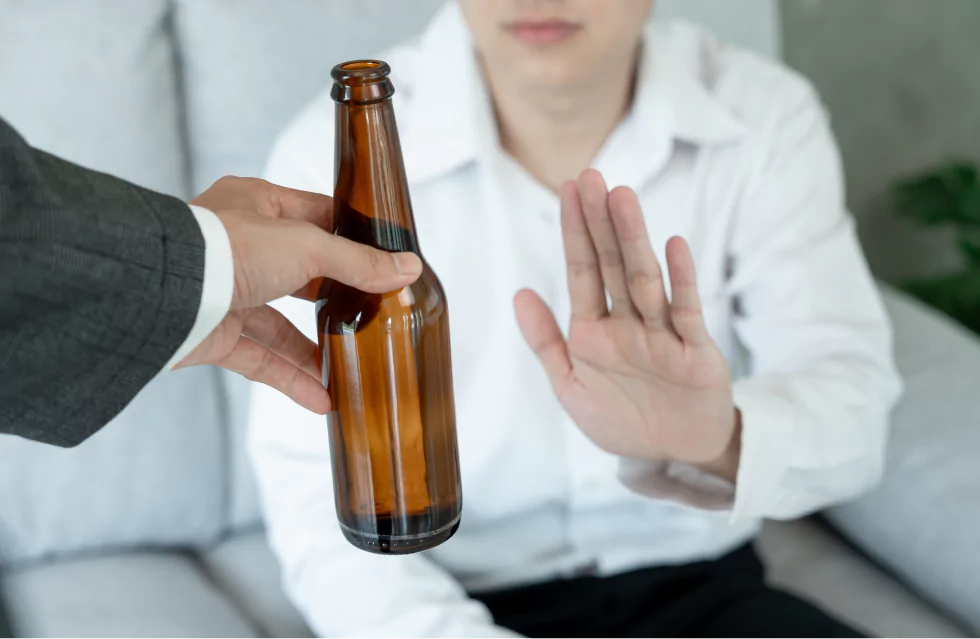
Peer pressure is the influence exerted by a peer group or individual that encourages others to change their attitudes, values, or behaviors in order to conform to group norms. In the context of social drinking, peer pressure can manifest in many forms, from direct offers of a drink to more subtle cues like questioning your choice to stay sober.
It's important to recognize that peer pressure can arise from a variety of sources:
It can feel personal when a friend pushes a drink on you after you’ve said no, but their reasons often have more to do with them than with you. Drinking is frequently a shared social ritual, and when you change your role in that dynamic, it can unintentionally hold a mirror up to their own habits. This can make people uncomfortable. Your choice might challenge the way your social circle has always operated, where drinking is seen as the default way to have fun and connect. As some experts note, friends who use substances together can normalize the behavior, making your decision to abstain seem unusual. It’s less about you being "boring" and more about them adjusting to a shift in a long-standing group norm. Understanding this can help you approach the situation with empathy instead of frustration.
Surround yourself with friends and family who respect your decision to stay sober. Having a support network can provide the encouragement and reassurance needed to resist peer pressure. These individuals can also help you navigate social situations by offering companionship and advocating for your choice.
A truly supportive friend is a game-changer. They're the ones who champion your decision to drink less without making you feel like you have to explain yourself. Instead of suggesting another happy hour, they might propose a hike, a coffee date, or a movie night. They listen without judgment when you’re struggling and remind you of your goals when you need to hear it most. These friends respect your decision and your boundaries, creating a safe space where you don’t feel pressured to participate in activities that don’t align with your well-being. They celebrate your milestones, no matter how small, and genuinely want to see you thrive. This kind of friendship is built on mutual respect and understanding, making your journey feel less isolating and much more manageable.
On the flip side, some friends can make your journey more difficult, even if they don’t mean to. These are the friends who constantly talk about drinking, downplay your efforts, or try to guilt you into having "just one." You might notice they still invite you to bars or parties centered around alcohol, ignoring your new lifestyle. A major red flag is when someone makes fun of your sobriety or pressures you to drink, even if they claim it's just a joke. This kind of behavior can undermine your confidence and make social situations feel incredibly stressful. While it’s a tough reality to face, recognizing these unsupportive patterns is the first step toward protecting your progress and prioritizing relationships that truly have your back.
Knowing how to confidently and succinctly articulate your decision not to drink can be powerful. Prepare a few responses that you’re comfortable with, such as:
Before attending social events, plan your approach. This might include deciding what you’ll say if offered a drink, bringing your own non-alcoholic beverages, or arranging to leave early if the pressure becomes too intense. Having a strategy can alleviate anxiety and bolster your resolve.
Sometimes, the best plan is knowing when to call it a night. Having an exit strategy isn't about being pessimistic; it's about being prepared so you can relax and enjoy yourself without anxiety. Before you even leave the house, decide on a time you'll head home or have a simple reason ready for when you want to leave. This could be anything from an early morning workout to needing to let the dog out. As experts suggest, planning ahead for social events can significantly reduce worry and temptation. If a situation starts to feel uncomfortable or the pressure mounts, you have a pre-made, graceful way to exit. True friends will respect your decision and won't make you feel guilty for taking care of yourself. Your well-being always comes first, and a good exit plan is a powerful tool to protect it.
It can be helpful to practice turning down offers of alcohol in a firm yet polite manner. Role-playing scenarios with a trusted friend or family member can help you feel more confident in saying no. Remember, it’s your right to make choices that align with your values and well-being.
Setting and maintaining boundaries is all about clear communication. It means being direct with your friends about what you need to feel supported and what makes you feel pressured. The people who truly have your back will respect your choice not to drink and won't push you into uncomfortable situations. Make an effort to surround yourself with friends who encourage healthy choices and celebrate your successes. And if someone’s behavior makes you feel uneasy, it's okay to say so. Remember, these boundaries aren't about building walls; they're about creating a safe space for yourself as you practice mindful drinking.
Encourage social activities that don’t center around drinking. Suggest alternatives such as going for a hike, attending a cultural event, or hosting a game night. By shifting the focus from alcohol, you can enjoy meaningful interactions without feeling pressured.
If you feel comfortable, share your reasons for staying sober with your peers. Often, people will respect your honesty and may even be inspired by your commitment. Transparency can also help dispel any misconceptions about your decision.
In moments of pressure, it’s easy to forget why you started this journey in the first place. Keeping a personal reminder of your goals can be a powerful anchor. This doesn’t have to be anything elaborate — it could be a simple note on your phone listing the reasons you’re cutting back, a photo of your family, or even a quick glance at an app that tracks your progress. Seeing how much money you’ve saved or how many days you’ve gone without a drink can be incredibly motivating. Your support system can also be a living reminder. A quick text to a supportive friend can ground you in your commitment. This personal touchstone helps you stay connected to your “why,” making it easier to handle social settings with confidence and stick to the choices that feel right for you.
Remaining steadfast in your choice to stay sober requires inner strength and self-confidence. Remind yourself of the reasons behind your decision and the benefits you’re experiencing. Keeping your long-term goals in mind can reinforce your determination.
This is a classic for a reason: it works. Walking around with a drink in your hand acts as a simple social shield. When you’re already holding something, people are far less likely to offer you another drink or question why you aren’t drinking. A club soda with lime, a cranberry and tonic, or even just sparkling water in a nice glass looks the part and keeps you in the loop. This small act helps you blend in comfortably without having to explain yourself over and over. It’s a low-effort way to redirect unwanted attention and focus on what you’re really there for — to connect with people and have a good time on your own terms. It's a key part of practicing mindful drinking in a social setting.
Looking for a socially accepted, no-questions-asked reason to stay sober? Offer to be the designated driver (DD). This is a powerful move because it immediately frames your choice not to drink as a responsible and caring act. No one is going to argue with the person who is ensuring they get home safely. Taking on this role gives you a clear purpose and an easy out from any pressure. Plus, there are some great perks: you’ll save money, you’ll wake up feeling refreshed, and your friends will be incredibly grateful. It’s a win-win that allows you to enjoy the party while staying true to your goals and being a great friend in the process.
Protecting your progress is your top priority, and sometimes that means respectfully declining an invitation. If you know a certain party, event, or environment will be too tempting or stressful, it is perfectly okay to sit it out. This isn’t about avoidance; it’s about self-awareness and making strategic choices for your well-being. Early in your journey, you might find that certain situations are particularly triggering. Recognizing this and choosing to protect your peace is a sign of strength, not weakness. You can always suggest an alternative way to catch up with friends later, in a setting where you feel more comfortable and in control.
Staying sober, particularly in social settings, can yield numerous benefits:
The culture surrounding alcohol is deep-rooted, but it’s evolving. More people are beginning to question traditional drinking norms and are seeking healthier lifestyles. This shift presents an opportunity to redefine social habits and norms around drinking. By choosing sobriety and encouraging others to do the same, you can be part of this positive change.
Your decision to stay sober can serve as a powerful example to others. Demonstrating that it’s possible to enjoy social gatherings without alcohol can inspire those around you to reconsider their own drinking habits.
If you host events, make sure there are plenty of non-alcoholic options available. Creating an inclusive environment where everyone feels comfortable, regardless of their drinking choices, can promote healthier social habits.
Engage in conversations about the benefits of sobriety and the challenges of peer pressure. Advocacy can raise awareness and foster a more accepting atmosphere for those who choose not to drink.
Sometimes, the most effective way to handle pressure from your current social circle is to expand it. Building a network of friends who share your commitment to a healthier lifestyle can make all the difference in feeling supported versus feeling isolated. When you’re surrounded by people who get it, you won’t have to constantly explain or defend your choices. This isn’t about ditching your old friends, but about adding new, supportive connections that reinforce your goals. It transforms your journey from a solitary effort into a shared, positive experience, making it easier and more enjoyable to stick with your decision.
Connecting with people who are on a similar path can be incredibly validating. Whether in person or online, support groups provide a safe space to share experiences and strategies without fear of judgment. Building a strong support system with sober friends is a powerful tool for long-term success. Digital communities, like the one within the Reframe app, offer 24/7 access to encouragement and advice right from your phone. You can find people who truly understand the challenges and celebrate your victories, big and small, which can be a huge source of strength when you need it most.
Redefining your social life can be an exciting adventure. Instead of focusing on what you’re avoiding, concentrate on all the new experiences you can explore. You can suggest alternatives to your current friends, like planning a hike, visiting a museum, or hosting a board game night. You can also seek out new environments designed for sober fun. Look for alcohol-free bars, sober meetups, or community events in your area. Discovering new hobbies and activities not only fills your time but also introduces you to new people who value connection and fun over cocktails.
Having a plan and a few go-to phrases can make a world of difference in most social settings. But what if the pressure to drink feels less about others and more like an internal need? For many of us, alcohol becomes a tool to quiet a racing mind or ease the discomfort of social situations. If you find that your desire to drink is tied to managing anxiety or other difficult emotions, it might be time to consider reaching out for professional support. This isn't a sign of failure; it's a proactive step toward building a stronger foundation for your well-being, one that doesn't rely on a substance to get you through the day.
Think of it this way: you're not just learning to say no to a drink, you're learning new ways to handle life's challenges. A therapist or counselor can act as a guide, helping you identify the triggers that lead you to drink and equipping you with healthier coping strategies. This process can be incredibly empowering, as it addresses the root cause rather than just the symptom. When you understand the "why" behind your drinking habits, you gain more control over your choices and can build a social life that feels authentic and enjoyable, without needing alcohol as a crutch to participate.
If the thought of a party or networking event makes your palms sweat, you’re not alone. Many people use alcohol as a "social lubricant" to take the edge off and feel more outgoing. While it might seem to work in the short term, relying on alcohol can prevent you from developing genuine social confidence. Learning to handle social stress and anxiety without a drink is a crucial part of feeling better for the long haul. A therapist can help you unpack these feelings and teach you practical techniques, like mindfulness exercises or cognitive-behavioral strategies, to feel more at ease in social settings on your own terms.
Sometimes, drinking isn't just about social anxiety; it can be a way to self-medicate for other underlying conditions like depression or past trauma. If you suspect this might be the case, professional help is essential. A qualified mental health expert can provide the tools and support you need to feel steady in social situations and beyond. They can offer a proper diagnosis and create a treatment plan that might include therapy or medication, giving you a solid strategy for managing your mental health. This holistic approach makes long-term change much more achievable because you're healing the source of the issue, not just putting a bandage on it.
Managing and overcoming peer pressure in social situations while staying sober requires preparation, confidence, and support. By understanding the dynamics of peer pressure and employing strategies to resist it, you can navigate social environments with ease and integrity. Remember, your commitment to sobriety is a powerful choice that can lead to numerous personal and social benefits. As more individuals embrace sober living, the norms surrounding alcohol consumption are slowly but surely changing, paving the way for healthier and more inclusive social interactions.
What if my friends get defensive or annoyed when I turn down a drink? It’s tough when the people closest to you don’t seem to get it. Remember, their reaction often has more to do with their own relationship with alcohol than it does with you. Give them some time to adjust to this change in your dynamic. In the meantime, focus your energy on the friends who respect your decision without question. True friends will come around and value your presence more than what's in your cup.
Do I really have to explain to everyone why I’m not drinking? Absolutely not. You don't owe anyone a detailed explanation for your personal health choices. A simple and friendly "No, thanks, I'm good" is a complete answer. If someone pushes, you can have a short, prepared line like, "I'm just not feeling it tonight." The less of a big deal you make it, the less of a big deal it will become for others.
How can I still feel included and have fun at parties without drinking? Feeling like part of the fun is about connection, not consumption. A great strategy is to always have a non-alcoholic drink in your hand—like a soda with lime—which usually stops people from offering you one. Focus on engaging in great conversations, hitting the dance floor, or suggesting a game. Your energy and presence are what make you a fun person to be around, not the beverage you're holding.
Is it okay to just avoid social events for a while? Of course. Protecting your well-being is your top priority, and if that means skipping a few parties, that's a sign of strength, not weakness. This is especially true early in your journey when you're still building confidence. Think of it as a strategic pause. You can always suggest catching up with friends in a different setting, like a coffee shop or a walk in the park, where you feel more comfortable.
What should I do if a really close friend is the one pressuring me the most? This situation requires a more direct approach. Find a time to talk to your friend one-on-one, away from the party atmosphere. You can explain how much you value their friendship and then clearly state what you need. Something like, "Our friendship means a lot to me, and right now, I need your support in my decision not to drink. It would help me a lot if you could back me up." Setting this boundary is a crucial step in maintaining a healthy, respectful friendship.
Social gatherings and alcohol often feel like a package deal. Whether it's a casual get-together or a big celebration, opting out can feel like you're swimming upstream. It’s especially tough when you feel that subtle (or not-so-subtle) peer drink pressure. But you've already made a powerful choice for yourself. This guide is about owning that choice when you've decided ahead of time to abstain from drinking at social functions. Remember, surrounding yourself with friends who encourage and support your healthy decisions can help you avoid pressure to drink alcohol—it truly makes all the difference.
Peer pressure is the influence exerted by a peer group or individual that encourages others to change their attitudes, values, or behaviors in order to conform to group norms. In the context of social drinking, peer pressure can manifest in many forms, from direct offers of a drink to more subtle cues like questioning your choice to stay sober.
It's important to recognize that peer pressure can arise from a variety of sources:
It can feel personal when a friend pushes a drink on you after you’ve said no, but their reasons often have more to do with them than with you. Drinking is frequently a shared social ritual, and when you change your role in that dynamic, it can unintentionally hold a mirror up to their own habits. This can make people uncomfortable. Your choice might challenge the way your social circle has always operated, where drinking is seen as the default way to have fun and connect. As some experts note, friends who use substances together can normalize the behavior, making your decision to abstain seem unusual. It’s less about you being "boring" and more about them adjusting to a shift in a long-standing group norm. Understanding this can help you approach the situation with empathy instead of frustration.
Surround yourself with friends and family who respect your decision to stay sober. Having a support network can provide the encouragement and reassurance needed to resist peer pressure. These individuals can also help you navigate social situations by offering companionship and advocating for your choice.
A truly supportive friend is a game-changer. They're the ones who champion your decision to drink less without making you feel like you have to explain yourself. Instead of suggesting another happy hour, they might propose a hike, a coffee date, or a movie night. They listen without judgment when you’re struggling and remind you of your goals when you need to hear it most. These friends respect your decision and your boundaries, creating a safe space where you don’t feel pressured to participate in activities that don’t align with your well-being. They celebrate your milestones, no matter how small, and genuinely want to see you thrive. This kind of friendship is built on mutual respect and understanding, making your journey feel less isolating and much more manageable.
On the flip side, some friends can make your journey more difficult, even if they don’t mean to. These are the friends who constantly talk about drinking, downplay your efforts, or try to guilt you into having "just one." You might notice they still invite you to bars or parties centered around alcohol, ignoring your new lifestyle. A major red flag is when someone makes fun of your sobriety or pressures you to drink, even if they claim it's just a joke. This kind of behavior can undermine your confidence and make social situations feel incredibly stressful. While it’s a tough reality to face, recognizing these unsupportive patterns is the first step toward protecting your progress and prioritizing relationships that truly have your back.
Knowing how to confidently and succinctly articulate your decision not to drink can be powerful. Prepare a few responses that you’re comfortable with, such as:
Before attending social events, plan your approach. This might include deciding what you’ll say if offered a drink, bringing your own non-alcoholic beverages, or arranging to leave early if the pressure becomes too intense. Having a strategy can alleviate anxiety and bolster your resolve.
Sometimes, the best plan is knowing when to call it a night. Having an exit strategy isn't about being pessimistic; it's about being prepared so you can relax and enjoy yourself without anxiety. Before you even leave the house, decide on a time you'll head home or have a simple reason ready for when you want to leave. This could be anything from an early morning workout to needing to let the dog out. As experts suggest, planning ahead for social events can significantly reduce worry and temptation. If a situation starts to feel uncomfortable or the pressure mounts, you have a pre-made, graceful way to exit. True friends will respect your decision and won't make you feel guilty for taking care of yourself. Your well-being always comes first, and a good exit plan is a powerful tool to protect it.
It can be helpful to practice turning down offers of alcohol in a firm yet polite manner. Role-playing scenarios with a trusted friend or family member can help you feel more confident in saying no. Remember, it’s your right to make choices that align with your values and well-being.
Setting and maintaining boundaries is all about clear communication. It means being direct with your friends about what you need to feel supported and what makes you feel pressured. The people who truly have your back will respect your choice not to drink and won't push you into uncomfortable situations. Make an effort to surround yourself with friends who encourage healthy choices and celebrate your successes. And if someone’s behavior makes you feel uneasy, it's okay to say so. Remember, these boundaries aren't about building walls; they're about creating a safe space for yourself as you practice mindful drinking.
Encourage social activities that don’t center around drinking. Suggest alternatives such as going for a hike, attending a cultural event, or hosting a game night. By shifting the focus from alcohol, you can enjoy meaningful interactions without feeling pressured.
If you feel comfortable, share your reasons for staying sober with your peers. Often, people will respect your honesty and may even be inspired by your commitment. Transparency can also help dispel any misconceptions about your decision.
In moments of pressure, it’s easy to forget why you started this journey in the first place. Keeping a personal reminder of your goals can be a powerful anchor. This doesn’t have to be anything elaborate — it could be a simple note on your phone listing the reasons you’re cutting back, a photo of your family, or even a quick glance at an app that tracks your progress. Seeing how much money you’ve saved or how many days you’ve gone without a drink can be incredibly motivating. Your support system can also be a living reminder. A quick text to a supportive friend can ground you in your commitment. This personal touchstone helps you stay connected to your “why,” making it easier to handle social settings with confidence and stick to the choices that feel right for you.
Remaining steadfast in your choice to stay sober requires inner strength and self-confidence. Remind yourself of the reasons behind your decision and the benefits you’re experiencing. Keeping your long-term goals in mind can reinforce your determination.
This is a classic for a reason: it works. Walking around with a drink in your hand acts as a simple social shield. When you’re already holding something, people are far less likely to offer you another drink or question why you aren’t drinking. A club soda with lime, a cranberry and tonic, or even just sparkling water in a nice glass looks the part and keeps you in the loop. This small act helps you blend in comfortably without having to explain yourself over and over. It’s a low-effort way to redirect unwanted attention and focus on what you’re really there for — to connect with people and have a good time on your own terms. It's a key part of practicing mindful drinking in a social setting.
Looking for a socially accepted, no-questions-asked reason to stay sober? Offer to be the designated driver (DD). This is a powerful move because it immediately frames your choice not to drink as a responsible and caring act. No one is going to argue with the person who is ensuring they get home safely. Taking on this role gives you a clear purpose and an easy out from any pressure. Plus, there are some great perks: you’ll save money, you’ll wake up feeling refreshed, and your friends will be incredibly grateful. It’s a win-win that allows you to enjoy the party while staying true to your goals and being a great friend in the process.
Protecting your progress is your top priority, and sometimes that means respectfully declining an invitation. If you know a certain party, event, or environment will be too tempting or stressful, it is perfectly okay to sit it out. This isn’t about avoidance; it’s about self-awareness and making strategic choices for your well-being. Early in your journey, you might find that certain situations are particularly triggering. Recognizing this and choosing to protect your peace is a sign of strength, not weakness. You can always suggest an alternative way to catch up with friends later, in a setting where you feel more comfortable and in control.
Staying sober, particularly in social settings, can yield numerous benefits:
The culture surrounding alcohol is deep-rooted, but it’s evolving. More people are beginning to question traditional drinking norms and are seeking healthier lifestyles. This shift presents an opportunity to redefine social habits and norms around drinking. By choosing sobriety and encouraging others to do the same, you can be part of this positive change.
Your decision to stay sober can serve as a powerful example to others. Demonstrating that it’s possible to enjoy social gatherings without alcohol can inspire those around you to reconsider their own drinking habits.
If you host events, make sure there are plenty of non-alcoholic options available. Creating an inclusive environment where everyone feels comfortable, regardless of their drinking choices, can promote healthier social habits.
Engage in conversations about the benefits of sobriety and the challenges of peer pressure. Advocacy can raise awareness and foster a more accepting atmosphere for those who choose not to drink.
Sometimes, the most effective way to handle pressure from your current social circle is to expand it. Building a network of friends who share your commitment to a healthier lifestyle can make all the difference in feeling supported versus feeling isolated. When you’re surrounded by people who get it, you won’t have to constantly explain or defend your choices. This isn’t about ditching your old friends, but about adding new, supportive connections that reinforce your goals. It transforms your journey from a solitary effort into a shared, positive experience, making it easier and more enjoyable to stick with your decision.
Connecting with people who are on a similar path can be incredibly validating. Whether in person or online, support groups provide a safe space to share experiences and strategies without fear of judgment. Building a strong support system with sober friends is a powerful tool for long-term success. Digital communities, like the one within the Reframe app, offer 24/7 access to encouragement and advice right from your phone. You can find people who truly understand the challenges and celebrate your victories, big and small, which can be a huge source of strength when you need it most.
Redefining your social life can be an exciting adventure. Instead of focusing on what you’re avoiding, concentrate on all the new experiences you can explore. You can suggest alternatives to your current friends, like planning a hike, visiting a museum, or hosting a board game night. You can also seek out new environments designed for sober fun. Look for alcohol-free bars, sober meetups, or community events in your area. Discovering new hobbies and activities not only fills your time but also introduces you to new people who value connection and fun over cocktails.
Having a plan and a few go-to phrases can make a world of difference in most social settings. But what if the pressure to drink feels less about others and more like an internal need? For many of us, alcohol becomes a tool to quiet a racing mind or ease the discomfort of social situations. If you find that your desire to drink is tied to managing anxiety or other difficult emotions, it might be time to consider reaching out for professional support. This isn't a sign of failure; it's a proactive step toward building a stronger foundation for your well-being, one that doesn't rely on a substance to get you through the day.
Think of it this way: you're not just learning to say no to a drink, you're learning new ways to handle life's challenges. A therapist or counselor can act as a guide, helping you identify the triggers that lead you to drink and equipping you with healthier coping strategies. This process can be incredibly empowering, as it addresses the root cause rather than just the symptom. When you understand the "why" behind your drinking habits, you gain more control over your choices and can build a social life that feels authentic and enjoyable, without needing alcohol as a crutch to participate.
If the thought of a party or networking event makes your palms sweat, you’re not alone. Many people use alcohol as a "social lubricant" to take the edge off and feel more outgoing. While it might seem to work in the short term, relying on alcohol can prevent you from developing genuine social confidence. Learning to handle social stress and anxiety without a drink is a crucial part of feeling better for the long haul. A therapist can help you unpack these feelings and teach you practical techniques, like mindfulness exercises or cognitive-behavioral strategies, to feel more at ease in social settings on your own terms.
Sometimes, drinking isn't just about social anxiety; it can be a way to self-medicate for other underlying conditions like depression or past trauma. If you suspect this might be the case, professional help is essential. A qualified mental health expert can provide the tools and support you need to feel steady in social situations and beyond. They can offer a proper diagnosis and create a treatment plan that might include therapy or medication, giving you a solid strategy for managing your mental health. This holistic approach makes long-term change much more achievable because you're healing the source of the issue, not just putting a bandage on it.
Managing and overcoming peer pressure in social situations while staying sober requires preparation, confidence, and support. By understanding the dynamics of peer pressure and employing strategies to resist it, you can navigate social environments with ease and integrity. Remember, your commitment to sobriety is a powerful choice that can lead to numerous personal and social benefits. As more individuals embrace sober living, the norms surrounding alcohol consumption are slowly but surely changing, paving the way for healthier and more inclusive social interactions.
What if my friends get defensive or annoyed when I turn down a drink? It’s tough when the people closest to you don’t seem to get it. Remember, their reaction often has more to do with their own relationship with alcohol than it does with you. Give them some time to adjust to this change in your dynamic. In the meantime, focus your energy on the friends who respect your decision without question. True friends will come around and value your presence more than what's in your cup.
Do I really have to explain to everyone why I’m not drinking? Absolutely not. You don't owe anyone a detailed explanation for your personal health choices. A simple and friendly "No, thanks, I'm good" is a complete answer. If someone pushes, you can have a short, prepared line like, "I'm just not feeling it tonight." The less of a big deal you make it, the less of a big deal it will become for others.
How can I still feel included and have fun at parties without drinking? Feeling like part of the fun is about connection, not consumption. A great strategy is to always have a non-alcoholic drink in your hand—like a soda with lime—which usually stops people from offering you one. Focus on engaging in great conversations, hitting the dance floor, or suggesting a game. Your energy and presence are what make you a fun person to be around, not the beverage you're holding.
Is it okay to just avoid social events for a while? Of course. Protecting your well-being is your top priority, and if that means skipping a few parties, that's a sign of strength, not weakness. This is especially true early in your journey when you're still building confidence. Think of it as a strategic pause. You can always suggest catching up with friends in a different setting, like a coffee shop or a walk in the park, where you feel more comfortable.
What should I do if a really close friend is the one pressuring me the most? This situation requires a more direct approach. Find a time to talk to your friend one-on-one, away from the party atmosphere. You can explain how much you value their friendship and then clearly state what you need. Something like, "Our friendship means a lot to me, and right now, I need your support in my decision not to drink. It would help me a lot if you could back me up." Setting this boundary is a crucial step in maintaining a healthy, respectful friendship.
