

The AA Preamble starts every meeting, but what’s it all about? Find out what role the Preamble of AA plays in the program and check out some AA alternatives in our latest blog!

Although it isn’t a treatment for alcohol use disorder (AUD), the Reframe app can help you cut back on drinking gradually, with the science-backed knowledge to empower you 100% of the way. Our proven program has helped millions of people around the world drink less and live more. And we want to help you get there, too!
The Reframe app equips you with the knowledge and skills you need to not only survive drinking less, but to thrive while you navigate the journey. Our daily research-backed readings teach you the neuroscience of alcohol, and our in-app Toolkit provides the resources and activities you need to navigate each challenge.
You’ll meet hundreds of fellow Reframers in our 24/7 Forum chat and daily Zoom check-in meetings. Receive encouragement from people worldwide who know exactly what you’re going through! You’ll also have the opportunity to connect with our licensed Reframe coaches for more personalized guidance.
Plus, we’re always introducing new features to optimize your in-app experience. We recently launched our in-app chatbot, Melody, powered by the world’s most powerful AI technology. Melody is here to help as you adjust to a life with less (or no) alcohol.
And that’s not all! Every month, we launch fun challenges, like Dry/Damp January, Mental Health May, and Outdoorsy June. You won’t want to miss out on the chance to participate alongside fellow Reframers (or solo if that’s more your thing!).
The Reframe app is free for 7 days, so you don’t have anything to lose by trying it. Are you ready to feel empowered and discover life beyond alcohol? Then download our app through the App Store or Google Play today!
If you’ve been to a few AA meetings, you’ve probably noticed some similarities across the board. There’s usually a round of introductions with most members saying, “My name is so-and-so, and I’m an alcoholic.” The 12 Steps are probably hanging on the wall. There’s probably coffee. And yes, the meeting usually starts with the reading of the AA Preamble.
But what is the purpose of the Alcoholics Anonymous Preamble? Let’s look into it.

First, let’s take a brief look at Alcoholics Anonymous itself. To learn about the ins and outs of AA and AA meetings, check out “How Does Alcoholics Anonymous Work?” and “What To Expect at an AA Meeting.” For now, here’s the gist:
The meetings are where the Preamble comes into the picture.

The Alcoholics Anonymous Preamble is read at the beginning of AA meetings. Short and sweet, it’s a concise statement introducing the group’s mission and principles. But what exactly is the purpose of the AA Preamble, and how does it contribute to the recovery process? Let’s take a closer look!
Once we hear the Preamble, there’s no mistaking what door we walked into — we’re definitely at an AA meeting — “a fellowship of people who share their experience, strength and hope.” Most importantly, we’re all here for the same reason — “to solve our common problem and help others recover from alcoholism.”
By emphasizing this goal, the AA Preamble reinforces it and makes clear what AA is all about. And while many might know this already, it never hurts to repeat it!
In fact, even if we end up finding that AA isn’t right for us, putting our “why” — our reasons for changing our relationship with booze — into a concise and clear statement is a great idea. Maybe we want to improve our cardiovascular health, sharpen our cognitive skills, or lose some weight. Or maybe the reason has to do with building more authentic friendships, spending more time with our kids, or strengthening our relationship with our partner. Whatever it is, stating it clearly is the first step.
Next, it’s a good idea to put our “purpose statement” in a place where we’ll come across it daily. Whether we write it on a post-it note and stick it to the bathroom mirror or use a phone widget to create a digital reminder, the effect is the same: seeing our “purpose statement” is a visual reminder of why we decided to make a shift in our daily habits.
Neuroscience fact: There’s an area of neuroscience that deals with the “purpose-driven life” hypothesis. This fascinating research field is all about how mental, emotional, social, and spiritual factors can directly affect our health. The idea behind it is that having a sense of purpose can actually make us physically stronger and more resilient, staving off dementia, improving cardiovascular health, and improving the outcomes of stroke and spinal cord injuries. Purpose statement, here we come! And remember, it doesn’t have to be in the context of AA — feel free to define yours however you want.
One thing is clear about AA: it tries to set a welcoming vibe with minimal expectations. The Preamble reaffirms that. As the second paragraph reads, “The only requirement for membership is a desire to stop drinking.” It also mentions that AA is always free and “self-supporting” — contributions are completely voluntary.
Making this tone of inclusivity clear from the start can go a long way to making newcomers feel comfortable. Even if we drank the night before, or that morning, or five minutes before the meeting, we know that we’re still welcome.
That said, while the statement works well to welcome those who want booze out of their lives completely, it’s not as inclusive when it comes to everyone else. A casual drinker exploring a sober-curious lifestyle or trying a Sober October or Dry January challenge to experience the benefits of drinking less without making a lifelong commitment might not feel quite as welcome. (Luckily, there are many AA alternatives — more on that later.)
Neuroscience fact: Social support triggers the release of oxytocin, a hormone that promotes feelings of trust and bonding. In addition to making us feel good naturally, it reduces stress — a common trigger for alcohol use.

According to the Preamble, AA “is not aligned with any sect, denomination, politics, organization, or institution,” doesn’t wish to “engage in any controversy,” or support any “opposing causes.”
While this purported neutrality sounds good, this is also where things get a bit muddled. It’s true that AA considers itself to be “spiritual but not religious,” and yet it’s impossible to go through a meeting without hearing the word “God” or references to prayer. While there’s nothing wrong with that, many first-timers may not realize this up-front, and those with differing views or religious trauma might find the tone a bit triggering (or, at the very least, a turn-off).
Neuroscience fact: The area of the brain known as the ventromedial prefrontal cortex (vmPFC) lights up when we make a judgment about another person. Curiously, if that judgment is positive, we get a “dopamine hit” that makes us feel good.
The AA Preamble emphasizes the importance of sharing stories — a crucial component of AA, which is based on people sharing their experiences with alcohol and giving hope to others that recovery is possible. This openness removes the stigma some might feel about their alcohol use: whatever we did, chances are, someone else has done the same thing (or worse). However much we drank, it’s all but certain that someone else drank even more than we did. And while this experience most likely wreaked havoc in our lives at the time, it can now serve as a way to connect with others who’ve been in our shoes.
Whether or not AA is ultimately right for us, having a support team willing to lend a helping hand and an empathetic ear is crucial in recovery. We are “social animals” by nature, and any complex task is infinitely easier with a solid support system to back us up, support us when things get rough, and celebrate our milestones.
Neuroscience fact: When we hear someone share their story, our mirror neurons activate, allowing us to empathize and connect with their experience. Mirror neurons fire when we watch someone perform an action as opposed to engaging in it ourselves. This shared experience, in turn, fosters empathy, makes us closer to others, and supports recovery for everyone involved. It’s a win-win!
Finally, while reading the same couple of paragraphs at the beginning of every meeting might seem a bit repetitive, there’s a reason for the reinforcement. Building new habits is all about repetition, and the AA Preamble reinforces the main points to keep in mind along the way.
And, just like its other benefits, the value of repetition goes beyond the Preamble! Repeating behaviors we want to make automatic can feel tedious at first, but before we know it, neuroplasticity — the brain’s ability to adapt and change — makes it easier. Remember, habit formation is all about repetition and reinforcement, and our thoughts and behaviors around alcohol are no different. The more we state our intentions while engaging in alcohol-free activities of any sort, the more we strengthen our connection with the habits fueling our new lifestyle and reinforce our commitment to them.
Neuroscience fact: The brain loves patterns, and repetition strengthens existing connections. Known as “Hebbian learning,” this phenomenon is captured in the saying “neurons that fire together wire together.” Repetition, in turn, serves as a sort of neurological glue that fosters these connections.

The AA Preamble might be useful for its purposes, but that doesn’t mean AA itself is for everyone. And that’s okay! For a deep dive, check out “Best Alternatives for AA.” For now, here are some options to think about:
Remember, whatever path you choose for your recovery, the most important part is this: you’ve decided to change your relationship with alcohol. That’s great! There’s so much to look forward to and so many perks to discover for yourself. And Reframe is here to support you, cheer you on, and help you reach your goals!


When it comes to the AA Preamble, it’s helpful to focus on the benefits of having a “preamble” for our alcohol journey as a whole — whatever form that takes. In the words of Tara Stiles:
“Our bodies and our minds have their own timing that pay little attention to our cerebral desires. We can't force or expect things to change as fast as we want, but when we put our efforts in the direction of our intention and drop everything else like snow falling, things unfold with ease.”
And if we set our intentions about alcohol — and, better yet, put them in writing — we can look forward to a healthier, happier version of ourselves “unfolding with ease” each day that we stay on our path!
If you’ve been to a few AA meetings, you’ve probably noticed some similarities across the board. There’s usually a round of introductions with most members saying, “My name is so-and-so, and I’m an alcoholic.” The 12 Steps are probably hanging on the wall. There’s probably coffee. And yes, the meeting usually starts with the reading of the AA Preamble.
But what is the purpose of the Alcoholics Anonymous Preamble? Let’s look into it.
First, let’s take a brief look at Alcoholics Anonymous itself. To learn about the ins and outs of AA and AA meetings, check out “How Does Alcoholics Anonymous Work?” and “What To Expect at an AA Meeting.” For now, here’s the gist:
The meetings are where the Preamble comes into the picture.
The Alcoholics Anonymous Preamble is read at the beginning of AA meetings. Short and sweet, it’s a concise statement introducing the group’s mission and principles. But what exactly is the purpose of the AA Preamble, and how does it contribute to the recovery process? Let’s take a closer look!
Once we hear the Preamble, there’s no mistaking what door we walked into — we’re definitely at an AA meeting — “a fellowship of people who share their experience, strength and hope.” Most importantly, we’re all here for the same reason — “to solve our common problem and help others recover from alcoholism.”
By emphasizing this goal, the AA Preamble reinforces it and makes clear what AA is all about. And while many might know this already, it never hurts to repeat it!
In fact, even if we end up finding that AA isn’t right for us, putting our “why” — our reasons for changing our relationship with booze — into a concise and clear statement is a great idea. Maybe we want to improve our cardiovascular health, sharpen our cognitive skills, or lose some weight. Or maybe the reason has to do with building more authentic friendships, spending more time with our kids, or strengthening our relationship with our partner. Whatever it is, stating it clearly is the first step.
Next, it’s a good idea to put our “purpose statement” in a place where we’ll come across it daily. Whether we write it on a post-it note and stick it to the bathroom mirror or use a phone widget to create a digital reminder, the effect is the same: seeing our “purpose statement” is a visual reminder of why we decided to make a shift in our daily habits.
Neuroscience fact: There’s an area of neuroscience that deals with the “purpose-driven life” hypothesis. This fascinating research field is all about how mental, emotional, social, and spiritual factors can directly affect our health. The idea behind it is that having a sense of purpose can actually make us physically stronger and more resilient, staving off dementia, improving cardiovascular health, and improving the outcomes of stroke and spinal cord injuries. Purpose statement, here we come! And remember, it doesn’t have to be in the context of AA — feel free to define yours however you want.
One thing is clear about AA: it tries to set a welcoming vibe with minimal expectations. The Preamble reaffirms that. As the second paragraph reads, “The only requirement for membership is a desire to stop drinking.” It also mentions that AA is always free and “self-supporting” — contributions are completely voluntary.
Making this tone of inclusivity clear from the start can go a long way to making newcomers feel comfortable. Even if we drank the night before, or that morning, or five minutes before the meeting, we know that we’re still welcome.
That said, while the statement works well to welcome those who want booze out of their lives completely, it’s not as inclusive when it comes to everyone else. A casual drinker exploring a sober-curious lifestyle or trying a Sober October or Dry January challenge to experience the benefits of drinking less without making a lifelong commitment might not feel quite as welcome. (Luckily, there are many AA alternatives — more on that later.)
Neuroscience fact: Social support triggers the release of oxytocin, a hormone that promotes feelings of trust and bonding. In addition to making us feel good naturally, it reduces stress — a common trigger for alcohol use.
According to the Preamble, AA “is not aligned with any sect, denomination, politics, organization, or institution,” doesn’t wish to “engage in any controversy,” or support any “opposing causes.”
While this purported neutrality sounds good, this is also where things get a bit muddled. It’s true that AA considers itself to be “spiritual but not religious,” and yet it’s impossible to go through a meeting without hearing the word “God” or references to prayer. While there’s nothing wrong with that, many first-timers may not realize this up-front, and those with differing views or religious trauma might find the tone a bit triggering (or, at the very least, a turn-off).
Neuroscience fact: The area of the brain known as the ventromedial prefrontal cortex (vmPFC) lights up when we make a judgment about another person. Curiously, if that judgment is positive, we get a “dopamine hit” that makes us feel good.
The AA Preamble emphasizes the importance of sharing stories — a crucial component of AA, which is based on people sharing their experiences with alcohol and giving hope to others that recovery is possible. This openness removes the stigma some might feel about their alcohol use: whatever we did, chances are, someone else has done the same thing (or worse). However much we drank, it’s all but certain that someone else drank even more than we did. And while this experience most likely wreaked havoc in our lives at the time, it can now serve as a way to connect with others who’ve been in our shoes.
Whether or not AA is ultimately right for us, having a support team willing to lend a helping hand and an empathetic ear is crucial in recovery. We are “social animals” by nature, and any complex task is infinitely easier with a solid support system to back us up, support us when things get rough, and celebrate our milestones.
Neuroscience fact: When we hear someone share their story, our mirror neurons activate, allowing us to empathize and connect with their experience. Mirror neurons fire when we watch someone perform an action as opposed to engaging in it ourselves. This shared experience, in turn, fosters empathy, makes us closer to others, and supports recovery for everyone involved. It’s a win-win!
Finally, while reading the same couple of paragraphs at the beginning of every meeting might seem a bit repetitive, there’s a reason for the reinforcement. Building new habits is all about repetition, and the AA Preamble reinforces the main points to keep in mind along the way.
And, just like its other benefits, the value of repetition goes beyond the Preamble! Repeating behaviors we want to make automatic can feel tedious at first, but before we know it, neuroplasticity — the brain’s ability to adapt and change — makes it easier. Remember, habit formation is all about repetition and reinforcement, and our thoughts and behaviors around alcohol are no different. The more we state our intentions while engaging in alcohol-free activities of any sort, the more we strengthen our connection with the habits fueling our new lifestyle and reinforce our commitment to them.
Neuroscience fact: The brain loves patterns, and repetition strengthens existing connections. Known as “Hebbian learning,” this phenomenon is captured in the saying “neurons that fire together wire together.” Repetition, in turn, serves as a sort of neurological glue that fosters these connections.
The AA Preamble might be useful for its purposes, but that doesn’t mean AA itself is for everyone. And that’s okay! For a deep dive, check out “Best Alternatives for AA.” For now, here are some options to think about:
Remember, whatever path you choose for your recovery, the most important part is this: you’ve decided to change your relationship with alcohol. That’s great! There’s so much to look forward to and so many perks to discover for yourself. And Reframe is here to support you, cheer you on, and help you reach your goals!
When it comes to the AA Preamble, it’s helpful to focus on the benefits of having a “preamble” for our alcohol journey as a whole — whatever form that takes. In the words of Tara Stiles:
“Our bodies and our minds have their own timing that pay little attention to our cerebral desires. We can't force or expect things to change as fast as we want, but when we put our efforts in the direction of our intention and drop everything else like snow falling, things unfold with ease.”
And if we set our intentions about alcohol — and, better yet, put them in writing — we can look forward to a healthier, happier version of ourselves “unfolding with ease” each day that we stay on our path!

What is the First Step of AA all about? Learn why admitting powerlessness over booze is so highly emphasized. Then, explore a more scientific approach with us!

Although it isn’t a treatment for alcohol use disorder (AUD), the Reframe app can help you cut back on drinking gradually, with the science-backed knowledge to empower you 100% of the way. Our proven program has helped millions of people around the world drink less and live more. And we want to help you get there, too!
The Reframe app equips you with the knowledge and skills you need to not only survive drinking less, but to thrive while you navigate the journey. Our daily research-backed readings teach you the neuroscience of alcohol, and our in-app Toolkit provides the resources and activities you need to navigate each challenge.
You’ll meet hundreds of fellow Reframers in our 24/7 Forum chat and daily Zoom check-in meetings. Receive encouragement from people worldwide who know exactly what you’re going through! You’ll also have the opportunity to connect with our licensed Reframe coaches for more personalized guidance.
Plus, we’re always introducing new features to optimize your in-app experience. We recently launched our in-app chatbot, Melody, powered by the world’s most powerful AI technology. Melody is here to help as you adjust to a life with less (or no) alcohol.
And that’s not all! Every month, we launch fun challenges, like Dry/Damp January, Mental Health May, and Outdoorsy June. You won’t want to miss out on the chance to participate alongside fellow Reframers (or solo if that’s more your thing!).
The Reframe app is free for 7 days, so you don’t have anything to lose by trying it. Are you ready to feel empowered and discover life beyond alcohol? Then download our app through the App Store or Google Play today!
It started out as harmless fun. Parties on the weekend, trivia night with a pitcher of beer on Thursdays with some pals from work, wine with dinner. Somehow the amount you drank kept increasing until you found yourself downing more than you set out to on a regular basis. The exact amount doesn’t matter. Whether you got to the point where you had to throw back a couple of beers in the morning just to stop the shakes or you found yourself waking up at 3 a.m. in a cold sweat, trying to piece the previous night together and making damage control plans, one thing is clear: alcohol has taken up way more real estate in your life than you’d like — and you’re ready to do something about it.

This realization, in turn, is what the First Step of AA — also considered the most important aspect of the program — is all about. But while there’s value in facing our demons head-on and being honest about our relationship with booze, the way the First Step is presented has some serious drawbacks. Let’s dig deeper into the First Step, AA’s take on it, and a “reframed” version that’s a bit more science-based and optimistic.
First things first: what is Alcoholics Anonymous (AA)? And what are the Steps? AA is the brainchild of Bill Wilson, a stockbroker who nearly lost his life to booze before a spontaneous recovery. It’s a fellowship of people who found themselves in the grip of what we now call alcohol use disorder (AUD). The idea is simple: like-minded people coming together to help each other by sharing stories, offering advice, and working through the “12 Steps.” The Steps serve as recovery instructions, steering people onto the path of sobriety and productive living by cleaning up the aftermath booze left in their own lives and helping others in the same boat.
Some swear by it, some can’t stomach its less-than-scientific claims (go figure — it was started nearly a century ago), and others fall somewhere in between. For a closer look, check out “How Does Alcoholics Anonymous Work?” For now, let’s focus on the First Step, AA’s take on it, and what might be a more palatable (and science-based) version.
So what is this famous First Step? Here goes: “We admitted we were powerless over alcohol and our lives have become unmanageable.” In other words, the First Step is admitting that booze got the better of us, as well as acknowledging the fact that our lives became a mess as a result.
What that mess looks like depends on the person. Some of us might be walking into the meeting having been court-ordered to do so after our last DUI. Others might be “functional,” taking swigs of vodka from a coffee thermos between Zoom conferences and PTA meetings. The only requirement, as the AA Preamble says, is the desire to stop drinking.
There’s a useful image that illustrates the power alcohol can have over us, and how the First Step can help. It’s the carnivorous “pitcher plant” analogy that addiction specialist Allen Carr describes in The Easy Way To Control Alcohol. Here’s the gist:
Luckily, however, there’s light at the end of the tunnel for us. While we might indeed feel like we’re hopelessly stuck, this is where our paths diverge from those of the doomed bugs. We can get out, and it starts with that famous First Step.

The First Step of AA lays the foundation for the whole program.
It puts us in “honesty mode.” If we’ve been struggling for a while, it’s likely that we’ve been less than honest about our daily dealings with others (and, even worse, with ourselves). What started out as a few “white lies” might have morphed into full-blown deception. The First Step, in turn, creates an opportunity to interrupt the cycle of lies and broken promises.
It’s about letting go of control. Releasing control is another key component of the AA program, which is echoed in the Serenity Prayer: “Grant me the serenity to accept the things I cannot change, the courage to change the things I can, and the wisdom to know the difference.”
In a way, the First Step (which is usually read at the beginning of an AA meeting) and the Serenity Prayer (the traditional closing) create a “bookend” structure around the meeting. Both are about accepting reality while taking an active step toward change.
The powerlessness at the heart of the First Step might appear baffling to the outside observer. “Why don’t they just stop?” is a question that keeps our loved ones awake at night as they witness our descent into the “pitcher.” In fact, it’s the same question that probably keeps us up as well. Why in the world are we powerless to stop what looks like voluntary behavior?
The First Step, in turn, is calling out this mess for what it is. We’re stuck between a rock and a hard place: wanting something and yet wishing we didn’t want it at the same time. Unmanageable indeed.
That said, the way the First Step is phrased misses a critical component — one that’s also backed by science. Understanding how the brain responds to alcohol gives us the tools to reclaim our own power on our own terms. The result? We break free from the trap and are no longer dependent on booze (or, for that matter, on AA). Instead of dwelling on our “powerlessness,” we focus on the power we have to rewire our own brain.
How can we make this magic happen? The answer lies in neuro-plasticity — the brain’s ability to change and adapt. There’s a beautiful symmetry here: the very thing that got us into the alcohol trap — our brain adjusting to the presence of alcohol — can also help get us out.
According to research, simply staying away from booze begins the process of rewiring the brain. The longer we abstain, the easier it gets, as new neural circuits get established. It’s a bit like creating a ski track in the snow: the first go is the hardest, but before we know it we’re gliding along almost effortlessly. It’s important to note, however, that for those of us who struggled with AUD in the past, drinking again isn’t a good idea. History can — and often does — repeat itself.
There’s a saying that illustrates this concept: “Neurons that fire together wire together.” In other words, the more we repeat a certain behavior, the stronger the connection between all of its constituent parts — in this case, the way we react to and behave around booze.
Scientists at MIT demonstrated this process in action and even found a key protein (called Arc) that serves as a neurochemical trigger to get neighboring neurons to sync up. The lead author compares this uncanny ability to “a massive school of fish [that] can suddenly change direction, en masse, so long as the lead fish turns and every other fish obeys the simple rule of following the fish right in front of it.”
Thanks to the power of neuroplasticity, the physical part of recovery kicks off as soon as we set down the glass, bottle, or coffee thermos we stash our booze in. Our brain adjusts to the “new” new normal: soon enough we’re no longer physically dependent, our dopamine levels begin to get restored, and our mood starts to lift. Hooray! We might still feel some emotional dependence on it, but that’s about to change, too.
Here’s the best news: in addition to recovering physically, we can actually be happy about it. The more we see through the illusion of pleasure alcohol created through its chemical shenanigans in our brain, the more our desire for it fades away.
This is what cognitive behavioral therapy is all about: uncovering our subconscious beliefs about alcohol and reframing these cognitive distortions in a way that changes how we feel about drinking.
For example, maybe you think you need booze to socialize. Okay, let’s look at the evidence. Were we able to have fun at social events before we drank? Of course — just think of the booze-free fun you had as a child running around the playground, feeding pigeons in the park, or building pillow forts in the living room. Now, think about all those embarrassing late-night phone calls, hangovers that made you cancel plans, and morning-after regrets. Chances are, they didn’t do much for your social life.
Moreover, by understanding alcohol’s effects on dopamine, we can finally understand why we kept drinking in the first place against our own better judgment (and, seemingly, even against our will). As Annie Grace explains in This Naked Mind,
“It’s important to understand the difference between wanting and liking. When I was in the deepest levels of my addiction, the cravings were overwhelming to the point where I felt I was no longer in control. Yet the pleasure I got from drinking was practically nonexistent.”
In other words, our intense desire for booze was driven by our brain running on autopilot, demanding that we continue doing what we’ve done before. It’s no accident that dopamine is involved in the process of learning — we’re naturally driven to repeat what we’ve done before, even if the dopamine hit we get from it is barely enough to return us to baseline.
The result of this insight is nothing short of a (scientific) miracle. As Grace goes on to say:
“When you completely change your mental (conscious and unconscious) perspective on alcohol, you begin to see the truth about drinking. When this happens, no willpower is required, and it becomes a joy not to drink.”
Interestingly, AA can actually foster this shift to some extent, but doesn’t give science any credit for it. People who keep going to meetings while helping others in the same boat really do start feeling better — often to the point that they no longer crave alcohol. However, what’s most likely happening is they’re seeing through the illusion alcohol created.
Hearing others’ stories, examining our own, and watching enough newcomers walk (or stumble) through the doors to take their own First Step adds up to a mountain of undeniable evidence that drinking too much doesn’t end well. In fact, the AA saying that “the newcomer is the most important person in any meeting” has a double meaning. Yes, it’s about helping those who need it the most. But it’s also about remembering that we don’t want to end up in their shoes again.
Moreover, the very act of helping others also plays a key role. Science says that authentic interactions and a genuine effort to help those around us is a natural way to boost “happy” neurochemicals such as dopamine, serotonin, and endorphins. In fact, it’s one of the best “natural highs”!
So how do we go about taking the First Step of AA (or its “reframed” version)? It’s actually easier than we might think. In fact, chances are, if we’re walking through the doors of that church basement — or even reading about it in order to find guidance for our current situation — we’ve already taken it. And even if we decide not to go to AA, just being mindful about wanting to change can set us up for success. As Ann Voskamp writes in One Thousand Gifts: A Dare to Live Fully Right Where You Are, “Sometimes you don’t know when you’re taking the First Step through a door until you’re already inside.”
Once we’ve made a decision, there are many ways we can build a booze-free life. This is the fun part — the sky’s the limit, and there’s so much to look forward to! Therapy, other support groups, and apps such as Reframe are all great ways to make lasting shifts in our relationship with alcohol. It’s all about understanding our own mind to put booze in the background and focus our energy on finding new sources of joy and becoming happier, healthier versions of ourselves.
It started out as harmless fun. Parties on the weekend, trivia night with a pitcher of beer on Thursdays with some pals from work, wine with dinner. Somehow the amount you drank kept increasing until you found yourself downing more than you set out to on a regular basis. The exact amount doesn’t matter. Whether you got to the point where you had to throw back a couple of beers in the morning just to stop the shakes or you found yourself waking up at 3 a.m. in a cold sweat, trying to piece the previous night together and making damage control plans, one thing is clear: alcohol has taken up way more real estate in your life than you’d like — and you’re ready to do something about it.
This realization, in turn, is what the First Step of AA — also considered the most important aspect of the program — is all about. But while there’s value in facing our demons head-on and being honest about our relationship with booze, the way the First Step is presented has some serious drawbacks. Let’s dig deeper into the First Step, AA’s take on it, and a “reframed” version that’s a bit more science-based and optimistic.
First things first: what is Alcoholics Anonymous (AA)? And what are the Steps? AA is the brainchild of Bill Wilson, a stockbroker who nearly lost his life to booze before a spontaneous recovery. It’s a fellowship of people who found themselves in the grip of what we now call alcohol use disorder (AUD). The idea is simple: like-minded people coming together to help each other by sharing stories, offering advice, and working through the “12 Steps.” The Steps serve as recovery instructions, steering people onto the path of sobriety and productive living by cleaning up the aftermath booze left in their own lives and helping others in the same boat.
Some swear by it, some can’t stomach its less-than-scientific claims (go figure — it was started nearly a century ago), and others fall somewhere in between. For a closer look, check out “How Does Alcoholics Anonymous Work?” For now, let’s focus on the First Step, AA’s take on it, and what might be a more palatable (and science-based) version.
So what is this famous First Step? Here goes: “We admitted we were powerless over alcohol and our lives have become unmanageable.” In other words, the First Step is admitting that booze got the better of us, as well as acknowledging the fact that our lives became a mess as a result.
What that mess looks like depends on the person. Some of us might be walking into the meeting having been court-ordered to do so after our last DUI. Others might be “functional,” taking swigs of vodka from a coffee thermos between Zoom conferences and PTA meetings. The only requirement, as the AA Preamble says, is the desire to stop drinking.
There’s a useful image that illustrates the power alcohol can have over us, and how the First Step can help. It’s the carnivorous “pitcher plant” analogy that addiction specialist Allen Carr describes in The Easy Way To Control Alcohol. Here’s the gist:
Luckily, however, there’s light at the end of the tunnel for us. While we might indeed feel like we’re hopelessly stuck, this is where our paths diverge from those of the doomed bugs. We can get out, and it starts with that famous First Step.
The First Step of AA lays the foundation for the whole program.
It puts us in “honesty mode.” If we’ve been struggling for a while, it’s likely that we’ve been less than honest about our daily dealings with others (and, even worse, with ourselves). What started out as a few “white lies” might have morphed into full-blown deception. The First Step, in turn, creates an opportunity to interrupt the cycle of lies and broken promises.
It’s about letting go of control. Releasing control is another key component of the AA program, which is echoed in the Serenity Prayer: “Grant me the serenity to accept the things I cannot change, the courage to change the things I can, and the wisdom to know the difference.”
In a way, the First Step (which is usually read at the beginning of an AA meeting) and the Serenity Prayer (the traditional closing) create a “bookend” structure around the meeting. Both are about accepting reality while taking an active step toward change.
The powerlessness at the heart of the First Step might appear baffling to the outside observer. “Why don’t they just stop?” is a question that keeps our loved ones awake at night as they witness our descent into the “pitcher.” In fact, it’s the same question that probably keeps us up as well. Why in the world are we powerless to stop what looks like voluntary behavior?
The First Step, in turn, is calling out this mess for what it is. We’re stuck between a rock and a hard place: wanting something and yet wishing we didn’t want it at the same time. Unmanageable indeed.
That said, the way the First Step is phrased misses a critical component — one that’s also backed by science. Understanding how the brain responds to alcohol gives us the tools to reclaim our own power on our own terms. The result? We break free from the trap and are no longer dependent on booze (or, for that matter, on AA). Instead of dwelling on our “powerlessness,” we focus on the power we have to rewire our own brain.
How can we make this magic happen? The answer lies in neuro-plasticity — the brain’s ability to change and adapt. There’s a beautiful symmetry here: the very thing that got us into the alcohol trap — our brain adjusting to the presence of alcohol — can also help get us out.
According to research, simply staying away from booze begins the process of rewiring the brain. The longer we abstain, the easier it gets, as new neural circuits get established. It’s a bit like creating a ski track in the snow: the first go is the hardest, but before we know it we’re gliding along almost effortlessly. It’s important to note, however, that for those of us who struggled with AUD in the past, drinking again isn’t a good idea. History can — and often does — repeat itself.
There’s a saying that illustrates this concept: “Neurons that fire together wire together.” In other words, the more we repeat a certain behavior, the stronger the connection between all of its constituent parts — in this case, the way we react to and behave around booze.
Scientists at MIT demonstrated this process in action and even found a key protein (called Arc) that serves as a neurochemical trigger to get neighboring neurons to sync up. The lead author compares this uncanny ability to “a massive school of fish [that] can suddenly change direction, en masse, so long as the lead fish turns and every other fish obeys the simple rule of following the fish right in front of it.”
Thanks to the power of neuroplasticity, the physical part of recovery kicks off as soon as we set down the glass, bottle, or coffee thermos we stash our booze in. Our brain adjusts to the “new” new normal: soon enough we’re no longer physically dependent, our dopamine levels begin to get restored, and our mood starts to lift. Hooray! We might still feel some emotional dependence on it, but that’s about to change, too.
Here’s the best news: in addition to recovering physically, we can actually be happy about it. The more we see through the illusion of pleasure alcohol created through its chemical shenanigans in our brain, the more our desire for it fades away.
This is what cognitive behavioral therapy is all about: uncovering our subconscious beliefs about alcohol and reframing these cognitive distortions in a way that changes how we feel about drinking.
For example, maybe you think you need booze to socialize. Okay, let’s look at the evidence. Were we able to have fun at social events before we drank? Of course — just think of the booze-free fun you had as a child running around the playground, feeding pigeons in the park, or building pillow forts in the living room. Now, think about all those embarrassing late-night phone calls, hangovers that made you cancel plans, and morning-after regrets. Chances are, they didn’t do much for your social life.
Moreover, by understanding alcohol’s effects on dopamine, we can finally understand why we kept drinking in the first place against our own better judgment (and, seemingly, even against our will). As Annie Grace explains in This Naked Mind,
“It’s important to understand the difference between wanting and liking. When I was in the deepest levels of my addiction, the cravings were overwhelming to the point where I felt I was no longer in control. Yet the pleasure I got from drinking was practically nonexistent.”
In other words, our intense desire for booze was driven by our brain running on autopilot, demanding that we continue doing what we’ve done before. It’s no accident that dopamine is involved in the process of learning — we’re naturally driven to repeat what we’ve done before, even if the dopamine hit we get from it is barely enough to return us to baseline.
The result of this insight is nothing short of a (scientific) miracle. As Grace goes on to say:
“When you completely change your mental (conscious and unconscious) perspective on alcohol, you begin to see the truth about drinking. When this happens, no willpower is required, and it becomes a joy not to drink.”
Interestingly, AA can actually foster this shift to some extent, but doesn’t give science any credit for it. People who keep going to meetings while helping others in the same boat really do start feeling better — often to the point that they no longer crave alcohol. However, what’s most likely happening is they’re seeing through the illusion alcohol created.
Hearing others’ stories, examining our own, and watching enough newcomers walk (or stumble) through the doors to take their own First Step adds up to a mountain of undeniable evidence that drinking too much doesn’t end well. In fact, the AA saying that “the newcomer is the most important person in any meeting” has a double meaning. Yes, it’s about helping those who need it the most. But it’s also about remembering that we don’t want to end up in their shoes again.
Moreover, the very act of helping others also plays a key role. Science says that authentic interactions and a genuine effort to help those around us is a natural way to boost “happy” neurochemicals such as dopamine, serotonin, and endorphins. In fact, it’s one of the best “natural highs”!
So how do we go about taking the First Step of AA (or its “reframed” version)? It’s actually easier than we might think. In fact, chances are, if we’re walking through the doors of that church basement — or even reading about it in order to find guidance for our current situation — we’ve already taken it. And even if we decide not to go to AA, just being mindful about wanting to change can set us up for success. As Ann Voskamp writes in One Thousand Gifts: A Dare to Live Fully Right Where You Are, “Sometimes you don’t know when you’re taking the First Step through a door until you’re already inside.”
Once we’ve made a decision, there are many ways we can build a booze-free life. This is the fun part — the sky’s the limit, and there’s so much to look forward to! Therapy, other support groups, and apps such as Reframe are all great ways to make lasting shifts in our relationship with alcohol. It’s all about understanding our own mind to put booze in the background and focus our energy on finding new sources of joy and becoming happier, healthier versions of ourselves.

Get ready for your first AA meeting. Learn what not to say, key etiquette tips, and how searching "aa meetings near me" can help you feel prepared.
Although it isn’t a treatment for alcohol use disorder (AUD), the Reframe app can help you cut back on drinking gradually, with the science-backed knowledge to empower you 100% of the way. Our proven program has helped millions of people around the world drink less and live more. And we want to help you get there, too!
The Reframe app equips you with the knowledge and skills you need to not only survive drinking less, but to thrive while you navigate the journey. Our daily research-backed readings teach you the neuroscience of alcohol, and our in-app Toolkit provides the resources and activities you need to navigate each challenge.
You’ll meet hundreds of fellow Reframers in our 24/7 Forum chat and daily Zoom check-in meetings. Receive encouragement from people worldwide who know exactly what you’re going through! You’ll also have the opportunity to connect with our licensed Reframe coaches for more personalized guidance.
Plus, we’re always introducing new features to optimize your in-app experience. We recently launched our in-app chatbot, Melody, powered by the world’s most powerful AI technology. Melody is here to help as you adjust to a life with less (or no) alcohol.
And that’s not all! Every month, we launch fun challenges, like Dry/Damp January, Mental Health May, and Outdoorsy June. You won’t want to miss out on the chance to participate alongside fellow Reframers (or solo if that’s more your thing!).
The Reframe app is free for 7 days, so you don’t have anything to lose by trying it. Are you ready to feel empowered and discover life beyond alcohol? Then download our app through the App Store or Google Play today!
Walking into any new group can be nerve-wracking. The last thing you want is to put your foot in your mouth. This is especially true for your first Alcoholics Anonymous meeting. After you search for "aa meetings near me" and find a group, you want to feel prepared, not anxious. Understanding the etiquette beforehand makes all the difference. So, what are the rules? What is cross talk in AA, and why is it discouraged? Knowing what to avoid saying helps you walk in with confidence, ready to connect and share without risking an unpleasant interaction.

What is Alcoholics Anonymous all about? For a deep dive, check out “How Does Alcoholics Anonymous Work?” For now, here are the basics:
If it turns out that AA isn’t for you, not to worry. There are plenty of AA alternatives out there. We’ll revisit this point at the end, but for now let’s dive into some AA etiquette.
Finding the right meeting can feel like the biggest hurdle, but there are several straightforward ways to locate one that fits your needs. The key is knowing where to look. Whether you prefer an in-person connection or the flexibility of an online group, resources are available to guide you. Most information is centralized through local and national AA organizations, making it simple to find up-to-date schedules and locations. Think of it as finding a new coffee shop — a little bit of searching upfront leads you to a comfortable spot where you can feel at ease.
The official Alcoholics Anonymous website is the best place to start your search. It acts as a central hub, connecting you to local groups in your area. According to AA, the most effective way to find meetings is by contacting these local chapters directly, as they maintain the most accurate and current lists for their specific region. The main site provides contact information and links to these local resources, so you can easily find a meeting schedule for your town or city. This direct approach ensures you get reliable information straight from the source.
If you prefer using your phone, AA offers a free mobile app called “Meeting Guide.” It’s a user-friendly tool designed to help you find meetings and resources on the go. The app uses your location to show you nearby meetings, and you can filter your search by distance, time of day, or meeting type. It’s a convenient and discreet way to access information whenever you need it. The app is available for both Apple and Android devices, putting a comprehensive directory of meetings right in your pocket.
For those who can't attend in person or simply prefer a virtual setting, online meetings are a fantastic option. They offer the same supportive environment from the comfort of your own home. The AA Online Intergroup website is the primary resource for finding virtual meetings. It lists a wide variety of online groups that meet via video conferencing, phone calls, or even text chats. This flexibility makes it easier than ever to connect with others, no matter where you are or what your schedule looks like, ensuring support is always within reach.
Think of local AA offices, often called "intergroups" or "central offices," as the administrative backbone for meetings in a specific geographic area. These offices are responsible for compiling and distributing the meeting schedules for the towns and counties they serve. If you’re looking for detailed information about meetings in your community, contacting your local office is a great step. They can provide printed schedules, answer questions, and help you find meetings that match exactly what you’re looking for, from beginner sessions to specialized groups.
Once you start looking, you’ll notice that AA meetings come in many different flavors. This variety is intentional, designed to ensure everyone can find a space where they feel comfortable and understood. Meetings can differ based on who can attend, the format of the discussion, and even practical features like location or language. Understanding these distinctions can help you choose a meeting that aligns with your personal needs and comfort level, making your experience much more positive and effective from the start.
The most fundamental difference between meetings is whether they are "open" or "closed." Open meetings are available to anyone who is interested in learning about Alcoholics Anonymous, including students, professionals, and friends or family members of attendees. It’s a great way to get a feel for the program without any pressure. Closed meetings, on the other hand, are reserved exclusively for individuals who have a desire to stop drinking. This creates a more focused and private environment where members can share more openly with others who have similar experiences.
To create an even greater sense of safety and connection, many areas offer specialized groups tailored to specific demographics. You can often find men's groups, women's groups, or meetings for the LGBTQ+ community. The purpose of these groups is to provide a highly relatable space where members can discuss issues and challenges unique to their shared identity. For many, sharing with peers who have similar life experiences can deepen the sense of community and make it easier to open up about personal struggles.
Beyond who attends, meetings are also structured around different formats and topics. You aren’t just walking into a room where people talk randomly; each meeting usually has a specific focus for the day. This structure helps guide the conversation and ensures that a variety of recovery-related subjects are covered over time. Some meetings are centered on AA literature, while others are more focused on personal sharing or listening to a specific speaker. This variety keeps the experience fresh and allows you to engage in different ways.
Some of the most common formats you’ll encounter include Speaker meetings, where one person shares their recovery story in depth. There are also Big Book Study or 12-Step Study meetings, which focus on discussing AA’s core texts. Discussion meetings are more interactive, with a chairperson choosing a topic for the group to talk about. For newcomers, Beginners meetings are specifically designed to introduce the basic principles of the AA program in an accessible and welcoming way, making them an excellent place to start.
The way you attend a meeting is another key variable. Traditionally, meetings have always been in-person, held in community centers, church basements, or dedicated clubhouses. These gatherings provide face-to-face connection and a strong sense of community. However, the rise of digital platforms has made online meetings incredibly popular and accessible. Many groups now also offer a hybrid format, allowing members to join either in person or virtually, providing the ultimate flexibility to fit recovery into a busy life.
To remove as many barriers to attendance as possible, many AA groups offer meetings with special features. If you have accessibility needs, you can often find meetings that are wheelchair accessible. Some groups provide childcare services, making it easier for parents to attend. You can also find meetings conducted in languages other than English, such as Spanish. These thoughtful accommodations ensure that anyone who wants help has the opportunity to receive it in a comfortable and supportive setting.
What are the rules of AA meetings? And what should you not say in AA? Let’s tackle each question separately, as there are subtle differences at play here.
First, here are the (more or less) official AA meeting rules.
The first big no-no? Cross talk. What is cross-talk in AA? Cross talk refers to interrupting or directly addressing another person who is sharing during the meeting.
Why is cross talk a problem? Part of the reason has to do with anonymity. AA is meant to be a safe, nonjudgmental place for anyone to share their experience. Cross talk may come off as confrontational and disrupt that safe space that the program strives to maintain.
Even when it’s meant well, cross talk can put people on edge and make them hesitant to share in an open and honest way. That said, you can always approach someone after the meeting and offer help, ask questions, or make polite suggestions in a discreet way. In fact, that’s what “fellowship” is all about.
To allow as many members as possible to share, most discussion meetings will have a time limit for sharing. What that is depends on the meeting, but it’s usually in the 3–5 minute range. There will often be a designated timekeeper (especially at larger meetings) who’ll keep an eye on the clock and give a gentle reminder (usually by raising their hand) when time’s up. Of course, we don’t have to stop mid-sentence — it’s just a signal to start wrapping things up.
As the AA Preamble states, the meetings have a specific purpose — to share our experience with alcohol. (This is not the time to share our new frittata recipe or our predictions for the latest season of Love Is Blind.)
That said, if the story relates to our recovery, it’s fair game. And let’s face it, especially in the early days, pretty much everything does. If we’ve been drinking heavily for a long time, chances are many aspects of our lives — including our culinary endeavors and TV program choices — have either been affected by, or perhaps became triggers for, our drinking. If so, it’s good to get things off our chest and share away!
Some meetings might have a discussion topic that is introduced at the start of the meeting. Common ones include “gratitude in recovery,” “the importance of fellowship,” “living life on life’s terms,” and other broad but relevant subjects. If that’s the case, we should try to relate our share to the chosen topic, but we shouldn’t feel compelled to do so if there’s something we need to get off our chest. In the end, all meetings are for helping each other stay sober — that’s always the top priority.
When we hear others share their struggles, it can be tempting to jump in with “solutions.” But when it comes to AA, there’s a time and a place for that — and that time is not during the meeting. Instead, try to phrase any suggestions in terms of your own experience to avoid giving what might be perceived as unsolicited advice (or that cross talk we mentioned earlier). Here are some examples:
Remember, we can always approach another member after the meeting to see if they want to chat! In fact, even if we find that AA isn’t right for us after all, we might end up making lasting friendships with those in the same boat. So feel free to connect with people in more informal ways outside of meetings — they could end up being a valuable support system (and might also be looking for AA alternatives).
The fact that AA is meant to be a safe space to share our stories without sensitive information leaving the room is the cornerstone of AA. After all, it’s in the name: we can expect to remain anonymous. There’s an AA saying that some groups repeat at the beginning of each meeting: “What you hear here, whom you see here, let it remain here, when you leave here!” And they mean it! Blabbing about someone else’s bender to the outside world is a huge no-no.
Just think about it: Would you want someone else to tell their friends or family about the number of beers you fessed up to drinking this St. Patrick’s Day, or the fight you had with your partner about those empty bottles at the back of your closet? Plus, those stories have a way of making it back to our nosy neighbors, coworkers, or in-laws, so it’s best for everyone to keep what they hear to themselves.
Sharing honestly is encouraged, but any “woe is me” talk is likely to be frowned upon. Personal responsibility is huge in AA, and while we obviously can talk about pressures we’re experiencing from others or difficulties we’re having in our relationships, it’s important to make sure we’re sticking to “our side of the street” and not blaming our problems on someone else. It’s all about what we can control — and while we don’t have to like the rest, sometimes we just need to accept it.
Now, we come to the “unofficial” guidelines about what might not be such a great idea to say in one of those church basements. Rather than rules, they are bits of friendly advice from members on avoiding potentially unpleasant interactions.
Now, we’re certainly not saying there aren’t other ways to get sober. In fact, many find that some of the more science-based AA alternatives work better for them than the “spiritual but not religious” steps of AA. For a deep dive, check out “Best AA Alternatives.” Just don’t mention them at an AA meeting — it might get people stirred up, and there’s no point trying to talk an AA advocate out of their views that 12 Step programs are the be-all and end-all of recovery.
As far as AA is concerned, once an alcoholic, always an alcoholic. And while the AA view of alcoholism as a type of “allergy” is less than scientific, there actually is science behind the risks of someone with alcohol use disorder (AUD) drinking again. That said, the question of moderate drinking might be on our mind, especially if we’re at the stage of wanting to explore a sober-curious lifestyle or are interested in cutting back rather than quitting completely.
There’s no wiggle room when it comes to ”just cutting back” in AA. The AA fellowship is for folks who have decided booze isn’t for them — period. If we’re wanting to explore a sober-curious lifestyle for health reasons, try a Dry January or Sober October challenge, or simply cut back (at least for now), saying so could get us the side-eye from other members. Some might even approach us after the meeting in an effort to “clarify” some things we might be “missing” about our relationship with booze. Rest assured, they mean well, but their efforts might not sit well with you, so keep this in mind!
Finally, as we already mentioned, spirituality is huge in AA, and challenging the “Higher Power” concept isn’t going to land well. That said, we should feel free to choose a path that’s right for us. Let’s look at some alternatives!

What if AA isn’t working for you? For a deep dive, check out the other blogs we mentioned earlier. For now, here’s a brief overview.
It doesn’t matter which road you take to recovery, and the decision is a personal one! The most important thing is finding what works for you.
Whatever path you choose, the main thing to remember is that you've made a commitment to a brighter future by changing your relationship with alcohol. Only good things await! The rest, ultimately, is details. And here at Reframe we’re happy to support you every step of the way, to be there for you when things get rough, and to celebrate your wins!
What exactly is "cross talk" and why is it such a big deal? Cross talk is essentially responding directly to what someone else has shared during the meeting. This includes giving advice, asking questions, or making comments about their story. It's discouraged because AA meetings are designed to be a safe space where everyone can share without feeling judged or put on the spot. The focus is on sharing your own experience, not critiquing or analyzing someone else's.
Do I have to share something at my first meeting? Not at all. You are never required to speak. It's completely acceptable to attend your first few meetings (or as many as you need) just to listen and get a feel for the environment. If you're invited to share, you can simply say, "I'll pass today, thank you," or "I'm just here to listen." The priority is your comfort.
What if I'm not religious? Can I still benefit from AA? Yes, you can. While AA is a spiritual program, the concept of a "Higher Power" is intentionally broad and open to your own interpretation. For many people, this power isn't a traditional deity; it could be the collective wisdom of the group, the principles of the program, nature, or any positive force outside of themselves. You don't need to subscribe to any specific religious doctrine to participate.
I'm worried about running into someone I know. How is privacy protected? Anonymity is a foundational principle of AA. The tradition, "What you hear here, whom you see here, let it remain here," is taken very seriously. This commitment to confidentiality is what allows members to be vulnerable and honest. While it relies on the personal integrity of everyone in the room, it's a core value that protects everyone's privacy.
What's the main difference between an "open" and a "closed" meeting? The difference is simply who can attend. Open meetings are available to anyone interested in learning about Alcoholics Anonymous, which can include family, friends, or students. Closed meetings are reserved only for those who have a desire to stop drinking. If you're looking for a more private setting to share with people who have similar experiences, a closed meeting might be a good place to start.
Walking into any new group can be nerve-wracking. The last thing you want is to put your foot in your mouth. This is especially true for your first Alcoholics Anonymous meeting. After you search for "aa meetings near me" and find a group, you want to feel prepared, not anxious. Understanding the etiquette beforehand makes all the difference. So, what are the rules? What is cross talk in AA, and why is it discouraged? Knowing what to avoid saying helps you walk in with confidence, ready to connect and share without risking an unpleasant interaction.
What is Alcoholics Anonymous all about? For a deep dive, check out “How Does Alcoholics Anonymous Work?” For now, here are the basics:
If it turns out that AA isn’t for you, not to worry. There are plenty of AA alternatives out there. We’ll revisit this point at the end, but for now let’s dive into some AA etiquette.
Finding the right meeting can feel like the biggest hurdle, but there are several straightforward ways to locate one that fits your needs. The key is knowing where to look. Whether you prefer an in-person connection or the flexibility of an online group, resources are available to guide you. Most information is centralized through local and national AA organizations, making it simple to find up-to-date schedules and locations. Think of it as finding a new coffee shop — a little bit of searching upfront leads you to a comfortable spot where you can feel at ease.
The official Alcoholics Anonymous website is the best place to start your search. It acts as a central hub, connecting you to local groups in your area. According to AA, the most effective way to find meetings is by contacting these local chapters directly, as they maintain the most accurate and current lists for their specific region. The main site provides contact information and links to these local resources, so you can easily find a meeting schedule for your town or city. This direct approach ensures you get reliable information straight from the source.
If you prefer using your phone, AA offers a free mobile app called “Meeting Guide.” It’s a user-friendly tool designed to help you find meetings and resources on the go. The app uses your location to show you nearby meetings, and you can filter your search by distance, time of day, or meeting type. It’s a convenient and discreet way to access information whenever you need it. The app is available for both Apple and Android devices, putting a comprehensive directory of meetings right in your pocket.
For those who can't attend in person or simply prefer a virtual setting, online meetings are a fantastic option. They offer the same supportive environment from the comfort of your own home. The AA Online Intergroup website is the primary resource for finding virtual meetings. It lists a wide variety of online groups that meet via video conferencing, phone calls, or even text chats. This flexibility makes it easier than ever to connect with others, no matter where you are or what your schedule looks like, ensuring support is always within reach.
Think of local AA offices, often called "intergroups" or "central offices," as the administrative backbone for meetings in a specific geographic area. These offices are responsible for compiling and distributing the meeting schedules for the towns and counties they serve. If you’re looking for detailed information about meetings in your community, contacting your local office is a great step. They can provide printed schedules, answer questions, and help you find meetings that match exactly what you’re looking for, from beginner sessions to specialized groups.
Once you start looking, you’ll notice that AA meetings come in many different flavors. This variety is intentional, designed to ensure everyone can find a space where they feel comfortable and understood. Meetings can differ based on who can attend, the format of the discussion, and even practical features like location or language. Understanding these distinctions can help you choose a meeting that aligns with your personal needs and comfort level, making your experience much more positive and effective from the start.
The most fundamental difference between meetings is whether they are "open" or "closed." Open meetings are available to anyone who is interested in learning about Alcoholics Anonymous, including students, professionals, and friends or family members of attendees. It’s a great way to get a feel for the program without any pressure. Closed meetings, on the other hand, are reserved exclusively for individuals who have a desire to stop drinking. This creates a more focused and private environment where members can share more openly with others who have similar experiences.
To create an even greater sense of safety and connection, many areas offer specialized groups tailored to specific demographics. You can often find men's groups, women's groups, or meetings for the LGBTQ+ community. The purpose of these groups is to provide a highly relatable space where members can discuss issues and challenges unique to their shared identity. For many, sharing with peers who have similar life experiences can deepen the sense of community and make it easier to open up about personal struggles.
Beyond who attends, meetings are also structured around different formats and topics. You aren’t just walking into a room where people talk randomly; each meeting usually has a specific focus for the day. This structure helps guide the conversation and ensures that a variety of recovery-related subjects are covered over time. Some meetings are centered on AA literature, while others are more focused on personal sharing or listening to a specific speaker. This variety keeps the experience fresh and allows you to engage in different ways.
Some of the most common formats you’ll encounter include Speaker meetings, where one person shares their recovery story in depth. There are also Big Book Study or 12-Step Study meetings, which focus on discussing AA’s core texts. Discussion meetings are more interactive, with a chairperson choosing a topic for the group to talk about. For newcomers, Beginners meetings are specifically designed to introduce the basic principles of the AA program in an accessible and welcoming way, making them an excellent place to start.
The way you attend a meeting is another key variable. Traditionally, meetings have always been in-person, held in community centers, church basements, or dedicated clubhouses. These gatherings provide face-to-face connection and a strong sense of community. However, the rise of digital platforms has made online meetings incredibly popular and accessible. Many groups now also offer a hybrid format, allowing members to join either in person or virtually, providing the ultimate flexibility to fit recovery into a busy life.
To remove as many barriers to attendance as possible, many AA groups offer meetings with special features. If you have accessibility needs, you can often find meetings that are wheelchair accessible. Some groups provide childcare services, making it easier for parents to attend. You can also find meetings conducted in languages other than English, such as Spanish. These thoughtful accommodations ensure that anyone who wants help has the opportunity to receive it in a comfortable and supportive setting.
What are the rules of AA meetings? And what should you not say in AA? Let’s tackle each question separately, as there are subtle differences at play here.
First, here are the (more or less) official AA meeting rules.
The first big no-no? Cross talk. What is cross-talk in AA? Cross talk refers to interrupting or directly addressing another person who is sharing during the meeting.
Why is cross talk a problem? Part of the reason has to do with anonymity. AA is meant to be a safe, nonjudgmental place for anyone to share their experience. Cross talk may come off as confrontational and disrupt that safe space that the program strives to maintain.
Even when it’s meant well, cross talk can put people on edge and make them hesitant to share in an open and honest way. That said, you can always approach someone after the meeting and offer help, ask questions, or make polite suggestions in a discreet way. In fact, that’s what “fellowship” is all about.
To allow as many members as possible to share, most discussion meetings will have a time limit for sharing. What that is depends on the meeting, but it’s usually in the 3–5 minute range. There will often be a designated timekeeper (especially at larger meetings) who’ll keep an eye on the clock and give a gentle reminder (usually by raising their hand) when time’s up. Of course, we don’t have to stop mid-sentence — it’s just a signal to start wrapping things up.
As the AA Preamble states, the meetings have a specific purpose — to share our experience with alcohol. (This is not the time to share our new frittata recipe or our predictions for the latest season of Love Is Blind.)
That said, if the story relates to our recovery, it’s fair game. And let’s face it, especially in the early days, pretty much everything does. If we’ve been drinking heavily for a long time, chances are many aspects of our lives — including our culinary endeavors and TV program choices — have either been affected by, or perhaps became triggers for, our drinking. If so, it’s good to get things off our chest and share away!
Some meetings might have a discussion topic that is introduced at the start of the meeting. Common ones include “gratitude in recovery,” “the importance of fellowship,” “living life on life’s terms,” and other broad but relevant subjects. If that’s the case, we should try to relate our share to the chosen topic, but we shouldn’t feel compelled to do so if there’s something we need to get off our chest. In the end, all meetings are for helping each other stay sober — that’s always the top priority.
When we hear others share their struggles, it can be tempting to jump in with “solutions.” But when it comes to AA, there’s a time and a place for that — and that time is not during the meeting. Instead, try to phrase any suggestions in terms of your own experience to avoid giving what might be perceived as unsolicited advice (or that cross talk we mentioned earlier). Here are some examples:
Remember, we can always approach another member after the meeting to see if they want to chat! In fact, even if we find that AA isn’t right for us after all, we might end up making lasting friendships with those in the same boat. So feel free to connect with people in more informal ways outside of meetings — they could end up being a valuable support system (and might also be looking for AA alternatives).
The fact that AA is meant to be a safe space to share our stories without sensitive information leaving the room is the cornerstone of AA. After all, it’s in the name: we can expect to remain anonymous. There’s an AA saying that some groups repeat at the beginning of each meeting: “What you hear here, whom you see here, let it remain here, when you leave here!” And they mean it! Blabbing about someone else’s bender to the outside world is a huge no-no.
Just think about it: Would you want someone else to tell their friends or family about the number of beers you fessed up to drinking this St. Patrick’s Day, or the fight you had with your partner about those empty bottles at the back of your closet? Plus, those stories have a way of making it back to our nosy neighbors, coworkers, or in-laws, so it’s best for everyone to keep what they hear to themselves.
Sharing honestly is encouraged, but any “woe is me” talk is likely to be frowned upon. Personal responsibility is huge in AA, and while we obviously can talk about pressures we’re experiencing from others or difficulties we’re having in our relationships, it’s important to make sure we’re sticking to “our side of the street” and not blaming our problems on someone else. It’s all about what we can control — and while we don’t have to like the rest, sometimes we just need to accept it.
Now, we come to the “unofficial” guidelines about what might not be such a great idea to say in one of those church basements. Rather than rules, they are bits of friendly advice from members on avoiding potentially unpleasant interactions.
Now, we’re certainly not saying there aren’t other ways to get sober. In fact, many find that some of the more science-based AA alternatives work better for them than the “spiritual but not religious” steps of AA. For a deep dive, check out “Best AA Alternatives.” Just don’t mention them at an AA meeting — it might get people stirred up, and there’s no point trying to talk an AA advocate out of their views that 12 Step programs are the be-all and end-all of recovery.
As far as AA is concerned, once an alcoholic, always an alcoholic. And while the AA view of alcoholism as a type of “allergy” is less than scientific, there actually is science behind the risks of someone with alcohol use disorder (AUD) drinking again. That said, the question of moderate drinking might be on our mind, especially if we’re at the stage of wanting to explore a sober-curious lifestyle or are interested in cutting back rather than quitting completely.
There’s no wiggle room when it comes to ”just cutting back” in AA. The AA fellowship is for folks who have decided booze isn’t for them — period. If we’re wanting to explore a sober-curious lifestyle for health reasons, try a Dry January or Sober October challenge, or simply cut back (at least for now), saying so could get us the side-eye from other members. Some might even approach us after the meeting in an effort to “clarify” some things we might be “missing” about our relationship with booze. Rest assured, they mean well, but their efforts might not sit well with you, so keep this in mind!
Finally, as we already mentioned, spirituality is huge in AA, and challenging the “Higher Power” concept isn’t going to land well. That said, we should feel free to choose a path that’s right for us. Let’s look at some alternatives!
What if AA isn’t working for you? For a deep dive, check out the other blogs we mentioned earlier. For now, here’s a brief overview.
It doesn’t matter which road you take to recovery, and the decision is a personal one! The most important thing is finding what works for you.
Whatever path you choose, the main thing to remember is that you've made a commitment to a brighter future by changing your relationship with alcohol. Only good things await! The rest, ultimately, is details. And here at Reframe we’re happy to support you every step of the way, to be there for you when things get rough, and to celebrate your wins!
What exactly is "cross talk" and why is it such a big deal? Cross talk is essentially responding directly to what someone else has shared during the meeting. This includes giving advice, asking questions, or making comments about their story. It's discouraged because AA meetings are designed to be a safe space where everyone can share without feeling judged or put on the spot. The focus is on sharing your own experience, not critiquing or analyzing someone else's.
Do I have to share something at my first meeting? Not at all. You are never required to speak. It's completely acceptable to attend your first few meetings (or as many as you need) just to listen and get a feel for the environment. If you're invited to share, you can simply say, "I'll pass today, thank you," or "I'm just here to listen." The priority is your comfort.
What if I'm not religious? Can I still benefit from AA? Yes, you can. While AA is a spiritual program, the concept of a "Higher Power" is intentionally broad and open to your own interpretation. For many people, this power isn't a traditional deity; it could be the collective wisdom of the group, the principles of the program, nature, or any positive force outside of themselves. You don't need to subscribe to any specific religious doctrine to participate.
I'm worried about running into someone I know. How is privacy protected? Anonymity is a foundational principle of AA. The tradition, "What you hear here, whom you see here, let it remain here," is taken very seriously. This commitment to confidentiality is what allows members to be vulnerable and honest. While it relies on the personal integrity of everyone in the room, it's a core value that protects everyone's privacy.
What's the main difference between an "open" and a "closed" meeting? The difference is simply who can attend. Open meetings are available to anyone interested in learning about Alcoholics Anonymous, which can include family, friends, or students. Closed meetings are reserved only for those who have a desire to stop drinking. If you're looking for a more private setting to share with people who have similar experiences, a closed meeting might be a good place to start.

Learn how the AA anonymity statement protects privacy, encourages honesty, and shapes the supportive environment found in Alcoholics Anonymous meetings.
Although it isn’t a treatment for alcohol use disorder (AUD), the Reframe app can help you cut back on drinking gradually, with the science-backed knowledge to empower you 100% of the way. Our proven program has helped millions of people around the world drink less and live more. And we want to help you get there, too!
The Reframe app equips you with the knowledge and skills you need to not only survive drinking less, but to thrive while you navigate the journey. Our daily research-backed readings teach you the neuroscience of alcohol, and our in-app Toolkit provides the resources and activities you need to navigate each challenge.
You’ll meet hundreds of fellow Reframers in our 24/7 Forum chat and daily Zoom check-in meetings. Receive encouragement from people worldwide who know exactly what you’re going through! You’ll also have the opportunity to connect with our licensed Reframe coaches for more personalized guidance.
Plus, we’re always introducing new features to optimize your in-app experience. We recently launched our in-app chatbot, Melody, powered by the world’s most powerful AI technology. Melody is here to help as you adjust to a life with less (or no) alcohol.
And that’s not all! Every month, we launch fun challenges, like Dry/Damp January, Mental Health May, and Outdoorsy June. You won’t want to miss out on the chance to participate alongside fellow Reframers (or solo if that’s more your thing!).
The Reframe app is free for 7 days, so you don’t have anything to lose by trying it. Are you ready to feel empowered and discover life beyond alcohol? Then download our app through the App Store or Google Play today!
Walk into any Alcoholics Anonymous meeting, and you'll notice something immediately: first names only. This isn't just a tradition; it's a powerful promise of safety. The aa anonymity statement read aloud is the core of this promise, creating a sanctuary from public judgment. It allows people to be vulnerable without risking their reputation or career. This commitment to privacy is what separates AA from other programs like Celebrate Recovery and helps counter false narratives, like the persistent 'aa is a cult' myth. It’s a space where the only thing that matters is getting better.
But why does AA emphasize anonymity? Why is it so deeply embedded in its core values? Understanding the pros and cons of anonymity in AA’s philosophy may help you decide if this well-known option for stopping alcohol misuse feels like a good fit. A good place to start is at the beginning.

AA was founded in 1935 in Akron, Ohio, by Bill Wilson, who came to be known as “Bill W.,” and Bob Smith, or “Dr. Bob.” A stockbroker and a surgeon respectively, they began their recovery only after meeting each other and subsequently recognizing the power of peer support. Prior to the recognition of alcohol use disorder as a disease in 1956, it was seen as a “bad habit” or “moral failing.” Even today, we continue to work towards destigmatizing alcohol use disorder (AUD) as we spread awareness and reframe it through the lens — and facts — of neuroscience. As individuals who struggled with AUD nearly a century ago, the founders of AA understood all too well the shame, fear, and guilt associated with the condition and decided that anonymity was a way to open the doors and help others.
When they developed the core values, or Twelve Traditions of AA, anonymity was written into two of them. The 11th Tradition states that AA aims to attract rather than promote, and the 12th Tradition states that anonymity serves as the spiritual foundation of AA. But exactly what does that mean?
Anonymity in AA includes individual and group guidelines. For an individual, it doesn’t mean that we’re not allowed to disclose that we’re a member of AA, but instead that we have the right to choose whether we want to disclose that we’re a member and to whom. That also goes for respecting the anonymity of other members, whether they’re acquaintances, public figures, or people we’re meeting for the first time.
Public anonymity refers to the practice that AA members don’t refer to themselves as AA members using full names or full-face photos on publicly accessible content on the internet or in other media. This refers to social media platforms, websites, TV, film, newspapers, books, magazines, podcasts, speeches, presentations, and more. Members certainly may disclose their identity and speak as someone in recovery on public platforms, as long as their AA membership isn’t shared. Alternatively, members may speak as AA members if their names and faces aren’t revealed. Either way, members may share their knowledge and experiences before and during recovery without bringing in AA.
To formalize this commitment to privacy, many AA groups use a specific tool: the Anonymity Statement Card, also known as the F-20. This card is often read aloud at the beginning of open meetings to set the tone and remind everyone of their shared responsibility. Its message is simple but powerful, asking attendees to respect the confidentiality of everything shared in the room. This practice helps create a safe and trusting atmosphere, ensuring that individuals feel secure enough to open up about their personal experiences without worrying that their stories will be repeated outside the group. It’s a foundational element that allows vulnerability and honesty to flourish, making the space feel protected for everyone involved.
The core principle of AA’s confidentiality is perfectly captured in the phrase, "What you see here, what you hear here, when you leave here, let it stay here." This simple saying encapsulates the essence of anonymity and serves as a constant, gentle reminder for all members. It reinforces the idea that the meeting room is a sanctuary where people can speak freely about their deepest struggles and greatest triumphs in recovery. By honoring this agreement, members build a strong foundation of trust with one another. This trust is what makes the peer support system so effective, as it allows for the kind of raw, honest conversation that is essential for healing and growth.
AA chooses to remain anonymous to protect individual members and the group as a whole. The founders of AA stressed the importance of equality of the members and unity in the fellowship. Here are five reasons AA stands firm in its choice to remain anonymous.
AA’s rule of anonymity protects its members’ identities. Members are therefore free to share without fear of judgment or repercussions. Anonymity encourages open and honest communication, which is critical in coming to terms with our drinking habits and developing strategies to overcome them.
Anonymity may not only be beneficial for current members, but it can also encourage participation of new members who might be hesitant to participate due to shame or fear of judgment. The stigma surrounding AUD is often a major barrier for those struggling to seek help, which AA’s anonymity can eliminate.
Rules to protect members’ identities also help promote equality among members — another core value of AA. The principle of equality unifies its members and serves as a reminder that AUD can affect anyone.
In Alcoholics Anonymous, social status, income, fame, and other external factors don’t matter. Everyone is treated equally, and everyone gets a fair chance to work towards a healthier and happier life by quitting alcohol. This removes stigma and other barriers that may impact motivation or ability to access support.
Members can tell their stories without sharing their identity. AA’s anonymity helps prevent misuse of members’ stories. Although hearing recovery stories can motivate others, everyone’s story is theirs to tell and not to be shared outside AA for any purpose, such as acquiring new members, gaining financial support, or promoting AA to the media. One of the Twelve Traditions of AA is to attract rather than promote.
Protecting members’ identities not only protects individuals but also AA’s reputation. While AA’s program may not work for everyone, it has worked for many people dealing with alcohol use disorder. So, imagine you’re thinking about going to a meeting just to see how you feel about it and then learning that a public figure you looked up to spoke poorly about the organization and their experience. The result: You might not go to the meeting based on that one person’s comments.
AA reports that, in the past, some members used their affiliation for personal gain through various business enterprises, jeopardizing AA’s reputation and dissuading potential members who might benefit from joining.
AA’s mission to stay anonymous as a group helps maintain the group’s focus on the core mission: recovery rather than personal gain or individual personalities. It makes the goal crystal clear: to recover from AUD and support others on the same journey.
Media attention, positive or negative, can distract from AA’s primary purpose. Imagine attending AA every week to recover from AUD, but a new Netflix documentary about AA has family and friends bombarding you with questions and comments. Or you’re perhaps finally seeing progress after attending AA meetings — until you stop going after reading media accounts about some member’s bad experience.
As we can see, AA’s anonymity has many positives — but there can also be some negatives.

To really get why anonymity is so central to AA, it helps to look at what the founders actually intended. This wasn't about creating a secret society. It was a practical approach designed to support the group's main goal: helping people stop drinking. Co-founder Dr. Bob, especially, had a clear and practical view of how anonymity should work. He saw it less as a rule for hiding and more as a way to protect the group's message while making sure people who needed help could still get it. His perspective highlights a thoughtful balance between keeping things private at a public level and being approachable for those who are still struggling.
It might be surprising, but Dr. Bob was actually worried about the problems that could come from being *too* anonymous. He felt that if he was only known as "Dr. Bob S.," it would be harder for people who were desperate for help to find him. For him, the most important thing was to be available to the person who was still suffering. This shows that anonymity was never meant to be a wall that blocked connection. It was a principle created to serve the greater good, and sometimes, that meant being just identifiable enough for someone to reach out for the support they needed to change their life.
Dr. Bob made it clear that the tradition of anonymity was meant for the public sphere — specifically at the level of "press, radio, and films." The idea was to keep full names and recognizable photos out of the media when connected to AA. Inside the group, however, things were different. The principle was there to stop individuals from becoming public faces or spokespeople for AA, which could lead to problems with ego or misrepresenting the program. This keeps the focus on the principles of recovery, not the personalities of the members. It’s a crucial distinction: privacy in public, but honesty and openness within the fellowship.
So, how do these founding ideas work in the real world for members today? AA has a set of practical guidelines that help people apply the tradition of anonymity in a way that protects both themselves and the group. These aren't strict laws but rather shared understandings that support the core mission. They give members the tools to make smart choices about their own privacy while also respecting the privacy of others. Knowing these guidelines can help clarify what to expect and how to participate respectfully if you decide an AA meeting is something you want to explore.
A key part of AA's approach is that keeping your anonymity is your own responsibility, not the job of the media or anyone else. This puts the control right where it belongs: in your hands. You are the one who decides if, when, and with whom you share your connection to AA. The organization offers a framework to protect your privacy, but ultimately, you are the guardian of your own story. This sense of personal responsibility encourages ownership over your recovery journey and makes sure that any decision to share is a conscious one, made without outside pressure.
Members are completely free to share their personal stories of recovery in public. The guideline, however, is to do so without identifying as an AA member. You can talk about your experience with alcohol use disorder and your path toward sobriety, but you shouldn't present yourself as a representative for AA. This practice protects the organization from being defined by one person's opinions or experiences. It ensures the focus stays on the collective wisdom of the group and the idea of placing "principles before personalities," so that when you speak, you are clearly speaking for yourself.
The commitment to anonymity is so deep that it continues even after a member has passed away. While the final choice is up to the family, the general suggestion is that a person's AA membership not be revealed in obituaries or other public notices. This practice shows the profound and lasting respect the fellowship has for its members' privacy. It honors the trust that people place in the group and ensures their personal journey remains confidential, respecting their wishes even after they are gone. This guideline highlights the spiritual foundation of anonymity as a principle of humility and respect.
Anonymity can be something of a double-edged sword. On the one hand, it can reduce stigma by protecting its members’ identities. On the other, it makes the organization seem a little ominous, leading to misperceptions. Over the years, anonymity has led some folks to perceive the organization as a kind of cult or secret society, although often they have just not understood the program.
With anonymity comes less public accountability. Some argue that anonymity fosters secrecy, which can promote unhealthy dynamics within a group. Think of the power of public accountability in our own community and how we value our ability to hold our town council accountable for proper management of utilities and finances. Transparency sets standards for integrity and, when necessary, it can drive positive change.
Although AA is anonymous, its purpose and teachings are clear. So, if we’re trying to determine whether or not it’s right for us, what should we expect when stepping into the world of AA?
The core of AA is the support group meeting where members can listen and share their experiences and help each other navigate the Twelve Steps of the program. There are two types of meetings in AA: open and closed. Open meetings are for anyone interested in the program, and closed meetings are only for members who are struggling with alcohol misuse and are committed to quitting alcohol. Both open and closed meetings follow AA’s anonymity rules.
AA meetings may differ slightly but contain similar elements. They typically follow this structure:
After understanding what we can expect at an AA meeting and how it can be used to support our journey, we may find that it’s not a good fit for us. If so, there are other pathways to recovery we can explore that might better suit our needs
The idea of sharing personal stories can be intimidating, especially for newcomers. It’s important to know that you are never required to speak during a meeting. When it’s your turn, you can simply say “I pass.” This option is a cornerstone of AA’s supportive structure, ensuring that no one feels pressured before they are ready. The freedom to simply listen creates a safe and non-judgmental space, which is essential for building trust and encouraging open communication. This pressure-free approach is particularly helpful for those who may be hesitant to participate due to the stigma surrounding AUD, allowing them to engage at their own pace and on their own terms.
AA may not be for everyone as we discuss in “Why 12 Step Programs Don’t Work For Everyone.” Fortunately, there are plenty of other recovery options we can explore.
While AA is a valuable support program for many, it’s worth exploring a range of options and tailoring the recovery journey to your unique needs.
The anonymity of AA may be perplexing, especially in this day and age where almost everything (too much?) is shared online. But AA continues to stand firm on its core value of anonymity, providing its members with both community and privacy in their recovery. These are undeniable benefits, but there are also some drawbacks to anonymity. At the end of the day, AA’s program may work for some, but not for everyone. Fortunately, there are plenty of routes we can take on our journey toward a happier, healthier life!
Does being in AA mean I have to keep it a total secret from everyone? Not at all. The principle of anonymity is about giving you the right to choose who you share your story with. You are in complete control of that decision. The core rule is that you must respect the privacy of every other member, meaning you don't share their names or stories outside the group. It’s a promise of safety for everyone in the room, including you.
What happens if I see someone I know at a meeting? This is a common worry, but it can actually be a comforting experience. Remember, they are there for the same reason you are, and the tradition of anonymity protects you both equally. The meeting room is considered a confidential space, and there's a powerful, unspoken agreement that what is shared there stays there. You both have a mutual interest in respecting that boundary.
Why is the focus on "principles, not personalities" so important? This idea keeps the group grounded and ensures everyone is on equal footing. It prevents any single person, famous or not, from becoming the face of AA. The focus remains on the shared journey of recovery and the steps that guide it, rather than on individual egos or stories. This helps maintain a humble and supportive atmosphere where the collective goal is what truly matters.
Am I forced to share my story or even introduce myself at my first meeting? Absolutely not. There is no pressure to speak until you feel ready. Many people attend meetings for a while just to listen and get a feel for the environment. When it's your turn to share, you can always say "I pass." The space is designed to be safe and supportive, which means you get to participate at your own pace.
If I'm not comfortable with AA's approach, are there other private ways to get support? Yes, there are many different paths to changing your relationship with alcohol. AA is one well-known option, but it isn't the only one. You can find support in other groups like SMART Recovery, through one-on-one therapy, or by using digital programs and apps that provide guidance and community right from your phone. The most important thing is finding a method that feels right and safe for you.
Walk into any Alcoholics Anonymous meeting, and you'll notice something immediately: first names only. This isn't just a tradition; it's a powerful promise of safety. The aa anonymity statement read aloud is the core of this promise, creating a sanctuary from public judgment. It allows people to be vulnerable without risking their reputation or career. This commitment to privacy is what separates AA from other programs like Celebrate Recovery and helps counter false narratives, like the persistent 'aa is a cult' myth. It’s a space where the only thing that matters is getting better.
But why does AA emphasize anonymity? Why is it so deeply embedded in its core values? Understanding the pros and cons of anonymity in AA’s philosophy may help you decide if this well-known option for stopping alcohol misuse feels like a good fit. A good place to start is at the beginning.
AA was founded in 1935 in Akron, Ohio, by Bill Wilson, who came to be known as “Bill W.,” and Bob Smith, or “Dr. Bob.” A stockbroker and a surgeon respectively, they began their recovery only after meeting each other and subsequently recognizing the power of peer support. Prior to the recognition of alcohol use disorder as a disease in 1956, it was seen as a “bad habit” or “moral failing.” Even today, we continue to work towards destigmatizing alcohol use disorder (AUD) as we spread awareness and reframe it through the lens — and facts — of neuroscience. As individuals who struggled with AUD nearly a century ago, the founders of AA understood all too well the shame, fear, and guilt associated with the condition and decided that anonymity was a way to open the doors and help others.
When they developed the core values, or Twelve Traditions of AA, anonymity was written into two of them. The 11th Tradition states that AA aims to attract rather than promote, and the 12th Tradition states that anonymity serves as the spiritual foundation of AA. But exactly what does that mean?
Anonymity in AA includes individual and group guidelines. For an individual, it doesn’t mean that we’re not allowed to disclose that we’re a member of AA, but instead that we have the right to choose whether we want to disclose that we’re a member and to whom. That also goes for respecting the anonymity of other members, whether they’re acquaintances, public figures, or people we’re meeting for the first time.
Public anonymity refers to the practice that AA members don’t refer to themselves as AA members using full names or full-face photos on publicly accessible content on the internet or in other media. This refers to social media platforms, websites, TV, film, newspapers, books, magazines, podcasts, speeches, presentations, and more. Members certainly may disclose their identity and speak as someone in recovery on public platforms, as long as their AA membership isn’t shared. Alternatively, members may speak as AA members if their names and faces aren’t revealed. Either way, members may share their knowledge and experiences before and during recovery without bringing in AA.
To formalize this commitment to privacy, many AA groups use a specific tool: the Anonymity Statement Card, also known as the F-20. This card is often read aloud at the beginning of open meetings to set the tone and remind everyone of their shared responsibility. Its message is simple but powerful, asking attendees to respect the confidentiality of everything shared in the room. This practice helps create a safe and trusting atmosphere, ensuring that individuals feel secure enough to open up about their personal experiences without worrying that their stories will be repeated outside the group. It’s a foundational element that allows vulnerability and honesty to flourish, making the space feel protected for everyone involved.
The core principle of AA’s confidentiality is perfectly captured in the phrase, "What you see here, what you hear here, when you leave here, let it stay here." This simple saying encapsulates the essence of anonymity and serves as a constant, gentle reminder for all members. It reinforces the idea that the meeting room is a sanctuary where people can speak freely about their deepest struggles and greatest triumphs in recovery. By honoring this agreement, members build a strong foundation of trust with one another. This trust is what makes the peer support system so effective, as it allows for the kind of raw, honest conversation that is essential for healing and growth.
AA chooses to remain anonymous to protect individual members and the group as a whole. The founders of AA stressed the importance of equality of the members and unity in the fellowship. Here are five reasons AA stands firm in its choice to remain anonymous.
AA’s rule of anonymity protects its members’ identities. Members are therefore free to share without fear of judgment or repercussions. Anonymity encourages open and honest communication, which is critical in coming to terms with our drinking habits and developing strategies to overcome them.
Anonymity may not only be beneficial for current members, but it can also encourage participation of new members who might be hesitant to participate due to shame or fear of judgment. The stigma surrounding AUD is often a major barrier for those struggling to seek help, which AA’s anonymity can eliminate.
Rules to protect members’ identities also help promote equality among members — another core value of AA. The principle of equality unifies its members and serves as a reminder that AUD can affect anyone.
In Alcoholics Anonymous, social status, income, fame, and other external factors don’t matter. Everyone is treated equally, and everyone gets a fair chance to work towards a healthier and happier life by quitting alcohol. This removes stigma and other barriers that may impact motivation or ability to access support.
Members can tell their stories without sharing their identity. AA’s anonymity helps prevent misuse of members’ stories. Although hearing recovery stories can motivate others, everyone’s story is theirs to tell and not to be shared outside AA for any purpose, such as acquiring new members, gaining financial support, or promoting AA to the media. One of the Twelve Traditions of AA is to attract rather than promote.
Protecting members’ identities not only protects individuals but also AA’s reputation. While AA’s program may not work for everyone, it has worked for many people dealing with alcohol use disorder. So, imagine you’re thinking about going to a meeting just to see how you feel about it and then learning that a public figure you looked up to spoke poorly about the organization and their experience. The result: You might not go to the meeting based on that one person’s comments.
AA reports that, in the past, some members used their affiliation for personal gain through various business enterprises, jeopardizing AA’s reputation and dissuading potential members who might benefit from joining.
AA’s mission to stay anonymous as a group helps maintain the group’s focus on the core mission: recovery rather than personal gain or individual personalities. It makes the goal crystal clear: to recover from AUD and support others on the same journey.
Media attention, positive or negative, can distract from AA’s primary purpose. Imagine attending AA every week to recover from AUD, but a new Netflix documentary about AA has family and friends bombarding you with questions and comments. Or you’re perhaps finally seeing progress after attending AA meetings — until you stop going after reading media accounts about some member’s bad experience.
As we can see, AA’s anonymity has many positives — but there can also be some negatives.
To really get why anonymity is so central to AA, it helps to look at what the founders actually intended. This wasn't about creating a secret society. It was a practical approach designed to support the group's main goal: helping people stop drinking. Co-founder Dr. Bob, especially, had a clear and practical view of how anonymity should work. He saw it less as a rule for hiding and more as a way to protect the group's message while making sure people who needed help could still get it. His perspective highlights a thoughtful balance between keeping things private at a public level and being approachable for those who are still struggling.
It might be surprising, but Dr. Bob was actually worried about the problems that could come from being *too* anonymous. He felt that if he was only known as "Dr. Bob S.," it would be harder for people who were desperate for help to find him. For him, the most important thing was to be available to the person who was still suffering. This shows that anonymity was never meant to be a wall that blocked connection. It was a principle created to serve the greater good, and sometimes, that meant being just identifiable enough for someone to reach out for the support they needed to change their life.
Dr. Bob made it clear that the tradition of anonymity was meant for the public sphere — specifically at the level of "press, radio, and films." The idea was to keep full names and recognizable photos out of the media when connected to AA. Inside the group, however, things were different. The principle was there to stop individuals from becoming public faces or spokespeople for AA, which could lead to problems with ego or misrepresenting the program. This keeps the focus on the principles of recovery, not the personalities of the members. It’s a crucial distinction: privacy in public, but honesty and openness within the fellowship.
So, how do these founding ideas work in the real world for members today? AA has a set of practical guidelines that help people apply the tradition of anonymity in a way that protects both themselves and the group. These aren't strict laws but rather shared understandings that support the core mission. They give members the tools to make smart choices about their own privacy while also respecting the privacy of others. Knowing these guidelines can help clarify what to expect and how to participate respectfully if you decide an AA meeting is something you want to explore.
A key part of AA's approach is that keeping your anonymity is your own responsibility, not the job of the media or anyone else. This puts the control right where it belongs: in your hands. You are the one who decides if, when, and with whom you share your connection to AA. The organization offers a framework to protect your privacy, but ultimately, you are the guardian of your own story. This sense of personal responsibility encourages ownership over your recovery journey and makes sure that any decision to share is a conscious one, made without outside pressure.
Members are completely free to share their personal stories of recovery in public. The guideline, however, is to do so without identifying as an AA member. You can talk about your experience with alcohol use disorder and your path toward sobriety, but you shouldn't present yourself as a representative for AA. This practice protects the organization from being defined by one person's opinions or experiences. It ensures the focus stays on the collective wisdom of the group and the idea of placing "principles before personalities," so that when you speak, you are clearly speaking for yourself.
The commitment to anonymity is so deep that it continues even after a member has passed away. While the final choice is up to the family, the general suggestion is that a person's AA membership not be revealed in obituaries or other public notices. This practice shows the profound and lasting respect the fellowship has for its members' privacy. It honors the trust that people place in the group and ensures their personal journey remains confidential, respecting their wishes even after they are gone. This guideline highlights the spiritual foundation of anonymity as a principle of humility and respect.
Anonymity can be something of a double-edged sword. On the one hand, it can reduce stigma by protecting its members’ identities. On the other, it makes the organization seem a little ominous, leading to misperceptions. Over the years, anonymity has led some folks to perceive the organization as a kind of cult or secret society, although often they have just not understood the program.
With anonymity comes less public accountability. Some argue that anonymity fosters secrecy, which can promote unhealthy dynamics within a group. Think of the power of public accountability in our own community and how we value our ability to hold our town council accountable for proper management of utilities and finances. Transparency sets standards for integrity and, when necessary, it can drive positive change.
Although AA is anonymous, its purpose and teachings are clear. So, if we’re trying to determine whether or not it’s right for us, what should we expect when stepping into the world of AA?
The core of AA is the support group meeting where members can listen and share their experiences and help each other navigate the Twelve Steps of the program. There are two types of meetings in AA: open and closed. Open meetings are for anyone interested in the program, and closed meetings are only for members who are struggling with alcohol misuse and are committed to quitting alcohol. Both open and closed meetings follow AA’s anonymity rules.
AA meetings may differ slightly but contain similar elements. They typically follow this structure:
After understanding what we can expect at an AA meeting and how it can be used to support our journey, we may find that it’s not a good fit for us. If so, there are other pathways to recovery we can explore that might better suit our needs
The idea of sharing personal stories can be intimidating, especially for newcomers. It’s important to know that you are never required to speak during a meeting. When it’s your turn, you can simply say “I pass.” This option is a cornerstone of AA’s supportive structure, ensuring that no one feels pressured before they are ready. The freedom to simply listen creates a safe and non-judgmental space, which is essential for building trust and encouraging open communication. This pressure-free approach is particularly helpful for those who may be hesitant to participate due to the stigma surrounding AUD, allowing them to engage at their own pace and on their own terms.
AA may not be for everyone as we discuss in “Why 12 Step Programs Don’t Work For Everyone.” Fortunately, there are plenty of other recovery options we can explore.
While AA is a valuable support program for many, it’s worth exploring a range of options and tailoring the recovery journey to your unique needs.
The anonymity of AA may be perplexing, especially in this day and age where almost everything (too much?) is shared online. But AA continues to stand firm on its core value of anonymity, providing its members with both community and privacy in their recovery. These are undeniable benefits, but there are also some drawbacks to anonymity. At the end of the day, AA’s program may work for some, but not for everyone. Fortunately, there are plenty of routes we can take on our journey toward a happier, healthier life!
Does being in AA mean I have to keep it a total secret from everyone? Not at all. The principle of anonymity is about giving you the right to choose who you share your story with. You are in complete control of that decision. The core rule is that you must respect the privacy of every other member, meaning you don't share their names or stories outside the group. It’s a promise of safety for everyone in the room, including you.
What happens if I see someone I know at a meeting? This is a common worry, but it can actually be a comforting experience. Remember, they are there for the same reason you are, and the tradition of anonymity protects you both equally. The meeting room is considered a confidential space, and there's a powerful, unspoken agreement that what is shared there stays there. You both have a mutual interest in respecting that boundary.
Why is the focus on "principles, not personalities" so important? This idea keeps the group grounded and ensures everyone is on equal footing. It prevents any single person, famous or not, from becoming the face of AA. The focus remains on the shared journey of recovery and the steps that guide it, rather than on individual egos or stories. This helps maintain a humble and supportive atmosphere where the collective goal is what truly matters.
Am I forced to share my story or even introduce myself at my first meeting? Absolutely not. There is no pressure to speak until you feel ready. Many people attend meetings for a while just to listen and get a feel for the environment. When it's your turn to share, you can always say "I pass." The space is designed to be safe and supportive, which means you get to participate at your own pace.
If I'm not comfortable with AA's approach, are there other private ways to get support? Yes, there are many different paths to changing your relationship with alcohol. AA is one well-known option, but it isn't the only one. You can find support in other groups like SMART Recovery, through one-on-one therapy, or by using digital programs and apps that provide guidance and community right from your phone. The most important thing is finding a method that feels right and safe for you.

Use this relapse calculator to assess your risk of alcohol relapse and get practical tips for building a stronger, more confident recovery plan.
Although it isn’t a treatment for alcohol use disorder (AUD), the Reframe app can help you cut back on drinking gradually with the science-backed knowledge to empower you 100% of the way. Our proven program has helped millions of people around the world drink less and live more. And we want to help you get there, too!
The Reframe app equips you with the knowledge and skills you need to not only survive drinking less, but to thrive while you navigate the journey. Our daily research-backed readings teach you the neuroscience of alcohol, and our in-app Toolkit provides the resources and activities you need to navigate each challenge.
You’ll meet millions of fellow Reframers in our 24/7 Forum chat and daily Zoom check-in meetings. Receive encouragement from people worldwide who know exactly what you’re going through! You’ll also have the opportunity to connect with our licensed Reframe coaches for more personalized guidance.
Plus, we’re always introducing new features to optimize your in-app experience. We recently launched our in-app chatbot, Melody, powered by the world’s most powerful AI technology. Melody is here to help as you adjust to a life with less (or no) alcohol.
And that’s not all! Every month, we launch fun challenges, like Dry/Damp January, Mental Health May, and Outdoorsy June. You won’t want to miss out on the chance to participate alongside fellow Reframers (or solo if that’s more your thing!).
The Reframe app is free for 7 days, so you don’t have anything to lose by trying it. Are you ready to feel empowered and discover life beyond alcohol? Then download our app today!
Relapse isn’t a matter of weak willpower; it’s deeply connected to brain science, habit formation, and psychology. The brain gets used to certain patterns, and things like stress or social cues can trigger old routines automatically. While the science is complex, the tools to manage it don’t have to be. We designed the relapse calculator to translate the science of habit change into a simple, personal assessment. It helps you see how external factors connect to your brain’s patterns, giving you a clear and practical starting point for building a stronger, more informed plan for your journey with alcohol.
In the context of recovery from alcohol misuse, a relapse is a return to drinking after a period of abstinence. While the main trigger for relapse is holding on to the belief that alcohol serves you in some way, there are additional factors — such as stress or lack of support — that amplify the risk.
You said goodbye to alcohol and meant it. But then … you said hello again. As Craig Beck writes in Alcohol Lied to Me Again, “This journey backwards virtually always starts with the same sentence being uttered: ‘Surely just one drink won’t hurt.’”
First things first: you’re not alone. Relapse is a reality for many people on the alcohol journey, and it doesn’t mean you’ve failed. There’s also no such thing as “going back to square one”: once you set off on the path of recovery, you’ve been moving forward, even if that path involves a setback. As Reshma Saujani puts it, “There’s no more powerful lesson than knowing that your setbacks will one day help you succeed.”
That said, relapse is something we want to avoid if we can. And that’s where our handy Relapse Risk Calculator comes in!
If you’re worried about relapse, looking at the data can actually be reassuring. Seeing the numbers helps demystify the experience and shows that it’s a common part of the process for many people. It’s not a sign of personal failure but a known challenge in a complex journey of change. Understanding that others face similar hurdles can connect you to a larger community of people who are also figuring things out one day at a time. This perspective allows you to reframe a setback as a data point—a learning opportunity—rather than a final destination. It’s all about discovering what works for you, identifying your triggers, and adjusting your approach as you move forward.
Here’s some encouraging news: the longer you maintain your new habits, the stronger your foundation becomes. Research shows a clear pattern where the likelihood of relapse decreases significantly over time. For people with less than a year of sobriety, about one in three are able to maintain it. However, once you reach the one-year milestone, more than half of people successfully avoid a relapse. For those who make it to five years, the chance of returning to old drinking patterns drops to less than 15%. This isn't just luck; it's the result of your brain and body adapting, building new and healthier neural pathways that eventually become your default.
It can be incredibly helpful to think about alcohol use disorder as a chronic health condition, not a moral failing. The relapse rate for addiction is around 50%, which is very similar to the rates for other long-term conditions like asthma or high blood pressure. Someone with asthma might forget their inhaler or encounter an unexpected trigger, causing their symptoms to flare up. This doesn’t mean they’ve failed at managing their health; it simply means they need to review their management plan. Viewing relapse in this light helps remove the shame and self-blame that can be so destructive, allowing you to focus on what really matters: getting back to your wellness plan.
While changing your habits is a personal journey, data shows that the specific substance involved can influence relapse rates. Different substances affect the brain and body in unique ways, creating varying levels of physical and psychological dependence. This can impact the intensity of cravings and withdrawal, which are major factors in the recovery process. Understanding the specific challenges associated with each substance isn't about creating a hierarchy of difficulty, but about empowering you to seek the right kind of support for your unique situation.
When it comes to alcohol, the statistics reveal a hopeful trend over time. In the first year of changing drinking habits, more than 30% of people experience a relapse. That number drops to about 21% in the second year, and between years three and five, it falls again to under 10%. After five years, only about 7% of people relapse. These figures highlight that the initial period is often the most challenging, but with persistence, the path becomes more stable. It’s a powerful testament to the brain's ability to heal and adapt, reinforcing that long-term, mindful drinking or sobriety is an achievable goal.
Opiates, like heroin and prescription painkillers, have one of the highest relapse rates at over 60%. This is largely due to the intense physical dependence they create. Withdrawal symptoms can be severe, and the substance produces powerful changes in the brain's reward system, leading to intense cravings that persist long after use has stopped. Managing recovery often requires a comprehensive approach that includes medical support, psychological therapy, and strong community support systems.
Cocaine and crack also have relapse rates that can exceed 60%. While these stimulants may not create the same level of physical withdrawal symptoms as opiates, they produce an incredibly strong psychological dependence. The intense euphoria rewires the brain's reward pathways, leading to powerful cravings triggered by people, places, or emotions. Overcoming this requires developing strong coping mechanisms and strategies to manage these triggers, often with the help of behavioral therapies and a solid support network to help you track your progress.
Recovery from alcohol use disorder (AUD) can be a rocky road full of ups and downs. A relapse means we returned to drinking after a period of being booze-free. Here are the main things to understand about the science behind it:
Want to know more? Check out “Defining Relapse: A Rehearsal for Success,” and “How To Stay Sober After Recovering From Alcoholism” to learn about the signs of relapse and more. But now, let’s get practical — ready to calculate your relapse risk and form a plan?
Teasing out the factors that might set the stage for relapse can be tricky. Enter the Relapse Risk Calculator! By analyzing responses to questions about your history and current habits, it helps you pinpoint factors that might set the stage for a relapse. Think of these factors as relapse red flags marking the areas of your life where slight shifts can set you on the path to success.
Ready to “weatherproof” your recovery? Let’s get started!
While our calculator offers a personal snapshot of your current situation, clinicians and researchers use more structured tools to understand the potential for relapse. These formal methods aren't about predicting the future with a crystal ball; they're about using data to identify patterns and risk factors that can inform a recovery plan. By looking at specific aspects of a person's drinking history and current circumstances, these models provide a standardized way to assess where someone might need extra support. This approach helps professionals create tailored plans that address specific challenges, making the path to long-term change clearer and more manageable for everyone involved.
One of the key tools in a professional's toolkit is the High-Risk Alcoholism Relapse (HRAR) Scale. Think of it as a structured questionnaire designed to estimate the likelihood that someone will return to heavy drinking after a period of sobriety or treatment. It’s not a judgment, but rather a data-driven assessment based on factors that research has consistently linked to relapse. According to medical resource QxMD, this scale helps estimate the chance of someone relapsing after receiving treatment. By quantifying the risk, it allows for a more proactive and personalized approach to aftercare and ongoing support, focusing efforts where they're needed most.
So, what exactly do these clinical models look at? The HRAR Scale, for example, zeroes in on a few critical questions about your history with alcohol. It typically asks about the duration of heavy drinking, the average number of drinks consumed daily, and how many times you’ve been treated for alcoholism in a hospital setting. These specific data points help create a clearer picture of an individual's risk profile. In broader clinical studies, researchers often calculate the annualized relapse rate (ARR) to measure how often relapse occurs over a year within a group. This helps them evaluate the effectiveness of different treatments and support systems, ensuring that recovery strategies are backed by solid evidence.
Congrats! You just took an important step to a lasting recovery by filling out the Relapse Risk Calculator and finding the factors that might lead you down the relapse road. Now, let’s look at each one in a bit more detail.
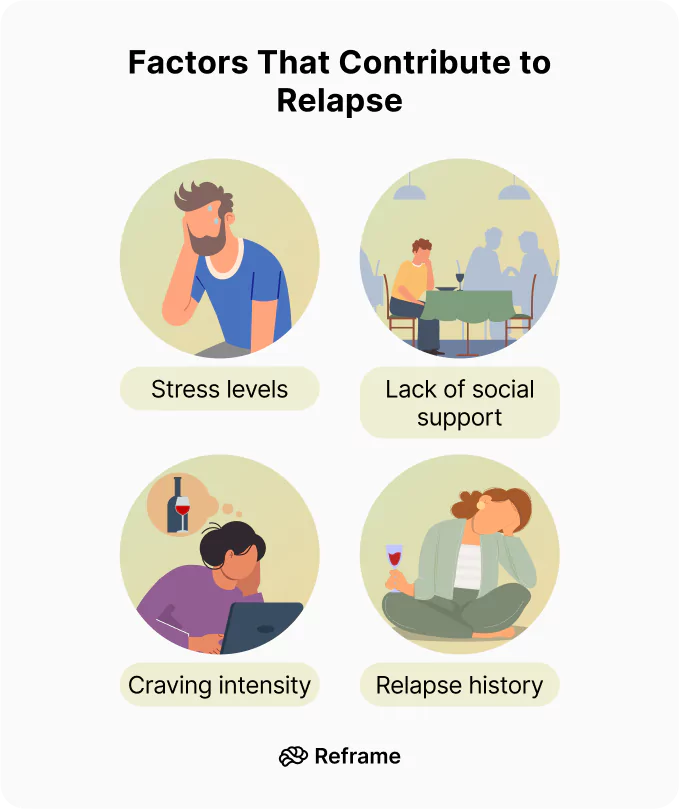
Biologically, stress is the body’s response to danger — the so-called “fight-or-flight” mechanism. The stress response is triggered by the amygdala, which stimulates the release of “stress hormones” such as adrenaline and cortisol. The result? Our body switches into “emergency mode”: our heart rate and breathing rate increases, glucose gets pumped into the blood to provide fuel for our muscles, and functions such as digestion get put on hold.
While the stress response is a (literal) lifesaver when it comes to “fighting” or “fleeing” from actual danger (think raging fire or an angry buffalo), it leads to a host of health problems if it’s triggered unnecessarily, especially on a chronic basis. And yet it’s a modern-day reality for many of us: in 2022, over a third of American adults reported that stress was “completely overwhelming” for them on most days.
High stress is a known trigger for relapse. In fact, studies show that stress is a major factor in relapse because of how it affects the brain. For one thing, chronic stress lowers dopamine levels, making alcohol cravings more powerful. It also interferes with the prefrontal cortex — the decision-making hub of the brain involved in self-regulation and impulse control.
Lower your risk:
Recovery is a journey, and having a strong support team to back us up is key. A network of trusted friends, family members, and others who support our booze-free life is an essential part of any relapse prevention plan.
While alcohol often gets credit for making us “more social,” the reality is it does the opposite. We might feel less inhibited, but solid connections are unlikely to take root with alcohol in the picture. And when we leave behind our drinking days — and our weekend barhopping posse — we might feel more isolated than ever.
Science says that social support is crucial in recovery for many reasons. Our peers hold us accountable, share their experience and coping skills, celebrate our milestones, and cheer us on when things get tough. As a result, social support provides a powerful buffer against relapse.
So if your social support system needs a tune-up, it’s time for some changes!
Lower your risk:
Even if we have a strong support system and keep our stress levels low, alcohol cravings can still creep in and lead to relapse. Remember how we said it takes the brain a while to adjust to being booze-free? The main reason for this is that alcohol disrupts the delicate neurotransmitter balance in the brain by boosting dopamine (the reward neurotransmitter) and GABA (an inhibitory one responsible for the downer effects of booze). It also lowers glutamate, GABA’s excitatory counterpart. And while the brain will rebalance itself in time, the process can take a few weeks or even months. In fact, studies show a strong correlation between dopamine levels and likelihood of relapse. One study found that participants who relapsed at various points after detoxification had less dopamine and less activity in the brain’s reward circuit than those who didn’t relapse.
Lower your risk:
Our alcohol journey is unique, and so is our history. One study compared participants who quit drinking and later relapsed to ones who stayed on track. Out of the “relapsers,” a greater percentage had made more than one attempt to leave booze behind, showing that having a history of relapse might sometimes make us more vulnerable in the future.
That said, having multiple relapses in the past is by no means a sign that another one is inevitably coming. Likewise, it’s not a sign of weakness — if anything, it’s a testament to our strength that we keep trying again in spite of experiencing setbacks. The key is to learn from each one and modify our strategy accordingly. Tracking our triggers is key here: if we know what set the relapse in motion — especially more than once — we can be prepared in the future.
Lower your risk:
Okay, so it happened. You had a drink after a period of not drinking. The first instinct might be to spiral into guilt or shame, but let's pause that thought. A relapse isn't a moral failing or a sign that you can't succeed. It's a common part of the journey for many people, and how you respond in this moment is what truly matters. Instead of seeing it as an endpoint, think of it as a detour. You still have the map, and you know the destination. The next few steps are about getting back on the main road, perhaps with a bit more wisdom than you had before.
The most important first step is to be kind to yourself. It’s easy to feel like you’ve gone “back to square one,” but that’s simply not true. Every single day you spent making a different choice has rewired your brain and taught you something new. A relapse doesn’t mean you've failed; it's just a part of the process. You’ve been moving forward this whole time, and this setback doesn't erase that progress. Acknowledge what happened, take a deep breath, and let go of the harsh self-criticism. It’s just a data point, not a definition of who you are or what you're capable of achieving.
You don't have to carry the weight of a relapse alone. This is the perfect time to lean on the people who have your back. A strong support system is a cornerstone of lasting change, providing accountability, encouragement, and a safe space to be vulnerable. Science confirms that social connection is crucial in recovery, as our peers can share coping skills and celebrate our efforts to get back on track. Reach out to a trusted friend, a family member, or connect with an online community like the one in the Reframe app. Sharing your experience can lift a huge burden and remind you that you have a team cheering you on.
A relapse doesn't have to be the end of your story. In fact, it can make your resolve even stronger. It proves that you have quit before, which means you absolutely have the power to do it again. Take a moment to remember why you started this journey. What were your goals? How did you feel during your alcohol-free days? Reconnect with that motivation. Then, use this experience as a learning opportunity. What were the triggers that led to the slip? By identifying what set the relapse in motion, you can create a better plan for the future and turn this setback into a setup for long-term success.
No matter which relapse-related factors loom large for you, there are some steps that every relapse prevention plan should include:
With these tips — and with the Relapse Risk Calculator — you’re off to a great start when it comes to lowering your chances of getting off track in the recovery journey.
Is this relapse calculator supposed to predict my future? Not at all. Think of the calculator less like a crystal ball and more like a personal awareness tool. It’s designed to help you identify which areas of your life—like stress levels or your support network—might need a little more attention. By highlighting these potential challenges, it gives you a clear, personalized starting point for creating a stronger, more effective plan to support your goals.
I had a drink after deciding to quit. Have I ruined all my progress? Absolutely not. It’s easy to feel like you’re back at square one after a slip, but that simply isn’t true. Every single day you spent making a different choice has taught you something and helped create new patterns in your brain. A slip doesn't erase that hard work. The most important thing is to treat yourself with kindness, acknowledge what happened without judgment, and see it as a learning experience that can make your plan even stronger going forward.
Why do I still get intense cravings even when I’m committed to not drinking? Cravings are a completely normal part of changing your relationship with alcohol. When you drink regularly, your brain's reward system adapts and comes to expect it. When you stop, it takes time for your brain chemistry to rebalance. These cravings are a physical and psychological sign of that adjustment period. The good news is that they are temporary, and as you build new habits and coping skills, their intensity and frequency will fade.
Stress is my biggest trigger. What are some immediate things I can do instead of reaching for a drink? When you feel overwhelmed, having a few go-to techniques can make all the difference. Try practicing diaphragmatic breathing—taking slow, deep breaths from your belly—to calm your nervous system almost instantly. Another effective trick is to splash cold water on your face, which can jolt your system out of that fight-or-flight mode. These simple actions create a brief pause, giving you the space to make a more intentional choice.
What’s the single most effective way to build a solid relapse prevention plan? The most effective plan is one that you build before you need it. It involves getting really honest about your personal triggers and then creating a toolbox of healthy coping strategies you can turn to instead. This includes everything from having a few supportive friends on speed dial to establishing a simple mindfulness practice. It’s not about achieving perfection, but about being prepared so you feel confident and in control during challenging moments.
Relapse isn’t a matter of weak willpower; it’s deeply connected to brain science, habit formation, and psychology. The brain gets used to certain patterns, and things like stress or social cues can trigger old routines automatically. While the science is complex, the tools to manage it don’t have to be. We designed the relapse calculator to translate the science of habit change into a simple, personal assessment. It helps you see how external factors connect to your brain’s patterns, giving you a clear and practical starting point for building a stronger, more informed plan for your journey with alcohol.
In the context of recovery from alcohol misuse, a relapse is a return to drinking after a period of abstinence. While the main trigger for relapse is holding on to the belief that alcohol serves you in some way, there are additional factors — such as stress or lack of support — that amplify the risk.
You said goodbye to alcohol and meant it. But then … you said hello again. As Craig Beck writes in Alcohol Lied to Me Again, “This journey backwards virtually always starts with the same sentence being uttered: ‘Surely just one drink won’t hurt.’”
First things first: you’re not alone. Relapse is a reality for many people on the alcohol journey, and it doesn’t mean you’ve failed. There’s also no such thing as “going back to square one”: once you set off on the path of recovery, you’ve been moving forward, even if that path involves a setback. As Reshma Saujani puts it, “There’s no more powerful lesson than knowing that your setbacks will one day help you succeed.”
That said, relapse is something we want to avoid if we can. And that’s where our handy Relapse Risk Calculator comes in!
If you’re worried about relapse, looking at the data can actually be reassuring. Seeing the numbers helps demystify the experience and shows that it’s a common part of the process for many people. It’s not a sign of personal failure but a known challenge in a complex journey of change. Understanding that others face similar hurdles can connect you to a larger community of people who are also figuring things out one day at a time. This perspective allows you to reframe a setback as a data point—a learning opportunity—rather than a final destination. It’s all about discovering what works for you, identifying your triggers, and adjusting your approach as you move forward.
Here’s some encouraging news: the longer you maintain your new habits, the stronger your foundation becomes. Research shows a clear pattern where the likelihood of relapse decreases significantly over time. For people with less than a year of sobriety, about one in three are able to maintain it. However, once you reach the one-year milestone, more than half of people successfully avoid a relapse. For those who make it to five years, the chance of returning to old drinking patterns drops to less than 15%. This isn't just luck; it's the result of your brain and body adapting, building new and healthier neural pathways that eventually become your default.
It can be incredibly helpful to think about alcohol use disorder as a chronic health condition, not a moral failing. The relapse rate for addiction is around 50%, which is very similar to the rates for other long-term conditions like asthma or high blood pressure. Someone with asthma might forget their inhaler or encounter an unexpected trigger, causing their symptoms to flare up. This doesn’t mean they’ve failed at managing their health; it simply means they need to review their management plan. Viewing relapse in this light helps remove the shame and self-blame that can be so destructive, allowing you to focus on what really matters: getting back to your wellness plan.
While changing your habits is a personal journey, data shows that the specific substance involved can influence relapse rates. Different substances affect the brain and body in unique ways, creating varying levels of physical and psychological dependence. This can impact the intensity of cravings and withdrawal, which are major factors in the recovery process. Understanding the specific challenges associated with each substance isn't about creating a hierarchy of difficulty, but about empowering you to seek the right kind of support for your unique situation.
When it comes to alcohol, the statistics reveal a hopeful trend over time. In the first year of changing drinking habits, more than 30% of people experience a relapse. That number drops to about 21% in the second year, and between years three and five, it falls again to under 10%. After five years, only about 7% of people relapse. These figures highlight that the initial period is often the most challenging, but with persistence, the path becomes more stable. It’s a powerful testament to the brain's ability to heal and adapt, reinforcing that long-term, mindful drinking or sobriety is an achievable goal.
Opiates, like heroin and prescription painkillers, have one of the highest relapse rates at over 60%. This is largely due to the intense physical dependence they create. Withdrawal symptoms can be severe, and the substance produces powerful changes in the brain's reward system, leading to intense cravings that persist long after use has stopped. Managing recovery often requires a comprehensive approach that includes medical support, psychological therapy, and strong community support systems.
Cocaine and crack also have relapse rates that can exceed 60%. While these stimulants may not create the same level of physical withdrawal symptoms as opiates, they produce an incredibly strong psychological dependence. The intense euphoria rewires the brain's reward pathways, leading to powerful cravings triggered by people, places, or emotions. Overcoming this requires developing strong coping mechanisms and strategies to manage these triggers, often with the help of behavioral therapies and a solid support network to help you track your progress.
Recovery from alcohol use disorder (AUD) can be a rocky road full of ups and downs. A relapse means we returned to drinking after a period of being booze-free. Here are the main things to understand about the science behind it:
Want to know more? Check out “Defining Relapse: A Rehearsal for Success,” and “How To Stay Sober After Recovering From Alcoholism” to learn about the signs of relapse and more. But now, let’s get practical — ready to calculate your relapse risk and form a plan?
Teasing out the factors that might set the stage for relapse can be tricky. Enter the Relapse Risk Calculator! By analyzing responses to questions about your history and current habits, it helps you pinpoint factors that might set the stage for a relapse. Think of these factors as relapse red flags marking the areas of your life where slight shifts can set you on the path to success.
Ready to “weatherproof” your recovery? Let’s get started!
While our calculator offers a personal snapshot of your current situation, clinicians and researchers use more structured tools to understand the potential for relapse. These formal methods aren't about predicting the future with a crystal ball; they're about using data to identify patterns and risk factors that can inform a recovery plan. By looking at specific aspects of a person's drinking history and current circumstances, these models provide a standardized way to assess where someone might need extra support. This approach helps professionals create tailored plans that address specific challenges, making the path to long-term change clearer and more manageable for everyone involved.
One of the key tools in a professional's toolkit is the High-Risk Alcoholism Relapse (HRAR) Scale. Think of it as a structured questionnaire designed to estimate the likelihood that someone will return to heavy drinking after a period of sobriety or treatment. It’s not a judgment, but rather a data-driven assessment based on factors that research has consistently linked to relapse. According to medical resource QxMD, this scale helps estimate the chance of someone relapsing after receiving treatment. By quantifying the risk, it allows for a more proactive and personalized approach to aftercare and ongoing support, focusing efforts where they're needed most.
So, what exactly do these clinical models look at? The HRAR Scale, for example, zeroes in on a few critical questions about your history with alcohol. It typically asks about the duration of heavy drinking, the average number of drinks consumed daily, and how many times you’ve been treated for alcoholism in a hospital setting. These specific data points help create a clearer picture of an individual's risk profile. In broader clinical studies, researchers often calculate the annualized relapse rate (ARR) to measure how often relapse occurs over a year within a group. This helps them evaluate the effectiveness of different treatments and support systems, ensuring that recovery strategies are backed by solid evidence.
Congrats! You just took an important step to a lasting recovery by filling out the Relapse Risk Calculator and finding the factors that might lead you down the relapse road. Now, let’s look at each one in a bit more detail.
Biologically, stress is the body’s response to danger — the so-called “fight-or-flight” mechanism. The stress response is triggered by the amygdala, which stimulates the release of “stress hormones” such as adrenaline and cortisol. The result? Our body switches into “emergency mode”: our heart rate and breathing rate increases, glucose gets pumped into the blood to provide fuel for our muscles, and functions such as digestion get put on hold.
While the stress response is a (literal) lifesaver when it comes to “fighting” or “fleeing” from actual danger (think raging fire or an angry buffalo), it leads to a host of health problems if it’s triggered unnecessarily, especially on a chronic basis. And yet it’s a modern-day reality for many of us: in 2022, over a third of American adults reported that stress was “completely overwhelming” for them on most days.
High stress is a known trigger for relapse. In fact, studies show that stress is a major factor in relapse because of how it affects the brain. For one thing, chronic stress lowers dopamine levels, making alcohol cravings more powerful. It also interferes with the prefrontal cortex — the decision-making hub of the brain involved in self-regulation and impulse control.
Lower your risk:
Recovery is a journey, and having a strong support team to back us up is key. A network of trusted friends, family members, and others who support our booze-free life is an essential part of any relapse prevention plan.
While alcohol often gets credit for making us “more social,” the reality is it does the opposite. We might feel less inhibited, but solid connections are unlikely to take root with alcohol in the picture. And when we leave behind our drinking days — and our weekend barhopping posse — we might feel more isolated than ever.
Science says that social support is crucial in recovery for many reasons. Our peers hold us accountable, share their experience and coping skills, celebrate our milestones, and cheer us on when things get tough. As a result, social support provides a powerful buffer against relapse.
So if your social support system needs a tune-up, it’s time for some changes!
Lower your risk:
Even if we have a strong support system and keep our stress levels low, alcohol cravings can still creep in and lead to relapse. Remember how we said it takes the brain a while to adjust to being booze-free? The main reason for this is that alcohol disrupts the delicate neurotransmitter balance in the brain by boosting dopamine (the reward neurotransmitter) and GABA (an inhibitory one responsible for the downer effects of booze). It also lowers glutamate, GABA’s excitatory counterpart. And while the brain will rebalance itself in time, the process can take a few weeks or even months. In fact, studies show a strong correlation between dopamine levels and likelihood of relapse. One study found that participants who relapsed at various points after detoxification had less dopamine and less activity in the brain’s reward circuit than those who didn’t relapse.
Lower your risk:
Our alcohol journey is unique, and so is our history. One study compared participants who quit drinking and later relapsed to ones who stayed on track. Out of the “relapsers,” a greater percentage had made more than one attempt to leave booze behind, showing that having a history of relapse might sometimes make us more vulnerable in the future.
That said, having multiple relapses in the past is by no means a sign that another one is inevitably coming. Likewise, it’s not a sign of weakness — if anything, it’s a testament to our strength that we keep trying again in spite of experiencing setbacks. The key is to learn from each one and modify our strategy accordingly. Tracking our triggers is key here: if we know what set the relapse in motion — especially more than once — we can be prepared in the future.
Lower your risk:
Okay, so it happened. You had a drink after a period of not drinking. The first instinct might be to spiral into guilt or shame, but let's pause that thought. A relapse isn't a moral failing or a sign that you can't succeed. It's a common part of the journey for many people, and how you respond in this moment is what truly matters. Instead of seeing it as an endpoint, think of it as a detour. You still have the map, and you know the destination. The next few steps are about getting back on the main road, perhaps with a bit more wisdom than you had before.
The most important first step is to be kind to yourself. It’s easy to feel like you’ve gone “back to square one,” but that’s simply not true. Every single day you spent making a different choice has rewired your brain and taught you something new. A relapse doesn’t mean you've failed; it's just a part of the process. You’ve been moving forward this whole time, and this setback doesn't erase that progress. Acknowledge what happened, take a deep breath, and let go of the harsh self-criticism. It’s just a data point, not a definition of who you are or what you're capable of achieving.
You don't have to carry the weight of a relapse alone. This is the perfect time to lean on the people who have your back. A strong support system is a cornerstone of lasting change, providing accountability, encouragement, and a safe space to be vulnerable. Science confirms that social connection is crucial in recovery, as our peers can share coping skills and celebrate our efforts to get back on track. Reach out to a trusted friend, a family member, or connect with an online community like the one in the Reframe app. Sharing your experience can lift a huge burden and remind you that you have a team cheering you on.
A relapse doesn't have to be the end of your story. In fact, it can make your resolve even stronger. It proves that you have quit before, which means you absolutely have the power to do it again. Take a moment to remember why you started this journey. What were your goals? How did you feel during your alcohol-free days? Reconnect with that motivation. Then, use this experience as a learning opportunity. What were the triggers that led to the slip? By identifying what set the relapse in motion, you can create a better plan for the future and turn this setback into a setup for long-term success.
No matter which relapse-related factors loom large for you, there are some steps that every relapse prevention plan should include:
With these tips — and with the Relapse Risk Calculator — you’re off to a great start when it comes to lowering your chances of getting off track in the recovery journey.
Is this relapse calculator supposed to predict my future? Not at all. Think of the calculator less like a crystal ball and more like a personal awareness tool. It’s designed to help you identify which areas of your life—like stress levels or your support network—might need a little more attention. By highlighting these potential challenges, it gives you a clear, personalized starting point for creating a stronger, more effective plan to support your goals.
I had a drink after deciding to quit. Have I ruined all my progress? Absolutely not. It’s easy to feel like you’re back at square one after a slip, but that simply isn’t true. Every single day you spent making a different choice has taught you something and helped create new patterns in your brain. A slip doesn't erase that hard work. The most important thing is to treat yourself with kindness, acknowledge what happened without judgment, and see it as a learning experience that can make your plan even stronger going forward.
Why do I still get intense cravings even when I’m committed to not drinking? Cravings are a completely normal part of changing your relationship with alcohol. When you drink regularly, your brain's reward system adapts and comes to expect it. When you stop, it takes time for your brain chemistry to rebalance. These cravings are a physical and psychological sign of that adjustment period. The good news is that they are temporary, and as you build new habits and coping skills, their intensity and frequency will fade.
Stress is my biggest trigger. What are some immediate things I can do instead of reaching for a drink? When you feel overwhelmed, having a few go-to techniques can make all the difference. Try practicing diaphragmatic breathing—taking slow, deep breaths from your belly—to calm your nervous system almost instantly. Another effective trick is to splash cold water on your face, which can jolt your system out of that fight-or-flight mode. These simple actions create a brief pause, giving you the space to make a more intentional choice.
What’s the single most effective way to build a solid relapse prevention plan? The most effective plan is one that you build before you need it. It involves getting really honest about your personal triggers and then creating a toolbox of healthy coping strategies you can turn to instead. This includes everything from having a few supportive friends on speed dial to establishing a simple mindfulness practice. It’s not about achieving perfection, but about being prepared so you feel confident and in control during challenging moments.

We see them on TV, but what is an AA meeting like in real life? What is a closed AA meeting vs. an open one? And how long are AA meetings, generally speaking? Find out in our latest blog!
Although it isn’t a treatment for alcohol use disorder (AUD), the Reframe app can help you cut back on drinking gradually, with the science-backed knowledge to empower you 100% of the way. Our proven program has helped millions of people around the world drink less and live more. And we want to help you get there, too!
The Reframe app equips you with the knowledge and skills you need to not only survive drinking less, but to thrive while you navigate the journey. Our daily research-backed readings teach you the neuroscience of alcohol, and our in-app Toolkit provides the resources and activities you need to navigate each challenge.
You’ll meet hundreds of fellow Reframers in our 24/7 Forum chat and daily Zoom check-in meetings. Receive encouragement from people worldwide who know exactly what you’re going through! You’ll also have the opportunity to connect with our licensed Reframe coaches for more personalized guidance.
Plus, we’re always introducing new features to optimize your in-app experience. We recently launched our in-app chatbot, Melody, powered by the world’s most powerful AI technology. Melody is here to help as you adjust to a life with less (or no) alcohol.
And that’s not all! Every month, we launch fun challenges, like Dry/Damp January, Mental Health May, and Outdoorsy June. You won’t want to miss out on the chance to participate alongside fellow Reframers (or solo if that’s more your thing!).
The Reframe app is free for 7 days, so you don’t have anything to lose by trying it. Are you ready to feel empowered and discover life beyond alcohol? Then download our app through the App Store or Google Play today!
You’re sitting on the bus, clutching a Xerox-copied brochure with a highlighted address. It’s a church basement (go figure — at least that part lives up to the stereotype). You might be uneasy, hoping your boss or neighbor isn’t in the seat behind you, looking over your shoulder. Or you might be excited — after all, it’s been years and this alcohol thing isn’t working anymore. And who knows, maybe AA will work. After all, what is it they told you at the hospital — it works if you work it? Something like that.
You walk in as the crowd is gathering. To your surprise, most of them look … normal. There’s a woman in her 30s with a blond bob haircut — you can just picture her at a PTA meeting. There’s a man in a spiffy business suit, glancing over spreadsheets on his laptop before the meeting starts. And yes, there’s probably a knitter or two. (Some of us just need to keep our hands busy. Plus, if we get a few scarves out of it, that’s a few Christmas presents out of the way.)
We’ve all seen AA meetings on TV, but most people don’t know quite what to expect when they walk into one in real life. The truth is, it depends on the location, the crowd, and a host of other factors that will be different depending on the particular church basement, YMCA meeting room, or college classroom you end up in. However, there are some common features among them. Let’s dig deeper and find out what happens at an AA meeting, what might happen, and what almost definitely won’t.

First things first: what’s an AA meeting all about? It comes down to one common purpose: a group of like-minded (but otherwise often very diverse) people who have alcoholism (or had it in the past) joining forces for mutual support.
In fact, this can make AA folks chatting outside during a break easy to recognize, once you have a trained eye. They’re friendly, they’re often smoking (which stands out these days), and they’re probably an odd mix. If you didn’t know any better, you might wonder how this unlikely bunch got together: what can the art college hippie, elegant white-haired grandmother, and 6’ 5’’ bodybuilder covered in tattoos be talking about with such enthusiasm?
To use an AA phrase, they’re together to “share their experience, strength, and hope.” Now, granted that during the sidewalk powwow they might be deciding which pizza joint or coffee shop to go to. However, inside “the rooms,” (another AA term referring to the meetings) the conversation is going to be about alcohol dependence: how they got stuck, how they got out (if they did), and what’s still a challenge today.
For more information, check out “How Does Alcoholics Anonymous Work?” For now, let’s take a closer look at what happens at an AA meeting.
You find the address, walk through the door, and pick a seat (maybe one that’s strategically close to the entrance, if you’re still feeling a bit sheepish about the whole thing). And yes, most meetings have chairs arranged in a circle.
There are groups of people catching up, and chances are whoever’s sitting next to you will introduce themselves and, perhaps, give you their phone number. Don’t worry, it’s not a come-on — calling other members when triggers pop up is a classic AA method to deal with urges and can work wonders for many. But don’t feel pressured to reciprocate!
There’s probably coffee, a box of cookies, and a few piles of multicolored brochures spread out on the table. You settle in, take a few sips, and wonder: now what?
Yes, most meetings start with people going around and saying their name followed by “and I’m an alcoholic” (though you don’t have to say it if you don’t want to — more on this later).
After introductions are over, someone will read the “preamble” that states the purpose and basic approach of AA. It takes a few minutes to go through it, but the most important part is right up front: “The only requirement for membership is a desire to stop drinking.”
As the AA preamble reads, “The newcomer is the most important person in any meeting.” And those folks really mean it. Showing up the morning after losing our job, getting evicted from our apartment after the super found us passed out in the laundry room for the hundredth time, or having a fight with our partner who found bottles in the hamper is no easy feat. Everyone at the meeting will understand that, nobody will judge us, and most have done the same things (or worse).
The 12 Steps will probably be displayed somewhere in the room. Here’s the gist:
It’s important to note that the phrasing of the Steps has been a sticking point for some over the years. In truth, they’re actually very much in line with science-backed approaches to habit change, such as cognitive behavioral therapy (when it comes to unmasking thought distortions in Steps 4-7), dialectical behavior therapy (regarding interpersonal effectiveness involved in making amends) and mindfulness (as far as the self-reflection at the heart of Step 11).
That said, terms like “higher power,” “character defects,” and “prayer” can be triggers for some, and many meetings have gone out of their way to modernize the language. Let’s face it, the Big Book (Alcoholics Anonymous) written by AA founder Bill W. back in 1939 used terms that didn’t age all that well. There’s plenty of judgment and a hefty dose of sexism among the pages, and many groups prefer to focus on the ideas behind the message rather than the way it’s phrased by Bill — an admittedly sketchy character, especially when it came to how he treated women.
At heart, all meetings are about sharing stories, reaching out for help, and offering support to others. There’s nothing like seeing a successful chemistry professor who once had to drop out of grad school and move in with his parents years earlier, a City Council representative who spent a night in jail after getting multiple DUIs, or a pilot who once lost his license after being caught drinking mid-flight (phew — thank goodness that one ended well). These people all made it, and all of them have been where we are.
The form that this sharing takes can vary (more on this later), but the main point is this: it’s possible to recover from alcohol use disorder (AUD) and be happy to boot. (And, by the way, that’s true no matter what you think of AA.)
Finally, most meetings have a “chip” ceremony at the end to celebrate those who stayed sober for a certain number of months. The “most important chip of all”? One day. Making a decision to change is key, and making it through those first 24 hours is often harder than surviving 12 months without a drink.
What happens next depends on the meeting format. Here’s an overview.
Open meetings are for anyone and everyone — people who identify as alcoholics, people who are there to support others, fulfill a course requirement, or simply satisfy their curiosity (“Is it really like the movies?”). If it’s your first time and you’re feeling nervous, open meetings are great: you can bring your partner, your neighbor, or your mom if you want to (even if they’ve never touched a drop of booze in their life).
Closed meetings, on the other hand, are for those with an alcohol misuse problem. Whether their last drink was 10 years or 10 minutes ago, they’re here because they want booze out of their lives for good.
The format of the meetings is different as well. Here’s an overview.
No matter what format a meeting is listed under, there will be individual differences. Some speaker meetings might seem a bit more formal, while discussion meetings tend to feel more cozy, but that’s not always the case. Feel free to check them out for yourself and see what fits best!
Most last either an hour or an hour and a half. The longer ones will often have a break in the middle.
There are also lots of myths about AA out there, and it’s important to dispel them. Things have also been changing over the years, and what used to be true in the past has (mostly) gone the way of the dinosaurs.
That said, AA is definitely not for everyone. Many find that its all-or-nothing approach, emphasis on a higher power, and over-reliance on meetings doesn’t work well for them. That’s perfectly okay! There are plenty of alternatives (such as Reframe) that offer a more modernized, science-backed approach to dealing with cravings and revamping your views of alcohol. Plus, you get all the social support from our thriving community of like-minded people!
Tried a few meetings but found it doesn’t jibe with you? No problem! AA is not for everyone. Luckily, there are many alternatives.
And don’t forget about Reframe! A treasure trove of science-backed information, tools to bust cravings, a motivational coach, and a supportive community of like-minded people all in one, it makes the alcohol journey easy, fun, and exciting!

The best part? Reframe helps you change how you see alcohol in a way that makes change natural. And that’s certainly something to consider when choosing your path. Many other approaches (including AA) focus on avoiding alcohol, which is always “lurking in the background.” Even those who left it behind and no longer crave it might live in fear of a relapse and form a new (albeit healthier) dependency on AA.
However, what if there were a way to make it “small and irrelevant,” as Annie Grace puts it in This Naked Mind? By changing how you feel about alcohol and focus on building a life beyond it, there’s a deeper level of recovery to discover. We’re here to help you do just that!
You’re sitting on the bus, clutching a Xerox-copied brochure with a highlighted address. It’s a church basement (go figure — at least that part lives up to the stereotype). You might be uneasy, hoping your boss or neighbor isn’t in the seat behind you, looking over your shoulder. Or you might be excited — after all, it’s been years and this alcohol thing isn’t working anymore. And who knows, maybe AA will work. After all, what is it they told you at the hospital — it works if you work it? Something like that.
You walk in as the crowd is gathering. To your surprise, most of them look … normal. There’s a woman in her 30s with a blond bob haircut — you can just picture her at a PTA meeting. There’s a man in a spiffy business suit, glancing over spreadsheets on his laptop before the meeting starts. And yes, there’s probably a knitter or two. (Some of us just need to keep our hands busy. Plus, if we get a few scarves out of it, that’s a few Christmas presents out of the way.)
We’ve all seen AA meetings on TV, but most people don’t know quite what to expect when they walk into one in real life. The truth is, it depends on the location, the crowd, and a host of other factors that will be different depending on the particular church basement, YMCA meeting room, or college classroom you end up in. However, there are some common features among them. Let’s dig deeper and find out what happens at an AA meeting, what might happen, and what almost definitely won’t.
First things first: what’s an AA meeting all about? It comes down to one common purpose: a group of like-minded (but otherwise often very diverse) people who have alcoholism (or had it in the past) joining forces for mutual support.
In fact, this can make AA folks chatting outside during a break easy to recognize, once you have a trained eye. They’re friendly, they’re often smoking (which stands out these days), and they’re probably an odd mix. If you didn’t know any better, you might wonder how this unlikely bunch got together: what can the art college hippie, elegant white-haired grandmother, and 6’ 5’’ bodybuilder covered in tattoos be talking about with such enthusiasm?
To use an AA phrase, they’re together to “share their experience, strength, and hope.” Now, granted that during the sidewalk powwow they might be deciding which pizza joint or coffee shop to go to. However, inside “the rooms,” (another AA term referring to the meetings) the conversation is going to be about alcohol dependence: how they got stuck, how they got out (if they did), and what’s still a challenge today.
For more information, check out “How Does Alcoholics Anonymous Work?” For now, let’s take a closer look at what happens at an AA meeting.
You find the address, walk through the door, and pick a seat (maybe one that’s strategically close to the entrance, if you’re still feeling a bit sheepish about the whole thing). And yes, most meetings have chairs arranged in a circle.
There are groups of people catching up, and chances are whoever’s sitting next to you will introduce themselves and, perhaps, give you their phone number. Don’t worry, it’s not a come-on — calling other members when triggers pop up is a classic AA method to deal with urges and can work wonders for many. But don’t feel pressured to reciprocate!
There’s probably coffee, a box of cookies, and a few piles of multicolored brochures spread out on the table. You settle in, take a few sips, and wonder: now what?
Yes, most meetings start with people going around and saying their name followed by “and I’m an alcoholic” (though you don’t have to say it if you don’t want to — more on this later).
After introductions are over, someone will read the “preamble” that states the purpose and basic approach of AA. It takes a few minutes to go through it, but the most important part is right up front: “The only requirement for membership is a desire to stop drinking.”
As the AA preamble reads, “The newcomer is the most important person in any meeting.” And those folks really mean it. Showing up the morning after losing our job, getting evicted from our apartment after the super found us passed out in the laundry room for the hundredth time, or having a fight with our partner who found bottles in the hamper is no easy feat. Everyone at the meeting will understand that, nobody will judge us, and most have done the same things (or worse).
The 12 Steps will probably be displayed somewhere in the room. Here’s the gist:
It’s important to note that the phrasing of the Steps has been a sticking point for some over the years. In truth, they’re actually very much in line with science-backed approaches to habit change, such as cognitive behavioral therapy (when it comes to unmasking thought distortions in Steps 4-7), dialectical behavior therapy (regarding interpersonal effectiveness involved in making amends) and mindfulness (as far as the self-reflection at the heart of Step 11).
That said, terms like “higher power,” “character defects,” and “prayer” can be triggers for some, and many meetings have gone out of their way to modernize the language. Let’s face it, the Big Book (Alcoholics Anonymous) written by AA founder Bill W. back in 1939 used terms that didn’t age all that well. There’s plenty of judgment and a hefty dose of sexism among the pages, and many groups prefer to focus on the ideas behind the message rather than the way it’s phrased by Bill — an admittedly sketchy character, especially when it came to how he treated women.
At heart, all meetings are about sharing stories, reaching out for help, and offering support to others. There’s nothing like seeing a successful chemistry professor who once had to drop out of grad school and move in with his parents years earlier, a City Council representative who spent a night in jail after getting multiple DUIs, or a pilot who once lost his license after being caught drinking mid-flight (phew — thank goodness that one ended well). These people all made it, and all of them have been where we are.
The form that this sharing takes can vary (more on this later), but the main point is this: it’s possible to recover from alcohol use disorder (AUD) and be happy to boot. (And, by the way, that’s true no matter what you think of AA.)
Finally, most meetings have a “chip” ceremony at the end to celebrate those who stayed sober for a certain number of months. The “most important chip of all”? One day. Making a decision to change is key, and making it through those first 24 hours is often harder than surviving 12 months without a drink.
What happens next depends on the meeting format. Here’s an overview.
Open meetings are for anyone and everyone — people who identify as alcoholics, people who are there to support others, fulfill a course requirement, or simply satisfy their curiosity (“Is it really like the movies?”). If it’s your first time and you’re feeling nervous, open meetings are great: you can bring your partner, your neighbor, or your mom if you want to (even if they’ve never touched a drop of booze in their life).
Closed meetings, on the other hand, are for those with an alcohol misuse problem. Whether their last drink was 10 years or 10 minutes ago, they’re here because they want booze out of their lives for good.
The format of the meetings is different as well. Here’s an overview.
No matter what format a meeting is listed under, there will be individual differences. Some speaker meetings might seem a bit more formal, while discussion meetings tend to feel more cozy, but that’s not always the case. Feel free to check them out for yourself and see what fits best!
Most last either an hour or an hour and a half. The longer ones will often have a break in the middle.
There are also lots of myths about AA out there, and it’s important to dispel them. Things have also been changing over the years, and what used to be true in the past has (mostly) gone the way of the dinosaurs.
That said, AA is definitely not for everyone. Many find that its all-or-nothing approach, emphasis on a higher power, and over-reliance on meetings doesn’t work well for them. That’s perfectly okay! There are plenty of alternatives (such as Reframe) that offer a more modernized, science-backed approach to dealing with cravings and revamping your views of alcohol. Plus, you get all the social support from our thriving community of like-minded people!
Tried a few meetings but found it doesn’t jibe with you? No problem! AA is not for everyone. Luckily, there are many alternatives.
And don’t forget about Reframe! A treasure trove of science-backed information, tools to bust cravings, a motivational coach, and a supportive community of like-minded people all in one, it makes the alcohol journey easy, fun, and exciting!
The best part? Reframe helps you change how you see alcohol in a way that makes change natural. And that’s certainly something to consider when choosing your path. Many other approaches (including AA) focus on avoiding alcohol, which is always “lurking in the background.” Even those who left it behind and no longer crave it might live in fear of a relapse and form a new (albeit healthier) dependency on AA.
However, what if there were a way to make it “small and irrelevant,” as Annie Grace puts it in This Naked Mind? By changing how you feel about alcohol and focus on building a life beyond it, there’s a deeper level of recovery to discover. We’re here to help you do just that!

While AA has helped many people, it’s not for everyone. Why is AA harmful to some? And what’s the AA success rate? Find out in our latest blog!
Although it isn’t a treatment for alcohol use disorder (AUD), the Reframe app can help you cut back on drinking gradually, with the science-backed knowledge to empower you 100% of the way. Our proven program has helped millions of people around the world drink less and live more. And we want to help you get there, too!
The Reframe app equips you with the knowledge and skills you need to not only survive drinking less, but to thrive while you navigate the journey. Our daily research-backed readings teach you the neuroscience of alcohol, and our in-app Toolkit provides the resources and activities you need to navigate each challenge.
You’ll meet hundreds of fellow Reframers in our 24/7 Forum chat and daily Zoom check-in meetings. Receive encouragement from people worldwide who know exactly what you’re going through! You’ll also have the opportunity to connect with our licensed Reframe coaches for more personalized guidance.
Plus, we’re always introducing new features to optimize your in-app experience. We recently launched our in-app chatbot, Melody, powered by the world’s most powerful AI technology. Melody is here to help as you adjust to a life with less (or no) alcohol.
And that’s not all! Every month, we launch fun challenges, like Dry/Damp January, Mental Health May, and Outdoorsy June. You won’t want to miss out on the chance to participate alongside fellow Reframers (or solo if that’s more your thing!).
The Reframe app is free for 7 days, so you don’t have anything to lose by trying it. Are you ready to feel empowered and discover life beyond alcohol? Then download our app through the App Store or Google Play today!
Ever walk by a church and notice an odd medley of folks chatting on the sidewalk? A college football player, a gangly art student covered in tattoos, and an elderly woman with a gray bob in a neatly pressed business pantsuit. What could they possibly have in common?
Chances are, they might be members of Alcoholics Anonymous catching up after a meeting. Some people swear by AA, other people hate it. But how effective is AA? Is AA just for alcoholics? And, most importantly, what are the reasons why AA is harmful, according to some? Let’s find out!

For better or for worse, AA has been synonymous with alcohol misuse recovery for generations. It all goes back to Bill W., a Wall Street hotshot who got caught up in the alcohol trap (which cost him his would-be law career back in the day). Bill tried everything under the sun to stop drinking — including LSD and belladonna with castor oil — with no success. (Apparently the latter gave him a serious case of “purge and puke,” but once he was able to keep things down, he went right back to booze.)
His situation looked hopeless to everyone around him, including his doctors, until he suddenly … stopped. The rest — including his partnership with “Dr. Bob” who co-founded Alcoholics Anonymous and ironed out the 12 Steps and 12 Traditions with him — is AA history.
Not necessarily, especially these days. While alcohol is the main focus of AA meetings, many of the ideas and methods behind it are “transferable” to other conditions such as (some) eating disorders, gambling, or other forms of substance misuse. Throughout the last few decades, 12-step “offshoot” groups such as NA (Narcotics Anonymous), OA (Overeaters Anonymous), and GA (Gamblers Anonymous) have become increasingly common. However, many (with the exception of NA) are still a bit harder to find and might not be available in all locations. As for friends and family of those in recovery, there’s a place for them too! They can attend open meetings with their loved ones or find support tailored to their needs in Al-Anon or Alateen.
In 2021, the number of AA members was reported to be 1,967,613, with as many as 120,455 separate groups around the world. And while many swear by it, others have a very different experience, going as far as to say that AA doesn’t work or that it has actually derailed their recovery. Clearly, there are different experiences out there. Why? Let’s explore!
Why do people choose to take an hour of their day (sometimes daily for years on end) to sit in a circle, talk about booze and read passages they will have certainly committed to memory? For some people, it’s clearly working (more on that later). However, many find that there are some serious problems with its structure, approach to recovery, and overall philosophy.
It’s important to acknowledge that measuring the effectiveness of AA — or any recovery program, for that matter — can be tricky. Does “success” mean abstinence? Or is it about building a meaningful life where alcohol is a nonissue? What if we develop a new addiction and swap booze for Xanax, binge-eating disorder, or even shopping? (Transfer addictions are, unfortunately, very common.) And how does AA play into the picture?
The notoriously difficult question about the AA success rate can be addressed in several ways. Here are a few:
And while there are still too many variables to comfortably give an exact number when it comes to the AA success rate, it clearly is the “recipe for success” for some.
That said, the same recipe is definitely not for everyone. While there are many reasons why someone’s experience in AA might have them running for the door (or at least hesitant about entering through it again), there are a few common trends.
Unlike science-based approaches (such as Reframe), AA is a spiritual program based on a “higher power.” In fact, the first three steps call on us to admit our “powerlessness” around alcohol while coming to an understanding that only a higher power can help us, if we surrender to it. This higher power, in turn, is usually referred to as “God,” bringing a distinctly religious flavor to the program (even though it doesn’t align itself with a particular religion).
The idea of a higher power — let alone one that we’re supposed to surrender to — doesn’t jibe well with many. And while AA famously says that your higher power doesn’t have to be “God” and can be anything (“the group itself, your cat, or even a doorknob!”) that’s not quite true in practice. It sounds “user-friendly,” but really, are you going to say a prayer to your door (or even Mr. Whiskers)?
While most meetings are welcoming, supportive, and nonjudgmental (unless you disagree with or badmouth AA itself — more on that later), it’s not true across the board. Some can be a bit cliquish, some might feel too religious, and some may simply have a crowd that’s hard for us to relate to. That’s okay! Remember, there are thousands of them out there in the world.
They’re rarer these days, but they do show up. Notorious “13th steppers” — older members who make sexual advances towards young (usually female) newcomers — unfortunately exist. Bill W. was known to have done this, and there are certainly others out there who do the same.
In some AA communities in particular, there’s next to no wiggle room when it comes to the approach to recovery. And recovery means one thing: staying away from booze completely. Unlike more flexible, individualized approaches (such as one provided by Reframe) doesn’t have any room for those exploring their relationship with alcohol by trying to cut back. Instead of providing members with science-backed information about what alcohol does to the body and mind to let them make their own decisions about what’s right for them, it tells them what to do. And for many, this simply doesn’t work.
Those looks of concern we get when we show up after missing a few weeks or meetings (because, you know, life happens) are meant well. Still, there’s a clear message behind them: “You’ve either relapsed or you’re on your way down.”
Unfortunately, this discouraging take on absenteeism can be harmful. When enough people tell us that we’re sure to relapse if we don’t attend meetings, skip the steps, or (gasp!) leave AA altogether after finding a different path to sobriety, subconscious doubt about the strength of our recovery starts to crop up. And that doubt might very well turn into an actual relapse, becoming a self-fulfilling prophecy.
There’s a slight flavor of self-flagellation to the steps, especially when it comes to the fourth — those notorious “character defects.” (“Of course I’m dishonest, untrustworthy, et cetera — I’m an alcoholic.”) That negativity also gets imposed on others (“Lost your job? Had an argument with your next-door neighbor who insists on playing heavy metal at night? Must be your character defect.”)
Here’s how 44-year-old Montana resident Gerald Zeigler put it: “Everybody has character flaws, but I don’t think that’s the reason for alcoholism … it was a real turn-off for me.” And many others agree.
This is also where things can start to feel a little bit “culty.” No, we’re not saying AA is a cult. However, the tendency to find the character defect responsible for any of life’s many problems is dangerously reminiscent of Scientology’s “auditing” (a practice that’s meant to uncover what you did to cause anything bad that happened to you). Although of course, AA doesn’t take it nearly as far.
Sponsorship is a big part of AA, and in the best scenarios, it’s a mutually enriching, helpful relationship. Checking in when things are going well, calling when we feel the pull of the bar or liquor store down the street, and hearing how someone else made it out of a seemingly hopeless situation can be a recovery goldmine.
However, that’s not always the case. Sometimes a codependent relationship develops, and we find ourselves unable to make decisions about whether to attend a friend’s wedding, accept a job offer, or go buy a new pair of sneakers without our sponsor’s permission. And that’s really taking it too far. While most mean well, sometimes sponsors might get power-hungry or even emotionally abusive.
While it’s great to know that there’s a supportive group of people waiting for us in at least a couple of church basements in our city on any given day, feeling like we need to attend meetings can be a double-edged sword. There are many who convince themselves that they will relapse if they skip a meeting, fostering a new type of dependency. Sure, it’s not as bad as being dependent on booze. But it’s not great, and it can also work as another self-fulfilling prophecy.
The last two reasons AA doesn’t work for many in the long run (although it could be a life-saver at the beginning) have to do with our overall take on what it means to be “sober.” While conversations inside the AA “rooms” might vary, they inevitably center on one subject: booze. And, while in the first few days, weeks, or even months after quitting alcohol cravings and booze-related thoughts might still be on our mind the majority of the time, there comes a point at which it might be healthier to focus on other things.
In This Naked Mind, Annie Grace suggests that the main weakness of AA and similar programs is that we end up spending our lives waiting to see if we succeeded in not doing something (drinking): “How will you know when you have succeeded? If you live waiting to see if you ever drink again, you won’t know you are successful until you are dead. Living a life in recovery, yet never recovered, implies you have no greater expectation than for life to be OK.” And that’s ultimately kind of depressing.
Instead, she proposes an alternative: “When you completely change your mental (conscious and unconscious) perspective on alcohol, you begin to see the truth about drinking. When this happens, no willpower is required, and it becomes a joy not to drink.” In other words, once we see through our cognitive distortions and realize we don’t need alcohol to relax or enjoy life, letting it go is no longer a struggle. The sobriety journey becomes fun!
That said, AA does have some notable strengths that deserve to be mentioned. Here’s an overview:
All in all, the steps — as well as the practice of going to meetings, reaching out, and helping others do the same — provides a structure for responsible and productive daily living that can be invaluable, especially in early recovery.
Still, while these reasons make AA a good choice for some, there are many others who find that the cons outweigh the pros or are simply looking for something different. Now, let’s take a brief look at alternative approaches that foster this positive point of view.

Are there alternatives to AA out there? You bet! Here’s an overview:
All in all, while AA can be helpful in many ways, there’s a higher level of recovery we can reach. A successful approach is about changing how you actually feel about alcohol, making it irrelevant and small rather than something you have to work to avoid. It’s also about making room in your life for things other than booze (and, for that matter, meetings). It’s about thriving rather than surviving. And that’s what Reframe is all about!
In the end, forming habits that stick is all about building, constructing, and creating a life that excites you and makes you look forward to the next day. It’s about creating rather than avoiding, and is based on joy rather than fear.
As Annie Grace puts it, “Don’t dwell on past experiences. Your past is in the past … Forgive yourself. You are the hero of this story. There is no reason to dwell on the negativity of the past and every reason to forgive yourself. Look forward to an incredible future.” We believe in you!
Ever walk by a church and notice an odd medley of folks chatting on the sidewalk? A college football player, a gangly art student covered in tattoos, and an elderly woman with a gray bob in a neatly pressed business pantsuit. What could they possibly have in common?
Chances are, they might be members of Alcoholics Anonymous catching up after a meeting. Some people swear by AA, other people hate it. But how effective is AA? Is AA just for alcoholics? And, most importantly, what are the reasons why AA is harmful, according to some? Let’s find out!
For better or for worse, AA has been synonymous with alcohol misuse recovery for generations. It all goes back to Bill W., a Wall Street hotshot who got caught up in the alcohol trap (which cost him his would-be law career back in the day). Bill tried everything under the sun to stop drinking — including LSD and belladonna with castor oil — with no success. (Apparently the latter gave him a serious case of “purge and puke,” but once he was able to keep things down, he went right back to booze.)
His situation looked hopeless to everyone around him, including his doctors, until he suddenly … stopped. The rest — including his partnership with “Dr. Bob” who co-founded Alcoholics Anonymous and ironed out the 12 Steps and 12 Traditions with him — is AA history.
Not necessarily, especially these days. While alcohol is the main focus of AA meetings, many of the ideas and methods behind it are “transferable” to other conditions such as (some) eating disorders, gambling, or other forms of substance misuse. Throughout the last few decades, 12-step “offshoot” groups such as NA (Narcotics Anonymous), OA (Overeaters Anonymous), and GA (Gamblers Anonymous) have become increasingly common. However, many (with the exception of NA) are still a bit harder to find and might not be available in all locations. As for friends and family of those in recovery, there’s a place for them too! They can attend open meetings with their loved ones or find support tailored to their needs in Al-Anon or Alateen.
In 2021, the number of AA members was reported to be 1,967,613, with as many as 120,455 separate groups around the world. And while many swear by it, others have a very different experience, going as far as to say that AA doesn’t work or that it has actually derailed their recovery. Clearly, there are different experiences out there. Why? Let’s explore!
Why do people choose to take an hour of their day (sometimes daily for years on end) to sit in a circle, talk about booze and read passages they will have certainly committed to memory? For some people, it’s clearly working (more on that later). However, many find that there are some serious problems with its structure, approach to recovery, and overall philosophy.
It’s important to acknowledge that measuring the effectiveness of AA — or any recovery program, for that matter — can be tricky. Does “success” mean abstinence? Or is it about building a meaningful life where alcohol is a nonissue? What if we develop a new addiction and swap booze for Xanax, binge-eating disorder, or even shopping? (Transfer addictions are, unfortunately, very common.) And how does AA play into the picture?
The notoriously difficult question about the AA success rate can be addressed in several ways. Here are a few:
And while there are still too many variables to comfortably give an exact number when it comes to the AA success rate, it clearly is the “recipe for success” for some.
That said, the same recipe is definitely not for everyone. While there are many reasons why someone’s experience in AA might have them running for the door (or at least hesitant about entering through it again), there are a few common trends.
Unlike science-based approaches (such as Reframe), AA is a spiritual program based on a “higher power.” In fact, the first three steps call on us to admit our “powerlessness” around alcohol while coming to an understanding that only a higher power can help us, if we surrender to it. This higher power, in turn, is usually referred to as “God,” bringing a distinctly religious flavor to the program (even though it doesn’t align itself with a particular religion).
The idea of a higher power — let alone one that we’re supposed to surrender to — doesn’t jibe well with many. And while AA famously says that your higher power doesn’t have to be “God” and can be anything (“the group itself, your cat, or even a doorknob!”) that’s not quite true in practice. It sounds “user-friendly,” but really, are you going to say a prayer to your door (or even Mr. Whiskers)?
While most meetings are welcoming, supportive, and nonjudgmental (unless you disagree with or badmouth AA itself — more on that later), it’s not true across the board. Some can be a bit cliquish, some might feel too religious, and some may simply have a crowd that’s hard for us to relate to. That’s okay! Remember, there are thousands of them out there in the world.
They’re rarer these days, but they do show up. Notorious “13th steppers” — older members who make sexual advances towards young (usually female) newcomers — unfortunately exist. Bill W. was known to have done this, and there are certainly others out there who do the same.
In some AA communities in particular, there’s next to no wiggle room when it comes to the approach to recovery. And recovery means one thing: staying away from booze completely. Unlike more flexible, individualized approaches (such as one provided by Reframe) doesn’t have any room for those exploring their relationship with alcohol by trying to cut back. Instead of providing members with science-backed information about what alcohol does to the body and mind to let them make their own decisions about what’s right for them, it tells them what to do. And for many, this simply doesn’t work.
Those looks of concern we get when we show up after missing a few weeks or meetings (because, you know, life happens) are meant well. Still, there’s a clear message behind them: “You’ve either relapsed or you’re on your way down.”
Unfortunately, this discouraging take on absenteeism can be harmful. When enough people tell us that we’re sure to relapse if we don’t attend meetings, skip the steps, or (gasp!) leave AA altogether after finding a different path to sobriety, subconscious doubt about the strength of our recovery starts to crop up. And that doubt might very well turn into an actual relapse, becoming a self-fulfilling prophecy.
There’s a slight flavor of self-flagellation to the steps, especially when it comes to the fourth — those notorious “character defects.” (“Of course I’m dishonest, untrustworthy, et cetera — I’m an alcoholic.”) That negativity also gets imposed on others (“Lost your job? Had an argument with your next-door neighbor who insists on playing heavy metal at night? Must be your character defect.”)
Here’s how 44-year-old Montana resident Gerald Zeigler put it: “Everybody has character flaws, but I don’t think that’s the reason for alcoholism … it was a real turn-off for me.” And many others agree.
This is also where things can start to feel a little bit “culty.” No, we’re not saying AA is a cult. However, the tendency to find the character defect responsible for any of life’s many problems is dangerously reminiscent of Scientology’s “auditing” (a practice that’s meant to uncover what you did to cause anything bad that happened to you). Although of course, AA doesn’t take it nearly as far.
Sponsorship is a big part of AA, and in the best scenarios, it’s a mutually enriching, helpful relationship. Checking in when things are going well, calling when we feel the pull of the bar or liquor store down the street, and hearing how someone else made it out of a seemingly hopeless situation can be a recovery goldmine.
However, that’s not always the case. Sometimes a codependent relationship develops, and we find ourselves unable to make decisions about whether to attend a friend’s wedding, accept a job offer, or go buy a new pair of sneakers without our sponsor’s permission. And that’s really taking it too far. While most mean well, sometimes sponsors might get power-hungry or even emotionally abusive.
While it’s great to know that there’s a supportive group of people waiting for us in at least a couple of church basements in our city on any given day, feeling like we need to attend meetings can be a double-edged sword. There are many who convince themselves that they will relapse if they skip a meeting, fostering a new type of dependency. Sure, it’s not as bad as being dependent on booze. But it’s not great, and it can also work as another self-fulfilling prophecy.
The last two reasons AA doesn’t work for many in the long run (although it could be a life-saver at the beginning) have to do with our overall take on what it means to be “sober.” While conversations inside the AA “rooms” might vary, they inevitably center on one subject: booze. And, while in the first few days, weeks, or even months after quitting alcohol cravings and booze-related thoughts might still be on our mind the majority of the time, there comes a point at which it might be healthier to focus on other things.
In This Naked Mind, Annie Grace suggests that the main weakness of AA and similar programs is that we end up spending our lives waiting to see if we succeeded in not doing something (drinking): “How will you know when you have succeeded? If you live waiting to see if you ever drink again, you won’t know you are successful until you are dead. Living a life in recovery, yet never recovered, implies you have no greater expectation than for life to be OK.” And that’s ultimately kind of depressing.
Instead, she proposes an alternative: “When you completely change your mental (conscious and unconscious) perspective on alcohol, you begin to see the truth about drinking. When this happens, no willpower is required, and it becomes a joy not to drink.” In other words, once we see through our cognitive distortions and realize we don’t need alcohol to relax or enjoy life, letting it go is no longer a struggle. The sobriety journey becomes fun!
That said, AA does have some notable strengths that deserve to be mentioned. Here’s an overview:
All in all, the steps — as well as the practice of going to meetings, reaching out, and helping others do the same — provides a structure for responsible and productive daily living that can be invaluable, especially in early recovery.
Still, while these reasons make AA a good choice for some, there are many others who find that the cons outweigh the pros or are simply looking for something different. Now, let’s take a brief look at alternative approaches that foster this positive point of view.
Are there alternatives to AA out there? You bet! Here’s an overview:
All in all, while AA can be helpful in many ways, there’s a higher level of recovery we can reach. A successful approach is about changing how you actually feel about alcohol, making it irrelevant and small rather than something you have to work to avoid. It’s also about making room in your life for things other than booze (and, for that matter, meetings). It’s about thriving rather than surviving. And that’s what Reframe is all about!
In the end, forming habits that stick is all about building, constructing, and creating a life that excites you and makes you look forward to the next day. It’s about creating rather than avoiding, and is based on joy rather than fear.
As Annie Grace puts it, “Don’t dwell on past experiences. Your past is in the past … Forgive yourself. You are the hero of this story. There is no reason to dwell on the negativity of the past and every reason to forgive yourself. Look forward to an incredible future.” We believe in you!

Discover effective ways to find AA meetings near you, from online directories and apps to local AA offices and recommendations from healthcare providers and support groups.
Although it isn’t a treatment for alcohol use disorder (AUD), the Reframe app can help you cut back on drinking gradually, with the science-backed knowledge to empower you 100% of the way. Our proven program has helped millions of people around the world drink less and live more. And we want to help you get there, too!
The Reframe app equips you with the knowledge and skills you need to not only survive drinking less, but to thrive while you navigate the journey. Our daily research-backed readings teach you the neuroscience of alcohol, and our in-app Toolkit provides the resources and activities you need to navigate each challenge.
You’ll meet hundreds of fellow Reframers in our 24/7 Forum chat and daily Zoom check-in meetings. Receive encouragement from people worldwide who know exactly what you’re going through! You’ll also have the opportunity to connect with our licensed Reframe coaches for more personalized guidance.
Plus, we’re always introducing new features to optimize your in-app experience. We recently launched our in-app chatbot, Melody, powered by the world’s most powerful AI technology. Melody is here to help as you adjust to a life with less (or no) alcohol.
And that’s not all! Every month, we launch fun challenges, like Dry/Damp January, Mental Health May, and Outdoorsy June. You won’t want to miss out on the chance to participate alongside fellow Reframers (or solo if that’s more your thing!).
The Reframe app is free for 7 days, so you don’t have anything to lose by trying it. Are you ready to feel empowered and discover life beyond alcohol? Then download our app through the App Store or Google Play today!
Alcoholics Anonymous (AA) meetings are a vital resource for individuals seeking support in their journey towards sobriety. However, finding the right AA meetings near you can sometimes be challenging. This guide will walk you through various methods to locate these meetings, including using online directories and apps, contacting local AA offices, and seeking recommendations from healthcare providers or support groups.

In today's digital age, finding AA meetings near you has never been easier. There are numerous online directories and apps designed to help you locate meetings in your area.
Online directories are a convenient way to find AA meetings. Websites like AA.org offer comprehensive directories that allow you to search for meetings by location, time, and type (e.g., open, closed, speaker meetings). These directories are frequently updated, ensuring that you have access to the most current information.
Mobile apps are another excellent resource for finding AA meetings. Some of the best apps include:
These apps often include additional features such as GPS navigation, reminders, and the ability to save favorite meetings, making it easier to stay committed to your recovery journey.
Another effective method to find AA meetings near you is by contacting local AA offices. These offices are staffed by individuals who are knowledgeable about the local AA community and can provide you with detailed information about meeting times and locations.
You can find local AA offices by visiting the AA.org website and using their office locator tool. Simply enter your city or zip code to find the nearest office. You can also search online for "AA meetings near me" to find contact information for local offices.
Healthcare providers and support groups can be invaluable resources when searching for AA meetings near you. These professionals and peers often have extensive knowledge of local AA communities and can provide personalized recommendations.
Your healthcare provider, such as a primary care physician, therapist, or counselor, can be a great source of information about AA meetings. They often have connections with local support groups and can recommend meetings that align with your schedule and preferences.
Support groups, such as Al-Anon and Al-Ateen, can also provide recommendations for AA meetings. These groups are designed to support the friends and families of alcoholics and often have extensive knowledge of local AA communities. For more information about these groups, check out All About The Idea Behind Al-Anon and Al-Ateen.
The frequency of attendance can vary based on individual needs. Some people find it helpful to attend daily, especially in the early stages of recovery, while others may attend weekly or bi-weekly. It's important to find a schedule that works for you.
Yes, there are various types of AA meetings, including open meetings (open to anyone), closed meetings (for those who have a desire to stop drinking), speaker meetings, and discussion meetings. It's beneficial to try different types to see which ones resonate with you.
Yes, many AA meetings are available online, especially in response to the COVID-19 pandemic. Online meetings can be a convenient option if you have mobility issues or live in a remote area. Check the AA.org website for a list of online meetings.
At your first AA meeting, you can expect a welcoming and supportive environment. Meetings typically start with readings from AA literature, followed by sharing from members. You are not required to speak or share unless you feel comfortable doing so.
No, AA meetings are free to attend. However, there may be a collection of voluntary contributions to cover expenses such as rent and literature.
Finding the right AA meetings near you can be a crucial step in your recovery journey. By utilizing online directories and apps, contacting local AA offices, and seeking recommendations from healthcare providers and support groups, you can find the support you need to maintain sobriety and build a healthier relationship with alcohol.
Alcoholics Anonymous (AA) meetings are a vital resource for individuals seeking support in their journey towards sobriety. However, finding the right AA meetings near you can sometimes be challenging. This guide will walk you through various methods to locate these meetings, including using online directories and apps, contacting local AA offices, and seeking recommendations from healthcare providers or support groups.
In today's digital age, finding AA meetings near you has never been easier. There are numerous online directories and apps designed to help you locate meetings in your area.
Online directories are a convenient way to find AA meetings. Websites like AA.org offer comprehensive directories that allow you to search for meetings by location, time, and type (e.g., open, closed, speaker meetings). These directories are frequently updated, ensuring that you have access to the most current information.
Mobile apps are another excellent resource for finding AA meetings. Some of the best apps include:
These apps often include additional features such as GPS navigation, reminders, and the ability to save favorite meetings, making it easier to stay committed to your recovery journey.
Another effective method to find AA meetings near you is by contacting local AA offices. These offices are staffed by individuals who are knowledgeable about the local AA community and can provide you with detailed information about meeting times and locations.
You can find local AA offices by visiting the AA.org website and using their office locator tool. Simply enter your city or zip code to find the nearest office. You can also search online for "AA meetings near me" to find contact information for local offices.
Healthcare providers and support groups can be invaluable resources when searching for AA meetings near you. These professionals and peers often have extensive knowledge of local AA communities and can provide personalized recommendations.
Your healthcare provider, such as a primary care physician, therapist, or counselor, can be a great source of information about AA meetings. They often have connections with local support groups and can recommend meetings that align with your schedule and preferences.
Support groups, such as Al-Anon and Al-Ateen, can also provide recommendations for AA meetings. These groups are designed to support the friends and families of alcoholics and often have extensive knowledge of local AA communities. For more information about these groups, check out All About The Idea Behind Al-Anon and Al-Ateen.
The frequency of attendance can vary based on individual needs. Some people find it helpful to attend daily, especially in the early stages of recovery, while others may attend weekly or bi-weekly. It's important to find a schedule that works for you.
Yes, there are various types of AA meetings, including open meetings (open to anyone), closed meetings (for those who have a desire to stop drinking), speaker meetings, and discussion meetings. It's beneficial to try different types to see which ones resonate with you.
Yes, many AA meetings are available online, especially in response to the COVID-19 pandemic. Online meetings can be a convenient option if you have mobility issues or live in a remote area. Check the AA.org website for a list of online meetings.
At your first AA meeting, you can expect a welcoming and supportive environment. Meetings typically start with readings from AA literature, followed by sharing from members. You are not required to speak or share unless you feel comfortable doing so.
No, AA meetings are free to attend. However, there may be a collection of voluntary contributions to cover expenses such as rent and literature.
Finding the right AA meetings near you can be a crucial step in your recovery journey. By utilizing online directories and apps, contacting local AA offices, and seeking recommendations from healthcare providers and support groups, you can find the support you need to maintain sobriety and build a healthier relationship with alcohol.

Identify your triggers, develop coping mechanisms, and practice urge surfing to maintain sobriety. Learn distraction techniques and keep a cravings journal for comprehensive sobriety management.
Although it isn’t a treatment for alcohol use disorder (AUD), the Reframe app can help you cut back on drinking gradually, with the science-backed knowledge to empower you 100% of the way. Our proven program has helped millions of people around the world drink less and live more. And we want to help you get there, too!
The Reframe app equips you with the knowledge and skills you need to not only survive drinking less, but to thrive while you navigate the journey. Our daily research-backed readings teach you the neuroscience of alcohol, and our in-app Toolkit provides the resources and activities you need to navigate each challenge.
You’ll meet hundreds of fellow Reframers in our 24/7 Forum chat and daily Zoom check-in meetings. Receive encouragement from people worldwide who know exactly what you’re going through! You’ll also have the opportunity to connect with our licensed Reframe coaches for more personalized guidance.
Plus, we’re always introducing new features to optimize your in-app experience. We recently launched our in-app chatbot, Melody, powered by the world’s most powerful AI technology. Melody is here to help as you adjust to a life with less (or no) alcohol.
And that’s not all! Every month, we launch fun challenges, like Dry/Damp January, Mental Health May, and Outdoorsy June. You won’t want to miss out on the chance to participate alongside fellow Reframers (or solo if that’s more your thing!).
The Reframe app is free for 7 days, so you don’t have anything to lose by trying it. Are you ready to feel empowered and discover life beyond alcohol? Then download our app through the App Store or Google Play today!
Living a sober life comes with its own set of challenges, especially when it comes to managing and overcoming the triggers that can lead to relapse. Understanding your personal triggers and developing effective coping mechanisms are essential steps toward maintaining sobriety. This article delves into identifying personal triggers, developing coping mechanisms, using distraction techniques, practicing urge surfing, and keeping a cravings journal.

Understanding what triggers your urge to drink is the first step in managing your sobriety. Triggers can be internal, such as emotions and thoughts, or external, like people, places, and events.
Triggers can vary from person to person, but some common ones include:
For a more comprehensive understanding, you can read about common triggers for drinking alcohol.
To identify your personal triggers, keep a detailed record of situations and emotions that lead you to think about drinking. Reflect on past experiences and note patterns that emerge. You can also use tools like the Reframe App to help you understand and track your triggers.
Once you have identified your triggers, developing coping mechanisms is crucial. Coping mechanisms are strategies that help you manage and overcome the urge to drink.
For more strategies, check out how to avoid your triggers for drinking alcohol.
Distraction is a powerful tool for managing cravings. By redirecting your focus, you can reduce the intensity of the urge to drink.
Urge surfing is a mindfulness technique that involves observing your cravings without giving in to them. The idea is to "ride the wave" of the craving until it passes, much like a surfer riding a wave.
Urge surfing can be a powerful tool in your sobriety toolkit, helping you manage cravings without giving in to them.
A cravings journal can be an invaluable resource in your journey to sobriety. By documenting your cravings, you can identify patterns, triggers, and effective coping strategies.
By regularly updating your cravings journal, you can gain insights into your triggers and refine your coping mechanisms.
Personal triggers are specific situations, emotions, or people that prompt the urge to drink. They can be internal, such as stress or loneliness, or external, like social events or specific locations.
To identify your personal triggers, keep a detailed record of situations and emotions that lead you to think about drinking. Reflect on past experiences and note patterns that emerge. Using tools like the Reframe App can also help.
Effective coping mechanisms include mindfulness and meditation, physical activity, social support, therapy and counseling, and engaging in hobbies or new activities.
Distraction techniques can help by redirecting your focus away from the craving, reducing its intensity. Engaging in hobbies, learning something new, volunteering, or exercising are all effective distraction techniques.
Urge surfing is a mindfulness technique that involves observing your cravings without giving in to them. By acknowledging the craving, observing the sensation, and riding the wave until it passes, you can manage cravings more effectively.
Keeping a cravings journal helps you identify patterns, triggers, and effective coping strategies. By documenting your cravings, you can gain insights into your triggers and refine your coping mechanisms.
By understanding your triggers and developing effective coping mechanisms, you can take significant steps toward maintaining a sober and healthy lifestyle. Remember, the journey to sobriety is unique for everyone, and finding what works best for you is key.
Living a sober life comes with its own set of challenges, especially when it comes to managing and overcoming the triggers that can lead to relapse. Understanding your personal triggers and developing effective coping mechanisms are essential steps toward maintaining sobriety. This article delves into identifying personal triggers, developing coping mechanisms, using distraction techniques, practicing urge surfing, and keeping a cravings journal.
Understanding what triggers your urge to drink is the first step in managing your sobriety. Triggers can be internal, such as emotions and thoughts, or external, like people, places, and events.
Triggers can vary from person to person, but some common ones include:
For a more comprehensive understanding, you can read about common triggers for drinking alcohol.
To identify your personal triggers, keep a detailed record of situations and emotions that lead you to think about drinking. Reflect on past experiences and note patterns that emerge. You can also use tools like the Reframe App to help you understand and track your triggers.
Once you have identified your triggers, developing coping mechanisms is crucial. Coping mechanisms are strategies that help you manage and overcome the urge to drink.
For more strategies, check out how to avoid your triggers for drinking alcohol.
Distraction is a powerful tool for managing cravings. By redirecting your focus, you can reduce the intensity of the urge to drink.
Urge surfing is a mindfulness technique that involves observing your cravings without giving in to them. The idea is to "ride the wave" of the craving until it passes, much like a surfer riding a wave.
Urge surfing can be a powerful tool in your sobriety toolkit, helping you manage cravings without giving in to them.
A cravings journal can be an invaluable resource in your journey to sobriety. By documenting your cravings, you can identify patterns, triggers, and effective coping strategies.
By regularly updating your cravings journal, you can gain insights into your triggers and refine your coping mechanisms.
Personal triggers are specific situations, emotions, or people that prompt the urge to drink. They can be internal, such as stress or loneliness, or external, like social events or specific locations.
To identify your personal triggers, keep a detailed record of situations and emotions that lead you to think about drinking. Reflect on past experiences and note patterns that emerge. Using tools like the Reframe App can also help.
Effective coping mechanisms include mindfulness and meditation, physical activity, social support, therapy and counseling, and engaging in hobbies or new activities.
Distraction techniques can help by redirecting your focus away from the craving, reducing its intensity. Engaging in hobbies, learning something new, volunteering, or exercising are all effective distraction techniques.
Urge surfing is a mindfulness technique that involves observing your cravings without giving in to them. By acknowledging the craving, observing the sensation, and riding the wave until it passes, you can manage cravings more effectively.
Keeping a cravings journal helps you identify patterns, triggers, and effective coping strategies. By documenting your cravings, you can gain insights into your triggers and refine your coping mechanisms.
By understanding your triggers and developing effective coping mechanisms, you can take significant steps toward maintaining a sober and healthy lifestyle. Remember, the journey to sobriety is unique for everyone, and finding what works best for you is key.
