

Court-ordered rehabilitation is often offered as an alternative to jail time crimes committed while under the influence. Read our latest blog to learn more about how these programs work.

Although it isn’t a treatment for alcohol use disorder (AUD), the Reframe app can help you cut back on drinking gradually with the science-backed knowledge to empower you 100% of the way. Our proven program has helped millions of people around the world drink less and live more. And we want to help you get there, too!
The Reframe app equips you with the knowledge and skills you need to not only survive drinking less, but to thrive while you navigate the journey. Our daily research-backed readings teach you the neuroscience of alcohol, and our in-app Toolkit provides the resources and activities you need to navigate each challenge.
You’ll meet millions of fellow Reframers in our 24/7 Forum chat and daily Zoom check-in meetings. Receive encouragement from people worldwide who know exactly what you’re going through! You’ll also have the opportunity to connect with our licensed Reframe coaches for more personalized guidance.
Plus, we’re always introducing new features to optimize your in-app experience. We recently launched our in-app chatbot, Melody, powered by the world’s most powerful AI technology. Melody is here to help as you adjust to a life with less (or no) alcohol.
And that’s not all! Every month, we launch fun challenges, like Dry/Damp January, Mental Health May, and Outdoorsy June. You won’t want to miss out on the chance to participate alongside fellow Reframers (or solo if that’s more your thing!).
The Reframe app is free for 7 days, so you don’t have anything to lose by trying it. Are you ready to feel empowered and discover life beyond alcohol? Then download our app through the App Store or Google Play today!
If you had the chance to attend a recovery program for your alcohol use, would you take it? Mel Gibson, an American actor and film director, was required by a court to go through rehabilitation for his alcohol use after driving under the influence of alcohol. Addiction recovery looks different for everybody, but some of us may be legally required to participate in rehabilitation to break unhealthy patterns.
Many people come out of these programs successfully and continue on the path of recovery, but how do they get there and what are the costs? Continue reading to find out more about the processes and standards behind court-ordered rehab for substance use.

Court-ordered rehabilitation, assigned by a drug court or a different component of the criminal justice system, is addiction therapy in lieu of jail time or other punishments. It may also be given as an option for those already in jail who can be out on parole or pretrial release. Case managers are put in charge of individual defendants for each case.
While it varies among states, here are some general guidelines for what qualifies someone for court-ordered rehab for addiction treatment:

Rehabilitation journeys look different for everyone. Court-ordered rehab treatment is no different. Some defendants may go through group therapy or one-on-one counseling while others may go through assessments and monitoring to help meet therapeutic goals and court-mandated rehabilitation requirements.
The following list, while not exhaustive, can give us a good idea of what to expect from court-ordered rehab:


We know drug courts assign the offenders to court-ordered rehabilitation, but what is a drug court? Let’s explore the history of drug courts and how they differ from their earliest days to the present.
In the 1980s, drug courts gained momentum due to the growing number of drug-related court cases. The “War Against Drugs,” a program of the federal government to ban certain drugs from the U.S., grew into a movement as the federal government and states cracked down on drug users and demanded more than police action.
The first official drug treatment court was created in Miami in 1989. Drug courts were created on the belief that addiction is a disease, and crimes associated with an addiction were outcomes of the disease and thus needed treatment instead of punishment. By 1997, over 300 drug courts were established across the U.S., and today there are more than 1,000 drug courts.
Drug courts bring together professionals from behavioral health, criminal justice, and social services to provide immediate and thorough drug addiction treatment for defendants who become participants. These courts assign treatment and provide alternatives to jail time.
Treatment for alcohol use fits into this category, and defendants who commit crimes due to their alcohol use may have the option to participate in court-ordered rehab instead of incarceration. Drug courts are used to give options to nonviolent offenders who committed crimes.
The primary purpose of court-appointed rehab is to provide a place for rehabilitation and recovery that is individualized and doesn’t involve jail time. Alternatively, an offender may be released from jail early so they can participate in court-appointed rehabilitation. Offenders who are released on parole or probation also can be assigned to court-appointed rehab so they can get the addiction recovery help they need.
Another important component of court-appointed rehab is to treat substance misuse in a safe and structured environment. Judges and other members of a drug court can keep offenders accountable to others and to themselves as they go through the treatment process in rehab. Court-appointed rehab aims to break the cycle of substance use, addiction to substances, and criminal behavior.
No specific time limits are set on court-ordered rehab, so it varies between states, courts, and offenders. Some offenders will find themselves going to programs for years, while others will participate in court-ordered rehab for a few months. There are 30-day, 60-day, and 90-day rehab programs and some even longer.
Rules often apply to court-ordered rehab, and it’s important for offenders to follow them. The offender has to stay in rehab for the entire duration of time assigned by the court unless stated otherwise during the treatment process.
The court has the right to change the rehab treatment time, too, so it’s important to stay in-contact with and up-to-date on the information assigned with a court-ordered rehab program. Typically, the conditions of the agreement for treatment last 12-15 months.
If we leave a court-appointed rehab program early, there will likely be legal consequences. Leaving a treatment program early can lead to, at best, longer rehabilitation time and, at worst, imprisonment for any duration of time the court sees fit. In most cases, termination or abandonment of a court-ordered rehab program before the court-assigned timeline is up will result in jail time.
What if we need to leave our state or want to go on vacation during court-appointed rehab? Regulations are on a state-by-state basis. Some states and courts may be more flexible than others, and travel restrictions may also depend on the type of program. For example, a participant in a court-ordered rehab program may be restricted to their state of rehab, while others may be allowed to leave their state for certain reasons.
Case managers, probation officers, and/or parole officers are usually responsible for holding offenders accountable to their rehab programs and rehab program timelines. Some offenders will also be in contact with the judge or other legal representatives from the initial drug court.

The defendant almost always pays for their court-ordered rehab. The cost of court-ordered rehabilitation treatment varies between addiction treatment centers, the condition being treated, state-by-state regulations, and insurance companies.
Different treatment centers will have different out-of-pocket costs. These also vary by state, county, and even on an individual basis. In the same light, the cost of court-ordered rehab will differ based on the condition being treated. For example, court-ordered rehab for alcohol use disorder could cost between $5,000 and $10,000 before insurance.
Some health insurance companies cover most costs for treatment of alcohol and other substance use. Unfortunately, most insurance companies themselves need to deem substance use treatment “medically necessary” before they will cover it. So, if court-ordered rehab is assigned, but the offender’s health insurance company doesn’t deem the treatment plan medically necessary, the health insurance company will likely not cover the cost (or at least not all of the cost).
For offenders who are part of Medicaid, the government-provided health insurance program, Medicaid is required to cover substance abuse and mental health treatment, but the extent to which this will be applied varies widely between states and individual plans. The fine print doesn’t specify that Medicaid must cover court-mandated alcohol use rehabilitation, only that substance use treatment must be covered to some extent.
If you find yourself fighting with your insurance company over court-ordered rehab coverage, remember the Mental Health Parity and Addiction Equity Act of 2008 requires insurance companies to cover substance abuse treatment. Most insurance companies should have some coverage for alcohol use treatment even if it is a small amount.
The National Institute on Drug Abuse (NIDA) has research demonstrating that court-mandated rehab for substance use does, in fact, work for participants who are mandated by the court to seek alcohol addiction treatment and treatment for use of other substances. This applied even to offenders who didn’t want to participate in the program.
The National Institute of Justice (NIJ) has some statistics on this subject as well:
A common misconception is that the rehab must be voluntary to work, but research shows this is not the case. Even those who don’t want to participate in court-ordered rehab can benefit from the program. However, the longer the treatment program is the less motivated offenders are to complete it, at least initially.
Sometimes the programs don’t work, and offenders go to jail or back to using their substance after rehabilitation treatment. The programs are not perfect, and there is still much research to be done on the best and most effective treatment programs for court-mandated substance misuse rehabilitation.
Court-ordered rehab isn’t a “cure-all” for alcohol use after a crime has been committed, but it can be part of the journey towards curbing alcohol use and recovering from alcohol use. Recovery is a process, and no path is linear.
If you are required to participate in court-mandated rehab, think of this as the beginning of your journey or a step along the way rather than a bump in the road or a hindrance to your goals.
Read this New York Times story by a mother who was worried about her son, who had substance use problems throughout his teenage years and was given the option to go to rehab instead of jail.
His mother wrote, “A sympathetic police officer gave him a choice between rehab or jail. He chose rehab. If he hadn’t been impelled, he says (and I believe), he probably wouldn’t be alive today. There was a time I didn’t think he would make it to 21. He turned 40 this year, after being sober for 11 years.”

Court-ordered rehabilitation can be daunting for those who have to choose between jail time and a rehabilitation program that emphasizes accountability to participants, loved ones, and a drug court. Hope is possible to maintain when participating in mandated addiction treatment!
If you had the chance to attend a recovery program for your alcohol use, would you take it? Mel Gibson, an American actor and film director, was required by a court to go through rehabilitation for his alcohol use after driving under the influence of alcohol. Addiction recovery looks different for everybody, but some of us may be legally required to participate in rehabilitation to break unhealthy patterns.
Many people come out of these programs successfully and continue on the path of recovery, but how do they get there and what are the costs? Continue reading to find out more about the processes and standards behind court-ordered rehab for substance use.
Court-ordered rehabilitation, assigned by a drug court or a different component of the criminal justice system, is addiction therapy in lieu of jail time or other punishments. It may also be given as an option for those already in jail who can be out on parole or pretrial release. Case managers are put in charge of individual defendants for each case.
While it varies among states, here are some general guidelines for what qualifies someone for court-ordered rehab for addiction treatment:
Rehabilitation journeys look different for everyone. Court-ordered rehab treatment is no different. Some defendants may go through group therapy or one-on-one counseling while others may go through assessments and monitoring to help meet therapeutic goals and court-mandated rehabilitation requirements.
The following list, while not exhaustive, can give us a good idea of what to expect from court-ordered rehab:
We know drug courts assign the offenders to court-ordered rehabilitation, but what is a drug court? Let’s explore the history of drug courts and how they differ from their earliest days to the present.
In the 1980s, drug courts gained momentum due to the growing number of drug-related court cases. The “War Against Drugs,” a program of the federal government to ban certain drugs from the U.S., grew into a movement as the federal government and states cracked down on drug users and demanded more than police action.
The first official drug treatment court was created in Miami in 1989. Drug courts were created on the belief that addiction is a disease, and crimes associated with an addiction were outcomes of the disease and thus needed treatment instead of punishment. By 1997, over 300 drug courts were established across the U.S., and today there are more than 1,000 drug courts.
Drug courts bring together professionals from behavioral health, criminal justice, and social services to provide immediate and thorough drug addiction treatment for defendants who become participants. These courts assign treatment and provide alternatives to jail time.
Treatment for alcohol use fits into this category, and defendants who commit crimes due to their alcohol use may have the option to participate in court-ordered rehab instead of incarceration. Drug courts are used to give options to nonviolent offenders who committed crimes.
The primary purpose of court-appointed rehab is to provide a place for rehabilitation and recovery that is individualized and doesn’t involve jail time. Alternatively, an offender may be released from jail early so they can participate in court-appointed rehabilitation. Offenders who are released on parole or probation also can be assigned to court-appointed rehab so they can get the addiction recovery help they need.
Another important component of court-appointed rehab is to treat substance misuse in a safe and structured environment. Judges and other members of a drug court can keep offenders accountable to others and to themselves as they go through the treatment process in rehab. Court-appointed rehab aims to break the cycle of substance use, addiction to substances, and criminal behavior.
No specific time limits are set on court-ordered rehab, so it varies between states, courts, and offenders. Some offenders will find themselves going to programs for years, while others will participate in court-ordered rehab for a few months. There are 30-day, 60-day, and 90-day rehab programs and some even longer.
Rules often apply to court-ordered rehab, and it’s important for offenders to follow them. The offender has to stay in rehab for the entire duration of time assigned by the court unless stated otherwise during the treatment process.
The court has the right to change the rehab treatment time, too, so it’s important to stay in-contact with and up-to-date on the information assigned with a court-ordered rehab program. Typically, the conditions of the agreement for treatment last 12-15 months.
If we leave a court-appointed rehab program early, there will likely be legal consequences. Leaving a treatment program early can lead to, at best, longer rehabilitation time and, at worst, imprisonment for any duration of time the court sees fit. In most cases, termination or abandonment of a court-ordered rehab program before the court-assigned timeline is up will result in jail time.
What if we need to leave our state or want to go on vacation during court-appointed rehab? Regulations are on a state-by-state basis. Some states and courts may be more flexible than others, and travel restrictions may also depend on the type of program. For example, a participant in a court-ordered rehab program may be restricted to their state of rehab, while others may be allowed to leave their state for certain reasons.
Case managers, probation officers, and/or parole officers are usually responsible for holding offenders accountable to their rehab programs and rehab program timelines. Some offenders will also be in contact with the judge or other legal representatives from the initial drug court.
The defendant almost always pays for their court-ordered rehab. The cost of court-ordered rehabilitation treatment varies between addiction treatment centers, the condition being treated, state-by-state regulations, and insurance companies.
Different treatment centers will have different out-of-pocket costs. These also vary by state, county, and even on an individual basis. In the same light, the cost of court-ordered rehab will differ based on the condition being treated. For example, court-ordered rehab for alcohol use disorder could cost between $5,000 and $10,000 before insurance.
Some health insurance companies cover most costs for treatment of alcohol and other substance use. Unfortunately, most insurance companies themselves need to deem substance use treatment “medically necessary” before they will cover it. So, if court-ordered rehab is assigned, but the offender’s health insurance company doesn’t deem the treatment plan medically necessary, the health insurance company will likely not cover the cost (or at least not all of the cost).
For offenders who are part of Medicaid, the government-provided health insurance program, Medicaid is required to cover substance abuse and mental health treatment, but the extent to which this will be applied varies widely between states and individual plans. The fine print doesn’t specify that Medicaid must cover court-mandated alcohol use rehabilitation, only that substance use treatment must be covered to some extent.
If you find yourself fighting with your insurance company over court-ordered rehab coverage, remember the Mental Health Parity and Addiction Equity Act of 2008 requires insurance companies to cover substance abuse treatment. Most insurance companies should have some coverage for alcohol use treatment even if it is a small amount.
The National Institute on Drug Abuse (NIDA) has research demonstrating that court-mandated rehab for substance use does, in fact, work for participants who are mandated by the court to seek alcohol addiction treatment and treatment for use of other substances. This applied even to offenders who didn’t want to participate in the program.
The National Institute of Justice (NIJ) has some statistics on this subject as well:
A common misconception is that the rehab must be voluntary to work, but research shows this is not the case. Even those who don’t want to participate in court-ordered rehab can benefit from the program. However, the longer the treatment program is the less motivated offenders are to complete it, at least initially.
Sometimes the programs don’t work, and offenders go to jail or back to using their substance after rehabilitation treatment. The programs are not perfect, and there is still much research to be done on the best and most effective treatment programs for court-mandated substance misuse rehabilitation.
Court-ordered rehab isn’t a “cure-all” for alcohol use after a crime has been committed, but it can be part of the journey towards curbing alcohol use and recovering from alcohol use. Recovery is a process, and no path is linear.
If you are required to participate in court-mandated rehab, think of this as the beginning of your journey or a step along the way rather than a bump in the road or a hindrance to your goals.
Read this New York Times story by a mother who was worried about her son, who had substance use problems throughout his teenage years and was given the option to go to rehab instead of jail.
His mother wrote, “A sympathetic police officer gave him a choice between rehab or jail. He chose rehab. If he hadn’t been impelled, he says (and I believe), he probably wouldn’t be alive today. There was a time I didn’t think he would make it to 21. He turned 40 this year, after being sober for 11 years.”
Court-ordered rehabilitation can be daunting for those who have to choose between jail time and a rehabilitation program that emphasizes accountability to participants, loved ones, and a drug court. Hope is possible to maintain when participating in mandated addiction treatment!

Alcohol can stay in our hair for a long time. Check out our latest blog for more info on the detection window of hair follicle tests and why it’s important.
Although it isn’t a treatment for alcohol use disorder (AUD), the Reframe app can help you cut back on drinking gradually with the science-backed knowledge to empower you 100% of the way. Our proven program has helped millions of people around the world drink less and live more. And we want to help you get there, too!
The Reframe app equips you with the knowledge and skills you need to not only survive drinking less, but to thrive while you navigate the journey. Our daily research-backed readings teach you the neuroscience of alcohol, and our in-app Toolkit provides the resources and activities you need to navigate each challenge.
You’ll meet millions of fellow Reframers in our 24/7 Forum chat and daily Zoom check-in meetings. Receive encouragement from people worldwide who know exactly what you’re going through! You’ll also have the opportunity to connect with our licensed Reframe coaches for more personalized guidance.
Plus, we’re always introducing new features to optimize your in-app experience. We recently launched our in-app chatbot, Melody, powered by the world’s most powerful AI technology. Melody is here to help as you adjust to a life with less (or no) alcohol.
And that’s not all! Every month, we launch fun challenges, like Dry/Damp January, Mental Health May, and Outdoorsy June. You won’t want to miss out on the chance to participate alongside fellow Reframers (or solo if that’s more your thing!).
The Reframe app is free for 7 days, so you don’t have anything to lose by trying it. Are you ready to feel empowered and discover life beyond alcohol? Then download our app through the App Store or Google Play today!
It’s Monday morning, and you’re still feeling the effects of the drinks you had at that wedding Saturday night. You’re no longer drunk, but you still don’t feel quite yourself yet. This is because alcohol stays in our system for longer than we may think.
Because it stays in our system for so long, it lingers in one of the most unsuspecting places — our hair. This makes the alcohol hair follicle test one of the most reliable tests for alcohol consumption. To understand how the test works and how to pass one, let’s first straighten out how alcohol is metabolized in our body and how long it can stay in our hair.
Metabolization refers to how our body breaks down a substance to use or eliminate. We metabolize anything we eat or drink. Alcohol is metabolized in our body through different pathways. When we drink alcohol, it’s absorbed primarily by the veins in our gastrointestinal tract. From there, the portal vein transports alcohol to our liver — which is tasked with over 90% of alcohol metabolization.
Alcohol also travels through our bloodstream to other parts of our body, which help to break down the remaining toxins through a process called non-oxidative alcohol metabolization. Through this process, the remaining alcohol is slowly eliminated through our sweat, urine, breath, and hair growth.
Due to this process, alcohol can be detected through blood tests, urine samples, breathalyzers, saliva, and yes, even hair tests. Alcohol hair follicle tests are one of the most reliable tests available, especially for longer timeframes (more on that later).
How quickly our body metabolizes alcohol can be influenced by several factors, including biological factors, gender, and health. Environmental factors such as the amount and type of alcohol we consume also make a difference.
While alcohol can only be detected in our blood, breath, saliva, or urine for up to 24 hours, it can be detected in our hair for about 6 months. Studies have also found markers that can be detected after years.

Because hair follicle tests span a broader timeframe than other tests, they serve a very specific purpose. But how do they work? How accurate are they? How much alcohol will show up on them? What are they used for? Let’s find out.
Alcohol hair tests require a sample of hair, which is examined by a lab for specific biomarkers that confirm alcohol consumption. The preferred sample is hair from our head, but body hair may also be used if needed.
Hair follicle tests can vary depending on the specific test and what it’s used for. Biomarkers that alcohol hair tests commonly look for include Ethyl Glucuronide (Etg), and Fatty Acid Ethyl Esters (FAEE). These biomarkers are products of nonoxidizing metabolization, which we know can linger in tissues in our body such as the ones found in our hair follicles.
Even though hair tests are generally reliable, several external factors can influence alcohol hair follicle test results:
If this many factors can influence the results of a hair follicle test, you’re probably wondering how accurate they can possibly be. Let’s take a closer look.
Most hair follicle tests are court-ordered and completed by authorized laboratories. Hair follicle tests are considered an accurate detector of regular or excessive alcohol consumption. A study on the sensitivity of EtG tests found that while the test may not be quantitatively accurate, a positive result is a strong qualitative indicator of alcohol consumption within the last three months. Comprehensive tests not only test for EtG but also FAEE for even greater accuracy.
Home hair follicle testing kits are also available for personal use. At-home kits can be helpful if we have concerns regarding a family member or a friend's alcohol use, or we’d like to test for our own reassurance. While they are usually less costly than laboratory tests, at-home tests can be less accurate. Directions are provided for us to be able to obtain and transport the sample; however, there’s more room for error and other external variables that can affect the results.
While some external influences may impact the detection of alcohol in a hair follicle test, alcohol can still be present in our hair.
The exact amount of alcohol needed to be detected by a hair follicle test is unclear. Hair tests are primarily used to identify regular drinking and are more accurate in identifying high-risk drinkers.
According to the Society of Hair Testing (SoHT), chronic excessive alcohol consumption is defined as having six or more standard drinks over several months. SoHT classifies drinkers into three categories depending on the levels of EtG detected in a hair follicle test:
Alcohol hair follicle tests provide an average rate of alcohol consumption over a given timeframe. However, due to the many variables that can influence the concentration of EtG and other markers — including the amount of alcohol, type of alcohol, and when it was consumed — we don’t know exactly how much alcohol can be detected in a sample.
That being said, it’s safe to assume that any amount of alcohol can be detected in a hair follicle test. While the test isn’t able to provide an exact snapshot of someone’s drinking habits, it’s often used in conjunction with other evidence for different purposes.
Hair follicle alcohol tests help identify drinking patterns within a specific timeframe. They are used for four main purposes:
Hair follicle alcohol tests are reliable but expensive because they require lab analysis. The tests provide an accurate picture of our drinking habits but aren't a sustainable tracking method or strategy to reduce consumption. Let’s look at some alternatives.
Alcohol is deeply ingrained in our social culture — making it challenging for some of us to cut back or quit. While it can be difficult, several strategies can help us to work toward a healthier relationship with alcohol:
Quitting alcohol can seem like a castle in the sky, but small steps we take to cut back can help us reach our end goal.
Alcohol hair follicle tests are a valuable tool to get an idea of our average alcohol consumption over a given timeframe. While detection ranges only go up to about 90 days, alcohol can linger in our hair for much longer. The exact detection window and minimal alcohol consumption have yet to be identified. However, as hair follicle tests are used primarily in important legal situations, it’s best to assume that any amount of alcohol during the given timeframe can be detected in a test. For those of us looking to get a clearer snapshot of our drinking habits, tracking and mindful drinking practices are more realistic tools to help us quit or cut back on alcohol. When drinking, we can be more aware that alcohol can linger in our hair!
It’s Monday morning, and you’re still feeling the effects of the drinks you had at that wedding Saturday night. You’re no longer drunk, but you still don’t feel quite yourself yet. This is because alcohol stays in our system for longer than we may think.
Because it stays in our system for so long, it lingers in one of the most unsuspecting places — our hair. This makes the alcohol hair follicle test one of the most reliable tests for alcohol consumption. To understand how the test works and how to pass one, let’s first straighten out how alcohol is metabolized in our body and how long it can stay in our hair.
Metabolization refers to how our body breaks down a substance to use or eliminate. We metabolize anything we eat or drink. Alcohol is metabolized in our body through different pathways. When we drink alcohol, it’s absorbed primarily by the veins in our gastrointestinal tract. From there, the portal vein transports alcohol to our liver — which is tasked with over 90% of alcohol metabolization.
Alcohol also travels through our bloodstream to other parts of our body, which help to break down the remaining toxins through a process called non-oxidative alcohol metabolization. Through this process, the remaining alcohol is slowly eliminated through our sweat, urine, breath, and hair growth.
Due to this process, alcohol can be detected through blood tests, urine samples, breathalyzers, saliva, and yes, even hair tests. Alcohol hair follicle tests are one of the most reliable tests available, especially for longer timeframes (more on that later).
How quickly our body metabolizes alcohol can be influenced by several factors, including biological factors, gender, and health. Environmental factors such as the amount and type of alcohol we consume also make a difference.
While alcohol can only be detected in our blood, breath, saliva, or urine for up to 24 hours, it can be detected in our hair for about 6 months. Studies have also found markers that can be detected after years.
Because hair follicle tests span a broader timeframe than other tests, they serve a very specific purpose. But how do they work? How accurate are they? How much alcohol will show up on them? What are they used for? Let’s find out.
Alcohol hair tests require a sample of hair, which is examined by a lab for specific biomarkers that confirm alcohol consumption. The preferred sample is hair from our head, but body hair may also be used if needed.
Hair follicle tests can vary depending on the specific test and what it’s used for. Biomarkers that alcohol hair tests commonly look for include Ethyl Glucuronide (Etg), and Fatty Acid Ethyl Esters (FAEE). These biomarkers are products of nonoxidizing metabolization, which we know can linger in tissues in our body such as the ones found in our hair follicles.
Even though hair tests are generally reliable, several external factors can influence alcohol hair follicle test results:
If this many factors can influence the results of a hair follicle test, you’re probably wondering how accurate they can possibly be. Let’s take a closer look.
Most hair follicle tests are court-ordered and completed by authorized laboratories. Hair follicle tests are considered an accurate detector of regular or excessive alcohol consumption. A study on the sensitivity of EtG tests found that while the test may not be quantitatively accurate, a positive result is a strong qualitative indicator of alcohol consumption within the last three months. Comprehensive tests not only test for EtG but also FAEE for even greater accuracy.
Home hair follicle testing kits are also available for personal use. At-home kits can be helpful if we have concerns regarding a family member or a friend's alcohol use, or we’d like to test for our own reassurance. While they are usually less costly than laboratory tests, at-home tests can be less accurate. Directions are provided for us to be able to obtain and transport the sample; however, there’s more room for error and other external variables that can affect the results.
While some external influences may impact the detection of alcohol in a hair follicle test, alcohol can still be present in our hair.
The exact amount of alcohol needed to be detected by a hair follicle test is unclear. Hair tests are primarily used to identify regular drinking and are more accurate in identifying high-risk drinkers.
According to the Society of Hair Testing (SoHT), chronic excessive alcohol consumption is defined as having six or more standard drinks over several months. SoHT classifies drinkers into three categories depending on the levels of EtG detected in a hair follicle test:
Alcohol hair follicle tests provide an average rate of alcohol consumption over a given timeframe. However, due to the many variables that can influence the concentration of EtG and other markers — including the amount of alcohol, type of alcohol, and when it was consumed — we don’t know exactly how much alcohol can be detected in a sample.
That being said, it’s safe to assume that any amount of alcohol can be detected in a hair follicle test. While the test isn’t able to provide an exact snapshot of someone’s drinking habits, it’s often used in conjunction with other evidence for different purposes.
Hair follicle alcohol tests help identify drinking patterns within a specific timeframe. They are used for four main purposes:
Hair follicle alcohol tests are reliable but expensive because they require lab analysis. The tests provide an accurate picture of our drinking habits but aren't a sustainable tracking method or strategy to reduce consumption. Let’s look at some alternatives.
Alcohol is deeply ingrained in our social culture — making it challenging for some of us to cut back or quit. While it can be difficult, several strategies can help us to work toward a healthier relationship with alcohol:
Quitting alcohol can seem like a castle in the sky, but small steps we take to cut back can help us reach our end goal.
Alcohol hair follicle tests are a valuable tool to get an idea of our average alcohol consumption over a given timeframe. While detection ranges only go up to about 90 days, alcohol can linger in our hair for much longer. The exact detection window and minimal alcohol consumption have yet to be identified. However, as hair follicle tests are used primarily in important legal situations, it’s best to assume that any amount of alcohol during the given timeframe can be detected in a test. For those of us looking to get a clearer snapshot of our drinking habits, tracking and mindful drinking practices are more realistic tools to help us quit or cut back on alcohol. When drinking, we can be more aware that alcohol can linger in our hair!

Is it possible to have fun at parties and stay sober? Totally. It may take some getting used to, but partying without drinking can be more fun than you may think.
Although it isn’t a treatment for alcohol use disorder (AUD), the Reframe app can help you cut back on drinking gradually with the science-backed knowledge to empower you 100% of the way. Our proven program has helped millions of people around the world drink less and live more. And we want to help you get there, too!
The Reframe app equips you with the knowledge and skills you need to not only survive drinking less, but to thrive while you navigate the journey. Our daily research-backed readings teach you the neuroscience of alcohol, and our in-app Toolkit provides the resources and activities you need to navigate each challenge.
You’ll meet millions of fellow Reframers in our 24/7 Forum chat and daily Zoom check-in meetings. Receive encouragement from people worldwide who know exactly what you’re going through! You’ll also have the opportunity to connect with our licensed Reframe coaches for more personalized guidance.
Plus, we’re always introducing new features to optimize your in-app experience. We recently launched our in-app chatbot, Melody, powered by the world’s most powerful AI technology. Melody is here to help as you adjust to a life with less (or no) alcohol.
And that’s not all! Every month, we launch fun challenges, like Dry/Damp January, Mental Health May, and Outdoorsy June. You won’t want to miss out on the chance to participate alongside fellow Reframers (or solo if that’s more your thing!).
The Reframe app is free for 7 days, so you don’t have anything to lose by trying it. Are you ready to feel empowered and discover life beyond alcohol? Then download our app today!
You’re committed to doing a sober challenge, and it’s been going great so far — until you get invited to a party. And a baby shower. And then there’s a work event. And your sister-in-law’s birthday brunch. And the family dinner with your crazy aunt. Your first response is an internal “ugh.” You can’t imagine these events sober, but you also don’t want to be antisocial and avoid going out. So what do you do?
We’re here for you! Whether you’re doing a dry challenge or navigating the sober lifestyle, social events, particularly parties, can take some getting used to now that you’re choosing not to drink alcohol. Even the idea of fun, for many of us, has gotten so tied up with drinking alcohol that we may have forgotten what fun can look like without it!
The good news is that yes, it’s 100% possible to party sober! Sure, Friday nights might look a bit different than they used to, but in time, you may even find that you have more fun than you did when partying sober vs. drunk. Read on for more on how to have fun at parties without alcohol.
When we think about the word “partying,” what automatically comes to mind? For many of us, it’s friends, music, and alcohol. Why do we often think of partying and alcohol as the perfect couple? First of all, alcohol’s immediate effects include sedation, relaxation, a quick mood boost, and decreased inhibition. This sets the stage for light, jovial socialization.
Unfortunately, these effects are short-lived. Alas, the idea of alcohol as a “social lubricant” is only true in the short term, but studies show that this effect quickly wanes as our body metabolizes alcohol and those “positive” effects rebound.
But wait, many of us have had tons of fun while drinking at parties … right? In her song “Last Friday Night,” Katy Perry recalled a wild party by singing, “It’s a blacked out blur, but I’m pretty sure it ruled.” This is an example of the peak-end rule, which explains that we remember the emotional peak of an event and the ending, or how it turned out.
When it comes to alcohol and fun parties, our peak emotion is often a sense of happiness and togetherness. Unfortunately, we are much less likely to remember the end due to alcohol’s detrimental effects on memory. As Katy Perry goes on to say, “Think we kissed, but I forgot.”
Fortunately, there are way better ways to have fun than whatever Ms. Perry was doing in “Last Friday Night!”
The first step to reframing the idea of “partying” is to shift our mindset around partying and redefine what a “fun” party looks like. If we’re going into a party atmosphere or situation assuming we won’t have a good time because we aren’t drinking alcohol, chances are we’ll ruin our chances of having fun because we’re already setting ourselves up to be disappointed. In other words, it’s a self-fulfilling prophecy. We think we won’t have fun, so we don’t! So why not shift that mentality?
If we change our mindset around the idea of “fun” and instead take on a positive outlook to partying sober, chances are we’ll be pleasantly surprised at the results. We can try saying something like this to ourselves before going into it: “Well, this might be different from the parties I’m used to going to, but I’m ready for a new experience!” Decide to have a good time, and our guess is that will end up happening.
Partying sober has many benefits — emotional, mental, physical, and even financial. Here are some of the top reasons sober partying can be super rewarding.
These are only some of the many benefits of sober partying. To learn more about how the benefits of sober living can extend beyond the party scene, check out our article on the many benefits of an alcohol-free lifestyle.
Even if we’re gung ho on all the benefits of an alcohol-free lifestyle, it can still be tough to navigate parties and social events when we’re sober or taking a break from drinking. Here are some tips to keep the party fun when we’re not drinking.
It’s certainly possible to enjoy a party while staying sober, though if you feel like it’s not the right thing for you, don’t push yourself! You can always plan a sober party yourself to ensure the setting will be more inclusive to you — and show your friends and family how fun it can be partying sober vs. drunk.

So now that we’re pros at being sober party attendees, what about when we’re the ones hosting? Even better! Hosting a sober party is a great way to show others that being sober can be lots of fun. Plus, as the host, we’re the ones in control to make sure it’s fun for everyone.
With so many fun and memorable things to do, people will be talking about the hilarious game of Cards Against Humanity — not how Nick drank too much and started a fight at the end of the night.
If you were doubtful about sober partying being possible before, we hope this article helped change your mind and gave you the confidence to party sober! Partying sober can take some getting used to, but it can definitely be a welcome change of pace from the mornings of hangovers and headaches. In fact, it may be so much fun that you won’t ever want to go back.
You’re committed to doing a sober challenge, and it’s been going great so far — until you get invited to a party. And a baby shower. And then there’s a work event. And your sister-in-law’s birthday brunch. And the family dinner with your crazy aunt. Your first response is an internal “ugh.” You can’t imagine these events sober, but you also don’t want to be antisocial and avoid going out. So what do you do?
We’re here for you! Whether you’re doing a dry challenge or navigating the sober lifestyle, social events, particularly parties, can take some getting used to now that you’re choosing not to drink alcohol. Even the idea of fun, for many of us, has gotten so tied up with drinking alcohol that we may have forgotten what fun can look like without it!
The good news is that yes, it’s 100% possible to party sober! Sure, Friday nights might look a bit different than they used to, but in time, you may even find that you have more fun than you did when partying sober vs. drunk. Read on for more on how to have fun at parties without alcohol.
When we think about the word “partying,” what automatically comes to mind? For many of us, it’s friends, music, and alcohol. Why do we often think of partying and alcohol as the perfect couple? First of all, alcohol’s immediate effects include sedation, relaxation, a quick mood boost, and decreased inhibition. This sets the stage for light, jovial socialization.
Unfortunately, these effects are short-lived. Alas, the idea of alcohol as a “social lubricant” is only true in the short term, but studies show that this effect quickly wanes as our body metabolizes alcohol and those “positive” effects rebound.
But wait, many of us have had tons of fun while drinking at parties … right? In her song “Last Friday Night,” Katy Perry recalled a wild party by singing, “It’s a blacked out blur, but I’m pretty sure it ruled.” This is an example of the peak-end rule, which explains that we remember the emotional peak of an event and the ending, or how it turned out.
When it comes to alcohol and fun parties, our peak emotion is often a sense of happiness and togetherness. Unfortunately, we are much less likely to remember the end due to alcohol’s detrimental effects on memory. As Katy Perry goes on to say, “Think we kissed, but I forgot.”
Fortunately, there are way better ways to have fun than whatever Ms. Perry was doing in “Last Friday Night!”
The first step to reframing the idea of “partying” is to shift our mindset around partying and redefine what a “fun” party looks like. If we’re going into a party atmosphere or situation assuming we won’t have a good time because we aren’t drinking alcohol, chances are we’ll ruin our chances of having fun because we’re already setting ourselves up to be disappointed. In other words, it’s a self-fulfilling prophecy. We think we won’t have fun, so we don’t! So why not shift that mentality?
If we change our mindset around the idea of “fun” and instead take on a positive outlook to partying sober, chances are we’ll be pleasantly surprised at the results. We can try saying something like this to ourselves before going into it: “Well, this might be different from the parties I’m used to going to, but I’m ready for a new experience!” Decide to have a good time, and our guess is that will end up happening.
Partying sober has many benefits — emotional, mental, physical, and even financial. Here are some of the top reasons sober partying can be super rewarding.
These are only some of the many benefits of sober partying. To learn more about how the benefits of sober living can extend beyond the party scene, check out our article on the many benefits of an alcohol-free lifestyle.
Even if we’re gung ho on all the benefits of an alcohol-free lifestyle, it can still be tough to navigate parties and social events when we’re sober or taking a break from drinking. Here are some tips to keep the party fun when we’re not drinking.
It’s certainly possible to enjoy a party while staying sober, though if you feel like it’s not the right thing for you, don’t push yourself! You can always plan a sober party yourself to ensure the setting will be more inclusive to you — and show your friends and family how fun it can be partying sober vs. drunk.
So now that we’re pros at being sober party attendees, what about when we’re the ones hosting? Even better! Hosting a sober party is a great way to show others that being sober can be lots of fun. Plus, as the host, we’re the ones in control to make sure it’s fun for everyone.
With so many fun and memorable things to do, people will be talking about the hilarious game of Cards Against Humanity — not how Nick drank too much and started a fight at the end of the night.
If you were doubtful about sober partying being possible before, we hope this article helped change your mind and gave you the confidence to party sober! Partying sober can take some getting used to, but it can definitely be a welcome change of pace from the mornings of hangovers and headaches. In fact, it may be so much fun that you won’t ever want to go back.

You’ve probably heard of Al-Anon and Alateen, but what are they all about, exactly? And what goes on at the meetings? Find out by reading our latest blog!
Although it isn’t a treatment for alcohol use disorder (AUD), the Reframe app can help you cut back on drinking gradually with the science-backed knowledge to empower you 100% of the way. Our proven program has helped millions of people around the world drink less and live more. And we want to help you get there, too!
The Reframe app equips you with the knowledge and skills you need to not only survive drinking less, but to thrive while you navigate the journey. Our daily research-backed readings teach you the neuroscience of alcohol, and our in-app Toolkit provides the resources and activities you need to navigate each challenge.
You’ll meet millions of fellow Reframers in our 24/7 Forum chat and daily Zoom check-in meetings. Receive encouragement from people worldwide who know exactly what you’re going through! You’ll also have the opportunity to connect with our licensed Reframe coaches for more personalized guidance.
Plus, we’re always introducing new features to optimize your in-app experience. We recently launched our in-app chatbot, Melody, powered by the world’s most powerful AI technology. Melody is here to help as you adjust to a life with less (or no) alcohol.
And that’s not all! Every month, we launch fun challenges, like Dry/Damp January, Mental Health May, and Outdoorsy June. You won’t want to miss out on the chance to participate alongside fellow Reframers (or solo if that’s more your thing!).
The Reframe app is free for 7 days, so you don’t have anything to lose by trying it. Are you ready to feel empowered and discover life beyond alcohol? Then download our app today!
In Truly Madly Guilty, author Liane Moriarty paints the inner world of a child growing up with parents who misused alcohol in poignant detail:
“When he was a kid, it used to feel like his parents disappeared when they got drunk. As the levels of their glasses went down, he could sense them pulling away from him, as if they were together on the same boat, slowly pulling away from the shore where Oliver was left stranded … and he'd think, Please don't go, stay here with me, because his real mother was funny and his real father was smart, but they always went. First his dad got stupid and his mum got giggly, and then his mum got nasty and his dad got angry, and so it went until there was no point staying and Oliver went to watch movies in his bedroom.”
If you’ve ever been close to someone struggling with substance misuse, you know what a lonely road it can be. Luckily, there’s help out there for people who find themselves in this difficult situation. One of the main forms of group support for loved ones struggling with alcohol in particular is Al-Anon (and its counterpart, Alateen). But what is the idea behind Al-Anon, and what’s the difference between Al-Anon vs. AA (Alcoholics Anonymous)? What are Al-Anon meetings and Alateen meetings like, and what are the pros and cons of both? Let’s find out!
Alcohol misuse doesn’t just affect the person who is doing the drinking — it has a ripple effect that can leave a long-lasting, painful mark on families, friend groups, and communities. It can be heartbreaking to watch someone we know and love turn into a person we barely recognize.

And then there are the day-to-day struggles. Living with someone who is misusing alcohol can be unpredictable, exhausting, and often scary. Maybe they don’t realize they have a problem and their loved ones are left wondering where they are spending their nights (and days). Maybe they’re trying to change their patterns but finding themselves slipping back over and over again. Either way, the days can start to blend together and it can feel like there’s no end in sight.
Supporting someone in recovery or someone struggling with alcohol misuse can quickly turn into a full-time job (or even more). Trying to help a relative, romantic partner, or close friend can be a daunting task.
A recent Geriatric Medicine paper titled “‘I Can't Live Like That’: The Experience of Caregiver Stress of Caring for a Relative with Substance Use Disorder” found a strong link between stress and caring for someone with substance use disorder. It goes on to explore the unique stressors caregivers face, focusing on marriage problems, violence, economic hardships, and emotional distress that can cause deep rifts within the family.
The paper identifies 4 common themes among the study participants that highlight the unique pain of those who find themselves in these difficult circumstances, and goes on to identify ways people have been able to find a light at the end of the tunnel. (Rest assured, there’s hope!)
For children growing up around alcohol misuse, the problem is a bit different, but just as (if not more) challenging. According to the American Academy of Child and Adolescent Psychiatry, as many as 1 in 5 Americans grew up around alcohol misuse. That’s an enormous burden! It’s hard to imagine if we haven’t experienced firsthand what it’s like to face such a serious problem so early in life.
The AACAP explains that children growing up in alcoholic households experience a number of physical and psychological effects:
As a result of this heavy burden, many children are at risk of turning to substances themselves, while others find themselves dealing with problems such as depression and anxiety. Some might even turn to delinquency and end up in trouble with the law.
Not all of the struggles that have to do with someone else’s addiction are necessarily in the present. Trauma left over from the past — for example, growing up with a parent who struggled with alcohol misuse — can leave wounds that feel just as fresh. Dealing with past trauma, in turn, is key to being the best, healthiest, and happiest versions of ourselves.
Thankfully, those of us who have watched loved ones struggle with substance misuse are not alone. In fact, there are many others who have gone through similar experiences, and there are a variety of ways to connect with others who have gone through a similar situation. Connecting with others validates our experience and gives us a roadmap for growth. Let’s explore a few.
Al-Anon stands for "Alcoholics Anonymous Family Groups." It is a fellowship designed for the relatives and friends of those struggling with alcohol misuse. Members share their experiences, provide support to each other, and learn how to apply the principles of the Al-Anon program to their individual situations. The goal is to help people cope with the challenges of having a loved one who is struggling with AUD while also promoting their own personal growth and recovery.
Al-Anon’s origins go way back to Alcoholics Anonymous (AA) and its famous (or infamous, depending on your viewpoint) founder, Bill W. Or, more precisely, they go back to Bill W.’s wife, Lois W. and her close friend Anne B. The women found themselves waiting in their cars while their partners attended AA meetings. They soon realized that they actually had quite a bit to talk about and found that this time was much better spent having a chat of their own — and these chats gave rise to the very first Al-Anon meeting in 1948.
The name “Al-Anon” was coined in 1951 from the first syllables of “Alcoholics Anonymous,” which served as the template for the new group’s meeting structure and core philosophy based on the “12 Steps” of the AA program. Like its parent organization, Al-Anon values the concept of anonymity: as they say in AA, “What you hear here stays here.”
The 12 Steps form the core philosophy of AA and have since been used to help those struggling with a host of other issues, including helping a drinker in their lives. In the case of Al-Anon, the 12 Steps are all about recognizing what is and isn’t our responsibility in order to help someone without enabling them. Here’s a brief summary:
Al-Anon meetings address challenges unique to parents, siblings, romantic partners, and children of those struggling with alcohol misuse. This takes place during free, anonymous meetings that can have a variety of formats. They fall into a few basic types:
These days, online Al-Anon meetings are also an option! These virtual gatherings became more popular during the height of the pandemic, and it seems online meetings are here to stay. They help break down geographical barriers, offering a space for those who may not be able to attend in person due to distance, health, or time constraints.
Al-Anon online meetings can take various forms, including video conferences, phone calls, chat rooms, or forums. They stick to the same principles as their in-person counterparts, ensuring confidentiality and a supportive environment with an added element of flexibility — they allow us to stay engaged from the comfort of our own home via text-based chat, phone call, or video call. The format is the same as in-person meetings, so members feel right at home wherever they go.

While Al-Anon has helped many people, it’s certainly not for everyone and has its pros and cons. Considering them can help you decide if Al-Anon is right for you.
A study in Psychology of Addictive Behaviors titled “Social Processes Explaining the Benefits of Al-Anon Participation” talks about the mechanisms behind Al-Anon’s wins and narrows them down to “support, goal direction, provision of role models, and involvement in rewarding activities.” According to the authors, these social processes account for a number of benefits for newcomers and “old-timers” alike, including better quality of life, more self esteem, less depression, and a greater ability to handle problems related to the drinker.
Let’s look at a few other benefits of Al-Anon.
Of course, everything has its caveats. Let’s look at some common criticisms of Al-Anon.
A study in Addictive Behaviors titled “Newcomers to Al-Anon family groups: Who stays and who drops out?” talks about this issue in more detail. The authors analyzed drop-out rates of Al-Anon newcomers, and found that often “philosophical differences” were the reason the group wasn’t the right fit for a prospective member.
Specifically, those who ended up leaving were worried about the psychological fallout for their drinker if they were to dive into the group’s approach head-on. For example, the concept of powerlessness and the emphasis on the need for lifelong attendance were often cited as the reason Al-Anon was ultimately a no-go for some.
Some have suggested outright that Al-Anon may be dangerous. While it’s unlikely to pose an actual threat, it makes sense to use basic caution when we’re still unfamiliar with a new situation. It’s always completely fine to opt out of a meeting if we’re feeling uncomfortable in any way — there should be no pressure to stay or to share anything we’re not ready to.
Unlike Al-Anon, Alateen focuses on teenagers dealing with a family member's alcohol misuse. It was established in 1955, when challenges unique to children growing up around alcohol misuse came up during the AA International Convention in St. Louis. It took another couple of years of planning, but in 1957 the first Alateen group was started in California, by a teenager whose parents were members of AA and Al-Anon. By 1962, there were 203 similar groups going in full swing around the world!
Like AA and Al-Anon, Alateen is based on the 12 Steps and 12 Traditions, which are the same as the original but are presented in a form that’s geared toward younger folks.
Alateen meetings follow the same general format as other 12 Step programs, but with teenagers in mind. Sharing and listening to others plays an important role, as do confidentiality and safety. Many participants are, unfortunately, coming from homes where safety is not a given, so creating a nurturing and supportive environment is crucial.
Like Al-Anon, Alateen has pros and cons, and it’s not for everyone.
If you decide that Al-Anon or Alateen isn’t the right fit for you, there are other options available!
Finally, here are some tips for those who are on an alcohol journey of their own. Often the best support can be provided by those who have faced the same struggle themselves, but that doesn’t mean your own needs should be neglected, even if you’re doing well when it comes to your own recovery.
In the end, we have to recognize that life is a series of choices, and ultimately we have to make our own. We can’t change someone else (as much as we would sometimes love to), but we do have a lot of control over how we choose to see the situation and our role in it. As writer Kami Garcia says in Beautiful Darkness, “We don't get to choose what is true. We only get to choose what we do about it.”
In Truly Madly Guilty, author Liane Moriarty paints the inner world of a child growing up with parents who misused alcohol in poignant detail:
“When he was a kid, it used to feel like his parents disappeared when they got drunk. As the levels of their glasses went down, he could sense them pulling away from him, as if they were together on the same boat, slowly pulling away from the shore where Oliver was left stranded … and he'd think, Please don't go, stay here with me, because his real mother was funny and his real father was smart, but they always went. First his dad got stupid and his mum got giggly, and then his mum got nasty and his dad got angry, and so it went until there was no point staying and Oliver went to watch movies in his bedroom.”
If you’ve ever been close to someone struggling with substance misuse, you know what a lonely road it can be. Luckily, there’s help out there for people who find themselves in this difficult situation. One of the main forms of group support for loved ones struggling with alcohol in particular is Al-Anon (and its counterpart, Alateen). But what is the idea behind Al-Anon, and what’s the difference between Al-Anon vs. AA (Alcoholics Anonymous)? What are Al-Anon meetings and Alateen meetings like, and what are the pros and cons of both? Let’s find out!
Alcohol misuse doesn’t just affect the person who is doing the drinking — it has a ripple effect that can leave a long-lasting, painful mark on families, friend groups, and communities. It can be heartbreaking to watch someone we know and love turn into a person we barely recognize.
And then there are the day-to-day struggles. Living with someone who is misusing alcohol can be unpredictable, exhausting, and often scary. Maybe they don’t realize they have a problem and their loved ones are left wondering where they are spending their nights (and days). Maybe they’re trying to change their patterns but finding themselves slipping back over and over again. Either way, the days can start to blend together and it can feel like there’s no end in sight.
Supporting someone in recovery or someone struggling with alcohol misuse can quickly turn into a full-time job (or even more). Trying to help a relative, romantic partner, or close friend can be a daunting task.
A recent Geriatric Medicine paper titled “‘I Can't Live Like That’: The Experience of Caregiver Stress of Caring for a Relative with Substance Use Disorder” found a strong link between stress and caring for someone with substance use disorder. It goes on to explore the unique stressors caregivers face, focusing on marriage problems, violence, economic hardships, and emotional distress that can cause deep rifts within the family.
The paper identifies 4 common themes among the study participants that highlight the unique pain of those who find themselves in these difficult circumstances, and goes on to identify ways people have been able to find a light at the end of the tunnel. (Rest assured, there’s hope!)
For children growing up around alcohol misuse, the problem is a bit different, but just as (if not more) challenging. According to the American Academy of Child and Adolescent Psychiatry, as many as 1 in 5 Americans grew up around alcohol misuse. That’s an enormous burden! It’s hard to imagine if we haven’t experienced firsthand what it’s like to face such a serious problem so early in life.
The AACAP explains that children growing up in alcoholic households experience a number of physical and psychological effects:
As a result of this heavy burden, many children are at risk of turning to substances themselves, while others find themselves dealing with problems such as depression and anxiety. Some might even turn to delinquency and end up in trouble with the law.
Not all of the struggles that have to do with someone else’s addiction are necessarily in the present. Trauma left over from the past — for example, growing up with a parent who struggled with alcohol misuse — can leave wounds that feel just as fresh. Dealing with past trauma, in turn, is key to being the best, healthiest, and happiest versions of ourselves.
Thankfully, those of us who have watched loved ones struggle with substance misuse are not alone. In fact, there are many others who have gone through similar experiences, and there are a variety of ways to connect with others who have gone through a similar situation. Connecting with others validates our experience and gives us a roadmap for growth. Let’s explore a few.
Al-Anon stands for "Alcoholics Anonymous Family Groups." It is a fellowship designed for the relatives and friends of those struggling with alcohol misuse. Members share their experiences, provide support to each other, and learn how to apply the principles of the Al-Anon program to their individual situations. The goal is to help people cope with the challenges of having a loved one who is struggling with AUD while also promoting their own personal growth and recovery.
Al-Anon’s origins go way back to Alcoholics Anonymous (AA) and its famous (or infamous, depending on your viewpoint) founder, Bill W. Or, more precisely, they go back to Bill W.’s wife, Lois W. and her close friend Anne B. The women found themselves waiting in their cars while their partners attended AA meetings. They soon realized that they actually had quite a bit to talk about and found that this time was much better spent having a chat of their own — and these chats gave rise to the very first Al-Anon meeting in 1948.
The name “Al-Anon” was coined in 1951 from the first syllables of “Alcoholics Anonymous,” which served as the template for the new group’s meeting structure and core philosophy based on the “12 Steps” of the AA program. Like its parent organization, Al-Anon values the concept of anonymity: as they say in AA, “What you hear here stays here.”
The 12 Steps form the core philosophy of AA and have since been used to help those struggling with a host of other issues, including helping a drinker in their lives. In the case of Al-Anon, the 12 Steps are all about recognizing what is and isn’t our responsibility in order to help someone without enabling them. Here’s a brief summary:
Al-Anon meetings address challenges unique to parents, siblings, romantic partners, and children of those struggling with alcohol misuse. This takes place during free, anonymous meetings that can have a variety of formats. They fall into a few basic types:
These days, online Al-Anon meetings are also an option! These virtual gatherings became more popular during the height of the pandemic, and it seems online meetings are here to stay. They help break down geographical barriers, offering a space for those who may not be able to attend in person due to distance, health, or time constraints.
Al-Anon online meetings can take various forms, including video conferences, phone calls, chat rooms, or forums. They stick to the same principles as their in-person counterparts, ensuring confidentiality and a supportive environment with an added element of flexibility — they allow us to stay engaged from the comfort of our own home via text-based chat, phone call, or video call. The format is the same as in-person meetings, so members feel right at home wherever they go.
While Al-Anon has helped many people, it’s certainly not for everyone and has its pros and cons. Considering them can help you decide if Al-Anon is right for you.
A study in Psychology of Addictive Behaviors titled “Social Processes Explaining the Benefits of Al-Anon Participation” talks about the mechanisms behind Al-Anon’s wins and narrows them down to “support, goal direction, provision of role models, and involvement in rewarding activities.” According to the authors, these social processes account for a number of benefits for newcomers and “old-timers” alike, including better quality of life, more self esteem, less depression, and a greater ability to handle problems related to the drinker.
Let’s look at a few other benefits of Al-Anon.
Of course, everything has its caveats. Let’s look at some common criticisms of Al-Anon.
A study in Addictive Behaviors titled “Newcomers to Al-Anon family groups: Who stays and who drops out?” talks about this issue in more detail. The authors analyzed drop-out rates of Al-Anon newcomers, and found that often “philosophical differences” were the reason the group wasn’t the right fit for a prospective member.
Specifically, those who ended up leaving were worried about the psychological fallout for their drinker if they were to dive into the group’s approach head-on. For example, the concept of powerlessness and the emphasis on the need for lifelong attendance were often cited as the reason Al-Anon was ultimately a no-go for some.
Some have suggested outright that Al-Anon may be dangerous. While it’s unlikely to pose an actual threat, it makes sense to use basic caution when we’re still unfamiliar with a new situation. It’s always completely fine to opt out of a meeting if we’re feeling uncomfortable in any way — there should be no pressure to stay or to share anything we’re not ready to.
Unlike Al-Anon, Alateen focuses on teenagers dealing with a family member's alcohol misuse. It was established in 1955, when challenges unique to children growing up around alcohol misuse came up during the AA International Convention in St. Louis. It took another couple of years of planning, but in 1957 the first Alateen group was started in California, by a teenager whose parents were members of AA and Al-Anon. By 1962, there were 203 similar groups going in full swing around the world!
Like AA and Al-Anon, Alateen is based on the 12 Steps and 12 Traditions, which are the same as the original but are presented in a form that’s geared toward younger folks.
Alateen meetings follow the same general format as other 12 Step programs, but with teenagers in mind. Sharing and listening to others plays an important role, as do confidentiality and safety. Many participants are, unfortunately, coming from homes where safety is not a given, so creating a nurturing and supportive environment is crucial.
Like Al-Anon, Alateen has pros and cons, and it’s not for everyone.
If you decide that Al-Anon or Alateen isn’t the right fit for you, there are other options available!
Finally, here are some tips for those who are on an alcohol journey of their own. Often the best support can be provided by those who have faced the same struggle themselves, but that doesn’t mean your own needs should be neglected, even if you’re doing well when it comes to your own recovery.
In the end, we have to recognize that life is a series of choices, and ultimately we have to make our own. We can’t change someone else (as much as we would sometimes love to), but we do have a lot of control over how we choose to see the situation and our role in it. As writer Kami Garcia says in Beautiful Darkness, “We don't get to choose what is true. We only get to choose what we do about it.”

Learn what enabling an alcoholic looks like, why it happens, and how to set boundaries that support real change for your loved one and yourself.

Although it isn’t a treatment for alcohol use disorder (AUD), the Reframe app can help you cut back on drinking gradually, with the science-backed knowledge to empower you 100% of the way. Our proven program has helped millions of people around the world drink less and live more. And we want to help you get there, too!
The Reframe app equips you with the knowledge and skills you need to not only survive drinking less, but to thrive while you navigate the journey. Our daily research-backed readings teach you the neuroscience of alcohol, and our in-app Toolkit provides the resources and activities you need to navigate each challenge.
You’ll meet millions of fellow Reframers in our 24/7 Forum chat and daily Zoom check-in meetings. Receive encouragement from people worldwide who know exactly what you’re going through! You’ll also have the opportunity to connect with our licensed Reframe coaches for more personalized guidance.
Plus, we’re always introducing new features to optimize your in-app experience. We recently launched our in-app chatbot, Melody, powered by the world’s most powerful AI technology. Melody is here to help as you adjust to a life with less (or no) alcohol.
And that’s not all! Every month, we launch fun challenges, like Dry/Damp January, Mental Health May, and Outdoorsy June. You won’t want to miss out on the chance to participate alongside fellow Reframers (or solo if that’s more your thing!).
The Reframe app is free for 7 days, so you don’t have anything to lose by trying it. Are you ready to feel empowered and discover life beyond alcohol? Then download our app through the App Store or Google Play today!
You love them, so you do everything you can to help. You make excuses, pay their bills, and clean up the messes left behind by their drinking. You're their rock, their safety net. But what if that support is actually preventing them from hitting the bottom they need to find? It's a frustrating and painful cycle. This is the classic trap of enabling an alcoholic. Recognizing this pattern is the first, most crucial step. Let's explore what enabling looks like and, more importantly, how to stop enabling an alcoholic so you can offer help that truly makes a difference.
Empathy is an important part of human connection; it hurts to see someone struggle. But in our efforts to care for someone with addiction, we may actually be enabling them. Enabling supports and sustains an individual’s addiction (even though this isn’t our intent!), but there are ways to channel our care into more helpful behaviors. In this blog, we’ll learn more about enabling behaviors, how to recognize them in ourselves, and how to help our loved one constructively.

Enabling is any behavior or action that allows our loved one to avoid the consequences of their actions. We enable others by justifying their bad actions or indirectly supporting their harmful behaviors (for example, paying off someone’s alcohol related debts).
Enabling is different from helping, even though they look alike. Helping provides support, assistance, and guidance in overcoming a specific challenge. Enabling directly or indirectly helps someone continue an unhealthy habit or behavior.
Helping empowers someone to escape their circumstance, whereas enabling them gives them permission to stay the same. While it may seem like we are helping the person or nurturing them with compassion, enabling actually makes things worse — and it typically prolongs recovery because it perpetuates the cycle of substance misuse.
Enabling isn't a one-size-fits-all behavior. It often shows up in subtle ways that can be hard to spot, especially when our actions come from a place of love and concern. These behaviors tend to fall into specific patterns and can evolve over time as the situation with our loved one intensifies. Recognizing these dynamics is the first step toward shifting from enabling to truly helping. By understanding the different types of enabling and the stages it progresses through, we can gain clarity on our own actions and learn how to build healthier, more supportive boundaries.
Enabling often fits into one of four roles. Caretaking is when you try to meet all of your loved one’s needs, believing you’re protecting them, but you’re actually shielding them from the consequences of their drinking. The Protective role involves covering up their mistakes, like calling them in sick to work after a night of heavy drinking. Rescuing happens when you swoop in to solve their problems, like paying off a credit card they maxed out at a bar. Finally, Overcompensating means taking on their responsibilities to make up for their inaction, which can create a deep imbalance in the relationship and prevent them from feeling the need to change.
Enabling behavior typically unfolds in stages. It often starts with Denial, where we might ignore or downplay the drinking, hoping it’s just a phase. As the problem continues, we may move into Compliance, where we start to go along with the behavior to avoid conflict. This can look like having a drink with them when we don't want to, just to keep the peace. Next comes Control, a stage where we try to manage the chaos by making excuses for them or covering up their actions. Eventually, this leads to a Crisis, where the stress becomes overwhelming and we can no longer deny the damaging effects of both their addiction and our enabling.
The solution may seem simple: stop enabling bad behavior! The reality is more complicated than that, as many of us know. Enabling is unintentional and stems from our want/need to help others, especially when it comes to those we are closest to and most comfortable with.
Justifying our actions as “caring” or “showing love” is natural — and these actions are definitely an expression of our love. We may not be aware that our behaviors are enabling our loved one. Let’s go through some reasons why we find ourselves enabling instead of helping.
We enable those who misuse alcohol for many reasons. Understanding the subconscious thought process behind our actions is a crucial first step towards recognizing and dismantling the cycle of enabling.

We learned what it means to enable someone and why we may do it. Now let’s examine what it looks like when we enable an alcoholic.
Though often unintentional, enabling an alcoholic supports their destructive drinking habits by shielding them from the consequences of their actions. This can take many forms, but there are some common patterns:
We shield our loved one from the consequences of their actions through a wide variety of behaviors, conscious and unconscious. Now that we know what enabling looks like, we can assess if it’s something we’re doing — and learn how to stop.
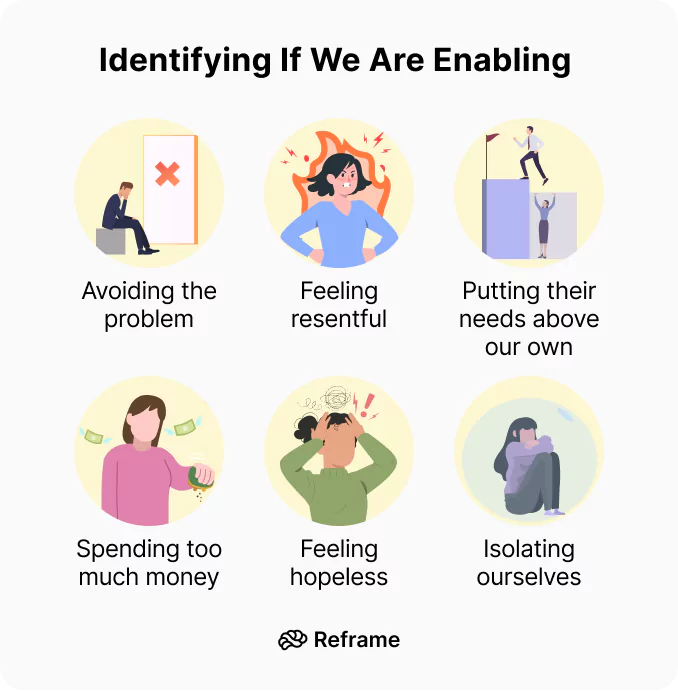
It’s tempting to avoid difficult conversations to “keep the peace.” You might ignore the smell of alcohol on their breath or quickly change the subject when a drinking-related incident comes up. While this feels like you’re preventing a fight, you’re actually creating a space where their drinking problem can exist without being challenged. By not talking about their substance use, you inadvertently send the message that their behavior is acceptable, or at least not worth discussing. This avoidance shields them from accountability and the natural consequences of their actions, making it easier for them to continue their patterns without facing the reality of the situation.
This one can feel counterintuitive. You might think, “If I have a drink with them, I can monitor how much they consume and keep them safe.” While your intention is to protect them, this action normalizes their behavior and validates their choice to drink. It sends a powerful, albeit unintentional, message: “What you’re doing is okay, because I’m doing it with you.” This form of enabling blurs boundaries and makes it harder for your loved one to see their drinking as a problem. Instead of helping them reduce their intake, you become a participant, which can diminish their motivation to seek help or make a change.
Sometimes it’s hard to recognize whether we are helping someone or enabling them. We should stop and ask ourselves, “Could they do this for themselves if they were sober?” Let’s go through some examples to help identify if we are enabling.
Reflecting on these questions helps us identify unhealthy enabling behaviors. Letting go of these behaviors can feel scary, especially when we don’t know what to expect.

We often imagine the worst possible scenario when we think about stopping our enabling behaviors. We may worry that they’ll end up in jail or without a home — but in reality, chronic alcohol misuse can be fatal. Ending enabling behaviors is the best way to help our loved one, even if the opposite feels true.
Let’s look at some ways we empower others when we stop enabling.
Helping someone recover from alcohol misuse can be stressful and taxing on everyone involved. Remember that it’s about progress, not perfection. There is an abundance of resources to support both you and your loved one through the recovery process.
There are healthy ways to actively support someone who is misusing alcohol. Let’s take a look.

Letting go of enabling behaviors is not easy. It takes setting boundaries and unlearning destructive patterns of behavior. Here are some things you can do to help an alcoholic:
The shift from enabling to helping is not easy! It’s important to remember the challenge will be worth it for you and the person struggling with alcohol addiction.
Before you can change your approach, it’s helpful to ground yourself in a few core ideas. The most important one is understanding what enabling truly is. It’s when you, with the best intentions, accidentally help someone continue their self-destructive behavior instead of helping them get better. Think of it this way: helping gives someone the tools to climb out of a hole, while enabling just makes the hole more comfortable to sit in. This distinction is crucial because it reframes your actions. You’re not being unkind by setting boundaries; you’re being truly helpful by creating an environment where change is possible.
Many of us have heard the idea that someone has to hit “rock bottom” before they’ll be ready to change. But this is a dangerous and outdated myth. Waiting for a major crisis—like a DUI, job loss, or serious health scare—can have devastating and sometimes irreversible consequences. You don’t have to wait for things to get as bad as they can possibly be. In fact, offering support and encouraging change before a person loses everything can be far more effective. True help involves stepping in with compassion and clear boundaries long before a crisis forces the issue.
So, how do you stop enabling? The answer is boundaries. Boundaries are simply the rules you set to protect your own well-being. They are not punishments or attempts to control the other person. Instead, they are clear lines that stop you from shielding your loved one from the natural results of their actions. When you set a boundary, you’re taking a step back and allowing reality to be the teacher. This can feel incredibly difficult, but it’s one of the most powerful ways to shift the dynamic from enabling to genuine support, creating the space they need to recognize the impact of their choices.
Boundaries are most effective when they are specific and consistent. You have to decide what you are and are not willing to do. For example, you can state that they cannot drink or use other substances in your home or around you. You might decide you will no longer lend them money or pay bills they can’t cover due to their drinking. This also means not calling their boss with an excuse when they’re too hungover for work or making excuses for them to friends and family. These aren’t threats; they are calm statements about what you will do to protect your own peace and stability.
Bringing up your concerns requires care and good timing. The best time to talk to your loved one about their drinking is when they are sober and you are both in a calm, private space. Approaching the conversation with kindness and concern, rather than blame or judgment, is key. Use "I" statements to express how their behavior affects you, like "I feel worried when I see you drinking so much," instead of accusatory "you" statements like "You always drink too much." The goal isn't to win an argument but to open a door for them to see the impact of their actions and consider getting help.
Supporting someone with an alcohol problem can be emotionally and mentally draining. It’s absolutely essential that you get support for yourself, too. This isn't selfish; it's necessary. Support groups can teach you how to "detach with love," a concept that means you can still love the person without being entangled in their destructive behaviors. It’s about letting them face the consequences of their choices while you focus on your own healing and well-being. You cannot pour from an empty cup, and getting your own support ensures you have the strength to help in a healthy way.
You are not alone in this experience. Groups like Al-Anon are specifically designed for the friends and family members of people struggling with alcohol misuse. In these groups, you can share your experiences and learn from others who truly understand what you’re going through. Finding a community that gets it can be incredibly validating and can provide you with the practical coping strategies and emotional support you need to navigate this difficult situation without losing yourself in the process.
If you’re looking for a more structured, skills-based approach, consider a program like CRAFT (Community Reinforcement and Family Training). This evidence-based method teaches family and friends how to have more positive and effective conversations with their loved one. CRAFT focuses on using positive reinforcement to encourage them to reduce their drinking and to engage in treatment. It’s a proactive program that equips you with tools to improve communication and support your loved one’s journey toward change in a constructive way.
If conversations and boundary-setting haven’t led to change, you might consider a formal intervention. This is a planned, structured meeting where family and friends, often with the guidance of a professional interventionist, come together to talk to the person about their drinking. The goal is to present them with a clear picture of how their behavior is impacting everyone and to encourage them to accept a pre-arranged treatment plan. An intervention should be approached with love and concern, not anger, and is focused on one clear outcome: getting them to accept help.
Ultimately, one of the most helpful things you can do is consistently encourage your loved one to seek professional help. This could mean inpatient or outpatient treatment, therapy, or counseling. You can research options and have them ready to share. For some, a structured program is the right fit, while for others, a more flexible approach might be better. An app like Reframe can be an accessible first step, offering neuroscience-based tools and a supportive community to help them build healthier habits right from their phone. The key is to guide them toward resources, not to manage their recovery for them.
A common fear is that forcing someone into treatment won't work if they don't want to go. However, research shows this isn't necessarily true. Treatment can be just as effective for people who are encouraged—or even pressured—by family or the legal system as it is for those who enter willingly. Sometimes, the structure and support of a treatment program are exactly what a person needs to gain clarity and motivation, even if they resisted it at first. Don't let their initial reluctance stop you from setting firm boundaries that lead to them getting the help they need.
This is incredibly important: your safety comes first. If your loved one’s behavior ever becomes emotionally, verbally, or physically abusive, or if they are endangering you or others in your home, you must prioritize your safety. This may mean creating physical distance or, in some difficult cases, making the decision to walk away from the relationship entirely. Removing yourself from a dangerous situation is not giving up on them; it is an act of self-preservation and the ultimate boundary. You can still love someone from a distance while protecting your own well-being.
I'm just trying to help. How do I know if I'm actually enabling? This is the question that keeps so many of us up at night. The simplest way to tell the difference is to look at the outcome of your actions. True help empowers your loved one to face their situation and build their own solutions, even if it's difficult. Enabling, on the other hand, removes the natural consequences of their drinking, which makes it easier for them to continue without changing. Ask yourself: Is my action solving a problem for them that they could, and should, be solving for themselves? If the answer is yes, it's likely leaning toward enabling.
What if they get angry when I set boundaries? I'm afraid of the conflict. It's completely normal to fear their reaction. Anger is a common response when you change the rules of a relationship they've grown comfortable with. Remember that their anger doesn't mean your boundary is wrong; it often means the boundary is working. The key is to communicate your boundary calmly and firmly, without blame or judgment, and then stick to it. Your goal isn't to control their reaction, but to control what you are and are not willing to do. The initial conflict is often temporary, while the benefits of a healthier dynamic can last a lifetime.
I'm terrified that if I stop paying their bills or bailing them out, they'll end up homeless or in jail. Isn't that worse? This fear is powerful, and it comes from a place of deep love. But consider this: shielding them from these major consequences is what allows the destructive pattern to continue, which could lead to a far worse, irreversible outcome. Allowing them to experience the direct results of their choices isn't cruel; it's often the only thing that can break through the denial and help them see the true severity of their problem. It can be the very catalyst that motivates them to finally accept real help.
Can I still support my loved one without enabling them? Absolutely. In fact, stopping your enabling behaviors is the most supportive thing you can do. True support looks different. It's offering to drive them to a therapy appointment, listening without judgment when they express a desire to change, or helping them research treatment options. It's about encouraging their recovery, not managing their addiction. You can be their biggest cheerleader for positive change while refusing to be a participant in their self-destruction.
This is all so overwhelming. Where do I even start? Start small, and start with yourself. You don't have to fix everything overnight. The most powerful first step is often finding your own support. Exploring a group like Al-Anon or speaking with a therapist can provide you with the clarity and strength needed to move forward. From there, you can focus on setting just one clear, manageable boundary. It could be as simple as deciding you will no longer make excuses for them to friends or family. Taking care of your own well-being is the foundation for helping anyone else effectively.
You love them, so you do everything you can to help. You make excuses, pay their bills, and clean up the messes left behind by their drinking. You're their rock, their safety net. But what if that support is actually preventing them from hitting the bottom they need to find? It's a frustrating and painful cycle. This is the classic trap of enabling an alcoholic. Recognizing this pattern is the first, most crucial step. Let's explore what enabling looks like and, more importantly, how to stop enabling an alcoholic so you can offer help that truly makes a difference.
Empathy is an important part of human connection; it hurts to see someone struggle. But in our efforts to care for someone with addiction, we may actually be enabling them. Enabling supports and sustains an individual’s addiction (even though this isn’t our intent!), but there are ways to channel our care into more helpful behaviors. In this blog, we’ll learn more about enabling behaviors, how to recognize them in ourselves, and how to help our loved one constructively.
Enabling is any behavior or action that allows our loved one to avoid the consequences of their actions. We enable others by justifying their bad actions or indirectly supporting their harmful behaviors (for example, paying off someone’s alcohol related debts).
Enabling is different from helping, even though they look alike. Helping provides support, assistance, and guidance in overcoming a specific challenge. Enabling directly or indirectly helps someone continue an unhealthy habit or behavior.
Helping empowers someone to escape their circumstance, whereas enabling them gives them permission to stay the same. While it may seem like we are helping the person or nurturing them with compassion, enabling actually makes things worse — and it typically prolongs recovery because it perpetuates the cycle of substance misuse.
Enabling isn't a one-size-fits-all behavior. It often shows up in subtle ways that can be hard to spot, especially when our actions come from a place of love and concern. These behaviors tend to fall into specific patterns and can evolve over time as the situation with our loved one intensifies. Recognizing these dynamics is the first step toward shifting from enabling to truly helping. By understanding the different types of enabling and the stages it progresses through, we can gain clarity on our own actions and learn how to build healthier, more supportive boundaries.
Enabling often fits into one of four roles. Caretaking is when you try to meet all of your loved one’s needs, believing you’re protecting them, but you’re actually shielding them from the consequences of their drinking. The Protective role involves covering up their mistakes, like calling them in sick to work after a night of heavy drinking. Rescuing happens when you swoop in to solve their problems, like paying off a credit card they maxed out at a bar. Finally, Overcompensating means taking on their responsibilities to make up for their inaction, which can create a deep imbalance in the relationship and prevent them from feeling the need to change.
Enabling behavior typically unfolds in stages. It often starts with Denial, where we might ignore or downplay the drinking, hoping it’s just a phase. As the problem continues, we may move into Compliance, where we start to go along with the behavior to avoid conflict. This can look like having a drink with them when we don't want to, just to keep the peace. Next comes Control, a stage where we try to manage the chaos by making excuses for them or covering up their actions. Eventually, this leads to a Crisis, where the stress becomes overwhelming and we can no longer deny the damaging effects of both their addiction and our enabling.
The solution may seem simple: stop enabling bad behavior! The reality is more complicated than that, as many of us know. Enabling is unintentional and stems from our want/need to help others, especially when it comes to those we are closest to and most comfortable with.
Justifying our actions as “caring” or “showing love” is natural — and these actions are definitely an expression of our love. We may not be aware that our behaviors are enabling our loved one. Let’s go through some reasons why we find ourselves enabling instead of helping.
We enable those who misuse alcohol for many reasons. Understanding the subconscious thought process behind our actions is a crucial first step towards recognizing and dismantling the cycle of enabling.
We learned what it means to enable someone and why we may do it. Now let’s examine what it looks like when we enable an alcoholic.
Though often unintentional, enabling an alcoholic supports their destructive drinking habits by shielding them from the consequences of their actions. This can take many forms, but there are some common patterns:
We shield our loved one from the consequences of their actions through a wide variety of behaviors, conscious and unconscious. Now that we know what enabling looks like, we can assess if it’s something we’re doing — and learn how to stop.
It’s tempting to avoid difficult conversations to “keep the peace.” You might ignore the smell of alcohol on their breath or quickly change the subject when a drinking-related incident comes up. While this feels like you’re preventing a fight, you’re actually creating a space where their drinking problem can exist without being challenged. By not talking about their substance use, you inadvertently send the message that their behavior is acceptable, or at least not worth discussing. This avoidance shields them from accountability and the natural consequences of their actions, making it easier for them to continue their patterns without facing the reality of the situation.
This one can feel counterintuitive. You might think, “If I have a drink with them, I can monitor how much they consume and keep them safe.” While your intention is to protect them, this action normalizes their behavior and validates their choice to drink. It sends a powerful, albeit unintentional, message: “What you’re doing is okay, because I’m doing it with you.” This form of enabling blurs boundaries and makes it harder for your loved one to see their drinking as a problem. Instead of helping them reduce their intake, you become a participant, which can diminish their motivation to seek help or make a change.
Sometimes it’s hard to recognize whether we are helping someone or enabling them. We should stop and ask ourselves, “Could they do this for themselves if they were sober?” Let’s go through some examples to help identify if we are enabling.
Reflecting on these questions helps us identify unhealthy enabling behaviors. Letting go of these behaviors can feel scary, especially when we don’t know what to expect.
We often imagine the worst possible scenario when we think about stopping our enabling behaviors. We may worry that they’ll end up in jail or without a home — but in reality, chronic alcohol misuse can be fatal. Ending enabling behaviors is the best way to help our loved one, even if the opposite feels true.
Let’s look at some ways we empower others when we stop enabling.
Helping someone recover from alcohol misuse can be stressful and taxing on everyone involved. Remember that it’s about progress, not perfection. There is an abundance of resources to support both you and your loved one through the recovery process.
There are healthy ways to actively support someone who is misusing alcohol. Let’s take a look.
Letting go of enabling behaviors is not easy. It takes setting boundaries and unlearning destructive patterns of behavior. Here are some things you can do to help an alcoholic:
The shift from enabling to helping is not easy! It’s important to remember the challenge will be worth it for you and the person struggling with alcohol addiction.
Before you can change your approach, it’s helpful to ground yourself in a few core ideas. The most important one is understanding what enabling truly is. It’s when you, with the best intentions, accidentally help someone continue their self-destructive behavior instead of helping them get better. Think of it this way: helping gives someone the tools to climb out of a hole, while enabling just makes the hole more comfortable to sit in. This distinction is crucial because it reframes your actions. You’re not being unkind by setting boundaries; you’re being truly helpful by creating an environment where change is possible.
Many of us have heard the idea that someone has to hit “rock bottom” before they’ll be ready to change. But this is a dangerous and outdated myth. Waiting for a major crisis—like a DUI, job loss, or serious health scare—can have devastating and sometimes irreversible consequences. You don’t have to wait for things to get as bad as they can possibly be. In fact, offering support and encouraging change before a person loses everything can be far more effective. True help involves stepping in with compassion and clear boundaries long before a crisis forces the issue.
So, how do you stop enabling? The answer is boundaries. Boundaries are simply the rules you set to protect your own well-being. They are not punishments or attempts to control the other person. Instead, they are clear lines that stop you from shielding your loved one from the natural results of their actions. When you set a boundary, you’re taking a step back and allowing reality to be the teacher. This can feel incredibly difficult, but it’s one of the most powerful ways to shift the dynamic from enabling to genuine support, creating the space they need to recognize the impact of their choices.
Boundaries are most effective when they are specific and consistent. You have to decide what you are and are not willing to do. For example, you can state that they cannot drink or use other substances in your home or around you. You might decide you will no longer lend them money or pay bills they can’t cover due to their drinking. This also means not calling their boss with an excuse when they’re too hungover for work or making excuses for them to friends and family. These aren’t threats; they are calm statements about what you will do to protect your own peace and stability.
Bringing up your concerns requires care and good timing. The best time to talk to your loved one about their drinking is when they are sober and you are both in a calm, private space. Approaching the conversation with kindness and concern, rather than blame or judgment, is key. Use "I" statements to express how their behavior affects you, like "I feel worried when I see you drinking so much," instead of accusatory "you" statements like "You always drink too much." The goal isn't to win an argument but to open a door for them to see the impact of their actions and consider getting help.
Supporting someone with an alcohol problem can be emotionally and mentally draining. It’s absolutely essential that you get support for yourself, too. This isn't selfish; it's necessary. Support groups can teach you how to "detach with love," a concept that means you can still love the person without being entangled in their destructive behaviors. It’s about letting them face the consequences of their choices while you focus on your own healing and well-being. You cannot pour from an empty cup, and getting your own support ensures you have the strength to help in a healthy way.
You are not alone in this experience. Groups like Al-Anon are specifically designed for the friends and family members of people struggling with alcohol misuse. In these groups, you can share your experiences and learn from others who truly understand what you’re going through. Finding a community that gets it can be incredibly validating and can provide you with the practical coping strategies and emotional support you need to navigate this difficult situation without losing yourself in the process.
If you’re looking for a more structured, skills-based approach, consider a program like CRAFT (Community Reinforcement and Family Training). This evidence-based method teaches family and friends how to have more positive and effective conversations with their loved one. CRAFT focuses on using positive reinforcement to encourage them to reduce their drinking and to engage in treatment. It’s a proactive program that equips you with tools to improve communication and support your loved one’s journey toward change in a constructive way.
If conversations and boundary-setting haven’t led to change, you might consider a formal intervention. This is a planned, structured meeting where family and friends, often with the guidance of a professional interventionist, come together to talk to the person about their drinking. The goal is to present them with a clear picture of how their behavior is impacting everyone and to encourage them to accept a pre-arranged treatment plan. An intervention should be approached with love and concern, not anger, and is focused on one clear outcome: getting them to accept help.
Ultimately, one of the most helpful things you can do is consistently encourage your loved one to seek professional help. This could mean inpatient or outpatient treatment, therapy, or counseling. You can research options and have them ready to share. For some, a structured program is the right fit, while for others, a more flexible approach might be better. An app like Reframe can be an accessible first step, offering neuroscience-based tools and a supportive community to help them build healthier habits right from their phone. The key is to guide them toward resources, not to manage their recovery for them.
A common fear is that forcing someone into treatment won't work if they don't want to go. However, research shows this isn't necessarily true. Treatment can be just as effective for people who are encouraged—or even pressured—by family or the legal system as it is for those who enter willingly. Sometimes, the structure and support of a treatment program are exactly what a person needs to gain clarity and motivation, even if they resisted it at first. Don't let their initial reluctance stop you from setting firm boundaries that lead to them getting the help they need.
This is incredibly important: your safety comes first. If your loved one’s behavior ever becomes emotionally, verbally, or physically abusive, or if they are endangering you or others in your home, you must prioritize your safety. This may mean creating physical distance or, in some difficult cases, making the decision to walk away from the relationship entirely. Removing yourself from a dangerous situation is not giving up on them; it is an act of self-preservation and the ultimate boundary. You can still love someone from a distance while protecting your own well-being.
I'm just trying to help. How do I know if I'm actually enabling? This is the question that keeps so many of us up at night. The simplest way to tell the difference is to look at the outcome of your actions. True help empowers your loved one to face their situation and build their own solutions, even if it's difficult. Enabling, on the other hand, removes the natural consequences of their drinking, which makes it easier for them to continue without changing. Ask yourself: Is my action solving a problem for them that they could, and should, be solving for themselves? If the answer is yes, it's likely leaning toward enabling.
What if they get angry when I set boundaries? I'm afraid of the conflict. It's completely normal to fear their reaction. Anger is a common response when you change the rules of a relationship they've grown comfortable with. Remember that their anger doesn't mean your boundary is wrong; it often means the boundary is working. The key is to communicate your boundary calmly and firmly, without blame or judgment, and then stick to it. Your goal isn't to control their reaction, but to control what you are and are not willing to do. The initial conflict is often temporary, while the benefits of a healthier dynamic can last a lifetime.
I'm terrified that if I stop paying their bills or bailing them out, they'll end up homeless or in jail. Isn't that worse? This fear is powerful, and it comes from a place of deep love. But consider this: shielding them from these major consequences is what allows the destructive pattern to continue, which could lead to a far worse, irreversible outcome. Allowing them to experience the direct results of their choices isn't cruel; it's often the only thing that can break through the denial and help them see the true severity of their problem. It can be the very catalyst that motivates them to finally accept real help.
Can I still support my loved one without enabling them? Absolutely. In fact, stopping your enabling behaviors is the most supportive thing you can do. True support looks different. It's offering to drive them to a therapy appointment, listening without judgment when they express a desire to change, or helping them research treatment options. It's about encouraging their recovery, not managing their addiction. You can be their biggest cheerleader for positive change while refusing to be a participant in their self-destruction.
This is all so overwhelming. Where do I even start? Start small, and start with yourself. You don't have to fix everything overnight. The most powerful first step is often finding your own support. Exploring a group like Al-Anon or speaking with a therapist can provide you with the clarity and strength needed to move forward. From there, you can focus on setting just one clear, manageable boundary. It could be as simple as deciding you will no longer make excuses for them to friends or family. Taking care of your own well-being is the foundation for helping anyone else effectively.

What does alcoholism have to do with maladaptive behavior? Learn the science behind the connection and get some practical advice in our new blog.
Although it isn’t a treatment for alcohol use disorder (AUD), the Reframe app can help you cut back on drinking gradually, with the science-backed knowledge to empower you 100% of the way. Our proven program has helped millions of people around the world drink less and live more. And we want to help you get there, too!
The Reframe app equips you with the knowledge and skills you need to not only survive drinking less, but to thrive while you navigate the journey. Our daily research-backed readings teach you the neuroscience of alcohol, and our in-app Toolkit provides the resources and activities you need to navigate each challenge.
You’ll meet hundreds of fellow Reframers in our 24/7 Forum chat and daily Zoom check-in meetings. Receive encouragement from people worldwide who know exactly what you’re going through! You’ll also have the opportunity to connect with our licensed Reframe coaches for more personalized guidance.
Plus, we’re always introducing new features to optimize your in-app experience. We recently launched our in-app chatbot, Melody, powered by the world’s most powerful AI technology. Melody is here to help as you adjust to a life with less (or no) alcohol.
And that’s not all! Every month, we launch fun challenges, like Dry/Damp January, Mental Health May, and Outdoorsy June. You won’t want to miss out on the chance to participate alongside fellow Reframers (or solo if that’s more your thing!).
The Reframe app is free for 7 days, so you don’t have anything to lose by trying it. Are you ready to feel empowered and discover life beyond alcohol? Then download our app through the App Store or Google Play today!
Adaptations are huge in the natural world. It all goes back to evolution: we’ve all heard about the first organisms that left the oceans to live on dry land. They thrived with the help of lungs and limbs that replaced gills and fins. All living things adapt; bees have developed an intricate way to communicate through their trademark “waggle dance,” and desert plants store water in their succulent tissues to get through long droughts.
As humans, we are also amazing at adapting to our environment. We created Stone Age tools (and eventually digital age computers and smartphones); we manage to navigate and even thrive in pretty much every type of climate around the globe, and we communicate with each other in thousands of languages that we acquire with relative ease before we are even old enough to feed and take care of ourselves.
And yet, many times those adaptations can take us in the wrong direction, leading to so-called maladaptive behavior. What is maladaptive behavior, and what is the science behind it? And how does alcohol fit into the picture? Let’s find out more!
As humans, we tend to be driven by two basic motivations: seeking pleasure and avoiding pain. It’s in our song lyrics — whether it’s The Eagles telling us that “Some dance to remember / some dance to forget,” or Pitbull encouraging us with “Now let's get loose, have some fun / forget about bills and the first of the month.” Even the substances we tend to misuse reflect this dichotomy, as we generally classify them as either “uppers” or “downers.”
The maladaptive behaviors we adapt also fit into these two basic categories. In an effort to create excitement or make life easier when it gets stressful, we fall into coping mechanisms that can sometimes become dysfunctional, or “maladaptive.”
There is no single “maladaptive behavior” definition, but it’s easy to identify patterns. Some behaviors are oriented toward the outside world, such as angry outbursts, while others are more internal, such as withdrawing into our thoughts. Many are a mixture of the two and can manifest themselves in a number of different ways ranging from eating disorders to substance misuse or self-harm.
The science behind maladaptive behaviors has to do with how our brain is wired. Structurally, the two main categories of maladaptive coping mechanisms originate from two main pathways: the reward system and the stress response.
There are many types of maladaptive behaviors, and each one will bear the hallmark of our individual characteristics. Our environments and personal histories are unique to us, and so are our behaviors — functional as well as dysfunctional ones.
That said, there are a few types of maladaptive behaviors that stand out among the rest. The first three are more thought-oriented, while the rest manifest in our external actions.
Avoidance is one of the most common types of maladaptive behaviors that fall more into the thought realm — though it does result in certain physical actions that we take when we follow those thoughts.
Avoidance is all about disengagement from the present as a way to avoid potentially stressful or painful experiences. Researchers describe it as a common maladaptive response to stress or anxiety. It’s the human version of the small animal that runs across the busy road with its eyes closed, hoping for the best.
Similar to avoidance, withdrawal is all about protecting ourselves by shutting down. We close ourselves off to the world around us because it feels easier than facing our problems or fears. It can manifest in many different ways, but ultimately it’s a protection reflex that can end up hurting us in the long run.

Passive-aggressive behavior is an indirect expression of negative feelings or attitudes toward someone. Instead of directly addressing the problem or being honest about our feelings, we use sarcasm and underhanded comments, and then deny our intentions when confronted. This “passive” behavior is ultimately masking the “aggressive” feelings at the heart of our actions.
Make no mistake, passive-aggression isn’t just “keeping the peace.” It can quickly go from a bad habit to a weaponized form of emotional manipulation. It has the potential to be very destructive to relationships, resulting in resentment and misunderstandings that can sometimes take years to untangle.
We all feel angry sometimes, and it’s natural. But what if anger becomes excessive? If we don’t find healthy ways to express our anger and instead we “bottle it up,” it can come out in harmful ways. As a maladaptive behavior, angry outbursts and tantrums can relieve that built-up stress and emotional pressure at the moment, but at a long-term cost. This anger tends to be misdirected and irrational, causing us to blame others instead of examining the heart of the matter. Frequent outbursts can take a toll on all areas of our lives, including our family, social, and work relationships.
Sometimes overwhelming stress or negative emotions can provoke us harm to ourselves as a way to “translate” emotional distress into physical pain. People might turn to this maladaptive behavior as a temporary escape, to express feelings they can't put into words, or to feel a sense of control. However, self-harm is a risky and destructive coping mechanism that can lead to more severe health issues — so never ignore it, and know that there’s help available.
Food is a source of dopamine for us — it activates our reward system. In times of stress, it can become a comfort, leading to overeating. (Ever heard of “stress eating?”) On the other hand, obsessively focusing on food and controlling this dopamine response through restriction can give us a powerful feeling of control — with potentially harmful consequences.
Whether the focus is on weight and body image or the food itself, issues like binge eating disorder, bulimia, and anorexia can develop when we cope by changing our food intake. While these might start as innocent coping mechanisms, they can quickly spiral out of control and become a source of more difficulty.
Like self-harm and substance misuse (discussed below), this maladaptive behavior comes with significant health risks, so it’s crucial to be vigilant and ask for help if these behavior patterns emerge.
Similar to eating disorders, substance use disorders involve the use of alcohol or other drugs in ways that might initially offer comfort or the illusion of pleasure, but that end up hurting us in the long run. According to research, they’re one of the most common types of maladaptive behaviors.
When it comes to alcohol’s effect on the brain, it’s kind of a chameleon. It initially seems to act as a stimulant, creating that energizing boozy “high” feeling we briefly get when we drink. However, it’s actually a depressant that dulls our senses and slows down our brain processes. How is this possible? Here’s a brief overview of the neurotransmitters behind these effects:
As we all know, though, these effects don’t last. Worse still, they backfire — big time. If we continue turning to alcohol to feel good for a short amount of time or use it for relaxation, it quickly becomes a maladaptive behavior. Unfortunately, this particular maladaptive behavior is one that can only accelerate. Here’s where that path goes:
Ultimately, maladaptive behaviors don’t serve us, and alcohol is no exception. Luckily, there are ways to overcome these habits and improve our ways of coping.
If you find yourself struggling as alcohol use becomes a maladaptive behavior in your life, you’re not alone. And there’s a way out! Here are some things you can do:

Adaptations are huge in the natural world. It all goes back to evolution: we’ve all heard about the first organisms that left the oceans to live on dry land. They thrived with the help of lungs and limbs that replaced gills and fins. All living things adapt; bees have developed an intricate way to communicate through their trademark “waggle dance,” and desert plants store water in their succulent tissues to get through long droughts.
As humans, we are also amazing at adapting to our environment. We created Stone Age tools (and eventually digital age computers and smartphones); we manage to navigate and even thrive in pretty much every type of climate around the globe, and we communicate with each other in thousands of languages that we acquire with relative ease before we are even old enough to feed and take care of ourselves.
And yet, many times those adaptations can take us in the wrong direction, leading to so-called maladaptive behavior. What is maladaptive behavior, and what is the science behind it? And how does alcohol fit into the picture? Let’s find out more!
As humans, we tend to be driven by two basic motivations: seeking pleasure and avoiding pain. It’s in our song lyrics — whether it’s The Eagles telling us that “Some dance to remember / some dance to forget,” or Pitbull encouraging us with “Now let's get loose, have some fun / forget about bills and the first of the month.” Even the substances we tend to misuse reflect this dichotomy, as we generally classify them as either “uppers” or “downers.”
The maladaptive behaviors we adapt also fit into these two basic categories. In an effort to create excitement or make life easier when it gets stressful, we fall into coping mechanisms that can sometimes become dysfunctional, or “maladaptive.”
There is no single “maladaptive behavior” definition, but it’s easy to identify patterns. Some behaviors are oriented toward the outside world, such as angry outbursts, while others are more internal, such as withdrawing into our thoughts. Many are a mixture of the two and can manifest themselves in a number of different ways ranging from eating disorders to substance misuse or self-harm.
The science behind maladaptive behaviors has to do with how our brain is wired. Structurally, the two main categories of maladaptive coping mechanisms originate from two main pathways: the reward system and the stress response.
There are many types of maladaptive behaviors, and each one will bear the hallmark of our individual characteristics. Our environments and personal histories are unique to us, and so are our behaviors — functional as well as dysfunctional ones.
That said, there are a few types of maladaptive behaviors that stand out among the rest. The first three are more thought-oriented, while the rest manifest in our external actions.
Avoidance is one of the most common types of maladaptive behaviors that fall more into the thought realm — though it does result in certain physical actions that we take when we follow those thoughts.
Avoidance is all about disengagement from the present as a way to avoid potentially stressful or painful experiences. Researchers describe it as a common maladaptive response to stress or anxiety. It’s the human version of the small animal that runs across the busy road with its eyes closed, hoping for the best.
Similar to avoidance, withdrawal is all about protecting ourselves by shutting down. We close ourselves off to the world around us because it feels easier than facing our problems or fears. It can manifest in many different ways, but ultimately it’s a protection reflex that can end up hurting us in the long run.
Passive-aggressive behavior is an indirect expression of negative feelings or attitudes toward someone. Instead of directly addressing the problem or being honest about our feelings, we use sarcasm and underhanded comments, and then deny our intentions when confronted. This “passive” behavior is ultimately masking the “aggressive” feelings at the heart of our actions.
Make no mistake, passive-aggression isn’t just “keeping the peace.” It can quickly go from a bad habit to a weaponized form of emotional manipulation. It has the potential to be very destructive to relationships, resulting in resentment and misunderstandings that can sometimes take years to untangle.
We all feel angry sometimes, and it’s natural. But what if anger becomes excessive? If we don’t find healthy ways to express our anger and instead we “bottle it up,” it can come out in harmful ways. As a maladaptive behavior, angry outbursts and tantrums can relieve that built-up stress and emotional pressure at the moment, but at a long-term cost. This anger tends to be misdirected and irrational, causing us to blame others instead of examining the heart of the matter. Frequent outbursts can take a toll on all areas of our lives, including our family, social, and work relationships.
Sometimes overwhelming stress or negative emotions can provoke us harm to ourselves as a way to “translate” emotional distress into physical pain. People might turn to this maladaptive behavior as a temporary escape, to express feelings they can't put into words, or to feel a sense of control. However, self-harm is a risky and destructive coping mechanism that can lead to more severe health issues — so never ignore it, and know that there’s help available.
Food is a source of dopamine for us — it activates our reward system. In times of stress, it can become a comfort, leading to overeating. (Ever heard of “stress eating?”) On the other hand, obsessively focusing on food and controlling this dopamine response through restriction can give us a powerful feeling of control — with potentially harmful consequences.
Whether the focus is on weight and body image or the food itself, issues like binge eating disorder, bulimia, and anorexia can develop when we cope by changing our food intake. While these might start as innocent coping mechanisms, they can quickly spiral out of control and become a source of more difficulty.
Like self-harm and substance misuse (discussed below), this maladaptive behavior comes with significant health risks, so it’s crucial to be vigilant and ask for help if these behavior patterns emerge.
Similar to eating disorders, substance use disorders involve the use of alcohol or other drugs in ways that might initially offer comfort or the illusion of pleasure, but that end up hurting us in the long run. According to research, they’re one of the most common types of maladaptive behaviors.
When it comes to alcohol’s effect on the brain, it’s kind of a chameleon. It initially seems to act as a stimulant, creating that energizing boozy “high” feeling we briefly get when we drink. However, it’s actually a depressant that dulls our senses and slows down our brain processes. How is this possible? Here’s a brief overview of the neurotransmitters behind these effects:
As we all know, though, these effects don’t last. Worse still, they backfire — big time. If we continue turning to alcohol to feel good for a short amount of time or use it for relaxation, it quickly becomes a maladaptive behavior. Unfortunately, this particular maladaptive behavior is one that can only accelerate. Here’s where that path goes:
Ultimately, maladaptive behaviors don’t serve us, and alcohol is no exception. Luckily, there are ways to overcome these habits and improve our ways of coping.
If you find yourself struggling as alcohol use becomes a maladaptive behavior in your life, you’re not alone. And there’s a way out! Here are some things you can do:

Resilience plays a pivotal role when going through AUD recovery and can be a decisive factor in success. Learn how to cultivate greater resilience to better support your recovery.
Inner work goes beyond building resilience. Perhaps you’d like to change how you feel in general. Or maybe you’re at a place where you’re thinking about changing your relationship with alcohol. Although it isn’t a treatment for alcohol use disorder (AUD), the Reframe app can help you cut back on drinking gradually, with science-backed knowledge to empower you 100% of the way. Our proven program has helped millions worldwide drink less and live more. And we want to help you get there, too!
The Reframe app equips you with the knowledge and skills to survive drinking less and thrive while navigating the journey. Our daily research-backed readings teach you the neuroscience of alcohol, and our in-app Toolkit provides the resources and activities you need to navigate each challenge
You’ll meet millions of fellow Reframers in our 24/7 Forum chat and daily Zoom check-in meetings. Receive encouragement from people worldwide who know what you’re going through! You’ll also be able to connect with our licensed Reframe coaches for more personalized guidance.
Plus, we’re constantly introducing new features to optimize your in-app experience. We recently launched our in-app chatbot, Melody, powered by the world’s most powerful AI technology. Melody is here to help you adjust to a life with less (or no) alcohol.
And that’s not all! We launch fun challenges monthly, like Dry/Damp January, Mental Health May, and Outdoorsy June. It’s a great chance to participate alongside fellow Reframers (or solo if that’s more your thing!).
The Reframe app is free for seven days, so you have everything to gain and nothing to lose by trying it. Are you ready to feel empowered and discover life beyond alcohol? Then download our app through the App Store or Google Play today!
You have to admire the resilience of the Energizer Bunny. You know that cute, battery-operated pink rabbit with sunglasses? He zips around, incessantly banging his drum while knocking over whatever’s in his path. Despite the obstacles, that bunny just “keeps going and going and going....”
This is resilience in action. And like that little bunny, we need the strength to keep going and going as we navigate Alcohol Use Disorder (AUD) recovery. Identifying and cultivating resilience is a process, but it can be a game changer when we are striving for an alcohol-free lifestyle. Let’s look at what it is, its role in AUD recovery, and ways to foster it.
Resilience is the ability to adapt and recover from challenges or adversity. It enables us to bounce back from stress, disappointment, or trauma. For some of us, it could mean getting our energy back after running a marathon. Or maybe it’s getting back on track following a breakup, job loss, or illness. It also offers a protective element because it can help prevent mental health conditions, such as depression and anxiety. Think of it as an inner strength that helps us cope with and adapt to hard times.
Some of the qualities we associate with resilient people include:
Each of us has our own level of resilience. We sometimes surprise ourselves with our ability to adapt when faced with grave or unforeseen circumstances. Yet there may be others who view even minor obstacles as insurmountable. The difference between us can often determine how well we cope throughout AUD recovery. Let’s take a closer look at the issues involved to learn more about building the resilience needed to help those of us who want to move forward when seeking an AUD recovery strategy.
Alcohol Use Disorder, or AUD, is a medical diagnosis that describes a problematic and unhealthy pattern of alcohol consumption that leads to distress or impairment in daily life. Symptoms of AUD include cravings, loss of control, physical dependence, neglect of responsibilities, and continued use of alcohol despite experiencing negative consequences. The latter factor is the most critical. Financial problems, relationship difficulties, legal issues, and poor job performance are some of the negative consequences associated with AUD. Let’s turn to some obstacles we may face when we choose a path to recovery.
For many of us who want to change our relationship with alcohol, we know deep down that if something is going to happen, it won’t happen on its own. For most of us, reaching this point doesn’t happen overnight, and neither did developing AUD. It sort of snuck up on us over time.
We once may have relied on drinking to blow off steam, temporarily curb anxiety, or relax with friends. However, after some time, we found this came with baggage such as poor judgment, arguments, memory lapses, fumbles at work, and so on.
And even when we faced the consequences of our drinking, denial stood in our way. That’s the insidious part of AUD: it changes our brain chemistry and interferes with the choices we make. It’s like being caught in a trap of knowing what we need to do but simply being unable to do it. It’s a common dilemma that often forces us to confront the barriers to AUD recovery.
Taking that first step toward AUD recovery involves more than motivation. It requires overcoming the often paralyzing barriers of shame, guilt, and fear of being stigmatized. And let’s not forget our negative self-talk like, “I can’t do this!” Instead, people who want to change their relationship with alcohol need to firmly believe it is possible to fully:
A recent study noted that despite its many challenges, resilience in addiction recovery is a vital component. Psychological toughness and inner strength are often necessary for tipping the scales in the direction of a successful recovery. One way to do this is by using a resilient approach.
Some of us are hardwired with innate resilience; it just kicks in when needed. Think of the Energizer Bunny! But not all of us are built this way, and that’s ok. We can develop resilience even when it isn’t second nature to us.
Here are some ways to build resiliency, specifically when it comes to AUD recovery:

Starting AUD recovery is a huge first step toward building a healthier and happier future. Resilience can be one of the most effective tools in recovery; it can help us adapt to and bounce back from its frequent ups and downs. Among other things, resiliency grows when we have a support network, manage expectations, and practice self-care. After all, we need all the cheerleading we can use.
Resilience isn’t just for the most challenging situations. We benefit from it in all aspects of life, whether perfecting our golf swing, studying for exams, or juggling two jobs. Getting through these challenges requires stamina and a stick-to-it attitude. That’s where resilience comes in.
You have to admire the resilience of the Energizer Bunny. You know that cute, battery-operated pink rabbit with sunglasses? He zips around, incessantly banging his drum while knocking over whatever’s in his path. Despite the obstacles, that bunny just “keeps going and going and going....”
This is resilience in action. And like that little bunny, we need the strength to keep going and going as we navigate Alcohol Use Disorder (AUD) recovery. Identifying and cultivating resilience is a process, but it can be a game changer when we are striving for an alcohol-free lifestyle. Let’s look at what it is, its role in AUD recovery, and ways to foster it.
Resilience is the ability to adapt and recover from challenges or adversity. It enables us to bounce back from stress, disappointment, or trauma. For some of us, it could mean getting our energy back after running a marathon. Or maybe it’s getting back on track following a breakup, job loss, or illness. It also offers a protective element because it can help prevent mental health conditions, such as depression and anxiety. Think of it as an inner strength that helps us cope with and adapt to hard times.
Some of the qualities we associate with resilient people include:
Each of us has our own level of resilience. We sometimes surprise ourselves with our ability to adapt when faced with grave or unforeseen circumstances. Yet there may be others who view even minor obstacles as insurmountable. The difference between us can often determine how well we cope throughout AUD recovery. Let’s take a closer look at the issues involved to learn more about building the resilience needed to help those of us who want to move forward when seeking an AUD recovery strategy.
Alcohol Use Disorder, or AUD, is a medical diagnosis that describes a problematic and unhealthy pattern of alcohol consumption that leads to distress or impairment in daily life. Symptoms of AUD include cravings, loss of control, physical dependence, neglect of responsibilities, and continued use of alcohol despite experiencing negative consequences. The latter factor is the most critical. Financial problems, relationship difficulties, legal issues, and poor job performance are some of the negative consequences associated with AUD. Let’s turn to some obstacles we may face when we choose a path to recovery.
For many of us who want to change our relationship with alcohol, we know deep down that if something is going to happen, it won’t happen on its own. For most of us, reaching this point doesn’t happen overnight, and neither did developing AUD. It sort of snuck up on us over time.
We once may have relied on drinking to blow off steam, temporarily curb anxiety, or relax with friends. However, after some time, we found this came with baggage such as poor judgment, arguments, memory lapses, fumbles at work, and so on.
And even when we faced the consequences of our drinking, denial stood in our way. That’s the insidious part of AUD: it changes our brain chemistry and interferes with the choices we make. It’s like being caught in a trap of knowing what we need to do but simply being unable to do it. It’s a common dilemma that often forces us to confront the barriers to AUD recovery.
Taking that first step toward AUD recovery involves more than motivation. It requires overcoming the often paralyzing barriers of shame, guilt, and fear of being stigmatized. And let’s not forget our negative self-talk like, “I can’t do this!” Instead, people who want to change their relationship with alcohol need to firmly believe it is possible to fully:
A recent study noted that despite its many challenges, resilience in addiction recovery is a vital component. Psychological toughness and inner strength are often necessary for tipping the scales in the direction of a successful recovery. One way to do this is by using a resilient approach.
Some of us are hardwired with innate resilience; it just kicks in when needed. Think of the Energizer Bunny! But not all of us are built this way, and that’s ok. We can develop resilience even when it isn’t second nature to us.
Here are some ways to build resiliency, specifically when it comes to AUD recovery:
Starting AUD recovery is a huge first step toward building a healthier and happier future. Resilience can be one of the most effective tools in recovery; it can help us adapt to and bounce back from its frequent ups and downs. Among other things, resiliency grows when we have a support network, manage expectations, and practice self-care. After all, we need all the cheerleading we can use.
Resilience isn’t just for the most challenging situations. We benefit from it in all aspects of life, whether perfecting our golf swing, studying for exams, or juggling two jobs. Getting through these challenges requires stamina and a stick-to-it attitude. That’s where resilience comes in.

Turn your Dry January into a Dry February! Learn the benefits of another month without booze, or how you can hop on after a Dry January slip.
Although it isn’t a treatment for alcohol use disorder (AUD), the Reframe app can help us cut back on drinking gradually with science-backed knowledge to empower you 100% of the way. Our proven program has helped millions of people around the world drink less and live more. And we want to help you get there, too!
The Reframe app equips you with the knowledge and skills to survive drinking less and thrive while navigating the journey. Our daily research-backed readings teach you the neuroscience of alcohol, and our in-app Toolkit provides the resources and activities to navigate each challenge.
You’ll meet millions of fellow Reframers in our 24/7 Forum chat and daily Zoom check-in meetings. Receive encouragement from people worldwide who know exactly what you’re going through! You’ll also have the opportunity to connect with our licensed Reframe coaches for more personalized guidance.
Plus, we’re constantly introducing new features to optimize your in-app experience. We recently launched our in-app chatbot, Melody, powered by the world’s most powerful AI technology. Melody is here to help you adjust to a life with less (or no) alcohol.
And that’s not all! Every month, we launch fun challenges, like Dry/Damp January, Mental Health May, and Outdoorsy June. You won’t want to miss out on the chance to participate alongside fellow Reframers (or solo if that’s more your thing!).
The Reframe app is free for 7 days, so you don’t have anything to lose by trying it. Are you ready to feel empowered and discover life beyond alcohol? Then download our app through the App Store or Google Play today!
Ah, love is in the air. Aquarius season evolves into Pisces season. The Dry January challenge comes to a close — but that doesn’t mean our sobriety has to end. A new month brings a new challenge to change our relationship with alcohol. Perhaps you fit into one of the following categories:
If any of these apply to you, you’re in the right place! Read on to learn about all the benefits of a sober February.
You’ve probably heard of Dry January — the challenge to go the whole month of January without drinking alcohol. The Dry January challenge started in the UK in 2013 as a way to reset and reflect on our drinking habits after the holiday season. The movement quickly spread across the globe, inspiring other month-long sobriety challenges like Sober October and Dry July.
The Dry February challenge is a way to continue that momentum — and it’s highly effective at forming a more permanent habit. It’s also a way to get back on track if our Dry or Damp January plans didn’t quite go as planned. Whatever the case, there are plenty of reasons to try out an alcohol-free February!
Yes! Damp (or Dry-ish) January is a challenge to cut back on alcohol and develop mindfulness about our drinking habits. For those of us who find Dry January a bit too restrictive, Damp January is an excellent way to take stock of the role alcohol plays in our life. A Damp January can take many forms: setting a drink budget for the week, creating boundaries about which days and places we choose to drink, or incorporating more sober days into our week.
Together, the Damp and Dry January challenges are a great way to start the year with an intention of self-care. But changing our relationship with alcohol isn’t something that has to end just because January is over. Continuing into a Dry February offers even more benefits — and as the shortest month of the year, it’s even easier to make it to the end.
Let’s take a look at Dry February’s benefits!
Physical health is one of the first things to improve when we cut out the booze. After just a few days without drinking, our inflammation levels go down, we get better sleep, and our heart starts to recover. After a whole month? The benefits only become more striking.
It’s hard to argue with the physical benefits of going a month without alcohol. Every month we stay sober, these benefits increase.
But there are so many more benefits to parlaying a Dry January into a Dry February — including some that really start to show up in the second month of sobriety.
Alcohol’s most profound effects are on our mental health, even if those effects don’t seem as obvious as the physical ones. Alcohol alters both our central nervous system (CNS) and our neurotransmitters’ functionality. After prolonged or excessive use, our brain chemicals lose their balance trying to adjust to the frequent presence of alcohol.
Mental health recovers more slowly because the brain’s balancing act with neurotransmitters is pretty precarious — chemical imbalances occur even without the presence of alcohol. One thing is for sure, though: alcohol increases our risk of anxiety and depression.
Let’s take a look at how another month without alcohol can benefit our brains.
Our mental and physical health improve each day we stay sober. But wait — that’s not all! There’s one more important part of our life that just keeps getting better the longer we stay away from alcohol.
Alcohol is a big expense; bars are expensive, bottles are expensive, and we also pay indirectly through the poor decisions we make while intoxicated. When we remove booze from our lives, we add money to our pockets.
The benefits of a sober February are plentiful. We thrive emotionally, we’re secure in our bodies, and we enjoy more financial security.
So how can we get through Dry February successfully and achieve our physical, mental, and financial health goals? Let’s take action!
Here’s the thing: Dry Feb. will look different for everyone. And that's okay! Wherever we start from, February is a great time to deepen our commitment to ourselves and keep our year on track. Let’s look at a few tips for thriving in sobriety this February.

Wherever we are in our journey, the Dry February challenge is one more opportunity to continue down the path to sobriety. We know how good it is for us, and challenging ourselves to stay dry is a radical act of self-love. Let’s show up for ourselves in February and keep the ball rolling into March!
Ah, love is in the air. Aquarius season evolves into Pisces season. The Dry January challenge comes to a close — but that doesn’t mean our sobriety has to end. A new month brings a new challenge to change our relationship with alcohol. Perhaps you fit into one of the following categories:
If any of these apply to you, you’re in the right place! Read on to learn about all the benefits of a sober February.
You’ve probably heard of Dry January — the challenge to go the whole month of January without drinking alcohol. The Dry January challenge started in the UK in 2013 as a way to reset and reflect on our drinking habits after the holiday season. The movement quickly spread across the globe, inspiring other month-long sobriety challenges like Sober October and Dry July.
The Dry February challenge is a way to continue that momentum — and it’s highly effective at forming a more permanent habit. It’s also a way to get back on track if our Dry or Damp January plans didn’t quite go as planned. Whatever the case, there are plenty of reasons to try out an alcohol-free February!
Yes! Damp (or Dry-ish) January is a challenge to cut back on alcohol and develop mindfulness about our drinking habits. For those of us who find Dry January a bit too restrictive, Damp January is an excellent way to take stock of the role alcohol plays in our life. A Damp January can take many forms: setting a drink budget for the week, creating boundaries about which days and places we choose to drink, or incorporating more sober days into our week.
Together, the Damp and Dry January challenges are a great way to start the year with an intention of self-care. But changing our relationship with alcohol isn’t something that has to end just because January is over. Continuing into a Dry February offers even more benefits — and as the shortest month of the year, it’s even easier to make it to the end.
Let’s take a look at Dry February’s benefits!
Physical health is one of the first things to improve when we cut out the booze. After just a few days without drinking, our inflammation levels go down, we get better sleep, and our heart starts to recover. After a whole month? The benefits only become more striking.
It’s hard to argue with the physical benefits of going a month without alcohol. Every month we stay sober, these benefits increase.
But there are so many more benefits to parlaying a Dry January into a Dry February — including some that really start to show up in the second month of sobriety.
Alcohol’s most profound effects are on our mental health, even if those effects don’t seem as obvious as the physical ones. Alcohol alters both our central nervous system (CNS) and our neurotransmitters’ functionality. After prolonged or excessive use, our brain chemicals lose their balance trying to adjust to the frequent presence of alcohol.
Mental health recovers more slowly because the brain’s balancing act with neurotransmitters is pretty precarious — chemical imbalances occur even without the presence of alcohol. One thing is for sure, though: alcohol increases our risk of anxiety and depression.
Let’s take a look at how another month without alcohol can benefit our brains.
Our mental and physical health improve each day we stay sober. But wait — that’s not all! There’s one more important part of our life that just keeps getting better the longer we stay away from alcohol.
Alcohol is a big expense; bars are expensive, bottles are expensive, and we also pay indirectly through the poor decisions we make while intoxicated. When we remove booze from our lives, we add money to our pockets.
The benefits of a sober February are plentiful. We thrive emotionally, we’re secure in our bodies, and we enjoy more financial security.
So how can we get through Dry February successfully and achieve our physical, mental, and financial health goals? Let’s take action!
Here’s the thing: Dry Feb. will look different for everyone. And that's okay! Wherever we start from, February is a great time to deepen our commitment to ourselves and keep our year on track. Let’s look at a few tips for thriving in sobriety this February.
Wherever we are in our journey, the Dry February challenge is one more opportunity to continue down the path to sobriety. We know how good it is for us, and challenging ourselves to stay dry is a radical act of self-love. Let’s show up for ourselves in February and keep the ball rolling into March!

Get practical tips and easy recipes for low alcohol cocktails that deliver big flavor. Enjoy mindful sipping with creative, delicious low-ABV drinks.
Although it isn’t a treatment for alcohol use disorder (AUD), the Reframe app can help you cut back on drinking gradually, with the science-backed knowledge to empower you 100% of the way. Our proven program has helped millions of people around the world drink less and live more. And we want to help you get there, too!
The Reframe app equips you with the knowledge and skills you need to not only survive drinking less, but to thrive while you navigate the journey. Our daily research-backed readings teach you the neuroscience of alcohol, and our in-app Toolkit provides the resources and activities you need to navigate each challenge.
You’ll meet millions of fellow Reframers in our 24/7 Forum chat and daily Zoom check-in meetings. Receive encouragement from people worldwide who know exactly what you’re going through! You’ll also have the opportunity to connect with our licensed Reframe coaches for more personalized guidance.
Plus, we’re always introducing new features to optimize your in-app experience. We recently launched our in-app chatbot, Melody, powered by the world’s most powerful AI technology. Melody is here to help as you adjust to a life with less (or no) alcohol.
And that’s not all! Every month, we launch fun challenges, like Dry/Damp January, Mental Health May, and Outdoorsy June. You won’t want to miss out on the chance to participate alongside fellow Reframers (or solo if that’s more your thing!).
The Reframe app is free for 7 days, so you don’t have anything to lose by trying it. Are you ready to feel empowered and discover life beyond alcohol? Then download our app through the App Store or Google Play today!
What really makes a cocktail great? It's more than just a cute garnish or a heavy pour of booze. The real magic is in the flavor—the perfect balance of sweet, sour, and even bitter notes. This is where low alcohol cocktails truly shine. By dialing back the booze, you let the complex ingredients, from fresh herbs to interesting bitter alcohols, take center stage. These sophisticated low abv cocktails are all about the experience, not just the buzz. We'll explore some fantastic low alcohol cocktails recipes that prove a delicious drink is all about flavor.
Cocktails are very well-marketed (hello, James Bond!) and hold an enduring allure in culture and media. Recent trends in mixology have elevated cocktail-making to an art, with innovative flavors and new twists on classics. Luckily, for those of us trying to cut back, delicious mocktails and low-alcohol cocktails have also proliferated and mixology specialists are challenging the conventional perception of drinking. In doing so, they are paving the way for a more inclusive and health-conscious approach to socializing.
Let’s explore the rise of low-alcohol drinks within the field of mixology. We’ll check out the reasons behind its popularity, the essential ingredients for crafting delightful concoctions, and the science behind crafting tantalizing low-alcohol drink recipes.
Mixology dates back to the mid-19th century and arose from a desire to shakeup traditional bartending. Whiskey was the primary drink of choice up until that point, but in 1850 the Sazerac became America’s first cocktail.

Today, mixology has evolved into both a science and an art by pushing traditional boundaries of alcohol-centric beverages by focusing on creativity, quality ingredients, and unique experiences. Mixology continues to evolve in response to drinkers’ desires. For those trying to cut back on alcohol, this creative boom lets us keep the flavor high and the alcohol by volume (ABV) low.
Thanks to the increasing social acceptance of sobriety, mindful drinking, and the rise of the sober-curious movement, there is a high demand for craft mocktails and alcohol-free spirits. It’s now easier than ever for non-drinkers to enjoy everything mixology has to offer.
This shift in focus has led mixologists to explore even more innovative ingredients and intricate flavor profiles and, by doing so, develop an entirely new conceptualization of the cocktail experience while still keeping the cute umbrellas.
One of the biggest challenges when you're trying to cut back is managing long social events. Whether it's a day party or a long dinner with friends, you might feel the pressure to have a drink in your hand. Low-alcohol cocktails are a fantastic solution for this. They let you enjoy the social ritual of drinking and savor complex flavors without getting too tipsy too fast. This makes them a great choice for extending an evening or when you just want something light and refreshing. By opting for drinks made with low-ABV ingredients like sherry or vermouth, or even a simple highball with lots of soda, you can easily pace yourself. It’s a simple way to practice a more mindful approach to drinking, allowing you to stay present and enjoy the moment without worrying about overdoing it.
Like we said earlier, mixology is both an art and a science. So what exactly goes into the technical side of mixing a good alcoholic drink (or mocktail)? Let’s dig deeper!
Creating a delicious low-alcohol drink starts with choosing the right base. Instead of reaching for high-proof spirits like vodka or gin, the secret lies in using ingredients with a lower alcohol content that still pack a flavorful punch. This is where fortified wines and liqueurs like vermouth, sherry, and amaro shine. These low-ABV ingredients bring complex herbal, sweet, or bitter notes to a drink, creating a sophisticated taste without the high alcohol percentage. Using them means you can savor a well-crafted cocktail and stay present in the moment, enjoying the conversation and atmosphere for longer. It’s a simple switch that makes a huge difference in practicing mindful drinking while still appreciating the art of mixology.
Crafting a cocktail is more than mixing a random liqueur with a random refresher and expecting it to taste good. Don’t be afraid to try new things, but avoid doing too many experiments all at once. Here are a few small ways you can play:
These principles are key to crafting balanced and delicious drinks, but it’s also important to carefully select premium quality ingredients. Less alcohol means the flavors have more room to shine! Let’s look at some items that play a pivotal role in attaining flavor.
To craft enticing low-ABV cocktails and mocktails, we need to be familiar with the ingredients that contribute the most flavor. Non-alcoholic heavy lifters — such as bitters, citrus, juice, sweeteners, and fresh fruits and herbs — offer a palette of flavors that pack a big punch.
Once we have our base components, it’s time to mix them all together and pick the perfect glass!
The science of mixology relies on two major factors — the blend of flavors and the glassware used. Yes, the glassware! While it may seem odd, specific shapes and styles of glassware not only make for a great presentation, but they also enhance the flavor of what we’re drinking.
For example, the shape of the cocktail glass not only influences the look and feel of the drink, they also influence how we drink. People tend to drink more quickly from wide glasses as opposed to straight or narrow glasses. Furthermore, glasses are typically designed to enhance certain aspects of the drink. Glasses with stems prevent our hands from warming up the beverage, and tulip-shaped beer glasses are designed to keep the aroma of the hops trapped in the glass.
Attention to detail is paramount when creating a cocktail or mocktail. Once we’ve applied our knowledge of flavors and hardware, it’s time for the finale! Garnishes add the final visual and sensory touch that can elevate a drink.
Garnishes may serve two purposes: they can add a whiff of aroma, or set the mood with their looks. Adding mint to the top of a drink provides a wave of botanical freshness that could enhance the sharpness of a blueberry spritzer or muddle the sweetness of a virgin piña colada. But that piña colada may feel a whole lot more fun with a little umbrella poking out of the top!
Smell is Presentation is essent. To make a low- or no-alcohol drink feel extra special, a beautifully placed garnish can inspire us to be mindful and enjoy.
We can reduce or eliminate alcohol from cocktails by taking inspiration from existing recipes. For instance, let’s think about the flavors that go into some classics:
Most flavored alcohol has non-alcoholic counterparts. Oftentimes, the taste profile of a cocktail comes from the mixers and added flavors, not the alcohol itself. If you do want a little alcohol kick, consider reducing the liquor by half or ordering a single instead of a double.
Going low-alcohol has plenty of benefits, and no-alcohol offers even more. Let’s get the skinny on the health benefits waiting for us when we go low.
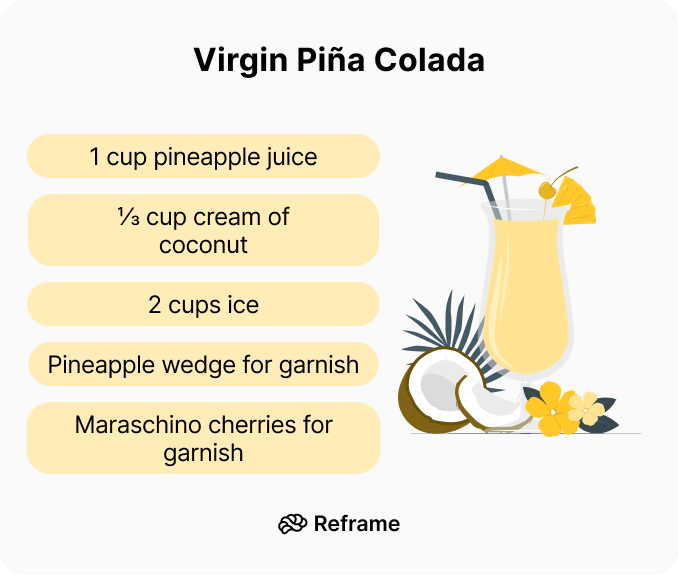
Ready to put your new mixology knowledge to the test? The great news is that you don't have to invent something from scratch. Many classic cocktails are naturally low in alcohol, making them perfect for social sipping. They offer all the flavor and sophistication of their boozier cousins without the intense effects. Here are a few timeless recipes that are easy to make and even easier to enjoy responsibly.
This classic Italian aperitif is a fantastic starting point. The Americano combines Campari, sweet vermouth, and a splash of soda water for a refreshingly bitter and complex flavor. Because it skips the hard liquor (like the gin in its cousin, the Negroni), it has about half the alcohol content of a typical cocktail. This makes it an ideal choice for a happy hour or dinner party where you want to enjoy a sophisticated drink and still feel clear-headed and present in the conversation. It’s a simple, elegant way to practice mindful drinking without feeling like you're missing out.
You’ve probably seen this vibrant, orange-hued drink lighting up patios everywhere, and for good reason. The Aperol Spritz is a bubbly and delightful mix of Aperol, prosecco, and soda water. Its light, citrusy profile makes it incredibly refreshing, especially on a warm day. If you want to lower the alcohol content even further, you can easily swap the prosecco for a non-alcoholic sparkling wine. This drink proves that you can have something festive and fun in your hand that looks and tastes amazing, all while keeping your wellness goals in check.
A British summertime staple, the Pimm's Cup is practically a fruit salad in a glass. This cocktail is built around Pimm's No. 1, a gin-based liqueur, which is then mixed with lemonade or ginger ale and loaded with fresh garnishes like cucumber, strawberries, orange slices, and mint. It’s light, fruity, and incredibly refreshing. Because the Pimm's itself has a lower ABV than straight gin and it's mixed with plenty of non-alcoholic ingredients, it's a perfect drink for pacing yourself during a long afternoon barbecue or social gathering. It’s all about enjoying the experience, not just the alcohol.
Alcohol impacts just about every aspect of our health. And according to the World Health Organization (WHO), alcohol’s wide-ranging effects reach further than just our body.
If we do choose to drink, low-alcohol options allow us to mitigate these risks. They’re easier on our brain, our body, our mental health, and our pocketbook. And for those of us trying to lose weight, it’s crucial to keep low-alcohol options in our toolbox.
Making low-alcohol drinks at home is one thing, but navigating a bar menu can feel like a whole different challenge. The good news is that you don’t have to stick to seltzer water all night (unless you want to!). With a little know-how, you can confidently order delicious, complex drinks that align with your goals. Choosing low-alcohol options allows you to fully enjoy the social aspects of being out with friends while being kinder to your body and mind. This approach is central to a more mindful drinking experience, letting you savor the flavor and the moment without the fog the next day.
When you’re scanning the menu, keep an eye out for "highball" style cocktails. These are your best friends when you’re looking for a low-ABV option. A highball is typically a simple drink made with a small amount of a base spirit and a larger proportion of a non-alcoholic mixer, like soda water or tonic, served in a tall glass over ice. Think of classics like a Gin and Tonic or a Vodka Soda. Because the non-alcoholic mixer makes up most of the volume, these drinks are naturally lower in alcohol content. They’re also incredibly refreshing and help you stay hydrated while you socialize, making them a smart and sophisticated choice for any occasion.
On the flip side, it’s wise to be cautious with cocktails that taste more like fruit juice than alcohol. Tiki drinks, like a Mai Tai, are a perfect example of this. They can be particularly deceptive, with their sweet and fruity flavors easily hiding two, three, or even more ounces of hard alcohol. It’s easy to drink them quickly and not realize how much alcohol you’re actually consuming until it’s too late. If you’re unsure about a drink’s strength, don’t hesitate to ask the bartender what’s in it. Knowing what you’re drinking is a key part of managing your intake and ensuring you can accurately track your consumption with tools like a Blood Alcohol Content (BAC) calculator.
Alcohol is full of empty calories that provide little to no nutritional value. Reducing or eliminating alcohol from our drinks makes for more health-friendly options without compromising on flavor.
Let's compare the calorie content of three common spirits found in alcoholic drinks.
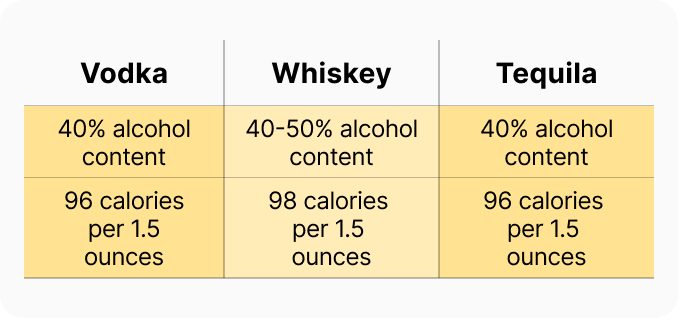
These measurements represent one standard serving of liquor. Although we may not think about it, many full-strength cocktails contain way more than this! Most well drinks and martinis contain at least 3 ounces of liquor, sometimes more.
Once these liquors get mixed into our favorite drinks, the calories tend to go up — especially as alcohol content goes up. Strong flavors and sugary mixers are often used to mask the flavor of alcohol in mixed drinks. Let’s take a look at the calorie content once these liquors get mixed into popular and easy alcoholic drinks.
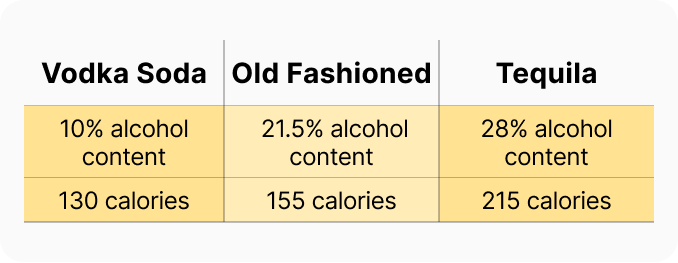
Calorie conscious sippers should focus on keeping the alcohol serving low and choosing low-calorie mixers. Then again, when alcohol isn’t in the mix, we have more room in our calorie budget for a second round!
The rise of low-alcohol mixology signals a significant shift in how we approach and enjoy cocktails. And with the rise of the sober-curious movement, there has been an explosion of no-proof spirits and low-proof alcohol options. Most of our favorite cocktails can be enjoyed with just a little less booze, and there is a whole world of craft mocktails to explore.
Crafting flavorful low-ABV cocktails is not about compromise; it's about embracing a new dimension of taste. When exploring the world of low-alcohol or alcohol-free cocktails, keep moderation in mind and remember that the benefits of mindful drinking extend beyond the glass.
When we think about calories, we usually think of food. But alcohol has calories, too — and our bodies handle them very differently. Your body sees alcohol as a toxin, so when you drink, your liver’s main job becomes getting it out of your system. This process takes priority over everything else, including metabolizing the nutrients from your food. As a result, any fats or carbohydrates you eat are more likely to be stored as fat while your body is busy processing the alcohol. This is why alcohol is often referred to as having “empty calories”; it provides energy but offers virtually no nutritional value, and it can disrupt your body's normal metabolic process.
Making a few simple swaps can dramatically change the health profile of your drink. Instead of high-proof spirits like vodka or gin, consider using a lower-ABV option like wine or a light beer as the base for a spritzer. You can also simply use less liquor. The real calorie culprits, however, are often the mixers. Syrups, sugary sodas, and many fruit juices can pack a surprising amount of sugar and calories into a single glass. To make your drink last longer and cut down on both alcohol and sugar, try adding non-alcoholic mixers like sparkling water, diet tonic, or a squeeze of fresh lime. This way, you can still enjoy a flavorful, refreshing drink without the extra baggage.
What you eat when you drink matters just as much as what you’re sipping. Since your body is focused on processing alcohol, it’s a good idea to avoid foods high in fat and simple carbs, like pizza or fries. These are more easily converted to fat when your metabolism is otherwise occupied. Instead, opt for lean protein and vegetables. Think grilled chicken skewers, a fresh salad, or a shrimp cocktail. These foods provide sustained energy and nutrients without overloading your system. Making smarter food choices helps support your body and can prevent that sluggish feeling the next day, making your experience much more enjoyable overall. It's a simple way to practice mindful drinking and take care of your well-being.
I want to order a low-alcohol drink at a bar but don't know what to ask for. Any simple tips? Absolutely. The easiest way is to look for drinks made with vermouth, sherry, or amaro as the main ingredient instead of gin or vodka. You can also ask for any "highball" style drink, like a Gin and Tonic, to be made with less alcohol—just ask for a "single" or a "light pour." Another great option is to ask for a wine spritzer, which is simply wine mixed with sparkling water. Bartenders are very used to these requests, so you can feel confident asking.
Are low-alcohol cocktails just watered-down versions of regular drinks? Not at all. A great low-alcohol cocktail isn't about subtracting booze; it's about building a more complex flavor profile. When you lower the alcohol, you create space for other ingredients to stand out. Think of the herbal notes in a good vermouth, the bright acidity of fresh citrus, or the subtle spice from a few dashes of bitters. The goal is to create a sophisticated and satisfying drink where the alcohol isn't the dominant flavor.
Besides the recipes you mentioned, what's an easy way to turn my favorite cocktail into a low-ABV version? A simple trick is to "split the base." This means you replace half of the main spirit with a lower-ABV alternative. For example, if your favorite drink calls for two ounces of gin, try using one ounce of gin and one ounce of a dry vermouth instead. You can also simply increase the amount of non-alcoholic mixers. Adding more soda water, tonic, or fresh juice will dilute the alcohol concentration while making your drink last longer.
Will switching to low-ABV drinks actually help me with my health goals? Choosing low-alcohol options is a fantastic step toward more mindful consumption. You'll naturally consume fewer calories and put less strain on your body, which is always a positive. It also helps you stay more present and in control during social situations, preventing you from drinking more than you intended. While it's not the same as abstaining completely, it's a practical way to enjoy the social ritual of drinking while being kinder to your body and mind.
What's the point of using bitters if they have a high alcohol content? This is a great question. While bitters are made with high-proof alcohol, they are used in incredibly small quantities—usually just two or three drops per drink. Their purpose is to add a concentrated burst of botanical flavor, not to contribute to the alcohol content. The amount of alcohol they add to a finished cocktail is so minimal that it's considered negligible, making them a perfect tool for adding complexity to low-ABV and even non-alcoholic drinks.
What really makes a cocktail great? It's more than just a cute garnish or a heavy pour of booze. The real magic is in the flavor—the perfect balance of sweet, sour, and even bitter notes. This is where low alcohol cocktails truly shine. By dialing back the booze, you let the complex ingredients, from fresh herbs to interesting bitter alcohols, take center stage. These sophisticated low abv cocktails are all about the experience, not just the buzz. We'll explore some fantastic low alcohol cocktails recipes that prove a delicious drink is all about flavor.
Cocktails are very well-marketed (hello, James Bond!) and hold an enduring allure in culture and media. Recent trends in mixology have elevated cocktail-making to an art, with innovative flavors and new twists on classics. Luckily, for those of us trying to cut back, delicious mocktails and low-alcohol cocktails have also proliferated and mixology specialists are challenging the conventional perception of drinking. In doing so, they are paving the way for a more inclusive and health-conscious approach to socializing.
Let’s explore the rise of low-alcohol drinks within the field of mixology. We’ll check out the reasons behind its popularity, the essential ingredients for crafting delightful concoctions, and the science behind crafting tantalizing low-alcohol drink recipes.
Mixology dates back to the mid-19th century and arose from a desire to shakeup traditional bartending. Whiskey was the primary drink of choice up until that point, but in 1850 the Sazerac became America’s first cocktail.
Today, mixology has evolved into both a science and an art by pushing traditional boundaries of alcohol-centric beverages by focusing on creativity, quality ingredients, and unique experiences. Mixology continues to evolve in response to drinkers’ desires. For those trying to cut back on alcohol, this creative boom lets us keep the flavor high and the alcohol by volume (ABV) low.
Thanks to the increasing social acceptance of sobriety, mindful drinking, and the rise of the sober-curious movement, there is a high demand for craft mocktails and alcohol-free spirits. It’s now easier than ever for non-drinkers to enjoy everything mixology has to offer.
This shift in focus has led mixologists to explore even more innovative ingredients and intricate flavor profiles and, by doing so, develop an entirely new conceptualization of the cocktail experience while still keeping the cute umbrellas.
One of the biggest challenges when you're trying to cut back is managing long social events. Whether it's a day party or a long dinner with friends, you might feel the pressure to have a drink in your hand. Low-alcohol cocktails are a fantastic solution for this. They let you enjoy the social ritual of drinking and savor complex flavors without getting too tipsy too fast. This makes them a great choice for extending an evening or when you just want something light and refreshing. By opting for drinks made with low-ABV ingredients like sherry or vermouth, or even a simple highball with lots of soda, you can easily pace yourself. It’s a simple way to practice a more mindful approach to drinking, allowing you to stay present and enjoy the moment without worrying about overdoing it.
Like we said earlier, mixology is both an art and a science. So what exactly goes into the technical side of mixing a good alcoholic drink (or mocktail)? Let’s dig deeper!
Creating a delicious low-alcohol drink starts with choosing the right base. Instead of reaching for high-proof spirits like vodka or gin, the secret lies in using ingredients with a lower alcohol content that still pack a flavorful punch. This is where fortified wines and liqueurs like vermouth, sherry, and amaro shine. These low-ABV ingredients bring complex herbal, sweet, or bitter notes to a drink, creating a sophisticated taste without the high alcohol percentage. Using them means you can savor a well-crafted cocktail and stay present in the moment, enjoying the conversation and atmosphere for longer. It’s a simple switch that makes a huge difference in practicing mindful drinking while still appreciating the art of mixology.
Crafting a cocktail is more than mixing a random liqueur with a random refresher and expecting it to taste good. Don’t be afraid to try new things, but avoid doing too many experiments all at once. Here are a few small ways you can play:
These principles are key to crafting balanced and delicious drinks, but it’s also important to carefully select premium quality ingredients. Less alcohol means the flavors have more room to shine! Let’s look at some items that play a pivotal role in attaining flavor.
To craft enticing low-ABV cocktails and mocktails, we need to be familiar with the ingredients that contribute the most flavor. Non-alcoholic heavy lifters — such as bitters, citrus, juice, sweeteners, and fresh fruits and herbs — offer a palette of flavors that pack a big punch.
Once we have our base components, it’s time to mix them all together and pick the perfect glass!
The science of mixology relies on two major factors — the blend of flavors and the glassware used. Yes, the glassware! While it may seem odd, specific shapes and styles of glassware not only make for a great presentation, but they also enhance the flavor of what we’re drinking.
For example, the shape of the cocktail glass not only influences the look and feel of the drink, they also influence how we drink. People tend to drink more quickly from wide glasses as opposed to straight or narrow glasses. Furthermore, glasses are typically designed to enhance certain aspects of the drink. Glasses with stems prevent our hands from warming up the beverage, and tulip-shaped beer glasses are designed to keep the aroma of the hops trapped in the glass.
Attention to detail is paramount when creating a cocktail or mocktail. Once we’ve applied our knowledge of flavors and hardware, it’s time for the finale! Garnishes add the final visual and sensory touch that can elevate a drink.
Garnishes may serve two purposes: they can add a whiff of aroma, or set the mood with their looks. Adding mint to the top of a drink provides a wave of botanical freshness that could enhance the sharpness of a blueberry spritzer or muddle the sweetness of a virgin piña colada. But that piña colada may feel a whole lot more fun with a little umbrella poking out of the top!
Smell is Presentation is essent. To make a low- or no-alcohol drink feel extra special, a beautifully placed garnish can inspire us to be mindful and enjoy.
We can reduce or eliminate alcohol from cocktails by taking inspiration from existing recipes. For instance, let’s think about the flavors that go into some classics:
Most flavored alcohol has non-alcoholic counterparts. Oftentimes, the taste profile of a cocktail comes from the mixers and added flavors, not the alcohol itself. If you do want a little alcohol kick, consider reducing the liquor by half or ordering a single instead of a double.
Going low-alcohol has plenty of benefits, and no-alcohol offers even more. Let’s get the skinny on the health benefits waiting for us when we go low.
Ready to put your new mixology knowledge to the test? The great news is that you don't have to invent something from scratch. Many classic cocktails are naturally low in alcohol, making them perfect for social sipping. They offer all the flavor and sophistication of their boozier cousins without the intense effects. Here are a few timeless recipes that are easy to make and even easier to enjoy responsibly.
This classic Italian aperitif is a fantastic starting point. The Americano combines Campari, sweet vermouth, and a splash of soda water for a refreshingly bitter and complex flavor. Because it skips the hard liquor (like the gin in its cousin, the Negroni), it has about half the alcohol content of a typical cocktail. This makes it an ideal choice for a happy hour or dinner party where you want to enjoy a sophisticated drink and still feel clear-headed and present in the conversation. It’s a simple, elegant way to practice mindful drinking without feeling like you're missing out.
You’ve probably seen this vibrant, orange-hued drink lighting up patios everywhere, and for good reason. The Aperol Spritz is a bubbly and delightful mix of Aperol, prosecco, and soda water. Its light, citrusy profile makes it incredibly refreshing, especially on a warm day. If you want to lower the alcohol content even further, you can easily swap the prosecco for a non-alcoholic sparkling wine. This drink proves that you can have something festive and fun in your hand that looks and tastes amazing, all while keeping your wellness goals in check.
A British summertime staple, the Pimm's Cup is practically a fruit salad in a glass. This cocktail is built around Pimm's No. 1, a gin-based liqueur, which is then mixed with lemonade or ginger ale and loaded with fresh garnishes like cucumber, strawberries, orange slices, and mint. It’s light, fruity, and incredibly refreshing. Because the Pimm's itself has a lower ABV than straight gin and it's mixed with plenty of non-alcoholic ingredients, it's a perfect drink for pacing yourself during a long afternoon barbecue or social gathering. It’s all about enjoying the experience, not just the alcohol.
Alcohol impacts just about every aspect of our health. And according to the World Health Organization (WHO), alcohol’s wide-ranging effects reach further than just our body.
If we do choose to drink, low-alcohol options allow us to mitigate these risks. They’re easier on our brain, our body, our mental health, and our pocketbook. And for those of us trying to lose weight, it’s crucial to keep low-alcohol options in our toolbox.
Making low-alcohol drinks at home is one thing, but navigating a bar menu can feel like a whole different challenge. The good news is that you don’t have to stick to seltzer water all night (unless you want to!). With a little know-how, you can confidently order delicious, complex drinks that align with your goals. Choosing low-alcohol options allows you to fully enjoy the social aspects of being out with friends while being kinder to your body and mind. This approach is central to a more mindful drinking experience, letting you savor the flavor and the moment without the fog the next day.
When you’re scanning the menu, keep an eye out for "highball" style cocktails. These are your best friends when you’re looking for a low-ABV option. A highball is typically a simple drink made with a small amount of a base spirit and a larger proportion of a non-alcoholic mixer, like soda water or tonic, served in a tall glass over ice. Think of classics like a Gin and Tonic or a Vodka Soda. Because the non-alcoholic mixer makes up most of the volume, these drinks are naturally lower in alcohol content. They’re also incredibly refreshing and help you stay hydrated while you socialize, making them a smart and sophisticated choice for any occasion.
On the flip side, it’s wise to be cautious with cocktails that taste more like fruit juice than alcohol. Tiki drinks, like a Mai Tai, are a perfect example of this. They can be particularly deceptive, with their sweet and fruity flavors easily hiding two, three, or even more ounces of hard alcohol. It’s easy to drink them quickly and not realize how much alcohol you’re actually consuming until it’s too late. If you’re unsure about a drink’s strength, don’t hesitate to ask the bartender what’s in it. Knowing what you’re drinking is a key part of managing your intake and ensuring you can accurately track your consumption with tools like a Blood Alcohol Content (BAC) calculator.
Alcohol is full of empty calories that provide little to no nutritional value. Reducing or eliminating alcohol from our drinks makes for more health-friendly options without compromising on flavor.
Let's compare the calorie content of three common spirits found in alcoholic drinks.
These measurements represent one standard serving of liquor. Although we may not think about it, many full-strength cocktails contain way more than this! Most well drinks and martinis contain at least 3 ounces of liquor, sometimes more.
Once these liquors get mixed into our favorite drinks, the calories tend to go up — especially as alcohol content goes up. Strong flavors and sugary mixers are often used to mask the flavor of alcohol in mixed drinks. Let’s take a look at the calorie content once these liquors get mixed into popular and easy alcoholic drinks.
Calorie conscious sippers should focus on keeping the alcohol serving low and choosing low-calorie mixers. Then again, when alcohol isn’t in the mix, we have more room in our calorie budget for a second round!
The rise of low-alcohol mixology signals a significant shift in how we approach and enjoy cocktails. And with the rise of the sober-curious movement, there has been an explosion of no-proof spirits and low-proof alcohol options. Most of our favorite cocktails can be enjoyed with just a little less booze, and there is a whole world of craft mocktails to explore.
Crafting flavorful low-ABV cocktails is not about compromise; it's about embracing a new dimension of taste. When exploring the world of low-alcohol or alcohol-free cocktails, keep moderation in mind and remember that the benefits of mindful drinking extend beyond the glass.
When we think about calories, we usually think of food. But alcohol has calories, too — and our bodies handle them very differently. Your body sees alcohol as a toxin, so when you drink, your liver’s main job becomes getting it out of your system. This process takes priority over everything else, including metabolizing the nutrients from your food. As a result, any fats or carbohydrates you eat are more likely to be stored as fat while your body is busy processing the alcohol. This is why alcohol is often referred to as having “empty calories”; it provides energy but offers virtually no nutritional value, and it can disrupt your body's normal metabolic process.
Making a few simple swaps can dramatically change the health profile of your drink. Instead of high-proof spirits like vodka or gin, consider using a lower-ABV option like wine or a light beer as the base for a spritzer. You can also simply use less liquor. The real calorie culprits, however, are often the mixers. Syrups, sugary sodas, and many fruit juices can pack a surprising amount of sugar and calories into a single glass. To make your drink last longer and cut down on both alcohol and sugar, try adding non-alcoholic mixers like sparkling water, diet tonic, or a squeeze of fresh lime. This way, you can still enjoy a flavorful, refreshing drink without the extra baggage.
What you eat when you drink matters just as much as what you’re sipping. Since your body is focused on processing alcohol, it’s a good idea to avoid foods high in fat and simple carbs, like pizza or fries. These are more easily converted to fat when your metabolism is otherwise occupied. Instead, opt for lean protein and vegetables. Think grilled chicken skewers, a fresh salad, or a shrimp cocktail. These foods provide sustained energy and nutrients without overloading your system. Making smarter food choices helps support your body and can prevent that sluggish feeling the next day, making your experience much more enjoyable overall. It's a simple way to practice mindful drinking and take care of your well-being.
I want to order a low-alcohol drink at a bar but don't know what to ask for. Any simple tips? Absolutely. The easiest way is to look for drinks made with vermouth, sherry, or amaro as the main ingredient instead of gin or vodka. You can also ask for any "highball" style drink, like a Gin and Tonic, to be made with less alcohol—just ask for a "single" or a "light pour." Another great option is to ask for a wine spritzer, which is simply wine mixed with sparkling water. Bartenders are very used to these requests, so you can feel confident asking.
Are low-alcohol cocktails just watered-down versions of regular drinks? Not at all. A great low-alcohol cocktail isn't about subtracting booze; it's about building a more complex flavor profile. When you lower the alcohol, you create space for other ingredients to stand out. Think of the herbal notes in a good vermouth, the bright acidity of fresh citrus, or the subtle spice from a few dashes of bitters. The goal is to create a sophisticated and satisfying drink where the alcohol isn't the dominant flavor.
Besides the recipes you mentioned, what's an easy way to turn my favorite cocktail into a low-ABV version? A simple trick is to "split the base." This means you replace half of the main spirit with a lower-ABV alternative. For example, if your favorite drink calls for two ounces of gin, try using one ounce of gin and one ounce of a dry vermouth instead. You can also simply increase the amount of non-alcoholic mixers. Adding more soda water, tonic, or fresh juice will dilute the alcohol concentration while making your drink last longer.
Will switching to low-ABV drinks actually help me with my health goals? Choosing low-alcohol options is a fantastic step toward more mindful consumption. You'll naturally consume fewer calories and put less strain on your body, which is always a positive. It also helps you stay more present and in control during social situations, preventing you from drinking more than you intended. While it's not the same as abstaining completely, it's a practical way to enjoy the social ritual of drinking while being kinder to your body and mind.
What's the point of using bitters if they have a high alcohol content? This is a great question. While bitters are made with high-proof alcohol, they are used in incredibly small quantities—usually just two or three drops per drink. Their purpose is to add a concentrated burst of botanical flavor, not to contribute to the alcohol content. The amount of alcohol they add to a finished cocktail is so minimal that it's considered negligible, making them a perfect tool for adding complexity to low-ABV and even non-alcoholic drinks.
